
Curtain holdbacks are wall-mounted hardware pieces that hold an open drapery panel away from the window, keeping light clear and fabric neatly swept to one side. The North America window coverings market reached USD 5.3 billion in 2024,3 reflecting how central window hardware has become to home interiors. This complete guide covers all five dimensions of curtain holdback selection: type, metal and finish, curtain weight, placement height, and decorative style, with deeper guides mapped to every aspect of the topic.
Quick Answer
What are Curtain Holdbacks?
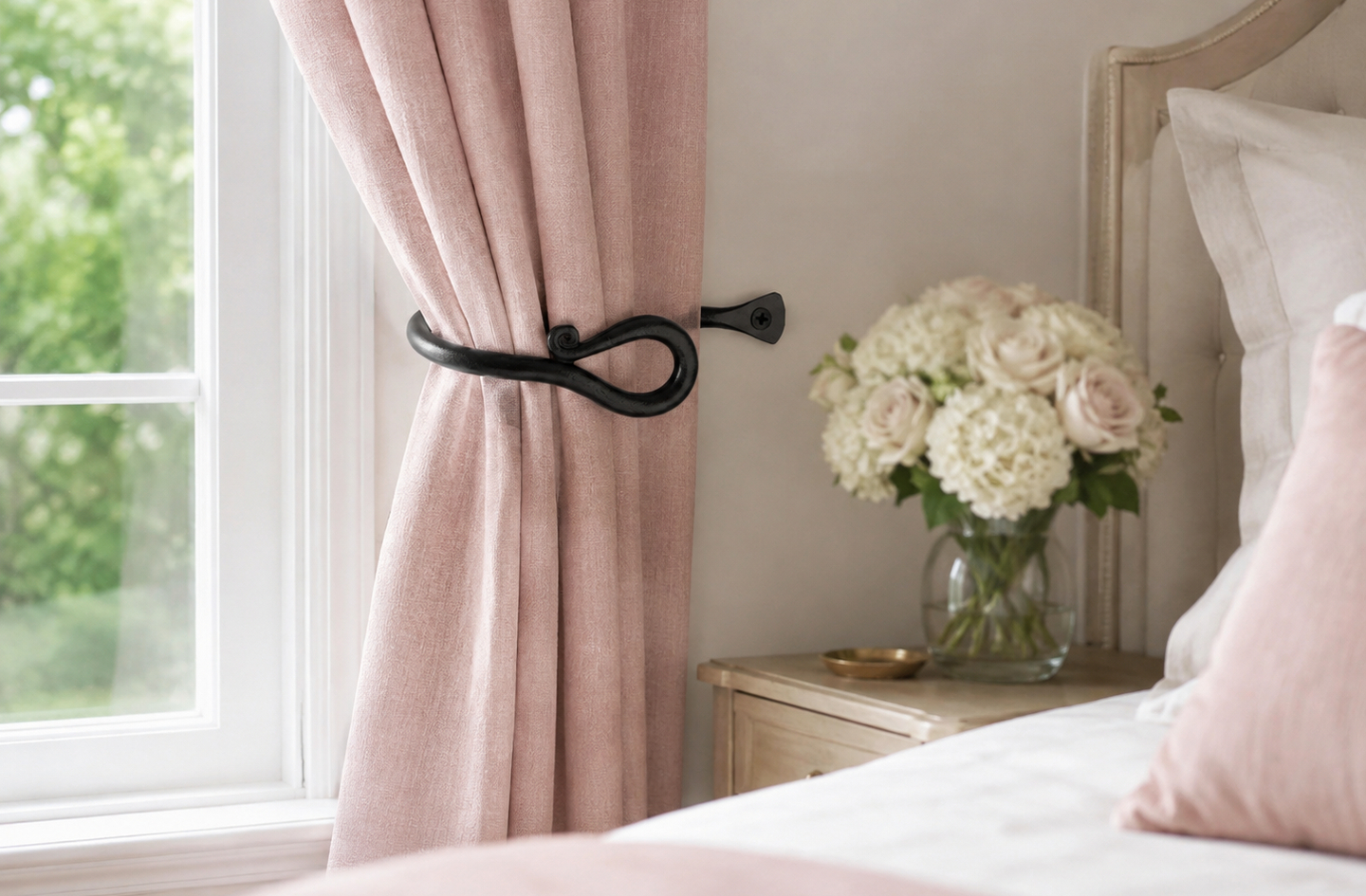
Curtain holdbacks are wall-mounted hooks or brackets that catch and hold an open drapery panel away from the window frame. Rigid metal holdbacks project 2 to 5 inches from the wall and retain the fabric by looping it around a decorative terminal end. They differ from soft tiebacks (fabric, rope, or magnetic bands) because they are permanently fixed to the wall and support heavier curtain weights without bending over time.
Why it matters:
Choosing a holdback with insufficient projection or a mounting base too small for the wall material causes the curtain to block light and pull the hardware forward over time. Matching holdback type, metal, projection, and placement to the curtain’s fabric weight and room style prevents both functional failure and visible wall damage.
Key Takeaways
- Rigid metal holdbacks project 2 to 5 inches from the wall; extra-long versions reach 6 inches or more for full, layered drapes.
- Wrought iron has a tensile strength of 234 to 372 MPa1 and a density of 7.7 g/cm³,1 making it a reliable material for supporting medium to heavy curtain fabrics without bending.
- Curtain fabrics divide into three weight classes: lightweight (under 150 GSM), medium (150 to 300 GSM), and heavyweight (over 300 GSM),2 each requiring different holdback strength and projection depth.
- Placement height follows the curtain panel’s proportion, not a fixed floor measurement: one-third up from the bottom hem is the standard starting point for floor-length panels.
Curtain Holdbacks in 30 Seconds
| If you have… | Choose this |
|---|---|
| Light sheers or voiles under 150 GSM | Standard-depth metal holdback or magnetic tieback |
| Mid-weight lined panels (150 to 300 GSM) | Medium wrought-iron holdback with 3 to 4 inch projection |
| Heavy blackout or thermal drapes over 300 GSM | Heavy-duty metal holdback, wider mounting base, wall anchor |
| Full or double-layered drapery | Extra-long holdback (5 to 6+ inch projection) to clear the fabric stack |
| Outdoor curtain panels | Corrosion-resistant finish: powder-coated iron or galvanized steel |
| Decorative or period-style rooms | Motif holdback (leaf, Victorian, butterfly, antler) matched to room decor |
What Are Curtain Holdbacks?
A curtain holdback is a wall-mounted hardware piece, typically a rigid hook or bracket, that catches an open curtain panel and holds it away from the window opening. Unlike soft tiebacks, which are loops of fabric or cord tied around the curtain and looped over a small wall hook, a rigid holdback is fixed directly to the wall and the curtain drapes over or into it without a separate tie.
The three defining dimensions are projection (how far the arm extends from the wall to clear the curtain stack), the mounting base (the plate or flange anchored to the wall), and the terminal end (the decorative shape at the tip, such as a ball, scroll, leaf, or bow, that prevents the curtain from slipping forward). Projection typically ranges from 2 to 5 inches for standard residential panels; full, layered, or formal drapes may require 6 inches or more.
This guide covers wall-mounted rigid metal holdbacks and hook-style curtain hardware. It does not cover curtain rods, rod finials, or rod brackets, which are a separate category. Magnetic tiebacks and fabric rope tiebacks are compared here as alternatives but are not the primary focus. The scope is fixed, wall-mounted, metal holdback and hook hardware designed to hold an open drapery panel to one side of a window.
Why Curtain Holdbacks Matter
Wrought iron is one of the most commonly used materials for curtain holdbacks. Its density of 7.7 g/cm³1 is comparable to structural steel, and its tensile strength of 234 to 372 MPa1 allows thin-section hardware to bear the sustained lateral pull of a gathered drapery panel without deforming. Understanding these material properties helps explain why iron thickness and iron-slag composite construction5 matter for holdbacks that will carry medium to heavyweight curtains day after day.
- A holdback whose arm projects too little from the wall causes the curtain to fall forward over the terminal end rather than resting inside it, blocking light and placing sideways stress on the mount.
- A holdback finish without adequate moisture protection in a bathroom, laundry room, or covered patio degrades within one to two seasons, leaving bare iron to rust and stain the curtain fabric.
- Mismatched motif scale, such as a large ornate Victorian-style holdback paired with a narrow sheer panel, creates proportion problems that affect the appearance of the whole window treatment.
Understanding the five dimensions of curtain holdback selection, type, metal and finish, curtain weight, placement, and decorative style, is the difference between hardware that functions cleanly for years and hardware that needs replacing within a season.
The 5-Part Curtain Holdbacks Framework
Every curtain holdback decision falls into one of five core dimensions. Together, these five dimensions account for the full topic. The guides below cover each in depth.
1. Holdback Type and Format
The primary choice is between a rigid metal holdback (a bracket fixed to the wall with a projecting arm and decorative terminal end), a hook-style holdback (a simpler wall hook over which a separate fabric or rope tieback is draped), and a magnetic tieback (two magnets that clip around the curtain without any wall mounting). Rigid holdbacks carry more weight and provide a fixed, repeatable hold position. Hook-style options work well with rope or fabric loops and can be repurposed for other uses. Magnetic versions are removable but limited to lighter fabric panels and do not provide the same visual presence as a metal holdback. Hook depth, curtain clearance, opening size, and rated load capacity differ significantly across all three formats; heavy curtain panels generally require rigid or heavy-duty hook-style hardware rather than magnetic solutions.
Deeper read: soft tiebacks vs metal holdbacks compared.
Deeper read: magnetic curtain tiebacks vs wrought-iron holdbacks.
Deeper read: heavy-duty curtain hooks vs holdbacks.
Deeper read: curtain tieback hook types and mounting.
Deeper read: curtain holdback hook sizing, shape, and mounting hardware.
2. Metal and Finish
The most common metals for curtain holdbacks are wrought iron, mild steel, brass, and aluminum. Wrought iron, with a tensile strength of 234 to 372 MPa,1 is well-suited for sustained load under heavy fabric and accepts hand-forged shaping that gives each piece a slightly varied, textured profile. Steel is comparably strong but typically requires additional surface treatment to resist rust. Brass offers a warm tone and natural corrosion resistance from its copper content, making it suitable for humid environments. Aluminum is lightweight but lower in load capacity than iron or steel and bends more readily under heavy curtain weight. Finish type is the most important long-term durability variable: a dual-layer system combining zinc galvanization with powder coating significantly outperforms a single-layer painted finish in moisture resistance. Outdoor and bathroom holdbacks should always specify this dual-layer or equivalent protection.
Deeper read: wrought iron vs steel, brass, and aluminum for holdbacks.
Deeper read: rust-resistant finishes for metal curtain tiebacks.
Deeper read: outdoor curtain hooks and holdbacks: metals and finishes for patios.
3. Curtain Weight and Projection Reach
Curtain fabrics fall into three weight categories measured in grams per square meter: lightweight (under 150 GSM), medium-weight (150 to 300 GSM), and heavyweight (over 300 GSM).2 Lightweight sheers and voiles drape easily over a standard-depth holdback. Medium-weight lined panels, including most cotton and polyester draperies, need a stable mounting base and at least 3 to 4 inches of projection to clear the fabric stack off the window frame. Heavyweight blackout, thermal, or velvet drapes require heavy-duty hardware with a reinforced bracket, deep projection, and secure wall anchoring, particularly into a stud or a properly rated drywall anchor. Full, double-layered, or pooled drapes add stack depth beyond the fabric weight alone, often requiring 5 to 6 inches or more of projection to prevent the gathered panel from pressing against the frame.
Deeper read: heavy-duty metal tiebacks for thick and oversized curtains.
Deeper read: extra-long metal tiebacks for full drapes.
4. Placement and Installation
Holdback height on the wall changes how a curtain panel reads visually and how much light the open position allows. The standard starting point for floor-length panels is one-third of the panel length up from the bottom hem, which creates a classic bell-shaped sweep and maximizes center-window light clearance. Formal or dramatic arrangements may drop the holdback closer to the panel midpoint. Distance from the window frame is a separate variable: a shallow single-layer panel needs only 3 to 4 inches of clearance from the frame edge, while a thick pinch-pleat drape may need 5 to 6 inches so the gathered fabric does not press against the woodwork. Installation requires drilling at the marked height, selecting the correct anchor for the wall material (stud, drywall, brick, or concrete), and securing the mounting plate firmly before loading the curtain.
Deeper read: curtain holdback placement: how high and how far from the window.
Deeper read: DIY wall-mounted curtain holdback setup.
Deeper read: DIY curtain tiebacks with iron wall hooks.
5. Decorative Design and Motif
Metal curtain holdbacks are available in both plain and ornamental forms. Plain holdbacks, including loophole and classic scroll-end designs, work across a wide range of interiors from minimalist to traditional. Motif holdbacks feature a cast or forged decorative shape at the terminal end: butterfly, leaf, ball, bow, horseshoe, antler, Victorian scroll, and animal figures are the most common categories. Motif scale must be proportionate to the window and panel: a large ornate holdback on a narrow panel looks heavy, while a small plain holdback on a wide formal drape appears undersized. Finish color, typically black, white, or antique brushed zinc on hand-forged wrought iron, should coordinate with other visible metal hardware in the room such as curtain rod finials, door handles, and light fixture hardware. Interior style is the final filter: rustic rooms suit natural-form motifs (leaf, horseshoe, antler), while traditional or period rooms call for scrollwork or Victorian ornament.
Deeper read: metal butterfly curtain tiebacks.
Deeper read: leaf curtain holdbacks.
Deeper read: horseshoe curtain tiebacks and rustic wrought-iron holdbacks.
Deeper read: Victorian curtain tiebacks and ornate wrought-iron holdbacks.
Deeper read: metal ball curtain tiebacks sizing and style guide.
Deeper read: metal bow curtain tiebacks.
Deeper read: metal antler curtain tiebacks for lodge-style rooms.
Deeper read: metal animal curtain tiebacks and decorative motifs.
How to Choose the Right Curtain Holdbacks
Projection depth and curtain weight class are the two most important starting variables. Follow these steps in order:
- Identify the curtain weight class. Check the fabric’s GSM specification or feel the weight of a gathered panel: under 150 GSM is lightweight, 150 to 300 GSM is medium, and over 300 GSM2 is heavyweight. Heavier fabrics need a stronger bracket and deeper projection.
- Measure the curtain stack depth. Pull the curtain fully to one side and measure how far it stacks from the window frame. The holdback projection must equal or exceed this measurement so the fabric clears the frame without bunching.
- Choose the metal and finish. For dry indoor spaces with standard humidity, powder-coated steel or wrought iron performs well. For bathrooms, covered patios, or coastal environments, specify a dual-layer finish (zinc galvanization plus powder coating) or brass hardware.
- Select the motif and finish color. Match the holdback finish to other metal hardware visible in the same room zone (rod brackets, finials, door hardware). Choose motif scale relative to window width: narrow windows call for smaller terminal detail, and wide bay windows accept a more prominent ornamental form.
- Confirm the wall material. A stud mount is preferred for heavy holdbacks. On drywall without a stud, use a toggle bolt or heavy-duty hollow-wall anchor rated for the expected load. Brick and concrete require masonry anchors.
- Set the height before drilling. Mark the position at one-third up from the curtain panel’s bottom hem, then hold the holdback in place and view it from across the room before committing. Adjust a few inches higher for a lighter silhouette or lower for a more formal drape.
Red flags at purchase: a holdback that wobbles when the mounting plate is hand-pressed against a surface, a terminal end too short to retain the fabric, or a finish that flakes at the edges of a bracket. These are hardware quality issues, not installation issues.
Compare All Curtain Holdback Types
| Criteria | Rigid Metal Holdback | Hook-Style Holdback | Magnetic Tieback | Soft (Fabric/Rope) Tieback |
|---|---|---|---|---|
| Wall mounting | Fixed (screws into wall) | Fixed (screws into wall) | None (clips to fabric) | Requires small wall hook |
| Curtain weight | Light to heavy | Light to heavy | Light only | Light to medium |
| Projection reach | 2 to 6+ inches | 2 to 4 inches | None (no wall projection) | Varies by loop length |
| Adjustability | Fixed position (re-drill to move) | Fixed position | Height-adjustable any time | Height-adjustable any time |
| Finish options | Powder coat, zinc, brass | Powder coat, wrought iron, zinc | Plastic, fabric, or metal shell | Fabric, rope, tassel |
| Best for | Permanent install, medium to heavy drapes | DIY use with fabric or rope loops | Temporary or no-drill settings | Soft informal window styles |
Choose rigid metal holdback if: the curtain is medium to heavyweight and the position is permanent.
Choose hook-style holdback if: the curtain uses a separate fabric or rope loop and needs to be easily removed for laundering.
Choose magnetic tieback if: wall drilling is not permitted or the curtain position changes frequently.
Choose soft tieback if: the window treatment already includes a decorative fabric tieback as part of the drapery design.
Deeper read: soft tiebacks vs metal holdbacks in detail.
Common Mistakes
Mistake 1: Choosing Projection That Is Too Short
Why it is a mistake: A holdback whose arm extends only 1 to 2 inches from the wall cannot clear a mid-weight or heavy curtain stack. The fabric folds over the top of the holdback end instead of looping naturally into it, causing the panel to droop forward and reducing the light clearance the holdback is meant to create. This is the most common installation failure across all curtain holdback types.
What to do instead: Measure the curtain stack depth with the panel pulled fully to one side before purchasing. Match or slightly exceed that measurement in the holdback’s projection specification. For layered or very full drapes, go 1 to 2 inches beyond the measured stack depth.
Read more: when extra-long metal tiebacks are needed for full drapes.
Mistake 2: Ignoring Curtain Fabric Weight Class
Why it is a mistake: A lightweight decorative holdback installed under a 400 GSM blackout panel will either bend at the bracket or pull the screws from the wall. Fabrics in the heavyweight class over 300 GSM2 apply sustained leveraged load at the bracket joint, not just vertical weight, and require hardware rated for that load with a multi-screw mounting plate.
What to do instead: Confirm the curtain’s GSM before selecting hardware. Heavyweight drapes call for heavy-duty iron or steel holdbacks with a reinforced bracket, multiple mounting screws, and a wall anchor matched to the wall substrate.
Read more: heavy-duty metal tiebacks for thick and oversized curtains.
Mistake 3: Measuring Height From the Floor Instead of the Panel
Why it is a mistake: Installing both holdbacks at the same measured distance from the floor instead of at a consistent proportion of the curtain panel length produces a visually uneven drape when ceiling height, floor finish, or baseboard height varies between the two sides of the window. The fabric sweep looks mismatched even when the hardware is technically at the same floor-to-bracket measurement.
What to do instead: Mark the holdback height as a proportion of the panel (one-third from the hem is the standard starting point), not as a fixed floor measurement. Measure the panel length independently on each side before marking if the ceiling or floor is not perfectly level.
Read more: curtain holdback placement height and distance from the window.
Mistake 4: Using a Single-Layer Finish in a Humid Space
Why it is a mistake: Many lower-cost metal holdbacks use a single layer of paint or a thin chromate coating. In bathrooms, laundry rooms, covered patios, or any space with recurring moisture exposure, that layer wears through within months, leaving bare iron to rust. The resulting rust stain transfers to the curtain fabric and the wall surface.
What to do instead: In humid or outdoor-adjacent settings, specify a finish with two protective layers: zinc galvanization as the base and powder coating as the outer surface. Hand-forged wrought iron hardware produced through a four-step process (cut, hand-forge, zinc-galvanize, powder-coat) handles moisture significantly better than single-coat alternatives.4
Read more: rust-resistant finishes for metal curtain tiebacks.
Mistake 5: Mismatching Motif Scale to the Window Width
Why it is a mistake: A large ornate antler or Victorian-scroll holdback on a narrow sash window overwhelms the frame and looks costume-like rather than decorative. Conversely, a very small plain holdback on a wide bay window with full formal drapes disappears into the gathered fabric and loses visual purpose at the window scale.
What to do instead: Hold a paper template or the holdback itself against the window frame before buying and view it from across the room. The terminal end should read as a proportionate accent, not dominate the frame width. Narrow windows call for smaller terminal detail; wide bay windows accept a more prominent ornamental form.
Read more: choosing decorative metal motifs for window hardware.
Best Curtain Holdbacks by Use Case
Best for First-Time Installation
A standard medium-weight rigid holdback in a plain scroll or classic profile, mounted into a stud with the included hardware, is the most straightforward reliable option. It requires one drill and two or three screws; the terminal end retains medium-weight panels without a complex loop or additional fastener; and the simple profile works in most room styles without needing to match a specific decor.
Deeper read: choosing hardware for a simple wall-mounted DIY holdback setup.
Best for Heavy or Lined Drapes
Panels above 300 GSM,2 including blackout, thermal-lined, or velvet drapes, require holdbacks with a reinforced mounting base, at least 4 inches of projection, and hardware anchored securely to the wall substrate. Heavy-duty wrought iron holdbacks with double front welding at the bracket joint handle this load better than thin-gauge stamped-metal options at similar price points.
Deeper read: heavy-duty metal curtain tiebacks for thick and oversized curtains.
Best for Rustic or Lodge-Style Rooms
Rooms with reclaimed wood, exposed beams, stone, or a cabin aesthetic suit horseshoe, antler, or leaf-motif holdbacks in a dark wrought-iron or antique finish. The holdback’s silhouette becomes part of the room’s decorative language rather than neutral background hardware, and the natural-form motif reinforces the interior style without needing to coordinate with highly polished or modern finishes elsewhere.
Deeper read: horseshoe curtain tiebacks and rustic wrought-iron holdbacks.
Best for Outdoor or Covered Patio Curtains
Outdoor panel holdbacks face wind load, rain splash, UV exposure, and temperature cycling. Finish quality is the critical variable here: powder-coated galvanized iron or stainless steel outperforms plated or painted alternatives. Mounting anchors need to be rated for the substrate (wood post, masonry, or metal frame), and stainless or galvanized screws prevent corrosion at the fastener point as well as at the hardware body.
Deeper read: outdoor curtain hooks and holdbacks for patios.
Best for Formal or Period-Style Rooms
Victorian, classical, or highly formal spaces call for holdbacks with ornate terminal detail (scrolls, florals, bow forms) in a scale proportionate to the panel width and ceiling height. In these settings the holdback is visible decor, and finish quality, crisp casting definition, and smooth paint or zinc-coat edges matter as much as the functional projection dimension.
Deeper read: Victorian curtain tiebacks and ornate wrought-iron holdbacks.
Frequently Asked Questions
What is the standard projection for a curtain holdback?
Most residential curtain holdbacks project 2 to 5 inches from the wall. A standard single-layer lined panel typically needs 3 to 4 inches to clear the window frame. Full, double-layered, or pinch-pleated drapes with a deep gathered stack may need 5 to 6 inches or more. Measure the curtain stack depth with the panel pulled fully to one side before purchasing any hardware.
How do I know if my curtain fabric is too heavy for a standard holdback?
Curtain fabrics above 300 GSM, the heavyweight threshold,2 require reinforced metal holdbacks with multi-screw mounting plates and anchors rated for the wall type. Signs that a holdback is undersized: the bracket tilts forward at the wall, the mounting screws begin to pull out over weeks of use, or the terminal end bends noticeably under the gathered panel weight.
Should curtain holdbacks match the curtain rod finish?
Matching finishes, such as matte black holdbacks with a matte black rod and finials, creates a cohesive look within the window zone. A practical guideline is to coordinate all metal hardware visible in the same wall zone: rod brackets, holdbacks, and any rings or clips. A deliberate contrast finish, such as white holdbacks paired with a black rod on a two-tone palette, also works when it is clearly intentional rather than incidental.
Can curtain holdbacks be used on outdoor patio panels?
Yes, with the right finish specification. A dual-layer finish combining zinc galvanization and powder coating handles outdoor moisture and UV exposure better than a single-coat painted iron holdback.4 Stainless steel or aluminum hardware also works for coastal and high-humidity environments. Mount with stainless or galvanized screws to prevent fastener corrosion, and select anchors rated for the specific substrate (wood post, masonry, or metal frame).
How high should curtain holdbacks be installed?
The standard starting point is one-third of the curtain panel’s length up from the bottom hem, not a fixed height from the floor. For an 84-inch floor-length panel, that places the holdback roughly 28 inches from the floor. Lower placement creates a more formal, dramatic drape; higher placement opens up more of the panel and allows more light at the center of the window. Always pin-test the position before drilling.
What This Hub Does Not Cover
- Curtain rods, finials, and rod brackets – this guide covers wall-mounted holdback hardware only; rod systems are a separate product category.
- Curtain heading styles, ring clips, and pleat tape – those belong in a drapery construction or installation guide.
- Fabric-only window treatments such as roman shades, roller blinds, and shutters, which do not use holdback hardware at all.
- Custom or made-to-order blacksmith holdbacks – the guide addresses commercially available hardware; bespoke ironwork has different selection and specification variables.
References
- AZoM (AZoNetwork) – Wrought Iron: Properties and Applications. Tensile strength 234-372 MPa; density 7.7 g/cm³; composition 99 to 99.8% iron.
- Classic Modern Fabrics – How to Choose the Right Fabric Weight for Curtains and Drapery. Weight classes: lightweight under 150 GSM, medium 150 to 300 GSM, heavyweight over 300 GSM.
- GM Insights – North America Window Coverings Market Size and Share Report. Market valued at USD 5.3 billion in 2024; projected CAGR of 7.3% through 2034.
- Nuclear Power – Engineering Reference – Wrought Iron: Microstructure and Properties. Fibrous iron-slag composite structure; yield strength 160 to 220 MPa; inherent corrosion resistance from slag inclusions.
- ScienceDirect (Elsevier) – Wrought Iron: Materials Science overview. Iron-slag composite with fibrous microstructure; slag content provides natural galvanic protection contributing to corrosion resistance.
Next Read
Curtain holdback selection comes down to five variables: type, metal and finish, curtain fabric weight class, placement height, and motif scale. Getting projection right for the curtain stack depth prevents the most common installation failure. Matching the finish to other room metal hardware completes the window treatment without additional effort.
Classic Holdbacks – hand-forged black wrought iron curtain holdbacks, available as a pair with mounting screws included.