
The metal in a curtain holdback decides how far its arm bends, how much it weighs on the wall, and how its finish ages. This comparison sits under the curtain holdbacks overview and covers one narrower question: which metal to choose. Four metals dominate the category: wrought iron, steel, brass and aluminum. Their differences are large and measurable. Aluminum weighs about 2,712 kilograms per cubic meter, while wrought iron weighs about 7,7501. That gap shapes almost every trade-off that follows.
Quick Answer
Which metal makes the best curtain holdbacks?
Forged wrought iron suits most curtains, because iron and steel are the stiffest of the four metals at 190 to 210 GPa, against 69 GPa for aluminum2. A zinc layer under a powder coat protects the iron from rust. Brass suits light panels where a polished, vintage look matters most. Aluminum suits sheers and damp spots where weight and rust matter more than stiffness.
Key Takeaways
- Stiffness decides whether a holdback arm sags under a heavy drape, and wrought iron (190 to 210 GPa) is close to three times as stiff as aluminum (69 GPa)2.
- Brass is the heaviest of the four metals at about 8,470 kilograms per cubic meter for yellow brass1, yet it bends more easily than iron or steel.
- Bare iron rusts, so the finish matters as much as the metal: zinc corrodes at about 1/30 the rate of bare steel in the same environment4.
- A zinc layer under paint or powder coat can last 1.5 to 2.5 times the combined lifetimes of both coatings5.
- The most common mistake is judging a holdback by its color alone, since a brass-look or iron-look finish can sit on any base metal.
Curtain Holdbacks Metal Comparison Table
The four metals separate clearly on stiffness, weight and corrosion behavior, and each difference traces to published material data. Iron and steel share nearly identical stiffness and density, so their real difference lies in how the holdback is made: forged solid bar or stamped sheet. Brass and aluminum each trade stiffness for something else, polish in one case and low weight in the other. The table puts the measurable values side by side, with density from one engineering reference1 and stiffness from another table by the same publisher2.
| Property | Wrought iron | Steel | Brass | Aluminum |
|---|---|---|---|---|
| Best for | Medium to heavy and lined drapes | Light to medium panels | Light panels with a polished look | Sheers and damp or outdoor spots |
| Density (kg per cubic meter) | 7,750 | 7,850 | 8,470 (yellow brass) | 2,712 |
| Stiffness, Young’s modulus (GPa) | 190 to 210 | 200 (structural steel) | 102 to 125 | 69 |
| What it is made of | Iron with very little carbon | Iron with a moderate share of carbon | Copper and zinc | Aluminum, often alloyed |
| Bare-metal corrosion | Rusts without a coating | Rusts without a coating | Tarnishes to a darker tone | Forms a thin oxide film |
| Usual finish | Zinc plus powder coat | Paint, chrome or nickel plating | Lacquer or polish | Anodizing or powder coat |
| Usual construction | Hand-forged solid bar | Stamped sheet or tube | Cast or turned solid | Extruded or cast |
| Upkeep | Dusting and a damp cloth | Dusting; watch for chips | Polishing or a wax coat | Dusting and a damp cloth |
| Visual character | Hand-worked, matte, rustic to classic | Smooth, uniform, modern | Warm, reflective, vintage | Light, smooth, contemporary |
| Overall verdict | Winner for most curtains | Good when forged solid | Winner for polished vintage looks | Winner for weight and damp rooms |
The decision rarely hinges on a single row. A holdback that has to carry a lined drape every day needs the stiffness column first and the finish column second. A sheer in a guest room can be chosen almost entirely on looks.
The Four Metals Behind Metal Curtain Holdbacks
Metal curtain holdbacks are made from four common metals, and the names on product pages do not always mean what buyers expect. The National Park Service survey of building metals separates the iron family by carbon content. Wrought iron contains not over 0.035% carbon, steel between 0.06% and 2%, and cast iron between 2% and 4%3. Brass and aluminum sit outside that family entirely.
What Counts as Wrought Iron?
Wrought iron is iron that has been worked or wrought at an anvil, or shaped by machines at a larger forge, which is how the National Park Service defines it3. The term describes both a low-carbon material and a way of making things. In decor, it names hardware that a blacksmith heats, hammers, bends and twists from solid bar. Wrought iron curtain holdbacks made this way carry visible hammer texture and a slightly irregular curve.
How Is Steel Different From Iron?
Steel is an alloy of iron with a moderate carbon content, between 0.06% and 2% by the same survey3. As a material it matches iron for stiffness. Most steel holdbacks on the market, though, are stamped from thin sheet or bent from hollow tube, then plated or painted. That construction, not the metal, is what limits them.
Is Brass Solid or Plated?
Brass is an alloy of copper and zinc, and its color shifts from red to bright yellow as the zinc content rises. Solid brass holdbacks are cast or turned, then polished and often lacquered. Many brass-look holdbacks are brass-plated steel instead. A fridge magnet settles the question, because a magnet applied to a painted or rusted surface reveals the presence of iron3, and solid brass does not attract it.
Where Does Aluminum Fit?
Aluminum is a light, non-ferrous metal that the National Park Service survey describes as attractive, lightweight and corrosion-resistant3. Aluminum holdbacks are usually extruded or cast, then anodized or powder coated. They feel noticeably light in the hand, which is both their main advantage and their main limit.
The name on the listing is a starting point, not proof. Carbon content, solid versus hollow construction and the base metal under the finish all change how the holdback behaves on the wall.
Strength and Stiffness: Which Metal Resists Bending Best?
Wrought iron and steel win on stiffness. Wrought iron measures 190 to 210 GPa and structural steel 200 GPa, against 102 to 125 GPa for brass and 69 GPa for aluminum2. Young’s modulus is a measure of stiffness: how much force a material needs to stretch or bend by a given amount. For a holdback, stiffness matters more than breaking strength. A holdback arm almost never snaps; the failure that owners notice is a slow sag or a bounce when the curtain is swept behind it.
How Iron and Steel Compare on Stiffness
Iron and steel are close to equal as materials, so the shape of the part decides the result. A forged holdback is solid bar from base to tip. A stamped steel holdback is folded sheet, which saves metal but leaves a thin section that flexes. At the same outside size, the solid part is the stiffer of the two by a wide margin.
How Brass and Aluminum Compare on Stiffness
Brass sits at roughly half the stiffness of iron, and aluminum at about a third, based on the published moduli2. Both work well for light curtains, and both bend more under a heavy, lined drape. Metal hook tiebacks hold less material than fabric tiebacks and may not work well with thick, heavy draperies8, so a soft metal makes that limit arrive sooner.
“Wrought iron is also remarkably malleable, which means it can be reheated and hot-worked again and again to the desired shape.”
National Park Service, Metals in America’s Historic Buildings, Margot Gayle, David W. Look and John G. Waite3
That malleability is why a blacksmith can forge a deep, curved holdback arm from one piece of bar, with no joints to work loose. The same survey adds that the more wrought iron is worked, the stronger it becomes3.
To match iron’s stiffness, a round aluminum arm needs to be about 30 percent thicker, and it still weighs about 40 percent less than the iron arm. A brass arm matched the same way is about 15 percent thicker and about 45 percent heavier than iron. These figures come from the published moduli and densities12, combined with the standard rule that a round bar’s bending stiffness grows with the fourth power of its diameter.
For a lined or blackout drape, stiffness is the deciding property, and only forged iron or solid steel delivers it in a slim, decorative arm. Brass and aluminum can match it only by getting thicker.
Weight: How Heavy Is Each Metal Holdback?
Aluminum wins on weight by a wide margin, at about 2,712 kilograms per cubic meter. That is close to a third the density of wrought iron at 7,750, steel at 7,850 or yellow brass at 8,4701. For a pair of small holdbacks, that difference is slight next to the weight of the curtain itself. What the wall does notice is the pull of the curtain.
Why Holdback Weight Rarely Decides the Anchor
A holdback’s own weight is small next to the sideways pull of a gathered drape that is swept open and closed every day. That pull, not the metal’s weight, is what loosens a screw in drywall. The anchor should be chosen for the curtain’s weight and use. The guide to heavy-duty curtain hooks compares hook load and wall anchoring for thick drapes in more detail.
When Light Weight Is the Right Call
Low weight helps in a few specific places: a thin plaster wall, a rental where only small fixings are allowed, or a window frame mount on soft wood. In those cases a light aluminum holdback paired with a sheer curtain keeps the load on the fixing to a minimum. For a heavy drape, the stiffer metal still matters more than the lighter one.
Weight favors aluminum on paper, but for most curtain holdbacks the curtain is the load and the metal’s density barely registers at the screw.
Finish Durability and Rust: Which Metal Lasts Longest?
Finish durability depends on the coating as much as the metal, and coated iron leads the four when zinc sits under the paint. Hot-dip zinc corrodes at about 1/30 the rate of bare steel in the same environment4. Bare iron and steel rust, brass tarnishes, and aluminum dulls. Each metal therefore needs a different kind of protection, and the protection is what a buyer is really comparing.
How Zinc and Powder Coat Protect Iron
Galvanizing is the process of coating iron or steel with a layer of zinc, which corrodes slowly and shields the metal underneath. Powder coating is a dry paint powder that is electrostatically applied and then baked into a hard, even film. Used together, the two form what the galvanizing industry calls a duplex system, and paint over zinc can last 1.5 to 2.5 times the combined lifetimes of both coatings5. The zinc also acts as a primer that bonds the topcoat to the iron.
How Brass and Aluminum Age
Brass does not rust, but it tarnishes from bright yellow toward brown, and handling speeds the change. Lacquer slows tarnish until the film wears through at the contact points. Aluminum forms a thin oxide film that protects the metal, which is why the National Park Service survey calls it corrosion-resistant3. Left uncoated, though, aluminum turns dull gray and can pit near salt air.
Why Plated Steel Wears Differently
Chrome, nickel or brass plating on stamped steel looks bright when new. Once the thin plating is scratched or chipped, the steel underneath is exposed and rusts from that point outward. Bathroom and kitchen holdbacks show this first, because humid air reaches every chip.
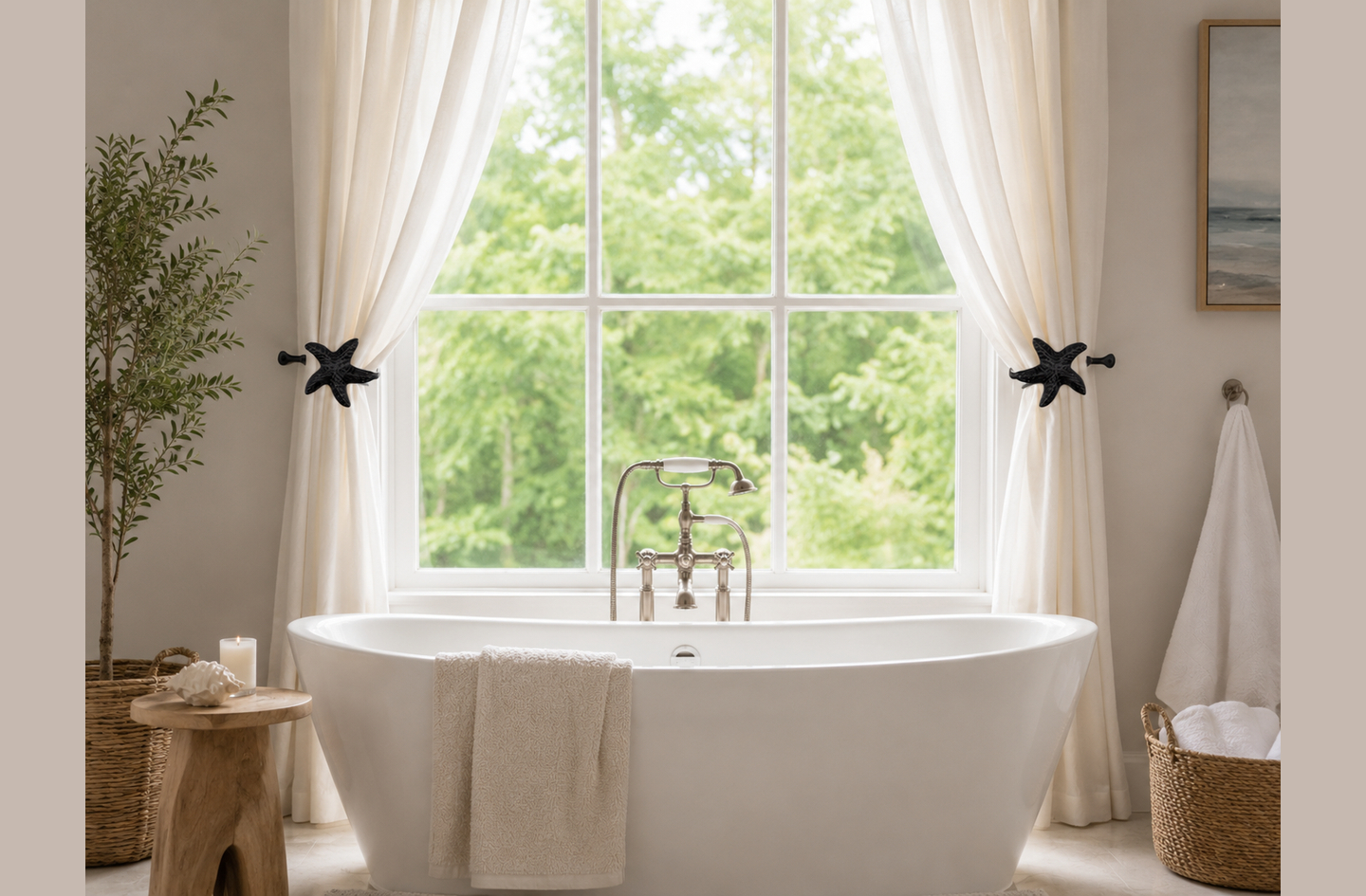
Bathrooms, kitchens and laundry rooms are the real test for any finish. The EPA advises keeping indoor relative humidity below 60 percent, ideally between 30 and 50 percent7. These rooms regularly exceed that after a shower or a pot of pasta. In those rooms a zinc-and-powder-coated iron holdback, such as the coastal Starfish holdback, holds its finish where bare or plated metal starts to mark. Aluminum also copes well with damp air, at the cost of stiffness.
For a humid room, the safest pairing is coated iron for stiffness or aluminum for a sheer. Plated steel is the one combination that tends to show wear first.
Maintenance: What Each Metal Needs Over the Years
Coated iron and aluminum need the least care, usually just dusting and a damp cloth, while polished brass needs the most attention to stay bright. The difference matters over a decade of use. A holdback that needs polishing every few months becomes a chore, and every polish removes a little of the piece.
“Repeated polishing results in loss of surface detail.”
Canadian Conservation Institute, CCI Notes 9/3 on the care of brass and copper6
Caring for Coated Iron and Steel
A powder-coated iron holdback needs a dry duster and, now and then, a cloth dampened with mild soapy water. Abrasive pads and solvent cleaners can dull the coating, so they are best avoided. A chip on a stamped steel holdback should be touched up quickly, because exposed steel rusts and spreads under the paint.
Caring for Brass
The Canadian Conservation Institute notes that polishing removes tarnish along with some surface metal, and that a protective wax coating reduces how often cleaning and polishing are needed6. Some owners skip polishing entirely and let brass darken to an antique tone. That works well on a vintage curtain holdback, where an aged surface suits the style.
Caring for Aluminum
Anodized or powder-coated aluminum cleans like coated iron. Bare aluminum can be wiped with a damp cloth, but it gradually loses its shine. The same small tieback hooks used with rope or fabric bands follow these care rules too. The guide to metal curtain tieback hooks covers how those hooks are sized and mounted.
Low-maintenance metals win for everyday rooms. Brass rewards owners who enjoy polishing or who are happy to let it age.
Visual Character: Decorative, Vintage and Small Holdbacks
Each metal carries a distinct visual signature, and the right one depends on the room rather than on any ranking. Hand-forged iron shows hammer marks and a matte finish. Brass reflects warm light. Steel and aluminum look smooth and uniform. Decorative curtain holdbacks pick up these qualities in their shape as well as their surface.
Vintage Curtain Holdbacks and Tiebacks
A vintage curtain holdback is usually brass or iron, because those were the metals available for decorative hardware before aluminum became affordable in the 20th century3. Brass rosettes suit Victorian and traditional rooms. Black iron scrolls suit farmhouse, rustic and cottage rooms. A vintage curtain tieback in either metal reads as part of the house rather than an add-on.
Unique and Decorative Shapes
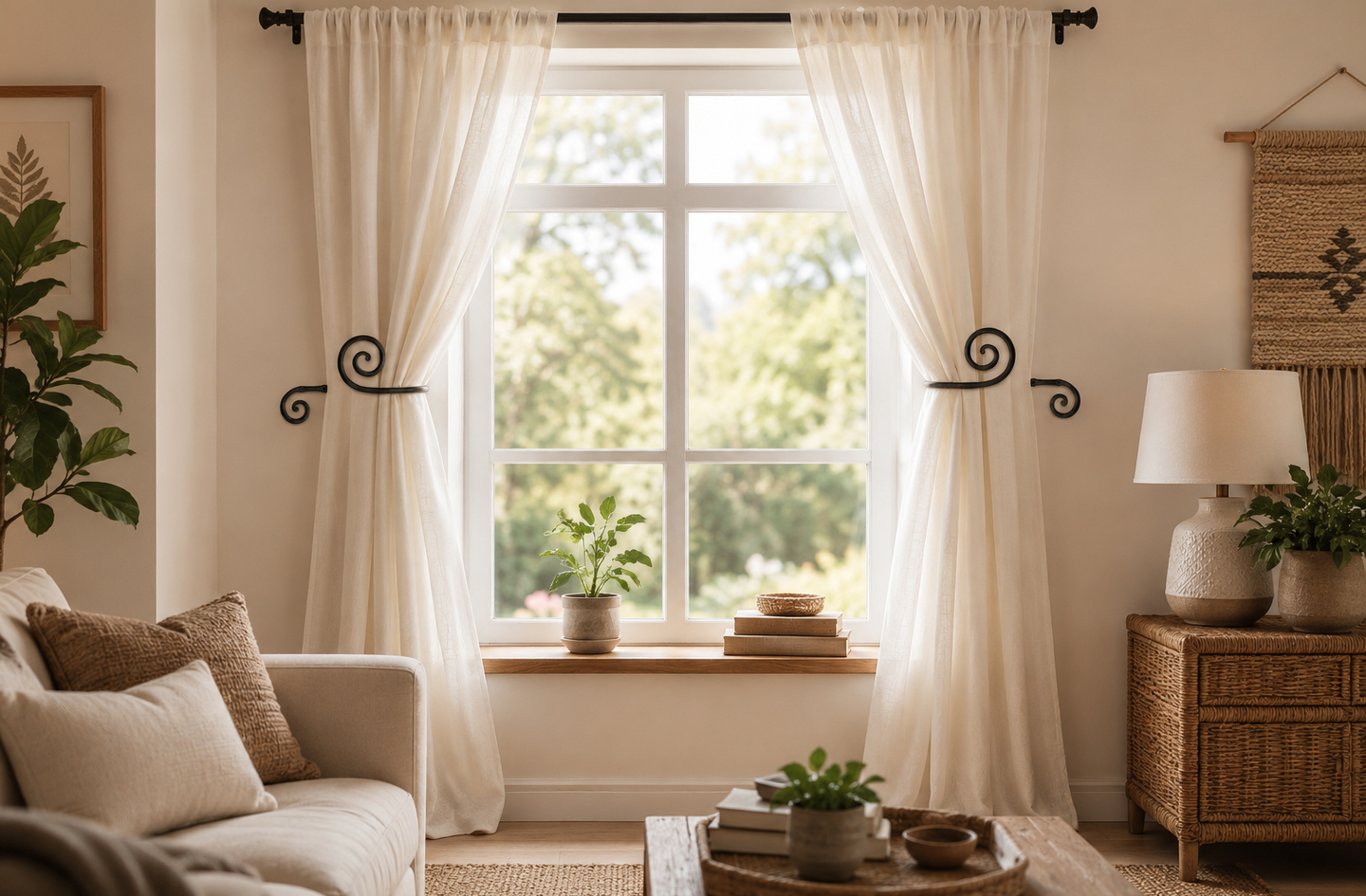
Forging makes shapes possible that stamping cannot copy: flowers, starfish, butterflies, loops and swirls drawn from one bar. That is why unique curtain holdbacks tend to be iron. The Flower holdbacks are one example, with a forged floral end on a curved arm for medium-weight drapes. Cast brass also allows ornament, but the detail is molded rather than hand-shaped.
Small Curtain Holdbacks
Small curtain holdbacks suit cafe curtains, narrow side windows and light panels in kitchens or bathrooms. At small sizes the stiffness gap between metals matters less, so brass and aluminum become fair choices. Placement matters more than metal here, and the guide to curtain holdback placement covers how height and distance from the frame change with curtain length.
Choose the metal by the room’s existing hardware first. A holdback that matches the curtain rod, door handles or light fittings looks intentional; one that clashes looks like an afterthought.
Price and Value: Why Forged Iron Costs More
Hand-forged iron and solid brass sit at the higher end of the price range, while stamped steel and cast aluminum sit at the lower end. The gap comes from labor and material, not branding. A forged holdback is heated, hammered, bent and finished by hand, one piece at a time, while a stamped one is pressed from sheet in a single machine stroke.
| Cost driver | Hand-forged iron | Stamped steel | Solid brass | Aluminum |
|---|---|---|---|---|
| Making method | Heated and hammered by hand | Pressed by machine | Cast, turned and polished | Extruded or cast |
| Material used | Solid bar | Thin sheet or tube | Solid copper alloy | Light alloy |
| Finish steps | Zinc plus powder coat | Plating or paint | Polish plus lacquer | Anodizing or powder coat |
| Long-term cost | Low upkeep, long life | Replacement once plating fails | Polishing time | Low upkeep, light-duty use |
RTZEN holdbacks follow a four-step process: the iron is cut, hand-forged, zinc-galvanized and powder-coated. That matches the duplex approach that the galvanizing industry credits with outlasting either coating alone5. The workshop, run by founders Tsach Levy and Rami Abramson since 1997, backs every holdback with a Lifetime Warranty against material and workmanship defects.
The cheaper holdback is only cheaper once. If it has to be replaced after the plating fails, the forged one becomes the better value over the life of the curtain.
Who Should Choose Which Metal
The simplest rule: choose iron for heavy curtains, brass for polished vintage looks, and aluminum for sheers in damp or outdoor spots. Steel works when it is solid rather than stamped. Most rooms fall clearly into one of these profiles.
- Owners of lined, blackout or velvet drapes: choose hand-forged iron. A deep forged arm such as the Swirly holdback holds a thick, gathered drape without sagging.
- Traditional and Victorian rooms with light panels: choose solid brass, and decide early whether to polish it or let it age.
- Sheers in bathrooms, sunrooms or porches: choose powder-coated aluminum or coated iron, both of which handle moisture well.
- Modern rooms with chrome or nickel fittings: choose solid steel with a durable finish, and check that it is not hollow before buying.
When neither fits, as with a very heavy drape on a hollow wall, the anchor matters more than the metal. A heavy-duty hook into a stud may be the better choice.
Verdict: Category Winners
Wrought iron wins the most categories for everyday curtains, with brass and aluminum each winning a specific niche. The table summarizes each comparison.
| Category | Winner |
|---|---|
| Stiffness and strength | Wrought iron, tied with solid steel |
| Weight | Aluminum |
| Finish durability | Zinc and powder-coated iron |
| Low maintenance | Coated iron and aluminum |
| Vintage visual character | Brass and forged iron |
| Decorative shapes | Hand-forged iron |
| Overall | Hand-forged iron, for most curtains in most rooms |
For a heavy or frequently opened curtain, forged iron with a zinc and powder-coat finish is the clear choice. For light panels, the choice becomes a matter of style, and brass or aluminum earn their place.
Frequently Asked Questions
What is the strongest metal for curtain holdbacks?
Wrought iron and solid steel are the stiffest common holdback metals, at 190 to 210 GPa and 200 GPa respectively2. Stiffness is what stops an arm from sagging under a gathered drape. A forged solid holdback uses that stiffness fully, while a stamped or hollow one gives much of it away.
Are wrought iron curtain holdbacks better than brass?
For heavy drapes, yes: wrought iron is close to twice as stiff as brass, at 190 to 210 GPa against 102 to 125 GPa2. Brass wins on polished, vintage looks for lighter panels. The better choice depends on curtain weight first and room style second.
Do metal curtain holdbacks rust in a bathroom?
Bare iron and scratched plated steel can rust in a bathroom, but zinc-coated iron resists it well, since zinc corrodes at about 1/30 the rate of bare steel4. A powder coat over the zinc adds a second barrier. Aluminum and brass do not rust, though both change color over time.
How can you tell if a curtain holdback is solid brass?
Hold a magnet against it. A magnet reveals iron even under paint or rust3, so a brass-look holdback that attracts it is plated steel. Solid brass does not attract a magnet, and it also feels heavy for its size, at about 8,470 kilograms per cubic meter for yellow brass1.
Are aluminum curtain holdbacks strong enough for heavy drapes?
Aluminum holdbacks suit sheers and light panels better than heavy drapes, because aluminum’s stiffness of 69 GPa is about a third of wrought iron’s2. A thicker aluminum arm can compensate. For lined or blackout curtains, forged iron remains the more dependable choice.
Limitations and Edge Cases
- The stiffness and density figures describe the metals themselves; a hollow or stamped holdback of any metal behaves very differently from a solid one of the same size.
- Brass and aluminum come in many alloys, so individual products can sit above or below the published ranges used here.
- Outdoor and coastal installations expose finishes to salt and rain, which shortens coating life compared with indoor rooms.
References
Methodology: every figure in this article comes from an independent published source linked below, and each source was checked live and read for its supporting sentence on October 7, 2026. The weight and stiffness chart and the stiffness-matched arm figures were calculated by RTZEN from the published data, and the article was reviewed by RTZEN co-founder Rami Abramson.
- Engineering ToolBox – Metals and Alloys – Densities, reference table, retrieved October 2026.
- Engineering ToolBox – Young’s Modulus of Elasticity – Values for Common Materials, reference table, retrieved October 2026.
- National Park Service – Metals in America’s Historic Buildings: Uses and Preservation Treatments, Margot Gayle, David W. Look and John G. Waite, 1992.
- American Galvanizers Association – How Long Does HDG Last?, retrieved October 2026.
- American Galvanizers Association – Specifying Duplex Systems, last updated January 2026.
- Canadian Conservation Institute – The Cleaning, Polishing and Protective Waxing of Brass and Copper, CCI Notes 9/3.
- U.S. Environmental Protection Agency – Mold Course Chapter 2, Lesson 3: Humidity.
- Hunker – The Average Height for Curtain Tiebacks, Linda Erlam, May 2011.
Conclusion
Among curtain holdbacks, metal choice comes down to stiffness, finish and style, in that order. Wrought iron and solid steel resist bending best, brass brings warmth and a vintage look to light panels, and aluminum keeps weight low in damp spots. Hand-forged iron with a zinc and powder-coat finish covers the widest range of curtains, built for real-world daily use and backed by a Lifetime Warranty.
For how metal choice fits the wider topic of curtain holdbacks, see the curtain holdbacks overview.