Heavy duty curtain hooks and rigid holdbacks both keep an open drape off the window glass, but they suit different curtains, walls and daily routines. This comparison sits under the curtain holdbacks overview and covers only the choice between the two. The deciding factor is rarely appearance but the weight of the fabric, the fastener behind it and the depth of the hardware. Upholstery-grade fabric runs 10 to 13 ounces per square yard7, and a full lined panel in that class asks far more of a wall than a sheer does.

Quick Answer
When should you choose heavy duty curtain hooks instead of curtain holdbacks?
Choose a heavy duty hook when the drape is lightweight to medium-weight, the wall space beside the window is tight, or the curtain is tied back with a cord. Choose a rigid holdback for thick, lined draperies that open every day. A hook should project an inch or two from the wall3, while a holdback arm reaches further and cradles the whole gathered stack.
Key Takeaways
- A lined heavyweight panel 84 to 108 inches long carries about 4 to 5 pounds of fabric on a 48-inch window. That estimate uses published fabric weights of up to 13 ounces per square yard7.
- The fastener matters more than the hook: a safe working load is the anchor’s rated load divided by 4, so a 100-pound rating supports 25 pounds4.
- Hardware within 3 inches of the window frame can go in with long screws, while anything further out needs toggle anchors in drywall2.
- The common mistake is treating a hook as a smaller holdback: metal hook tiebacks hold less material and may not suit thick, heavy draperies1.
Heavy Duty Curtain Hooks vs Holdbacks at a Glance
Heavy duty curtain hooks and rigid holdbacks differ in how they grip the fabric, how far they stand off the wall and how much material they can cradle. A hook catches a cord or the edge of a panel on a short prong. A holdback wraps an arm around the whole gathered stack and keeps it there. Both mount beside the window frame, and both depend on the screws and anchors behind them.
A heavy duty curtain hook is a solid metal wall hook with a deep, thick prong, used to support a curtain tieback loop or the leading edge of a drape. A curtain holdback is a rigid fixture, usually a curved metal arm on a wall plate, that supports a gathered curtain open in one fixed spot. Holdbacks have a more solid structure and are meant to keep a fixed position on the adjacent wall3. A hook is smaller and simpler, which is both its strength and its limit.
| Factor | Heavy duty curtain hook | Rigid curtain holdback |
|---|---|---|
| Best for | Light to medium draperies, cord or fabric tiebacks, tight wall space | Thick, lined or velvet draperies opened every day |
| How it supports the curtain | Catches a loop or the panel edge on one prong | Cradles the full gathered stack in a curved arm |
| Projection from the wall | About 1 to 2 inches | Deeper, position by the arm length |
| Fabric class it suits | Linings to midweight, up to about 7 ounces per square yard | Heavyweight, 10 ounces per square yard and up |
| Fixing in drywall | Long screws near the frame, anchors further out | Long screws near the frame, toggle anchors further out |
| Daily opening | Re-loop or re-tie each time | Tuck the drape behind the arm |
| Clearance needed beside the frame | Small | More, so the stack clears the window glass |
| Verdict | Wins on space and flexibility | Wins on load and daily use |
When the fabric is heavy and the drape moves daily, the holdback carries the job. When the wall is tight or the curtain is light, the hook earns its place. The sections that follow test each row with published figures, so the decision rests on numbers rather than on taste.
A hook is not a cut-down holdback: it is a different tool, and choosing it for a thick drape is the root of most sagging and pulled-out fasteners.
Load Capacity: Which Handles Heavier Drapes
A rigid holdback handles heavier draperies, because its arm supports the whole gathered stack instead of one loop or edge. Upholstery-weight textiles run 10 to 13 ounces per square yard, about 300 to 450 grams per square meter7. Linings sit far lower, at 2 to 4 ounces per square yard7.
Fabric weight is the mass of a textile per unit of area, quoted in ounces per square yard or in grams per square meter. Threads Magazine explains that a fabric listed in ounces is understood to mean ounces per square yard7. That one number, multiplied by the area of the panel, gives the weight of the fabric a hook or holdback has to control.
Combined panel width should be two to two-and-a-half times the width of the window for a full drape8. Standard curtain lengths run 63, 84, 96, 108 and 120 inches8. A 48-inch window at the fuller ratio needs 120 inches of fabric width, or two panels of 60 inches each.
Multiplying those published sizes by the published fabric weights gives an estimate for one panel. The figures count face fabric and lining only, so hems, headers, rings and trims add a little more.
A sheer or lining-weight panel stays near a pound, which any sound hook manages with ease. A heavy, lined panel at 108 inches passes 5 pounds of fabric before the header is counted, using the heaviest published upholstery weight7. On a 72-inch window at the same fullness, each lined heavy panel needs 90 inches of width8, which takes the fabric past 8 pounds.
Weight alone does not decide the load on the hardware, because the curtain rod carries most of a panel’s weight. The hook or holdback takes the sideways pull of the gathered fabric, plus every tug when the drape is drawn. A thick stack pushes back against whatever supports it, and a heavy hem swings when the curtain is released. Those forces grow with the fabric weight, which is why the curtain class matters more than the hardware’s looks.
“Remember too that metal hook tiebacks hold less material than fabric tiebacks and may not work well with thick, heavy draperies.”1
Linda Erlam, home decor writer, in The Average Height for Curtain Tiebacks
A heavy duty hook improves on a light hook in thickness and fastener, but its prong is still short. It supports a cord well, and it supports the edge of a medium panel well. It does not support a deep stack of velvet without the fabric slipping off the tip. A holdback arm is shaped to take that stack, so the fabric rests in a curve instead of hanging from one point.
For lined, velvet or interlined draperies, a holdback is the safer default, and a hook belongs only where a tieback does the holding.
Wall Fixing: Which Anchors More Securely
Neither a hook nor a holdback anchors more securely on its own: the fastener behind the plate decides. A safe working load is found by dividing the anchor maker’s shear load rating by 4, so an anchor rated for 100 pounds safely supports 25 pounds4.
A safe working load is the weight a fastener should carry in everyday use, set well below its failure point to leave a margin. This Old House puts the margin plainly: anchors should be able to support four times the weight of the object being hung5. Drywall with a simple nail supports between 5 and 10 pounds before it needs extra support5.
Family Handyman installed each anchor in one-half inch drywall, following the maker’s instructions, and then loaded it with weight6. A ribbed plastic anchor rated at 22 pounds held 80 pounds in that test6. A snap toggle rated at 80 pounds held 180 pounds6. The table below sets each tested anchor beside the safe working load its own rating gives under the divide-by-4 rule.
| Anchor type | Rated load | Tested load in half-inch drywall | Safe working load, rating divided by 4 |
|---|---|---|---|
| Ribbed plastic sleeve | 22 pounds | 80 pounds | 5.5 pounds |
| Pop toggle | 60 pounds | 130 pounds | 15 pounds |
| Self-drilling twist-lock | 75 pounds | 100 pounds | 18.75 pounds |
| Snap toggle | 80 pounds | 180 pounds | 20 pounds |
| Drill-in toggle | 90 pounds | 140 pounds | 22.5 pounds |
Set against the curtain estimates, the table explains a common failure. Under the divide-by-4 rule, a ribbed plastic anchor rated at 22 pounds has a safe working load of 5.5 pounds4. That is close to the fabric weight of one lined heavy 108-inch panel. The hardware does not carry that full weight in normal use. Yet a margin that thin leaves nothing for a child swinging on the drape or a hard pull on a stuck panel.
A toggle bolt is a drywall fastener with spring or strap wings that open behind the board and spread the load over a wider area. Toggle bolts suit heavy loads of 25 to 50 pounds in drywall, plaster and hollow-core concrete block4. Expanding plastic sleeves suit lightweight to medium-weight loads, typically up to 25 pounds4.
Why the window frame changes the fastener
Distance from the frame decides whether a screw finds solid wood. When the mark sits within 3 inches of the window frame, curtain holdbacks can go straight into the wall with long screws2. Past that point, toggle anchor bolts stop the hardware ripping out of the drywall under the weight of the curtains2.
Studs are the strongest option
Anchoring directly into a wall stud gives the most secure mounting for heavy objects, and studs are typically spaced 16 or 24 inches apart4. A stud finder shows whether one lands under the mark. When none does, a toggle is the next best choice for a heavy drape.
Hooks and holdbacks differ in one detail here: the number of screws. A holdback plate often carries two screws, and a hook may carry one or two. Two screws share the load, and the top screw resists the prying force when the curtain pulls outward. Included screws and anchors are a starting point, and the right choice of fastener still depends on what sits behind the board.
Choose the fastener for the curtain, not for the hardware: a heavy duty hook in a toggle outperforms a holdback hung from a single plastic sleeve.
Hook Depth and Curtain Clearance
A heavy duty hook wins on depth when wall space is tight, because its short prong stands only about an inch or two off the wall3. That projection is enough to keep a tied-back curtain from pressing against the window. A holdback arm reaches further, because it must cradle the full stack rather than one cord.
Projection is the distance a piece of hardware stands out from the wall, measured from the wall plate to the outer face of the hook or arm. A deeper projection gives the gathered fabric room to sit without crushing, and it also pushes the hardware further into the room where people walk past.
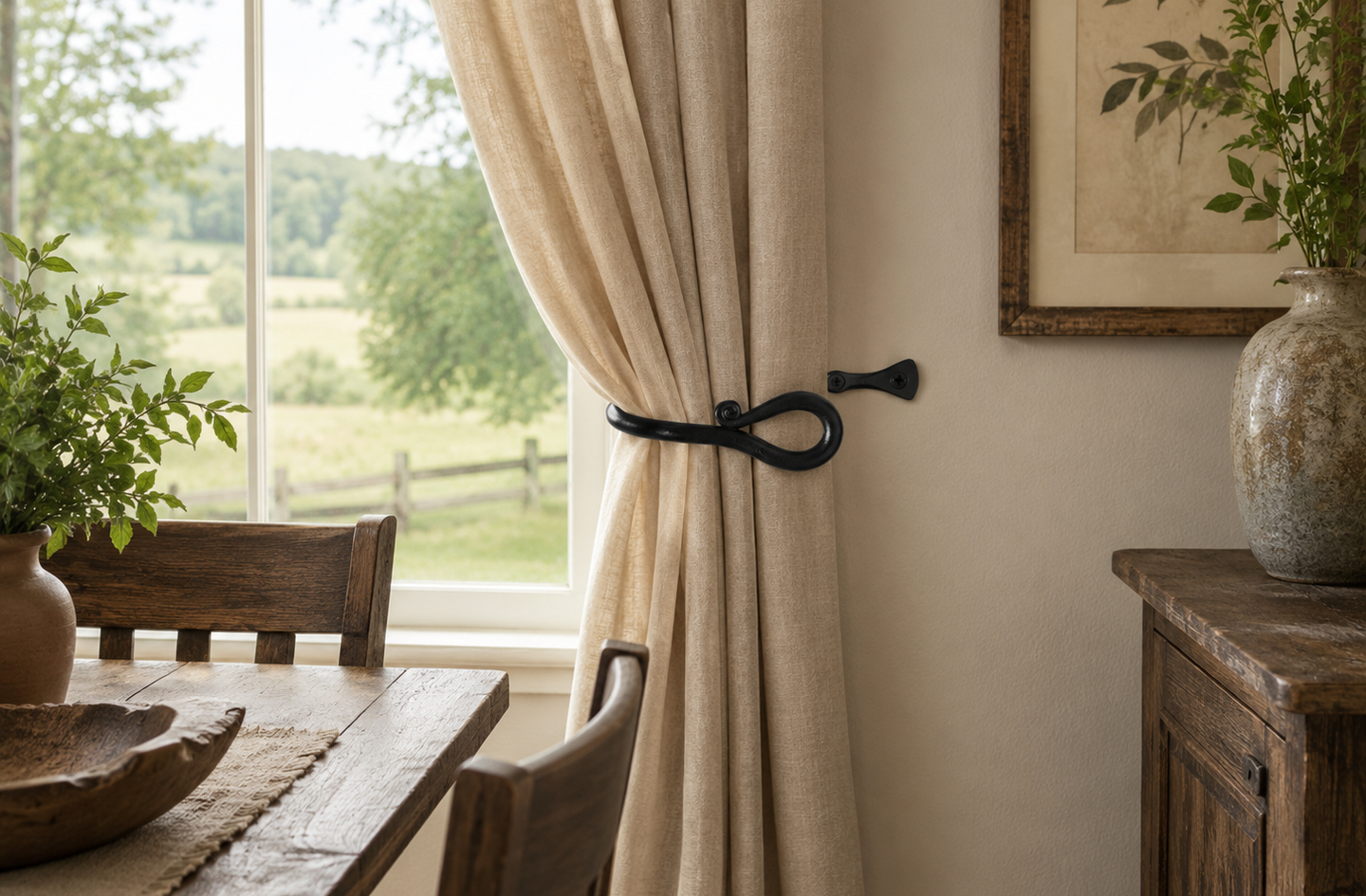
A common guideline leaves a 3-inch gap between the edge of the window opening and the mounting hook3. A hook can sit at that gap and still keep a slim cord tieback clear of the window glass. A holdback for a thick drape usually needs to sit further out, so that the stack rests on the wall and not across the window.
Depth also changes the force on the screws: for the same pull, a longer arm pries harder on the top screw, because the force acts further from the wall. Doubling the projection doubles that prying force, so a short heavy duty hook puts less strain on its fastener than a long holdback arm under the same tug.
When the window has trim
Window casing adds a step between the frame and the wall. If the window has trim, toggle bolts keep holdbacks from pulling out of the wall2. A hook with a small plate can sometimes sit on the flat face of wide trim, where its screws bite into solid wood.
Which way the hook faces
A curtain hook should open away from the window, so the drape is pulled outward as it is hooked. A hook that faces the window glass lets the fabric slide back toward the window each time the curtain shifts. The same rule applies to the open end of a holdback arm.
Where a walkway, a door swing or a deep window reveal leaves little room, the shallow projection of a heavy duty hook is the deciding advantage.
Daily Operation: Which Suits Drapes Opened Every Day
A rigid holdback suits draperies that open every day, because the curtain is simply swept behind the arm and released. Holdbacks are built to stay in one fixed position on the wall3, so the curtain returns to the same place each time. A hook used with a tieback asks for one more step, since the loop is wrapped and hooked by hand.
A thick drape is harder to gather into a neat loop, and the loop slips more easily when the fabric is slick, such as velvet or sateen. On a bedroom or living room window opened morning and night, the motion repeats hundreds of times a year. Each repetition is a small pull on the hook, the cord and the fastener.
The holdback spreads that wear differently, since the fabric rubs along a smooth curved arm instead of folding over the narrow tip of a prong. Many installers position holdbacks between 40 and 48 inches up from the floor2, a height most adults reach without stretching. Exact height on longer curtains follows the thirds rule: a 100-inch drape takes its tieback 33 inches from the bottom1.
The holdback placement guide sets out the full height and side-distance arithmetic for each standard curtain length. For daily use, the practical point is simple: hardware at the lower third stays in reach for every member of the household.
Where a cord or fabric tieback is part of the design, the hook is the anchor point and the tieback does the holding. In that pairing the hook sees a steady, lightweight load, and it rarely needs more than a sound fastener. The tieback hook types article compares the hook shapes that work best with rope, cord and fabric bands.
For a heavy drape opened twice a day, the holdback saves effort and wear; for a lightweight curtain with a decorative tieback, a heavy duty hook is enough.
Tight Spaces and Interior Style
A heavy duty curtain hook fits tight spaces better, because it needs less wall beside the frame and less depth into the room. Narrow walls between a window and a corner, a door or a bookcase often leave only a few inches. A small hook fits there, while a holdback arm and its gathered stack would cover part of the window glass.
A holdback is a visible, decorative piece, and its curve or finial becomes part of the window’s look. A hook is quieter, and it often disappears behind the tieback it supports. Rooms with a strong rustic or farmhouse theme tend to suit the shape of a forged holdback, and pared-back modern rooms suit a simple black hook.
Solid wrought iron and steel resist bending under a thick stack, while thin cast or stamped pieces can flex over time. The holdback metals compared article sets wrought iron, steel, brass and aluminum side by side on weight, stiffness and finish care.
Matching hooks and holdbacks in one room
A tall living room window with lined draperies can take holdbacks, while a narrow side window with a lightweight panel takes a hook and tieback. Matching the finish, such as black on both, keeps the room consistent even when the hardware shapes differ.
Layered curtains
A sheer under a heavy drape is a common layered setup. The heavy outer drape goes behind a holdback, and the sheer can stay loose or be caught by a small hook. Large holdbacks such as the white Swirly holdbacks are sized for thick curtains and layered drapery.
Choose by the wall first and the style second: a holdback that blocks the window looks wrong in any style.
Installation Effort and Hidden Costs
A heavy duty hook is the simpler installation, because it takes one small plate and, for light loads, a short fastener. A holdback for heavy draperies takes the same steps but with more care over the anchor. Both need a pencil, a tape measure, a drill, bits and a level, and holdback installs often add toggle anchor bolts2.
The hidden cost is rarely the hardware itself but the right fastener and the time spent locating a stud. A toggle sized for drywall needs a larger hole than a plastic sleeve, and a mistake leaves a mark that needs filling. Measuring twice and checking for a stud before drilling saves most of that work.
- Measure the finished curtain and mark the height on both sides of the window.
- Measure from the frame to each mark and note whether it falls within the 3-inch zone.
- Check for a stud with a stud finder before choosing the fastener.
- Drill pilot holes for wood or the size the anchor maker states for drywall.
- Fit the plate, check it with a level, and tighten until the hardware stops moving.
On heavy draperies, a two-screw plate in a stud or two toggles is the standard to aim for. The Swirly holdbacks are made for standard and heavy drapery panels and come with screws and drywall anchors. Every RTZEN piece is hand-forged, zinc-galvanized and powder-coated, and the catalog-wide Lifetime Warranty covers material and workmanship defects under normal use.
A Double Plate hook has a sturdy forged prong on a flat wall plate. Two screws in that plate spread the load better than one when a tieback is pulled tight.
Budget the time for the fastener rather than the hardware: a stud check before drilling is the single step that prevents most pulled-out installations.
When to Choose Heavy Duty Curtain Hooks Instead of Holdbacks
Choose heavy duty curtain hooks when the curtain is lightweight to medium-weight, a tieback does the holding, or the wall space is too tight for an arm. Choose a holdback when the drape is thick, lined or opened daily. The profiles below match the most common situations to the hardware that suits each one.
- Renters and lightweight curtains: a heavy duty hook with a cord tieback suits linen or cotton panels, since the load is small and the hole is easy to fill.
- Narrow walls beside the window: a hook wins where a corner, door or cabinet leaves only a few inches, because the shallow prong keeps clear of passing traffic.
- Lined, velvet or blackout draperies: a holdback wins, fixed into a stud or with toggles, because the arm supports the full gathered stack.
- Windows opened morning and night: a holdback wins, since the drape is swept behind the arm with no tying.
- Layered sheers and draperies: use both, with the holdback on the heavy layer and a small hook for the sheer.
Neither option is right for a very heavy, very wide drape on a wall with no stud and old, crumbling plaster. In that case, a curtain rod with a return bracket or a traverse track that stacks the fabric without a holdback is the better fix. The hardware question there becomes a wall repair question first.
The simplest rule is the fabric test: if a single panel feels heavy in one hand, it belongs behind a holdback, not on a hook.
Verdict: Category Winners
Holdbacks win the categories that matter most for thick draperies, while heavy duty hooks win on space and simplicity.
| Category | Winner | Main reason |
|---|---|---|
| Heavy draperies and load | Holdback | The arm cradles the full gathered stack |
| Wall fastener | Tie | The anchor behind the plate decides |
| Depth and clearance | Hook | A projection of about 1 to 2 inches |
| Daily opening | Holdback | Sweep and release, with no tying |
| Tight spaces | Hook | Needs little wall beside the frame |
| Installation effort | Hook | Smaller plate and lighter fastener |
| Overall for thick, daily-use draperies | Holdback | Load and routine outweigh space |
Thick, lined and daily-use curtains belong behind holdbacks fixed into studs or toggles. Light curtains, tieback designs and tight walls are where heavy duty hooks are the better choice.
Frequently Asked Questions
Can heavy duty curtain hooks support blackout curtains?
Heavy duty curtain hooks can support blackout curtains when a tieback does the holding and the hook is fixed into a stud or toggle. Toggle bolts suit loads of 25 to 50 pounds in drywall4. For a thick panel swept back daily, a rigid holdback grips the stack more securely than a single prong.
How far should a curtain hook stick out from the wall?
A curtain hook should project about an inch or two from the wall3, which keeps a tied-back curtain from pressing on the window glass. Thick draperies need more depth to sit without crushing, which is where a holdback arm suits better. Keep projection modest beside walkways and door swings.
Do curtain holdbacks need wall anchors?
Curtain holdbacks need wall anchors when the mark is more than 3 inches from the window frame in drywall2. Within that zone, long screws usually reach solid framing. Beyond it, toggle anchor bolts stop the holdback pulling out of the board under the weight of the curtains.
How much weight can a plastic drywall anchor support for curtains?
A ribbed plastic anchor rated at 22 pounds held 80 pounds in an independent half-inch drywall test6. The safe working load is the rating divided by 4, or 5.5 pounds. That is close to the fabric weight of one lined heavy panel, so heavy draperies call for a stud or toggle.
Are metal tieback hooks good for thick curtains?
Metal tieback hooks hold less material than fabric tiebacks and may not suit thick, heavy draperies1. A hook works best as the anchor point for a cord or fabric band. For lined, velvet or blackout panels, a rigid holdback carries the gathered stack in its curved arm.
Limitations and Edge Cases
- The panel weights are estimates of face fabric and lining only, for a 48-inch window at two-and-a-half times fullness; headers, rings, interlining and trims add weight on top.
- Anchor figures come from tests in half-inch drywall; plaster, lath, tile and masonry walls need fasteners rated for those materials.
- The comparison assumes a flat wall beside a standard rectangular window; bay windows, corner windows and ceiling tracks change where either type of hardware can go.
References
Methodology: every figure in this article comes from an independent published source and links to the page that carries it. The panel-weight estimates and safe working loads apply those published figures to standard curtain and window sizes, and the article is reviewed by Rami Abramson.
- Hunker – The Average Height for Curtain Tiebacks, Linda Erlam, May 2011.
- Hunker – How To Install Curtain Holdbacks, Laurie Brenner, updated August 2022.
- Designing Idea – Where to Place Curtain Holdbacks and Tiebacks, Ellen Siloy, architect, updated September 2024.
- This Old House – How To Choose the Right Hanging Hardware, Tim Snyder, updated June 2026.
- This Old House – How To Hang Something Heavy On a Wall, Jim Gorman, updated June 2026.
- Family Handyman – How Much Weight Can Drywall Anchors Hold, HomeLAB test by Jason Ingolfsland, updated October 2024.
- Threads Magazine – Matters of Fabric Weights, April 2022.
- Homes and Gardens – How to measure for curtains, Sarah Warwick, updated May 2025.
Conclusion
Heavy duty curtain hooks are the right choice for light to medium curtains, tieback designs and tight walls, where their shallow projection of an inch or two is an advantage. Thick, lined drapes that open every day belong behind rigid holdbacks. In both cases, the fixing behind the plate decides how long the hardware stays put, so heavy curtains call for a stud or a toggle.
For how hooks and holdbacks fit the wider topic of choosing them, see the holdbacks overview.