Magnetic curtain tie backs hold a curtain open with a pair of magnets, while a wrought-iron holdback is a forged arm screwed to the wall. This article narrows the overview in our Curtain Holdbacks guide to one decision between those two. The difference starts with grip. A half-inch sewing-magnet pair listed at 3 lb against a steel plate pulls only 0.52 lb through two layers of canvas1. A screwed holdback has no such fade. Installation, curtain weight, adjustability, wall impact and finish settle the rest.
Quick Answer
Which is better, magnetic curtain tie backs or wrought-iron holdbacks?
Wrought-iron holdbacks are better for lined, heavy or daily-used drapes, because screws and anchors hold them whatever the fabric. Magnetic tie backs suit sheers and light panels where drilling is not an option. Magnet grip drops with any material between the magnets, such as a cover or a pinched curtain. One small pair falls from 1.90 lb through two layers of cotton T-shirt fabric to 0.52 lb through canvas1.
Key Takeaways
- Magnet grip falls as the material between the magnets thickens. K&J Magnetics lists one half-inch pair at 1.90 lb through two layers of cotton T-shirt fabric and 0.52 lb through canvas1.
- A 48 by 84 inch panel in 13-ounce fabric weighs about 40.4 ounces, more than three times the same panel in 4-ounce lining fabric23.
- Hunker advises long screws for a holdback within 3 inches of the window frame and toggle anchors beyond that5.
- A common misconception is that a magnet’s listed pull force is its grip on a curtain. K&J Magnetics measures that headline figure against a thick steel plate1.
- The CPSC estimates 26,600 magnet ingestions were treated in hospital ERs from 2010 through 20218, so small loose magnets belong out of children’s reach.
Magnetic Curtain Tie Backs vs Holdbacks at a Glance
Magnetic curtain tie backs win on speed and a hole-free wall, while wrought-iron holdbacks win on grip, repeat use and lifespan. Magnetic curtain tie backs are bands, cords or clips whose two magnetic ends snap together around a gathered curtain. A curtain holdback is a rigid arm or hook fixed to the wall beside the window, which the gathered curtain rests behind. The table compares the two on the points buyers raise most often.
| Category | Magnetic tie back | Wrought-iron holdback |
|---|---|---|
| How it holds | Magnet closure around the gathered fabric | Fixed arm the fabric rests behind |
| Installation | No tools; clips on in seconds | Drill, screws and anchors on each side |
| Grip on full drapes | Weakened by any layer between the magnets | Set by the screws and wall, not the fabric |
| Best curtain type | Sheers, linen and unlined panels | Lined, layered and heavy drapery |
| Adjustability | Moves anywhere, any time | Fixed height once mounted |
| Wall impact | None | Small screw holes |
| Child safety | A magnet that comes loose is an ingestion hazard | No magnets |
| Verdict | Renters and light curtains | Heavy drapes and daily use |
If the curtain is lined or opened every day, the holdback’s fixed grip matters more than the magnet’s convenience.
Installation: No Drill Versus Screws and Anchors
Magnetic curtain tie backs install faster, because they need no tools and leave the wall untouched. The band wraps around the gathered curtain and the magnets close it. Nothing is measured, marked or drilled, so the whole job takes seconds and can be undone just as fast.
A wrought-iron holdback takes a drill, a tape measure and fasteners suited to the wall. Hunker’s installation guide sets the anchoring rule by distance from the frame: within 3 inches, long screws can go straight into the wall5. Beyond that, toggle anchor bolts keep the holdback from ripping out of the drywall under the curtain’s weight5. The same guide calls for toggle bolts when the window has trim5.
A toggle bolt is a drywall fastener whose spring-loaded wings fold through a drilled hole and open flat behind the wallboard. RTZEN’s forged holdbacks ship with mounting hardware, and several sets list wall anchors in it. Where Hunker’s rule calls for toggle bolts, check the included anchors or buy toggles separately5. The swirled Black Swirly holdbacks, for example, come with screws and drywall anchors in the box.
Choose the magnet when drilling is off the table, and plan a short, one-time job for the holdback when it is not.
Holding Strength and Curtain Weight
Wrought-iron holdbacks hold heavy curtains better, because their grip comes from screws in the wall. A magnet’s grip shrinks with every layer between the magnets. Pull force is the force needed to separate a magnet from steel or from its partner magnet, and it is the figure magnet makers publish.
How magnet grip falls through fabric
K&J Magnetics, a magnet maker, publishes its sewing magnets’ pull force through common materials. Its half-inch plastic-covered pair is listed at 3 lb in a test against a thick steel plate1. Through two layers of fabric the figures fall fast, and the maker warns that holding force decreases as the distance between the magnets increases1.
| Material | Single-layer thickness, in | Pull force, lb |
|---|---|---|
| Cotton T-shirt | 0.012 | 1.90 |
| Denim | 0.028 | 0.87 |
| Canvas | 0.04 | 0.52 |
| Leather, 1/16 in | 0.0625 | 0.22 |
The same maker suggests a pull force between 1 and 3 lb as a useful target for many fabric closures. It adds that the ideal strength depends on the application1. By that yardstick, this pair passes through cotton but sits below the range through denim and canvas. In a band-style tie back, the band’s own cover sits between the magnets. In a clip-style tie back, the curtain itself does. Either way, a thick curtain pushes back harder against the closure.
How heavy a curtain panel gets
Off-the-shelf curtain panels are usually 48 inches wide, and standard lengths run 63, 84, 96, 108 and 120 inches, according to Homes & Gardens3. A 48 by 84 inch panel covers about 3.11 square yards of fabric3.
Threads magazine lists linings at 2 to 4 ounces/square yard and upholstery at 10 to 13 ounces/square yard2. Threads covers dressmaking and upholstery fabrics rather than drapery, so the bands are a guide2. Multiplying the panel area by each band’s upper figure gives the chart’s panel weights, from 12.4 to 40.4 ounces23.
Worked example: magnet grip loss and anchor rating
Worked example, calculated from cited inputs. K&J Magnetics lists its half-inch pair at 3 lb against steel and 0.52 lb through two layers of canvas1. The ratio is 0.52 / 3 = 0.17, so the pair delivers about 17% of its headline figure through canvas1. Through cotton T-shirt fabric it delivers 1.90 / 3 = 0.63, or about 63%1. The two figures come from different test setups, so the ratio shows how far the headline steel-plate figure sits above the through-fabric figures.
On the wall side, the 13-ounce panel above weighs about 40.4 ounces, or 2.5 pounds2. Even if one holdback carried that whole panel, This Old House’s four-times rule asks for anchors rated 2.5 x 4 = 10 pounds26. This Old House reserves heavy-duty anchors for items over 25 pounds6.
The calculation separates the two jobs. A magnetic closure has to stay shut while thick, springy fabric pushes against it, and any layer between the magnets weakens it. For a holdback, the four-times rule puts this panel at anchors rated about 10 pounds26. Fabric thickness does not change that figure.

For lined, blackout or layered drapes, choose a screwed holdback. A full bundle of thick fabric pushes hardest on a closure that any covering already weakens.
Adjustability and Everyday Opening and Closing
Magnetic curtain tie backs are more adjustable, while holdbacks are faster to use every day once they are mounted. A magnetic band can sit at any height and move whenever the look changes. A holdback’s height is set when it is drilled, and Hunker notes the usual range is 40 to 48 inches from the floor5.
Daily use favors the fixed arm. Opening a curtain onto a holdback is one motion: sweep the fabric behind the arm. A magnetic tie back has to be unclipped, wrapped and closed again each time, and a heavy, bunched panel resists that wrap.
Fullness is the total width of the curtain fabric compared with the width of the window or rod. Homes & Gardens recommends a combined panel width of two to two-and-a-half times the window width3. More fullness means a fatter bundle at the side of the window, which a holdback’s open arm accepts more easily than a closed magnetic loop.
“Two hundred per cent fullness is an industry standard for a good rippling of the fabric.”3
Noelle Isbell, Noelle Interiors, in Homes & Gardens3
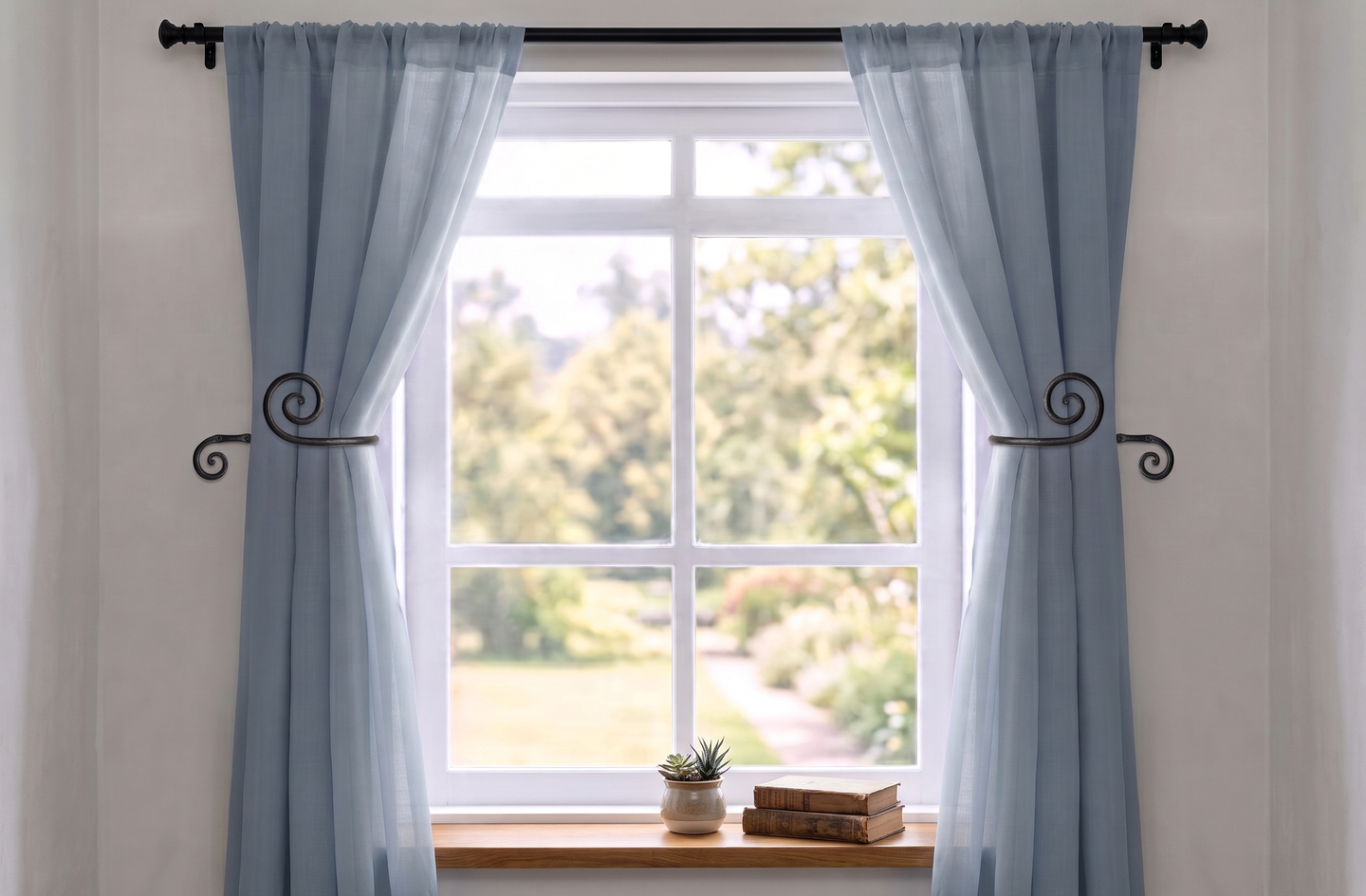
The forged arm also leaves the bundle loose enough to drape. The Black Classic holdbacks use a U-shaped profile for medium-weight curtains, and the larger White Swirly holdbacks are sized for thick curtains and layered drapery.
If the curtains open and close every morning and night, the holdback saves the daily wrap. If the look changes with the seasons, the magnet’s freedom matters more.
Wall Impact, Renters and Window Trim
Magnetic curtain tie backs win on wall impact, because they never touch the wall. That makes them the default for renters, for tiled or plastered surfaces that are hard to drill, and for anyone testing a look before committing.
A holdback leaves screw holes on both sides of the window. Their size depends on the fastener. This Old House notes that toggle-bolt anchors hold the heaviest tensile loads but leave a larger hole in the wall6. The same source says drywall typically supports 5 to 10 pounds with a simple nail6, so heavier loads need an anchor.
Window trim changes the plan too. Hunker calls for toggle bolts when the window has trim, to keep holdbacks from pulling out of the wall5. For exact spacing from the frame, see the guide to curtain holdback placement.
A rental lease or a tiled wall usually settles this category for the magnet before strength is even considered.
Durability, Finish and Rust
Wrought-iron holdbacks last longer, because solid forged iron under a zinc and powder-coat finish has no fabric, cord or glue to wear out. RTZEN forges each holdback in four steps: cut, hand-forge, zinc-galvanize and powder-coat, a process the workshop has used since 1997.
A duplex coating system is zinc galvanizing topped with paint or powder coating, so each layer protects the other. The American Galvanizers Association reports that this pairing can last 1.5 to 2.3 times the combined lifetimes of both systems7. That figure was measured for hot-dip galvanized steel, not indoor hardware. The principle still explains why RTZEN pairs zinc with powder coat on holdbacks such as the Black Swirly set.
A magnetic tie back’s weak points are its covering and its closure. Rope and fabric covers fade in the sun, and plastic shells can crack or wear.
RTZEN backs every holdback with a Lifetime Warranty covering material and workmanship defects under normal use. The swirled black set, for example, carries zinc plating under its black powder coating.
For a window treatment meant to stay for years, the forged holdback is the longer-lived hardware.
Small Magnets and Child Safety
Wrought-iron holdbacks are the safer choice in a child’s room, because they contain no magnets. The U.S. Consumer Product Safety Commission (CPSC) warns that swallowed high-powered magnets can attract to each other through internal body tissue8.
The CPSC estimates 26,600 magnet ingestions were treated in hospital ERs from 2010 through 20218. The standard the CPSC approved in 2022 covers loose or separable magnets in certain magnet products8. They must be too large to swallow or weak enough to reduce internal injury8. Curtain tie backs are not the products that rule names, but the same hazard applies if a small, high-powered magnet works loose.
Before hanging magnetic tie backs in a nursery or playroom, check that the magnets are sealed inside their housing and cannot pull free. The forged Black Starfish holdbacks are one magnet-free option, with handcrafted starfish accents.
Where small children play near the curtains, a magnet-free holdback removes the question entirely.
Style and How Each Looks in the Room
Magnetic curtain tie backs suit relaxed, minimal rooms, while forged holdbacks suit rooms that want visible craftsmanship at the window. Interior designer Joshua Smith, speaking to Livingetc, links magnetic ties with lighter fabrics.
“These ties are often paired with lightweight, flowy curtains and offer an effortless solution to draw drapes back without the complexity of a tie-back.”
Joshua Smith, interior designer, in Livingetc4
A wrought-iron holdback becomes part of the room’s hardware, so its finish and shape can match curtain rods, hooks and lighting. RTZEN’s range runs from plain U-shapes to scrolls, flowers and butterflies, in black, white and bronze. The Black Butterfly holdbacks add ornamental finials, while the Black Loophole holdbacks keep a simpler looped end.
If the curtain is the feature, a discreet magnet keeps attention on the fabric. If the window hardware is part of the design, the forged holdback earns its place.
Who Should Choose Which
Choose magnetic curtain tie backs when the wall cannot be drilled and the curtains are light. Choose a wrought-iron holdback when the curtains are heavy, used daily or meant to stay for years.
- Renters with sheer or linen panels: magnetic tie backs. They suit light fabric and leave no holes when the lease ends.
- Homes with lined, blackout or layered drapes: a wrought-iron holdback. Its grip does not fade with fabric thickness, and its open arm takes a full bundle.
- Bedrooms and living rooms opened twice a day: a holdback, because sweeping fabric behind a fixed arm is quicker than rewrapping a band.
- Nurseries and playrooms: a magnet-free holdback, because of the magnet-ingestion hazard the CPSC describes8.
Some windows suit neither option. Very heavy, floor-length drapes may call for a deeper hook, covered in the guide to heavy duty curtain hooks. Hook styles are compared in the guide to curtain tie back hooks. Soft fabric and rope ties are set against metal in soft tiebacks versus metal holdbacks.
Most owners can decide from two facts: whether drilling is allowed, and whether the curtains are lined.
Verdict by Category
Wrought-iron holdbacks win most of the categories below, while magnetic curtain tie backs win installation and adjustability.
| Category | Winner |
|---|---|
| Installation | Magnetic tie back |
| Holding strength on thick fabric | Wrought-iron holdback |
| Adjustability | Magnetic tie back |
| Daily opening and closing | Wrought-iron holdback |
| Durability and finish | Wrought-iron holdback |
| Child safety | Wrought-iron holdback |
| Overall, heavy or daily-used curtains | Wrought-iron holdback |
Wall impact is a tie-breaker rather than a category: if the wall cannot take a screw, the magnet wins by default. Otherwise the holdback is the hardware that keeps working as the curtains get heavier.
Frequently Asked Questions
Do magnetic curtain tie backs work on heavy curtains?
They work best on light curtains. Any layer between the magnets weakens their grip: one small pair listed by K&J Magnetics falls to 0.52 lb through two layers of canvas1. Lined or blackout drapes form a bulkier bundle that pushes harder on the closure, so a screwed holdback is the steadier choice.
Are magnetic curtain tiebacks safe around children?
They are safe only while the magnets stay sealed in their housing. The CPSC warns that swallowed high-powered magnets can attract to each other through internal body tissue8. In a nursery, check the housing often or choose a holdback with no magnets.
How high should curtain holdbacks be installed?
Holdbacks often sit between 40 and 48 inches from the floor, according to Hunker5. Height is still a design choice: a higher holdback shows more glass, and a lower one gives a longer sweep of fabric. Mark both sides at the same height before drilling.
Do curtain holdbacks need drywall anchors?
It depends on where they sit. Hunker says a holdback within 3 inches of the window frame can usually take long screws, while one farther out needs toggle anchor bolts5. Trimmed windows also call for toggle bolts.
Can you hold curtains back without drilling?
Yes. Magnetic tie backs wrap around the gathered curtain and close on themselves, so nothing touches the wall. Fabric and rope ties work the same way. Both suit rentals and light panels, but neither gives the fixed position of a wall-mounted holdback.
Limitations and Edge Cases
- The pull-force figures come from one maker’s half-inch sewing magnets. Magnetic tie backs use magnets of other sizes and covers, so their grip will differ, though the drop through thicker material follows the same rule.
- The panel weights use the upper end of each Threads fabric band and a single 48 by 84 inch panel. Linings, interlinings and longer drops add weight.
- Metal choice for the holdback itself is covered in the comparison of curtain holdback metals.
References
Methodology: RTZEN compiled the figures in this article from a magnet maker’s published pull-force table, two home publications, a sewing magazine, an industry association and a federal safety agency, read in October 2026. Tsach Levy holds editorial responsibility for the comparison.
- K&J Magnetics – 1/2 x 0.075 Inch Plastic Covered Neodymium Sewing Magnets N38 (1 Pair), product specification swp-s, read October 2026.
- Threads – A Matter of Fabric Weights, answer by Carol J. Fresia, April 19, 2022.
- Homes & Gardens – How to measure for curtains: easy steps for a perfect finish, Sarah Warwick, last updated May 22, 2025.
- Livingetc – Are Curtain Tie-Backs Old-Fashioned? Here’s What I Think, Seraphina Kyprios, July 5, 2025.
- Hunker – How To Install Curtain Holdbacks, Laurie Brenner, updated August 1, 2022.
- This Old House – How To Hang Something Heavy On a Wall, Jim Gorman, updated June 7, 2026.
- American Galvanizers Association – Duplex Systems: Paint or Powder Coating Over HDG, updated 2025.
- U.S. Consumer Product Safety Commission – CPSC Approves New Federal Safety Standard for Magnets to Prevent Deaths and Serious Injuries from High-Powered Magnet Ingestion, news release, September 7, 2022.
Conclusion
Magnetic curtain tie backs are the right call for light curtains on walls that cannot be drilled. For lined, heavy or daily-used drapes, a wrought-iron holdback holds the same way every time. Its grip comes from the wall, not from a magnet. RTZEN backs its hand-forged holdbacks with a Lifetime Warranty.
See the broader Curtain Holdbacks overview for how holdbacks fit the wider topic of window styling.