Curtain tie back hooks are small metal fixtures screwed to the wall beside a window. They hold a curtain open in one of two ways: by catching the loop of a fabric or rope tieback, or by cradling the gathered panel directly. This article sits under the curtain holdbacks overview and covers one narrower job: choosing the hook type, size, metal and wall anchor, then mounting it. Placement follows a simple rule: on a standard 84-inch curtain, the tie point sits a third of the way along, at 28 inches1.

Quick Answer
Which curtain tie back hook should you choose, and how should you mount it?
Choose a small anchor hook when a fabric or rope tieback does the holding, and a rigid U-shaped holdback hook when the metal holds the curtain itself. Size the hook to the gathered fabric, because panels sized at 2 to 2.5 times the window width2 make a thick bundle. Mount it a third of the way along the curtain, into a stud or a rated wall anchor.
Key Takeaways
- Curtain hardware performs two distinct jobs: a small anchor hook holds a decorative tieback’s ring, while a U-shaped holdback hook cradles the curtain itself.
- Metal hook tiebacks hold less material than fabric tiebacks and may not work well with thick, heavy draperies3, so the depth of the hook matters more than its ornament.
- Mount at one-third: 28 inches on an 84-inch curtain, with the anchor at least 1 inch from the window frame1.
- Rate the wall anchor at four times the load, since an anchor rated for 100 pounds will safely support 25 pounds4.
- The most common mistake is mounting the hook halfway up the curtain, which cuts the window in half and makes it look shorter3.
What Curtain Tie Back Hooks Do: The Main Types
Curtain tie back hooks belong to two families with different functions. An anchor hook secures the ring or loop of a decorative tieback, so the fabric band provides the grip. A holdback hook is the holder itself, with the gathered curtain resting behind a rigid metal arm. Published guidance describes tiebacks the same way, as fabric bands or metal hooks that hold drapes back from the window3. Identifying the family first settles most later decisions about size, metal and anchor.
Small Anchor Hooks for Fabric, Rope and Cord Tiebacks
A tieback hook is a small metal hook or knob screwed to the wall that holds the end ring or loop of a fabric, braid, rope or cord tieback. Most are a simple cup or J shape secured with a single screw. Because the band wraps the fabric, the hook’s main responsibility is stability: it must release and receive the ring every day without working loose.
U-Shaped and J-Shaped Holdback Hooks
A holdback hook is a rigid metal arm that projects from the wall so the gathered curtain can be tucked behind it, with no band required. Opening the curtain takes one sweep of the hand. The arm’s depth and inner width determine its fabric capacity, and a two-screw base plate distributes the curtain’s pull across the wall.
Knob and Rosette Holdbacks
A rosette holdback is a decorative round face on a short stem, with the curtain swept behind the stem. This historic design survives in a 19th-century brass example from the Historic New England collection, which measures 2.375 by 4.5 inches. Its molded flower face sits on a tapered stem ending in a screw6. Rosettes complement lightweight curtains, but their short stems leave little room for a full, lined panel.
| Hook type | How it holds the curtain | Usual fixing | Best curtain match | Look on the wall |
|---|---|---|---|---|
| Small anchor hook | Holds the ring of a fabric, rope or cord tieback | One screw | Sheers to medium drapes with a soft tieback | Almost hidden behind the tieback |
| U-shaped or J-shaped holdback hook | Curtain tucked behind a rigid arm | Two screws through a base plate | Medium to heavy and lined drapes opened daily | A visible piece of hardware |
| Knob or rosette holdback | Curtain swept behind a short stem | One central screw | Sheers and light unlined panels | Decorative face, small footprint |
| Deep holdback used as an anchor | Either holds a tieback loop or cradles the curtain | Two screws through a base plate | Rooms that switch between both looks | Hardware stays visible either way |
The decisive question is which component does the holding. When the fabric band holds the curtain, a small hook is sufficient; when the metal holds it, the hook must be sized like a tool.
Before You Begin: Tools, Wall Type and Time
Installing curtain tie back hooks requires only a tape measure, a pencil, a level and a drill1, plus a stud finder and anchors suited to the wall. A pair of hooks is a beginner project completed in well under an hour, and the wall material determines almost every other decision.
- Tools: tape measure, pencil, level, drill with bits, screwdriver, and a stud finder.
- Hardware: the hooks with their screws, plus anchors matched to the wall rather than whatever came in the bag.
- Curtains: the panels hung on the rod at their final height, so the tie point can be measured from real fabric.
Drywall is the most common surface, and it is weaker than it appears. Typically, drywall can support between 5 and 10 pounds with a simple nail, but anything heavier needs additional support7. A stud is the strongest fixing point, and studs are typically spaced 16 or 24 inches apart4. Window openings are usually framed with additional studs, so a quick stud finder check is worthwhile. Plaster, brick and tile each require their own drill bit and plug.
Treat the wall check as part of selecting the hook rather than an installation detail, because a well-made hook in the wrong anchor fails as surely as a weak one.
Step 1: Match the Hook to How the Curtain Is Held
By the end of this step, the window has a hook family: a small anchor hook for a decorative tieback, or a rigid holdback hook for a bare curtain. The decision depends on the fabric and on how frequently the curtain moves. For heavy drapes, one published observation settles it: metal hook tiebacks hold less material than fabric tiebacks and may not work well with thick, heavy draperies3.
- Decide whether a tieback will be used: a fabric band, rope or cord with a tassel needs only a small anchor hook, while no band means a holdback hook.
- Check the fabric weight: lined, interlined, velvet and blackout drapes form a firm, bulky stack that suits a deep holdback hook or an adjustable fabric tieback.
- Count how often the curtain moves: a curtain opened every morning wears out a band and its ring, whereas a rigid arm has nothing to fray or knot.
- Check who uses the room: in a child’s room, a rigid holdback avoids a hanging loop of cord near the floor.
Frequently opened, heavy drapes test the limits of a decorative hook. For those windows, the choice between a heavy-duty curtain hook and a rigid holdback depends on load, wall anchoring, hook depth and curtain clearance.
To verify the decision, gather one panel by hand at the planned position. If the bundle stays in place inside a light band, an anchor hook is sufficient; if it springs back, plan for a holdback hook.
For living room drapes that open daily, the rigid holdback hook is the lower-effort choice. The soft tieback on a small anchor hook remains the better option for sheers and formal swags.
Step 2: Size the Hook to the Gathered Curtain
A tieback hook must be sized to the fabric it gathers, not to the window, and fullness determines that size. Panels look ample when closed if their combined width is two to two-and-a-half times the window width2, and that fabric ends up in the bundle beside the frame. Panels at 1.5 times the pole width give some fullness when pulled back, but not much2.
By the end of this step, the hook’s depth and opening will match the real bundle, using two measurements. Projection is the distance the arm stands out from the wall, and it sets how thick a stack fits behind it. Throat width is the inner opening of a U-shaped hook, and it sets how wide a stack it can take without crushing the folds.
- Gather one panel by hand at the planned tie point and pinch it into the shape it should hold.
- Measure the bundle front to back and side to side with a tape measure.
- Compare it with the hook’s listed size: the arm should clear the bundle with about a finger’s width to spare, so the fabric drapes rather than jams.
- Size up for lined or layered curtains: a sheer layered under a drape doubles the stack.
Catalog sizes follow the same logic: medium holdbacks, such as the U-shaped Black Classic holdbacks, are designed for standard and medium-weight panels. Large holdbacks, such as the scrolled Black Swirly holdbacks, accommodate thick curtains and layered drapery.
| Curtain | Fullness | Bundle at the tie point | Hook to choose |
|---|---|---|---|
| Sheer or voile panel | About 1.5 times the window width | Thin, soft, light | Small anchor hook with a tieback, or a rosette |
| Unlined cotton or linen | 2 times the window width | Medium, compresses easily | Medium U-shaped holdback hook |
| Lined drape | 2 to 2.5 times the window width | Thick and firm | Large holdback hook with a deep arm |
| Velvet, blackout or layered | 2 to 2.5 times the window width | Bulky, springs back | Large holdback hook, or a fabric tieback on a sturdy anchor hook |
When a bundle sits between two sizes, choose the larger hook, because a crushed stack looks forced and pulls harder on the wall every time it is tucked in.
Step 3: Choose the Metal and the Finish
Metal curtain tie back hooks are manufactured from wrought iron, steel, brass or aluminum, and the metal determines both strength and appearance. Iron and steel resist bending under a heavy stack, brass brings a warm, traditional finish, and lightweight aluminum suits sheers. By the end of this step, the hook’s metal and finish will suit the curtain’s weight and the room’s existing hardware.
The finish matters as much as the metal, because window walls experience condensation, sunlight and daily handling. Zinc galvanizing is a process that bonds a layer of zinc to iron or steel so the zinc corrodes first and protects the metal beneath. Powder coating is a dry paint powder fused to metal with heat, forming a hard, even shell. Used together, the zinc protects the iron and the powder coat protects the zinc.
RTZEN holdbacks follow a four-step process: cut, hand-forge, zinc-galvanize, powder-coat. Hand-forging shapes solid iron rather than stamping hollow sheet metal, so the arm retains its shape under a heavy drape. The family workshop has worked iron this way since 1997. The holdback metals comparison examines how iron, steel, brass and aluminum differ in strength and finish maintenance.
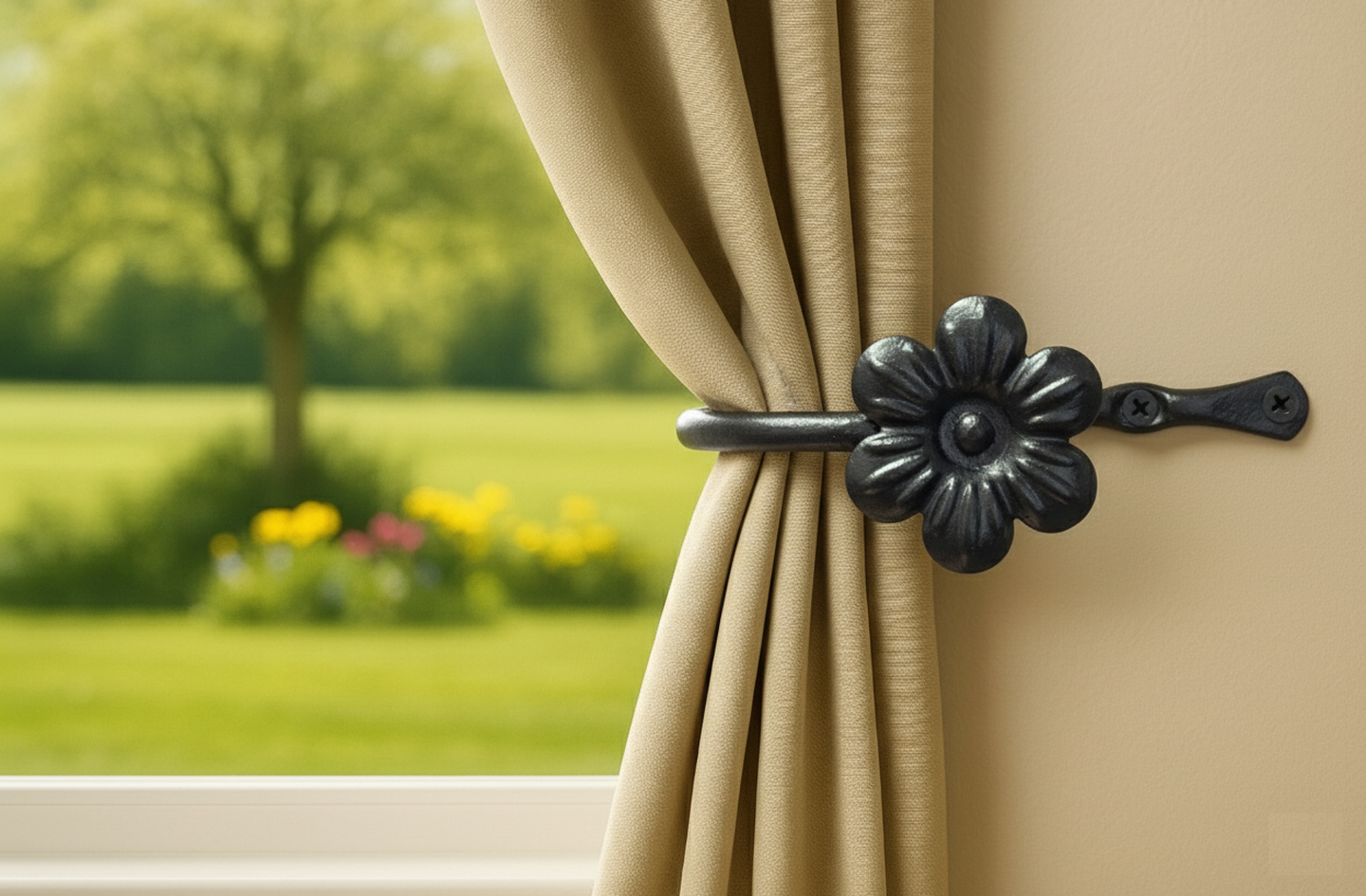
Style should follow the room: a black finish coordinates with black curtain rods, picture frames and cabinet hardware, reading as farmhouse, rustic or modern depending on the silhouette. White suits painted trim and cottage interiors. Ornament changes visibility: a plain U-shape stays quiet, but the forged petals of the Black Flower holdbacks become a decorative feature beside the glass.
Select the metal for the curtain and the finish for the room. Solid iron or steel suits anything lined, and the color should connect the hook to the existing rod and frames.
Step 4: Mark the Height and the Distance From the Frame
Curtain tie back hooks are mounted a third of the way along the curtain, never halfway: measure from the bottom of the curtain to the rod and divide by three. On a standard 84-inch curtain, that third is 28 inches1. By the end of this step, both sides of the window will carry level pencil marks at the correct height.
- Choose high or low: for fuller fabric below the hook, mark one-third down from the rod. For fuller fabric above it, mark two-thirds down, which is 56 inches from the top on an 84-inch curtain1.
- Mark the distance from the frame: for most tie backs, the anchor should sit at least 1 inch from the window frame1.
- Level the pair: mark the second side at the same height, and check both marks with a level.
- Match every window in the room: if there is more than one window, mount all the tiebacks at the same height3.
The rule scales to any length: if a drape is 100 inches long, the low tie point sits 33 inches from the bottom3. This table applies the same one-third and two-thirds rule to common ready-made panel lengths, so measurements can be set without arithmetic at the wall.
| Panel length | One-third point | Two-thirds point | Typical room |
|---|---|---|---|
| 63 inches | 21 inches | 42 inches | Bedroom or kitchen window above a sill |
| 84 inches | 28 inches | 56 inches | Standard living room window |
| 95 inches | About 31.7 inches | About 63.3 inches | Taller window or raised rod |
| 108 inches | 36 inches | 72 inches | Tall window or high ceiling |
A low tie point creates a wide, sweeping top and a formal appearance, though it blocks quite a bit of natural light3. A high tie point exposes more glass and makes the window look taller. A wide or fringed tieback usually looks best hung lower than a narrow one3. The holdback placement guide explains how height and side distance interact with curtain length and fullness.
The one-third rule is a starting mark, not a law. Hold the gathered curtain at the mark, step back, and adjust the pencil line before drilling if the drape looks pinched.
Step 5: Pick the Wall Anchor for Metal Curtain Tie Back Hooks
The wall anchor, not the hook, is where most curtain hardware fails. The safe rule is to divide an anchor’s shear load rating by 4: an anchor rated for 100 pounds will safely support 25 pounds4. By the end of this step, each hook will have a fixing matched to its wall and to the pull of the curtain.
A tieback hook rarely carries the full weight of a curtain, because the rod supports it. Instead, the hook absorbs a sideways and outward pull from the gathered fabric, plus a sharp tug whenever the curtain is tucked in or released. Over months of use, that repeated pull loosens the screw, and a loose plastic plug is the usual consequence.
“It’s best to anchor directly into wall studs for the most secure mounting of heavy objects.”
Tim Snyder, This Old House4
When no stud sits at the mark, choose the anchor by its load range. Expanding plastic sleeves suit light to medium loads, typically up to 25 pounds4. Molly bolts handle medium to heavy loads of 10 to 50 pounds in drywall and plaster4. Toggle bolts are ideal for heavy loads of 25 to 50 pounds in drywall, plaster and hollow-core concrete blocks4.
Independent testing shows the ratings are conservative: Family Handyman installed each anchor in half-inch drywall and pulled it to failure with a tension scale5. A snap toggle rated at 80 pounds held 180 pounds before the test rig ran out of travel5. A ribbed plastic anchor rated at 22 pounds held 80 pounds5.
“All the anchors we tested lived up to the claims, and all but one exceeded their weight rating.”
Jason Ingolfsland, Family Handyman5
Combining the two sources gives a planning number for each anchor. Applying the divide-by-4 rule4 to the manufacturer ratings in the Family Handyman test5 shows the safe working load each anchor offers a tieback hook.
Which Anchor Suits Which Curtain?
For sheers and light tiebacks, a ribbed plastic sleeve is adequate. For lined drapes on a daily-use holdback hook, a toggle anchor or a stud provides the margin that survives years of tugging. Brick, block and concrete require masonry bits and wall plugs, and tile requires a tile bit and a slow start to protect the glaze.
What About the Screws in the Box?
The screws and anchors packaged with a hook are selected for drywall or wood surfaces, and they are a sound starting point for light and medium curtains. For a heavy drape or a masonry or crumbly plaster wall, match the anchor to the wall and reuse the hook’s screws only if they fit.
Choose the anchor for the worst day, not the average one. A curtain yanked open by a child pulls harder than its weight suggests, and a toggle costs little more than a plug.
Step 6: Install, Level and Test the Hook
Installing a curtain tie back hook takes six short actions once the measurements and anchors are ready. By the end of this step, both hooks will be fixed, level and correctly oriented. Remove the curtains and rod first, so the panels stay clear of the drill1.
- Re-check the marks with the level and measure each one from the frame, so both sides sit evenly spaced1.
- Drill the pilot hole: for expanding plastic sleeves, drill a pilot hole slightly smaller than the sleeve diameter4. For a stud, drill a small pilot hole to stop the wood splitting.
- Set the anchor by tapping a sleeve flush with the wall, or by pushing a toggle through and letting its wings open behind the board.
- Fix the hook with its screws, turned so the hook faces away from the window1. A hook facing the glass allows the curtain to slide off.
- Repeat on the other side, then rehang the rod and curtains.
- Gather and test: sweep one panel behind the hook, or loop the tieback over it, arrange the folds1, and give the hook a firm tug.
To verify the installation, apply sideways pressure to the hook with a thumb; it should not wobble, rotate or creak. Any movement means the anchor is spinning or the screw has missed the stud, so refit it immediately rather than after a month of daily use.
The tug test is the step most people skip, yet it is the only reliable indication that the anchor will hold under everyday use.
Common Mistakes With Curtain Tie Back Hooks
The most frequent mistake with curtain tie back hooks is mounting them halfway up the curtain. Tiebacks placed in the middle of curtains are a decorating taboo, because they cut the window in half and make it look shorter3. Four other mistakes follow closely, each with a simple correction.
Trusting a Plastic Plug Under a Heavy Drape
Expanding plastic sleeves top out at light to medium loads of up to 25 pounds4, and daily tugging loosens them. The mistake comes from using whatever hardware is included in the package. The fix is a toggle or a stud for any lined or velvet curtain.
Buying a Hook Too Shallow for the Bundle
A shallow hook compresses the folds and pushes the fabric back out. Metal hook tiebacks hold less material than fabric tiebacks3, so the margin is small. The solution is to measure the gathered bundle and choose the larger size when uncertain.
Turning the Hook Toward the Window
A hook facing the glass allows the curtain to slip off whenever it is brushed. The mistake happens when the base plate is fitted without checking the hook’s direction. The fix is to turn the open side away from the window before driving the screws1.
Mounting Each Window at a Different Height
Hooks positioned by eye on each window drift up and down along a wall. The mistake comes from measuring each curtain individually. The fix is to mount all the tiebacks in a room at the same height3, measured from a level line.
Almost every hook failure traces back to the wall or the measurement, not the metal, so the fix is usually ten minutes of re-measuring rather than a new hook.
What a Well-Fitted Hook Looks Like
A well-fitted curtain tie back hook disappears into the routine of the room. The curtain sweeps behind it in one motion, the folds fall evenly, and the hook remains immovable when tugged. Both sides sit level at the one-third mark, 28 inches along a standard 84-inch panel1, and every window in the room matches.
- The gathered bundle fits the hook with a little room to spare.
- The hook faces away from the glass and stays put under a firm sideways push.
- The finish matches the rod and frames, and shows no rust spots at the screw heads.
Frequently Asked Questions
What is the difference between a curtain tie back hook and a holdback?
A tie back hook holds the ring or loop of a fabric, rope or cord tieback, so the band grips the curtain. A holdback is a rigid arm that the curtain is tucked behind. Metal hook tiebacks hold less material than fabric tiebacks3, so heavy drapes need a deep holdback or a fabric band.
How high should curtain tie back hooks be mounted?
Mount them a third of the way along the curtain. Measure from the bottom of the curtain to the rod and divide by three, which gives 28 inches on a standard 84-inch curtain1. One-third up gives a sweeping top and two-thirds up shows more glass, but never mount the hook halfway.
Can curtain tie back hooks go into drywall without a stud?
Yes, with the right anchor: divide the anchor’s rating by 4 to find its safe working load. Plastic sleeves suit light curtains, while toggle bolts handle heavy loads of 25 to 50 pounds4 and suit lined drapes that are tugged open every day. A stud is still the most secure fixing.
How far from the window frame should a tie back hook go?
For most tie backs, at least 1 inch from the frame1, and further when the curtain is full. Panels at 2 to 2.5 times the window width2 need room to stack beside the glass rather than over it. Keep both hooks the same distance from the frame.
Which way should a curtain tie back hook face?
The hook should face away from the window1. A hook whose open side faces the glass lets the curtain slide off when it is brushed or caught by a draft. Check the direction before driving the screws, because turning a fixed base plate later means drilling new holes.
Limitations and Edge Cases
- The anchor test behind the chart used half-inch drywall5. Plaster on lath, block and brick behave differently, so follow the anchor maker’s rating for those walls.
- The one-third rule assumes a curtain that hangs to the sill or the floor. Cafe curtains, swags and arched windows can need a tie point set by eye.
- Rods, brackets and finials are outside this angle, because the hooks discussed here hold a curtain open rather than holding it up.
References
Methodology: every figure in this article comes from an independent published source linked below, and each source was checked live and read for its supporting sentence on October 7, 2026. The anchor chart and the mounting height table were calculated by RTZEN from the published rules, and the article was reviewed by RTZEN co-founder Rami Abramson.
- Hunker – The Correct Way To Install Metal Tie Backs For Drapes, Amanda Bell, October 2011.
- Homes and Gardens – How to measure for curtains, Sarah Warwick, updated May 2025.
- Hunker – The Average Height for Curtain Tiebacks, Linda Erlam, May 2011.
- This Old House – How To Choose the Right Hanging Hardware, Tim Snyder, updated June 2026.
- Family Handyman – How Much Weight Can Drywall Anchors Hold, HomeLAB test by Jason Ingolfsland, updated October 2024.
- Historic New England – Curtain Hold-back, Rundlet-May House collection, 1800s, via Digital Commonwealth.
- This Old House – How To Hang Something Heavy On a Wall, Jim Gorman, updated June 2026.
Conclusion
Choosing curtain tie back hooks comes down to four checks: the holding method, the size of the gathered bundle, the wall material, and the position of the one-third mark. Get the anchor right, orient the hook away from the glass, and the hook will function every day without a second thought. Hand-forged iron with a zinc and powder-coat finish keeps that hook looking right for years, backed by a Lifetime Warranty.
For how tie back hooks fit the wider topic of curtain holdbacks, see the curtain holdbacks overview.