
An indoor plant hanger has to carry more than the plant it was bought for, because every watering adds weight. Bob Vila notes that many potted plants weigh upward of 10 to 15 pounds1. This guide sits under the plant hangers overview, which summarizes how to choose and mount plant hangers. Here the focus is narrower: choosing a solid iron hanger that lasts, judged by its load, welds, finish and fixings.
Quick Answer
How do you choose an indoor plant hanger in solid iron that lasts?
Weigh the planter after watering, then choose a solid iron bracket with clean, crack-free welds and a layered rust-resistant finish. Fix it into a stud or a rated anchor. This Old House advises anchors that can hold four times the weight of the object you hang2. Plan for the wet weight, not the dry one.
Key Takeaways
- In a trial reported by Greenhouse Grower, impatiens baskets in 18 commercial growing mixes held 51 to 77 fluid ounces of available water3. By RTZEN’s calculation, that is roughly 3.2 to 4.8 pounds between a wilting basket and a freshly watered one.
- Weld standards taught from AWS D1.1 allow no cracks and no visible porosity, and cap undercut at 1/32 inch deep5. The joint between arm and wall plate is where a hanger’s life is decided.
- The American Galvanizers Association reports that paint or powder coating over hot-dip galvanized steel can last 1.5 to 2.3 times the combined lifetimes of both systems8.
- In Family Handyman’s test in half-inch drywall, anchors claimed 22 to 90 pounds and held 80 to 180 pounds4. By RTZEN’s reading, anchor choice and wall type usually set the working limit, not the iron.
- A common misconception is that all black metal plant hangers are the same. Solid forged iron and hollow stamped metal behave very differently once a wet planter hangs from the tip.
Before You Begin: Where an Indoor Plant Hanger Wears Out
An indoor plant hanger rarely fails all at once; it wears out at five points, and each one can be inspected before purchasing. A wall-mounted plant hanger is an iron bracket whose horizontal arm holds a hanging planter away from the wall.
Gather the following before choosing or mounting a hanger:
- The planter you plan to hang: potted, planted and watered, so its real weight can be measured.
- A bathroom or kitchen scale: any scale that reads in pounds will do for a weigh-in.
- A tape measure: to measure the planter’s widest point and the space the arm needs to clear it.
- A stud finder: or a willingness to tap the wall and listen for solid framing.
- A note of the surface: drywall, plaster, brick, wood paneling or a ceiling joist.
The table sets out the five wear points and the inspection that answers each one.
| Wear point | How it fails over time | What to inspect before purchasing | Step |
|---|---|---|---|
| Arm | Droops or twists under a wet planter | Solid bar, arm length matched to the pot | Steps 1 and 2 |
| Weld | Cracks where the arm meets the wall plate | A smooth, continuous bead with no cracks or pits | Step 3 |
| Finish | Rust spots where watering drips settle | Zinc under a powder coat, no bare edges | Step 5 |
| Fixings | Screws loosen and the plate tilts | A stud, a joist or a rated anchor | Step 4 |
| Hanging point | Chain or hook slides off the tip | An upturned tip, a ring or a closed curl | Step 2 |
A plant hanger lasts only as long as its weakest point, so inspect all five before purchasing any bracket.
Step 1: Weigh the Planter Wet, Not Dry, Before Choosing
By the end of Step 1, the buyer has a real planning weight for the planter, measured after watering. Bob Vila advises potting the plant and weighing it first, keeping in mind that freshly watered soil is heavier than dry soil1. The same article notes that many potted plants weigh upward of 10 to 15 pounds1.
Wet weight is the weight of the pot, the soil, the plant and the water the soil holds after a thorough watering. It is the figure a hanger meets every few days, so it is the figure to plan around. Dry weight describes the planter only on the day it was potted.
How much weight water adds between wilting and a full watering
Greenhouse Grower reported a trial of impatiens baskets grown in 18 commercially prepared growing mixes. The available water held by those baskets ranged from 51 to 77 fluid ounces3. The authors, Bill Argo and Paul Fisher, also note that one pound is approximately 16 fluid ounces of water3.
By RTZEN’s calculation, that range works out to roughly 3.2 to 4.8 pounds gained between a wilting basket and a freshly watered one3. The plant, the pot and the soil itself come on top of that water.
A simple way to weigh a planter on a bathroom scale
Water the planter until it drains, and let it finish dripping in a sink. Step on the scale alone, then step on again holding the planter, and subtract the first reading from the second. Write the result on a tag tied to the chain, so the figure travels with the plant.
Why the pot material changes the planning weight
Bob Vila points out that hanging plant containers come in lightweight plastic as well as heavier terra cotta1. A glazed ceramic or terra cotta pot adds its own weight before any soil goes in, and it also holds water in its walls. A plastic or fiber pot keeps the planning weight lower, which leaves more margin for the bracket and the fixings.
The planning weight for an indoor plant hanger is the planter freshly watered and fully grown, never the dry pot on the day it was bought.
Step 2: Confirm Solid Iron and an Arm Length That Suits the Pot
Step 2 confirms that the bracket is solid iron and that its arm suits the planter. Solid bar stock retains its full section through the bend where the arm leaves the plate. Hollow tube or thin stamped sheet has far less metal at that same point, which is where a loaded arm begins to deform.
Hand-forged iron is iron that a smith heats and shapes by hammering, bending and twisting, rather than stamping it from sheet or bending hollow tube.
Three quick inspections that separate solid iron from hollow metal
First, weigh the empty bracket in the hand: solid iron feels heavy for its size, while a hollow arm feels light and sounds tinny when tapped. Second, look at the arm’s end: a forged curl or scroll is closed, while a tube shows a cap, a crimp or an open seam. Third, look for a visible seam along the underside of the arm, which marks a rolled or folded part.
How arm length changes the leverage on the top screw
The arm works as a lever: the farther the planter hangs from the wall, the harder it pulls the top of the wall plate outward. Doubling the arm length doubles that leverage for the same planter. A long arm suits a wide basket, but it asks more of the weld and the top fixing than a short arm does.
Choose the shortest arm that keeps the planter’s widest point clear of the wall, with room for the foliage to fill out. The bracket sizes guide explains projection and arm shape in more detail.
Why the hanging point at the tip matters as much as the arm
A chain or an S-hook needs something to sit behind at the tip of the arm. An upturned tip, a closed ring or a forged curl stops the chain from sliding outward when the plant is turned or watered. A straight, open arm lets the chain creep toward the end, which adds leverage and eventually drops the planter.
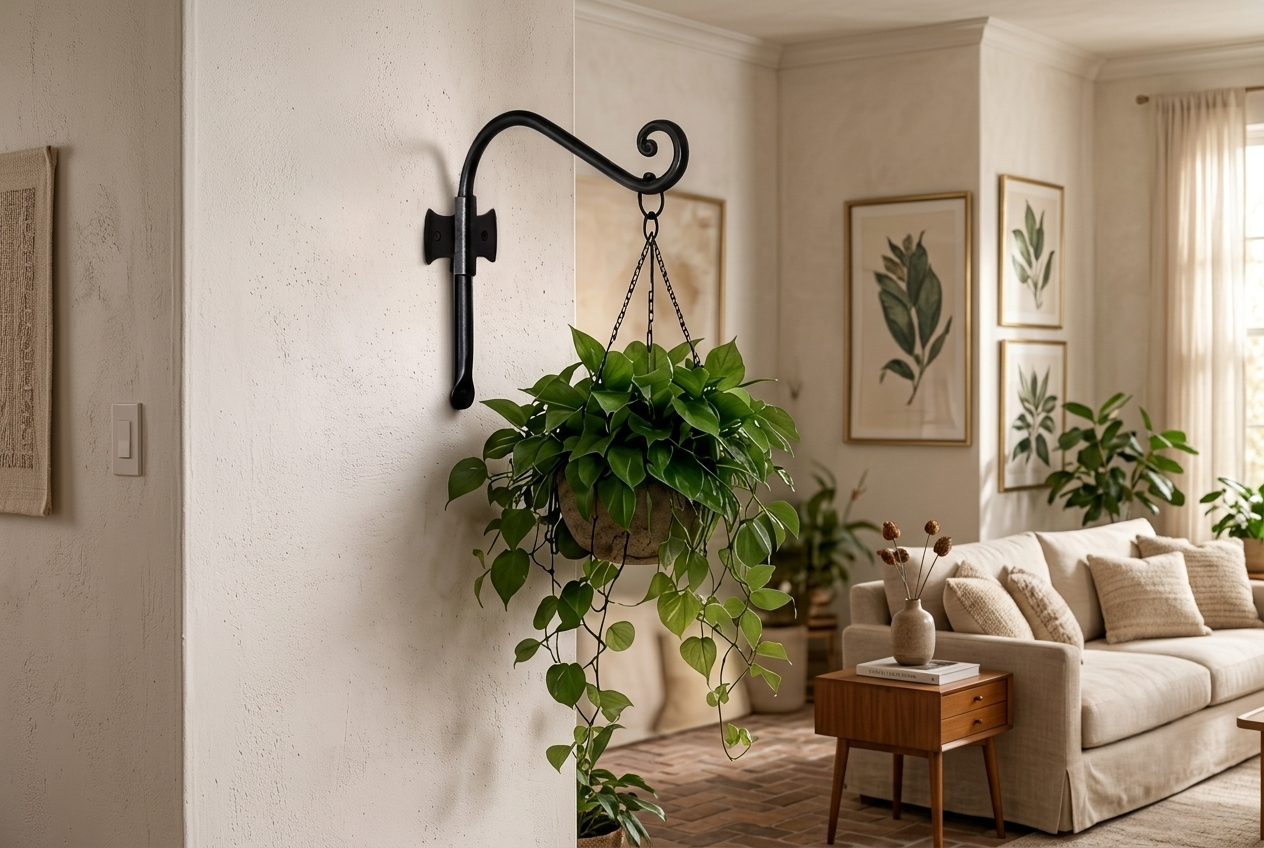
The Black Shepherd’s Hooks use a classic curled hook profile in solid wrought iron, with a zinc-plated and powder-coated finish. RTZEN lists that bracket at a weight capacity of thirty pounds, with double front welding.
Inspect the wall plate as well. A plate with two or more screw holes, set one above the other, spreads the arm’s leverage across more of the wall. A single central screw lets the bracket pivot whenever the planter is turned toward the light.
Solid iron and a sensible arm length decide whether a hanger stays level for years, so purchase the shortest solid arm that clears the planter.
Step 3: Inspect the Weld Where the Arm Meets the Wall Plate
By the end of Step 3, the buyer has inspected the joint that carries the whole planter: the weld between arm and wall plate. The Portland Community College welding department grades student welds by the visual inspection requirements of AWS D1.1. Under those criteria, the maximum number of cracks allowed is none, and visual porosity is unacceptable5.
A home buyer is not a weld inspector, and a powder coat hides much of the bead. Even so, the three faults those standards limit or reject can often be seen or felt through the finish.
Undercut: the groove that starts cracks at the edge of a weld
Undercut is a groove where the base metal melted away at the edge of a weld and too little filler metal was added to fill it. The PCC standards explain that undercut creates a stress riser, a potential starting point for weld cracking, and cap it at 1/32 inch deep5. On a finished bracket, it appears as a thin trench running along the edge of the weld.
Cracks and pinholes: the faults that a visual inspection rejects outright
The PCC standards call cracks a major concern because their ends are sharp and jagged, so added stress can spread them until the part fails completely5. On a coated bracket, look for a hairline break in the finish that follows the joint. Porosity is a cavity left by gas trapped as the weld solidifies5. On a finished bracket, it can appear as small pinholes in the bead.
“A defect is a rejectable discontinuity.”
Nick DuPont, AWS Certified Welding Inspector, in a Michigan Tech Center for Technology and Training webinar on welding discontinuities6
DuPont’s training draws a useful line for buyers: a discontinuity is not necessarily a defect6. It becomes one when its size, shape or location impairs the part’s service and is rejectable to a specification, standard or code. A small cosmetic ripple in a bead is a discontinuity. A crack at the root of a loaded arm is a defect.
Weld profile: why a smooth, full bead matters for a loaded arm
The PCC standards state that weld profile causes more weld failures than internal flaws5. They call for a smooth transition from weld metal to base metal. On a plant hanger, that means a bead that wraps the joint and leaves no gap a fingernail can catch.
Inspect both faces of the joint. RTZEN uses double front welding on load-bearing pieces.
Hold the bracket to the light, follow the bead around the joint and run a fingertip along each edge. Reject a bracket with a visible crack, a gap at the plate or a cluster of pinholes.
A weld that passes a finger-and-eye inspection at purchase is the best predictor a buyer has that the arm will still be level years later.
Step 4: Match the Fixings to the Wall or Ceiling Behind the Hanger
Step 4 ends with the hanger fixed into a stud, a joist or a rated anchor with margin to spare. This Old House reports that drywall typically supports 5 to 10 pounds with a simple nail, and calls for heavy-duty anchors and screws above 25 pounds2. A large watered basket can approach that line, and a long arm adds pull on the top fastener.
Fasten a wall bracket into a stud whenever one sits behind it
A wood stud gives the fasteners solid material to grip, which makes it the first choice for any plant hanger. This Old House notes that studs sit 16 or 24 inches on center, with older houses usually at 162. Find one with a stud finder or by knocking, then confirm it with a small pilot hole before marking the plate.
Where the best spot falls between studs, a painted backer board screwed across two studs gives the bracket a solid base.
Read drywall anchor ratings with the four-times rule in mind
This Old House gives a simple rule: anchors should be able to hold four times the weight of the object you are hanging2. Family Handyman tested seven anchors in half-inch drywall, pulling each with a turnbuckle until it buckled. Claimed ratings ran from 22 to 90 pounds, and every anchor lived up to its claim4.
By RTZEN’s calculation, dividing those claimed ratings by four gives a working load of 5.5 to 22.5 pounds per anchor42. Bob Vila notes that many potted plants weigh upward of 10 to 15 pounds1. Only anchors claimed at 60 pounds or more reach 15 pounds alone.
The comparison is per anchor, and a bracket shares its load across two or more fasteners. By RTZEN’s reading, the top screw still takes most of the arm’s outward pull, so it deserves the strongest fixing.
Ceiling hooks need a joist, a beam or a toggle bolt above them
A ceiling hook pulls straight down, out of the ceiling board, on every fixing that holds it. Bob Vila reports that plastic anchors support 10 to 25 pounds in a wall, but only approximately a third of that in a ceiling1. The same guide says a swag hook can hold around 20 pounds, and calls for a toggle bolt in hollow plaster or drywall1.
“Never attempt to use a plastic anchor to mount a screw to the ceiling.”
Tony Carrick, home improvement writer, in How to Hang Plants From the Ceiling for Bob Vila1
A ceiling hook driven straight into a joist or an exposed beam avoids the anchor question altogether. Where no joist sits in the right spot, a toggle bolt spreads the load across the back of the ceiling board. The ceiling hook installation guide covers hook choice by ceiling type in more depth.
Brick and concrete walls call for their own masonry anchors
This Old House recommends masonry anchors for concrete and brick, and toggle bolts, molly bolts or expansion anchors for drywall2.
The iron rarely sets the limit for a plant hanger; the fastener and the wall usually do.
Step 5: Choose a Finish Built for an Indoor Watering Routine
By the end of Step 5, the buyer can read a finish label and tell a layered rust defense from a single coat of paint. Indoors, rust starts where watering drips settle, at chips around the screw holes and on bare cut edges. Kitchens, bathrooms and sunny windows that see daily misting add humidity on top of the drips.
The American Galvanizers Association reports that hot-dip galvanizing generally corrodes at a rate of 1/30 of bare steel in the same environment7. By RTZEN’s reading, that is why a zinc layer under the top coat matters on any iron that meets water.
What a duplex zinc and powder coat adds to the iron
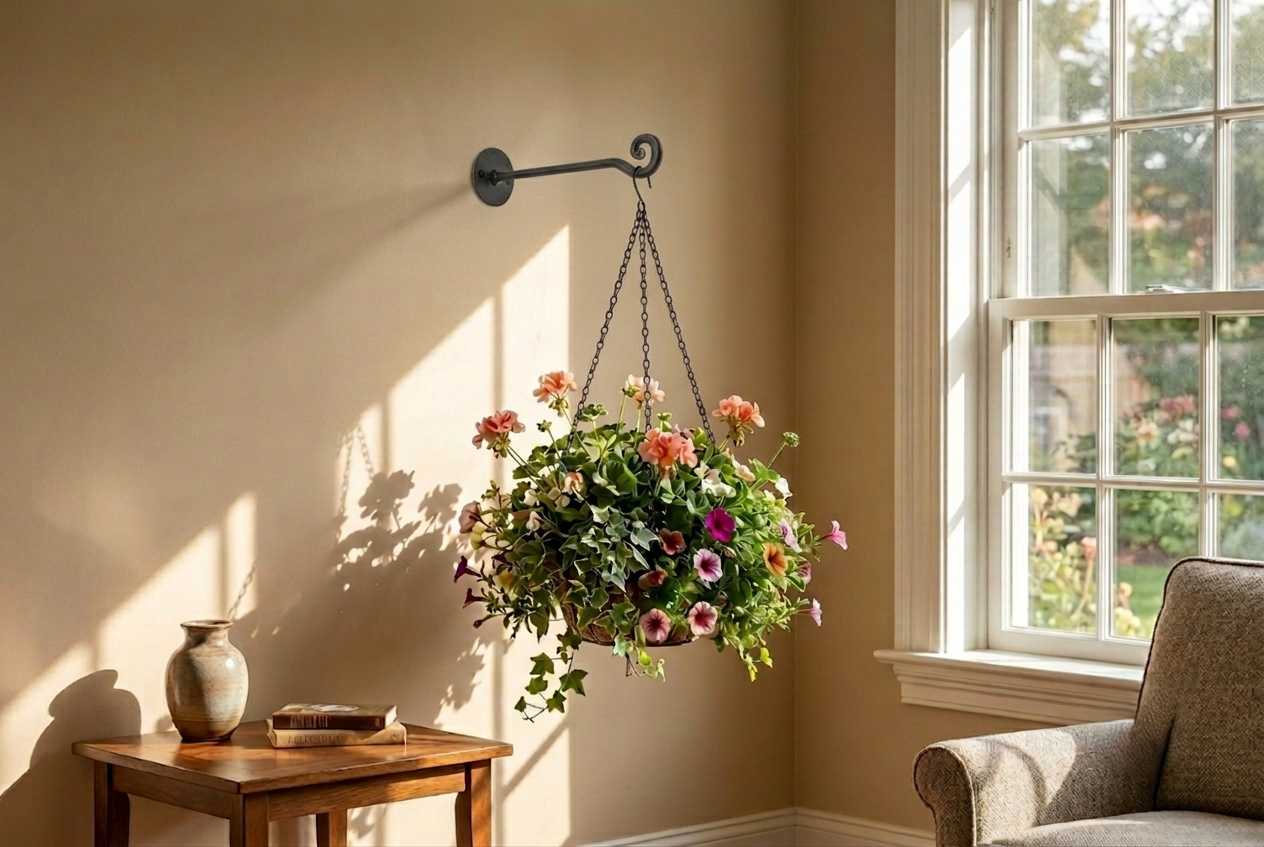
A duplex finish is a zinc coating under a paint or powder coat, so two separate systems protect the iron. The AGA reports that the pair together can last 1.5 to 2.3 times the combined lifetimes of both systems on hot-dip galvanized steel8. It also states that the zinc underneath extends the life of the paint or powder coating by at least 50%8.
Those figures describe hot-dip galvanized steel. Thinner zinc plating sits outside them, so treat the AGA figures as the reason the layering works, not a lifetime promise for every plated bracket.
Reading a finish label honestly before purchasing
“Black finish” alone usually means a single coat of paint. Look for the zinc layer named separately from the top coat, such as galvanized and powder-coated. The Black Swirl Hooks list solid iron with an anti-rust finish, while the shepherd’s hook bracket names both layers.
RTZEN’s own process runs in four steps: cut, hand-forge, zinc-galvanize, powder-coat. The zinc and the powder coat are the two layers, and the Lifetime Warranty covers material and workmanship defects under normal use.
Simple habits that keep an indoor finish sound for years
Water hanging plants over a sink or a tray where possible, so the drips do not run down the chain onto the arm. Wipe standing water off the bracket after misting. Inspect the edges of the screw holes once a season, since a chip there exposes the metal right where moisture collects.
For the appearance of a bracket rather than its protection, the ornamental finishes guide covers scrollwork, proportions and finish colors.
For a hanger that meets water every week, a zinc layer under the powder coat matters more than the color on top.
Step 6: Hang the Indoor Plant Hanger, Load It and Recheck It
Step 6 leaves the indoor plant hanger level, loaded with the watered planter and scheduled for a short recheck. The first weeks reveal most problems, because that is when a screw settles into its anchor and the plate finds its final position.
Place the hanger where the planter will not meet heads or doors
Suspend the planter over furniture, a corner or a windowsill, not over a walkway or a door swing. Measure the full drop from the arm to the bottom of the pot, so the planter clears anyone walking past.
Load the bracket gradually and watch the wall plate
Suspend the planter, then water it in place over a drip tray and watch the plate as the weight rises. A plate that stays flat against the wall is a reassuring sign. A plate that lifts at the top, or a screw head that moves, means the fixing requires a stud, a larger anchor or a shorter arm.
Match a compact arm to a small planter in a tight space
Smaller planters suit a shorter arm, which keeps the leverage low. The Black Curved Hooks come in an 8-inch size with a compact arm for smaller hanging baskets, built from solid iron with a rust-resistant coating. The same design also comes in 10-inch and 12-inch sizes.
Recheck the hanger after one month and then every season
After a month, confirm the plate is level, the fasteners are tight and the chain is seated at the tip. Each season, look at the finish around the screw holes and along the underside of the arm, where drips collect. Re-weigh the planter once a year, since growing plants and fresh soil both add weight.
For the wider selection question, from projection to room placement, the plant hanger bracket guide walks through choosing a bracket for indoor rooms.
A plant hanger that passes its first month of watering without moving has usually been chosen and fixed correctly for years of use.
Common Mistakes That Shorten a Plant Hanger’s Life
The most common mistake is choosing the hanger for the dry planter and the appearance of the scroll, then trusting the wall to cope. This Old House’s note that a simple nail in drywall typically holds only 5 to 10 pounds demonstrates how little margin a weak fixing leaves2.
- Planning for the dry weight: a planter gains weight at every watering, so weigh it wet and fully grown before choosing the bracket.
- Choosing the longest arm on offer: a long arm adds leverage on the top screw, so select the shortest arm that clears the planter.
- Ignoring the joint between arm and plate: a hairline crack or a gap at the weld is where a loaded arm gives way first.
- Using a plastic plug in the ceiling: drive the hook into a joist or a beam, or use a toggle bolt in hollow board.
Most plant hanger failures are decided at the purchase and the first drill hole, not by years of use.
What Success Looks Like After a Year of Watering
A well-chosen indoor plant hanger still sits level and tight after a year of weekly watering. The plate lies flat, the fasteners have not moved and the finish shows no rust at the screw holes. A final inspection confirms it: no gap behind the plate, no hairline break at the weld and a planter weight that still matches its tag.
Frequently Asked Questions
How much weight should an indoor plant hanger be able to hold?
Plan for the planter freshly watered and fully grown. Bob Vila notes that many potted plants weigh upward of 10 to 15 pounds1. This Old House advises anchors that hold four times the hung weight2. Use a stud or joist where possible.
Can a plant hanger go on drywall when there is no stud?
Yes, with rated anchors. In Family Handyman’s test in half-inch drywall, anchors claimed 22 to 90 pounds and held 80 to 180 pounds when pulled4. For a constant planter load, divide the claimed rating by four, and put the strongest anchor in the top hole.
Will a wrought iron plant hanger rust when used indoors?
Bare iron can rust where watering drips settle, so the finish matters. The AGA reports that hot-dip galvanizing generally corrodes at 1/30 the rate of bare steel in the same environment7. That figure describes hot-dip galvanizing, and any zinc layer under a powder coat still adds a second barrier indoors.
How can a buyer tell whether a plant hanger’s weld is good?
Look and feel along the joint between arm and plate. Weld criteria taught from AWS D1.1 allow no cracks, reject visible porosity and cap undercut at 1/32 inch deep5. A smooth, continuous bead with no gap or hairline break is the sign to look for.
Is a ceiling hook safer than a wall bracket for a heavy plant?
Only when it is fixed correctly. Bob Vila reports that plastic anchors handle only approximately a third of their wall capacity in a ceiling1. A hook in a joist or beam, or on a toggle bolt, suits a heavy planter. A wall bracket fixed into a stud works equally well.
Limitations and Edge Cases
- The water figures come from one trial of impatiens baskets in commercial growing mixes, grown outdoors in summer3. Larger pots, garden soil and other plants hold different amounts, so weigh the actual planter.
- The anchor figures come from one Family Handyman test in half-inch drywall with a slow, steady pull4. Ceilings, old plaster and damaged board can hold less.
- The AGA corrosion figures describe hot-dip galvanized steel; thinner zinc plating falls outside them. Of the hangers named here, only the shepherd’s hook bracket lists a weight capacity, so no load figure is claimed for the others.
References
Methodology: every sourced figure comes from an independent published source and links to the page that carries it. Figures derived from those sources are labeled as RTZEN’s, and co-founder Rami Abramson reviewed the article.
- Bob Vila – How to Hang Plants From the Ceiling, Tony Carrick, updated September 9, 2021.
- This Old House – How To Hang Something Heavy On a Wall, Jim Gorman, updated June 7, 2026.
- Greenhouse Grower – Producing Consumer-Friendly Baskets, Bill Argo and Paul Fisher (University of Florida), June 13, 2008.
- Family Handyman – How Much Weight Can Drywall Anchors Hold In Your Home?, Jason Ingolfsland, updated October 28, 2024.
- Portland Community College – Weld Quality Standards, PCC Welding Department, visual inspection criteria based on AWS D1.1.
- Michigan Tech Center for Technology and Training – Introduction to Welding Discontinuities and Defects, Nick DuPont, AWS Certified Welding Inspector.
- American Galvanizers Association – How Long Does Hot-Dip Galvanizing Last?, updated October 2019.
- American Galvanizers Association – Duplex Systems: Paint or Powder Coating Over HDG, updated October 2, 2025.
Conclusion
An indoor plant hanger lasts when the whole system is chosen for the wet planter. That means a solid iron arm of sensible length, a clean weld and a zinc layer under the powder coat. It also means a fixing into a stud, joist or rated anchor. A hand-forged wall bracket made that way holds a plant for years, backed by a Lifetime Warranty.
For the wider context of choosing and mounting hangers, see the plant hangers overview.