
Scrollwork pattern, arm length, and finish each shape how an ornamental plant hanger looks and how long it holds up. The global indoor plants market is projected to reach $13.61 billion in 20261, and plant display hardware is part of that growth. For context on the broader category, see the plant hangers overview. This guide covers the five design factors that separate a lasting, visually intentional bracket from one that bends, rusts, or looks out of place: scrollwork, forged details, proportions, load capacity, and protective finish.
Quick Answer
What factors most affect the style, strength, and finish of an ornamental plant hanger?
Scrollwork pattern and forged surface texture determine decorative character. Arm length and bar thickness control visual proportion and wall clearance. Load capacity, typically 25-45 lbs for quality hand-forged wrought iron brackets, must exceed the weight of a fully loaded planter. Protective finish determines rust resistance: the American Galvanizers Association reports that hot-dip galvanizing corrodes at 1/30 the rate of bare steel2, and a powder coat layer on top adds a second, physically bonded barrier.
Key Takeaways
- Hand-forged scrollwork produces surface variations in thickness that catch light differently than machine-stamped iron, making a genuine decorative difference at normal viewing distance.
- Arm length governs wall clearance: a 7.5-inch arm suits small to medium planters; a 10-12 inch arm provides clearance for larger baskets in full seasonal growth.
- A loaded 14-inch hanging basket can reach 12-15 lbs when fully watered; the bracket’s rated capacity should comfortably exceed that with a meaningful safety margin.
- Zinc galvanizing corrodes at 1/30 the rate of bare steel2; powder coating on top adds a second independent barrier against moisture and physical wear.
- Dual-layer protection (zinc plus powder coat) is the standard in quality hand-forged plant hangers and underpins RTZEN’s catalog-wide Lifetime Warranty.
What Makes an Ornamental Plant Hanger Decorative?
The decorative quality of an ornamental plant hanger comes from two physical characteristics: the shape of the scrollwork along the arm, and the surface texture produced by hand forging. A bracket with well-formed C-scrolls or S-scrolls reads as intentionally designed. A bracket with flat, uniform surfaces reads as purely utilitarian. The difference is most visible from three to six feet, which is exactly the viewing distance for a wall-mounted planter in an entry, balcony, garden, or living space. Neither scrollwork nor surface texture affects structural performance; they are purely visual signals of craftsmanship and material quality.
Scrollwork Patterns: C-Scrolls, S-Scrolls, and Vine Motifs
Scrollwork in decorative ironwork refers to curved elements shaped to suggest an unrolling scroll, a wave, or a vine. In plant hangers, the scroll typically appears as a decorative curl on the support arm or at the junction where the arm meets the wall plate. A C-scroll curves in one continuous direction; an S-scroll reverses mid-curve, creating a more fluid and symmetrical form. Vine motifs extend this principle with branching or leaf-shaped additions that reinforce the visual connection between the bracket and what it is holding, making the hardware feel like a natural extension of the planting.
The quality of a scroll depends on more than its outline shape. According to Palmetto Iron and Forge, a blacksmithing studio, hand-forged scrollwork exhibits “subtle variations in thickness that catch light beautifully,”4 creating a visual depth that machine-rolled or stamped equivalents cannot replicate. When iron is shaped under a hammer at forging temperature, the cross-section changes slightly throughout the length of the curve. These variations are not defects: they are the visual evidence of the hand-forging process, and they make a scroll read as three-dimensional rather than flat. A stamped bracket can reproduce the outline of a scroll but not its surface movement.
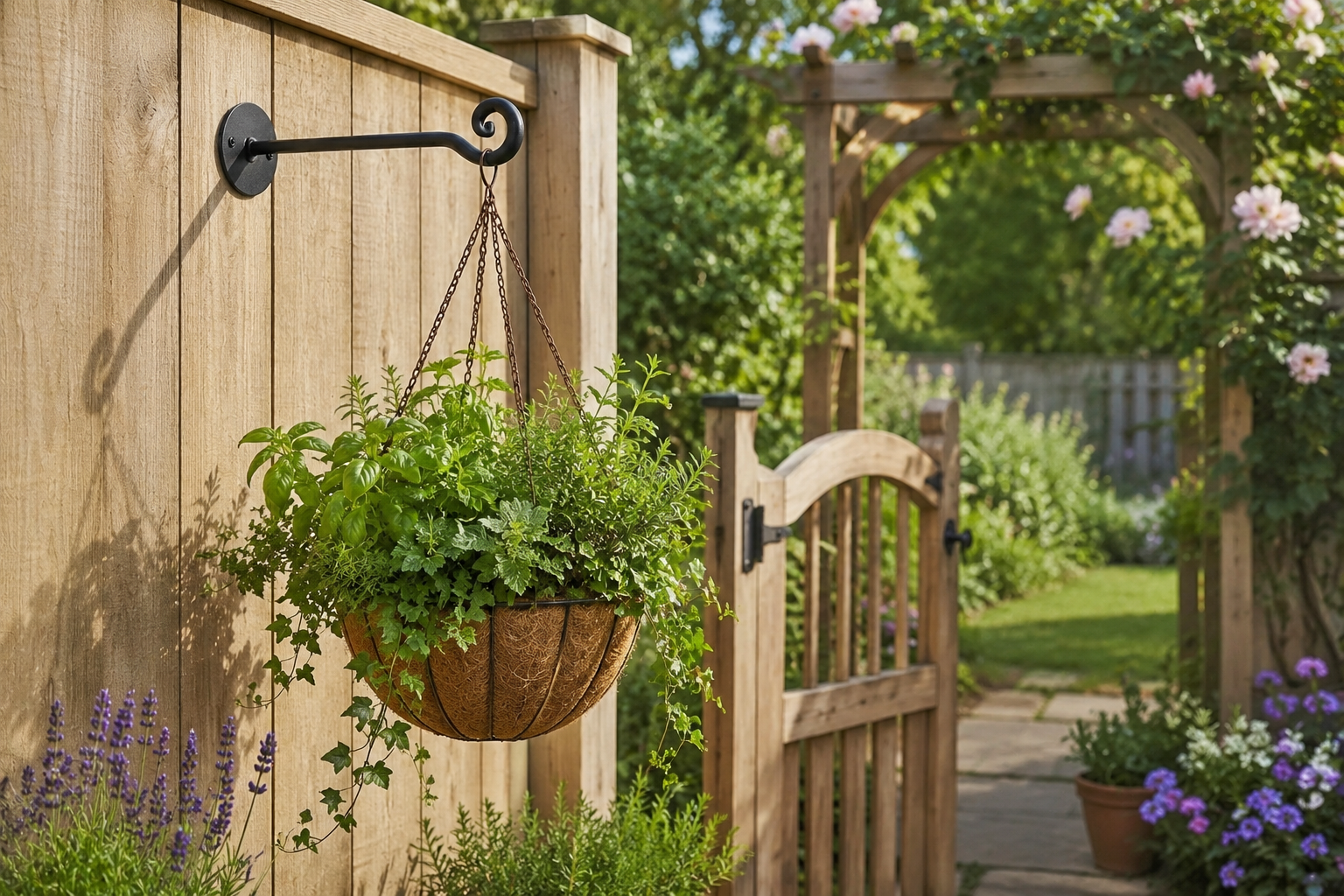
RTZEN’s Swirl Hooks carry decorative scrollwork along the main support arm, positioning the design element at the widest visible part of the bracket for maximum effect from normal indoor and outdoor viewing distances.
Forged Texture vs. Stamped Uniformity
Hand forging changes the iron surface in a way that stamping does not. When a blacksmith heats iron and shapes it under a hammer, the outer surface develops subtle hammer facets, directional grain, and micro-variations in section thickness. These surface characteristics are evidence of the process, and they contribute directly to how the piece looks in different lighting conditions. A hand-forged arm reflects light unevenly, producing shadows and highlights across the surface. This gives the bracket visual weight and presence even at a distance.
Stamped brackets are cut from flat sheet stock and bent into shape. The sheet’s original surface remains uniform throughout, meaning the finished bracket looks the same from every angle, with no variation in light reflection or shadow depth. Stamped hardware can carry a scroll shape, but the scroll appears as an outline rather than a three-dimensional form. The distinction matters because ornamental plant hangers are display objects as much as functional hardware: mounted on a wall, they are seen daily by residents and guests. A forged bracket earns its place visually; a stamped imitation occupies the same wall space without earning it.
RTZEN’s process runs four steps: cut, hand-forge, zinc-galvanize, and powder-coat. The hand-forging step is what produces the surface character that distinguishes genuine ornamental ironwork. Hollow stamped metal, regardless of what its finish imitates, cannot replicate the density, surface variation, or resistance to bending that solid forged iron provides under daily use.
How Proportions Shape an Ornamental Plant Hanger
Proportions determine whether a plant hanger looks right on the wall and physically suits the planter it holds. Three measurements interact: arm length (horizontal projection from the wall), overall mounting height, and bar thickness (the cross-section of the iron). When these three are balanced relative to each other and to the planter size, the bracket looks intentional. When they are mismatched, the bracket either overpowers the planter or looks undersized and inadequate for the load it carries.
Arm Length and Wall Clearance
Arm length sets the horizontal distance between the wall surface and the point where the planter hangs. A 7.5-inch arm is the standard for small to medium planters, providing enough clearance for a 10-12 inch diameter basket while keeping the bracket visually proportioned to a standard wall or post surface. A 10-inch or 12-inch arm is appropriate for larger baskets or situations where the planter needs clearance from a wall feature such as window trim, siding joints, or columns.
Arm length also determines how prominently the bracket’s decorative elements appear in silhouette. A longer arm gives a C-scroll or S-scroll room to develop its full curve without being visually compressed against the wall surface. A very short arm forces the scroll into a tight space where its form cannot read clearly from a normal viewing distance. This is part of why longer decorative brackets tend to carry more elaborate scrollwork: the arm length physically supports the design rather than crowding it. The negative space between the scroll and the wall is as much a part of the visual design as the scroll itself.
For outdoor use on porch posts, wooden fences, or masonry walls, RTZEN’s 12-inch curved brackets provide the reach needed for larger hanging baskets while maintaining a stable and secure mount against a flat vertical surface.
Bar Thickness and Visual Weight
Bar thickness refers to the cross-section of the iron rod or bar used for the arm. A thicker bar carries more load and looks heavier and more architecturally substantial on the wall. A finer bar looks more delicate and suits ornamental or cottage-style settings where lightness is desirable. The visual balance between bar thickness and scroll diameter matters as much as either measurement in isolation.
Palmetto Iron and Forge, speaking from direct craft practice, notes that “a scroll’s diameter should relate to the bar thickness in specific ratios”4 and that when this relationship is off, the piece looks wrong even to a viewer who cannot identify exactly why. Scrolls executed in thick-section iron read as bold and architectural. Scrolls in finer iron read as light and ornamental. Neither is wrong; each suits different architectural contexts. What creates a visual problem is mismatching the two: a large-diameter scroll on very fine-section iron looks oversized and top-heavy, while a tiny scroll on thick stock looks cramped and afterthought.
In standard bracket designs, the hook-end of the arm and the mounting flange are the thickest sections, providing strength where the load transfers to the wall. The decorative middle section can be somewhat lighter, which is what allows scroll forms to develop without making the bracket look overbuilt.
“Scrolls that are too tight look cramped. Spacing that’s slightly off creates visual tension.”
Palmetto Iron and Forge, blacksmithing studio4
What Load Capacity Does an Ornamental Plant Hanger Need?
Load capacity is the maximum safe working load the bracket can carry without deforming or failing. For ornamental plant hangers, this means the combined weight of the planter container, growing medium, plant, and water after a watering or rain event. That total weight can surprise buyers who assume a bracket rated for 30 lbs is more than sufficient, until they weigh a large 14-inch basket after a heavy rain and find it pressing the bracket’s realistic limit.
A 14-inch hanging basket loaded with moist potting soil, an established plant, and a water reservoir can reach 12-15 lbs. Larger baskets, 16-18 inches in diameter with dense soil mixes and established root systems, can run 25-35 lbs when saturated. For safety and to account for dynamic loads from wind, the bracket’s rated capacity should meaningfully exceed the loaded basket weight rather than match it. A bracket rated for 30 lbs provides adequate margin for a 12-15 lb basket; for a 25+ lb basket, a bracket rated 40-50 lbs is the appropriate range. For more detail on how different hook and bracket types compare on weight limits, see the guide on hanging plant hook types and weight limits.
| Planter Diameter | Estimated Loaded Weight | Recommended Bracket Capacity | Suitable Arm Length |
|---|---|---|---|
| 8-10 inches | 6-10 lbs | 20+ lbs | 7.5 inches |
| 12-14 inches | 10-18 lbs | 30+ lbs | 7.5-10 inches |
| 16-18 inches | 20-35 lbs | 40-50+ lbs | 10-12 inches |
| Lantern or bird feeder | 5-15 lbs | 25+ lbs | 7.5-10 inches |
Hand-forged wrought iron brackets carry load more reliably than hollow stamped alternatives because the iron is solid throughout the section. Stamped hardware has a wall thickness rather than a solid cross-section, which means the arm can flex and eventually deform under sustained load in a way that solid forged iron does not. Double front welding at the arm-to-wall-plate junction, which RTZEN applies as standard, is the point most likely to fail under overload: a welded joint made with proper technique and material is significantly stronger than one that is crimped, pressed, or secured only with a backing plate.
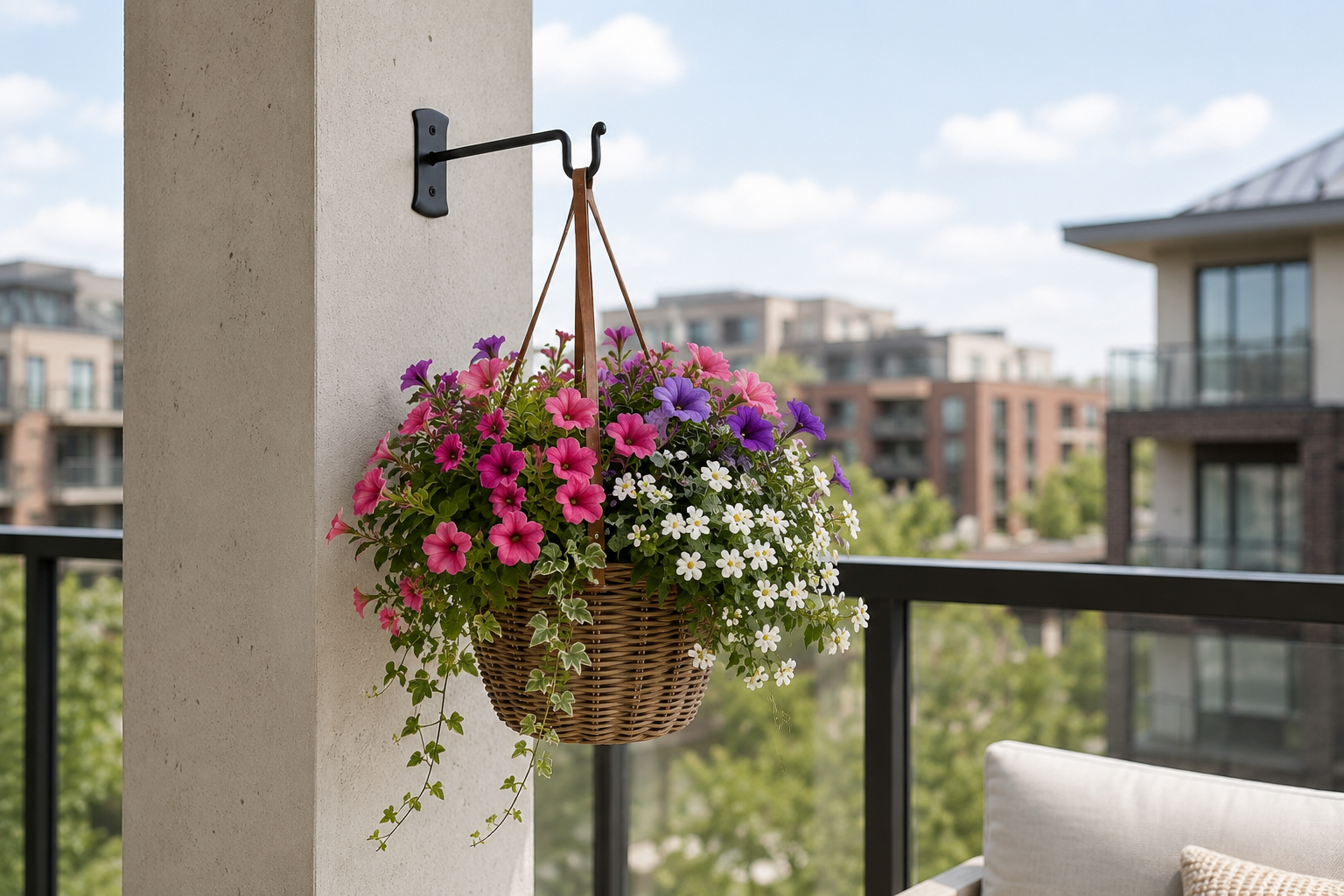
RTZEN’s Shepherd’s Hooks are rated at 30 lbs and carry the same Lifetime Warranty as the rest of the catalog, backed by zero customer rejections on quality and durability after years of sales. The 7.5-inch arm suits most 10-14 inch planters. Buyers who need additional reach for larger installations should step up to the 10-inch or 12-inch arm options.
How to Read a Protective Finish for Iron Plant Hangers
The protective finish on a wrought iron plant hanger determines how long it resists rust in outdoor and high-humidity conditions. This matters for ornamental plant hangers in particular because they live in the environments most likely to accelerate corrosion: outdoor walls, covered porches, balconies with morning dew, and indoor spaces near sinks and humid kitchens. A single-layer paint finish delays rust; a dual-layer system stops it for a measurably longer period.
The most durable approach combines two independent protective mechanisms: a zinc galvanizing layer applied directly to the iron, and a powder coat layer applied on top. Each layer protects through a different principle, which is why their combined effect exceeds what either provides alone.
Zinc Galvanizing: The Sacrificial Layer
Zinc galvanizing applies a coating of zinc to the iron surface before any top coat is added. Zinc protects iron through two mechanisms. First, it forms a physical barrier that prevents moisture and oxygen from reaching the iron beneath it. Second, and more importantly, zinc is electrochemically sacrificial: in the presence of moisture, zinc corrodes preferentially, protecting the underlying iron even when the zinc surface is scratched or damaged.
The American Galvanizers Association, an industry standards body, reports that hot-dip galvanized steel “corrodes at a rate of 1/30 of bare steel in the same environment”2 and that hot-dip galvanized structural steel “provides 72-73 years of life to first maintenance even in the most corrosive atmosphere, industrial.”2 These figures apply to structural steel, not decorative hardware specifically, but they establish the fundamental durability characteristic of zinc as a protective system.
“The corrosion resistance of hot-dip galvanizing varies according to its surrounding environments, but generally corrodes at a rate of 1/30 of bare steel in the same environment.”
American Galvanizers Association, industry technical standards body2
For ornamental plant hangers used outdoors or in high-humidity spaces, the zinc layer does the sustained protective work over years of exposure. Without it, a powder coat alone eventually chips or develops micro-cracks, at which point moisture reaches the iron directly and rust begins immediately.
Powder Coating: The Physical Barrier
Powder coating applies dry powder to the zinc-galvanized surface electrostatically, then cures it in an oven, creating a continuous polymer film bonded to the metal. As Keystone Koating, a professional coating manufacturer, states: “Powder coating is more durable than paint because of its ingredients, bonding and curing processes. It uses electrostatic energy to bond to surfaces in a thick layer, making it more resistant to rusting, scratching, peeling and chipping.”3
The curing process is what distinguishes powder coat from liquid paint in durability. A liquid paint dries by solvent evaporation and remains somewhat flexible and porous. A cured powder coat forms a cross-linked polymer network that is chemically resistant, harder, and more tightly bonded to the substrate. For plant hangers that see regular watering, seasonal rain, and physical contact from vegetation, this difference in surface hardness matters over the product’s lifetime.
RTZEN applies powder coat on top of the zinc layer, not directly to bare iron. This means the powder coat never contacts bare iron and the zinc never faces the environment directly. The two layers reinforce each other: the zinc sacrifices if the powder coat is compromised, and the powder coat prevents the zinc from facing direct exposure for as long as it remains intact.
Choosing by Style, Strength, and Finish
Style, strength, and finish are not independent variables. They interact in ways that make some combinations more successful than others, and understanding those interactions makes the selection decision straightforward.
For a primarily decorative indoor bracket with a small to medium planter, the most important factor is scrollwork quality and bar proportion. The bracket will live in a dry or mildly humid indoor environment where the finish faces minimal corrosion risk, so any quality dual-layer finish will perform. The visual factors (scroll form, forged texture, arm length relative to planter diameter) determine whether the bracket earns its place on the wall or simply holds a pot. Choose scroll size and arm length in proportion to the planter: a small succulent in a 6-inch pot reads best on a bracket with a 7.5-inch arm and a fine-section scroll; a large fern in a 14-inch basket needs a 10-12 inch arm and a bolder scroll that reads at normal room distance.
For an outdoor bracket on a porch, fence, or garden wall, protective finish becomes the primary selection factor because outdoor exposure is where finish failures compound over time. Brackets with a dual-layer zinc plus powder coat finish cost more than single-coat alternatives, but a bracket that rusts through in two seasons and leaves a rust stain on a white wall costs more in total than one that holds up for a decade. A 30 lb rated bracket with proper dual-layer finish is a better investment than a 50 lb rated bracket with a single paint coat, all else being equal.
For heavy or mixed-use hanging, where the bracket might hold a lantern in winter and a large planter in summer, load capacity becomes the governing factor. Choose the capacity first, then select scroll and arm length based on that capacity tier. A bracket rated for 45 lbs in a 12-inch arm configuration can accommodate large baskets, wind chimes, and hanging lanterns equally; the scroll design on that arm is secondary to its structural rating.
The clearest selection framework: start with the planter size to determine arm length and capacity requirements, then select the scroll complexity and bar thickness that suits the room or garden aesthetic, and confirm that the finish system includes both zinc and powder coat before purchasing. A bracket that meets all three criteria at once will look intentional, hold reliably, and remain rust-free for years without maintenance. For help selecting by indoor mounting criteria specifically, see the guide on indoor plant hanger bracket selection.
RTZEN’s catalog covers this selection range with brackets differing in arm length (7.5 to 12 inches), scroll design (swirl, butterfly/curved, and shepherd’s hook profiles), and finish (black and white powder coat over zinc). All carry the same four-step process and Lifetime Warranty regardless of scroll design or arm length, which means the style decision is genuinely free of durability trade-offs across the line.
Frequently Asked Questions
What is the difference between a decorative and a plain ornamental plant hanger?
A decorative ornamental plant hanger incorporates scrollwork, vine motifs, or forged texture along the support arm, making the bracket a visible design element rather than a neutral support. A plain bracket uses a straight arm with no decorative elements. Both can be hand-forged; the difference is whether the bracket is meant to contribute to the room’s look or simply do its functional job unseen. In open-wall settings where the bracket is visible, decorative scrollwork adds a design layer without affecting structural performance.
How much weight can a wrought iron plant hanger hold?
Quality hand-forged wrought iron plant hangers are typically rated from 25 to 45 lbs, depending on arm length, bar thickness, and welding method. RTZEN’s Shepherd’s Hooks carry a 30 lb rating for a 7.5-inch arm. A loaded 14-inch basket can reach 12-15 lbs when fully watered, well within that range. For larger 16-18 inch planters or seasonal plantings with dense root systems, a 40-50 lb rated bracket provides safer working margin against wind load and saturated soil weight.
Does powder coat prevent rust on outdoor plant hangers?
Powder coat reduces rust by creating a thick, physically bonded barrier that excludes moisture from the iron surface3. On its own, however, powder coat is not rust-proof: if the surface chips or cracks, moisture reaches bare iron and rust begins. Powder coat applied over zinc galvanizing provides significantly better long-term protection because the zinc layer continues to protect the iron sacrificially even after the powder coat is compromised. Quality outdoor plant hangers use both layers, not powder coat alone.
What arm length should I choose for a 12-inch hanging basket?
A 7.5-inch arm provides enough wall clearance for a 12-inch basket in most mounting situations, keeping the planter’s outer edge roughly 3-4 inches clear of the wall. For a 12-inch basket that will grow substantially in diameter through the season, a 10-inch arm gives more comfortable clearance and allows the plant to drape without pressing against the wall surface. If the bracket mounts on a textured surface like brick or siding with projecting boards, move up to the 10-inch or 12-inch arm to clear the surface variation.
Does scrollwork affect the load capacity of a plant hanger?
No. Scrollwork is a design element applied to the arm and does not affect load capacity in a properly designed bracket. The load capacity is determined by the iron bar’s cross-section at its thinnest point, the welding method at the arm-to-wall-plate junction, and the mounting hardware used in the wall. A bracket with an elaborate swirl scroll and one with a plain arm, made from the same section of iron with the same weld, carry equivalent loads. Decorative elements and structural capacity are independent of each other in quality ironwork.
Limitations and Edge Cases
- Load capacity figures in this guide apply to standard wall-mounted configurations with properly anchored screws in structural material (wood stud, masonry anchor, or equivalent). Mounting into drywall only without a stud or anchor reduces effective capacity significantly regardless of the bracket’s nominal rating.
- The zinc galvanizing lifespan data from the American Galvanizers Association2 applies to industrial-grade hot-dip galvanizing on structural steel. Decorative hardware may use thinner zinc coatings, which reduces the comparable service life; confirm coating thickness with the manufacturer when this distinction matters.
- Scroll proportion guidance applies to standard C-scroll and S-scroll designs. Vine motifs and figurative ironwork elements (leaves, animal forms) follow different proportion conventions and are covered in the broader plant hanger selection context.
References
- Mordor Intelligence – Indoor Plant Market Size and Share Outlook, 2026 report, market size projections for 2025-2026.
- American Galvanizers Association – Why Hot-Dip Galvanizing: Longevity, technical data on corrosion rates and service life, retrieved July 2026.
- Keystone Koating – Powder Coating vs. Painting: Which is Better?, industry technical comparison, retrieved July 2026.
- Palmetto Iron and Forge – The Craftsmanship Behind Ornamental Ironwork, blacksmithing practitioner guide on scrollwork proportions and forged texture, retrieved July 2026.
Conclusion
An ornamental plant hanger’s decorative value comes from scrollwork quality and forged surface texture. Its functional reliability comes from arm length matched to planter size, load capacity matched to filled basket weight, and a dual-layer protective finish (zinc plus powder coat) that resists rust through years of outdoor or high-humidity exposure. These three dimensions operate independently but reinforce each other: a bracket with excellent scrollwork and inadequate finish will rust; a bracket with excellent finish and wrong arm length will look out of proportion; a bracket that gets all three right earns its place permanently.
For the broader context on how plant hangers compare as a category, see the plant hangers overview for selection and mounting guidance.