
By 2020, 37.6 million U.S. households were growing indoor plants1, and nearly every one of them eventually faces the same question: which bracket do you trust with a pot full of wet soil? A plant hanger bracket indoor is the piece the whole display depends on, yet most buyers pick by looks alone and overlook load rating, arm clearance, and wall type. This guide covers each factor in order. For a broader overview of mounting styles and materials, see the plant hangers guide first, then return here to apply what fits your room.
Quick Answer
How do you choose the right indoor plant hanger bracket?
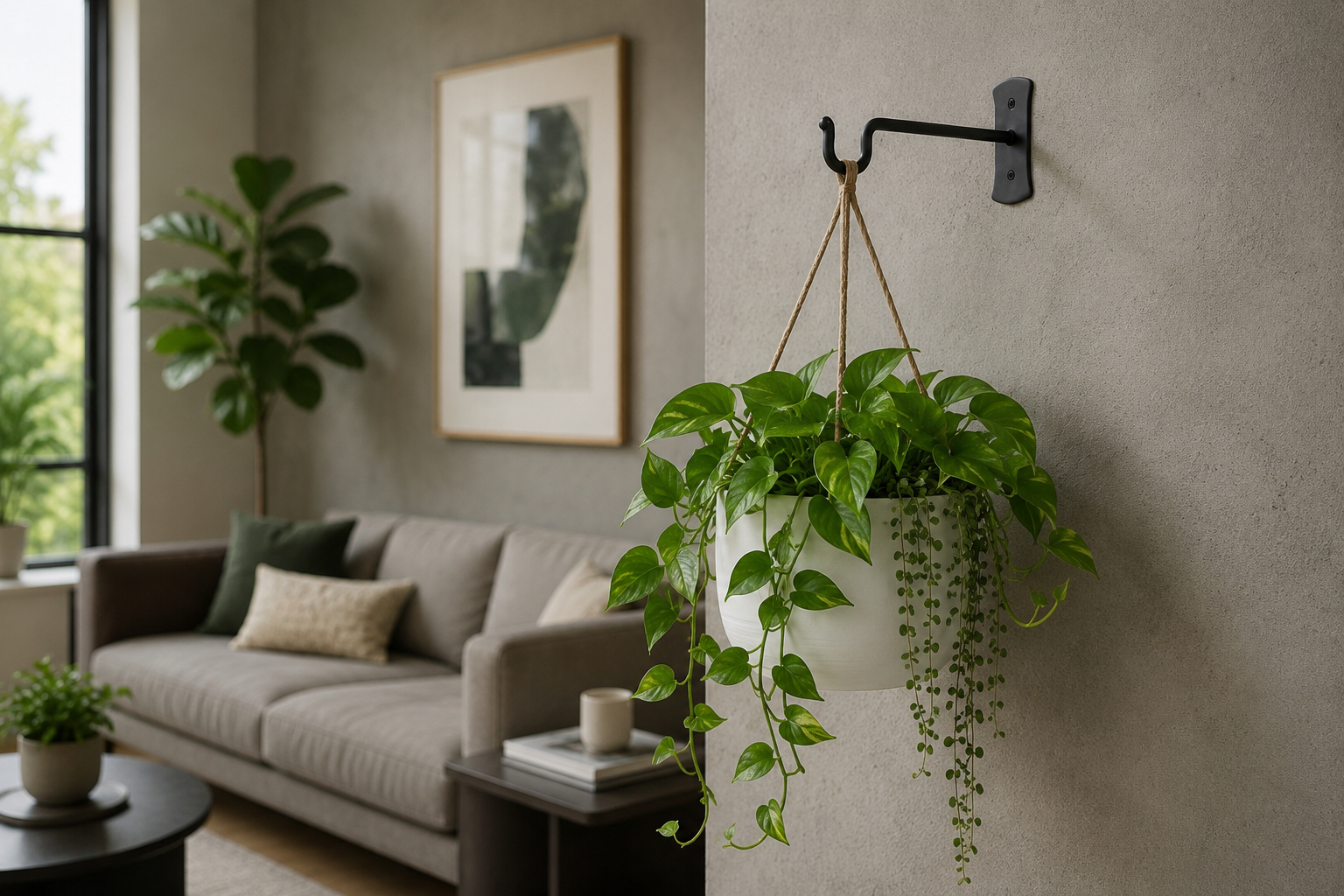
Start with load capacity: choose a bracket rated for at least twice your planter’s filled weight. A 10-inch pot with moist potting mix typically weighs 8-14 lbs4, so a bracket carrying 30 lbs gives comfortable margin. Then match arm length to pot diameter, confirm your wall type supports the fastener, pick a finish suited to the room’s humidity, and verify that mounting hardware is included before you buy.
Key Takeaways
- A filled 10-inch indoor hanging planter can weigh 8-14 lbs; always choose a bracket rated for at least twice that load.
- Arm length should extend at least 1 inch beyond the pot’s rim radius so the pot hangs freely without scraping the wall.
- About 90% of U.S. residential walls are drywall5; a stud mount or heavy-duty toggle bolt is required for any bracket holding more than 10 lbs.
- Hand-forged iron with dual-layer zinc and powder coating resists the humidity that indoor plant watering creates; single-layer painted finishes do not.
- Always confirm the bracket ships with mounting screws and anchors. A good bracket with wrong-sized hardware fails the wall, not the iron.
What to Measure Before You Choose
Before comparing brackets, gather three numbers from your space. They take less than five minutes to collect and they eliminate most of the guesswork.
Planter diameter. Measure across the widest point of your pot in inches. Most indoor hanging baskets fall between 8 and 14 inches in diameter2, and that number drives your arm-length decision in Step 2.
Wall surface type. Tap the wall where you plan to mount. A hollow thud means drywall. A solid thunk means plaster, brick, or masonry. The surface type controls which fastener keeps the bracket safe, covered in Step 3.
Approximate planter weight when full. You can weigh your pot empty on a bathroom scale, then estimate the soil weight using the chart in Step 1. Or simply note the pot’s diameter and use that chart directly. The result tells you the minimum bracket load rating you need.
Tools you’ll need:
- Measuring tape (for pot diameter and arm length)
- Bathroom scale, optional (to weigh pot + plant before mounting)
- Stud finder (for drywall mounting)
- Drill with appropriate bit
- Level
Estimated time to complete the selection process: 10-20 minutes of measuring, plus the installation itself.
Step 1: Check Load Capacity for Your Planter’s Weight
Load capacity is the most critical number on a bracket’s spec sheet. Match the bracket’s weight rating to at least twice your planter’s filled weight4 – that margin absorbs the dynamic load of the pot swaying when a window is opened and the added weight of waterlogged soil.
A filled indoor hanging planter’s weight comes from the pot, the potting mix, the plant, and retained water. Eight quarts of moist potting mix weigh 7-10 lbs; the same volume fully saturated can reach 11-15 lbs4. A 10-inch pot holds roughly six quarts, so the soil alone adds 5-7 lbs moist. Add the pot and plant and total weight ranges from 8-14 lbs moist to 14-20 lbs fully waterlogged.
The chart below synthesizes soil weight data with common pot volumes to show estimated filled weights across the four most common indoor hanging planter sizes. Every pot size stays well below the 30 lb working load of a heavy-duty hand-forged bracket, but the gap narrows fast for 12-inch ceramic pots that are regularly watered to saturation.
What load rating to look for. For a 10-inch planter at 11 lbs average filled weight4, a bracket rated 20 lbs would technically pass, but 30 lbs provides the 2.7x safety factor that absorbs watering surge and dynamic sway without concern. RTZEN brackets are hand-forged from solid wrought iron with double front welding, which is what holds load at the joint, not just along the bar. Stamped metal hooks crimp at the mounting point under sustained weight; solid forged iron does not.
If you can’t find a stated load rating on a bracket’s listing, skip it. A bracket that won’t publish its capacity is one whose manufacturer doesn’t test it.
Step 2: Match Arm Length to Your Planter’s Diameter
Arm length determines whether your pot hangs freely or scrapes against the wall. The rule is simple: the arm should extend at least 1 inch beyond the pot’s rim radius (half the pot diameter) when measured from the wall. For a 10-inch planter, the radius is 5 inches, so the arm needs at least 6 inches of clearance from the wall face to the hook tip.
In practice, most indoor hanging planters fall between 8 and 14 inches in diameter2. Iowa State University Extension recommends that hanging baskets of 12-14 inches can support 3-5 plants, while smaller 8-inch baskets suit compact trailing varieties3. The arm length you need scales directly with that diameter.
| Pot Diameter | Minimum Arm Length | Est. Filled Weight (moist) | Bracket to Consider |
|---|---|---|---|
| 6 in. | 4-5 in. | 3-6 lbs | Standard single-arm bracket |
| 8 in. | 5-7 in. | 5-9 lbs | Standard heavy-duty, 7-8 in. arm |
| 10 in. | 6-8 in. | 8-14 lbs | Heavy-duty, 7.5-8 in. arm, double-welded |
| 12 in. | 7-9 in. | 12-20 lbs | Extended arm, 10-12 in., double-welded |
| 14 in. | 8-10 in. | 16-25 lbs | 12 in. arm, stud mount, heavy-duty |
Choosing by arm length for standard planters (8-10 inches). A 7.5-inch arm works for most 8-10 inch indoor pots. The RTZEN Shepherd’s Hooks 7.5-inch bracket is the workshop’s best-selling indoor bracket, with over 1,700 Amazon reviews from buyers using it for trailing pothos, ferns, and philodendrons. Its double front welding carries 30 lbs, and the curved shepherd’s hook profile keeps the pot stable without a secondary chain or ring.
Choosing by arm length for larger planters (12-14 inches). A 12-inch planter needs at least a 7-9 inch arm, and the extra weight of a full 14-inch basket makes a longer, stronger arm worth the investment. RTZEN’s Curved Hooks 12-inch bracket extends the hanging point well clear of the wall, which prevents the trailing leaves of larger plants from dragging on the paint. The butterfly accent on the support bar is forged into the iron, not applied as an add-on, so it adds character without adding failure points.
A note on decorative scrollwork and arm length. Some brackets pair a long arm with a large decorative element on the back plate. That element adds visual weight but not structural weakness when it’s forged as part of the bracket rather than welded on as an ornament. Always check whether the decorative piece is integral to the iron or attached separately.
Step 3: Identify Your Mounting Surface
The wall surface is what actually holds the bracket in place. A hand-forged iron bracket rated for 30 lbs will fail at 5 lbs if it’s fastened with the wrong anchor into the wrong surface. Identify your wall type before you buy so you can confirm the included hardware is the right match.
Drywall without a stud. Approximately 90% of U.S. residential walls are drywall5. If your bracket hits drywall and no stud is available in the right spot, you need a toggle-style anchor, not a plastic expansion anchor. A heavy-duty toggle bolt (1/4-inch) in 1/2-inch drywall can carry up to 238 lbs in shear6, giving you far more than enough margin for any indoor hanging planter. Plastic expansion anchors, by contrast, are rated for 10-25 lbs and can pull out of drywall under the dynamic load of a hanging pot if watering causes the pot to swing.
Drywall into a wood stud. This is the preferred mount for any bracket carrying more than 15 lbs. A 3-inch wood screw driven into a 1.5-inch stud has a shear strength that far exceeds anything a planter can exert. Use a stud finder before drilling. Most RTZEN brackets ship with screws long enough to reach stud depth through standard 1/2-inch drywall; confirm the screw length on the product page before installation.
Brick or masonry. Brick walls need a masonry bit and masonry anchors. The hole diameter must match the anchor size; too loose and the anchor spins rather than grips. Once set correctly, a masonry anchor delivers very high pull-out resistance, often more than the wall material itself. RTZEN mounting screws are included with every bracket and work on concrete, wood, and brick when paired with the appropriate drill bit for the surface.
Plaster over lath (older homes). Plaster is denser and more brittle than drywall. Drill slowly and skip toggle bolts unless the plaster layer is confirmed thick enough; a thin layer can crack around butterfly wings when tightened. A screw into the lath or a stud behind it is the cleaner mount.
Tile. Use a diamond-tip bit to enter the tile surface without hammer mode, then switch to a masonry bit for the substrate. Anchor into the tile body or substrate only – never into grout lines.
Step 4: Choose a Finish That Handles Your Room’s Conditions
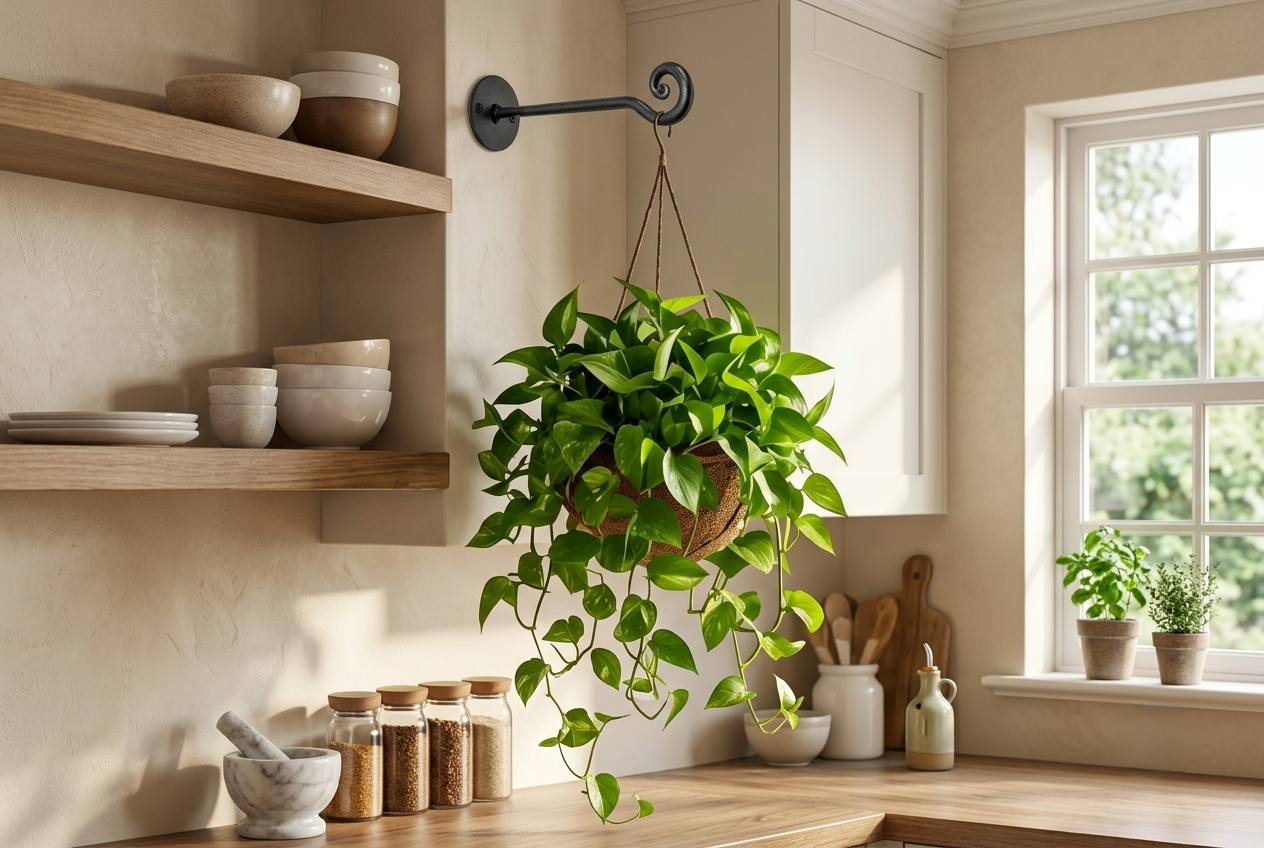
Finish is where most buyers make a purely aesthetic choice when they should be making a durability one first. The room where you hang the bracket determines which finish holds up, and that should narrow the options before style enters the conversation.
Why finish matters indoors. Indoor plant brackets face a specific threat: repeated moisture from watering. Every time you water a hanging planter, droplets run down the pot and onto the bracket. Over months, a single-layer painted iron bracket starts to show rust at the moisture contact points. A bracket with dual-layer zinc galvanization plus powder coating handles that cycle without the same degradation. The zinc layer acts as a sacrificial barrier that protects the iron substrate; the powder coat seals the zinc against abrasion and contact moisture.
Powder-coated iron meets the ISO 9227 neutral salt spray standard at 500 hours minimum before showing blistering or substrate corrosion7. For an indoor bracket, the relevant comparison is not salt spray hours directly, but what that 500-hour performance means in terms of material integrity: the protective layers are thick enough that routine indoor moisture exposure, including daily watering and bathroom humidity, does not compromise them over years of use. The RTZEN four-step process (cut, hand-forge, zinc-galvanize, powder-coat) applies both layers to every bracket in the catalog.
Black finish. The most versatile choice for indoor use. Flat black or very dark brown sits comfortably in modern, farmhouse, rustic, and bohemian interiors. It reads as a structural element rather than a decorative one, which means the bracket fades into the display and the plant takes center stage. The RTZEN Swirl Hooks bracket pairs the standard black finish with a hand-forged scrollwork detail along the arm, adding visual texture without changing the profile.
White finish. White brackets work in Scandinavian, cottage, and contemporary spaces, reading lighter against cream or white walls so the planter takes visual priority. White powder-coated iron carries the same rust resistance as black; the color difference is cosmetic. Inspect annually and recoat if the powder coat chips near watering contact points.
Bathrooms and kitchens. These rooms have the highest sustained humidity in a home. The bracket’s finish takes more wear here than in a living room. Choose double-layer-coated iron over any painted or lacquered alternative. If the bracket is near a shower or directly above a sink, wipe it dry after heavy steam exposure. Hand-forged iron tolerates humidity far better than hollow stamped metal, which corrodes from the inside out once moisture enters through pin holes in a single-layer finish.
“These benefits don’t happen by accident. They rely on using the right systems, in the right way, with the right lighting and maintenance.”
Professor Prashant Kumar, Co-Director, Global Centre for Clean Air Research (GCARE), University of Surrey8
That principle applies directly to brackets. A well-chosen bracket in the right finish, mounted correctly, is what keeps a display performing for years. A bracket chosen only by look, in a finish that can’t handle the room’s humidity, fails the plant before the plant fails the bracket.
Step 5: Place the Bracket for Light and Access
Where you mount the bracket shapes how well the plant grows and how easily you can maintain it. Placement is a functional decision as much as a visual one.
Height above floor. Mount the bracket high enough that the hanging planter clears furniture and foot traffic below. As a practical rule, the bottom of a trailing plant should clear the top of the tallest piece of furniture directly beneath it by at least 6 inches. That’s typically a wall height of 6.5-7.5 feet for a 10-inch planter with a 12-inch trailing spread. Higher is fine for aesthetic effect, but consider whether you can reach the pot for watering without a step stool. Indoor brackets at 7 feet or above almost always require a watering wand or a pulley-style hanger to avoid weekly ladder climbs.
Light zones in the room. Indoor plants need light, and the bracket’s position determines how much the plant receives. A February 2026 University of Surrey study, drawing on 35 expert collaborators across six continents, found that placing the right indoor greening system in the right position – including light exposure – determined whether the reported wellbeing benefits materialized8. For bracket placement, that means mapping where direct light hits the wall at different times of day before drilling. A north-facing wall in a living room suits low-light plants like pothos and ZZ plants. A south- or east-facing kitchen wall handles ferns and herbs that need brighter indirect light.
Clearance from ceilings and crown molding. Leave at least 4-6 inches between the top of the bracket’s mounting plate and the ceiling, or between the bracket and any crown molding. This keeps the installation looking deliberate rather than cramped, and it ensures the bracket can be tightened with a screwdriver without the handle hitting the ceiling.
Spacing multiple brackets. If you’re mounting two or more brackets on the same wall, space them at least 18-24 inches apart horizontally. This allows each plant’s trailing growth to spread without tangling, and it keeps the visual line clean. Stagger heights by 6-12 inches on a single wall for a more layered display than a flat row.
Heating and cooling vents. Keep brackets at least 3 feet from forced-air vents. Dry forced air dehydrates plants faster and stresses the finish by cycling through humidity extremes.
Step 6: Confirm the Hardware Package Before You Buy
The bracket itself is one half of the installation; the fasteners are the other. Most buyers check the bracket’s dimensions and material, then overlook what comes in the box. A solid iron bracket shipped without suitable fasteners requires a separate hardware store visit and the risk of choosing the wrong anchor for your wall type.
What should be in the box. A complete bracket package includes mounting screws matched to the bracket’s screw-hole diameter, wall anchors or plugs sized for the screws, and (ideally) a small instruction sheet with the recommended bit size. RTZEN includes mounting screws with every bracket. The screws are sized for the bracket’s hole pattern and matched to the wall types the bracket is designed to handle.
Screw length and wall depth. For drywall installation, the screw should reach the stud (at least 1.5 inches into wood) or match the anchor’s required thread engagement (typically 1-1.5 inches of thread inside the anchor body). A screw too short threads only into the drywall paper and pulls out under load. A screw too long can hit electrical wiring or plumbing behind the wall in older construction. Confirm the screw length against your wall construction before drilling.
Anchor type and wall type must match. Plastic expansion anchors work on light-duty hooks for single lightweight items, typically rated 10-25 lbs6. For a bracket holding a filled planter, the anchor needs to be a toggle-style or a snap-toggle rated for the load. Check the anchor’s rated pull-out and shear strength against the filled weight of your planter, and apply the 2x safety factor from Step 1.
Two-bracket installations. Most RTZEN plant brackets are sold as 2-packs with two full hardware sets. Verify that both sets are identical before installing; mismatched screw lengths between a pair can cause one bracket to protrude slightly, throwing off alignment even when each is level individually.
Common Mistakes When Choosing a Plant Hanger Bracket Indoor
Most bracket failures in the first year trace back to one of four errors made at selection time, not at installation. Here are the most common ones and how to avoid them.
Buying the bracket before measuring the pot
A buyer sees a bracket they like, purchases it, then discovers the arm is 2 inches short of the pot radius. Measure pot diameter first, calculate the minimum arm length from Step 2’s table, then filter by arm length.
Trusting a bracket with no stated load rating
A reputable bracket manufacturer publishes the working load limit. If the listing shows only style and dimensions without a weight capacity, the bracket’s integrity under load is unknown. Hollow stamped metal brackets often omit this number because testing would reveal inadequate capacity. Hand-forged solid iron brackets state their load ratings because the construction earns them. Skip any bracket that doesn’t publish its number.
Using a plastic expansion anchor in drywall for heavy planters
Plastic expansion anchors are rated for light picture frames and small hooks, typically 10-25 lbs6. A 12-inch planter saturated with water can exceed 20 lbs4. The anchor holds on installation day, then fails slowly as the weight of repeated watering cycles stresses the drywall cavity. Use a toggle bolt for any bracket carrying a planter heavier than 10 lbs without a stud behind it.
Choosing a finish purely by color without checking the coat thickness
Two black brackets can look identical on a product photo and behave completely differently after six months of indoor plant watering. A single-layer painted bracket chips at watering contact points and rusts beneath the paint layer. A dual-layer zinc-plus-powder-coated bracket maintains its surface integrity through the same moisture cycle. Ask whether the finish includes a zinc galvanization step before the top coat. If the listing doesn’t mention it, assume it doesn’t have one.
Placing the bracket too close to the ceiling or too low for the plant’s light needs
Mounting a bracket 2 inches below a white ceiling is both hard to install and visually unbalanced. Mounting it at standing-arm height in a dim corner suits neither the plant nor the aesthetic. Take 10 minutes before drilling to hold a mock bracket location with painter’s tape and observe the light at that spot across an afternoon. That test costs nothing and avoids a wall repair.
What the Right Choice Looks Like When It’s on the Wall
A well-chosen indoor plant hanger bracket meets a short checklist: the pot hangs at least 1 inch clear of the wall, the bracket’s load rating is at least twice the filled weight, the fasteners match the wall surface, the finish suits the room’s humidity, and the bracket is level at a height the plant can use. If any condition isn’t met, one of the six steps above is the source. Most fixes are pre-drill changes – moving the location, swapping the anchor type, or choosing a longer arm. Fixes after drilling cost more and leave a wall mark.
A hand-forged iron bracket done correctly requires no follow-up. The iron doesn’t deform under load, the dual-layer finish doesn’t degrade under routine moisture, and the mounting hardware doesn’t back out of the wall over time.
Frequently Asked Questions
How much weight can an indoor wall bracket hold?
A heavy-duty hand-forged iron bracket with double front welding typically carries 25-30 lbs. A heavy-duty toggle bolt in 1/2-inch drywall is rated up to 238 lbs in shear6, so the bracket’s stated load limit, not the fastener, is the binding constraint for most indoor hanging planters. Always choose a bracket rated for at least twice the filled weight of your planter.
What arm length do I need for a 10-inch hanging planter?
A 10-inch planter has a 5-inch radius. The bracket arm should extend at least 6 inches from the wall to the hook tip (1 inch of clearance beyond the rim radius). A 7.5-inch arm works comfortably for a 10-inch pot, giving 2.5 inches of clearance between the pot rim and the wall face. Indoor hanging baskets in the 10-14 inch range are among the most common2, and a 7.5-8 inch arm handles them without the pot grazing the wall.
Can I mount a plant hanger bracket in drywall without finding a stud?
Yes, provided you use the correct anchor. A toggle-style anchor (snap-toggle or butterfly toggle bolt) in 1/2-inch drywall supports well above the weight of any standard indoor planter, while a standard plastic expansion anchor should not be used for planters heavier than 10 lbs. Approximately 90% of U.S. residential walls are drywall5; the correct anchor choice is a routine part of the installation process, not an obstacle.
What is the best finish for a plant hanger bracket in a bathroom?
A dual-layer finish (zinc galvanization plus powder coating) is the most moisture-resistant option for a bathroom. Powder coating meets the ISO 9227 standard at 500 hours of salt spray without blistering7, making it durable against the sustained humidity of a bathroom. Single-layer painted brackets rust at moisture contact points within months in high-humidity rooms. Either black or white powder-coated iron works; the choice between them is aesthetic.
How do I know if a bracket has double front welding?
Double front welding means the arm is welded to the back plate at two contact points rather than one, distributing the load across a wider joint. Look for this detail in the product description. If the listing does not mention welding at all, the bracket is likely stamped and folded rather than hand-forged and welded – two very different constructions. Hand-forged brackets with named welding details are made by manufacturers who understand why the specification matters.
Limitations and Edge Cases
- Planter weight estimates in Step 1 and the chart assume standard potting mix density. Specialty mixes (bark-heavy orchid mix, lightweight perlite blends) weigh less; dense loam or clay-heavy mixes weigh more. Weigh your specific filled pot before finalizing the load rating decision for very large or heavy planters.
- Weight estimates use moist potting mix as the baseline4. A pot that drains fully between waterings weighs less; one held at saturation may exceed the upper estimate shown in the chart.
- This guide covers wall-mounted indoor brackets. Ceiling hook selection, outdoor bracket considerations, and post or fence mounting involve different load vectors and fastener choices covered in the plant hangers topic cluster.
References
- The Nature of Home – Houseplant Statistics: 37.6 Million U.S. Households, citing Statista Research Department, 2020 data, published 2024.
- Epic Gardening – How Many Plants Go in a Hanging Basket? Madison Moulton, reviewed by Sarah Jay, 2024. Hanging baskets typically 10-14 inches in diameter.
- Iowa State University Extension – Creating and Growing Hanging Baskets. Yard and Garden Extension, Iowa State University. Plant counts and size guidance for hanging baskets 12-18 inches.
- EatHealthy365 – The Ultimate Guide to Potting Soil Weight and Volume. 8 quarts of moist potting mix weighs 7-10 lbs; saturated 11-15 lbs. 10-inch pot requires approximately 6 quarts of soil, 2024.
- Worldmetrics – Drywall Industry Statistics Report 2026. Approximately 90% of U.S. residential construction projects use drywall. Published February 12, 2026.
- TOGGLER – SNAPTOGGLE Heavy-Duty Toggle Bolt product specification. 1/4-inch toggle bolt rated 238 lbs in 1/2-inch drywall. Current manufacturer specification.
- PMC / Materials (Basel) – Kunce I., Krolikowska A., Komorowski L. “Accelerated Corrosion Tests in Quality Labels for Powder Coatings on Galvanized Steel.” Materials 14(21), 6547. DOI: 10.3390/ma14216547. PubMed Central, 2021. ISO 9227 salt spray standard for powder-coated steel.
- University of Surrey – “New Evidence Shows Indoor Plants Can Quietly Reshape Health and Quality of Our Homes and Workplaces.” Global Centre for Clean Air Research (GCARE) press release, February 23, 2026. Study drew on 35 expert collaborators across six continents.
Conclusion
Choosing an indoor plant hanger bracket comes down to six decisions made in order: load capacity, arm length, wall type, finish, placement, and hardware. Get the first two right and the rest follows logically. Skip them and a bracket that looks correct on delivery can fail within a season.
Hand-forged iron with double front welding and dual-layer coating is the construction that holds up to the repeated moisture of indoor plant care without deteriorating. Everything else is a secondary preference. For how bracket selection fits within the broader range of mounting styles, plant types, and display configurations, see the plant hangers overview for the full picture.