
Picking the wrong hanging plant bracket is one of the most common reasons a planter comes down from the wall. A small plastic wall anchor is rated for as little as 3 pounds of safe working load,1 yet a watered 16-inch basket can weigh 25 pounds or more once the soil is fully saturated.2 The overview in plant hangers overview covers the broader mounting picture; this guide goes deep on one question: how to read a bracket’s projection, arm shape, mounting plate, material, finish, and rated load capacity, then match each factor to the real wet weight of your planter.
Quick Answer
How do you choose a hanging plant bracket?
Weigh your basket after a full watering. Select a bracket with a rated load capacity at least twice that wet weight. Match arm projection to basket diameter so the rim clears the wall surface by 1 to 2 inches. For any basket weighing 20 pounds or more, use toggle bolts or structural screws driven into a stud – not plastic expansion anchors, which are rated for only 3 pounds of safe working load at the standard 4:1 safety factor.1
Key Takeaways
- A 16-inch hanging basket can weigh 20 to 35 pounds when fully watered; always use wet weight, not dry weight, when sizing a hanging plant bracket.2
- Arm projection should exceed the basket radius by at least 1 to 2 inches so the basket rim never contacts the wall surface.
- Toggle bolts carry a safe working load of 25 pounds or more per anchor in standard half-inch drywall; plastic expansion anchors hold only 3 pounds at the same 4:1 safety factor.1
- Wrought iron develops a natural protective patina that halts rust from penetrating deeper into the metal, giving brackets inherent corrosion resistance beyond the finish coat alone.4
- A swivel hanging plant bracket allows 360-degree rotation so every side of the plant receives even light exposure without removing the basket from the hook.
Start with Wet Weight: The Number That Drives Every Other Decision
Every other selection criterion for a hanging plant bracket follows from one figure: the wet weight of the basket. Dry potting mix weighs far less than saturated mix, and most brackets fail not because the hardware is weak in principle, but because the buyer weighed the basket dry and mounted hardware rated only for that figure.
“Wet soil can easily triple the initial dry weight, especially after a thorough watering or heavy rain outdoors.”
Engineer Fix, structural engineering reference publication2
That tripling effect is not rare. It happens every time a hanging basket outdoors gets rained on, or every time an indoor basket is watered to the point of runoff. The only reliable operating weight is the wet weight.
How to Measure Wet Weight Before Buying a Bracket
Hang the existing basket on a luggage scale or set the fully watered pot on a kitchen scale. Record the peak reading immediately after watering. If you are buying the planter and the bracket together, estimate wet weight by the basket volume: saturated potting mix weighs roughly 80 to 100 pounds per cubic foot.2 A 12-inch basket holding half a cubic foot of mix adds 40 to 50 pounds of soil and water weight alone, plus the weight of the pot, liner, and plant material itself.
Use the wet weight as the base figure, then double it. The bracket’s stated load rating should be at least twice the wet weight. That gives a 2:1 in-use safety margin on top of the anchor’s own 4:1 safety factor, and it accounts for dynamic loads such as wind swing and chain movement that increase the real force on the wall connection point.1
Dynamic Load: Why Static Weight Is Not the Whole Story
A hanging basket does not simply pull straight down. Wind pushes it laterally, and swing-force from movement transfers to the anchor as a pull-out load rather than a pure shear load, which is more likely to pull an anchor directly out of the wall. Engineers call this pull-out failure, or tensile failure.1 Using a bracket rated at double the wet weight, with the correct anchor for the wall type, accounts for both load types without a formal calculation.
Match Bracket Projection to Your Basket Diameter
Bracket projection is the horizontal distance from the wall surface to the hanging hook at the arm tip. It determines whether your basket hangs freely or presses against the wall, which splits plant stems and traps moisture against the mounting surface. The arm projection must be at least equal to half the basket diameter (the basket radius), and in practice should exceed the radius by 1 to 2 inches to keep the basket rim fully clear of the wall.
Hanging baskets are sized by rim diameter. Small baskets range from 12 to 14 inches; large baskets measure 17 to 20 inches.5 A 14-inch basket requires at least 7 inches of arm projection to center the hook over the basket, plus the 1 to 2 inch clearance margin. In practice, a 10-inch or 12-inch arm is the working minimum for a 12- to 14-inch basket mounted flat against a wall, and an 18-inch arm is the standard for baskets 16 inches or wider.
| Arm Projection | Basket Diameter Range | Common Use Case |
|---|---|---|
| 7 to 8 inches | Up to 10 inches | Small pots, herb planters, narrow porch columns |
| 10 to 12 inches | 10 to 14 inches | Standard hanging baskets, most residential walls and fences |
| 18 inches | 14 to 18 inches | Large flowering baskets, garden walls, wide fences |
| 20 inches or more | 18 to 24 inches | Commercial planters, pergola posts, extra-large baskets |
When your basket diameter sits at the top of a projection range, step up to the next arm length. A 14-inch basket on a 10-inch arm may just clear the wall when new, but the plant grows outward, the basket swings, and the clearance margin disappears. The extra 2 inches of arm costs nothing in terms of load capacity and prevents ongoing contact with the exterior wall surface.
Projection and Wall Depth
Bracket projection is measured from the wall surface at the mounting plate, not from the outermost edge of the bracket body. On a thick stone wall or a wall with protruding trim, the effective clearance is less than the nominal arm length. Measure from the actual surface the plant will hang near, not from the stud or masonry behind it. On deep sill ledges or behind a wide column face, add the ledge depth to the required projection before selecting an arm length.
For comparisons between bracket types and ceiling hooks
Wall-mounted brackets are the most common choice for porch columns, fences, and exterior walls, but they are not the only option. For details on how wall hooks compare to ceiling hooks for the same hanging application, see hanging plant hooks for a breakdown of each hook format and its weight limits.
Choose an Arm Shape That Fits the Setting
The arm shape of a hanging plant bracket affects three things simultaneously: how far the basket projects from the wall (projection is partly a function of arm geometry), how the bracket looks against the wall surface, and whether it includes a swivel or fixed hook at the tip. Most residential brackets fall into three arm geometries: straight, curved (shepherd’s-hook profile), and scrollwork or swirl.
Straight-Arm Brackets
A straight arm projects horizontally from the wall plate at a fixed angle. It is the simplest geometry, produces a predictable projection distance equal to the arm length, and suits minimalist or modern settings where a clean line is preferred over decorative detail. Straight arms are also easier to confirm for load capacity because the lever arm geometry is straightforward: the load hangs directly from the tip, and the bending moment on the wall bracket is simply the load times the arm length. Use a straight arm when the wall finish is flat and you want the bracket to read as hardware rather than decor.
Curved and Shepherd’s-Hook Arms
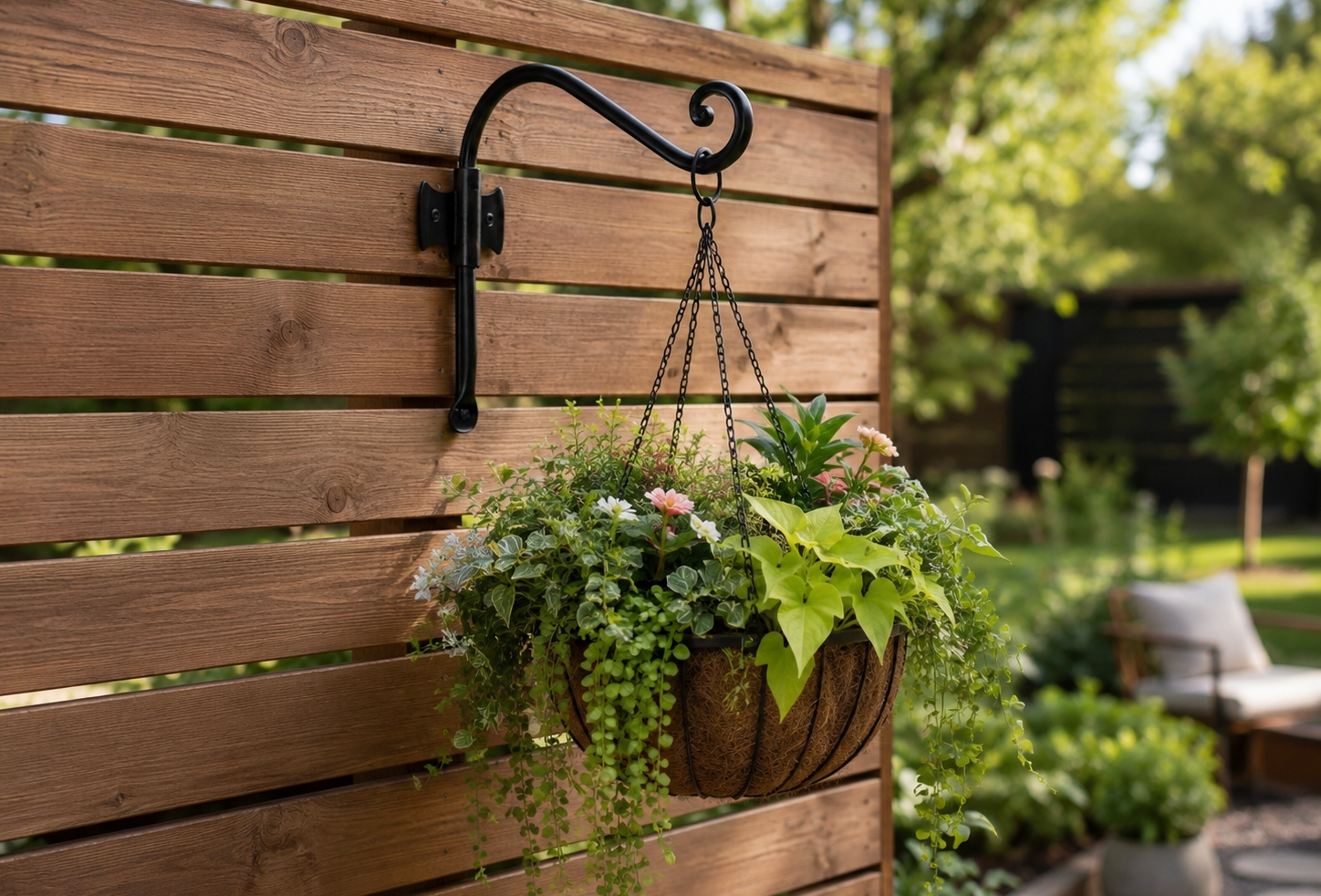
A curved arm arches upward from the mounting plate before curving over and ending in a downward hook. This profile keeps the hanging point directly above the basket’s center of gravity even when the arm sweeps outward, which improves load stability on a swinging basket. The shepherd’s-hook shape is the most widely used profile for residential plant brackets and works on fences, porch columns, and brick exteriors. The classic 7.5-inch projection is standard for baskets up to 12 inches in diameter and pairs with the common mounting plate configuration of two to four screws vertically aligned on the wall. For indoor applications, the same profile with a shorter arm keeps the basket tight to the wall with minimal visual intrusion into the room. For detailed indoor guidance, see indoor bracket selection for room-placement recommendations.
Scroll and Swirl Arms
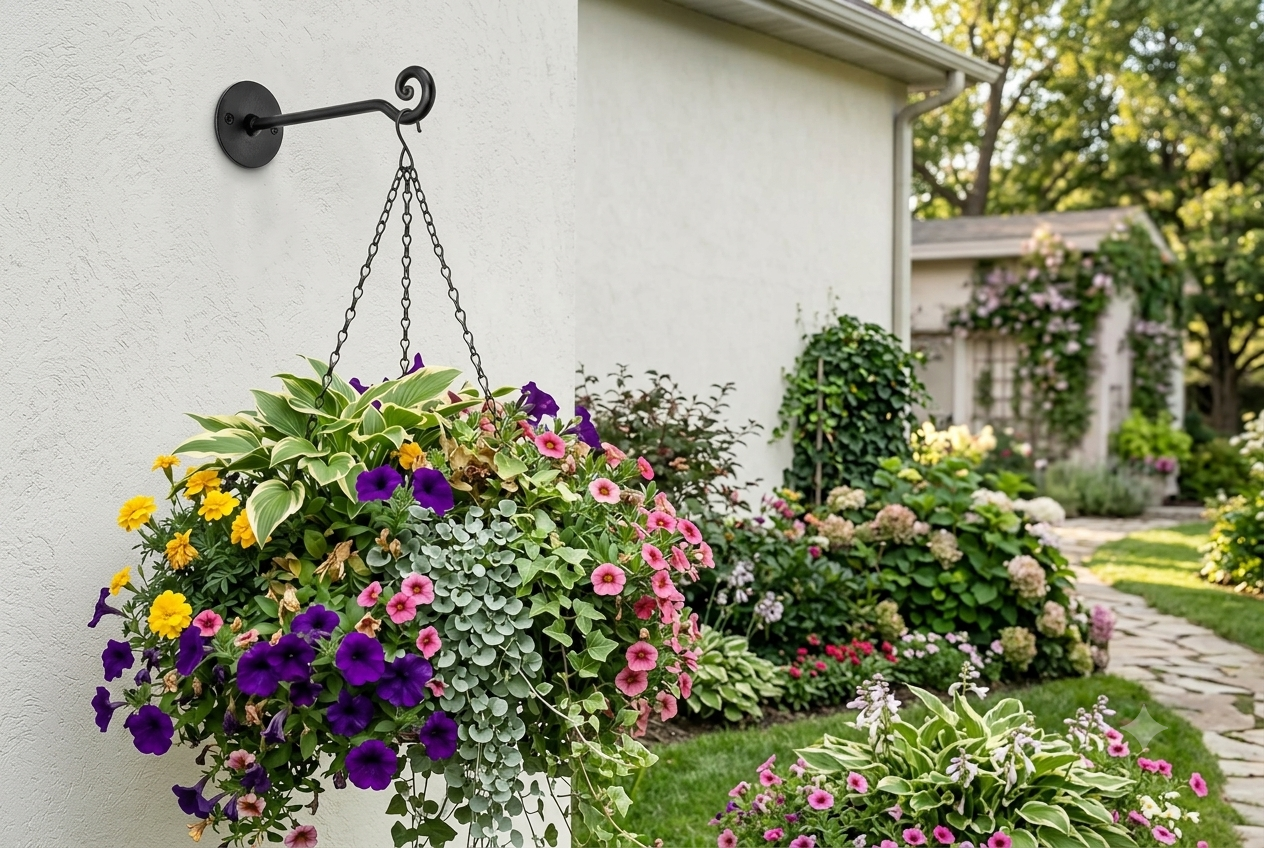
A scroll or swirl arm adds decorative ironwork along the horizontal support, typically a hand-forged spiral or open-loop accent welded to the main arm. This style suits farmhouse, rustic, vintage, bohemian, and classic interiors where the bracket reads as decor alongside the plant. The scrollwork is ornamental, not load-bearing: the load path runs through the solid main arm from wall plate to hook tip, so structural strength is unaffected when the bracket is properly forged. For how ornamental detailing, finish quality, and capacity interact across the full range of styles, see ornamental plant hangers.
Swivel Hanging Plant Brackets
A swivel hanging plant bracket adds a rotating joint at the hook tip, allowing the basket to spin 360 degrees while remaining mounted. The primary function is even light distribution: a plant hanging from a fixed hook rotates only when lifted off and turned manually, so one side of the plant tends to face away from the light source and grow unevenly. A swivel bracket lets the basket rotate freely as the plant leans toward the light, keeping growth more symmetrical without removing the pot. Swivel brackets carry the same load considerations as fixed-hook brackets: the rated capacity applies to the total wet weight, and the swivel joint itself must be rated for that load, not just the arm and plate. Verify that the rated capacity spec covers the swivel mechanism and is not limited to the arm alone.
Inspect the Mounting Plate and Installation Hardware
The mounting plate is the flat section of the bracket that sits against the wall surface. It transfers the entire load of the hanging basket into the wall substrate through the screws or bolts that pass through it. A bracket with a generous projection and high arm rating still fails at the wall if the plate is too small, has too few screw holes, or is paired with the wrong anchor type for the wall material.
The chart above shows why anchor selection matters as much as bracket selection. A plastic expansion anchor in drywall provides only 3 pounds of safe working load at the standard 4:1 engineering safety factor. A toggle bolt or snap toggle in the same wall provides 25 pounds or more per anchor.1 The brackets are often identical; the anchor determines whether the system holds or pulls out.
Mounting Plate Size and Screw Count
A larger mounting plate distributes the bending moment across more wall surface, reducing stress concentration at any single screw. For a bracket carrying 20 pounds or more of wet basket weight, the plate should have a minimum of two screw holes vertically aligned, and ideally three or four, so the load shares across multiple anchor points. A plate with one central screw can rotate under load, increasing the prying force on that single fastener. Look for plates at least 2 inches tall and wide enough to allow screws spaced at least 2 inches apart vertically.
Matching Hardware to Wall Material
On wood studs, a 2.5-inch or 3-inch structural screw driven directly into the stud is the strongest connection and requires no anchor. On drywall without a stud, toggle bolts or snap toggles are the minimum for baskets over 10 pounds wet. On brick, stone, or concrete, a masonry anchor rated for the load is required; standard drywall anchors pull straight out of masonry. The screws and wall plugs included with most wrought iron brackets are rated for standard drywall and wood. For masonry or tile installations, purchase separate masonry anchors sized to the screw diameter specified by the bracket manufacturer. For a full treatment of anchor selection by wall material, see hanging plant hooks, which covers anchor options across all common wall substrates.
Double Front Welding on Load-Bearing Brackets
On hand-forged iron brackets, the arm-to-plate joint is the highest-stress point in the bracket assembly. Double front welding at this joint adds a second weld pass on the front face of the connection, creating a bond that resists both the downward shear from the basket weight and the outward prying moment from the arm’s lever action. A bracket without visible weld reinforcement at the arm-to-plate joint relies entirely on a single bond line, which can crack under repeated load cycling from wind swing. When the product description or photos confirm double front welding, the bracket is built to hold its rated capacity through real outdoor use, not just under static lab conditions.
Select Material and Finish for Indoor or Outdoor Use
Bracket material and finish coating determine long-term durability, especially for hanging plant brackets outdoor where moisture, UV, and temperature cycling all act on the metal surface. The three materials most commonly used for residential plant brackets are wrought iron, mild steel, and cast iron. Each has a different strength profile and corrosion behavior.
Wrought Iron: Tensile Strength and Natural Rust Resistance
Wrought iron has a tensile strength of 34,000 to 54,000 psi (234 to 372 MPa).3 That is sufficient for any residential plant bracket application and well above the loads produced by even the heaviest planted baskets. More practically, wrought iron contains up to 2 percent slag by weight, and that slag content gives the material an inherent defense against rust. Metal Supermarkets, a materials distributor that publishes technical data on iron and steel alloys, explains that the ferrous silicate present in wrought iron helps prevent excessive corrosion, with wrought iron products left outside forming a protective patina.4 That patina is an oxide layer that forms on the outer surface and slows further oxidation of the material beneath it.
This is different from plain steel, which rusts progressively. On plain steel, surface rust continues advancing inward because there is no slag barrier to halt penetration. On wrought iron, the slag layer interrupts the rust front before it reaches the core of the bracket arm. The result is a material that holds its structural strength longer under outdoor exposure, particularly relevant for hanging plant brackets outdoor where rain contact is continuous through the growing season.
Finish Coatings: Zinc Galvanization and Powder Coating
Most hand-forged iron brackets receive two finish layers: a zinc galvanization pass then a powder coat. Zinc corrodes preferentially to iron, so moisture attacks the zinc first before reaching the metal beneath. Powder coating seals over the zinc with a polymer layer that resists chipping, UV fading, and moisture penetration. For outdoor use without overhead cover, a bracket with dual-layer zinc plus powder coat holds its finish far longer than one finished with paint or powder coat alone.
Finish Color and Interior Style Matching
Bracket finishes come in three primary colors: flat black (sometimes described as very dark brown), white, and antique brushed zinc. Flat black suits farmhouse, rustic, modern, and industrial settings. White pairs with bright painted exteriors and cottage or coastal interiors. Antique brushed zinc works in transitional or vintage spaces where aged hardware is the intent. The finish color does not affect load capacity, but a tonal match to the wall tends to let the plant take visual priority; a contrasting finish makes the bracket part of the composition.
Verify Rated Load Capacity Against Your Wet Weight
After gathering wet weight, arm projection, arm shape, mounting plate size, and material information, the final check before purchasing is to confirm the bracket’s stated load capacity covers the calculated wet weight with the 2:1 in-use safety margin. Stated load capacity on a product listing can refer to different things: some manufacturers list the ultimate breaking load; others list the safe working load; and others list the load at which deflection becomes visible. Always verify which figure the product is quoting.
Reading Load Ratings on Product Listings
The most conservative and most useful figure is the safe working load: the load the bracket can carry continuously over time without fatigue or deformation. When a product listing states only a single capacity figure without qualification, assume it is an ultimate or structural load rating and apply the 4:1 safety factor yourself: divide the listed figure by four to get an approximate safe working load.1 A bracket listed at 60 pounds capacity therefore has an approximate safe working load of 15 pounds. That covers a 14-inch basket at 12 pounds wet, but not a 16-inch basket at 28 pounds wet. Confirming the calculation takes 30 seconds and avoids the most common sizing error.
Selecting the Right Bracket for Your Basket Size
For a standard 12-inch to 14-inch basket weighing 15 to 20 pounds when watered, an 8-inch projection bracket rated at 30 pounds or higher is a reliable starting point. The curved plant hooks from RTZEN, hand-forged and finished with dual-layer zinc and powder coat, suit this basket size and projection range for both indoor and outdoor use. For baskets in the 14-inch to 18-inch range with wet weights above 25 pounds, a 12-inch projection bracket with a higher load rating is required. The 12-inch brackets in the same RTZEN curved-hook range extend the arm length and maintain the same dual-layer rust protection appropriate for outdoor placement through all seasons. Both come as a 2-pack and include mounting hardware rated for standard drywall, wood, and masonry installation.
Common Hanging Plant Bracket Mistakes
Bracket failures follow predictable patterns. The mistakes below account for the majority of planters that pull away from the wall, bend at the arm joint, or drop the basket entirely.
Using Dry Weight to Size the Bracket
The most frequent sizing error is weighing the basket before watering, finding it manageable at 8 pounds, and selecting a bracket and anchor rated for 15 pounds. After the first rain or thorough watering, the basket weighs 22 pounds, which is 7 pounds over the anchor’s safe working load. The anchor does not fail immediately, but repeated wet-to-dry cycling fatigues the anchor over weeks until it pulls out. Always use wet weight.
Using Plastic Expansion Anchors in Drywall for Heavy Baskets
Plastic expansion anchors are suitable for light wall objects: hooks, small mirrors, picture frames. They are not rated for heavy, dynamically loaded items like outdoor hanging baskets. A small plastic expansion anchor in drywall has an ultimate shear load of only 10 to 15 pounds, giving a safe working load of roughly 3 pounds at a 4:1 safety factor.1 A watered basket weighing 20 pounds is seven times beyond that safe working load. Use toggle bolts or snap toggles for any basket over 10 pounds wet, and drive structural screws into a stud whenever the stud falls within the mounting plate width.
Selecting an Arm Too Short for the Basket Diameter
A 7-inch arm mounting a 14-inch basket places the basket rim in contact with the wall surface. The plant grows outward and presses harder against the wall over time. Stem contact with the wall causes bruising, moisture accumulation, and eventually stem rot. The basket also swings less freely, increasing lateral load on the anchor. Check that the arm projection equals the basket radius plus 1 to 2 inches before purchasing.
Mounting into Hollow Drywall Without a Stud or Toggle
Standard drywall screws without a stud or toggle anchor hold approximately 15 to 20 pounds before the gypsum core tears.1 A bracket mounted this way may feel solid at first, but wind swing applies a prying force over time and the failure is sudden. Use a stud finder before marking mounting holes. If no stud falls within the plate, use toggle bolts and confirm the toggle arms are fully deployed behind the drywall before tightening.
Ignoring Finish Quality for Outdoor Use
A bracket with a single paint layer or no zinc underlayer will show rust at any chip or scratch point within one season of outdoor use. Bare metal exposed to moisture and oxygen begins oxidizing immediately, and on plain steel the rust front advances inward without stopping. For hanging plant brackets outdoor, the minimum acceptable finish is a powder coat over a zinc galvanization base. A bracket advertised as “black painted” with no mention of zinc or galvanization is not the same product as one described as zinc-galvanized and powder-coated, even if they look identical on the day of purchase.
Frequently Asked Questions
How much weight can a hanging plant bracket hold?
That depends on both the bracket’s rated capacity and the anchor holding it to the wall. A bracket rated at 30 pounds has a safe working load of roughly 30 pounds only when the anchor is also rated for that load. Toggle bolts in standard half-inch drywall provide a safe working load of 25 pounds or more per anchor;1 plastic expansion anchors provide only 3 pounds. Always match the anchor to the bracket rating, not just the bracket to the basket.
What size arm projection do I need for a 14-inch hanging basket?
A 10-inch to 12-inch arm projection is the working minimum for a 14-inch basket mounted flat against a wall. The arm needs to equal the basket radius (7 inches) plus 1 to 2 inches of clearance. Hanging baskets in the 12-to-14-inch range are classified as small by horticultural standards,5 but they still need sufficient arm length to hang freely without contacting the wall surface.
Can I use the same bracket indoors and outdoors?
Yes, if the bracket has a finish rated for outdoor exposure: dual-layer zinc galvanization plus powder coat. Brackets finished with paint alone or powder coat without a zinc undercoat can rust when moved from indoor to outdoor use. Wrought iron brackets with proper zinc and powder-coat finish work in both settings because the zinc layer sacrifices itself to protect the iron even when the outer coat chips, while the natural patina of wrought iron provides a secondary barrier.4
What is a swivel hanging plant bracket and when do I need one?
A swivel hanging plant bracket has a rotating joint at the hook tip that allows the basket to spin 360 degrees while mounted. It is most useful for plants with strong directional growth, where one side leans toward the light source and creates uneven growth. The swivel lets the basket rotate passively as the plant leans, keeping all sides closer to even light exposure. The load capacity of a swivel bracket applies to the full assembly, including the swivel joint; verify that the rated figure covers the joint, not just the arm.
How do I install a hanging plant bracket on a brick or concrete wall?
Brick and concrete require masonry anchors, not standard drywall anchors or plastic expansion plugs. Drill into the mortar joint (softer than the brick itself and easier to patch) using a hammer drill and masonry bit sized to the anchor diameter. Insert a masonry wall plug, then drive the bracket screw through the mounting plate into the plug. Standard plastic anchors included with most brackets are for wood or drywall; purchase masonry-rated anchors separately when mounting into brick, stone, or concrete.
Limitations and Edge Cases
- This guide covers wall-mounted bracket selection for hanging plant baskets. For ceiling-mounted hook installations in wood joists, drywall, or concrete, see the ceiling hanging hook guide for ceiling-specific load and hardware guidance.
- Anchor capacity figures cited here are for standard half-inch drywall with paper facing. Older drywall, water-damaged gypsum, or non-standard wall thicknesses may have lower anchor performance; test with a pilot load before hanging a heavy basket unattended.
- Arm projection sizing in the comparison table reflects common residential market dimensions. Commercial planter brackets for public spaces or large outdoor displays follow additional load codes and require engineering review beyond this guide’s scope.
References
- Engineer Fix – Drywall Anchor Weight Chart: How Much Can They Hold, structural engineering reference publication, retrieved August 2026.
- Engineer Fix – How to Hang Planters Securely and Safely, structural engineering reference publication, retrieved August 2026.
- Machine MFG – Understanding Wrought Iron Properties, Uses, and Composition, manufacturing engineering reference, retrieved August 2026.
- Metal Supermarkets – Wrought Iron vs Cast Iron: What Is the Difference, materials industry reference, retrieved August 2026.
- Wikipedia – Hanging Basket, encyclopedic reference for basket diameter classification, retrieved August 2026.
Conclusion
Choosing a hanging plant bracket comes down to five concrete numbers: the wet weight of the basket, the arm projection needed to clear the basket rim, the anchor’s safe working load for the wall type, the bracket’s rated capacity, and the finish stack required for indoor or outdoor placement. Work through those numbers in order and the right bracket becomes straightforward to identify. Skip any one of them and the margin that keeps the basket on the wall disappears.
For the full context of where brackets fit within the range of mounting options, see the plant hanger guide.