A cast iron key holder, a wrought iron one and a steel one can look identical in a product photo. Yet each metal is made and behaves differently. The National Park Service traces the difference to carbon: 0.035% at most in wrought iron, 0.06% to 2% in steel, 2% to 4% in cast iron1. This comparison sits under the key holders overview, which summarizes how to choose a key holder for the home. Here the focus is narrower: how the metal changes weight, strength, shape, finish, rust protection and mounting.
Quick Answer
What changes between a cast iron, wrought iron and steel key holder?
The way the metal is shaped changes most. Cast iron is poured into molds and, in the National Park Service’s words, it is brittle, so it breaks rather than bends1. Wrought iron is heated and hammered into shape, and steel is cut or stamped from bar and sheet. Weight barely changes, because the densities of all three fall between 6,800 and 7,850 kg/m32. The finish decides rust.
Key Takeaways
- Carbon content separates the three metals: up to 0.035% in wrought iron, 0.06% to 2% in steel and 2% to 4% in cast iron1. Cast iron is very hard, and the carbon flakes it absorbs make it brittle.
- Engineering ToolBox lists wrought iron at 7,750 kg/m3, steel at 7,850 and cast iron at 6,800 to 7,8002. Two key holders of the same size weigh nearly the same, whatever the metal.
- All three metals rust when bare. The American Galvanizers Association reports that hot-dip galvanizing generally corrodes at about 1/30 the rate of bare steel in the same environment4. The finish matters more than the metal.
- A common misconception is that all black metal key holders are the same. A cast holder, a hand-forged holder and a stamped sheet holder differ in toughness, detail and edge quality, even under the same black paint.
Quick Comparison Table: Cast Iron Key Holder vs Wrought Iron vs Steel
The table sets the three metals side by side on the points that change a key holder in daily use. Figures come from the National Park Service survey of historic metals and the Engineering ToolBox material tables12.
| Point of comparison | Cast iron | Wrought iron (traditional) | Steel, cut or stamped |
|---|---|---|---|
| Best for | Repeated sculptural detail, light keys | Scrolls and twists, keys plus leashes and bags | Flat, precise silhouettes and modern looks |
| How it is shaped | Melted and poured into a sand mold | Heated, hammered, bent and twisted | Cut, stamped or bent from bar and sheet |
| Carbon content | 2% to 4%1 | Not over 0.035%1 | 0.06% to 2%1 |
| Density | 6,800 to 7,800 kg/m32 | 7,750 kg/m32 | 7,850 kg/m32 |
| Stiffness, Young’s modulus | 130 GPa grey, 170 GPa ASTM A-48 at 4.5% carbon3 | 190 to 210 GPa3 | 200 GPa, A36 structural steel3 |
| Behavior when overloaded | Brittle, breaks rather than bends | Tough and stringy, with tensile strength | Good in both tension and compression |
| Visible surface | Cast texture and molded relief | Hammer marks, tapered ends, scrolls | Smooth faces and square cut edges |
| Rust when left bare | Yes, iron-based | Yes, iron-based | Yes, iron-based |
| Verdict | Detail wins, toughness loses | Toughness and handwork win | Precision and flat designs win |
The wrought iron column gives traditional figures. By 1992, the NPS reported, most metal sold as wrought iron was mild steel1. By RTZEN’s reading, modern hand-forged decor therefore sits close to the steel column.
The one row that never separates them is rust. The National Park Service calls rust the tell-tale sign of a ferrous, or iron-based, metal1. All three qualify, so protection comes from the coating.
Read a key holder’s listing for the shaping method first, because “iron” or “metal” alone says almost nothing about how the piece will behave.
How Each Metal Is Made: Poured, Forged or Cut
A cast iron key holder is poured and a wrought iron key holder is forged. A steel key holder is usually cut or stamped from stock. These three making methods explain most of what follows, from texture to toughness.
Cast iron: poured into a mold that sets the whole shape
Cast iron is an iron alloy with 2% to 4% carbon that is poured into a mold and hardens there1. The National Park Service describes wooden patterns carved to make sand molds for recasting lost iron parts1. In the casting process, the NPS adds, elaborate shapes could be built into the mold and used repeatedly.
Wrought iron: heated and hammered at the anvil
Wrought iron is iron worked, or wrought, at an anvil or shaped by machines at a larger forge, in the NPS definition1. On historic gates, the NPS notes, the iron was heated, hammered, bent and twisted to form each part of the design1. The same hand methods produce the scrolls, loops and tapered hook ends found on forged key holders today.
One honest caveat applies to the name. By 1992, the NPS reported, very little true wrought iron was produced, and almost all metal sold as wrought iron was really mild steel1. Mild steel is a low-carbon steel, the common grade sold as bar and rod. In modern decor, “wrought iron” therefore names a method: low-carbon metal, mostly mild steel, shaped by heat and hammer.
Steel: cut, stamped or bent from bar and sheet
Steel production on a large scale followed Henry Bessemer’s demonstration of his new method in England in 18561. A steel key holder is cut from flat sheet, stamped with a die, or bent from rod and tube. The NPS records that sheet iron and steel was also sometimes stamped with designs for pressed metal ceilings1. A stamped hardware plate uses the same basic process.
RTZEN’s workshop, founded in 1997 by Tsach Levy with co-founder Rami Abramson, works in the forged tradition in four steps: cut, hand-forge, zinc-galvanize and powder-coat. The Black Swirly holder shows the method plainly, with handcrafted swirl metalwork above a row of forged hooks for keys, leashes and small accessories.
The making method is the most reliable label on a key holder, because it predicts toughness, texture and repairability better than the metal’s name.
Weight: Why Same-Size Key Holders Weigh Almost the Same
Iron and steel are close in density, so a cast, forged or steel key holder of the same size weighs nearly the same. Engineering ToolBox lists wrought iron at 7,750 kg/m3, steel at 7,850, cast iron at 6,800 to 7,800 and stainless steel at 7,480 to 8,0002.
Density is the mass of a material per unit of volume, so it decides how heavy a given shape will be. To make the figures concrete, RTZEN converted them for one solid rail, 10 inches long, 1 inch tall and a quarter inch thick.
| Metal | Density, kg/m3 | Same solid rail, ounces, RTZEN calculation |
|---|---|---|
| Cast iron | 6,800 to 7,8002 | About 9.8 to 11.3 |
| Wrought iron | 7,7502 | About 11.2 |
| Steel | 7,8502 | About 11.3 |
| Stainless steel | 7,480 to 8,0002 | About 10.8 to 11.6 |
By RTZEN’s calculation, using Engineering ToolBox’s conversion of 1 kg/m3 to 0.000036127 lb/in3, the 2.5-cubic-inch rail weighs about 11.2 ounces in wrought iron2. The same rail comes to about 11.3 ounces in steel and 9.8 to 11.3 ounces in cast iron2. The spread between the lightest and heaviest result is under 2 ounces.
What a heavier or lighter key holder indicates
Because the metals weigh about the same, a heavier holder contains more metal: a thicker plate, deeper hooks or solid bar instead of thin sheet. A light holder of the same size is thinner or hollow. When a listing gives a weight, compare it with the holder’s dimensions rather than with its metal.
A cast holder is sometimes heavier in practice for a different reason. The NPS notes that cast iron is much weaker in tension than in compression1. By RTZEN’s reading, a cast hook therefore needs more thickness to carry the same pull. Forged and steel hooks can stay slimmer for the same job.
Judge solidity by weight for size, not by metal name. A thick forged rail and a thin stamped plate differ far more than iron and steel do.
Strength and Toughness: Bending Versus Breaking
Wrought iron and steel win on toughness, and cast iron loses because it is brittle. The National Park Service explains that carbon flakes make cast iron brittle, while wrought iron is tough and stringy1.
“Cast iron is very hard and, because of the flakes of carbon it absorbs during production, it is brittle.”
National Park Service, Metals in America’s Historic Buildings, Chapter 7: Iron and Iron Alloys, 19921
Brittleness means a material fractures with little or no bending first, so it gives no warning before it fails. Cast iron is remarkably strong in compression, which made it the standard choice for structural columns for over a century1. In tension it is much weaker, so the NPS calls it not appropriate for structural beams.
Why a hook arm is a test of tension
A loaded hook arm sticks out from the wall and carries its weight at the tip. By RTZEN’s reading, that makes it a short cantilever, a beam fixed at one end. Its top face is stretched while the underside is squeezed. That stretched face is exactly where cast iron is weakest, and where wrought iron’s tensile strength helps.
Wrought iron has the elasticity and tensile strength needed for bolts, beams and girders, and the more it is worked, the stronger it becomes1. Builders later turned to steel, which was stronger than cast iron in compression and wrought iron in tension1. For a key holder, that means forged iron and steel hooks deform before they fail under overload, while a cast hook can snap.
Young’s modulus is a measure of stiffness, or how much a material flexes under load before springing back. Engineering ToolBox lists wrought iron at 190 to 210 GPa, A36 structural steel at 200 GPa and grey cast iron at 130 GPa3.
Repair and reshaping after years of use
The NPS notes that wrought iron is remarkably malleable and can be reheated and hot-worked again and again, and that it is easily welded1. A blacksmith can reheat and reshape forged iron, but bending a coated hook cold can crack the powder coat. Contact the maker before reshaping a bent hook. A cracked casting can’t be bent back at all.
If the key holder will also carry a leash, a bag or a child’s tug, choose forged iron or steel. Toughness matters more than stiffness at the moment of overload.
Shape, Detail and Surface Texture
Cast iron wins on repeated sculptural relief, forged iron wins on scrolls, twists and tapered ends, and steel wins on crisp flat outlines. Each method leaves its own marks, and those marks are the easiest way to tell the three apart on the wall.
Cast relief: detail copied from a pattern
Casting copies whatever the pattern holds, so leaves, animals and lettering can stand out in deep relief. The NPS notes that architects chose cast iron stairs because it didn’t burn and suited efficient molds. Ornate designs could also be cast rather than carved1. The trade-off is sameness: every casting from one pattern carries the same detail, and thin parts stay brittle.
Forged character: scrolls, twists and hammer marks
Forged work shows how it was made. On historic gates, the NPS describes vertical bars that were split and then bent to form the scrolls1. Look for tapered hook tips, rounded scroll ends, twisted bars and faint hammer texture.
Steel outlines: flat, even and precise
Cut and stamped steel produces flat shapes with even thickness, such as words, animal outlines or geometric panels. The faces are smooth and the edges are square unless the maker rounds them. Steel rod and tube can also be bent into simple modern hooks.
Run a finger along each hook where a key ring will rest. A good hook feels rounded, with no casting seam, burr or sharp corner that can scratch a fob or wear a leash. For how these textures fit modern, farmhouse or vintage rooms, the guide to decorative key holder styles matches looks to function.
Choose cast iron for sculptural detail, forged iron for hand-shaped curves and steel for clean outlines. Then check the edges, which matter every day.
Finish Options and Rust Protection
None of the three metals resists rust on its own, so the finish decides how a key holder ages. The NPS explains that rust is porous and lets deeper layers oxidize, and that corrosion in exposed thin sheet metal can be quite rapid1.
That second point matters for thin stamped steel holders, which have less metal to lose before a hook weakens. A thick forged or cast piece has more material in reserve, but it still rusts wherever its coating is chipped.
Zinc first: what galvanizing adds
Hot-dip galvanizing is a process that bonds a zinc coating to iron or steel to protect it from corrosion. The American Galvanizers Association reports that hot-dip galvanizing generally corrodes at about 1/30 the rate of bare steel in the same environment4. The zinc wears slowly so the iron underneath does not.
Powder coating on top: the duplex finish
Powder coating is a dry paint powder applied to metal and baked into a hard, even film. Over zinc, it forms a duplex system, and the AGA describes the combined protection on galvanized steel this way5:
“When paint/powder coating and galvanized steel are used together, the corrosion protection is superior to either protection system used alone and can last from 1.5 to 2.3 times the combined lifetimes of both systems.”5
American Galvanizers Association, Duplex Systems: Paint or Powder Coating over HDG, updated 20255
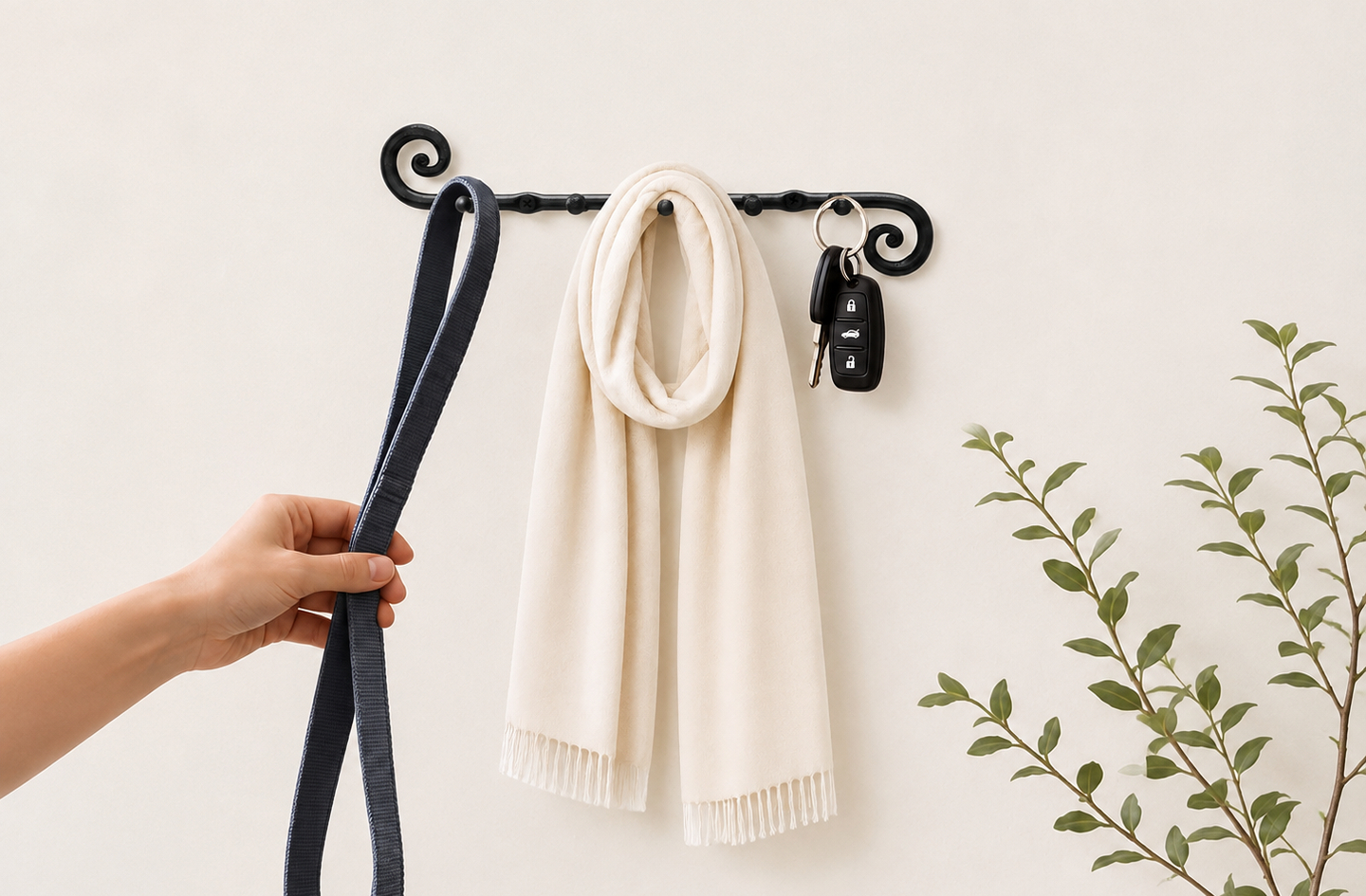
RTZEN finishes its forged iron with a similar stack: zinc galvanizing under a powder coat. The White Classic holder is finished in a clean white powder coating, with forged hooks along a sturdy horizontal bar.
Damp rooms and covered porches
A key holder near a bathroom, a laundry or a back door faces more moisture than one in a dry hall. The EPA advises keeping indoor humidity below 60 percent, ideally between 30 and 50 percent, as part of its mold guidance6. By RTZEN’s reading, a drier room also slows rust at any chip in a finish.
Buy the finish stack, not the metal name. On galvanized steel, the AGA finds that zinc under a powder coat outlasts either layer alone.
Mounting Needs for Each Metal
Mounting changes less with the metal than with the load. A ring of keys is light, while a leash or a bag adds a sharp tug. This Old House calls for heavy-duty anchors and screws for anything over 25 pounds, and advises anchors that hold four times the hung weight7.
Weight for size is nearly equal across the three metals, so the holder itself rarely decides the anchor. What decides it is the heaviest thing the hooks will carry, multiplied by that four-times margin.
Cast iron: snug the screws, never crank them
A cast holder’s mounting holes sit in the same brittle metal as its hooks. By RTZEN’s reading, overtightening a screw against an uneven wall can crack a cast mounting ear. Drive screws until snug and shim any gap behind the plate. Keep cast holders for keys and other light items.
Forged iron and steel: plan for the leash and the bag
Forged and steel hooks tolerate sudden pulls, so the weak point moves to the wall, and that’s where the planning goes. Family Handyman tested seven drywall anchors in half-inch drywall and found that all lived up to their claims, and all but one exceeded the rating8. Claimed ratings ran from 22 to 90 pounds, and tested results from 80 to 180 pounds8.
By RTZEN’s calculation, applying the four-times rule to those claimed ratings gives working loads of 5.5 to 22.5 pounds per anchor78. Keys never approach that, but a sudden pull on a leash is a different kind of load. When a leash or a heavy bag lives by the door, a separate hook fastened into a stud carries it best.
Vertical and narrow holders
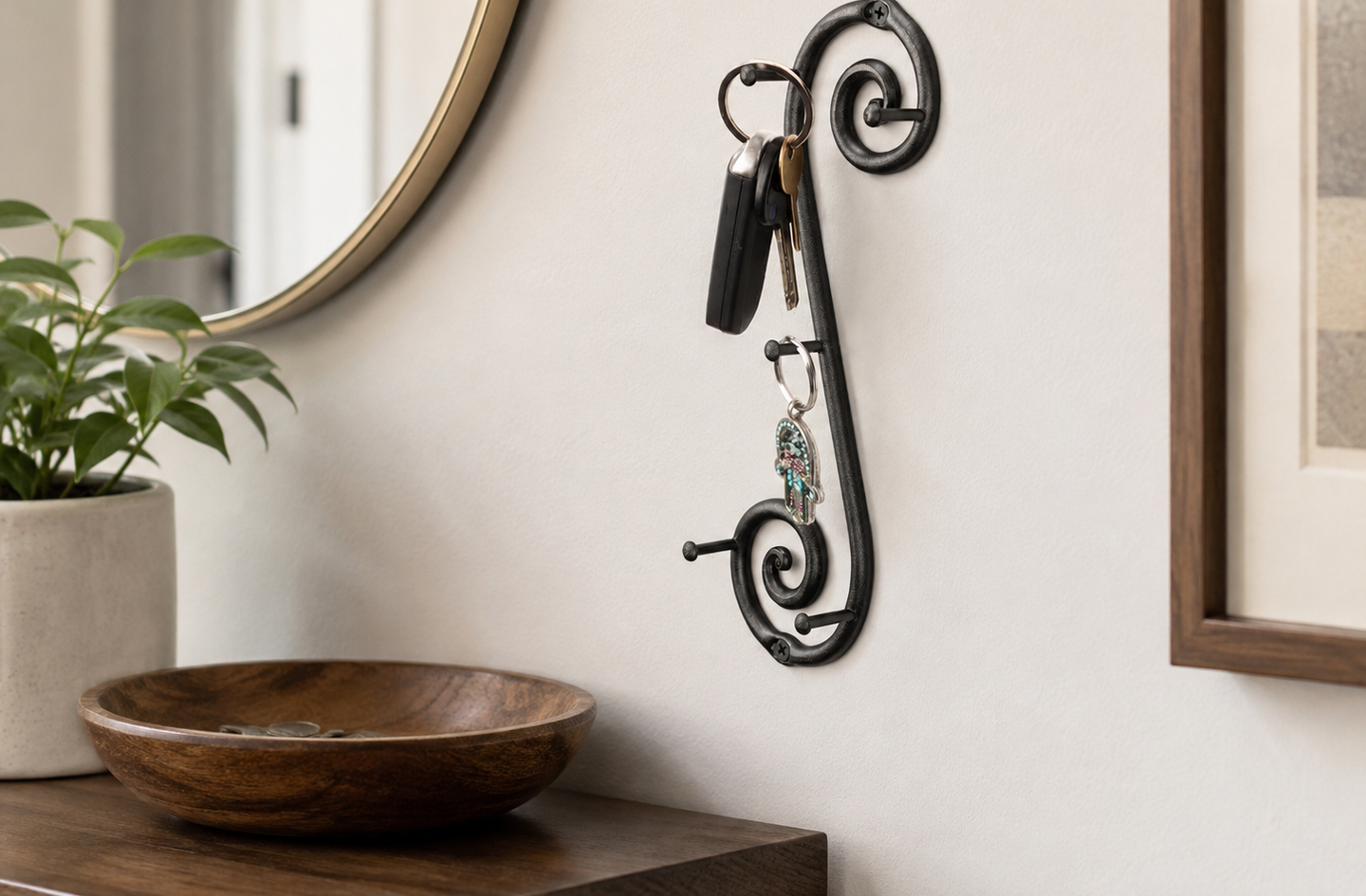
A vertical holder puts its screws one above the other, which suits a narrow strip of wall beside a door frame. The Black Infinity holder fits this layout, with an infinity-inspired loop and staggered hooks along a slender frame, and wall mounting screws included. For more narrow-wall layouts, see the compact key holder ideas.
Wall type matters as much as the metal. For drywall, plaster and wood studs, the key holder mounting guide walks through pilot holes, anchors and leveling surface by surface.
Match the anchor to the heaviest daily load, not to the metal, and give a cast holder only the light jobs it handles well.
Cost and Long-Term Value
Forged iron costs the most to make, and cast iron costs less per piece once the pattern exists. Stamped steel is the quickest to produce in volume. The NPS notes that architects valued cast iron partly because the repetitive nature of railings allowed efficient use of molds1.
Hand-forging repeats the heating, hammering and bending for every piece, and that labor is the honest reason a forged holder carries a higher price. Stamping and laser cutting shape steel quickly, while casting spreads the cost of one pattern over many copies.
Long-term value depends on toughness and finish more than on the purchase price. A brittle hook that snaps or a thin plate that rusts through needs replacing, while a tough, well-coated forged holder keeps working. RTZEN backs its hand-forged pieces with a Lifetime Warranty against material and workmanship defects under normal use.
The holder that costs least to make rarely costs least to own, because toughness and the finish stack decide how often it gets replaced.
Who Should Choose Which Key Holder
Choose cast iron for sculptural detail and light keys, forged wrought iron for daily loads and hand-made character, and steel for flat modern outlines. Five household profiles turn that rule into a quick match.
- Keys only, in a dry hallway: any of the three works. Choose by look, then check the edges and the finish.
- Keys plus a dog leash or a bag: choose forged iron or steel, because their toughness handles sudden pulls that a brittle casting resists poorly.
- Farmhouse, rustic or vintage rooms: forged scrolls and twists fit naturally, and cast relief suits a heritage look when the load stays light.
- Modern or minimalist rooms: cut steel outlines or a plain forged bar keep the look clean.
- Damp entries and covered porches: choose any metal with zinc under a powder coat, and skip painted bare iron.
If none of these fits, the deciding question is load. Light loads allow any metal; heavy, sudden loads point to forged iron or steel on a stud or a rated anchor.
Verdict by Category
Hand-forged metal wins overall for a key holder that also carries daily gear, because it combines toughness with hand-shaped detail. Cast iron and steel each win a category of their own.
| Category | Winner | Why |
|---|---|---|
| Toughness under sudden load | Wrought iron and steel | Tough in tension; cast iron is brittle |
| Weight for size | Tie | Densities sit within a narrow band |
| Sculptural relief | Cast iron | Molds copy deep, repeated detail |
| Scrolls, twists and character | Hand-forged iron or steel | Heated, hammered and bent by hand |
| Flat, precise outlines | Steel | Cut or stamped from sheet |
| Rust protection | Tie, decided by finish | The coating, not the metal, resists rust |
| Repair after damage | Forged iron or steel | A smith can reheat and rework it |
| Overall | Hand-forged iron or steel | Best mix of toughness and craft |
The overall verdict assumes daily use with a leash or a bag on the hooks. For keys alone in a dry room, the choice is mostly a matter of style, and any well-finished holder of the three metals serves.
Frequently Asked Questions
Is a cast iron key holder stronger than a wrought iron one?
Not for hanging. Cast iron is strong in compression but much weaker in tension, and the NPS describes it as brittle, with 2% to 4% carbon1. The top face of a loaded hook arm is in tension, so a forged hook deforms under overload where a cast one can crack. Cast iron suits light keys and sculptural designs.
Is modern wrought iron really iron or steel?
Mostly low-carbon steel. True wrought iron carries no more than 0.035% carbon. By 1992 the NPS reported that very little was produced, and most metal sold under the name was mild steel1. For a key holder, the method matters most: metal heated and hammered into shape, then protected by its finish.
Will a wrought iron or steel key holder rust indoors?
Bare iron and steel rust in damp air, and a zinc coating under the paint slows that. The AGA reports that hot-dip galvanizing, one type of zinc coating, generally corrodes at about 1/30 the rate of bare steel in the same environment4. For mold control, the EPA advises indoor humidity below 60 percent6; by RTZEN’s reading, drier air also slows rust at chips.
How can you tell cast iron from forged iron or steel?
Look for the making marks. Cast pieces show molded relief and sometimes a seam. Forged pieces show tapered ends, scrolls and hammer texture, and cut steel shows flat faces with square edges. The NPS notes that a magnet reveals iron even under paint or rust1, but it sticks to all three.
Which key holder metal is the lightest for its size?
Cast iron can be slightly lighter. Engineering ToolBox lists cast iron at 6,800 to 7,800 kg/m3 against 7,850 for steel2. By RTZEN’s calculation, that gap stays under 2 ounces on a 10-inch solid rail2. Thickness and design change the weight far more than the metal does.
Limitations and Edge Cases
- The density and stiffness figures are handbook values from Engineering ToolBox23. A real key holder also varies with its exact alloy, thickness and heat treatment.
- The NPS survey describes historic architectural iron, published in 19921. Its wrought iron figures describe the traditional material, while most modern decor sold as wrought iron is mild steel.
- The AGA figures describe hot-dip galvanized steel45, and thinner zinc plating falls outside them. The anchor figures come from one slow-pull test in half-inch drywall8. The products named here list no weight capacity, so no load figure is claimed for them.
References
Methodology: every sourced figure comes from an independent published source and links to the page that carries it. Weights and working loads derived from those sources are labeled as RTZEN’s calculations, and co-founder Rami Abramson reviewed the article.
- National Park Service – Metals in America’s Historic Buildings: Uses and Preservation Treatments, Chapter 7: Iron and Iron Alloys, Part I by Margot Gayle and David W. Look, 1992.
- Engineering ToolBox – Metals and Alloys: Densities, table of densities in kg/m3.
- Engineering ToolBox – Young’s Modulus of Elasticity: Values for Common Materials, with ultimate tensile and yield strengths.
- American Galvanizers Association – How Long Does HDG Last?, last updated October 2019.
- American Galvanizers Association – Duplex Systems: Paint or Powder Coating over HDG, knowledgebase article, updated 2025.
- U.S. Environmental Protection Agency – A Brief Guide to Mold, Moisture and Your Home.
- This Old House – How To Hang Something Heavy On a Wall, Jim Gorman, updated June 7, 2026.
- Family Handyman – How Much Weight Can Drywall Anchors Hold?, Jason Ingolfsland, updated October 28, 2024.
Conclusion
A cast iron key holder, a wrought iron key holder and a steel one weigh almost the same and all rust when bare. What really changes is the making: cast iron brings molded detail but brittleness, forged iron brings toughness and hand-shaped curves, and steel brings clean outlines. Choose the method for the load, then insist on zinc under a powder coat. Hand-forged iron finished that way keeps a key holder working for years, backed by a Lifetime Warranty.
For the wider context of choosing a key holder for the home, see the key holders overview.