
Curtain tie backs come in two families: soft tiebacks that wrap around the fabric, and rigid metal holdbacks that cradle it against the wall. This article sits under the curtain holdbacks overview and answers one narrower question: which of the two suits a given window, curtain and household. The choice matters because a drape only lets in winter sun when it is held fully open. Windows account for 25% to 35% of the heat lost from a typical single family home1. The comparison here weighs grip, daily use, drape shape, safety, durability and style.
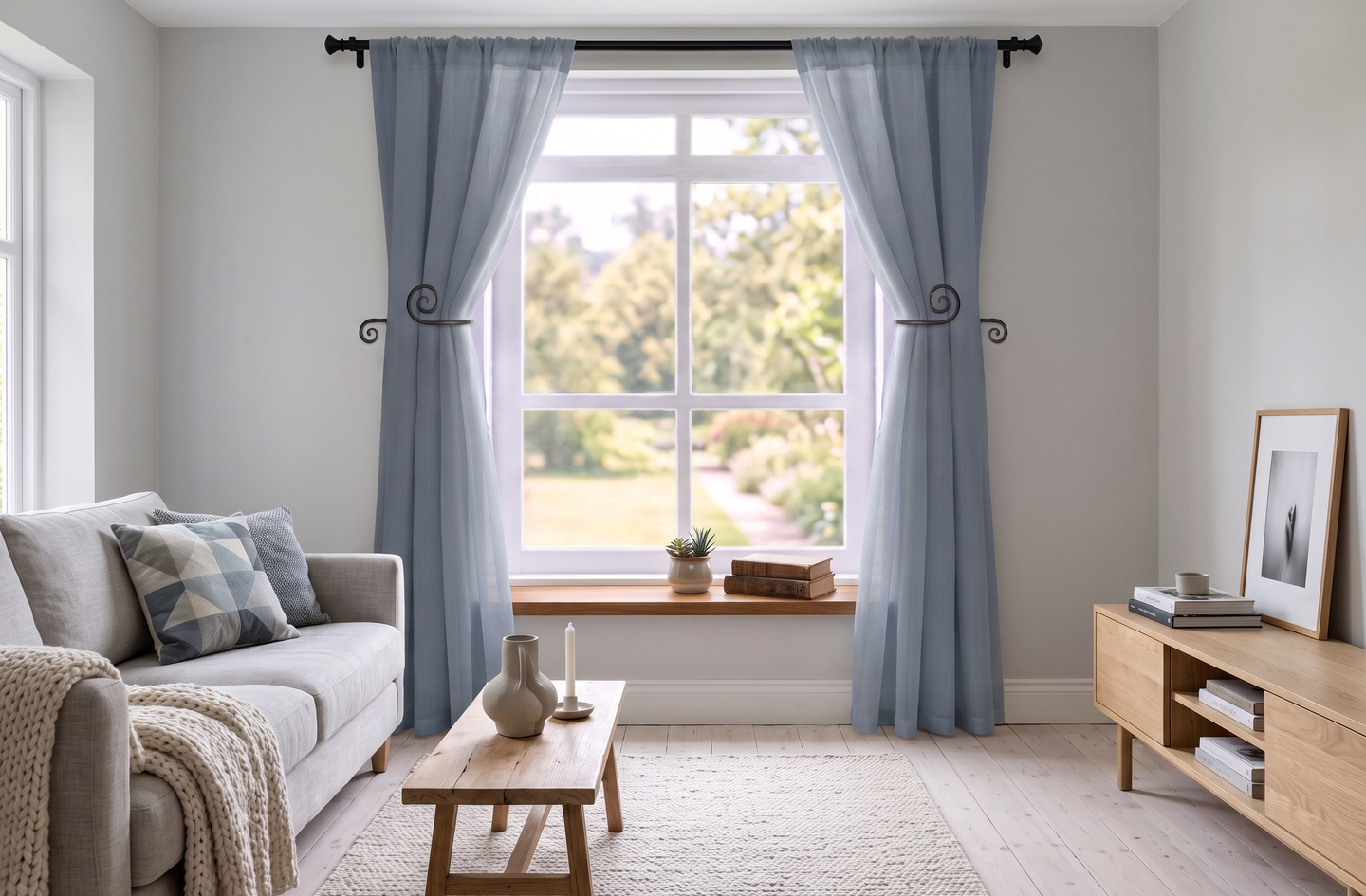
Quick Answer
Should you pick a soft tieback or a metal holdback?
Pick a rigid metal holdback for lined or heavy drapes that open every day, because it screws into the wall, never slips and releases with one hand. Pick a fabric, rope or magnetic tieback for sheers and light panels, where a soft cinch looks right. Check fullness first: panels sized at 2 to 2.5 times the window width3 gather into a large bundle, so a holdback needs a deep enough arm.
Key Takeaways
- Soft tiebacks hold more loose fabric. Metal hook tiebacks hold less material than fabric ones and can struggle with thick, heavy drapery5, so holdback size has to match the bundle.
- A rigid holdback wins on daily handling and safety, since it has no loop or cord. Window cord entanglements in young children were fatal in 67.1% of the incidents studied7.
- Placement shapes the drape more than the hardware does: the classic rule sets the tie point a third of the way up, or 33 inches on a 100-inch drape5.
- Holding curtains fully open by day is how drapes earn solar heat; conventionally hung draperies cut window heat loss by no more than 10 percent1.
- The most common misconception is that tiebacks and holdbacks are interchangeable decor. They hold fabric in different ways and suit different curtains.
Soft Tiebacks and Metal Holdbacks: The Options Defined
Five common ways to hold a curtain open fall into two groups, and the group decides how the fabric is held. Soft tiebacks wrap the fabric and hang from a small wall hook. Metal holdbacks are fixed arms that the fabric rests behind. Each option below is defined in plain terms, so the comparison that follows uses the same words throughout.
Fabric and Rope Tiebacks
A fabric tieback is a band of cloth, braid or rope that loops around a gathered curtain and hooks onto a small fixture on the wall. Rope versions often end in a tassel. The band can be loosened or tightened, so one tieback fits a thin sheer or a bulky velvet panel. The look is soft and tailored, with a pinched waist in the drape.
Magnetic Tiebacks
A magnetic tieback is a fabric or cord strap with a magnet sewn into each end. It wraps the curtain and clips to itself with no wall fixture at all. Renters like it because nothing is drilled. The catch is grip: the hold depends on the magnet and on how much fabric sits inside the loop.
Hook-and-Loop Tiebacks
A hook-and-loop tieback is a strap that closes with a fabric fastener, one side covered in tiny hooks and the other in soft loops. It is quick to sew and easy to wash, and it is common on outdoor and nursery curtains. The fastener collects lint over time and loses grip as the hooks clog.
Rigid Metal Holdbacks
A curtain holdback is a rigid arm, knob or hook screwed into the wall beside the window, with the gathered curtain tucked behind it. Holdbacks come in iron, brass, steel and aluminum, in sizes matched to curtain thickness. Opening the curtain is one motion: sweep the fabric behind the arm. Closing it is the reverse, with nothing to tie.
Hook-Style Holders
A small metal hook can also serve a soft tieback, holding the loop of a cord or band. That hybrid sits between the two families: a soft wrap with a fixed anchor point. The tieback hook types article covers those hooks, their sizes and their wall anchors in detail.
The useful split is not soft versus hard but wrap versus cradle: a wrap squeezes the fabric, a cradle simply supports it.
Curtain Tie Backs Compared at a Glance
A metal holdback beats soft tiebacks on everyday handling, child safety and lifespan, while soft tiebacks win on fabric capacity and on a gentle, cinched look. The table sets the main differences side by side. Fullness and placement guidance comes from published design advice, and the safety rows draw on peer-reviewed injury research7.
| Factor | Fabric or rope tieback | Magnetic tieback | Hook-and-loop tieback | Rigid metal holdback |
|---|---|---|---|---|
| Best for | Sheers to medium drapes, formal swags | Light panels, rentals | Outdoor and nursery panels | Lined or heavy drapes opened daily |
| Wall fixture | Small hook, one screw | None | Small hook or none | Arm screwed to wall, two screws typical |
| Fabric capacity | Adjustable, highest | Fixed by strap length | Fixed by strap length | Fixed by arm depth and size |
| Open and close | Two hands, tie and untie | One hand, clip | Two hands, peel and press | One hand, tuck and lift |
| Drape shape | Pinched hourglass | Pinched hourglass | Pinched hourglass | Soft sweep, no pinch |
| Loop or cord hazard | Yes, on rope and tassel styles | Small magnets inside | Low | None |
| Main wear point | Fading and fraying | Magnet slip, strap wear | Lint clogging the hooks | Finish, and the wall anchor |
| Verdict | Wins on capacity and softness | Wins on no-drill install | Niche use | Wins on handling, safety, lifespan |
If the curtain moves every day, handling and safety outweigh softness, and the holdback column carries more of the decision.
Which Holds More Fabric?
Soft tiebacks hold more fabric, because a band or rope can be let out to fit any bundle, while a metal holdback is fixed in size. Published installation advice puts it plainly: metal hook tiebacks hold less material than fabric tiebacks and may not work well with thick, heavy draperies5. That is a sizing problem rather than a flaw, and it is solved by choosing the holdback to match the curtain.
The bundle grows with fullness. Design guidance sets the combined panel width at 2 to 2.5 times the width of the window for curtains that look ample when closed3. The same guidance notes that 1.5 times the pole width gives some fullness when the drapes are pulled back, but not much3. A full, lined drape therefore sends a wide stack of fabric to each side of the window, and the holdback arm must clear all of it.
Sizing a Metal Holdback to the Bundle
Match the arm to the curtain, not to the window. Medium holdbacks suit standard unlined or lightly lined panels. Large holdbacks, with a longer reach from the wall, suit thick velvet, blackout lining or two layered panels. A quick test helps: gather one panel by hand at the planned height and measure how far the bundle stands off the wall. The arm should reach past that depth with a little room to spare.
When a Soft Tieback Is the Better Fit
Very full curtains on a wide window can outgrow even a large holdback. A fabric tieback simply loosens to take the extra width, and it compresses the stack so less fabric covers the glass. For bay windows and floor-length drapes in heavy cloth, that flexibility is the reason designers still reach for soft tiebacks.
Capacity favors soft tiebacks, but only at the extremes; for a normal lined panel, a correctly sized holdback holds the whole bundle without strain.
Which Holds Heavy Drapes Steady?
A metal holdback holds heavy drapes steadier because it is fixed into the wall. The fabric rests on it rather than being squeezed by a strap that can slide. A magnetic tieback depends on two small magnets, and a full panel tugs them apart. A fabric tieback stays put once tied, but heavy cloth pulls the loop down its hook over time.
The wall fixing decides how steady a holdback stays. Independent anchor testing found a toggle-style anchor rated for 80 pounds held 180 pounds before the test rig ran out of travel2. In the same test, a ribbed plastic anchor rated at 22 pounds held 80 pounds2. A holdback rarely carries anything near those loads, since the rod still bears the curtain’s weight. The anchor matters because the holdback is pulled sideways every time the curtain is opened, and a loose plastic plug works free faster than a toggle.
Getting the Mounting Right
Drive the screws into a stud or window framing where one sits beside the window, and use the included anchors only in hollow drywall. Keep the fixing a short distance off the window trim so the screw does not split the casing. Brick, tile and plaster need a masonry bit and the matching plug. The heavy-duty curtain hooks comparison covers very heavy drapes that may call for a hook in place of a holdback.
For thick or layered panels, the Swirly holdbacks are built for standard and heavy drapery and ship with screws and drywall anchors. The same rule applies to any holdback: the fixing, not the arm, is usually what fails first.
For heavy drapes, steadiness comes from a rigid arm and a sound anchor together; a strap of any kind cannot match that.
Which Is Faster to Open and Close Every Day?
A metal holdback is the fastest option for daily use: one hand sweeps the curtain behind the arm in the morning and lifts it free at night. Magnetic tiebacks come close, since the strap clips shut in one motion. Fabric and rope tiebacks are the slowest, because each one must be untied, removed and refastened twice a day.
Speed matters most where curtains do real work. Cornell Cooperative Extension advises opening a drapery during the day and closing it at night, to gain solar heat and prevent heat loss1. That routine is easy with a holdback and tedious with a knotted tieback, so households with tied curtains tend to leave them in one position all season.
“Magnetic ties are especially great for spaces where you want to maintain the soft, casual feel of the room but still need a way to keep curtains out of the way.”
Joshua Smith, interior designer, speaking to Livingetc4
Where Each Option Fits in a Daily Routine
Bedrooms and living rooms, where drapes open every morning, suit holdbacks. Guest rooms and formal dining rooms, where curtains stay framed for weeks, suit fabric tiebacks, because the slower handling barely matters. Hook-and-loop straps suit outdoor curtains on a porch, where they are opened only on warm days.
Choose by how often the curtain moves: daily movement points to a holdback, occasional movement leaves the choice to style.
Which Shapes the Drape Better?
Soft tiebacks and metal holdbacks shape the drape differently, so the better choice depends on the look wanted. A tieback cinches the fabric into an hourglass with a crisp waist. A holdback cradles it, leaving a soft, open sweep with no pinch. Neither is wrong; the height of the tie point changes the result more than the hardware does.
The traditional rule places a tieback a third of the way up from the bottom of the curtain. On a 100-inch drape, that is 33 inches from the bottom5. Raising the tie point gives a fuller lower curtain and a longer sweep, while lowering it gives a fuller top. Those heights apply to both families, and the holdback placement guide works through window width and curtain length in detail.
Fullness turns into a concrete load for each tieback or holdback. Applying the 2 to 2.5 times fullness rule3 to three common window widths shows how much flat fabric each side has to gather, before any lining is counted.
Reading the Chart Before Buying
The fabric each side must gather grows quickly with window width. A wide window at full fullness sends a stack to each side that is far wider than the window frame itself. That is the point where a large holdback, or a soft tieback that can be let out, stops being optional.
For a tailored, formal look a tieback’s cinch is hard to beat; for a relaxed, modern window, a holdback’s open sweep looks more natural.
Which Helps More With Light and Heat?
Neither family insulates a window by itself, but the option that pulls the fabric fully clear of the glass lets in more daylight and winter sun. Cornell Cooperative Extension reports that conventionally hung draperies reduce window heat loss by no more than 10 percent1. Their value comes from being closed at night and fully open by day, so the hardware that holds them open is part of the energy routine.
The same fact sheet notes that lined draperies sealed at the top and sides, and reaching the sill or floor, can be up to 25% effective1. Sealed, lined drapes are thick, which brings back the capacity question: the heavier the curtain, the more the tie point has to gather. A holdback set just outside the window trim keeps that thick stack off the glass. A tieback placed too close to the frame lets the bundle shade the window edge.
Placement for Maximum Daylight
Mount the rod wide enough that the open stack sits on the wall rather than over the glass, then set the tie point on the wall beside the frame. The same rod and fullness guidance applies here unchanged. The aim is a clear pane from edge to edge when the curtain is open.
For light and heat, the hardware choice is a tie; the placement of the tie point decides how much glass the open curtain uncovers.
Which Lasts Longer?
A forged metal holdback outlasts every soft tieback, because it has no fabric to fade, no fastener to clog and no magnet to weaken. Soft tiebacks sit in the sunniest part of the room, right beside the glass, and they age with the curtain. A rope tassel frays, a fabric band fades, and a hook-and-loop strap loses grip as lint fills the hooks.
Metal holdbacks have their own wear point: the finish. Hollow stamped hardware with a single coat of paint chips and rusts near a damp window. Hand-forged wrought iron holds up because of how it is made. RTZEN holdbacks go through four steps: cut, hand-forge, zinc-galvanize, powder-coat. The zinc layer protects the iron if the outer coat is ever scratched, and the powder coat gives the finished color. Tsach Levy, who has run the workshop since 1997, forges each piece by hand, and the catalog-wide Lifetime Warranty covers material and workmanship defects under normal use.
Care for Each Type
Fabric tiebacks need washing on the curtain’s schedule, and rope tassels can only be brushed. Hook-and-loop straps need the hooks cleared with a stiff brush. A powder-coated iron holdback needs a dry cloth now and then, and a damp cloth with mild soap if it sits in a kitchen.
Over a decade a soft tieback is a replaceable textile, while a well-finished iron holdback is a fixture that stays on the wall.
Which Is Safer in a Home With Children?
A rigid metal holdback is the safer choice in a home with young children, because it has no loop, cord or small magnet. Window cords are a documented hazard: from 1990 to 2015, an estimated 16,827 window blind injuries among children under 6 were treated in U.S. emergency departments7. In the incident reports that study reviewed, two-thirds of cord entanglements ended in death, 67.1%7.
Those figures concern blind cords, not tiebacks, but the mechanism is the same: a loop of cord at child height. A rope tieback with a hanging tassel loop, left dangling when the curtain is closed, recreates it. Fabric bands are lower risk when they are removed or tied flat, yet they are still a loop near a low window or a crib.
The Magnet Question
Magnetic tiebacks remove the cord but add small magnets. Researchers estimated that 23,756 children presented to U.S. emergency departments with a suspected magnet ingestion from 2009 to 2019, with cases rising by an average of 6.1% a year8. Magnets sewn securely into a strap are hard to reach, but a worn or split strap in a nursery should be replaced.
For nurseries and children’s rooms, a holdback mounted above easy reach is the one option with no loop and no loose parts.
Which Suits Vintage, Decorative and Modern Rooms?
Both families cover a wide style range, so style is a tie that turns on the room. Soft tiebacks bring color and texture, from silk tassels in a formal dining room to linen bands in a cottage. Metal holdbacks bring line and finish. Black wrought iron suits farmhouse and rustic rooms, plain arms suit modern spaces, and ornamental forms suit rooms where the hardware is meant to be seen.
Decorative metal holdbacks have a long history. A brass holdback from the 1800s survives in the Historic New England collection. It measures 2.375 by 4.5 inches, with a molded flower terminus on a stem that screws into the wall6. That small, screw-mounted design is the ancestor of today’s vintage curtain tie backs, and it explains why ornamental knobs and flowers still read as period-correct in older homes.
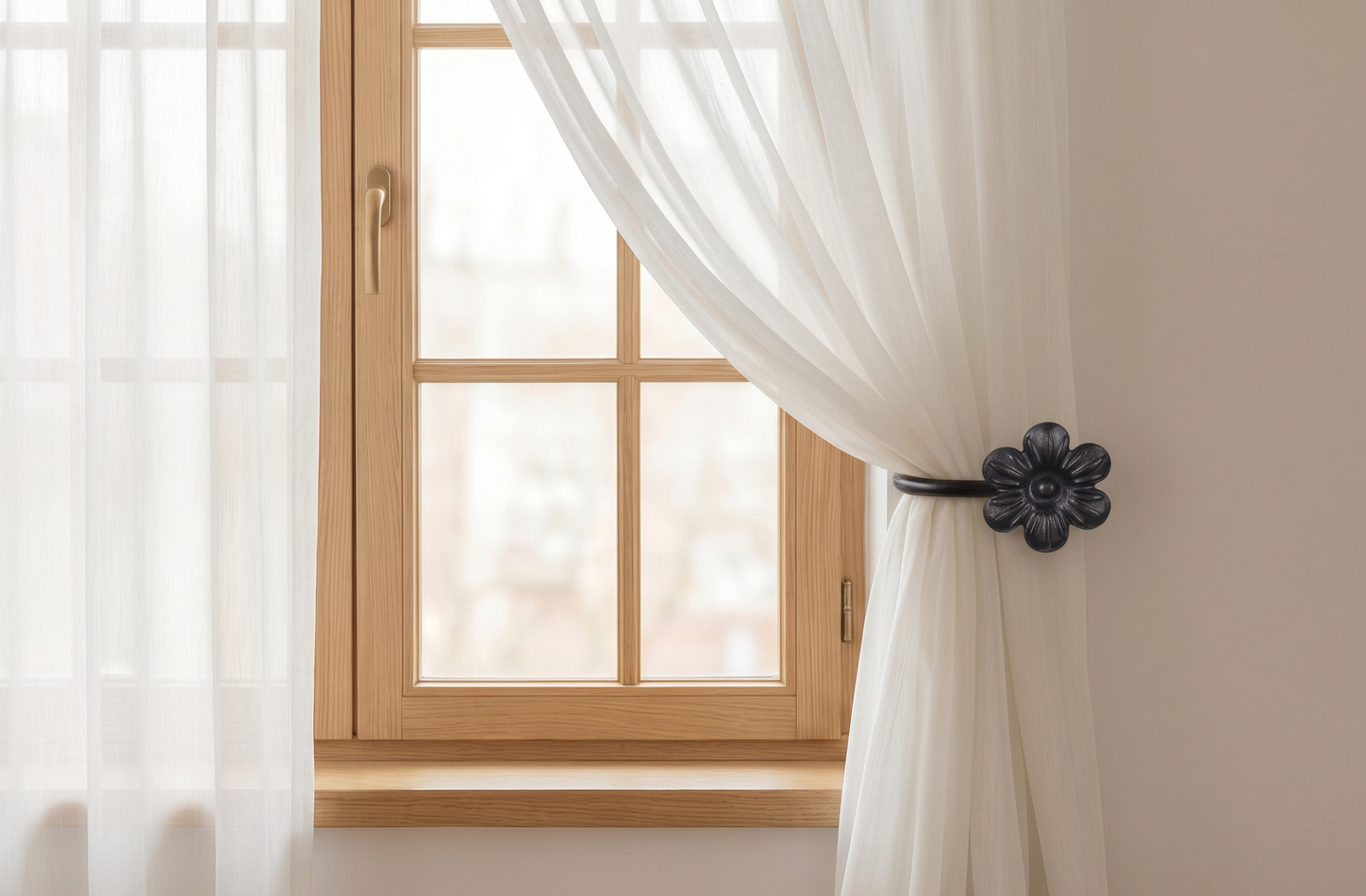
“These tend to be more understated than traditional tie-backs and a practical option to gather curtains neatly without the ornate finish.”
Joshua Smith, interior designer, on simple curtain holdbacks, speaking to Livingetc4
Matching the Holdback to the Room
For rustic and farmhouse rooms, black iron in a scroll or flower form repeats the dark notes of beams and hardware. The Flower holdbacks suit traditional and cottage windows, while coastal rooms take a motif such as the Starfish holdbacks. For modern rooms, a plain arm in black or white keeps the window quiet. The metal comparison covers how iron, steel, brass and aluminum differ in finish and character.
Pick soft tiebacks when the curtain fabric should star, and a metal holdback when the window hardware should.
Cost and Value Over Time
Soft tiebacks cost less to buy, and many curtains ship with a matching pair. A forged iron holdback costs more, and the price difference has a reason. Hand-forging, a zinc layer and a powder coat take more labor and material than a stamped shape with one coat of paint. The useful comparison is cost per year of service.
A fabric tieback is a textile that fades and is replaced along with the curtain. A hook-and-loop strap wears out sooner. A well-finished iron holdback stays on the wall through several sets of curtains, and RTZEN backs its holdbacks with a Lifetime Warranty. Installation is a one-time job with one drill and the included screws and anchors.
Soft tiebacks win on purchase price; a forged holdback wins on value once the curtains have been changed once.
Who Should Choose What
If the curtain is lined and opens every day, choose a metal holdback. If the curtain is a sheer or stays framed for weeks, a soft tieback is the better fit. The profiles below apply that rule.
- Families with young children: a rigid holdback mounted above easy reach, with no cord loop or magnet strap in the room.
- Renters who cannot drill: a magnetic tieback, checked now and then for split seams.
- Owners of heavy, lined drapes: a large metal holdback screwed into a stud or a rated anchor.
- Formal rooms with very full curtains: fabric or rope tiebacks that can be let out, kept tied flat when closed.
- Farmhouse, rustic and vintage interiors: black wrought iron holdbacks in a scroll, flower or motif form.
If neither fits, as with a curtain that never opens, skip the tie point and hang a fixed panel on its own.
Verdict: Category Winners
The metal holdback wins four of the seven categories, soft tiebacks win two, and one is a tie. The table summarizes the result.
| Category | Winner |
|---|---|
| Fabric capacity | Soft tieback |
| Steadiness with heavy drapes | Metal holdback |
| Daily open and close | Metal holdback |
| Drape shape | Soft tieback, for a cinched look |
| Light and heat | Tie |
| Lifespan | Metal holdback |
| Child safety | Metal holdback |
| Overall | Metal holdback, for curtains used every day |
Style and purchase price are left out of the count, since both depend on the room and the buyer. The overall rule holds: daily curtains suit a holdback, decorative and very full curtains suit a tieback.
Frequently Asked Questions
How high should curtain tie backs be placed?
About a third of the way up from the bottom of the curtain. On a 100-inch drape that puts the tie point 33 inches from the bottom5. A higher tie point gives a fuller lower curtain and a longer sweep; a lower one gives a fuller top. Use the same height on both sides.
Are metal curtain tie backs better than fabric ones?
For curtains opened every day, yes in most homes. A metal holdback screws to the wall, releases with one hand and has no cord loop. Fabric tiebacks hold more cloth, though, and metal hook tiebacks may not suit thick, heavy draperies5, so size the holdback to the curtain.
Can magnetic tiebacks hold heavy curtains?
Only light to medium ones. A magnetic strap has a fixed length and depends on two small magnets, so a full lined drape can pull it open. Curtains sized at 2 to 2.5 times the window width3 gather a large bundle, which suits a large holdback or an adjustable fabric tieback better.
Are rope curtain tie backs safe in a child’s room?
They carry a cord-loop risk, so a rigid holdback is the safer pick. An estimated 16,827 window blind injuries among U.S. children under 6 were treated in emergency departments from 1990 to 20157. If rope tiebacks stay, keep tassel loops short, out of reach and tied flat.
Do curtain tie backs help save energy?
Indirectly. Windows account for 25% to 35% of the heat lost from a typical single family home1. Drapes help most when closed at night and fully open on sunny days. A holdback that is quick to use makes that routine easy and keeps the open stack off the glass.
Limitations and Edge Cases
- The comparison assumes a curtain hung from a rod or track that opens and closes; fixed decorative panels that never move need no tie point at all.
- The safety figures come from U.S. research on window blind cords and magnet ingestion; they describe the hazard mechanism rather than tiebacks specifically.
- Very heavy blackout-lined drapes on tall windows can exceed what a decorative holdback should carry, and a heavy-duty hook is the better fixture there.
References
Methodology: every figure in this article comes from an independent published source linked below, each source was checked live and read for its supporting sentence on October 7, 2026, the fabric-per-side chart was calculated by RTZEN from the published fullness rule, and the article was reviewed by RTZEN co-founder Rami Abramson.
- Cornell Cooperative Extension – Energy Saving Window Treatments, Housing Fact Sheet, Department of Design and Environmental Analysis.
- Family Handyman – Drywall anchors weight tested, Jason Ingolfsland, updated October 2024.
- Homes and Gardens – How to measure for curtains, Sarah Warwick, updated May 2025.
- Livingetc – My Friends Keep Asking Me If Curtain Tie-Backs Are Old-Fashioned, Seraphina Kyprios, with comments from interior designer Joshua Smith, July 2025.
- Hunker – The Average Height for Curtain Tiebacks, Linda Erlam, May 2011.
- Historic New England – Curtain Hold-back, Rundlet-May House collection, 1800s, via Digital Commonwealth.
- Pediatrics – Pediatric Injuries Related to Window Blinds, Shades, and Cords, Onders, Kim, Chounthirath, Hodges and Smith, January 2018.
- Journal of Pediatric Gastroenterology and Nutrition – Magnet Ingestions in Children Presenting to Emergency Departments in the United States 2009-2019, Reeves, Rudolph and Nylund, December 2020.
Conclusion
Soft tiebacks and metal holdbacks solve the same problem in different ways. Soft tiebacks wrap and cinch, hold the most fabric and suit decorative or rarely moved curtains. A rigid metal holdback cradles the drape, opens with one hand and has no cord loop. It also lasts through several sets of curtains, which makes it the stronger choice for windows used every day.
For the wider context of choosing and installing holdbacks, see the curtain holdbacks overview.