
A key holder for wall decorative use has two jobs: it has to suit the room, and it has to catch keys at a glance every single day. The style question is simpler than it looks. Transitional, the most popular kitchen style in the 2026 Houzz study, held 25% of style changes and blends classic and modern lines1. This comparison sits under the key holders overview and covers one angle in depth. It compares seven looks, from modern and farmhouse to bohemian and minimalist, on hook spacing, visibility, finish durability, wall fit and mounting.
Quick Answer
Which decorative key holder style keeps both the look and the function?
A classic or transitional silhouette in black or white iron suits the widest range of rooms. Transitional led kitchen style changes at 25% in both the 2025 and 2026 Houzz studies12. Choose the style second. First confirm open hooks with room for each key set, a zinc and powder coat finish, and solid fixings for the wall you have.
Key Takeaways
- Transitional held the lead at 25% in both Houzz kitchen studies, while traditional slipped from 14% to 12%12. A holder that bridges classic and modern lines fits most homes.
- Farmhouse dropped to 7% of kitchen style changes in the 2025 Houzz study2, so a light farmhouse piece will age better than a heavily themed one.
- Galvanizing under powder coating can last 1.5 to 2.3 times the combined lifetimes of both coatings3, which is why the finish stack matters more than the color.
- About 43 percent of everyday actions repeat in the same context4, so open, visible hooks support the habit that keeps keys from going missing.
- The common mistake is choosing on silhouette alone: an object between 27 and 80 inches high may protrude only 4 inches into a walkway under the ADA standard7.
Quick Comparison: Each Key Holder for Wall Decorative Style Side by Side
Seven decorative looks cover nearly every key holder on the market, and each one changes how the holder works as well as how it looks. The table sets them side by side on the points that decide daily use. It lists the defining lines, the best finish, the hook layout, the right rooms and the trap to avoid.
In decor, wrought iron refers to iron that is heated and shaped by hammering, bending and twisting, rather than poured into a mold or stamped from thin sheet. That process is why the same material can read as rustic, classic or modern. The smith decides the shape, so the style lives in the line of the metal, not in added ornament.
| Style | Signature lines | Finish that suits it | Typical hook layout | Best rooms | Watch for |
|---|---|---|---|---|---|
| Modern | Clean geometric loops, no added ornament | Black or white | Vertical or staggered | Entryway, apartment hall | Thin frames that flex under a bag |
| Farmhouse | Plain bar, forged hooks, light hammer texture | Black or white | Horizontal row of five | Mudroom, kitchen door | Large sign boards that crowd the hooks |
| Rustic | Heavy forged texture, thick stock | Black or antique brushed zinc | Horizontal, widely spaced | Back door, cabin-style hall | Dark backboards that hide dark keys |
| Vintage | Swirl and scroll metalwork | Black or antique brushed zinc | Hooks along a base bar | Older homes, plaster walls | Fragile cast detail that snaps |
| Bohemian | Curves, loops, mixed textures | Black or white | Staggered or single hooks | Bedroom, studio corner | Fringe or beads that tangle key rings |
| Classic | Symmetrical bar, restrained scrolls | Black or white | Horizontal row | Front hall, home office | Can read plain in a busy room |
| Minimalist | Single bar or single hooks, no decoration | Matched to the wall or trim | Single hooks or a narrow column | Small entry, office door | Too few hooks for the household |
The style column decides the first impression, but the last two columns decide whether the holder still gets used a year later, so read the table from right to left.
Style Fit: Which Looks Bridge the Most Rooms
Transitional and classic silhouettes bridge the most rooms, because the style homeowners choose most often is itself a blend. In the 2026 Houzz kitchen study of 1,780 homeowners, transitional led style changes at 25%, followed by traditional at 12%, modern at 11% and contemporary at 10%1.
Transitional style is a blend of traditional and modern design: classic shapes with simpler, cleaner detailing and a calm palette. A key holder in that middle ground sits comfortably next to a shaker cabinet, a plain modern door or an antique console.
The year before, the 2025 Houzz study of 1,620 homeowners also put transitional at 25%, with traditional at 14% and modern at 12%2. The same study found farmhouse style falling out of favor at 7%2.
Kitchen data is a proxy, not a key holder survey. Still, the kitchen is the room where homeowners most often make a deliberate style choice, and the entry hall usually sits next to it. A holder that matches the kitchen’s style family will rarely clash in the hall.
The stable leader is the blend, not a single theme, so a classic or transitional key holder is the lowest-risk choice for a home that will be redecorated around it.
Seven Decorative Looks, Judged on Daily Function
Each decorative look carries a typical strength and a typical weakness in daily use, and knowing both avoids buying a piece that photographs well but works badly. The short profiles judge every style on the same test: can a tired person hang and find a key set in two seconds?
Modern
Modern key holders use clean loops and geometric frames with no added ornament. The vertical format suits narrow walls, and a staggered hook pattern keeps rings from touching. The risk is a frame drawn too thin, which flexes once a bag joins the keys. Forged stock avoids that problem while keeping the slim profile.
Farmhouse
Farmhouse pieces favor a plain bar with sturdy hooks and a light hammered texture. They work hard in mudrooms because a straight row of five hooks takes keys, a leash and a cap together. The weak point is the oversized sign board that often comes with the look, which pushes the hooks out of easy reach.
Rustic
Rustic holders lean on heavy texture and thick forged stock, and they read well in a back hall or cabin-style entry. Their strength is load: thick iron shrugs off a loaded tote. Their weakness is contrast, since dark keys on a dark backboard vanish in low light, so pair a rustic piece with a light wall.
Vintage
Vintage designs use swirl and scroll metalwork that suits older homes and plaster walls. The Swirly key holder places hand-forged swirls above a row of forged hooks, so the ornament never sits where the keys hang. That separation is the test for any vintage piece: decoration above, working hooks below.
Bohemian
Bohemian styling mixes curves, loops and soft textures, and single scattered hooks fit its relaxed feel. The look suits bedrooms, where a hook can hold a necklace beside a spare key. Keep fringe, beads and macrame away from the hooks themselves, because key rings snag on loose fibers every time they are lifted off.
Classic
Classic holders use a symmetrical bar with restrained scrolls, and they are the easiest style to place in any room. The White Classic holder puts forged hooks along a horizontal bar in a white powder coat, which reads clean on a light wall. Its only weakness is restraint, since it can look plain in a busy, layered room.
Minimalist
Minimalist setups use a single bar or a few single hooks with no decoration at all. Matched to the wall or trim color, they almost disappear. The risk is capacity. Two or three hooks rarely cover a household with cars, a bike lock and a spare house key, so count key sets before choosing the smallest option.
Every style can work, but each fails in a predictable way, and checking for that one failure point before buying is worth more than any trend report.
Hook Spacing and Count: Which Layouts Hold the Most Without Crowding
A horizontal row of five forged hooks holds the most without crowding. Each hook gets its own column of space, so a key ring, a fob and a lanyard all hang straight. Vertical and staggered layouts win where wall width is short, since they trade width for height.
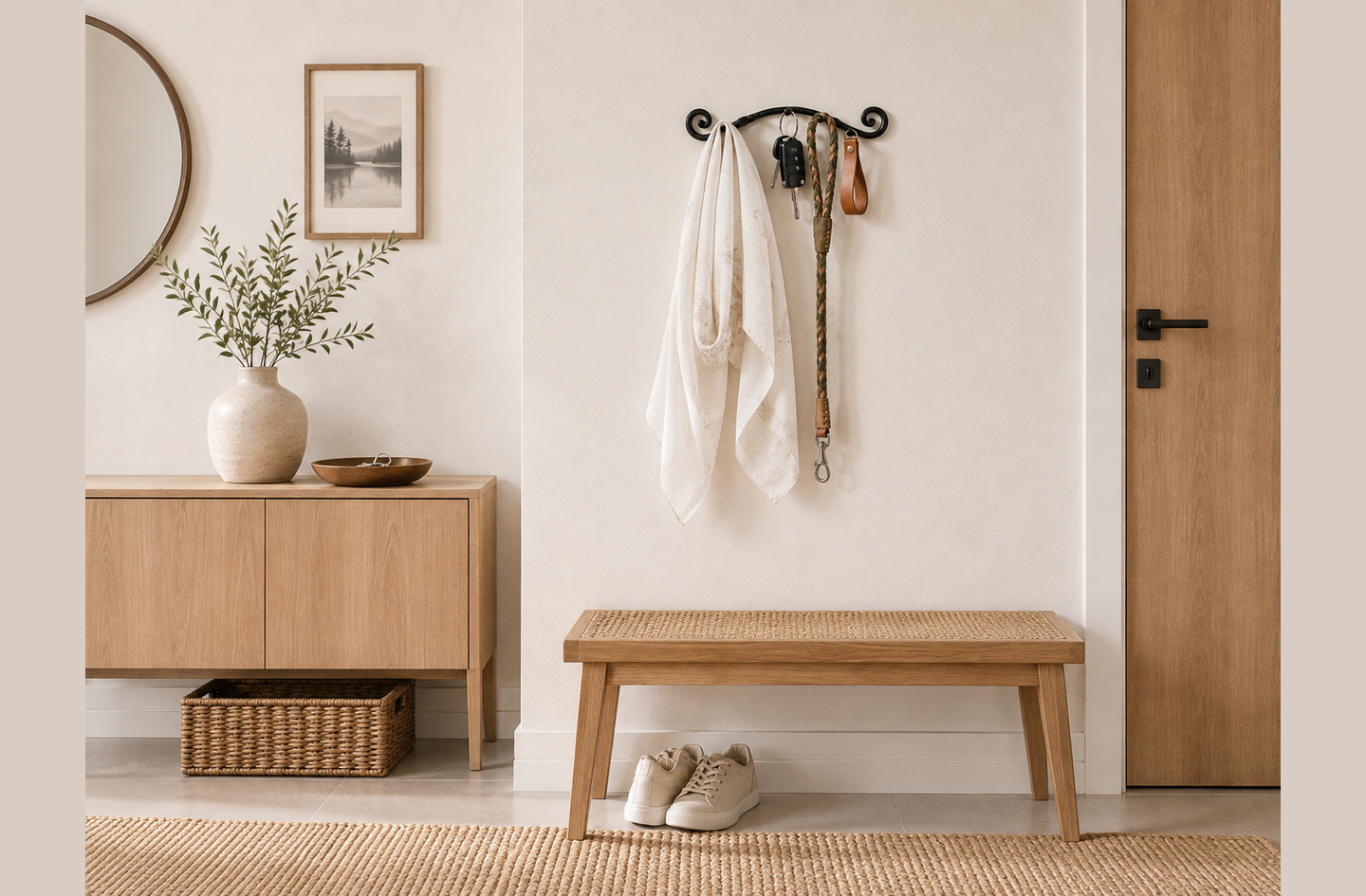
Hook spacing is the side-to-side distance between neighboring hook tips, and it decides whether two bulky key sets can hang without stacking. A ring with a car fob and a loyalty card is wider than it looks, and a leash clip or a bag strap needs more room again. The table gives working clearances for common items.
| Item on the hook | Side clearance to allow | Layout that suits it |
|---|---|---|
| Single key ring, no fob | About 1.5 inches | Any layout, including staggered |
| Key ring with car fob | About 2.5 inches | Horizontal row or wide stagger |
| Lanyard or badge clip | About 2 inches | Vertical column |
| Dog leash, folded | About 3 inches | End hook of a horizontal row |
| Small bag or tote strap | About 4 inches | End hook, never a middle hook |
Count the key sets before the hooks
Count one hook per adult key set, one for each shared item such as a leash or a spare car key, and one empty hook for guests. Most households land on five, which is why a five-hook bar is the common format across styles. A household with a leash and a tote should put the heavy items on the end hooks, so they never swing into the keys.
When a vertical layout wins
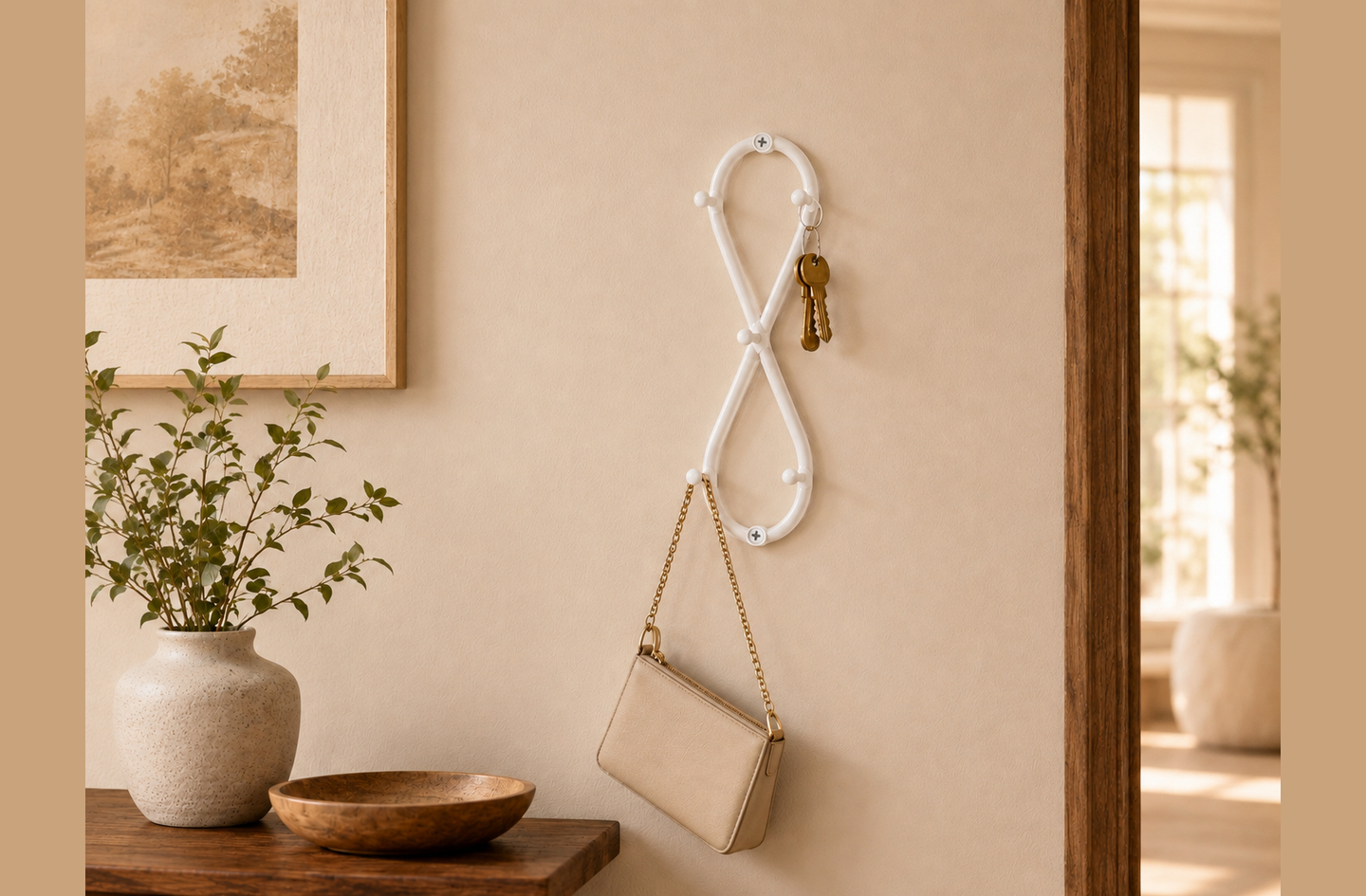
A vertical layout wins on a narrow strip of wall beside a door frame. The Infinity key holder staggers its hooks along a slim infinity loop, so rings hang at different heights instead of side by side. For walls with even less room, the guide to compact key holder ideas compares narrow formats in detail.
Buy for the busiest morning, not the average one: a holder with one spare hook stays tidy, while a holder with exactly enough hooks fills up within a month.
Visibility: Which Designs Keep Keys in Sight
Open-hook designs keep keys in sight better than boxes, cabinets or closed trays. A key that can be seen from the doorway is a key that gets hung and found. Habit research explains why the visible spot matters.
“About 43 percent of everyday actions are done repeatedly almost every day in the same context,”4
Wendy Wood, psychologist and habit researcher, University of Southern California, speaking to NPR’s Hidden Brain4
Hanging keys is one of those repeated actions, and a visible hook in the same place every day is what turns it into an automatic one. Losing keys has a real cost: Consumer Reports found that replacing a modern key fob can run from $50 to as high as $400, plus $50 to $100 for programming5.
Contrast between finish and wall
Contrast decides how fast the eye finds the hooks. Black iron on a white, cream or beige wall stands out from across a hall, while white iron disappears into the same wall. White and antique brushed zinc finishes earn their place on darker paint, wood paneling and brick, where black would vanish.
Keep ornament away from the hooks
Decoration should frame the hooks, not crowd them. Scrolls, leaves and swirls work best above the hook line, where they draw the eye without catching a ring on the way down. Where the holder goes in the room matters too; the guide on where to put key hangers compares entryway, bedroom, kitchen and office spots.
The most decorative holder is worth nothing if keys still end up on the counter. Choose the finish for contrast with the wall first and for the room’s style second.
Finish Durability: Which Coatings Keep the Look Longest
A zinc layer under a powder coat keeps a decorative finish looking right far longer than paint alone. The American Galvanizers Association reports that paint or powder coating over galvanized steel can last 1.5 to 2.3 times the combined lifetimes of both systems3.
Powder coating is a dry, finely ground resin that is sprayed onto metal and then baked so it melts and cures into a hard, even skin. A duplex system refers to a powder coat or paint layer applied over zinc galvanizing. The outer layer shields the zinc, and the zinc protects the iron if the coating is ever chipped.
Every RTZEN key holder goes through four steps in the workshop: cut, hand-forge, zinc-galvanize, powder-coat. That finish stack applies the same two-layer principle the galvanizing research describes. For a key holder, the practical test is the chip. A key ring knocks the lower edge of each hook thousands of times, and a bare-paint finish rusts at the first chip.
| Finish | Styles it suits | Walls it reads best on | Daily-use note |
|---|---|---|---|
| Black powder coat over zinc | Modern, farmhouse, rustic, vintage, classic | White, cream, beige, light wood | Hides scuffs; strongest contrast on light walls |
| White powder coat over zinc | Classic, minimalist, bohemian, modern | Dark paint, wood paneling, brick | Shows grime sooner; wipe with a damp cloth |
| Antique brushed zinc | Vintage, rustic, transitional | Gray, green, warm neutrals | Soft metallic tone that pairs with mixed metals |
| Paint only, no zinc layer | Any | Any | Rust starts at the first chip on a hook edge |
Color is a style choice, but the layer under the color is a durability choice, so ask what sits beneath the paint before comparing shades.
Wall Fit and Projection: Which Shapes Suit Tight Walls
Flat-backed shapes with short hooks suit tight walls best, because projection, not width, is what people bump into. Under the ADA standard, objects with leading edges between 27 and 80 inches above the floor may protrude no more than 4 inches into a circulation path7.
Projection is how far the holder and its loaded hooks stand out from the wall surface. A bare hook can sit inside the limit, but keys, a fob and a bag strap add depth, so measure the loaded depth rather than the product’s empty profile.
Horizontal bars versus vertical columns
Horizontal bars need open wall width but keep everything at one comfortable height. Vertical columns fit beside a door frame or between a switch and a corner, but the lowest hook can drop below easy reach for adults. Swirl and scroll designs add width at the ends, so leave space for the ornament as well as the bar.
Height belongs to the household
Mounting height affects both reach and how the style reads in the room. The guide to key holder height and placement covers the measured height range, door swing and switch clearance for every room.
On a hallway wall, the slimmest loaded profile wins over the prettiest one, because a holder that catches a sleeve every morning soon comes down.
Mounting and Load: Which Holders Stay Put
Solid forged holders with two or more screw points stay put, as long as the fixing matches the wall and the load. This Old House advises heavy-duty anchors and screws for any item weighing more than 25 pounds8. A key holder that also carries a loaded tote can approach that figure.
Anchors usually hold more than their package claims. In Family Handyman tests in half-inch drywall, a ribbed plastic anchor claimed 22 pounds and held 80 pounds, while a snap toggle claimed 80 pounds and held 180 pounds6. A stud is still the best fixing of all, and a simple tap test finds one without tools.
“The sound and the pitch goes from a little hollow, low pitch to something a little higher.”8
Tommy Silva, This Old House general contractor, describing how a knock on drywall changes over a stud8
Decorative weight changes the fixing
Heavy rustic and vintage pieces weigh more than slim modern frames, and their weight sits further from the wall. Use the included screws and anchors on drywall for keys alone, and step up to toggles or a stud when the holder also carries a leash and a bag. Surface-by-surface steps for drywall, plaster and wood are in the guide on mounting a key holder.
The wall decides the fixing and the heaviest item decides the anchor, so plan for the tote, not just the keys.
Value Over Time: Forged Iron Against Stamped Decor
Hand-forged iron costs more than stamped decorative metal, and the difference pays back through years of daily use rather than at the checkout. Stamped holders are cut from thin sheet and painted once, so the hooks bend under a loaded bag and the paint chips at the hook edge.
Forged hooks are shaped from solid stock, then zinc-galvanized and powder-coated, which is slower and more expensive work. RTZEN has done that work in a family workshop since 1997, led by master blacksmith Tsach Levy and co-founder Rami Abramson. Every piece is backed by a Lifetime Warranty that covers material and workmanship defects under normal use.
A key holder is touched more often than almost any other piece of decor in the house, so it is the wrong place to save on materials.
Who Should Choose Which Style
The simplest decision rule is to match the holder to the household first and the decor second. These profiles cover the common cases.
- Families with a dog: choose a farmhouse or classic horizontal bar with five hooks, so the leash takes an end hook and the keys stay clear.
- Renters and small apartments: choose a modern vertical piece or a minimalist bar, which fits a narrow strip of wall and leaves few holes to patch.
- Owners of older homes: choose a vintage swirl design in black or antique brushed zinc, and fix it to the lath or a stud rather than to the plaster alone.
- Mixed or changing decor: choose a classic or transitional silhouette in black, the finish that sits comfortably beside the widest range of styles.
- Bedroom or studio use: choose a bohemian arrangement of single hooks for keys, jewelry and a light bag, kept away from soft hangings.
When two styles seem equally right, pick the one with the better hook layout for the household. The eye adjusts to a style within weeks, while a cramped layout annoys every day.
Verdict: Category Winners for a Decorative Key Holder
Classic and transitional silhouettes win overall, with farmhouse close behind for busy households. The table lists the winner in each category of this comparison.
| Category | Winner | Runner-up |
|---|---|---|
| Style fit across rooms | Classic | Modern |
| Hook spacing and count | Farmhouse | Classic |
| Visibility | Minimalist | Classic |
| Finish durability | Any style with zinc under powder coat | Antique brushed zinc |
| Tight walls | Modern vertical | Minimalist |
| Load and mounting | Rustic | Farmhouse |
| Overall | Classic or transitional in black | Farmhouse |
No single style wins every category, which is the clearest sign that the household’s needs, not the trend, should break the tie.
Frequently Asked Questions
What is the most versatile style for a decorative key holder?
A classic or transitional silhouette is the most versatile choice. Transitional style led kitchen style changes at 25% in the 2026 Houzz study1, and it blends classic and modern lines. A plain forged bar with restrained detail in black suits most entryways, offices and kitchens.
Is farmhouse style still a good choice for a key holder?
Yes, when it is kept light. Farmhouse fell to 7% of kitchen style changes in the 2025 Houzz study2, so heavy themed pieces with large sign boards can date a hallway. A simple black bar with forged hooks keeps the farmhouse feel and works with other styles too.
Does a powder-coated key holder rust?
A powder coat alone can rust once it chips, but a powder coat over zinc resists far longer. Coating over galvanized steel can last 1.5 to 2.3 times the combined lifetimes of both systems3. The zinc layer keeps protecting the iron at a chipped hook edge.
How far should a decorative key holder stick out from the wall?
In a walkway, keep the loaded holder within 4 inches of the wall. The ADA standard limits objects between 27 and 80 inches above the floor to that protrusion7. Measure with keys and bags on the hooks, because the loaded depth is what people bump into.
Can drywall anchors hold a key holder with a bag on it?
Yes, with the right anchor. In Family Handyman tests, a snap toggle rated at 80 pounds held 180 pounds in drywall6. For keys alone the included anchors are enough; for a leash and a loaded tote, use toggles or screw into a stud.
Limitations and Edge Cases
- The style shares come from Houzz kitchen remodel studies of U.S. homeowners, so they show style preference in one room and one country, not key holder sales.
- The hook clearances are workshop guidance for common items; very large fobs, tagged keys, or several keychains on one ring need wider spacing.
- Outdoor porches and damp mudrooms put more stress on any finish than an indoor hall, so the finish advice here assumes indoor use.
References
Methodology: every figure in this comparison comes from an independent published source and links to the page that carries it, the style and clearance guidance is RTZEN workshop synthesis marked as such, and the article is reviewed by co-founder Rami Abramson.
- Houzz – 2026 U.S. Houzz Kitchen Trends Study, Houzz Research, January 13, 2026.
- Houzz – 2025 U.S. Houzz Kitchen Trends Study, Houzz Research, January 9, 2025.
- American Galvanizers Association – Painting Galvanized Steel: Duplex Coating Systems, updated July 2025.
- NPR – Building Better Habits And Breaking Bad Ones, Hidden Brain, December 11, 2019.
- Consumer Reports – How to Replace Your Car’s Key Fob.
- Family Handyman – How Much Weight Can Drywall Anchors Hold In Your Home?, Jason Ingolfsland, 2024.
- U.S. Access Board – ADA Accessibility Standards, section 307.2 Protrusion Limits.
- This Old House – How To Hang Something Heavy On a Wall.
Conclusion
The best decorative key holder is the one whose style suits the room and whose hooks, finish and fixings suit the household. Classic and transitional silhouettes in black bridge the most rooms, farmhouse bars carry the most, and a zinc layer under the powder coat keeps any style looking right for years.
For the wider context of key storage, see the key holders overview, which summarizes how key holders work across the home.