
Deciding where to hang key holder hooks comes down to two numbers: how high the hooks sit and how far they are from the door. For most adults, a hook center 60 to 66 inches above the floor puts hanging keys close to eye level. The reason is body height: the average U.S. woman stands 63.5 inches tall and the average man 68.9 inches2. This guide sits under the key holders overview and covers one question in depth: mounting height and position. It walks through shared-family reach, door swing, switch and furniture clearance, and wall type, with a quick-reference height table and a room comparison.
Quick Answer
How high should a key holder hang, and where should it go?
Hang a key holder with its hook center 60 to 66 inches above the floor, on the latch side of the main door, just past the trim. Add a lower hook for children, since accessibility guidance puts the high reach of children aged 5 through 8 at 40 inches1. Set the holder beside the light switch, never directly above it.
Key Takeaways
- Average U.S. adult height is 63.5 inches for women and 68.9 inches for men2, which is why a 60 to 66 inch hook center suits most households.
- Galleries center artwork 57 inches above the floor as a standard eye level3; key hooks go a little higher, because keys hang below the hook.
- The ADA side reach range for adults runs from 15 to 48 inches1, so a wheelchair user needs at least one hook inside that band.
- About 43 percent of everyday actions repeat in the same context6, so the right spot is the one on the path from the lock, not the emptiest wall.
- The common mistake is hanging the holder at picture height above a console or switch; mounting height should follow reach and routine, not the decor around it.
Before You Begin: What to Measure and Gather
A key holder placement plan needs four measurements and a few basic tools, and gathering them first prevents a second set of holes in the wall. The measurements describe the people who use the holder and the wall it hangs on. The tools mark, level and fix the hardware.
Mounting height is the distance from the finished floor to the center of the hooks, measured straight up with a tape. Measuring to the hook center, rather than the top of the backplate, keeps the figure the same for any holder design.
- Tallest and shortest regular user: note the standing height of each person who will hang keys every day, including older children.
- Seated reach: if anyone uses a wheelchair, have that person reach sideways along the wall and mark the highest comfortable point.
- Open wall width: measure from the outer edge of the door trim to the nearest corner, cabinet, switch plate or thermostat.
- Door swing: open the door fully and mark where its edge and handle stop on the wall.
- Tools: a tape measure, a pencil, a level, a stud finder or a small magnet, a drill, and the screws and anchors supplied with the holder.
- Difficulty and time: a beginner job that takes well under an hour on drywall over studs, and a little longer on plaster.
Measure the people before the wall: the right height belongs to the household, so a tape and two minutes with each user saves a misplaced holder.
Step 1: Set the Standard Key Holder Height for Adults
The standard key holder mounting height for an adult household is 60 to 66 inches from the floor to the hook center. That range places the hooks at shoulder to eye level for most adults. Keys stay visible without stooping, and nobody has to reach overhead after a long day.
U.S. anthropometric data for August 2021 to August 2023 put the average adult height at 63.5 inches for women and 68.9 inches for men2. Separately, galleries often center artwork 57 inches above the floor, because that line matches the eye level of most adults3.
Why key hooks sit above picture height
A picture is viewed at its center, but a key ring is viewed where it hangs, a few inches below the hook. Raising the hooks above the 57-inch picture line drops the keys themselves into the band where the eye already rests. A hook center near 63 inches suits a household of average adults, and the full range flexes for taller or shorter users.
Choosing a number inside the range
Use the shortest regular adult as the guide for the top of the range. If that person is shorter than average, start near 60 inches; if every user is tall, 66 inches keeps keys clear of shoulders and bags. Test the height by taping a paper template to the wall and miming the hand-off of a key ring a few times.
| Household or user | Hook center height | Why |
|---|---|---|
| Adults of average height | 60 to 66 inches | Keys hang near eye level for most adults |
| Tall adults only | 64 to 68 inches | Clears shoulders and bag straps |
| Children aged 3 to 4 | No higher than 36 inches | Top of the reach range for that age |
| Children aged 5 to 8 | No higher than 40 inches | Top of the reach range for that age |
| Children aged 9 to 12 | No higher than 44 inches | Top of the reach range for that age |
| Wheelchair user, side approach | 15 to 48 inches | Unobstructed side reach range |
| Shared family wall | Two rows: about 63 and 40 inches | One row for adults, one for children |
The adult rows are a planning synthesis of the height and eye-level data above. The child and wheelchair rows come from the 2010 ADA Standards1, written for public buildings and used here as a benchmark for homes.
Start at 63 inches for a household of adults, then move the number toward the shortest daily user rather than toward the tallest.
Step 2: Adjust the Height for Children and Accessible Use
A single row at adult height fails anyone who cannot reach it, so a shared household needs at least one hook inside every user’s reach range. Reach range is the band of heights a person can touch comfortably without stretching, measured from the floor. Accessibility standards publish these bands for adults and for children.
For an unobstructed side approach, the 2010 ADA Standards set the high side reach at 48 inches maximum and the low side reach at 15 inches minimum1. Children’s advisory figures are lower. The high reach is 36 inches for ages 3 and 4, 40 inches for ages 5 through 8, and 44 inches for ages 9 through 121.
The two-row family layout
The simplest answer for a mixed household is two rows on the same wall. The adult row sits in the standard band, and a child row goes at or just under the reach limit for the youngest child who carries keys. Offset the rows sideways so a long lanyard on the top row never drapes over the hooks below it.
Planning for a wheelchair user
For a household member who uses a wheelchair, the whole holder, or at least that person’s hooks, belongs inside the 15 to 48 inch side reach range1. Keep the floor in front of the holder clear, because a shoe rack or bench below it blocks the side approach. A single horizontal bar mounted near 44 inches can serve standing and seated adults together.
When to keep keys out of reach
Some families want car keys out of small children’s reach. In that case, put the car keys on the adult row and give the child a separate low hook for a house key or a backpack tag. The adult row then stays well above the 36 inch reach of a preschooler1.
Set the lowest hook by the person with the shortest reach who needs it daily; everyone taller can still reach down, but nobody shorter can reach up.
Step 3: Decide Where to Hang Key Holder Hooks by Room
The best location for a key holder is the room nearest the door the household uses most, on the wall the hand passes right after unlocking. For many homes that is the front entryway; for others it is a mudroom, a garage door or a kitchen side door.
Routine explains why: habit researcher Wendy Wood found that a large share of daily behavior runs on autopilot in a stable setting.
“About 43 percent of everyday actions are done repeatedly almost every day in the same context.”6
Wendy Wood, psychology professor, University of Southern California
Harvard Health makes the same point about keys directly, advising readers to leave car keys, glasses and a phone in the same place every day so finding them becomes automatic7. A holder on the arrival path turns that advice into hardware.
| Location | Best for | Height notes | Watch out for |
|---|---|---|---|
| Main entryway | Households that come and go by the front door | Standard 60 to 66 inch band | Door swing and the light switch |
| Mudroom or garage entry | Drivers who park in a garage | Standard band, child row below | Coats and bags crowding the keys |
| Kitchen side door | Homes where the kitchen is the real entrance | Above counter backsplash height | Heat, grease and cabinet doors |
| Hallway | Narrow entries with no side wall | Standard band, shallow holder | People brushing past the hooks |
| Bedroom | Spare keys and rarely used sets | Any comfortable height | Too far from the door for daily keys |
| Home office | Work keys and badges | Beside the desk at standing reach | Splitting keys across two rooms |
One location for daily keys
A second holder in a bedroom or office is useful for spares, but daily keys need one home. Splitting them across rooms defeats the habit the holder exists to build. Room-by-room ideas for bedrooms, kitchens and offices are covered in the sibling guide on key hanger placement.
Matching the holder to the room
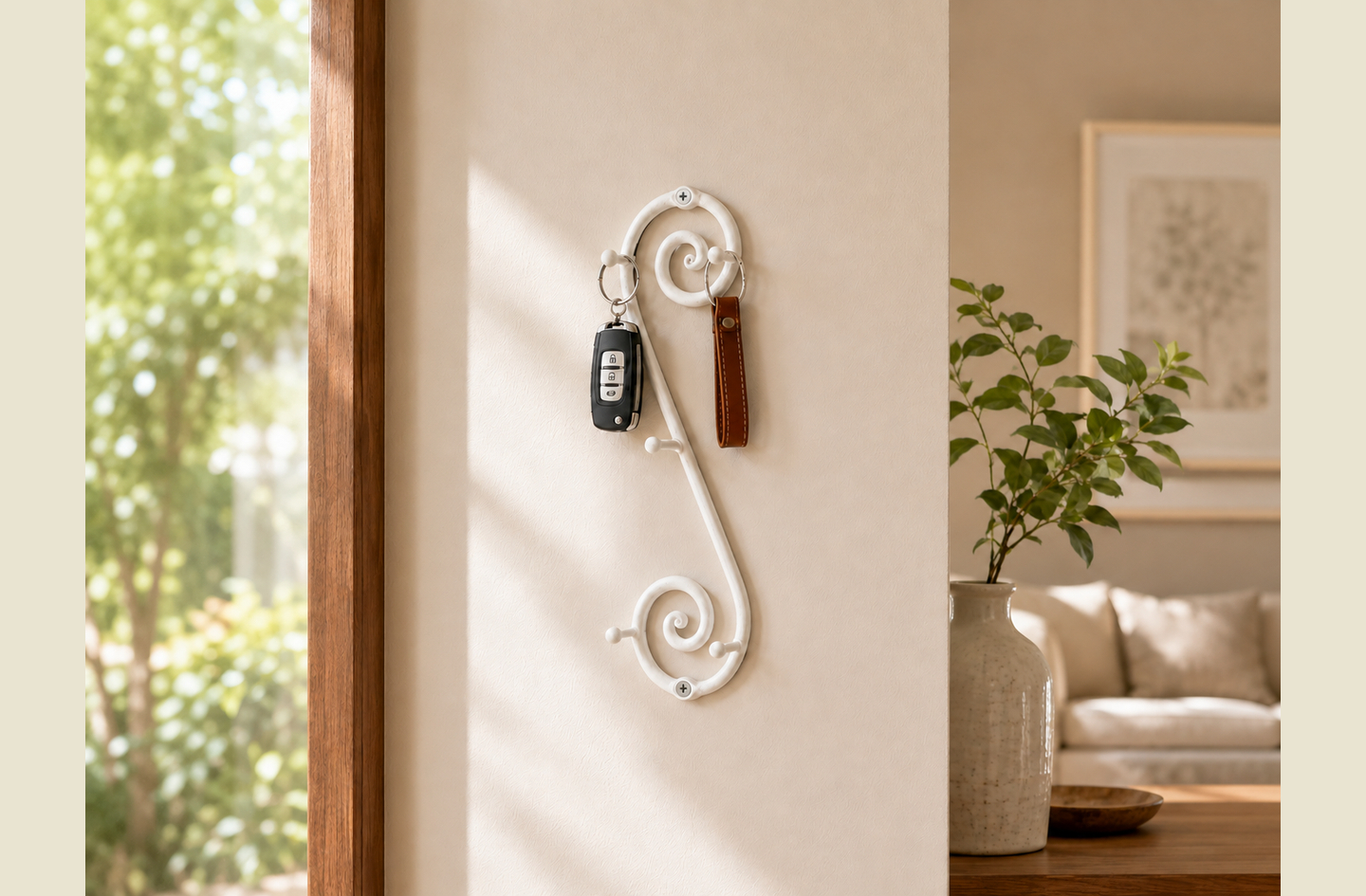
A decorative piece suits a formal front entry, where the holder is the first thing a guest sees. The Swirly key holder carries handcrafted swirl metalwork along its frame, with five forged hooks for keys, a leash and small accessories. A mudroom or garage door calls for plainer hardware that takes daily knocks.
Choose the room by where the keys leave the lock, then choose the holder to suit that room; reversing the order puts a handsome rack on a wall nobody passes.
Step 4: Measure the Horizontal Distance From the Door Frame
A key holder works best on the latch side of the door, starting a short step past the outer edge of the door trim. That spot is where the hand holding the key already is after the door closes. The hinge side is often hidden behind the open door, so a holder there gets covered on every arrival.
Door casing is the decorative trim that frames a door opening and covers the joint between the door jamb and the wall. The most widely used door casing is 2 1/4 inches wide, and some profiles run up to 3 inches5. Horizontal distance should be measured from the outer edge of that trim, not from the door opening.
A practical horizontal gap
A gap of roughly 6 to 12 inches between the casing and the nearest hook keeps the holder within one step of the door. It also keeps screws clear of the framing that surrounds the opening. On a wide wall, stay near the low end of that gap; the farther the holder drifts from the door, the more often keys land on a table instead.
Keeping keys clear of the door handle
The ADA Standards place door handles, locks and other operable hardware between 34 and 48 inches above the floor1. A holder set at the standard adult height hangs above that zone, so dangling keys never tangle with the handle. A low child row near the latch should sit far enough along the wall that the open door misses it.
Checking the door swing
Open the door to its stop and look at where the handle and the door edge meet the wall. If the door swings toward the only open wall, move the holder past the end of that swing or fit a doorstop. Ideas for very narrow walls beside a door, including vertical and staggered layouts, are in the guide to compact key holder ideas.
Measure from the outer edge of the trim and stay within about a foot of it, close enough to reach in one step.
Step 5: Clear the Light Switch, Furniture and Walkway
A key holder near the door shares its wall with a light switch, often a console or bench, and the walking path itself. The holder should sit beside the switch, above any furniture, and shallow enough that people do not catch it while passing.
The ideal light switch height is 48 inches from the floor4. A key holder at the standard adult height therefore sits higher than the switch, which keeps the switch plate clear. The risk is a holder hung directly above it, where a swinging fob or lanyard can flip the toggle.
Placing the holder beside the switch
Set the holder to one side of the switch, with the nearest hook a hand’s width away from the plate. Wiring runs up and down from a switch box, so drilling straight above or below it is the riskiest spot on the wall. A sideways offset keeps both the switch and the cable safe.
Hanging above a console or bench
When a console or bench sits below the holder, keep the lowest hook a hand’s width above anything on its top. Keys then hang free instead of resting on the furniture. A bench also lets a child stand on the floor beside it and still reach a low hook placed at the end.
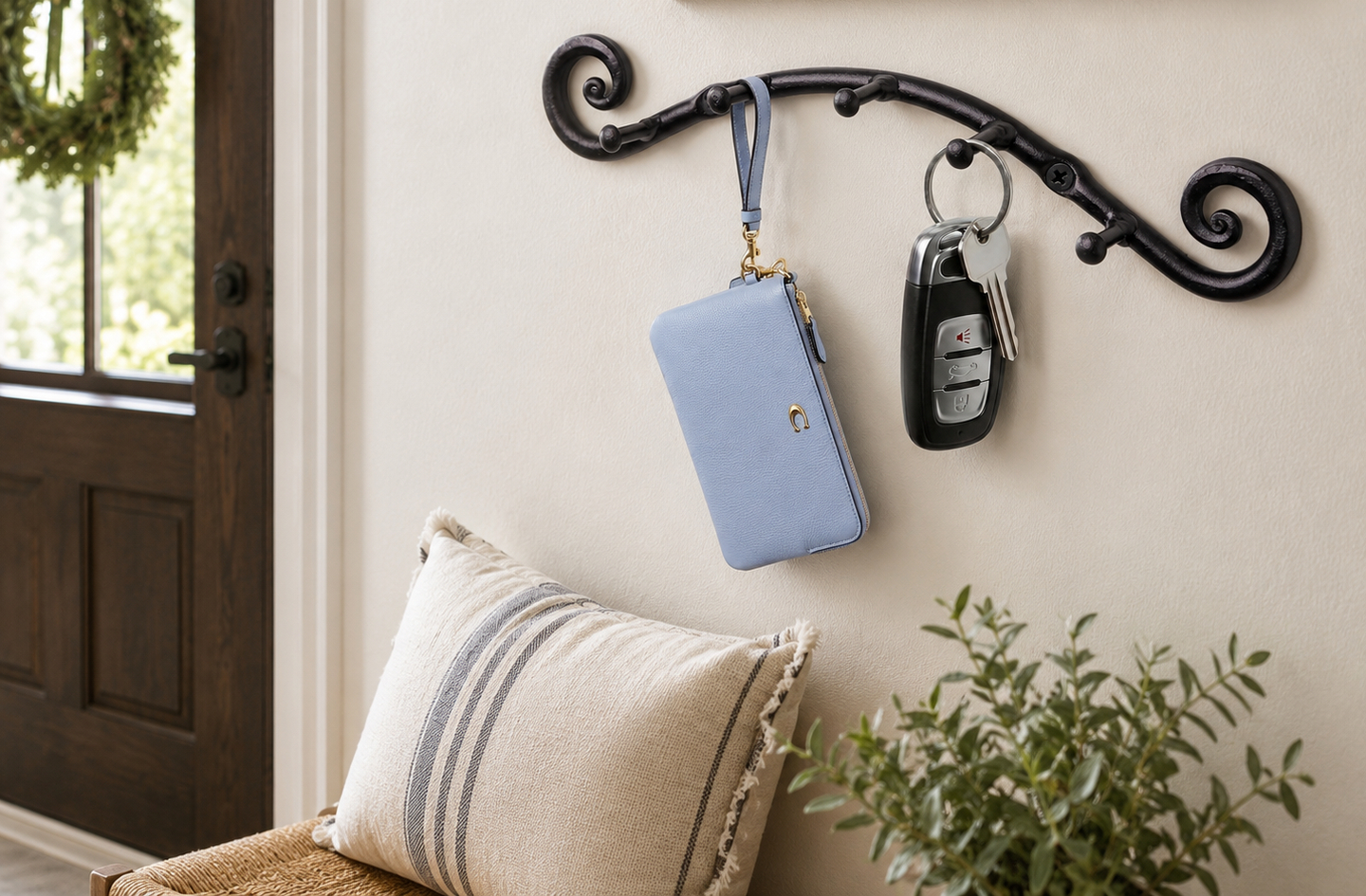
Projection is the distance an object sticks out from the wall, measured from the wall surface to its outermost point. The 2010 ADA Standards limit objects with leading edges between 27 and 80 inches above the floor to 4 inches of projection into a walking path1. A key holder in a hallway should stay inside that depth when loaded.
Read together, the figures show a clear split12. The adult hook band starts just above the 57 inch picture line3 and overlaps average adult height. The reach ranges for children and seated users stop at 48 inches or lower. No single row of hooks serves every member of a mixed household.
Plan the holder as one item on a crowded wall: beside the switch, a hand’s width above the furniture, and no deeper than a walkway allows.
Step 6: Match the Wall Type, Then Level and Fix the Holder
Wall type decides how the chosen height is held, so check it before drilling. A key holder carrying only keys is light, but most end up holding a leash, a lanyard or a small bag as well. A sudden tug on a leash loads the fixing far more than a ring of keys.
Typically, drywall can support between 5 and 10 pounds with a simple nail8, and anything heavier needs an anchor or a stud. As a rule, anchors should hold four times the weight of the object being hung8.
A stud is a vertical wooden or metal framing member inside the wall that the drywall or plaster is fastened to. Once one stud is found, the next ones are usually 16 inches on center8. A screw driven into a stud holds far more than any hollow-wall anchor.
Finding a stud without a tool
Knocking along the wall is the oldest stud finder. This Old House general contractor Tommy Silva describes the change in sound when a knuckle passes over framing.
“The sound and the pitch goes from a little hollow, low pitch to something a little higher.”8
Tommy Silva, general contractor, This Old House
Leveling at the chosen height
Mark the hook-center height first, then hold the holder against the wall and mark the screw holes from its backplate. Check the marks with a level before drilling, because a holder a few degrees off level looks crooked next to door trim. The White Classic holder ships with screws and wall anchors, which covers the common case of drywall over studs.
Plaster, wood and masonry
Plaster and solid wood need pilot holes, and masonry needs a masonry bit and plugs. The step-by-step drilling and anchor detail for each surface is in the wall-mount installation guide. Height and position stay the same whatever the wall; only the fixing changes.
Pick the height first and the fixing second; if a stud sits a few inches from the planned spot, shift the holder sideways to use it.
Common Key Holder Height and Placement Mistakes
Most key holder problems trace back to one of four placement mistakes, and each is easy to avoid at the planning stage.
Hanging the holder at picture height
A holder centered at the 57 inch line used for art3 puts the keys themselves below eye level, where they blend into a console or a coat. The fix is to raise the hook center into the 60 to 66 inch band, so the keys hang where the eye already looks.
Mounting one row for the tallest person
A single high row suits whoever installed it and nobody shorter. Children under 9 cannot reach above 40 inches by the ADA advisory figures1, so their hooks need a separate row. Set the adult row by the shortest adult, then add the child row.
Putting the holder on the hinge side
The hinge-side wall disappears behind the open door, and a door that swings into the hooks knocks keys loose. Move the holder to the latch side, measured from the outer edge of the casing, where the hand already is after locking up.
Centering the holder over the light switch
A holder directly above the switch looks tidy on paper but leaves a fob swinging against the toggle and puts the drill near the cable. Offset it sideways from the switch at 48 inches4, keeping a hand’s width between the plate and the nearest hook.
If a placement only looks right with nobody standing in front of it, it is placed for the wall, not for the household.
What a Well-Placed Key Holder Looks Like
A well-placed key holder passes a simple test: every daily user can hang and take keys in one motion, without stretching, stooping or stepping away from the door. If that works on the first try for each person, the height and position are right.
- Height: the adult hooks sit 60 to 66 inches from the floor, and any child row sits at or below the youngest user’s reach.
- Position: the holder is on the latch side, within about a foot of the outer edge of the casing, and clear of the full door swing.
- Clearance: the switch plate is a hand’s width away, the lowest key hangs above the furniture top, and the loaded depth suits the walkway.
- Fixing: at least one screw is in a stud, or the anchors are rated well above the heaviest item on the hooks.
- Habit: after a week, the keys are on the hooks every evening without anyone thinking about it.
Hardware that holds up to daily use helps the habit stick. RTZEN holders are hand-forged from solid wrought iron in four steps: cut, hand-forge, zinc-galvanize and powder-coat. That finish stack is why an iron holder by a damp entry door resists rust and keeps its hooks straight year after year.
Judge the result by the habit, not the look: a holder that the household actually uses every day is placed correctly, whatever the tape said.
Frequently Asked Questions
How high should a key holder be hung?
For adults, hang it with the hook center 60 to 66 inches above the floor. Average U.S. height is 63.5 inches for women and 68.9 inches for men2, so this band keeps hanging keys near eye level. Start near 63 inches and adjust toward the shortest daily user.
What height should key hooks be for children?
Match the child’s reach. ADA advisory figures put the high reach at 36 inches for ages 3 and 4, 40 inches for ages 5 through 8, and 44 inches for ages 9 through 121. A second, lower row keeps adult keys at standard height.
How far from the door should a key holder go?
Place it on the latch side, roughly 6 to 12 inches past the outer edge of the door trim. Standard casing is 2 1/4 inches wide5, so measure from that edge, not the opening. Keep the holder clear of the door’s full swing.
Should a key holder go above the light switch?
No, set it beside the switch instead. The ideal switch height is 48 inches4, and a holder directly above it lets keys swing against the toggle. Drilling straight above a switch box also risks hitting the cable that runs up from it.
Can a key holder be mounted on drywall without a stud?
Yes, with proper anchors. Drywall supports only 5 to 10 pounds on a simple nail8, so use anchors rated at four times the load, especially if a leash or bag hangs there. A stud is still the strongest fixing when one is nearby.
Limitations and Edge Cases
- The reach and protrusion figures come from the 2010 ADA Standards for public and commercial buildings. Private homes are not bound by them, so they serve here as practical benchmarks.
- The 60 to 66 inch band is a planning synthesis built on average U.S. adult heights. Households of very tall or very short adults should test a paper template at their own height first.
- A holder that also carries coats or heavy bags is a coat rack in practice, and coat length then sets a higher minimum height than keys alone would need.
References
Methodology: every figure in this article comes from an independent published source linked below, each source was checked live and its supporting sentence recorded on the day of publication, the height bands are the author’s synthesis of those figures, and the article was reviewed by RTZEN co-founder Rami Abramson.
- U.S. Access Board – ADA Accessibility Standards, sections 307.2, 308.3.1, 404.2.7 and the advisory children’s reach ranges, 2010 Standards.
- CDC National Center for Health Statistics – FastStats: Body Measurements, data for August 2021 to August 2023.
- Hunker – How To Calculate The Proper Height For Hanging Pictures On Your Wall, Jill Arens, updated May 2022.
- Bob Vila – The Ideal Light Switch Height for Any Room, Solved!
- Hunker – The Standard Wood Trim Molding Sizes.
- NPR – Building Better Habits And Breaking Bad Ones, Hidden Brain, December 2019.
- Harvard Health Publishing – Tips to get the most out of your memory, Harvard Medical School.
- This Old House – How To Hang Something Heavy On a Wall, Jim Gorman.
Conclusion
The best place to hang a key holder is on the latch side of the most-used door, with the hook center 60 to 66 inches above the floor. Add a lower row for anyone with a shorter reach. Average adult heights of 63.5 and 68.9 inches2 set that band, and reach ranges set the second row. Clear the switch, the furniture and the door swing, then fix the holder into a stud where possible. Built to perform and made to last, a hand-forged iron holder placed this way is backed by a Lifetime Warranty.
For how height and placement fit the wider topic of key storage, see the key holders overview.