
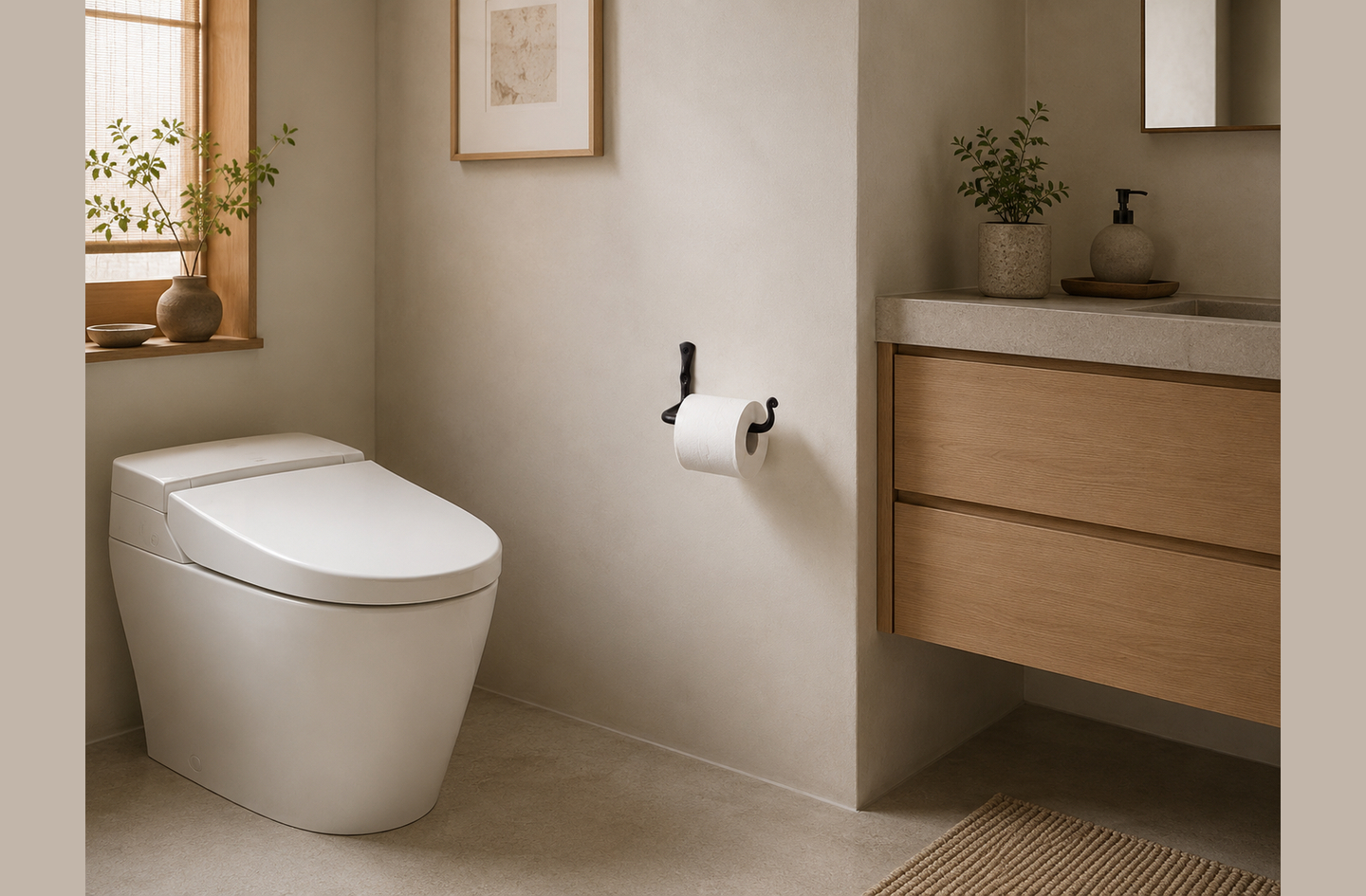
A black toilet paper holder looks right when it repeats a dark note already in the room and looks wrong when it adds one more finish to a crowded wall. This article sits under the toilet paper holders overview and covers one decision: coordinating dark iron with the faucet, towel hardware, pulls, tile and paint. Low-sheen metal is now the norm, since matte finishes led faucet choices at 54% in the NKBA 2026 Bath Trends Report1. The steps below turn that trend into a simple finish plan.
Quick Answer
How do you match a black toilet paper holder without overdoing dark hardware?
Give black one clear job. Keep the room to one or two metal finishes, as most designers recommend for small bathrooms3. Then repeat black in a few deliberate places such as the towel ring and a mirror frame. Matte black sits comfortably beside both warm and cool metals3, so the holder rarely has to match the faucet exactly.
Key Takeaways
- Most designers limit a small bathroom to one or two metal finishes, often one dominant metal and one accent3.
- A black paint measures an LRV of 4.56 on a scale of 0 to 1006, so dark iron stands out sharply against almost any light wall.
- White still leads bathroom surfaces: it appears on 48% of renovated countertops, against 4% for black2.
- Black hardware works as the accent in a 60-30-10 color split, where the smallest share is reserved for small touches and accessories4.
- The most common misconception is that every metal in the room must be black once one black piece goes in.
Before You Begin: What a Black Toilet Paper Holder Has to Match
A black toilet paper holder is rarely the first finish chosen in a bathroom, so it has to fit a palette that already exists. Before buying or mounting anything, it helps to know which surfaces and metals the holder will sit beside and which of them the eye reads first.
A finish palette is the complete set of colors and metal finishes visible in one room, from the faucet to the grout. A matte black finish is a dark coating with a low sheen that diffuses light instead of mirroring it. On wrought iron, that finish is usually a powder coat applied over a protective base layer.
Gather these before deciding on the holder’s finish and style:
- A phone photo of each wall, taken in daylight and again under the room’s own lighting
- A list of every metal piece: faucet, shower trim, towel bar or ring, robe hook, cabinet pulls, mirror frame and light fixture
- The paint name or color chip for the wall, so its reflectance value can be looked up
- A sample of the tile and grout, or a close photo if the tile is already installed
- About half an hour for the planning steps, and no special tools; difficulty is beginner
The planning matters more than the shopping. Once the inventory exists on paper, most finish decisions become obvious, and the black holder either fits a pattern or clearly does not.
If the inventory shows no dark element anywhere, the black holder becomes the room’s main accent. It then needs at least one partner piece to look intentional.
Why Black Hardware Reads So Strongly in a Bathroom
Black hardware stands out because almost every bathroom surface around it is light, and the contrast between them is measurable. Paint makers publish a light reflectance value, which is a number showing how much visible light a color reflects.
LRV is measured on a scale from zero, absolute black, to 100 percent, pure white7. A soft blue such as Monet Magic sits at LRV 66, while a warm brown such as Weaver’s Tool sits at LRV 257. Benjamin Moore lists its color simply named Black at LRV 4.566.
The U.S. Access Board gives a formula for contrast between two surfaces: subtract the darker LRV from the lighter one, divide by the lighter LRV, and multiply by 1005. Its guidance notes that signs are more legible for people with low vision at a contrast of at least 70 percent5. That benchmark was written for signage, yet it gives a useful yardstick for how loudly a dark object reads against a wall.
Running the formula with a black finish at LRV 4.56 gives about 93% contrast against the LRV 66 blue and about 82% against the LRV 25 brown5. Contrast stays above the 70 percent line until the wall drops to roughly LRV 15. In plain terms, a black holder pops on nearly every wall color homeowners choose.
Visibility is not the risk with black hardware; quantity is. Because each black piece reads at high contrast, every additional piece adds visual weight, so the count of dark objects matters more than their exact shade.
Step 1: Map Every Finish in the Room
By the end of this step, every metal and color in the bathroom sits in one written list, grouped by how much of the room it occupies. That list is the base for every later choice about the black toilet paper holder.
Start with the largest areas and work down to the smallest. Walls, floor, tile and the vanity front form the background. Fixtures and hardware form the foreground. Decor such as towels, rugs and frames forms the layer that changes most easily.
| Layer | Typical items | Share of what the eye sees | How hard to change |
|---|---|---|---|
| Background | Wall paint, wall tile, floor, vanity front, countertop | Largest | Hard: paint is the only quick change |
| Fixtures | Faucet, shower trim, tub filler, light fixture | Medium, but high attention | Hard: plumbing work required |
| Hardware | Toilet paper holder, towel ring or bar, robe hook, cabinet pulls | Small | Easy: a drill and an afternoon |
| Decor | Towels, mirror frame, baskets, plants, soap dish | Small | Very easy |
Next, mark each metal piece with its finish family: cool (chrome, polished nickel, stainless), warm (brass, gold, bronze, copper) or neutral (black). House Digest suggests grouping like items, such as all plumbing fixtures or all lights, and giving each category one finish to avoid a cluttered look3.
To verify this step, count the distinct metal finishes on the list. Two is a calm room. Three needs a clear reason. Four or more is a sign that the black holder should replace a finish rather than add one.
The toilet paper holder is one of the simplest pieces to change and one of the last chosen. That makes it the best tool for pulling a scattered finish list back into order.
Step 2: Choose a Lead Metal and Give Black One Clear Role
For small rooms like bathrooms, most designers recommend limiting metal finishes to one or two choices, often one dominant metal and one accent finish3. By the end of this step, the room has a named lead metal and black has a defined role beside it.
The faucet usually decides the lead metal, because it is the most expensive fixture to swap and the one the eye returns to. Black then takes one of two roles. It can be the lead, with every fixture and accessory in black. Or it can be the accent, appearing on hardware and decor while the plumbing stays chrome, nickel or brass.
“I’m the biggest fan of mixed metals, but if it’s done randomly and without intention it can go wrong quick.”
Margie Kaercher, designer and founder of Hearth & Honey Homes, as reported by House Digest3
Kaercher’s warning points at the real problem. A black holder next to a chrome faucet looks planned. A holder in a slightly different bronze from the towel bar looks like a mistake. House Digest reports her view that the biggest pitfall is mixing metals that are close in color but not an exact match3.
Black has one advantage here. House Digest describes matte black as a neutral finish that goes with both warm and cool metals3. That means a black accent can sit beside brass or chrome without reading as a near miss.
Decide the role before choosing the product. A black accent holder needs partners, while a holder in an all-black room needs variety in shape, not more black.
Step 3: Pair the Black Toilet Paper Holder With the Faucet Finish
A black toilet paper holder pairs well with every common faucet finish because black is the neutral of the metal family. In the NKBA 2026 Bath Trends Report, matte (54%), brushed (51%) and satin (46%) faucet finishes all ranked above polished (39%)1. Low-sheen faucets share texture with matte iron, which makes the pairing easier.
That report rests on a survey of nearly 700 industry experts, including designers, manufacturers, remodelers and architects1. It describes the shift away from polished metal as part of a wider move toward organic, natural design cues.
| Faucet finish | How a black holder reads beside it | Where black should repeat | Watch out for |
|---|---|---|---|
| Polished chrome | Crisp, graphic contrast between cool shine and dark matte | Towel ring and mirror frame | Adding a third metal such as brass |
| Brushed nickel | Soft, low-sheen pairing; the textures agree | Towel hardware and one decor piece | Mixing in polished nickel, which reads as a near match |
| Brass or gold | Warm and dramatic; black frames the brass | Towel bar, robe hook, light fixture arms | Bronze pieces that compete with both |
| Matte black | Fully matched; black is the lead metal | Everywhere, but vary shapes and sizes | A flat, heavy look with no relief |
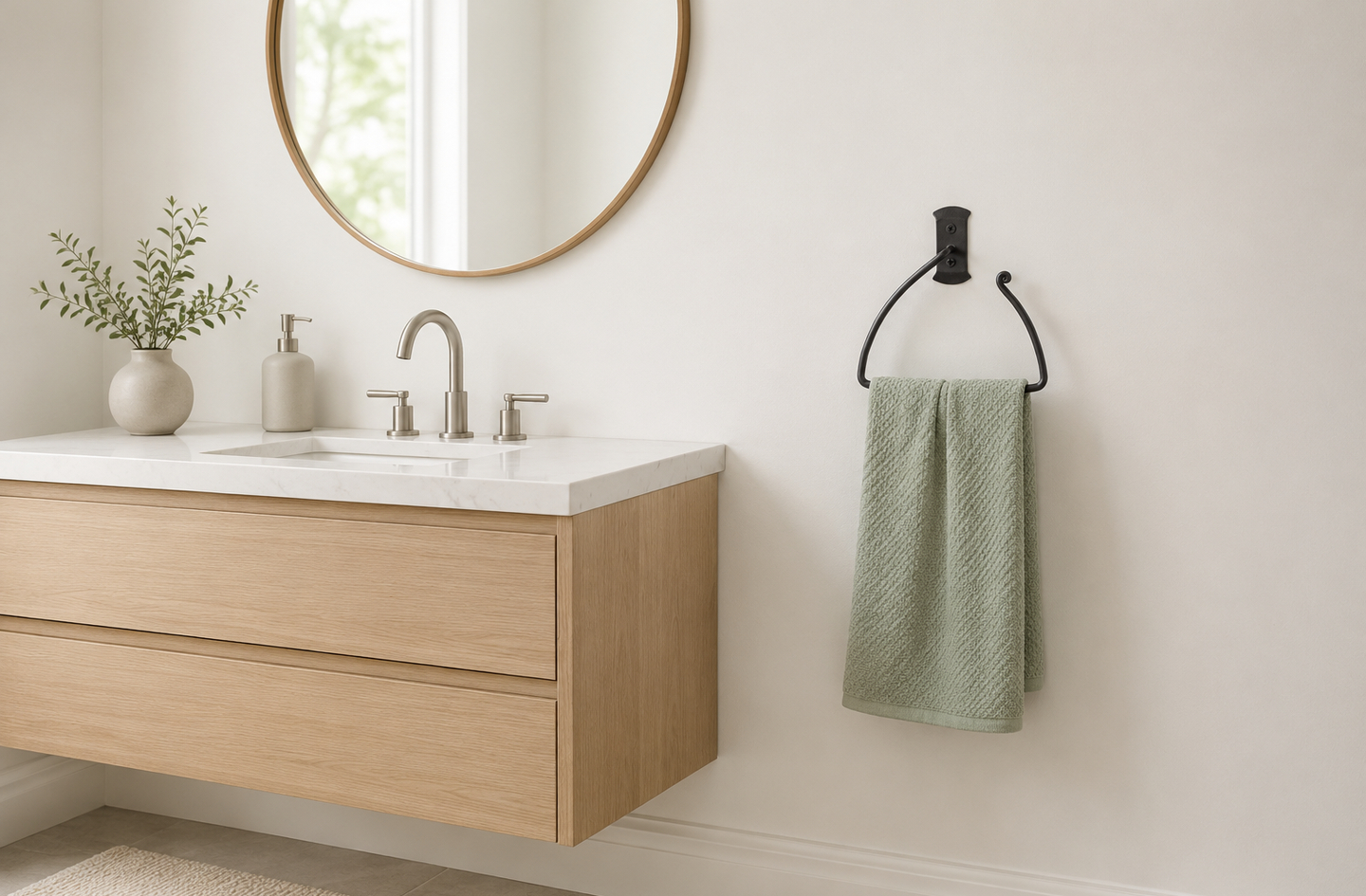
With chrome or nickel, the holder works best when one or two other black accents appear near the vanity. With brass, black often frames the warm metal, so the brass faucet stays the star. With a black faucet, the holder simply joins the set, and attention moves to form and texture.
The faucet finish rarely rules out a black holder; it only changes how many black partners the holder needs to look deliberate.
Step 4: Repeat Black Across Towel Hardware and Pulls, Not Everywhere
Black looks intentional when it appears in a few related spots and looks heavy when it covers every surface. The 60-30-10 rule sets a practical limit. It puts 60 percent of a scheme in one color, 30 percent in a second, and 10 percent in a third, used for small touches and accessories4.
In most bathrooms, black hardware belongs in that smallest share. The holder, a towel ring, a robe hook and a pair of pulls together cover a tiny fraction of the visible surface. That is why a handful of black pieces can define the style without darkening the room.
“We tend to work around 60 percent being a neutral base, typically muted colors to reflect more light, the 30 percent tends to be a darker color to bring some contrast and definition to the space and distinction between surfaces, and the 10 percent is the fun wild card, one that is usually less dominant and that can be easily changed over time to offer a fresh feel to a room.”4
Ester Corti, Mitchell + Corti Architects, quoted by Livingetc4
A useful working pattern is the three-touch rule. Place black in at least three spots that the eye can link from the doorway. Good choices are the toilet paper holder, the towel hardware by the sink, and one higher element such as a mirror frame or light fixture. Three points form a visual triangle, so the black reads as a theme rather than a stray piece.
Towel hardware is the natural second touch, because it sits at a similar height and shares the same forged language as the holder. The half-circle ring repeats a curved black line beside the sink, and the Elegant Towel Hanger carries that line along a longer wall. Cabinet pulls can be the third touch when the vanity is wood or white.
The upper limit matters just as much. When black covers the faucet, shower trim, every pull, the mirror, the light and the accessories, the room loses its accent. At that point, black has become the lead metal, and the plan from Step 2 should be reset.
Three to five black touches is the range where a dark finish reads as planned; fewer looks accidental, and many more turns the accent into the base.
Step 5: Check the Holder Against Wall, Tile and Countertop Color
White and off-white surfaces still dominate bathroom renovations, which is why a black holder almost always reads as a strong accent. Houzz found white chosen for shower walls in 36% of renovations, with off-white next at 18%2.
Countertops follow the same pattern. White appears in 48% of renovated bathrooms, followed by off-white (20%), gray (9%), beige (6%) and black (4%)2. In the NKBA survey, 96% of respondents named neutrals as the most popular bath colors, with black at 18%1.
Use the wall color to set how much black the room can carry:
- White or pale walls: black reads at full strength, so the three-touch rule is plenty and more pieces start to feel busy.
- Warm mid-tones and wood paneling: black sits more quietly against brown and tan, so forged detail such as scrolls stays visible without dominating.
- Sage, olive and soft greens: black adds definition to these muted colors, and NKBA respondents expect sage to be popular at 64%1.
- Very dark walls: below roughly LRV 15, black drops under the 70 percent contrast benchmark5, so the holder blends in and its silhouette matters less than its function.
Tile and grout deserve the same check. Dark grout lines on white tile already create a grid of thin black accents, and a black holder ties into that grid. Bright white grout on white tile leaves the holder as a single dark mark, which is the case where partner pieces matter most.
The lighter the room’s background, the fewer black pieces it needs, because each one already carries high contrast.
Step 6: Match Style and Scale, Not Only Color
Two black pieces can share a finish and still clash when their shapes disagree. By the end of this step, the toilet paper holder and its partner pieces share one design language: line weight, curves and overall size.
Wrought iron hardware is iron worked into shape by heating and hammering, which leaves slight variations in line and surface that stamped hardware lacks. RTZEN hardware is made in a four-step process: cut, hand-forge, zinc-galvanize and powder-coat. Hand-forged pieces carry visible character, so pairing them works best when every piece shares a similar style family.
- Classic curves: traditional scrolled ends suit farmhouse, cottage and vintage rooms. The Classic holder uses gentle curved lines and an open roll bar.
- Swirl and scroll detail: decorative forged swirls suit rustic and bohemian rooms, and they look best repeated on the towel hardware.
- Minimal lines: a single open arm suits modern and minimalist rooms, where one dark line is enough.
- Hammer-nail texture: a hammered surface suits farmhouse rooms with wood and shiplap.
Scale matters as well. A heavy scrolled holder beside a thin minimal towel bar looks mismatched even in identical black. Keep line thickness and decorative weight similar across the set. For the trade-offs between open-arm, pivoting and spring-loaded mechanisms, the guide to choosing a wall-mounted design covers selection in depth.
A holder with an integrated shelf adds a horizontal black surface, which counts as a larger dark element than an arm alone. The article on holders with a shelf explains when that extra surface earns its place.
Matching the style family does more for a cohesive room than matching the exact shade of black, since the eye reads shape before sheen.
Step 7: Protect the Dark Finish in a Humid Bathroom
A black finish only looks right while it stays even and dark, so moisture control is part of matching. The EPA advises keeping indoor humidity below 60 percent, ideally between 30 and 50 percent8, and a running exhaust fan during and after showers helps hold that range.
Matte black shows mineral spots and soap residue more than chrome does, because pale deposits stand out on a dark surface. The holder sits away from the sink and shower, so it collects less spray than a faucet. A soft dry cloth once a week is usually enough.
Powder coating is a dry paint applied as a fine powder and then cured with heat into a hard, even layer. On RTZEN pieces, the powder coat sits over a zinc galvanized base, which is the dual-layer protection behind the brand’s rust resistance. That finish stack is backed by a catalog-wide Lifetime Warranty covering material and workmanship defects under normal use.
- Wipe the holder with a damp cloth and mild soap, then dry it.
- Skip abrasive pads and acidic cleaners, which can dull a matte surface.
- Check the mounting screws once a year so the holder stays level and tight.
Placement also affects how the finish ages. A holder mounted within easy reach but out of the direct splash zone stays cleaner. The guide to holder height and placement gives the measurements.
A dark finish that is kept dry and clean keeps its even tone, and that even tone is what lets several black pieces read as one set.
Common Mistakes When Matching Dark Hardware
The most frequent mistake is mixing metals that are close in color but not an exact match, which House Digest reports as one of the biggest pitfalls designers see3. The others follow the same pattern: the eye notices a near miss faster than a clear contrast.
Is it a mistake to mix black with oil-rubbed bronze?
Yes, in most rooms. Oil-rubbed bronze is very dark brown with copper highlights, so beside black it looks like a failed match. Choose one of the two for every dark piece, or keep bronze to a different wall.
What happens when black is a single lonely piece?
A single black holder in an otherwise chrome room reads as an odd leftover. Add a black towel ring, mirror frame or pair of pulls so the holder has partners, or choose a holder in the room’s lead metal instead.
Why does an all-black bathroom feel heavy?
When every fixture, accessory and frame is black, nothing acts as the accent. Vary the shapes, keep the walls light, and let wood, plants or textiles break up the dark lines.
Does adding a third metal always fail?
No, but it needs a reason. House Digest advises avoiding finishes that match too closely, such as chrome and polished nickel, when a third metal is added3. Black is the safest third finish, because it bridges warm and cool metals.
Each of these mistakes is about intent: a clear contrast reads as a choice, while a near match reads as an accident.
What a Balanced Black Bathroom Looks Like
A balanced room shows one or two metal finishes, with black appearing in three to five related places and light surfaces carrying most of the area. Standing in the doorway, the eye should travel between the black pieces without stopping at any one of them as an outlier.
Check the result against this short list:
- The finish list from Step 1 shows no more than two metals, or three with black as the bridge.
- The holder shares its style family and line weight with the towel hardware.
- At least two other black touches sit at different heights in the room.
- The wall and countertop stay light enough that black reads as an accent.
- The finish is dry, even and free of mineral spots.
As a next step, review the rest of the room’s small hardware. Robe hooks, a towel bar near the tub and the vanity pulls are the easiest places to extend the same plan.
The best test is subtraction: if removing any one black piece would make the room feel unfinished, the balance is right.
Frequently Asked Questions
Does a black toilet paper holder have to match the faucet?
No. Matte black works as a neutral that goes with both warm and cool metals3, so it can sit beside chrome, nickel or brass. What matters is that black appears in a few other places, such as the towel ring or mirror frame, so the holder looks planned.
How many metal finishes should a small bathroom have?
One or two. For small rooms like bathrooms, most designers recommend one dominant metal and one accent finish3. Black can be either. When a third metal is unavoidable, black is the safest choice because it bridges warm and cool metals without reading as a near match.
Is matte black still a current choice for bathroom hardware?
Yes. In the NKBA 2026 Bath Trends Report, matte faucet finishes were chosen by 54% of surveyed experts, ahead of polished at 39%1. Low-sheen metal is the mainstream direction, and a matte black holder fits that preference while staying neutral beside other finishes.
Will a black holder disappear on a dark wall?
Partly. On a very dark wall below roughly LRV 15, a black finish falls under the 70 percent contrast benchmark from the U.S. Access Board5. The holder then reads as a quiet shape rather than an accent, which suits moody rooms but hides decorative forged detail.
How do you keep a matte black holder looking even?
Keep the room dry and wipe the holder gently. The EPA recommends indoor humidity between 30 and 50 percent8, and an exhaust fan helps. Clean with a damp cloth and mild soap, dry it, and avoid abrasive pads that can dull a matte surface.
Limitations and Edge Cases
- The contrast figures use a black paint’s published LRV as a stand-in for a black powder-coated iron finish; real hardware under bathroom lighting can read slightly lighter or darker.
- Trend percentages come from United States surveys of renovations and industry experts in 2025, and finish preferences differ by region and by the age of the home.
- Rooms with antique brushed zinc or white hardware follow the same steps with a different accent color. The finish plan depends on contrast and count, not on black itself.
References
Methodology: every figure in this article comes from an independent published source linked below, each source was checked live and read for its supporting sentence on October 6, 2026, the contrast chart was calculated by RTZEN from those published values, and the article was reviewed by RTZEN co-founder Rami Abramson.
- Kitchen & Bath Business – NKBA | KBIS Releases Annual 2026 Bath Trends Report, November 2025.
- Houzz – See the Bathroom Features Homeowners Want Most in 2025, Mitchell Parker, September 30, 2025.
- House Digest – The Bathroom Design Mistake That’s Making Your Space Look and Feel More Cluttered, Nancy Schaffer, February 2026.
- Livingetc – A decorator’s guide to the 60-30-10 rule, with comments from Ester Corti of Mitchell + Corti Architects.
- U.S. Access Board – Appendix: Advisory Guidance, color contrast and the light reflectance value formula.
- Benjamin Moore – Black 2132-10 color information page, LRV listing.
- Diamond Vogel – What is LRV?, architectural paint blog.
- U.S. Environmental Protection Agency – A Brief Guide to Mold, Moisture and Your Home, updated February 2026.
Conclusion
A black toilet paper holder works best as part of a small, deliberate set. That means one or two metal finishes, black repeated in three to five places, and light surfaces carrying most of the room. Match the style family and line weight, keep the finish dry, and the dark iron reads as a choice rather than a leftover.
Hand-forged, zinc-galvanized and powder-coated, an iron holder is backed by a Lifetime Warranty, so the finish plan is the last decision left. For how this choice fits the wider topic, see the toilet paper holders overview.