
A swivel plant hanger lets a hanging basket rotate without unhooking it from the wall or ceiling. Plants bend toward light within hours through phototropism, creating uneven growth on a fixed hanger. Indoor houseplant spending reached $3.4 billion in 2023, up from $2.3 billion the year before, per the National Gardening Association’s annual survey.1 The overview in plant hanger types and mounting covers the broader category; this guide focuses on the swivel angle: when rotation helps, how much clearance a hanging planter needs, what it can safely hold, and which mounting details keep it secure indoors.
Quick Answer
What makes a swivel plant hanger worth choosing over a fixed bracket?
A swivel plant hanger allows the basket to rotate in place, letting you turn the plant toward even light without lifting it down. A fully watered 10-inch basket weighs 6 to 8 pounds,4 so any mounting that removes the need for repeated lift-and-rehang cycles is safer for the anchor and the plant. Choose a ceiling hook for full 360-degree indoor rotation, and verify the anchor’s safe working load is at least four times the basket’s wet weight before mounting.5
Key Takeaways
- A fully watered 10-inch hanging basket weighs 6 to 8 pounds; the anchor’s safe working load should be at least four times that figure to account for the engineering safety factor.
- Plants left stationary develop uneven, leaning growth through phototropism; a swivel hanger lets you rotate the basket without unhooking it, keeping foliage balanced without stressing the mount.
- Ceiling hooks provide the most natural 360-degree rotation indoors; wall-mounted brackets need at least 6 inches of arm length to keep a 10-inch basket clear of the wall surface.
What Is a Swivel Plant Hanger and How Does It Differ from a Fixed Bracket?
A swivel plant hanger is any hanging configuration that allows the suspended basket to rotate, either through a dedicated ball-bearing swivel connector or through a hook profile that lets the basket’s chain or macrame cord turn freely. The defining trait is rotation: a fixed wall bracket holds the planter at a set angle relative to the wall, while a swivel setup lets you turn the basket without lifting it off the hook.
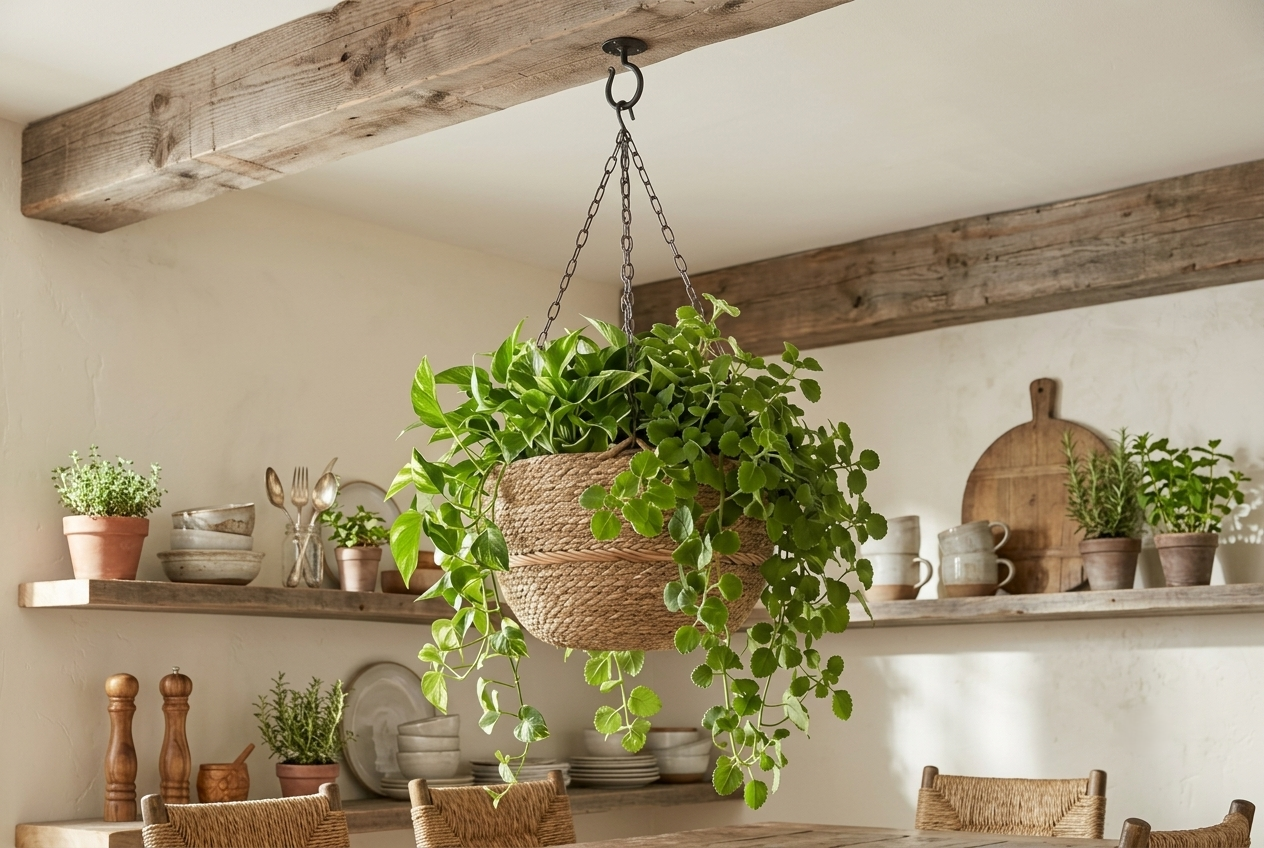
Ceiling hooks are the most practical swivel solution for indoor use. When a plant hangs from a ceiling hook on a macrame hanger or chain, the basket can rotate a full 360 degrees by hand because the cord slides against the smooth metal profile of the hook. No separate swivel bearing is needed; the hook’s curve does the work. Wall-mounted brackets with a curved hook tip also allow partial rotation. The basket swings on the hook’s end, which is enough for quarterly turns, though the rotation is constrained by the wall behind the planter.
The practical difference between these setups shows up most clearly when a plant leans toward a window. On a fixed wall bracket, correcting that lean means lifting the basket clear of the hook with both hands, turning it, and re-hanging it – a repeated load cycle that stresses the mounting point every time. On a ceiling hook with free rotation, the grower turns the basket with one hand while it stays on the hook. That single difference reduces cumulative anchor stress and removes the risk of dropping a heavy, wet basket.
A dedicated swivel joint (a ball-bearing connector between the hook and the hanging cord) adds explicit rotation to any hook type. The tradeoff is an additional connection point that must be rated for the load and checked for corrosion seasonally.
When Does a Swivel Plant Hanger Make the Most Difference?
A swivel plant hanger produces the most visible benefit in three situations: rooms with dominant one-direction light, plants that grow quickly, and locations where lifting the basket is impractical because of height or weight.
One-direction light is the most common driver. U.S. horticulture operations sold $18.3 billion in specialty crops in 2024,2 a figure that reflects how central plants have become to home interiors. A window on a single wall creates a strong light gradient across a room. Plants placed more than 3 to 4 feet from that window receive uneven illumination: one face of the canopy gets substantially more photons than the opposite face. Research published in The Plant Cell confirms that this differential light exposure redistributes growth hormone (auxin) to the shaded side of the stem within hours, causing accelerated cell elongation on the darker side and bending the plant toward the source.
“Light-mediated lateral redistribution of a plant growth hormone to the shaded side of the seedling causes the differential growth associated with phototropic curvature.”
University of Missouri-Columbia, Esmon et al., The Plant Cell (2005)6
Fast-growing plants compound the effect. Pothos and heartleaf philodendron can produce several inches of growth per week; a plant left stationary for a month develops a visibly asymmetric canopy. A quarter turn at each watering rebalances that growth without any other intervention.7
Height adds a third variable. A ceiling-hung basket at 7 or 8 feet is difficult to reach safely for lifting. A swivel setup that allows rotation with one hand from a standing position eliminates the need for a step stool for routine maintenance. The weight of a watered basket makes this practical advantage significant: a 12-inch basket can weigh 9 to 12 pounds when thoroughly watered, and lifting that weight repeatedly overhead increases the risk of dropping the basket or overloading the anchor.
Which Plants Benefit Most from a Rotating Hanger?
Plants with strong phototropic responses and rapid growth rates benefit most from regular rotation on a swivel hanger. The same auxin redistribution mechanism that causes bending also governs root orientation and stem diameter, so plants that grow quickly and respond sharply to light direction show the most visible improvement when rotated consistently.
High-response trailing plants
Pothos (Epipremnum aureum), heartleaf philodendron, and string-of-pearls develop a pronounced lean within one to two weeks in one-direction light. Their long, flexible stems make the asymmetry visible quickly and also make it easiest to correct. A quarter turn every seven to ten days keeps the canopy growing outward in all directions.
Ferns and foliage plants
Boston fern, maidenhair fern, and asparagus fern have fronds that orient individually toward light. A stationary fern in a single-window room develops a flat, wall-facing silhouette rather than the full, round form that makes hanging ferns visually effective. Rotation maintains the spherical shape.
Flowering annuals in hanging baskets
Petunias, million bells, and bacopa are commonly sold in 10-inch and 12-inch hanging baskets for outdoor or bright-indoor use. These plants bloom on the outer surface of the canopy and stop flowering on stems that receive insufficient light. Rotation distributes bloom production evenly around the basket rather than concentrating it on the window-facing side.
For room-by-room placement guidance, see indoor bracket selection.
How Much Clearance Does a Hanging Planter Need from the Wall?
A hanging planter needs enough clearance from the wall to prevent leaf contact, allow airflow that reduces moisture buildup, and give the basket room to swing during rotation without scraping. For most 10-inch and 12-inch baskets, a minimum of 4 to 6 inches of clearance between the basket’s outer rim and the wall surface is the practical working figure, though the exact number depends on plant canopy width and basket diameter.
Leaf contact with a wall surface causes two problems. In bright conditions, leaves pressed against a painted or masonry wall can experience elevated temperatures from surface heat radiation, leading to scorching or premature yellowing. In humid conditions, leaves in contact with a wall trap moisture against the surface, which promotes mold growth behind the basket. Adequate clearance prevents both.
For a wall-mounted bracket, the clearance between the basket and the wall equals the bracket’s arm length minus half the basket’s diameter. A 10-inch basket has a radius of 5 inches. A bracket with a 6-inch arm positions the basket’s outer rim exactly at the wall face – zero clearance. An 8-inch arm provides 3 inches of clearance; a 10-inch arm provides 5 inches. On a 12-inch basket, those figures shift by 1 inch in each direction.
Iowa State University Extension notes that container size directly affects hanging weight, and larger containers compound the clearance calculation: a larger pot needs both more arm length for clearance and a higher-capacity anchor for the increased weight.
“Larger and deeper containers will not dry out as quickly but will be heavier, an important consideration of hanging baskets.”
Iowa State University Extension, Yard and Garden3
Ceiling-mounted hangers eliminate the wall-clearance problem entirely by moving the suspension point overhead. The basket hangs in the center of the room or beneath a beam, with clearance from all vertical surfaces determined only by the length of the hanging cord rather than by bracket arm geometry.
What Arm Length Keeps a Basket Clear of the Wall?
For a 10-inch basket on a wall bracket, an arm length of at least 10 inches keeps the basket 5 inches clear of the wall surface. For a 12-inch basket, an arm length of at least 12 inches achieves the same 6-inch clearance. Shorter arms work for smaller baskets (6-inch pots can hang comfortably from an 8-inch arm), but sizing an arm to a basket that is too large leaves the foliage in contact with the wall or limits rotation range.
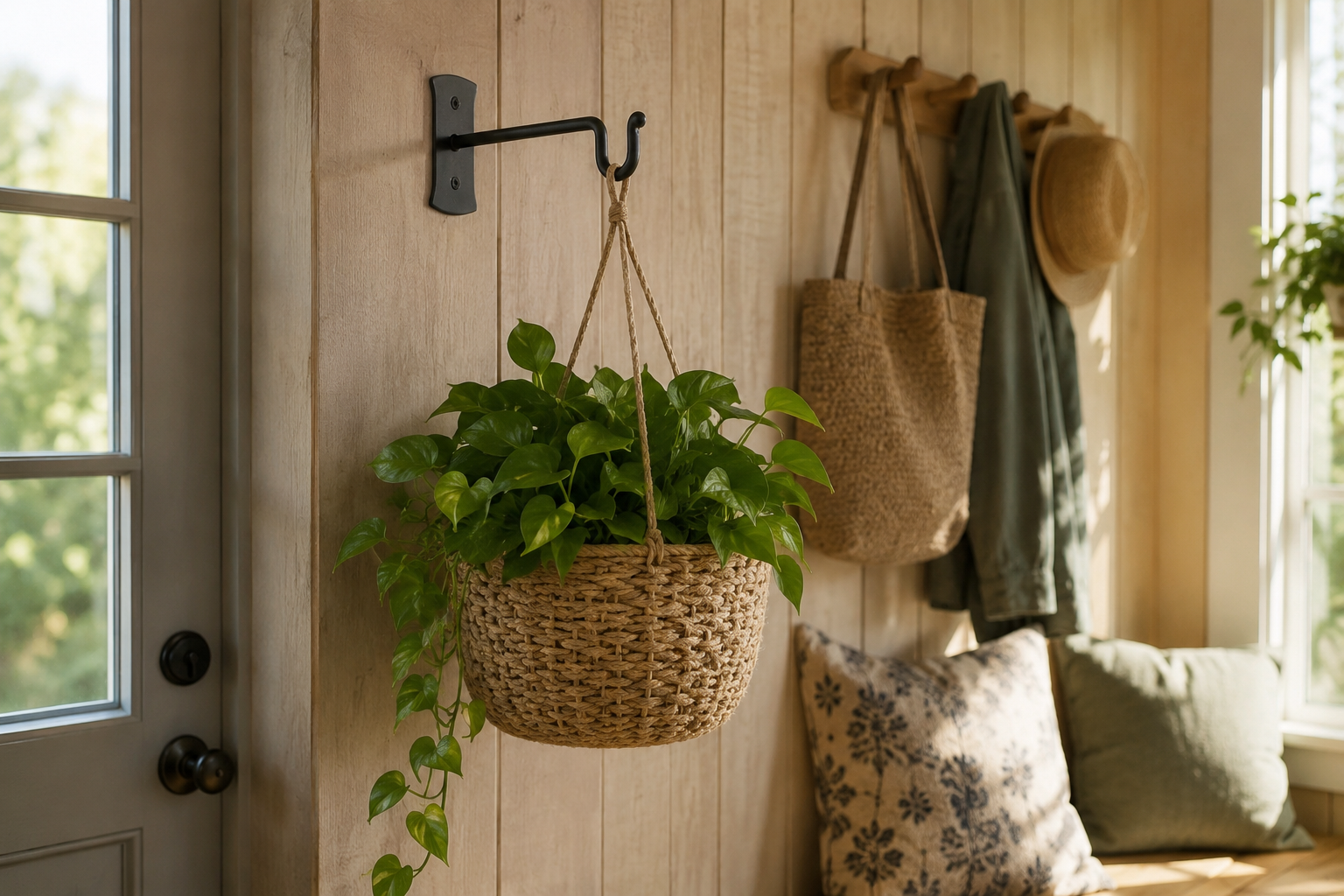
Arm length also affects the swing arc during rotation. On a short arm, the basket’s base stays close to the wall mounting point, and a 90-degree turn swings the outer rim only a short distance. On a longer arm, the same rotation arc sweeps a wider radius. In a hallway or narrow space, that wider arc can bring the basket into contact with a door frame or adjacent shelf. Measure the full swing radius (arm length plus half the basket diameter) before committing to a long-arm bracket in a confined room.
For baskets larger than 12 inches – the 14-inch and 16-inch sizes common in outdoor flowering arrangements – wall brackets generally do not provide adequate arm length to keep foliage clear of the wall without projecting so far that the bracket tip becomes a head-height hazard. These larger baskets are better suited to ceiling mounting or to freestanding shepherd’s poles in outdoor areas.
A 12-inch curved bracket in wrought iron is the standard match for a 10-inch basket needing full 5-inch wall clearance. The extended arm length also positions the basket’s hanging point far enough from the wall that the cord or chain can swing freely during rotation without contacting the bracket’s mounting plate.
| Basket diameter | Basket radius | Arm length needed for 4″ clearance | Arm length needed for 6″ clearance |
|---|---|---|---|
| 8 inches | 4 inches | 8 inches | 10 inches |
| 10 inches | 5 inches | 9 inches | 11 inches |
| 12 inches | 6 inches | 10 inches | 12 inches |
| 14 inches | 7 inches | 11 inches | 13 inches |
How Much Weight Can a Swivel Plant Hanger Safely Hold?
The safe load for any hanging plant setup is determined by the weakest link in the system: the anchor, the bracket, or the hook itself. For most wrought iron plant hanger brackets mounted with appropriate anchors, the bracket is rarely the limiting factor. The anchor almost always is. A self-drilling drywall anchor has a safe working load of only 6 to 12 pounds when the 4:1 engineering safety factor is applied to its rated ultimate strength.5 A fully watered 10-inch basket weighs 6 to 8 pounds.4 On a self-drilling anchor, that leaves almost no margin – and any swinging motion from rotation or air movement adds dynamic load that exceeds the margin entirely.
Toggle bolts change that calculation. A toggle bolt rated above 100 lbs ultimate shear has a safe working load of at least 25 lbs per anchor,5 giving an 18-lb margin above a wet 10-inch basket. That headroom accommodates dynamic swing loads, the weight of a heavier pot, and the gradual corrosion of cast-iron watering cans dripping onto the anchor over a season.
Wall-mounted wrought iron brackets made from solid iron resist bending at loads well above typical basket weights. The bracket itself is not where failures occur. The anchor is. Always select the anchor for the wet weight of the basket plus a 4:1 safety factor, and never rely on a self-drilling anchor for a basket that will be rotated or that hangs in a location subject to airflow or children’s contact.
For more on hook weight limits by type and mounting position, see hanging plant hooks: types, uses, and weight limits.
What Anchors Work Best for a Ceiling-Mounted Swivel Hook?
Ceiling mounting creates a more demanding anchor situation than wall mounting because the anchor bears tensile (pulling) force rather than shear force. An anchor rated for 100 pounds on a wall may carry only 30 to 50 pounds on a ceiling when the force direction changes from lateral shear to vertical pull.5b A hanging basket that swings or rotates adds dynamic load on top of that tensile force, which engineering practice addresses with a higher safety factor of 6:1 or more for dynamic loads.
The preferred ceiling anchor for hanging plants indoors is one of three types, depending on what the ceiling structure contains:
Into a ceiling joist or beam
A lag screw or wood screw driven directly into a ceiling joist or wooden beam is the strongest option. A 3-inch lag screw in solid wood provides several hundred pounds of withdrawal resistance – far above any hanging basket load. Locate the joist with a stud finder, pre-drill to prevent splitting, and drive the screw at a right angle to the ceiling surface. Wrought iron ceiling hooks designed for overhead installation mount to this base with matching hardware included in the package.
Drywall without joist access
A toggle bolt (also called a butterfly anchor) is the correct choice when there is no joist behind the drywall at the desired location. Toggle bolts grip the back face of the drywall panel, distributing the load over a larger area than a self-drilling anchor. Select a toggle bolt rated at a minimum 4 times the wet basket weight and verify the bolt’s shaft diameter clears the ceiling hook’s mounting hole before purchase.5b Self-drilling anchors are not appropriate for ceiling mounting with dynamic hanging loads.
Masonry, concrete, or plaster ceilings
Masonry anchors (sleeve anchors or wedge anchors) driven into concrete or masonry ceilings provide very high tensile strength. Plaster ceilings require care: plaster is brittle and can fracture around the anchor if the installation load is not spread with a backing plate. When in doubt on a plaster ceiling, locate the lath or substrate stud behind it rather than anchoring into plaster alone.
Which Mounting Surface Matters Most for a Swivel Plant Hanger?
The mounting surface determines which anchor is appropriate, what load the installation can carry, and whether the swivel function adds torque that the anchor must resist. Drywall, wood, brick, and concrete each behave differently under the slow, repeated load cycles that plant rotation creates.
Standard drywall (half-inch or five-eighths-inch gypsum board) contributes little to anchor strength on its own. Toggle bolts clamp against the back face of the panel, bypassing that limitation. For a wall bracket in drywall, hit a stud when the mounting holes align with one, and use a toggle bolt when they do not.
Solid wood surfaces (door frames, wooden posts, deck columns, exposed beams) accept wood screws directly and provide the highest load capacity per anchor point. A wrought iron shepherd’s hook bracket mounted into a 4×4 wooden post with 3-inch screws will carry load in excess of any hanging basket that fits on the bracket’s hook. This is the preferred surface for outdoor porch or deck mounting.
Brick and concrete surfaces require a hammer drill and masonry anchors. Keep the bit perpendicular to avoid cracking, and anchor into the brick face rather than the softer mortar joints.
Rotation adds a slow torque to the mounting point each time the basket is turned. On a well-set anchor in solid material this is negligible; on a loose drywall anchor, repeated turning can gradually widen the hole. Inspect anchors seasonally in high-use locations.
What Are the Most Common Mounting Mistakes?
Most hanging plant hanger failures trace to three errors: undersized anchors, basket weight estimated dry rather than wet, and brackets selected for appearance without checking arm length against basket diameter.
Using a self-drilling anchor for a watered basket
Self-drilling anchors require no pre-drilling, but their safe working load (6 to 12 pounds with the 4:1 safety factor) is close to or below the wet weight of a 10-inch basket. A basket hung dry seems fine; the first thorough watering brings it to 6 to 8 pounds, at or past the anchor’s limit. A toggle bolt provides three to four times the margin at comparable cost.
Selecting a bracket arm that is too short
A bracket with an arm shorter than the basket’s radius puts the basket’s outer edge at or behind the wall plane, causing the foliage to press against the surface. Beyond the plant health consequences, a basket that contacts the wall cannot rotate freely on the hook tip: turning it pushes it into the wall surface rather than swinging it outward. Match arm length to basket diameter using the clearance table earlier in this guide.
Mounting into drywall without locating the stud or using a toggle bolt
A screw driven into drywall with no anchor and no stud relies on gypsum friction alone – adequate for a picture frame, not a 7-pound wet basket. Use a stud finder before drilling; when the position misses the stud, use a toggle bolt.
Forgetting to account for swing radius in tight spaces
In hallways, stairwells, and narrow alcoves, a bracket arm that is long enough for good wall clearance may also project the basket far enough that a 90-degree rotation arc brings the outer rim into contact with a door frame, adjacent shelf, or person walking past. Measure the full swing radius (arm length plus basket radius) from the mounting point before deciding on arm length in constrained spaces.
How Do I Choose the Right Indoor Swivel Plant Hanger Setup?
The right indoor swivel plant hanger setup depends on three variables: the room’s available mounting surfaces, the basket size and weight, and how often rotation is needed.
For full 360-degree rotation and plants that need frequent turning, a ceiling hook is the most practical choice. The basket hangs freely on the hook and rotates with a single hand. Ceiling hooks in wrought iron are sized by their capacity rather than by arm length; select a hook whose published load rating is at least 4 times the expected wet basket weight,5 then confirm the ceiling anchor behind it is rated to match. Wrought iron ceiling hooks finished with dual-layer zinc and powder coating resist the moisture that accumulates above plants watered overhead.
For a wall-mounted setup, the shepherd’s hook profile is the most versatile option for standard 10- and 12-inch baskets. Its curved hook positions the basket outward from the wall, allowing it to swing on the hook tip during rotation. For a 10-inch basket needing 5 inches of clearance, a 7.5-inch arm is the minimum; a 10- or 12-inch arm leaves comfortable room for a larger basket in the future.
For larger baskets, a longer curved bracket provides the arm length without changing the mounting pattern. A 12-inch arm keeps a 12-inch basket fully clear of the wall and allows a generous rotation arc. The forged iron construction carries the repeated load cycles of plant rotation without bracket fatigue.
For finish and style matching across hook types, see ornamental plant hanger finishes.
Regardless of hook type, wrought iron’s hand-forge, zinc-galvanize, powder-coat process resists the corrosion that plant moisture introduces over a season.
Frequently Asked Questions
How often should I rotate a plant on a swivel hanger?
Rotate the plant a quarter turn each time you water it. Gardening Know How recommends this schedule because it ties rotation to an existing routine, ensuring it happens regularly without a separate reminder.7 For plants in bright, one-direction light that grow quickly (pothos, philodendron), that means a turn every seven to ten days. Slow-growing plants in diffuse light can go three to four weeks between turns without developing a significant lean.
Can I add a swivel connector to a fixed wall bracket?
Yes. A ball-bearing swivel connector inserts between the bracket’s hook tip and the hanging cord or chain, adding 360-degree rotation to any bracket profile. Select a swivel connector rated above the wet weight of the basket with a 4:1 safety factor applied, and check that the connector’s ring diameter fits the hook tip. Stainless steel swivel connectors resist moisture better than zinc-plated versions in high-humidity indoor locations.
What is the maximum rotation range for a wall-mounted swivel plant hanger?
On a wall-mounted bracket without a swivel connector, the basket can rotate roughly 180 degrees on the hook tip before the cord contacts the bracket arm. With a swivel connector added, full 360-degree rotation is possible as long as the cord is not twisted. A ceiling hook provides unconstrained 360-degree rotation in either direction because there is no bracket arm to limit the swing arc.
Does a swivel plant hanger need a different anchor than a fixed bracket?
Not a different type, but a higher capacity. The dynamic load from rotation and swinging requires applying a safety factor of 6:1 or more rather than the standard 4:1 used for static hanging loads.5b This means the anchor’s ultimate load rating should be at least six times the wet basket weight. For a 7-pound basket, that means an anchor rated at 42 pounds ultimate – which points to toggle bolts or joist-screwed mounts rather than self-drilling drywall anchors.
How do I know if my swivel plant hanger anchor is still safe after a season of use?
Check the anchor annually and after any period of very frequent watering. Signs of anchor fatigue include visible wobble in the bracket when the basket swings, visible gaps opening between the bracket mounting plate and the wall, or a screw that turns without tightening. If any of these appear, remove the basket, replace the anchor with a higher-capacity toggle bolt or joist screw, and allow the new installation to cure before re-hanging. A wrought iron bracket itself rarely fails; anchor failures account for the vast majority of hanging plant falls.
Limitations and Edge Cases
- The weight figures in this guide (6 to 8 pounds for a watered 10-inch basket)4 apply to standard nursery-mix potting soil and a single trailing plant. Baskets filled with heavier growing media (coconut coir, perlite-amended mixes with high water retention) or multiple plants can weigh 20 to 30 percent more; add that margin to the safety-factor calculation.
- Outdoor swivel hangers face wind loads that substantially exceed indoor dynamic loads. The 4:1 and 6:1 safety factors discussed here are for indoor use; outdoor hanging basket standards in exposed locations require engineering assessment specific to the local wind zone.
- Rotation guidance assumes a light source on one primary side of the room. In conservatories, sunrooms, or under grow lights positioned directly above, light is sufficiently multi-directional that phototropic bending is minimal; rotation is optional rather than necessary in those environments.
References
- Greenhouse Management – “Space jam: 2024 National Gardening Survey results,” National Gardening Association 2023 Survey data, 2024.
- USDA National Agricultural Statistics Service – “2024 Census of Horticultural Specialties,” press release, February 26, 2026.
- Iowa State University Extension – “Creating and Growing Hanging Baskets,” Yard and Garden, Iowa State University Extension and Outreach.
- Stefczak’s Greenhouse – Hanging basket weight reference, commercial greenhouse grower resource page.
- Engineer Fix – “Drywall Anchor Weight Chart: How Much Can They Hold?,” engineering practitioner guide covering safe working load and safety factor standards.
- Engineer Fix – “How Much Weight Can Drywall Ceiling Anchors Hold?,” covering tensile vs. shear load differences and dynamic load safety factors for ceiling anchors.
- PubMed Central / NIH – Esmon et al., “Phototropism: Bending towards Enlightenment,” The Plant Cell, University of Missouri-Columbia, 2005.
- Gardening Know How – “Rotating Houseplants: How Often Should I Turn A Houseplant,” practical guide to plant rotation frequency and auxin growth effects.
Conclusion
A swivel plant hanger delivers two practical benefits: it removes the need to lift a heavy, wet basket for routine rotation, and it lets you keep that rotation frequent enough to prevent phototropic lean. The weight and anchor math is straightforward – a watered 10-inch basket needs an anchor with at least 25 pounds of safe working load to meet the 4:1 engineering standard, which means toggle bolts or joist-mounted screws, not self-drilling drywall anchors. Arm length for wall brackets should equal the basket’s radius plus at least 4 inches of clearance from the wall surface.
For context on how swivel hooks fit the broader category, see plant hanger types and mounting for the selection and mounting overview.