
Heavy duty curtain hooks and rigid wrought iron holdbacks both keep thick drapes gathered to the side of a window, but they differ in arm projection, wall anchoring requirements, and fabric bundle management over time. A full-length velvet panel, blackout-lined and fully interlined, can weigh over 17 lbs per side3, and that weight changes which tieback hardware actually holds it through hundreds of daily opening and closing cycles. The curtain holdbacks guide covers the broader category; this article focuses on one specific decision: when does a simple wall hook outperform a rigid holdback arm, and when does the holdback clearly win for thick or frequently opened drapes?
Quick Answer
When should you choose a simple wall hook instead of curtain holdbacks?
Choose a sturdy wall hook when the drape is medium-weight (under 200 GSM unlined), the window sits in a tight reveal where a projecting holdback arm would obstruct traffic, or the installation is temporary and you expect to relocate the hardware. Choose a rigid wrought iron holdback when the panel is thick, lined, or velvet (300 GSM and above1), the drape is opened and closed at least once daily, or the wall situation allows a two-screw base plate to anchor on solid framing or a toggle bolt – the only anchor type whose safe working load clears the weight of a heavy panel4.
Key Takeaways
- A fully interlined heavy velvet panel at a 200 cm drop can weigh over 17 lbs per side3, which exceeds the safe working load of plastic expansion anchors and standard self-drilling threaded anchors even before a safety factor is applied.
- Rigid holdbacks distribute the gathered drape over a 4 to 6 inch arm projection, reducing slippage compared with a shallow single-point hook, particularly for thick or lined fabric.
- No ANSI or ASTM standard sets a minimum load rating for residential curtain tieback hardware: anchor choice is entirely driven by fabric weight, wall structure, and the 4:1 safety factor applied to the anchor’s ultimate load rating4.
Quick Comparison: Heavy Duty Curtain Hooks vs Holdbacks
The table below captures the core differences between a heavy-duty wall hook used as a curtain tieback and a rigid wrought iron holdback arm across the dimensions most relevant to thick or frequently used drapes.
| Dimension | Heavy-Duty Wall Hook | Rigid Wrought Iron Holdback |
|---|---|---|
| Best for fabric weight | Medium-weight, unlined, or semi-sheer (under 200 GSM) | Heavy, lined, or velvet (300 GSM and above) |
| Arm projection from wall | 1 to 2 inches (shallow; minimal clearance from frame) | 4 to 6 inches (fabric clears deep window reveals) |
| Wall anchor points | 1 to 2 screws on a single base | 2 screws on a wider base plate (two load paths) |
| Fabric hold under sustained load | Contact at one curve; fabric can slide down over time | Arm cradles bundle over its full length; minimal creep |
| Suitable anchor type (per 4:1 safety factor) | Toggle bolt (25 lbs SWL) or stud mount required for heavy drapes | Same anchor standard, but two screws split the load |
| Performance at daily use frequency | Adequate for weekly or occasional use | Designed for daily opening and closing cycles |
| Precision needed at installation | Low: single hole, easy to relocate | Moderate: height and offset from frame affect drape volume |
| Decorative visibility | Largely hidden behind gathered fabric | Visible motif (scroll, flower, swirl) adds room character |
| Overall verdict | Use for light or medium drapes, tight spaces, temporary installs | Use for heavy, lined, or decorative drapes in permanent rooms |
Which Handles Heavier Fabric Weight Better?
Rigid curtain holdbacks handle heavier fabric better than simple hooks because the arm projection cradles the gathered stack over a longer contact zone, distributing friction and reducing slippage that builds up when 15 or more pounds of velvet rest on a single narrow curve.
Fabric weight varies sharply across curtain types. According to Jestextile (October 2025), velvet curtain fabric ranges from 300 to 400 GSM for lightweight velvet, 500 to 700 GSM for medium-weight velvet, and over 700 GSM for heavy theatrical velvet1. A standard unlined linen drape sits at 200 to 260 GSM. Adding blackout lining to any base fabric contributes a further 100 to 200 GSM to the panel total, and standard interlining adds another 80 to 150 GSM on top of that2. The cumulative effect is significant: a cotton base panel at a 200 cm drop and 2 fabric widths weighs approximately 11.5 lbs unlined; with blackout lining and full interlining, the same panel reaches 17.8 lbs3.
A simple wall hook makes contact with the drape fabric at one narrow curve, typically 1 to 2 inches wide. When a 17-lb bundle of velvet rests on that curve, the weight pulls the fabric downward and outward simultaneously. During the day, the bundle shifts and by afternoon the drape has migrated several inches from where it started. Simple J-hooks and loop-style hooks have a shallow curve designed to prevent items from falling off, not to support a large sustained downward load with a lateral component.
A rigid holdback arm projects 4 to 6 inches from the wall and curves upward at the tip, which means the gathered fabric rests against the full arm length, not at a single point. The bundle is cradled rather than balanced. Friction works along the entire contact surface, and the upward curve at the tip prevents the stack from migrating outward. For panels under 200 GSM and 10 lbs per side, the distinction is minor and either hardware can work. For panels above 300 GSM or 14 lbs per side, the holdback arm provides measurably more stable support through a full day.
Why Fabric GSM Ratings Matter for Hardware Selection
Fabric weight is expressed as grams per square meter (GSM) and measured under a standardized ASTM test method for mass per unit area of fabric6. When a fabric supplier states a GSM rating, that figure uses this method. This matters for hardware selection because values from different sources are directly comparable: a velvet face fabric rating and a blackout lining rating are both measured the same way, so adding them gives a reliable estimate of the lined panel’s total weight before factoring in heading tape.
Verdict: Holdbacks win for heavy fabric. For medium-weight, unlined drapes under 200 GSM and under 10 lbs per panel, a sturdy wall hook is adequate. For thick, lined, or velvet panels above 300 GSM, a rigid holdback arm is the appropriate hardware for sustained daily use.
Which Requires Stronger Wall Anchoring?
Both hook and holdback must anchor to the same wall and carry the same curtain weight, but a rigid holdback’s two-screw base plate spreads the load across two anchor points, halving per-anchor demand compared with a one-screw hook installation and providing a meaningful safety margin for heavy panels.
Anchor type is where many installations fail silently. Engineering guidance from Engineer Fix (Liam Cope, November 2025) states that a 4:1 safety factor should be applied to the ultimate load rating of a wall anchor when determining the safe working load (SWL) for suspended items4. Applying that factor: plastic expansion anchors carry a SWL of 2 to 4 lbs; self-drilling threaded anchors, 6 to 12 lbs; toggle bolts, 25 lbs or more; and screws driven directly into a wood stud, 80 to 100 lbs45. No ANSI or ASTM standard currently sets a minimum load rating for residential curtain tieback hardware specifically. ANSI/WCMA A100.1-2022, which covers interior window coverings including traverse rods, curtains, and drapes, addresses cord safety rather than bracket or holdback load performance7. Anchor selection is therefore left entirely to the installer’s judgment, which makes the 4:1 safety rule the practical standard to apply.
A 17-lb heavy drape panel loaded onto a single wall hook demands that one anchor point carry at least 17 lbs of sustained downward force. With the 4:1 safety factor, the anchor’s ultimate rating needs to be at least 68 lbs. Plastic expansion anchors and standard self-drilling threaded anchors do not approach that threshold. Toggle bolts at 25 lbs SWL do clear the load, but they meet it narrowly when the full panel weight is at stake. Driving screws directly into a wood stud at 80 to 100 lbs SWL per screw is the reliably safe option for any panel at or above 15 lbs.
“I use a stud finder to locate the studs beside the window. If a stud is close to my desired location, I shift my placement slightly so that my mounting screws can set.”
Jenn Largesse, DIY Expert and Editor, This Old House8
A two-screw holdback base plate splits the panel’s weight between two anchors. If each anchor is a toggle bolt at 25 lbs SWL, the combined capacity reaches 50 lbs, which safely clears a 17-lb panel with a 3:1 safety margin. A single-screw hook with one toggle bolt provides only that one anchor’s capacity: the margin disappears if the panel is near the top of the weight range or if the anchor was not set perfectly. The holdback’s two-screw design is inherently more forgiving on walls where stud location does not align perfectly with the desired holdback position.
Verdict: Holdbacks win on anchor reliability. A two-screw base plate distributes load across two anchors and halves per-anchor demand. For any drape panel above 15 lbs, toggle bolts or stud mounting are required regardless of whether you use a hook or holdback; the holdback’s two-screw design provides additional safety margin that a single-screw hook cannot match.
Which Gives Better Hook Depth and Curtain Clearance?
Rigid curtain holdbacks give better hook depth and curtain clearance because their 4 to 6 inch arm projection pushes the gathered fabric stack fully clear of the window frame and any deep reveal, while a shallow wall hook projects only 1 to 2 inches and may leave the fabric pressing against the glass or frame edge.
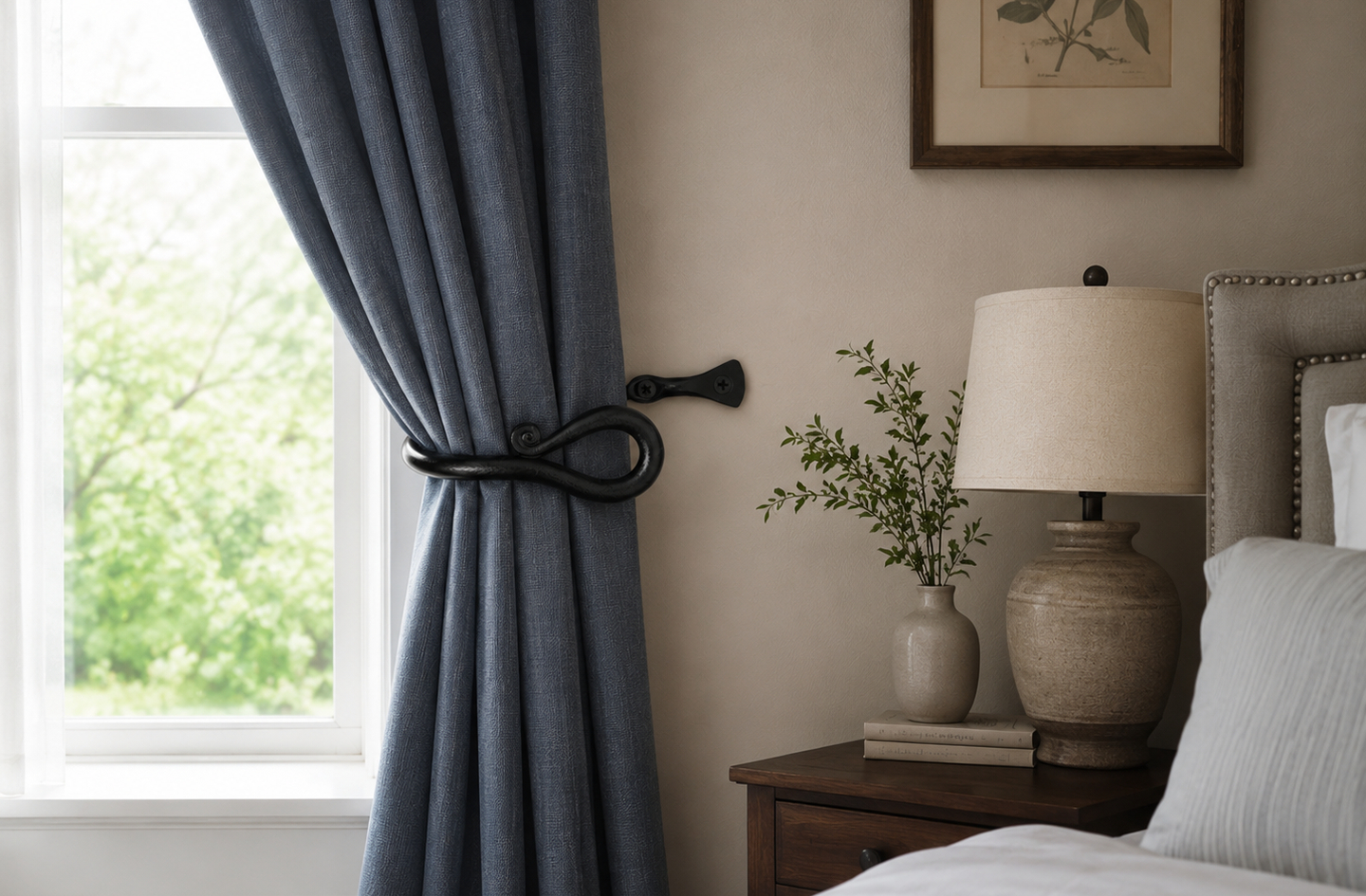
Clearance is the distance between the gathered curtain stack and the face of the window frame. For a drape opened multiple times per day, adequate clearance prevents the stack from fouling on a window handle, impeding airflow, or pressing against the glass in a way that traps moisture. A typical residential holdback arm, including the RTZEN hand-forged models, projects 4 to 6 inches from the wall, which accommodates most residential window reveals and the gathered volume of a 2-width velvet panel without the fabric touching the frame.
A simple wall hook projects 1 to 2 inches from the wall surface, which is sufficient clearance for a lightweight single-width sheer. It is not sufficient for a fully interlined velvet panel: the gathered stack of fabric at 2 widths of heavy velvet with lining and interlining can compress to 6 to 8 inches of depth, meaning the hook pushes only the outermost inch or two of the bundle clear while the rest presses against the frame. Over time, this abrades the lining fabric at the contact point and lets condensation build up between fabric and glass in winter months.
Hook Depth Relative to Curtain Header Tape
The hook depth discussion connects to curtain header tape geometry. A standard triple-pleat heading tape has a pleat depth of approximately 27.5 mm (about 1 inch) and a design repeat of 265 mm. When a drape is gathered to the side, the heading tape bulk stacks against the wall behind the holdback arm. A 4 to 6 inch holdback arm clears that stack cleanly; a 1 to 2 inch hook does not, which causes the heading tape to press against the wall beside the hook and distort the drape’s hang when the bundle is released.
The classic holdbacks are built at the arm projection and height that handles this volume correctly for standard residential windows, with solid wrought iron construction that does not flex under the lateral push of a thick gathered panel.
Verdict: Holdbacks win on clearance. For any panel with a deep heading tape or more than 1 fabric width of lining, a 4 to 6 inch holdback arm is the minimum projection needed to keep gathered fabric off the frame. A shallow hook is only adequate for lightweight, single-width panels in windows without a deep reveal.
Which Holds Up to Frequent Opening and Closing?
Rigid holdbacks perform better under frequent daily use because the curved arm provides a consistent parking position for the gathered drape, while a simple hook allows the bundle to reposition itself each time, gradually training the fabric into an uneven hang.
For a room where curtains are opened every morning and closed each evening, the tieback hardware needs to place the fabric in the same position reliably, two-way, 365 days a year. That adds up to more than 700 placement cycles per year. A rigid holdback arm has a fixed geometry: the arm angle and the upward tip define a single resting position for the fabric bundle. Each time you open the drape and gather it to the side, the fabric settles into the same arm position because the arm’s angle determines the natural hang. The upward tip prevents the bundle from migrating outward and the wall prevents it from moving inward.
A simple wall hook has a single contact point and an open profile. The drape bundle slides into whatever angle the fabric’s own weight and the last gathering gesture left it in. For light sheers that settle uniformly, this is barely noticeable. For a stiff interlined velvet panel with a thick heading tape, the bundle rotates on the hook over the course of a day and settles at a different angle each evening. After a week, the lining develops crease marks where it contacted the hook, and the drape no longer falls in a clean stack when released.
Frequency of Use and Iron Hardware Durability
Hand-forged solid wrought iron resists the metal fatigue that affects stamped or hollow hooks after thousands of loading cycles. Hammering heated iron rather than stamping cold sheet metal produces a denser grain structure at the bend, which resists cracking at the contact arc under repeated loading. The dual zinc and powder-coat finish also prevents the surface corrosion that rough-surfaced metal causes on velvet and linen linings at the daily contact point.
Verdict: Holdbacks win for frequent use. For windows opened and closed daily, a rigid holdback arm provides a consistent parking position that a simple hook cannot match. For infrequently used decorative drapes that stay in position for weeks at a time, a hook is adequate and easier to reposition if placement is not perfect on the first try.
Which Is Easier to Install and Adjust?
Simple hooks are easier to install and easier to move after installation: one or two screw holes, a quick removal, and a new hole in a better location. Rigid holdbacks require more measurement precision at installation but deliver a more stable and predictable result once placed correctly.
A single-screw hook goes up in under ten minutes: mark one hole, drill, set the anchor or drive the screw into a stud, and attach the hook. If the height is wrong by an inch, remove one screw and redrill. The repair to the original hole is a small nail putty fill. That low consequence matters especially in rented spaces or rooms where the window treatment is being tested before committing.
A rigid holdback with a two-screw base plate requires two holes in precise alignment. The height relative to the window sill determines whether the fabric hangs in a graceful swag or a stiff stack. Standard placement guidance puts holdbacks one-third to one-half of the way up from the sill, adjusted for ceiling height, fabric weight, and rod position. Getting this right requires careful measuring before drilling, as two misplaced holes close together are visible even after patching on smooth painted walls.
For situations where the final position is genuinely uncertain, starting with a heavy-duty hook confirms the right height before committing to two-hole holdback placement. Once confirmed, moving to a holdback at those coordinates is straightforward.
Verdict: Hooks win on installation flexibility. For permanent rooms and fabric that warrants extra care in placement, a holdback’s two-screw base is worth the planning. For temporary or test installations, a heavy-duty hook’s single-screw mounting simplifies the process significantly.
Which Suits Traditional and Farmhouse Interiors Better?
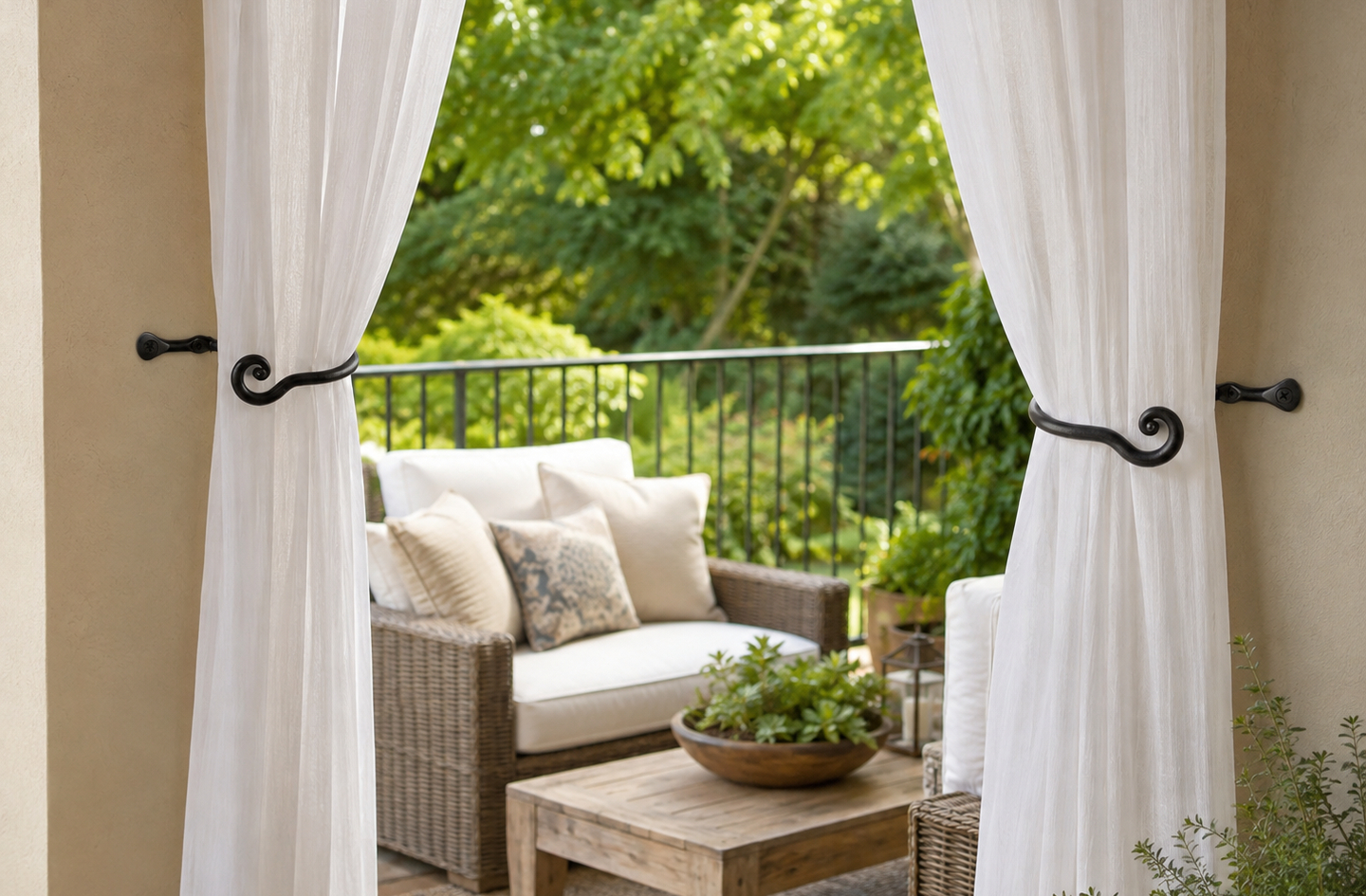
Rigid wrought iron holdbacks suit traditional, farmhouse, rustic, and classic interiors better than simple hooks because the visible arm, scroll, or motif contributes to the room’s decorative character, while a simple hook is largely concealed behind the gathered fabric and adds no decorative element of its own.
When a drape is pulled to the side and gathered at a holdback, the holdback arm and its tip motif are clearly visible from across the room. A swirl, flower, or scroll end on a hand-forged iron arm reads as deliberate hardware selection, the same way a curtain rod finial does. In farmhouse and rustic interiors, where iron hardware is part of the design vocabulary alongside wood beams, dark cabinet pulls, and exposed stone, a wrought iron holdback with a matching finish ties the window treatment into the room’s material palette.
A simple wall hook, even a heavy-duty one, disappears behind the gathered fabric in most installations. For a minimalist or contemporary interior where hardware should not be seen, this invisibility is a genuine advantage. For a traditional, farmhouse, or vintage interior where each piece of iron hardware is part of the room’s texture, the invisible hook misses an opportunity that a wrought iron holdback captures.
The loophole holdbacks, with their integrated loop end, suit heavy drapery materials and keep fabric panels secure against a clean profile that works in both modern farmhouse and transitional spaces. Flower motif and swirl designs address more overtly traditional and rustic palettes.
Verdict: Holdbacks win for decorative interiors. For rooms where the window treatment is a designed element and the hardware is meant to be seen, a wrought iron holdback earns its place visually. A simple hook is the right choice for hidden, minimal, or temporary applications where the tieback should not draw attention.
Who Should Choose What
Choose based on three factors: fabric weight, use frequency, and whether the holdback will be visible in the room’s design.
Homeowners with thick, lined, or velvet drapes opened daily: Choose a rigid wrought iron holdback. The fabric weight and daily frequency both call for a two-screw base plate, a long arm projection, and a hand-forged arm that will not fatigue at the contact curve. Use toggle bolts or stud screws for panels above 15 lbs; do not rely on plastic expansion anchors for heavy drapes.
Renters or those testing curtain placement: Start with a heavy-duty wall hook at a single anchor point. Confirm the height and distance from the frame before committing to two-hole drilling. Once the right position is confirmed, moving to a holdback at those coordinates is straightforward.
Interior designers fitting farmhouse, rustic, or transitional rooms: Choose wrought iron holdbacks with a motif that matches the room’s iron vocabulary. Match the finish (black or white) to the curtain rod and other iron accents in the room. The holdback is a visible design element, not just a functional bracket.
When neither may apply: If the window has a very narrow sill return (under 4 inches of wall between the frame and a perpendicular wall), a holdback arm may project into the walking path. In that specific geometry, a jamb-mounted tieback hook with minimal projection is the appropriate solution.
Verdict by Category
| Dimension | Winner |
|---|---|
| Fabric weight management | Rigid holdback |
| Wall anchoring reliability | Rigid holdback |
| Hook depth and curtain clearance | Rigid holdback |
| Performance under frequent daily use | Rigid holdback |
| Installation ease and adjustability | Heavy-duty hook |
| Decorative suitability for traditional interiors | Rigid holdback |
| Overall for heavy or frequently used drapes | Rigid wrought iron holdback |
The heavy-duty wall hook wins on one dimension: installation ease and the ability to reposition without leaving a visible repair. On every dimension that matters for thick, lined, or velvet drapes – fabric weight management, wall anchoring, clearance, and durability under daily use – the rigid holdback is the appropriate hardware. The hook’s advantage applies mainly to temporary installations or lightweight fabric. For a permanent room with quality drapes, a rigid wrought iron holdback anchored to a stud or toggle bolt is the correct long-term choice.
Frequently Asked Questions
Can heavy-duty curtain hooks hold velvet drapes?
Heavy-duty wall hooks can physically hold velvet drapes, but they are not the best hardware for that fabric. Velvet drape panels at a standard floor-length drop can weigh 15 to 18 lbs per side3, and the fabric bundle rests on the hook’s narrow curve rather than along an arm. The bundle shifts during the day and the fabric can work itself loose by afternoon. A rigid holdback arm, which supports the gathered stack over 4 to 6 inches of contact length, handles that weight with noticeably less migration.
What anchor do I need for a curtain holdback on drywall?
For a heavy drape panel (15 lbs or more), use toggle bolts or drive screws directly into a wood stud. Toggle bolts carry a safe working load of 25 lbs or more per anchor4, and a two-screw holdback with two toggle bolts provides 50 lbs of combined capacity. Plastic expansion anchors (2 to 4 lbs SWL) and standard self-drilling threaded anchors (6 to 12 lbs SWL) are undersized for panels above 10 lbs once a 4:1 safety factor is applied4.
How far from the window frame should I mount a curtain holdback?
Mount the holdback far enough from the window frame that the arm projection keeps the gathered fabric stack fully clear of the frame edge when the drape is held open. For a 2-width velvet panel fully interlined, the compressed stack depth can reach 6 to 8 inches, so the holdback center should sit at least 4 to 6 inches beyond the frame face. Height placement typically falls one-third to one-half of the way up from the sill, adjusted for ceiling height and how much of the window you want visible when the drape is open.
Do curtain holdbacks damage fabric over time?
A well-finished holdback arm should not damage curtain fabric under normal use. The risk arises with hardware that has rough welds, sharp edges, or paint that chips into flakes at the contact curve. Hand-forged wrought iron holdbacks with a powder-coated finish have a smooth, consistent surface at the contact arc. The fabric makes contact with the same smooth finish point each time, which does not abrade lining or velvet fabric under daily use the way a raw stamped metal edge can. Inspect the contact point on any new holdback before use and file any rough spot.
Is there a standard load rating for curtain holdback hardware?
No residential curtain holdback load rating standard currently exists from ANSI, ASTM, or the Window Covering Manufacturers Association. ANSI/WCMA A100.1-2022, which took effect June 1, 2024 and applies to curtains, drapes, and traverse rods, addresses cord safety rather than bracket or holdback load performance7. Holdback selection is entirely a function of fabric weight, anchor type, and the 4:1 safety factor applied to the anchor’s rated load. This gap means buyers must calculate load requirements themselves rather than relying on a labeled hardware rating.
References
- Jestextile – “What Is the Weight of Velvet Curtain Fabric?” October 9, 2025. Reports lightweight velvet at 300-400 GSM, medium-weight at 500-700 GSM, and heavy theatrical velvet above 700 GSM.
- Engineer Fix – “How Heavy Are Curtains? A Guide to Curtain Weight,” Liam Cope, December 30, 2025. Reports heavy-weight fabrics including thermal, blackout, and velvet exceeding 300 GSM; blackout lining adds 100-200 GSM.
- Ritetrack – “Curtain Weight Guide,” 2026. Based on Silent Gliss panel weight data: unlined cotton panel at 200 cm drop, 2 widths, weighs 5.2 kg (11.5 lbs); with full interlining and blackout lining, 8.1 kg (17.8 lbs).
- Engineer Fix – “Drywall Anchor Weight Chart: How Much Can They Hold?” Liam Cope, November 18, 2025. Reports safe working loads by anchor type with 4:1 safety factor: plastic expansion 2-4 lbs, threaded 6-12 lbs, toggle bolt 25+ lbs, wood stud 80-100 lbs.
- Walabot – “How Much Can a Drywall Anchor Actually Hold?” September 30, 2024. Corroborates anchor capacity ranges: plastic expansion 10-25 lbs ultimate, threaded 25-75 lbs ultimate, toggle bolts 100-200 lbs ultimate.
- ASTM International – “D3776/D3776M-20 Standard Test Methods for Mass Per Unit Area (Weight) of Fabric.” Active standard, last revised August 20, 2025. The standardized measurement method for all fabric GSM ratings.
- Window Covering Safety Council – “WCMA Announces Historic New Window Covering Safety Standard,” 2022. Describes ANSI/WCMA A100.1-2022, effective June 1, 2024, which covers cord safety for interior window coverings including curtains and drapes but does not establish load ratings for holdback hardware.
- This Old House – “How to Hang a Curtain Rod,” Jenn Largesse (DIY Expert and Editor), updated May 29, 2026. Expert guidance on locating studs and adjusting mounting position for secure curtain rod installation.
Conclusion
Heavy duty curtain hooks are the right tool for medium-weight drapes in temporary installations, tight wall reveals, or rooms where the hardware position is still being tested. Rigid wrought iron holdbacks are the correct long-term hardware for thick, lined, or velvet panels opened daily: they distribute fabric weight over a longer arm, provide two anchor points instead of one, and hold the drape in a consistent position through repeated use. Toggle bolts or stud mounting are required for panels above 15 lbs regardless of hardware type.
For the full context on holdback sizing, positioning, and style matching by room type, the curtain holdbacks guide covers how this decision fits into the broader window treatment picture.