
Two-thirds of all U.S. housing units have a garage or carport,2 yet a 2022 survey found that 36% of American garages are too cluttered to park a vehicle inside.3 Heavy duty garage hooks solve that problem when they’re chosen and placed correctly. For a broader overview of the topic, see our guide on heavy duty wall hooks, which covers selection and installation across all settings. This article focuses on the garage specifically: tool bags, ladders, hoses, cords, and bicycles, where to place each type of hook, when two hooks work better than one, and why the wall behind the hook matters as much as the hook itself.
Quick Answer
What hook setup do you need for a well-organized garage?
Match the hook’s load rating to your heaviest item, then mount into wall studs for anything over 25 lbs. Stud-mounted screws hold up to 100 lbs,7 which covers most bikes, ladders, and loaded tool bags. Use paired hooks spaced 12-18 inches apart for ladders and bikes, and closed-loop designs for cords and hoses that tend to slip off straight hooks.
Key Takeaways
- Road bikes weigh 17-20 lbs; trail mountain bikes reach 30-36 lbs; loaded tool belts exceed 50 lbs. Your hook’s rated capacity should exceed your heaviest item by a comfortable margin.46
- Screws driven into wall studs hold up to 100 lbs; drywall-only anchors safely hold only 25-50 lbs. For ladders, bikes, and tool bags, always hit a stud or use masonry fasteners on concrete block.78
- Spreading hooks across multiple wall bays prevents overloading one section of drywall and keeps heavy items accessible without crowding.
- Paired hooks spaced 12-18 inches apart keep ladders and bicycles balanced and reduce tipping risk during storage.
What to Know Before You Hang Anything
Before you drive a single screw, a few quick facts will save you from a hook that pulls out of the wall six months later or a bike that clips your shoulder every time you walk past.
Know what you’re hanging. Each item in this article has a different weight profile and a different hang point. A coiled garden hose drops its weight from a single loop. A ladder distributes weight across two contact points. A bicycle balanced on its top tube needs support at two separate spots to keep it from tipping sideways. The hook type and spacing depend on how the item balances, not just how heavy it is.
Know your wall. Most residential garages have one of three wall surfaces: gypsum drywall on wood studs, exposed concrete block, or sheet plywood nailed to studs. The substrate changes what fasteners you use and how much weight each mounting point can carry. We cover this in Step 2.
Gather these before you start: a stud finder, a pencil, a drill with appropriate bits, a level, and a tape measure. For concrete block walls, add a masonry bit and concrete anchors. Most hand-forged wrought iron hooks ship with mounting hardware, but the screws in the package are sized for wood studs. Concrete and hollow drywall require different fasteners.
Estimated time: 20-40 minutes per hook location for marking, drilling, and mounting. Plan a full afternoon if you’re setting up a complete garage wall system with four or more hook zones.
Step 1: Match Heavy Duty Garage Hooks to Your Item’s Weight Class
The first thing to establish is the actual weight of what you’re planning to hang. Most people underestimate, and that leads to hooks rated for 25 lbs carrying items that weigh twice that.
Here is a reference breakdown from independent sources:
Bicycles
Road bikes average 17-20 lbs, XC mountain bikes run 23-28 lbs, and trail or enduro mountain bikes typically weigh 30-36 lbs.4 Hybrid bikes sit in the 24-31 lb range.5 An e-bike is a different category entirely and commonly exceeds 50 lbs, which puts it beyond the scope of most standard wall hook systems. For any standard adult bike, a hook rated for at least 50 lbs gives you a comfortable margin above the actual weight.
Ladders
A Werner fiberglass 6-ft Type IA stepladder ships at roughly 22 lbs; the 8-ft version ships at roughly 30 lbs,9 with the 300 lb duty rating referring to the user load capacity, not the ladder’s own weight. An aluminum extension ladder in the 20-foot range typically weighs 35-50 lbs, depending on the manufacturer and style. For any ladder over 30 lbs, mount into studs and plan on two contact points rather than one.
Tool bags and hoses
An empty tool bag weighs 4-8 lbs. The moment it’s loaded with wrenches, sockets, and a cordless drill, the picture changes. OSHA notes that loaded tool belts can weigh over 50 lbs,6 and a fully packed contractor bag often falls in the same range. Garden hoses add up faster than expected: a 50-foot rubber hose weighs roughly 10-13 lbs and a 100-foot hose runs 18-25 lbs. Coiled on a hook, the weight concentrates at a single point.
The chart below synthesizes weight data across these categories from independent sources, so you can see at a glance where your gear falls.
For heavy tool bags and contractor gear, a hook with a double mounting point distributes that load across two screws instead of one. The double hooks from RTZEN are hand-forged from solid wrought iron with thick construction specifically built to resist bending under heavy loads, which is exactly what a loaded bag demands.
Step 2: Choose the Right Mounting Substrate
The hook matters. The mounting substrate matters more. A high-quality hand-forged hook rated for 80 lbs will pull clean out of the wall if you drive its screws into bare drywall without hitting a stud. The substrate is what carries the load.
Wood studs
Standard residential garage walls have wood studs spaced 16 or 24 inches on center. Screws driven into studs offer the highest holding power for wall-mounted hooks. Today’s Homeowner reports that several screws driven into wall studs can support up to 100 lbs.7 This capacity covers road bikes, most stepladders, and loaded hoses with room to spare. Use a stud finder before marking, and use screws that penetrate at least 1.5 inches into the stud. The screws included with wrought iron hooks are typically sized for this requirement, but confirm the length before you drive them.
Drywall without a stud
When a stud isn’t in the right position for your layout, drywall anchors are the fallback. The capacity drop is significant. Toggle bolts hold 25-50 lbs in drywall or plaster; expanding plastic sleeve anchors support around 25 lbs; standard molly bolts run 10-50 lbs depending on size.7 More importantly, the working load is lower than the rated load. As This Old House explains:
“An anchor rated for 100 pounds will safely support 25 pounds.”
This Old House, “How To Choose the Right Hanging Hardware”8
That four-to-one margin is the standard safety factor for hanging hardware. Apply it to any rated anchor when calculating your actual safe load. In practice: use drywall-only anchors for lighter items (small tool collections, coiled extension cords, garden gloves) and reserve stud mounting for anything that weighs more than 25 lbs in use.
Concrete block and masonry
Many attached garages have at least one concrete block or poured concrete wall, particularly the shared wall between the garage and the house or the rear wall. Concrete block is actually excellent for heavy-duty hanging because the material is dense and solid. You need a masonry bit and either sleeve anchors or wedge anchors rated for the load. Screw-in concrete anchors are available in a range of capacities; choose anchors rated for at least double what you plan to hang. Avoid driving standard wood screws or plastic drywall anchors into concrete. They’ll hold for a week, then loosen.
Plywood panels
Some garages have 3/4-inch plywood sheets nailed over the studs. Every screw has solid material to bite into rather than a thin gypsum layer. You still benefit from hitting the underlying studs for heavy items, but plywood distributes stress better than drywall alone. A full plywood wall lets you mount hooks anywhere and relocate them without patching holes.
Step 3: Map Out Your Garage Wall Zones
Random hook placement creates a frustrating garage. You reach for a tool and knock over a hose. The ladder hangs in front of the workbench. Cords dangle at head height. A simple zone approach fixes this before you drill a single hole.
Zone 1: The active tool wall
This is the wall at or near your workbench, or the wall you face most often when doing projects. It holds items you reach for regularly: hand tools, power-tool cases, cords, gloves, tape measures, and smaller bags. Hook heights here should fall between 48 and 72 inches from the floor, putting everything in comfortable arm’s reach. Avoid placing heavy items at full arm’s length because they’re harder to control during takedown. The active tool wall works best with a combination of single hooks for individual tools and a multi-hook rack for items you tend to grab in groups.
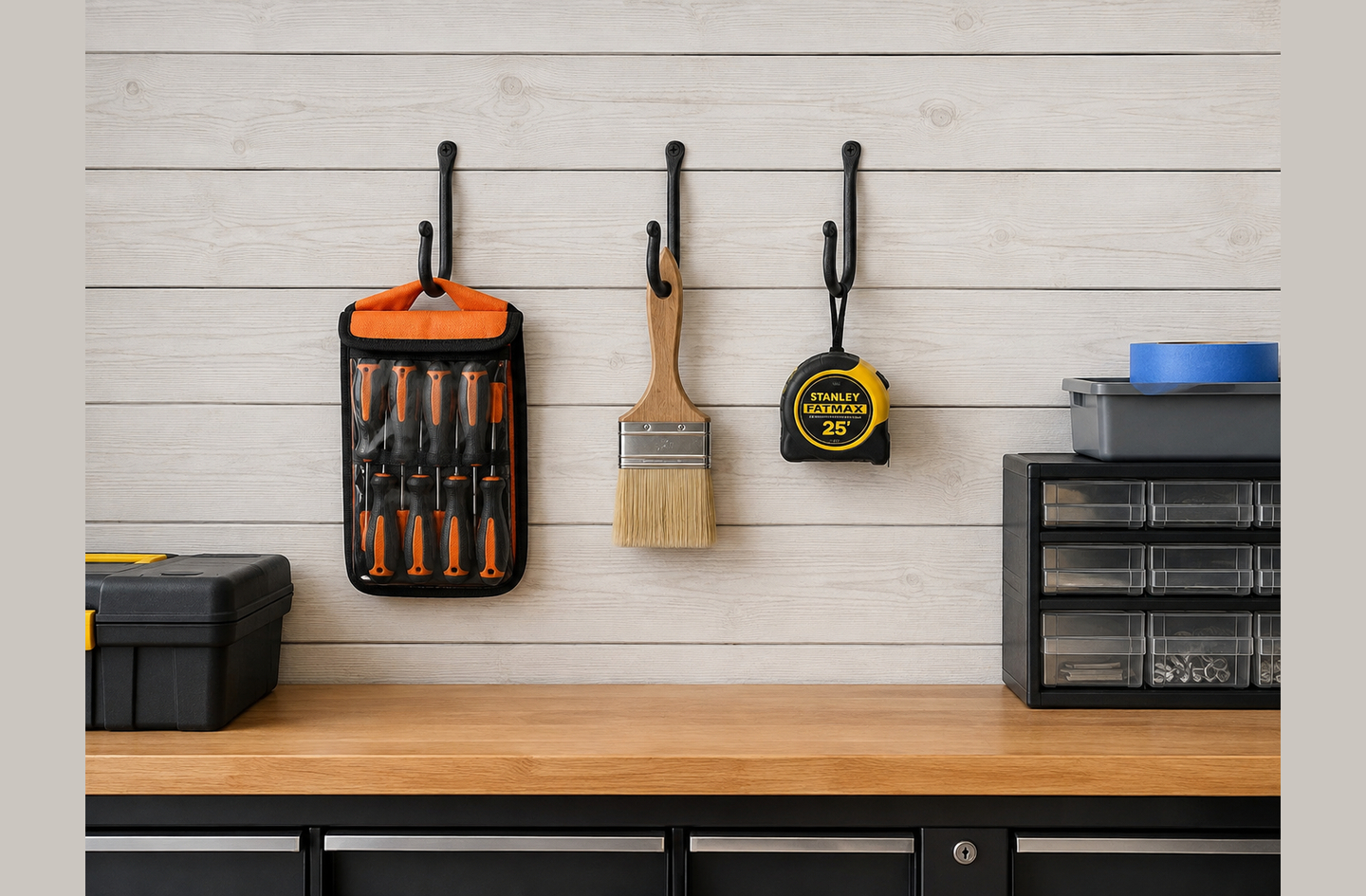
A 5-hook rack mounted at 60 inches on a stud works well here: you get five positions on a single backplate, the hooks are hand-forged to hold heavy tool bags and gear without bending, and you clear the bench surface underneath without filling an entire wall section.
Zone 2: The sport and recreation bay
Bikes, scooters, and sports equipment belong in this zone, on a wall section away from vehicle parking paths. Height depends on how you’re hanging the bike: front-wheel hanging is compact; top-tube hanging is easier on the frame but needs more horizontal space. Allow at least 18 inches of clearance on each side of a hanging bike.
Zone 3: The tall-item bay
Ladders, long-handled tools (rakes, shovels, brooms), and extension poles belong in a dedicated vertical zone. Mount paired hooks at 72-84 inches from the floor for ladders, high enough to clear walking height underneath but low enough to lift the ladder into position without straining. This zone works best in a corner or on a wall section that you don’t walk past constantly, since ladders extending from the wall create a bump hazard at lower mounting heights.
Zone 4: The cord and hose wall
Extension cords, garden hoses, air hoses, and straps are bulky and tangle easily. Giving them a dedicated low-traffic wall section keeps them accessible without making the rest of the garage look cluttered. These items are typically lighter than ladders or bikes, but they bunch awkwardly on hooks that are spaced too close together. A single hook per item works here: one hook for each cord, one for each hose, with about 12 inches of horizontal clearance between them so the loops don’t overlap.
Step 4: Use Paired Hooks for Bulky and Awkward Gear
A single hook works for most hand tools, cords, and bags. For ladders and bicycles, a single hook is the wrong tool for the job. These items are wide, heavy, and prone to tipping when balanced at a single contact point. Two hooks spaced correctly solve all three problems at once.
Ladders on paired hooks
A stepladder hung horizontally by two hooks at its top rails sits flat against the wall and doesn’t tip. Space the hooks to match the width of the ladder’s top section, typically 12-16 inches apart for a standard 6- to 8-foot stepladder. Both hooks must be at the same height, or the ladder will hang at an angle and slide toward the lower side. Use a level when marking; a 1-inch height difference over 16 inches is enough to cause the ladder to shift. For heavy extension ladders, consider three contact points: two hooks at the top and a simple support bracket at the bottom to take some weight off the upper anchor points.
Bikes on paired hooks
Hanging a bike by its front wheel on a single hook puts the full weight of the frame on a small section of rim. Over time, this can cause the rim to go slightly out of true. A better approach: two hooks at different heights, one catching the front wheel and one catching the rear, so the bike hangs at an angle with the weight spread across both tires. Alternatively, hang the bike from its top tube on two hooks spaced to match the tube’s position, keeping the frame horizontal. Either way, the hooks need to be far enough from the wall to clear the handlebars, typically 4-6 inches of projection from the wall surface depending on your handlebar width.
Hoses and cords on closed-loop hooks
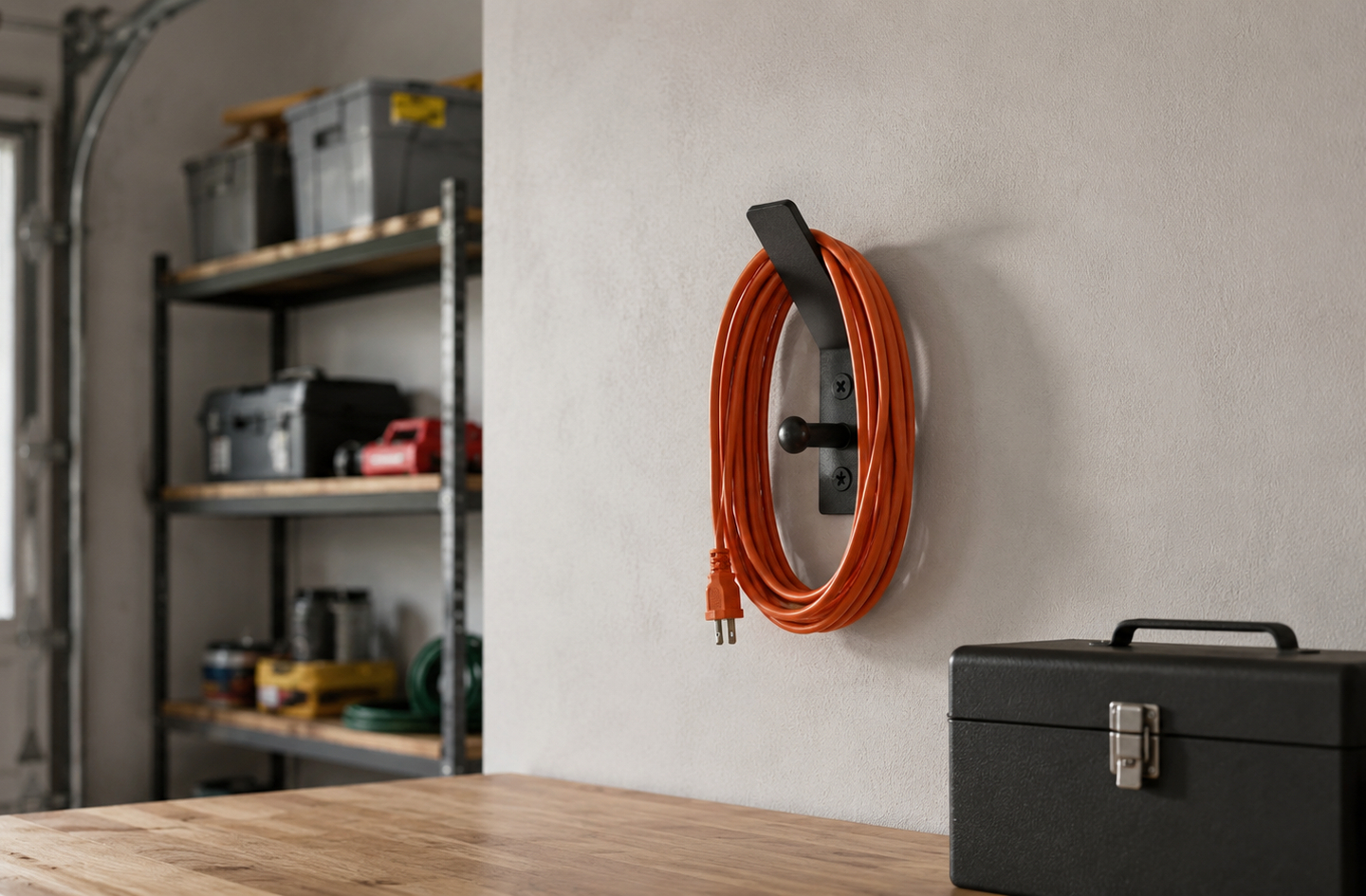
Coiled hoses and extension cords have a tendency to uncoil and fall off open hooks, especially in a garage where vibration from door openers and vehicles is constant. A closed-loop hook design holds the coil in place even when bumped. The loop wraps around the cord or hose rather than just resting beneath it, which means the item stays put without friction or contact pressure on the material. For cords you use regularly, loop hooks with a closed design prevent the coil from sliding off when you pull out a section of cord, keeping the rest of the coil on the hook rather than piling up on the floor.
Spacing paired hooks correctly
The general rule is to space paired hooks so the contact points fall about one-third of the way in from each end of the item you’re hanging. For a 24-inch-wide ladder rail, that puts hooks about 8 inches from each end, or 8 inches apart on center. For a 60-inch bike, one-third spacing puts hooks roughly 20 inches from each end, about 20 inches apart. This distributes the load symmetrically and keeps the item balanced without putting stress on a single end. Measure the item before marking the wall. Getting the spacing right on the first try is much easier than patching and re-drilling.
Step 5: Distribute Load Across the Wall
Hanging all your heavy items in a 3-foot cluster on one wall section is a common mistake. It looks efficient, but it concentrates several hundred pounds of load on a small number of studs and makes every item harder to access without moving adjacent gear.
A better approach: spread heavy items across multiple bays of the wall so each bay carries one heavy item and several lighter ones. In a standard single-car garage, the long wall typically spans 20-24 feet. That’s room for four to six 4-foot wall bays, each anchored to its own pair of studs. Putting one ladder, one set of bikes, and one heavy tool zone in separate bays is a practical load-distribution strategy that also keeps the wall organized visually.
Stud-to-stud spacing considerations
Studs at 16-inch centers give you a new mounting location roughly every 16 inches. At 24-inch centers, the stud grid is coarser and you have fewer options. If your layout requires a hook at a point between studs, use a toggle bolt rated for the item’s weight, applying the four-to-one safety margin mentioned in Step 2. For anything heavier than 30 lbs, plan your hook locations around the stud grid from the start rather than trying to accommodate a pre-decided layout with drywall anchors.
Thinking about dynamic load
Static load is the weight of an item at rest. Dynamic load is the force applied when you pull the item off the hook, bump into it, or when the garage door vibration transmits through the wall. In practice, a loaded tool bag that weighs 40 lbs can exert two to three times that force at the hook point if you grab and yank it quickly. Hooks and fasteners rated for 40 lbs may not tolerate repeated dynamic loading at that level over time. Build in a margin: for items you grab and replace frequently, choose hooks rated for 60-80 lbs even if the item itself weighs 30-40 lbs. Solid wrought iron construction, double front welding, and stud mounting are the three factors that handle dynamic load better than anything else in a hook’s spec sheet.
Seasonal rotation
Garages are not static spaces. The same wall that holds ski equipment in January might hold garden gear in April. Build your layout with seasonal rotation in mind: give seasonal items their own dedicated row at a convenient height, and plan for three to four hooks per category so you’re not cramming gear onto two pegs when the season changes.
Step 6: Verify Your Installation Before Loading
Before you hang a 33-lb mountain bike or a 30-lb ladder on a newly installed hook, confirm that the installation is solid. A few quick checks now prevent a hook failure that could damage gear or injure someone later.
The basic test is the wiggle check: grip the hook firmly and apply pressure in four directions, forward, backward, left, and right. A properly installed stud-mounted hook has no give in any direction. If you feel movement, especially a cracking or popping sound from the drywall, the screw is not in the stud. Remove it, find the stud with a finder, and remount.
For toggle bolts in drywall, a slight flex in the forward direction is normal because the wall panel itself has some give. But lateral movement (side to side) or a loosening sensation when you pull outward indicates the anchor didn’t set correctly. Toggle bolts that were driven before the toggle fully expanded behind the drywall will loosen under repeated load.
Load gradually on first use
When hanging a bike or ladder for the first time, load it fully and leave it for 24 hours. Come back and check the hook’s position relative to the wall: if it has tilted even slightly, the fastener is moving. A good installation shows zero change after 24 hours under load.
Inspect every six months
Garage environments are hard on hardware. Temperature swings from below freezing to over 100 degrees Fahrenheit, humidity fluctuations from spring rain to summer heat, and vibration from the garage door all stress fasteners over time. Check each hook twice a year: look for visible rust at the screw head (sign of moisture infiltration), drywall crumbling around the fastener (sign of loosening), or hooks that feel marginally less tight than they did at installation. Hand-forged wrought iron hooks with a zinc galvanization and powder coating layer resist corrosion well in these conditions, but the fasteners behind the wall face the same environment.
Common Mistakes to Avoid
A few patterns show up repeatedly when garages are set up without a plan. Each one is simple to avoid once you know to look for it.
Hanging into hollow drywall for heavy items
The most common failure mode in garage hook installations is a fastener that was driven into drywall without hitting a stud. It holds fine for months, sometimes years, under light loads. Then you hang a 35-lb ladder, and three weeks later the hook tilts forward and pulls the screw through the drywall face. Always use a stud finder for anything over 25 lbs. If you’re unsure whether your screws hit the stud, you can tell by resistance: a screw going into solid wood stud offers consistent resistance all the way in. A screw hitting only drywall feels like it’s threading easily until the thread strips on the gypsum core.
Hanging a bike by the rim
Hooks that cradle the wheel at the rim rather than gripping the tire put point pressure on the rim’s sidewall. Under a 20-lb bike hanging at rest, this doesn’t cause visible damage quickly. But repeated cycles of hanging and removing, combined with any side-to-side movement, can slowly distort the rim’s true. Hang bikes by the tire or by the frame, not by the bare rim. If you’re using a single hook and hanging by the front tire, make sure the hook’s contact surface is wide enough to sit on the tire tread, not on the rim edge.
Overloading a single wall section
This one is about cumulative weight, not any individual hook. Five hooks on three adjacent studs, each carrying 30-40 lbs, put 150-200 lbs of load on a 4-foot wall section. The studs handle it, but the drywall fastening system was not designed for that kind of combined outward pull. Spread heavy items across the wall and leave at least two empty studs between any two heavy hanging points.
Ignoring the hook’s projection length for bulky items
A hook that projects 2 inches from the wall is excellent for hanging a key ring. It is too short for a coiled garden hose or a thick tool bag. The item’s bulk pushes the center of gravity out from the wall, which creates a forward-tipping moment at the mounting screws. Use a hook with enough projection to bring the item’s center of mass close to or slightly over the hook’s contact point. For tool bags with a wide base, a 3-4 inch projection is often the minimum. For coiled hoses, 4-6 inches gives the coil enough clearance to settle onto the hook without pressing against the wall.
Frequently Asked Questions
How much weight can a garage wall hook hold?
It depends entirely on the mounting substrate. Screws driven into wood studs support up to 100 lbs per Today’s Homeowner,7 while toggle bolts in drywall top out at 25-50 lbs. Apply a 4-to-1 safety margin to any anchor’s rated capacity. A hook mounted into studs with good-quality hardware handles bikes, stepladders, and loaded tool bags reliably.
What type of hook is best for hanging a bicycle in a garage?
Two hooks are better than one for any full-size adult bike. Hang the bike by the tires (not the rim) using paired hooks spaced to match the front-to-rear wheelbase, or use two hooks on the frame. Road bikes weigh 17-20 lbs and mountain bikes reach 30-36 lbs,4 so hook capacity of at least 50 lbs gives a safe working margin.
Can I hang a ladder on a single hook?
For a 6-ft stepladder weighing roughly 22 lbs,9 a single heavy-duty stud-mounted hook works in a pinch, but two hooks at the same height spaced to match the ladder’s rail width is a more stable and safer setup. The ladder hangs flat, doesn’t tip sideways, and distributes weight across two mounting points instead of one.
Do I need special hooks for a concrete block garage wall?
The hook itself is the same. What changes is the fastener. Standard wood screws and plastic drywall anchors will not hold in concrete block. Use sleeve anchors or wedge anchors rated for masonry, sized to the hook’s load requirement. Drill with a masonry bit sized to the anchor’s specification. Concrete block can carry substantial loads when properly fastened, often more reliably than drywall over studs.
How far apart should paired hooks be for storing gear?
Space paired hooks so contact points fall roughly one-third from each end of the item. For a standard 6-ft stepladder with a 16-inch-wide top section, that puts hooks about 8 inches apart. For a full-size adult bike hung by the top tube, space hooks 18-24 inches apart. Always check the item’s width before marking the wall, and use a level so both hooks sit at exactly the same height.
Limitations and Edge Cases
- This guide covers standard residential garage walls (drywall on studs, plywood on studs, concrete block). Metal stud framing requires specialized toggle anchors rated for metal stud cavities; wood-stud guidance does not apply.
- E-bikes commonly exceed 50 lbs and some approach 80 lbs. Wall-mounted hook systems in the residential wrought iron category are typically not the right solution; ceiling-mounted pulley systems or floor storage are better suited.
- Weight figures for ladders are based on Werner Type IA fiberglass stepladder specifications from IndustrialLadder.com. Other brands, materials, and extension ladder styles have different weights. Weigh your specific ladder before finalizing hook placement and load ratings.
References
- U.S. Department of Energy – “FOTW #1268, December 12, 2022: As of 2021, Two-Thirds of U.S. Housing Units Had a Garage or Carport,” citing U.S. Census Bureau American Housing Survey, published 2022.
- PR Newswire – “Take Back Your Garage: American Garages Store More Clutter Than Cars, According to CRAFTSMAN Survey,” Atomik Research for CRAFTSMAN, n=2,004 U.S. adults, published October 2022.
- The Pro’s Closet – “Bike Weight Guide 2026: Road, Gravel and MTB Weights,” updated 2026.
- BikeTips – “How Much Does a Bike Weigh? Average Weights by Type,” published 2023-2024.
- OSHA, U.S. Department of Labor – “Solutions for Electrical Contractors: Installation and Repair – Using Tools,” eTool, current guidance.
- Today’s Homeowner – “How Much Weight Can Drywall Hold? Anchor Ratings by Type,” published 2023-2024.
- This Old House – “How To Choose the Right Hanging Hardware,” published 2023-2024.
- IndustrialLadder.com – Werner 6206 (6-ft) and Werner 6208 (8-ft) Type IA Fiberglass Stepladder specifications, current product listings.
Conclusion
Getting heavy duty garage hooks right comes down to three decisions: matching the hook’s rated capacity to what you’re actually hanging, mounting into a substrate that can carry the load (studs for anything over 25 lbs), and spreading that load across the wall rather than clustering heavy items in one section. Paired hooks handle ladders and bikes more safely than any single-point solution, and closed-loop designs keep cords and hoses on the wall between uses.
For the broader context on selection and installation across all settings, see our heavy duty wall hooks overview covering types, capacities, and use cases beyond the garage.