A farmhouse paper towel holder works as a style piece when its iron, shape and finish repeat something the kitchen already has. This list sits under the practical guide to paper towel holders, which summarizes how to choose the right holder. Here the focus stays on style pairing for country, retro, rustic and vintage kitchens. Warm materials are gaining ground. In the 2026 Houzz kitchen study, wood became the most popular cabinet color at 29%, just ahead of white at 28%1.
Quick Answer
Which farmhouse paper towel holder fits a rustic or vintage kitchen?
Choose the holder that repeats the room’s strongest material. Black forged iron reads as farmhouse beside wood cabinets, butcher block and black cabinet pulls. Among 2026 Houzz respondents who chose a separate island surface, 44% picked butcher block or wood slab2. Scrolls and hearts suit vintage rooms, while a plain upright holder suits retro kitchens.
Key Takeaways
- Wood is now the top cabinet color at 29%, and medium wood tones lead at 15%1. Black iron shows clearly against medium and light wood.
- Black is the second most popular cabinet hardware finish at 18%, behind brushed nickel at 28%1. A black holder matches black pulls directly and contrasts with nickel.
- Farmhouse drew only 7% of style choices in the 2025 Houzz study, where it continued to fall out of favor4. In RTZEN’s view, a holder adds the look without a remodel.
- In the NKBA 2026 kitchen survey, 81% of respondents named reducing clutter as a way to make a kitchen feel larger6. One styled holder beats several loose items on the counter.
- A common misconception is that forged iron only suits farmhouse rooms. The shape decides the style: scrolls and hearts read vintage, while a plain upright reads retro.
1. Forged Countertop Stand on a Butcher-Block Island – Best for Farmhouse Kitchens
A forged wrought iron stand on a wood island is the most direct farmhouse pairing. Dark iron and warm wood are the style’s two core materials. Wood is gaining ground on islands. Among 2026 Houzz respondents who used a separate island surface, 44% chose butcher block or wood slab, up 13 points in a year2.
Butcher block is a countertop built from strips of hardwood glued edge to edge, so the grain runs in long parallel lines. Those lines give the island a warm, worked surface. A black stand with forged curves adds movement against that straight grain, which keeps the pairing from looking flat or heavy.
The Fancy stand brings that dark forged iron to the island. It is forged from wrought iron with a weighted base, finished with a zinc coating and black powder, and topped with a decorative forged element. It holds standard and jumbo rolls and needs no wall mounting, so it can move between the island and the main counter.
Place the stand toward the working end of the island rather than in the center. A clear center leaves room for serving boards and bowls, and the roll still sits within reach of the preparation area. For base footprint, overall height and refill access, the countertop stand comparison sets the options side by side.
If the island top is wood, choose dark iron with curves, because a straight wood-toned holder on a wood surface tends to blend into the grain.
2. Heart-Shaped Stand as a Vintage Table Centerpiece – Best for Vintage Dining Nooks
A heart-shaped iron stand suits a vintage kitchen, because ornamental forged shapes belong to a long decorative tradition rather than a recent trend. The National Park Service notes that wrought iron was used in American buildings for decorative elements from the 18th century on7.
Wrought iron is iron that is worked at an anvil or shaped by machines at a larger forge7. That working process is what produces the hearts, scrolls and finials that vintage rooms favor. On hand-forged pieces, small hammer marks can show along each bend, a detail that reads as older craftsmanship on a table.
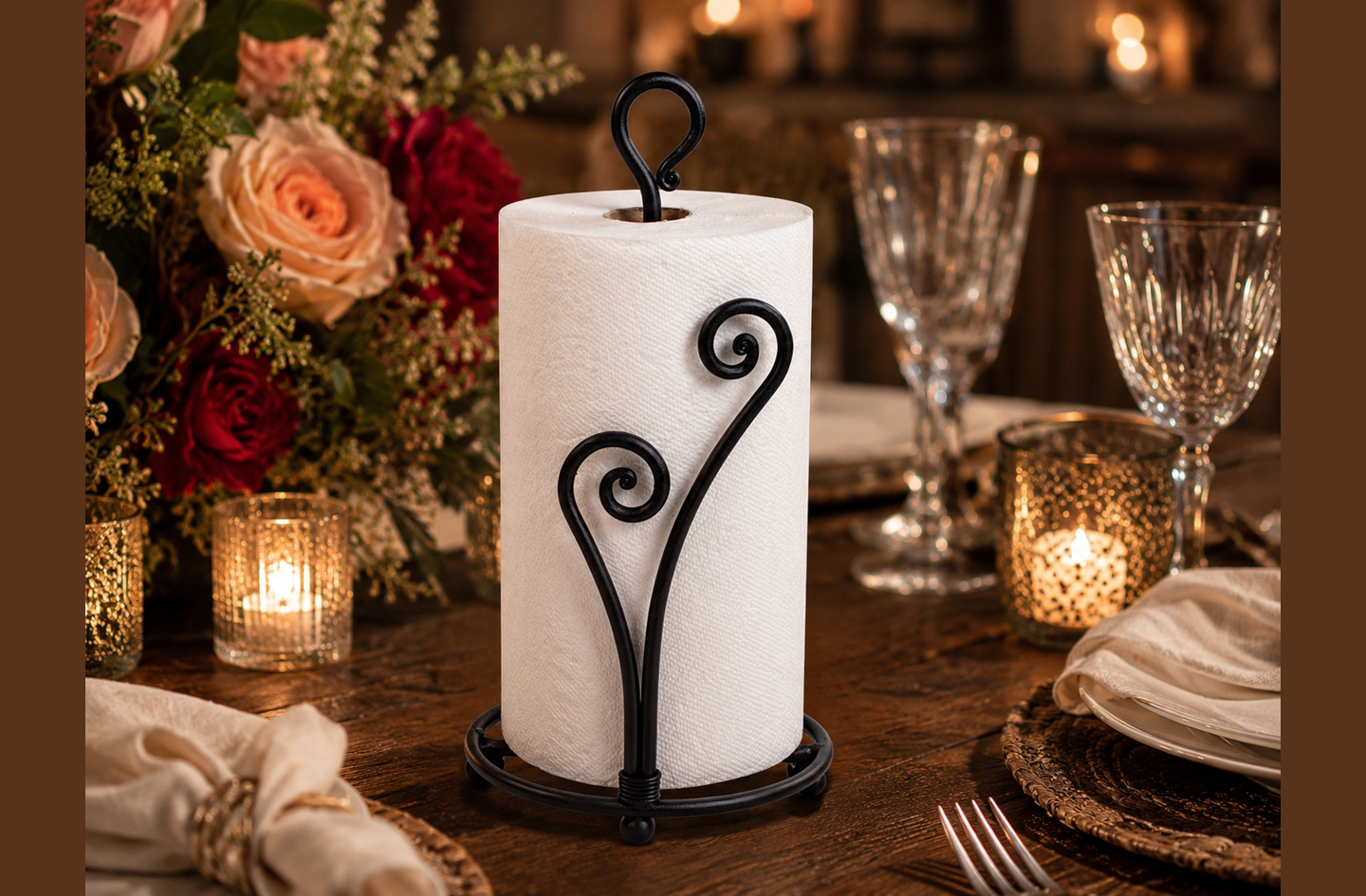
The Heart Shape stand has an ornate forged base and a decorative top finial. It is handcrafted from solid iron with an anti-rust coating, and it rests on a kitchen countertop or dining table without any wall mounting. That freedom matters in a vintage breakfast nook, where the table often doubles as the main work surface.
On a breakfast table, treat the holder as part of the setting. Pair it with a linen runner, stoneware plates and one or two taper candles. Keep any other metal on the table quiet, so the heart outline remains the focal point. Vintage rooms also take aged wood well, such as a farm table with softened edges and visible repairs.
A shaped stand earns its place only when the rest of the setting stays simple, because several ornate pieces hide the heart outline.
3. Match the Iron to Your Cabinet Handles – Best for Country Kitchens
Cabinet hardware is the metal a holder sits closest to, so matching its finish quickly makes a country kitchen read as one design. In the 2026 Houzz study, 95% of renovating homeowners chose cabinets with handles, and bar pulls led at 74%1.
Finish preferences divide clearly. Brushed nickel led at 28%, black followed at 18% and brushed gold reached 12%1. A black iron holder matches black pulls exactly. Beside nickel or gold it reads as a deliberate contrast instead, which works when the room repeats black in a light fixture or window frames.
A cup pull is a half-moon handle, open at the bottom, that the fingers hook from below. In the same handle question, cup pulls drew 10% and knobs drew 37%1. Both shapes appear often on country and vintage cabinetry, so a holder with rounded scrolls repeats their curve.
Shape matters as much as color. Long bar pulls suit a straight vertical holder or a plain horizontal arm. Round knobs and cup pulls suit scrolls, hearts and curled ends. Before choosing, hold a photograph of the holder beside a cabinet door and compare the curves. A small mismatch becomes obvious once both pieces share a wall.
When the holder and the handles share both a color and a shape, the kitchen looks planned; when only one can match, match the color.
4. Black Iron Against Warm Wood Cabinets – Best for Rustic Kitchens
Black wrought iron against wood cabinets is RTZEN’s top rustic pairing, because wood has now overtaken white in survey data. In the 2026 Houzz study, 29% of renovating homeowners chose wood cabinets, up 6 percentage points, while white fell to 28%1.
Industry professionals report the same direction. In the NKBA 2026 kitchen survey, 59% of respondents identified wood grain as growing in popularity, and white oak led wood types at 51%5. Among homeowners, medium tones lead at 15%, followed by light wood at 11% and dark wood at 3%1.
Contrast decides which holder works. Black iron stands out clearly against light and medium wood such as white oak, maple or hickory. Against dark walnut or an espresso stain, black iron can disappear. Choose an open scroll outline that lets the wood show through, and let the white roll carry the contrast.
Two-tone kitchens offer a second route. Nearly a quarter of renovating homeowners (24%) chose contrasting upper and lower cabinets in 2026, and wood led the lowers at 37%2. In that layout a countertop holder sits just above the wood lowers, so black iron connects them to the black hardware nearby.
The darker the wood, the more open the iron outline should be; on pale oak, almost any black holder reads clearly.
5. Pair the Holder With a Towel Ring by the Farmhouse Sink – Best for Matching Sets
A paper towel holder and a hand towel ring in the same forged iron make the sink wall read as one coordinated set. The pairing suits farmhouse sinks, where the hand towel and the paper roll both sit within a step of the basin.
Matching works best when the two pieces share forging details, not only color. Scrolls on one should echo scrolls on the other, and a hammered texture should appear on both. Historic ironwork shows why those details matter. On one early gate, the wrought iron was heated, hammered, bent and twisted to form each part of the design7.
“Wrought iron is also remarkably malleable, which means it can be reheated and hot-worked again and again to the desired shape.”
National Park Service, Metals in America’s Historic Buildings7
RTZEN makes its paper towel holders and towel hangers with the same four steps: cut, hand-forge, zinc-galvanize and powder-coat. The Fancy stand and the Hand Towel Ring both list a zinc layer under a black powder finish, so the pair shares one finish system. Both carry the catalog-wide Lifetime Warranty.
Give each piece its own space so both read clearly. A towel ring set a short distance from the paper towel holder looks deliberate, while two pieces touching look crowded. Keep both on the same side of the sink when the wall allows, so the eye reads them as a pair.
Choose the holder and the towel ring from one forged line, because matching black across brands is easy while matching scroll shapes rarely works.
6. Under-Cabinet Iron Holder Beneath Open Shelving – Best for Clear Rustic Counters
An under-cabinet iron holder keeps a rustic counter clear while still showing forged iron at eye level. Clear counters matter to professionals: in the NKBA 2026 survey, 81% of respondents named reducing clutter as a way to make a kitchen feel larger6.
Rustic kitchens often pair open wood shelves with stoneware, cutting boards and plants. A holder under the lowest shelf joins that display instead of competing with it. The roll hangs where it is needed, and the counter below stays free for boards, bowls and everyday preparation.
The Under Cabinet holder is a wrought iron design made for under-cabinet or under-shelf mounting. It is solid iron with a rust-resistant finish, holds standard rolls, and uses an open-arm design for easy roll replacement. For arm opening, roll loading and cabinet material, see the under-cabinet holder guide.
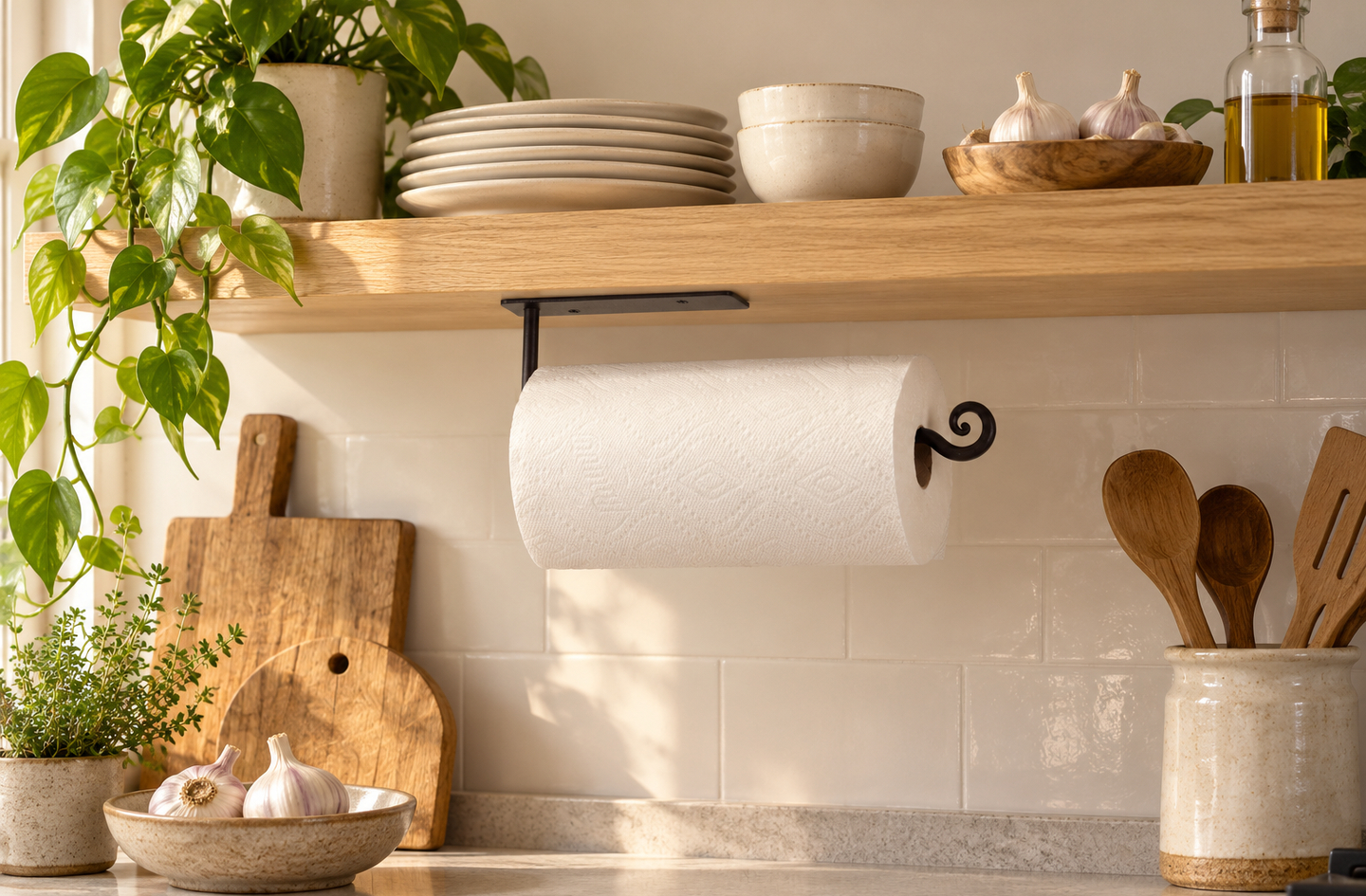
Styling the shelf above matters as much as the holder. Keep the items over the holder low and solid, such as crocks or stacked plates, so the shelf outweighs the roll visually. Tall, loose items above a hanging roll make the corner look unsettled.
When the counter is already busy, move the holder up under a shelf rather than adding another freestanding piece.
7. Black Iron in a White Farmhouse Kitchen – Best for Light Neutral Rooms
Black iron gives the classic white farmhouse kitchen its outline, because a dark piece against a light background is the style’s signature contrast. White remains common: 28% of renovating homeowners chose white cabinets in 20261, and another 15% chose off-white2.
Industry professionals rank neutrals at the top as well. In the NKBA 2026 kitchen survey, 96% of respondents identified neutrals as the most popular colors5. Light walls, white counters and pale tile all let a black holder stand out without any extra decoration around it.
In a white room, use the holder as one of several repeated black points. A black holder, black cabinet pulls and a black light fixture form a simple triangle that the eye follows across the room. A single black piece on its own can look accidental rather than chosen.
Keep the roll visible as well. A white paper roll on a black holder repeats the room’s two main colors in a small space. That suits the clean, graphic side of farmhouse design. Shiplap walls and a white apron sink complete the look without competing with the iron.
In a white kitchen, black iron works only as part of a pattern, so plan at least two other black accents before adding the holder.
8. Plain Vertical Holder With One Color Accent – Best for Retro Kitchens
A plain vertical iron holder suits a retro kitchen, because retro design depends on simple shapes and one strong color rather than ornament. Statement color is moving into finishes and accessories: NKBA respondents expect new statement colors on the backsplash (60%) and in decorative accessories (55%)5.
Retro style refers to kitchens that borrow from the 1950s and 1960s, with chrome edges, enamel colors, checkered floors and simple geometric forms. A scroll-heavy holder fights that look. A straight upright or a plain horizontal arm in black reads as a clean line, and the color comes from the surroundings.
Let the color live in the backdrop. Greens and blues ranked just behind neutrals in the NKBA survey, at 86% and 78%5. A black holder against a mint or sky-blue backsplash looks crisp. On a red or yellow wall black still works, and the white roll adds a third tone.
A wall-mounted holder keeps the retro counter bare, which suits the period’s clean surfaces. The wall-mounted holder guide covers orientation, reach and roll access for upright and horizontal designs. For a retro room, choose the simplest outline that still holds the roll securely.
In a retro kitchen the holder should be the quietest shape in the room, and the color should do the talking.
9. Vintage Holder at the Coffee or Pantry Station – Best for Beverage Corners
A vintage-style holder at a coffee or pantry station dresses a corner that many renovated kitchens now include. In the 2026 Houzz study, 24% of homeowners adding built-in features chose a beverage station, such as a coffee or espresso bar1.
Industry professionals expect more of these stations. NKBA respondents named dedicated beverage areas (85%) among the top lifestyle features for the next three years5. Drips and spills happen at a coffee bar, so a roll within reach is practical as well as decorative.
Paper towels have a vintage story of their own. The Scott Paper Company introduced paper towel rolls for kitchens in 19318. A forged holder with a scroll or a finial fits that era better than a sleek plastic dispenser does.
Style the station as a small arrangement: a wood tray, a stoneware or enamel mug set, a canister and the holder at one end. For sink, preparation counter, pantry and appliance spots, the kitchen zones placement guide compares reach, splash exposure and refill access.
A beverage corner is the easiest place to try a vintage holder, because its small scale lets one ornate piece lead without crowding the main kitchen.
Farmhouse Paper Towel Holder Ideas Compared by Style
The comparison table summarizes the nine ideas by kitchen style, holder type and the material each one repeats. Use it to shortlist two ideas, then test them against the room’s cabinet color and hardware finish before choosing.
| Idea | Kitchen style | Holder type | Iron detail | Repeats |
|---|---|---|---|---|
| Stand on a butcher-block island | Farmhouse | Countertop stand | Forged top element, curves | Wood island top |
| Heart-shaped table centerpiece | Vintage | Countertop stand | Heart base, finial | Table setting, aged wood |
| Match the cabinet handles | Country | Any | Curves for knobs, straight for bar pulls | Black pulls |
| Black iron on wood cabinets | Rustic | Countertop or wall | Open scrolls on dark wood | Wood grain |
| Set with a towel ring | Farmhouse sink wall | Wall or countertop | Shared scrolls or hammered texture | Hand towel ring |
| Under open shelving | Rustic | Under-cabinet | Open iron arm | Wood shelves, crocks |
| White farmhouse contrast | Light neutral | Any | Solid black outline | Black pulls, fixtures |
| Plain vertical with color | Retro | Wall-mounted | Straight upright | One bold backdrop color |
| Coffee or pantry station | Vintage | Countertop stand | Scroll or finial | Wood tray, canisters |
Most kitchens can use two of these ideas at once, one at the sink or counter and one at a smaller station.
How These Ideas Were Selected
The nine ideas on this list come from a research-only review of current kitchen surveys and historic ironwork, not from a hands-on test of kitchens. Each idea had to pair a holder type with a style signal that current survey data supports.
Style preferences set the scope. Transitional style led newly renovated kitchens at 25% in the 2026 Houzz study, followed by traditional at 12%, modern at 11% and contemporary at 10%1. In the 2025 study, transitional also led at 25%, while farmhouse drew 7%4. That gap shaped this list. RTZEN reads it as farmhouse living on in accents rather than full remodels, so accents carry the style here.
Transitional style is a blend of traditional and modern design, with classic shapes kept simple and colors kept neutral. A forged holder fits that blend when its outline stays restrained, which is why several ideas here favor open scrolls over heavy ornament.
Each idea was checked against four criteria:
- Material match: the holder repeats a material already in the room, such as wood, black hardware or white surfaces.
- Shape match: the iron outline echoes nearby shapes, such as cup pulls, knobs or straight bar pulls.
- Counter effect: the idea keeps the work surface usable instead of adding clutter.
- Documented features: product descriptions use only features listed for each product, with no assumed finishes or capacities.
The pairing rule behind every idea is simple: repeat one material and one shape, and the holder will look like it belongs.
Frequently Asked Questions
What makes a paper towel holder look farmhouse?
Dark forged iron, simple scrolls and a pairing with wood make a holder look farmhouse. Wood now leads cabinet colors at 29% in the 2026 Houzz study1, so RTZEN treats black iron against wood as the core farmhouse combination. Hammered texture and curled ends add the handmade signal.
Should a paper towel holder match the cabinet hardware?
Matching the color is the safest choice. Black was the second most popular hardware finish at 18% in 2026, behind brushed nickel at 28%1. Black iron matches black pulls directly. Beside nickel or gold, repeat black elsewhere so the holder reads as a planned contrast.
What is the difference between rustic and vintage paper towel holders?
A rustic holder leans on raw texture, heavy bases and rough wood around it. A vintage holder leans on ornament: hearts, scrolls and finials that echo wrought iron decoration used in American buildings from the 18th century on7. Both work best in black forged iron.
Does a black paper towel holder work in a white kitchen?
Yes, and it is the classic farmhouse contrast. White cabinets still drew 28% of renovating homeowners in 20261. Repeat black at least twice more, through pulls, a light fixture or window frames, so the holder looks like part of the color scheme.
Is a countertop or under-cabinet holder better for a rustic kitchen?
Choose by counter space. A countertop stand shows off the forging and moves easily between surfaces. An under-cabinet holder frees the counter, which matters when 81% of NKBA survey respondents named reducing clutter as a way to make kitchens feel larger6.
Limitations and Edge Cases
- The Houzz figures describe U.S. renovating homeowners, and the NKBA figures describe industry professionals’ expectations56. They show what people chose or expect, not what suits every room.
- Style labels overlap. A kitchen can be farmhouse and transitional at once, so treat these ideas as starting points rather than fixed rules.
- Roll size is outside this list. Jumbo and mega rolls differ in width and diameter, so check the roll against any holder’s listed fit before buying.
References
Methodology: every sourced figure below comes from an independent published survey, study or reference work. Each links to the page that carries it. The style pairings are RTZEN’s editorial reasoning from those figures, and co-founder Rami Abramson reviewed the article.
- Houzz – Homeowners Turn to Specialty Built-In Features in Kitchen Renovations, Houzz Study Finds (2026 U.S. Houzz Kitchen Trends Study press release), January 13, 2026.
- Houzz – These Are the Kitchen Features Homeowners Are Choosing Right Now, Mitchell Parker, January 20, 2026 (2026 U.S. Houzz Kitchen Trends Study).
- Houzz – See the Top Trends in Kitchen Cabinets, Countertops and More, Mitchell Parker, January 16, 2025 (2025 U.S. Houzz Kitchen Trends Study).
- Houzz Research – 2025 U.S. Houzz Kitchen Trends Study, January 9, 2025.
- Kitchen & Bath Business – NKBA | KBIS Releases 2026 Kitchen Trends Report, Carrie Whitney, September 18, 2025 (reporting the NKBA 2026 Kitchen Trends Report).
- Kitchen & Bath Business – NKBA’s 2026 Kitchen Trends Report, Dianne M. Pogoda, December 22, 2025.
- National Park Service – Metals in America’s Historic Buildings: Uses and Preservation Treatments, Part I: A Historical Survey of Metals, chapter on iron and iron alloys, 1992 edition.
- Wikipedia – Paper towel, History section, accessed November 13, 2026.
Conclusion
A farmhouse paper towel holder looks right when it repeats something the kitchen already has: wood, black hardware, scrolls or one bold color. Match the material first, then the shape, then the spot on the counter or wall. RTZEN’s four-step process of cutting, hand-forging, zinc-galvanizing and powder-coating keeps that accent in daily use, backed by a Lifetime Warranty.
For the wider basics of choosing a holder, see the paper towel holders guide.