
A double toilet paper holder makes sense when a bathroom runs through rolls fast enough that an empty holder keeps catching people mid-visit. Roll use scales with the number of people, and Fortune’s 2019 report put U.S. use at almost three rolls per person each week[1]. Our toilet paper holders guide explains the main holder types. This page covers when the second roll earns its wall space and what to check before buying.
Quick Answer
When does a double toilet paper holder make sense?
A double toilet paper holder makes sense in a bathroom shared by several people, where rolls run out often. The spare within reach saves someone from getting up to look for one. It also needs the right wall: enough width beside the toilet, a spot within the seated user’s reach, and clearance for the household’s rolls. In a one-person home, a single holder plus nearby spare storage usually does the same job.
Key Takeaways
- The NKBA recommends placing a toilet paper holder 8 to 12 inches in front of the edge of the toilet bowl, centered at 26 inches above the floor[2]. A double unit should keep both rolls near that spot.
- A Procter & Gamble patent states that home holders are designed for rolls up to 6.5 inches in diameter[6]. Oversized rolls need a clearance check before purchase.
- A toilet paper holder is not a grab bar. MedlinePlus warns against using towel racks as grab bars because they can’t support a person’s weight[5].
- CDC data cover 2008 nonfatal bathroom injuries treated in emergency departments[4]. Among people 85 and older, the share tied to getting on, off or using the toilet reached 36.9%[4].
Double Toilet Paper Holder Basics: What It Is and Who Benefits
A double toilet paper holder earns its place when a household uses rolls quickly or when getting up mid-visit is hard.
What is a double toilet paper holder, and how does it differ from a single one?
A double toilet paper holder is a bathroom fixture that holds two rolls of toilet paper at once. The second roll is already in place when the first runs out. A single holder presents one roll. Inventor Scott Engler described the gap in a 2018 patent: standard holders present one roll, and when it runs out the person has no recourse[8].
Common layouts include two arms side by side, one roll stacked above another, and floor stands holding a roll in use plus a reserve.
Who benefits most from keeping a spare roll ready?
Shared bathrooms benefit most, because roll use grows with the number of people. Fortune reported annual use of 141 rolls of toilet paper per capita in the United States, more than any other country[1]. The table turns that average into a household pace.
| People sharing the bathroom | Rolls a week | Hours one roll lasts |
|---|---|---|
| 1 | 2.7 | 62.1 |
| 2 | 5.4 | 31.1 |
| 3 | 8.1 | 20.7 |
| 4 | 10.8 | 15.5 |
| 5 | 13.6 | 12.4 |
By our calculation at that national average, a family of four empties a roll about every 15.5 hours, more than once a day.
Why does a spare roll matter more for older adults?
For older adults, toilet-related injuries make up a larger share of their bathroom injuries. A CDC analysis covered nonfatal bathroom injuries among people 15 and older treated in emergency departments in 2008. It found that injury rates rose with age[4].
In that data, 14.1% of the injuries happened when standing up from, sitting down on, or using the toilet[4]. Among people aged 85 and older, the share tied to getting on, off or using the toilet reached 36.9%[4].
“These results suggest that bathrooms tend to be most hazardous for persons in the oldest age groups.”
Judy A. Stevens, PhD, Elizabeth N. Haas and Tadesse Haileyesus, MS, National Center for Injury Prevention and Control, CDC[4]
A second roll beside the seat removes one reason to stand up halfway through a visit.
When is a single holder with nearby storage enough?
By our calculation at the national average, a one-person home goes through about 2.7 rolls a week. A single holder with a spare stored within reach usually keeps up. A narrow powder room may also lack the wall width for two rolls side by side. Our guide to small bathroom holder options compares wall, shelf, double and stand formats for tight rooms.
How Dual Toilet Paper Holders Work
A dual toilet paper holder works like two single holders sharing one base or frame. One roll is in use while the other waits as the reserve, and the layout sets the unit’s width or height.
How do side-by-side, stacked and shelf designs compare?
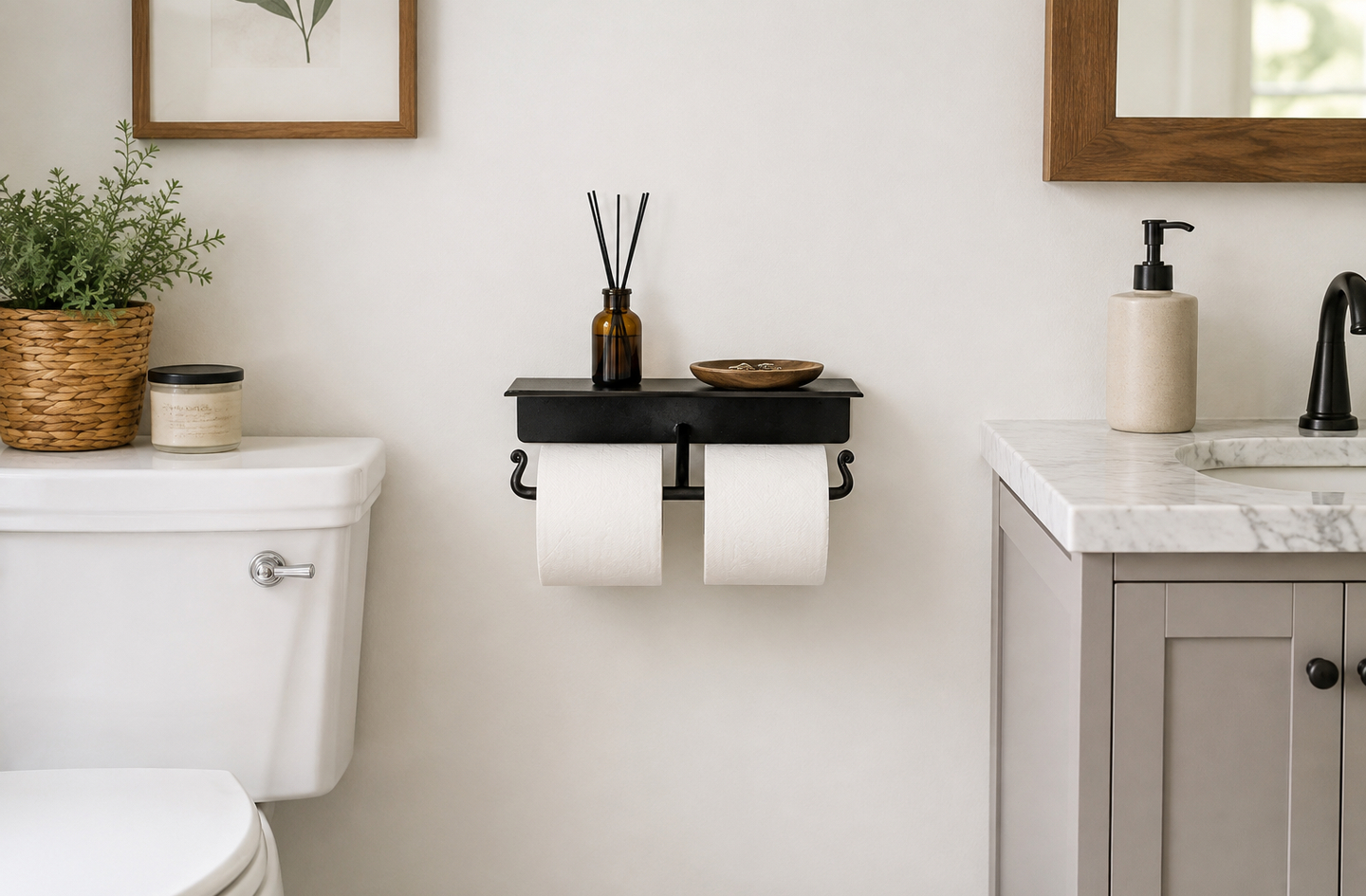
Side-by-side holders put two arms or spindles on one base, so both rolls hang at the same height. Stacked holders put one roll above the other, which saves width but makes the unit taller. Shelf models add a flat top over the rolls for small items.
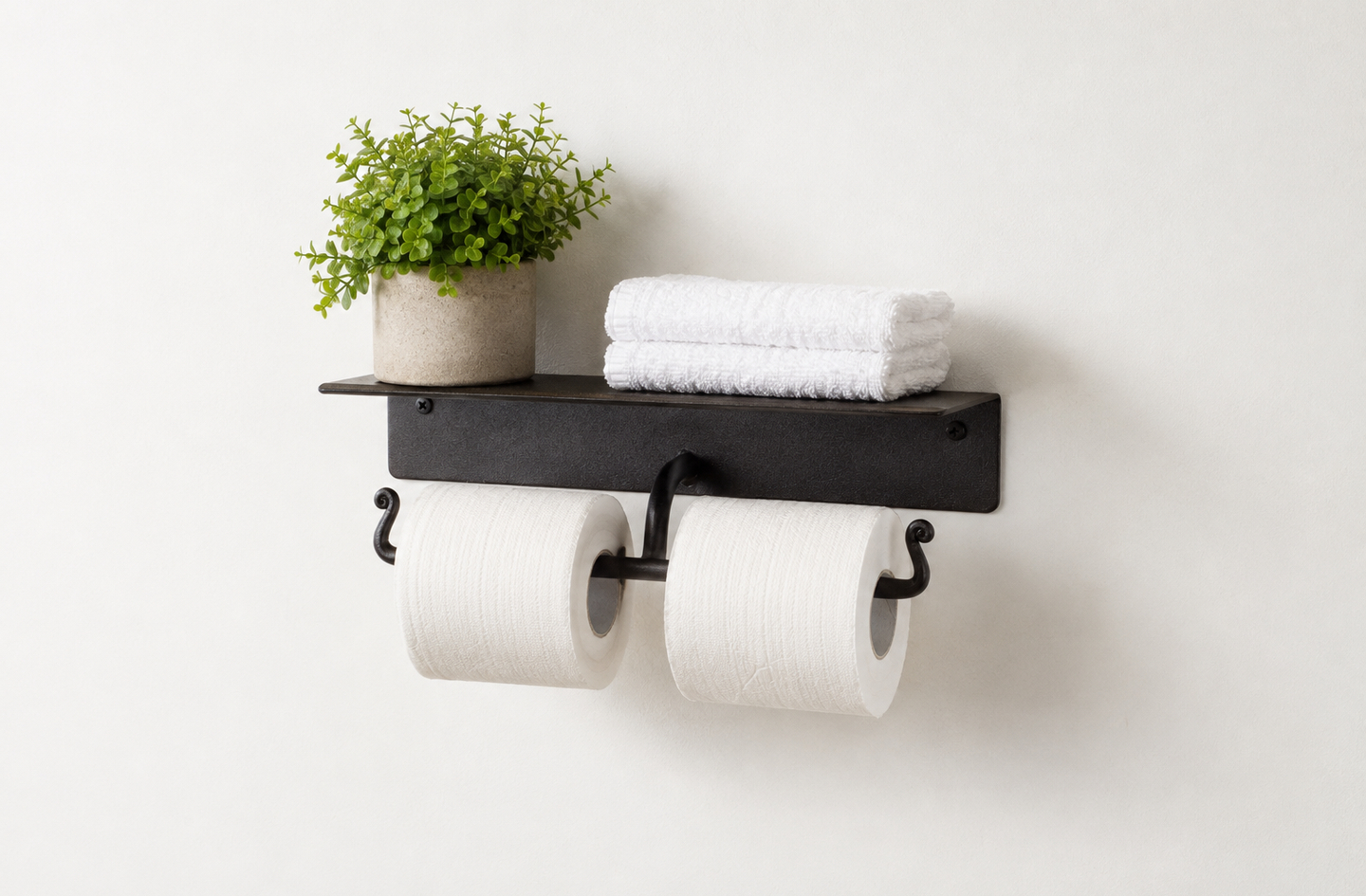
RTZEN’s double shelf holder is a wall-mounted wrought iron model handcrafted from solid iron. Its two lower arms hold standard toilet paper rolls, and its flat upper shelf takes a phone or small decor. Mounting hardware is included.
Can a double holder take jumbo or mega rolls?
Roll clearance is the distance from a holder’s spindle or arm to the wall or base plate, and it limits the largest roll that can turn freely[7]. Mario Dermo’s 2014 patent notes that jumbo rolls of 5 or more inches in diameter are too large for some holders. The roll hits the wall or the base and will not rotate[7].
A Procter & Gamble patent states that home toilet tissue holders are designed for rolls up to 6.5 inches in diameter[6]. That diameter is measured before first use[6].
Measure the diameter of the largest roll the household buys, then measure from the center of each arm to the wall. Halve the roll diameter and compare: if that half is larger than the arm-to-wall distance, the roll will rub. On a stacked design, also check that the upper roll clears the lower one. The wall-mounted design guide compares open-arm, pivoting and spring-loaded holders.
RTZEN lists the double model’s two lower arms for standard toilet paper rolls, so measure first if the household buys jumbo or mega rolls.
How Much Wall Space a Wall Mounted Double Toilet Paper Holder Needs
A wall mounted double toilet paper holder needs a strip of wall beside the toilet that stays inside the seated user’s reach. The NKBA recommends placing a toilet paper holder 8 to 12 inches in front of the edge of the toilet bowl, centered at 26 inches above the floor[2].
That guideline describes one holder, so center a double unit on that spot and keep both rolls close to it. The holder height and placement guide covers left-or-right placement and how to measure from the bowl.
How wide is a side-by-side double unit?
Width depends on the model, so measure the holder itself before drilling. As a reference point, Dermo’s patent describes a holder whose arms are spaced approximately 5 inches apart[7]. By our calculation, two such roll bays side by side need about 10 inches of wall before the frame and any gap between them.
Tape a paper template of the holder to the wall at the planned height. Check that the vanity edge, door swing and any towel ring stay clear.
How do grab bars change where a double holder can go?
In public buildings, the 2010 ADA Standards place a toilet paper dispenser 7 to 9 inches in front of the water closet, measured to its centerline[3]. Its outlet sits 15 to 48 inches above the floor[3]. The dispenser must not sit behind a grab bar. The space between a grab bar and any projecting object above it is 12 inches minimum[3].
The same standards set grab bars at 33 to 36 inches above the floor, measured to the top of the gripping surface[3]. These standards cover public accommodations, commercial facilities and state and local government facilities, not private homes. They are still a useful benchmark where a home has grab bars.
The NKBA’s access standard is based on the ICC A117.1-2009 standard[2]. It places the holder 24 to 42 inches from the rear wall and 18 to 48 inches above the floor[2]. It also calls for at least 1½ inches of clearance below a grab bar, or 12 inches above it[2].
Take a side grab bar at the ADA’s lowest height of 33 inches[3]. The NKBA’s 26-inch center[2] sits below the bar’s top by a margin that works out to 7 inches. A holder centered there sits under a side bar, not above it. Before choosing a tall stacked unit, measure from its planned top edge to the bottom of the bar and confirm that clearance.
Where a bathroom has a grab bar beside the toilet, or may need one later, plan the holder around the bar. The bar does the safety job.
Common Problems With an Extra Toilet Paper Holder
The common problems with an extra toilet paper holder are a roll that rubs the wall, a loose holder, and a holder used as a handhold.
Why does the roll rub the wall or refuse to spin?
When the roll’s outer surface reaches the wall or the base, it stops turning, as Dermo’s patent describes for jumbo rolls[7]. Switch to a smaller roll, or choose a holder whose arms stand farther from the wall.
Why does a double holder work loose from the wall?
A holder works loose when its fasteners don’t suit the wall. Follow the maker’s installation instructions and use the fasteners they specify for the wall type.
Fix into a stud where one sits behind the mounting spot. On hollow drywall, use anchors made for that wall. On tile over an unknown backing, check with a contractor before drilling.
Can a toilet paper holder double as a grab bar?
No. MedlinePlus advises against using towel racks as grab bars because they can’t support a person’s weight[5]. A toilet paper holder is built to carry rolls, not to hold a person up.
Grab bars in public buildings meet a structural test. Under the ADA Standards, allowable stresses shall not be exceeded when a vertical or horizontal force of 250 pounds is applied at any point[3]. That test applies to grab bars, not to roll holders. The CDC report suggests installing grab bars next to the toilet for added support if needed[4].
Double Holder or Wall Mounted Spare Toilet Paper Holder: Which Fits?
A double holder suits a shared bathroom with free wall width near the seat. A wall mounted spare toilet paper holder, a separate spot for the reserve roll, suits a narrow wall. A freestanding stand suits a bathroom where drilling is not an option.
| Option | Rolls ready at the seat | Wall work | Best fit |
|---|---|---|---|
| Double wall holder | Two, both on arms | Drilling for one unit | Shared bathrooms with wall width beside the toilet |
| Single holder plus separate spare holder | One in use, one stored nearby | Drilling for two small units | Narrow walls and one-person homes |
| Freestanding stand | One in use, reserves on the spindle | None | Rentals and walls the owner will not drill |
RTZEN’s decorative stand is a freestanding wrought iron model with a weighted base and a vertical spindle for active and reserve rolls. Its standalone design needs no wall drilling. Like a wall holder, a stand is not a grab bar. Place a stand where it stays within reach of the seat and out of the walking path.
A shelf adds a surface but no second roll. The holder with shelf guide covers shelf size and what the surface suits.
The household’s roll use decides whether a second roll is worth having, and the wall decides which design can deliver it.
Frequently Asked Questions
Is a double toilet paper holder worth it for a one-person home?
Usually not. Fortune reported a national average of 141 rolls per person a year[1], and by our calculation that is about 2.7 rolls a week for one person. A single holder with a spare stored within reach keeps up at that pace and takes less wall.
How high should a double toilet paper holder be mounted?
Center it on the NKBA’s recommended spot: 26 inches above the floor and 8 to 12 inches in front of the edge of the toilet bowl[2]. Keep both rolls close to that point so the spare stays in reach from the seat, and plan around any grab bar first.
Will jumbo or mega rolls fit a double holder?
Only when the holder has enough roll clearance. A Procter & Gamble patent states that home holders are designed for rolls up to 6.5 inches in diameter[6]. Even so, rolls of 5 inches or more are too large for some holders[7]. Measure the roll’s diameter and each arm’s distance from the wall before buying.
Can a toilet paper holder be used for support when standing up?
No. A roll holder is not a grab bar, and MedlinePlus advises against using towel racks as grab bars because they can’t support a person’s weight[5]. Where support is needed, the CDC report suggests installing grab bars next to the toilet[4].
Limitations and Edge Cases
- The roll-pace table spreads a national per-person average evenly across a household. Actual use depends on schedules, guests and time spent at home.
- The ADA figures apply to public accommodations, commercial facilities and state and local government facilities[3]. In a private home they are a benchmark, and local building rules decide what applies.
- Roll sizes vary by brand and pack, so the patent’s 6.5-inch design limit[6] is a reference point, not proof that a roll fits a given holder.
Shop the collection: Wrought Iron Toilet Paper Holders
References
Methodology: this article was drafted with AI assistance. Its sources are the 2010 ADA Standards, a CDC injury report, the NKBA bathroom planning guidelines, three U.S. patents and a Fortune news report, all listed below. RTZEN, which makes the products linked here, publishes this article. The safety guidance in this article comes from MedlinePlus, the CDC and the U.S. Access Board.
- Fortune – The Average American Uses 3 Rolls of Toilet Paper Each Week, Grace Dobush, February 28, 2019.
- National Kitchen & Bath Association (NKBA) – Bathroom Planning Guidelines with Access Standards, Guideline 23: Accessories.
- U.S. Access Board – ADA Accessibility Standards (2010 ADA Standards), sections 604.7, 609.3, 609.4 and 609.8.
- Centers for Disease Control and Prevention (CDC) – Nonfatal Bathroom Injuries Among Persons Aged 15 Years or Older, United States, 2008, MMWR, Judy A. Stevens, Elizabeth N. Haas and Tadesse Haileyesus, June 10, 2011.
- MedlinePlus – Bathroom safety for adults, U.S. National Library of Medicine, review date April 9, 2026.
- Google Patents – US11633076B2, Sanitary tissue product rolls, assigned to Procter and Gamble Co, granted April 25, 2023.
- Google Patents – US8622333B2, Toilet tissue roll holder capacity extender, Mario Dermo, granted January 7, 2014.
- Google Patents – US10136770B2, Dual paper roll holder, Scott Engler, granted November 27, 2018.
Conclusion
A double toilet paper holder pays off in shared bathrooms and for anyone who should not get up mid-visit to hunt for a roll. Fit it to the wall beside the seat, check the roll clearance, and plan around any grab bar.
For the other holder types and how they compare, see the toilet paper holders overview.