
The history of candle snuffers is really the story of different tools that shared one name. This article traces that story from museum records, and it sits under the candle snuffers overview, which introduces the topic as a whole. The Victoria and Albert Museum (V&A) says snuffers were first invented to cut off and keep the burnt wick. It records them from the 15th century, with patents appearing until a self-trimming wick arrived in 18251. The bell that puts out a flame today does the job of a separate tool, the cone extinguisher.
Quick Answer
What is the history of candle snuffers, in short?
Early candle snuffers were scissor tools for trimming the charred wick, and were not necessarily used to put the flame out. Depending on the candle and wick, households cut the wick back to 10 to 15 millimetres every 5 to 20 minutes2. Douters and cone extinguishers put flames out, and the cone was called a snuffer too. Once self-trimming wicks ended the trimming chore, the cone’s job carried on in the modern bell snuffer.
Key Takeaways
- The V&A states that snuffers were first invented to cut off and keep the burned wick, and were not necessarily used to put out the flame1.
- The three museum wick trimmers cited here are hand-sized tools. Royal Museums Greenwich lists one 18th-century pair at 180 mm long4.
- Douters pinched the lit wick, and cone extinguishers smothered the flame. The Science Museum Group holds an extending douter recorded at 303 mm overall6.
- The National Candle Association still advises trimming the wick to ¼ inch before each use8, so the old wick-care job never fully disappeared.
- Antique scissor snuffers and modern bell snuffers share a name, but for centuries they did different jobs.
The History of Candle Snuffers Starts With an Untrimmed Wick
The history of candle snuffers starts with the wick, because for centuries most candle wicks did not burn away by themselves. The Swiss National Museum explains that the wick itself didn’t burn, so it grew longer as the candle burned down2. A long wick smoked, dripped and gave less light, so it had to be cut back by hand.
A candle snuffer, in its original sense, is a scissor-shaped tool that cuts off the charred end of a wick. A small box on the tool traps the cut piece. The same word also named the cone extinguisher, and today it means a bell on a handle. Those overlapping meanings are the thread of this history.
Why tallow candles needed attention every few minutes
Everyday candles were made from tallow, the rendered fat of mutton and beef, because beeswax was expensive. Art historian Murielle Schlup, writing for the Swiss National Museum, notes that these candles burned erratically and uncleanly2. The wick had to be cut back to 10 to 15 millimetres. Depending on the candle and wick, the job came round every 5 to 20 minutes2.
By RTZEN’s calculation from those intervals, one candle burning through a four-hour evening needed somewhere between 12 and 48 trims2. A room lit by six candles multiplied that work. Wick care was a steady household chore, not an occasional fix.
What the word snuffer means in the V&A’s metalwork records
In the V&A’s records, the word snuffer names a trimming tool, and the Swiss National Museum calls the trimmed piece of burnt wick the snuff2. The V&A catalogue states the original purpose plainly in its metalwork records1.
“Snuffers were first invented to cut off and retain the burned wicks of candles when the wax around them had melted; they were not necessarily used to extinguish the candle’s flame.”1
Victoria and Albert Museum, Metalwork Collection catalogue entry for a British snuffer, ca. 18001
The same record adds the risk behind the chore. A wick that outlasted its wax could droop onto the side of the candle, put the candle out or, much worse, start a fire1. Trimming was a safety task as much as a lighting task.
Who did the trimming in homes, palaces and theatres
In homes with servants, the trimming often fell to them. Some candle tools were attached to the candlesticks with chains or brackets, and others were carried from room to room. Schlup’s article reproduces a painting by Cornelis Troost from 1737 that shows a maidservant with a candle-care tool fastened at her waist2.
Large buildings turned the chore into a job title. The Opéra Royal of Versailles used around 3,000 candles for every performance in 17702. Theatres employed a wick trimmer who worked through intermissions and, when needed, in the middle of a scene. Schlup describes him as both lighting technician and fire safety officer2.
Anyone reading an old inventory or a sale listing should not assume “snuffers” means a bell. In museum metalwork records, the word often names a wick-trimming tool.
How Wick-Trimming Snuffers Worked: Blades, Box and Spike
A wick-trimming snuffer worked like a pair of scissors with a small box fixed to one blade. The blades cut the charred wick, and the box caught it. The V&A describes the usual form: blades to cut the wick, plus a small box beside them to catch the hot wick1.
The box did more than keep the table clean. The Swiss National Museum explains that the smouldering snuff dropped straight into the box, where the closing box cut off its oxygen and put it out2. Without the box, a glowing wick end could fall onto tablecloths, scorch furniture or start a fire.
The spike, the box and the spring in museum catalogue records
Museum records show the extra parts some trimmers carried. A European wrought iron snuffer in the Science Museum Group collection, dated 1700-1800, has an arch-shaped box and a spike for straightening the wick before trimming3. It measures 165 mm overall, a size that sits comfortably in one hand3.
Royal Museums Greenwich holds plated steel snuffers that belonged to Captain James Cook and his wife Elizabeth. They use a scissor form with a sprung box mechanism and measure 180 mm overall4. Small rests on the blades and handle loops let the pair stand on its tray.
Trays, stands and snuffers matched to the candlestick
Snuffers were household equipment, so they came with their own storage. The V&A notes that snuffers were often made to match candlesticks and were often supplied with a stand or tray1. The tray held the tool between uses and collected flakes of wax and burnt wick. Cook’s snuffers are still part of a set with their matching tray4.
That habit of pairing the candle tool with the candlestick still makes sense. A taper holder such as the classic candle holder sits on a flat surface. A snuffer stored beside it stays within reach when the evening ends.
Materials, from everyday iron to silver for upscale homes
Most candle scissors were made of iron, brass or steel, according to the Swiss National Museum. Upscale households also used silver versions with an accompanying base, such as a Swiss model from about 1730/402. The V&A snuffer from about 1800 combines steel with silver handles and measures 17.8 cm long1.
“In any household, candle scissors (also known as wick trimmers) were essential tools for everyday use.”
Murielle Schlup, art historian and cultural scientist, writing for the Swiss National Museum2
Ornament followed the setting. The V&A records that snuffers could be finely decorated with heraldry or engraved decoration1. Iron, brass and steel were the everyday materials, while silver versions belonged to upscale households.
The box and the spike are the quickest way to recognize a wick trimmer. A tool with a blade and a catch-box was built to cut the wick, not to put out the flame.
Douters and Cone Extinguishers: The Tools That Put the Flame Out
Putting a candle out was a separate job from trimming it. Besides blowing, two tools did it: the douter and the cone extinguisher. The Science Museum Group catalogues a steel douter from about 1750 “for extinguishing candles by pinching the lighted wick”5. The cone, which smothered the flame, does the same job as today’s bell snuffer.
A douter is a scissor-form tool that puts a candle out by pinching the lit wick between flat discs or pincers. Pinching starves the wick of air at the point where it burns, and the flame dies without a breath of air across the wax.
How douters closed on the wick without touching the flame
The steel douter from about 1750 is short, at 120 mm overall, and ends in a pair of flat discs5. Another Science Museum Group douter, in wrought iron and dated 1700-1820, uses an extending “lazy tong” frame6. Its arms end in small teardrop-shaped pincers, and the record gives it a length of 303 mm6.
By RTZEN’s comparison of the two catalogue records, the lazy tong douter is about two and a half times as long overall as the short one56. RTZEN reads that extra length as a way to reach candles set high, deep or close together.
The cone extinguisher on the chamber candlestick
A candle extinguisher is a small hollow cone that is lowered over a flame to cut off its air. The V&A holds a late 18th-century chamber candlestick made in Sheffield whose scrolled loop handle holds a conical extinguisher7. The museum describes the chamber candlestick, also called a bedroom candlestick, as intended to light the way indoors7.
The pairing made practical sense. A person carrying a candle up to bed needed a way to put it out once there, and the cone travelled on the holder itself. The record lists the candlestick, the extinguisher and a drip tray as the object’s three parts, and gives the base a diameter of 16.5 cm7.
What is the difference between a snuffer and an extinguisher?
In the museum records, the difference was the job: snuffers were made mainly to cut and keep the wick, and extinguishers put out the flame. The table sets the historic tools side by side, using the museum records cited in this section.
| Historic tool | Job | How it works | Museum example | Recorded length |
|---|---|---|---|---|
| Wick-trimming snuffer | Shortens the wick while the candle burns | Scissor blades cut the charred wick; a box on one blade catches it | Wrought iron snuffer, Europe, 1700-18003 | 165 mm3 |
| Douter | Puts the flame out | Flat discs or pincers close on the lit wick | Steel douter, England, about 17505 | 120 mm5 |
| Extending douter | Puts the flame out at a distance | A lazy tong frame carries the pincers forward | Wrought iron douter, Europe, 1700-18206 | 303 mm6 |
| Cone extinguisher | Puts the flame out | A hollow cone covers the flame and cuts off its air | Sheffield plate chamber candlestick, late 18th century7 | Not recorded separately |
Of these tools, the cone is the one whose shape and job match the modern bell snuffer. The scissor trimmer lost its main job to new wicks in the 19th century.
In these five records, the three trimmers are hand-length, and the one extending douter is the longest tool.
Why Wick Trimmers Faded in the 19th Century
Wick trimmers faded because the wick itself changed. The V&A records that snuffer patents kept reappearing with improvements until Joseph Cambacères invented the self-trimming plaited wick in 18251. That wick curls over into the hottest part of the flame and burns away, so there is nothing left to trim1.
A self-trimming wick is a braided wick that bends as it burns, carrying its own tip to the edge of the flame where it is consumed. The Swiss National Museum explains that an asymmetrical braid makes the lengthening tip curve toward the edge of the flame, where the most oxygen is present2.
New candle fuels finished the job the new wick started
Better wicks arrived alongside better wax. Schlup dates the discovery of stearin to 1818 and paraffin to 1830, and notes that wicks of soaked or impregnated cotton appeared from the 1820s onwards2. Stearin and paraffin candles burn brightly, cleanly and consistently, and are virtually odour-free, according to the same article2.
Together, the braided wick and the cleaner fuels removed the reason for the scissors. Schlup concludes that it was simply no longer necessary to shorten the wick by hand2. A household that once trimmed every few minutes could now light a candle and leave the wick alone.
How the word snuffer came to cover the cone
The word “snuffer” covered the cone as well as the scissors. Schlup calls the snuffer the closest relative of the candle scissors, used to put out the flame more discreetly and hygienically than blowing2. She traces the expression “to snuff out” to putting out a flame with the cone2.
The cone also became a popular image. Schlup’s article reproduces an 1803 caricature by William Holland in which King George III snuffs out Napoleon2. That print predates the 1825 wick by 22 years, so the cone was already a flame-ending image before the scissors lost their job12.
When an antique listing calls a pair of scissors a “candle snuffer,” it uses the older meaning of the word, and the listing is not wrong.
From Cone Extinguisher to the Modern Bell Snuffer
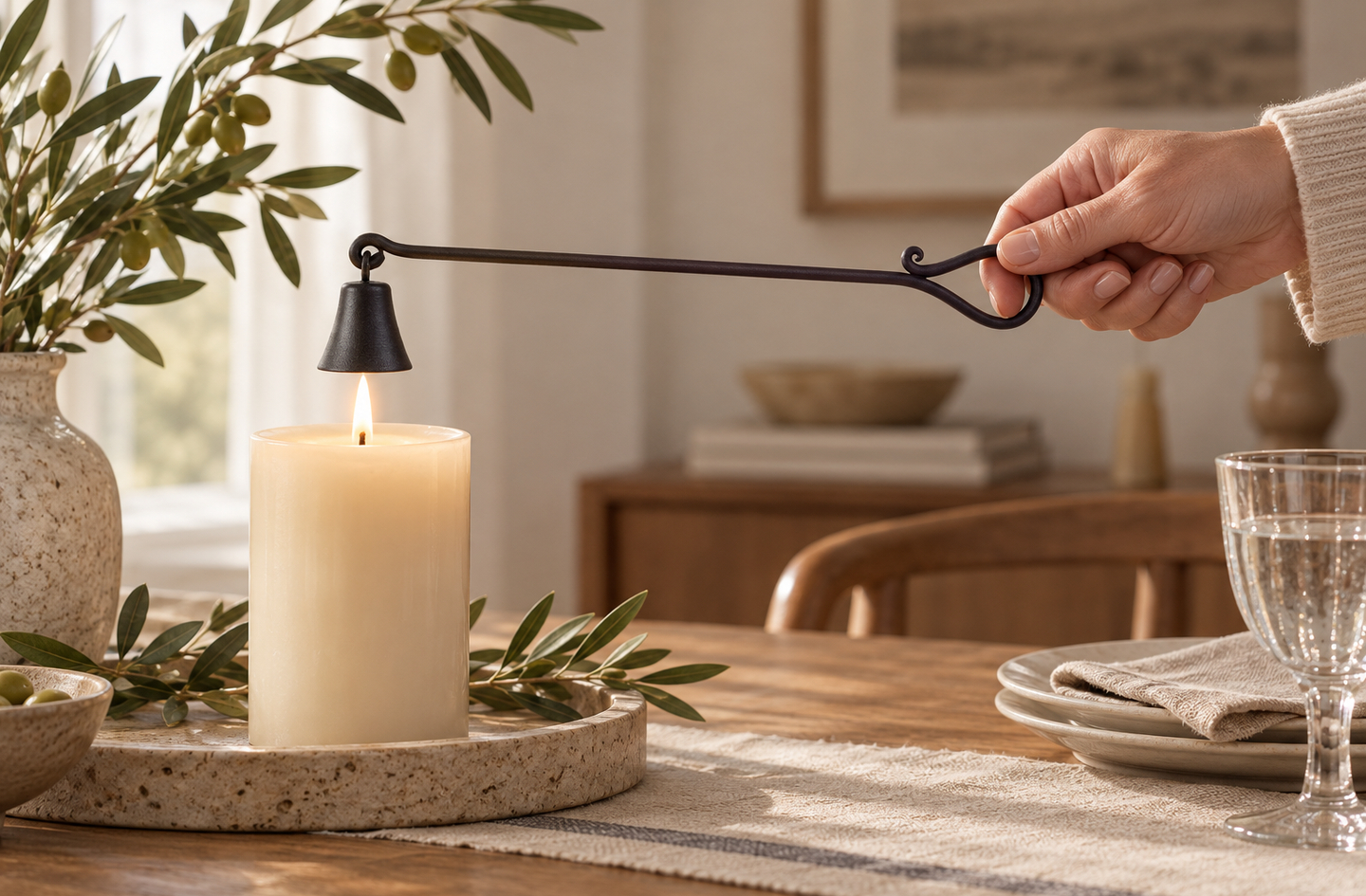
The modern bell snuffer works like the old cone extinguisher, set on a handle long enough to reach into jars and over pillars. Its job matches the cone’s, not the scissors’: it puts the flame out. The National Candle Association (NCA) advises using a snuffer or gently blowing out the flame, and warns that water can make hot wax splatter8.
Wick care did not vanish with the scissors; it moved to the start of the burn. The NCA tells candle users to trim the wick to ¼ inch before each use, to prevent high flames and soot8. By RTZEN’s calculation, ¼ inch is about 6.4 mm, roughly half the 10 to 15 mm that historic households trimmed back to28. The modern trim is shorter, and it happens once per lighting instead of every few minutes.
How hand-forged iron carries the old forms into a modern snuffer
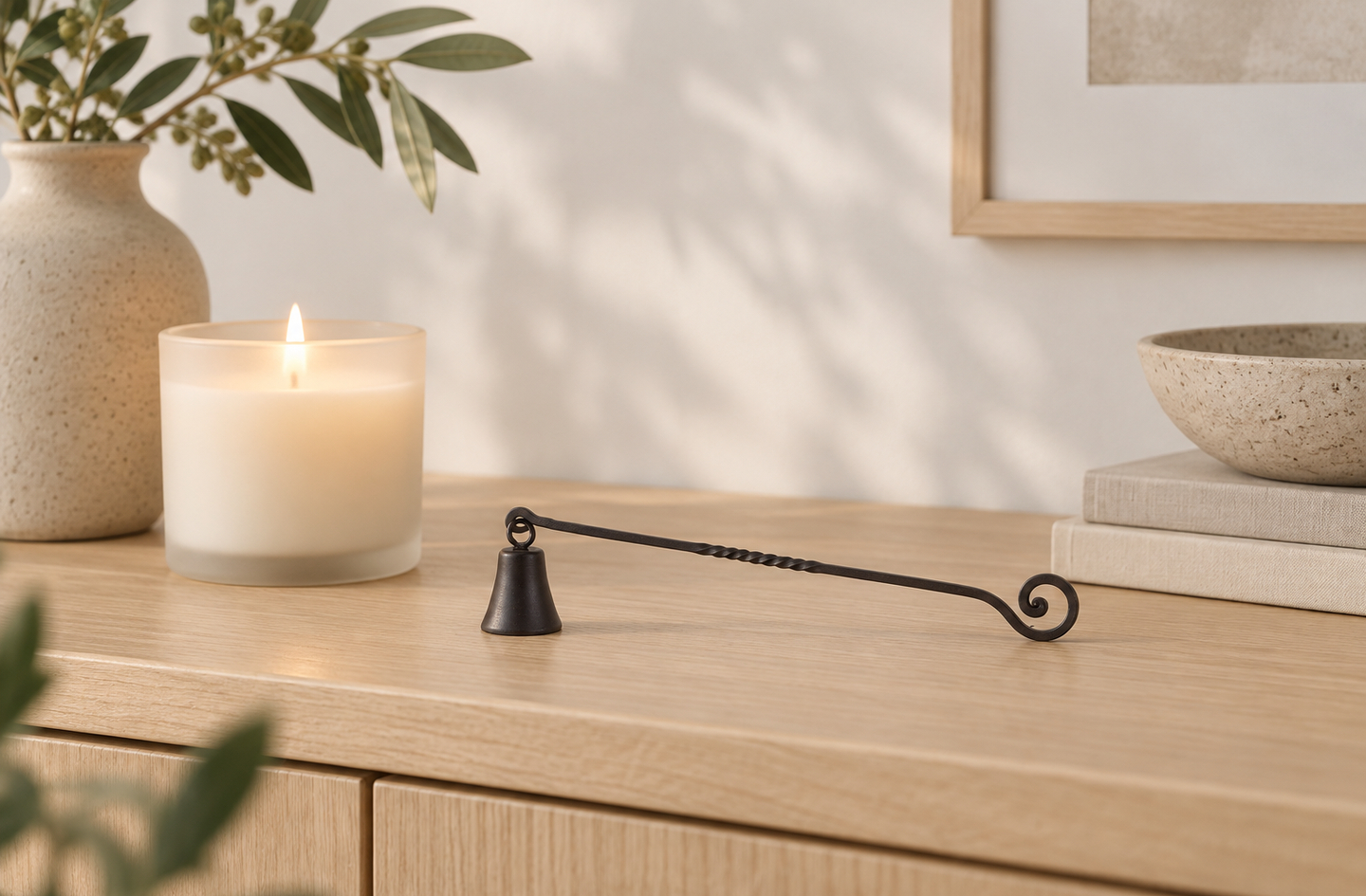
RTZEN’s snuffers come from the family workshop Tsach Levy opened in 1997 after training with master artisans. Each one is made in four steps: cut, hand-forge, zinc-galvanize and powder-coat. The Antique Snuffer pairs an elongated handle and artisanal grip with a hinged bell, a layout in the spirit of the extending douter.
The Classic Snuffer uses a decorative looped handle and a pivoted bell that smothers the wick without blowing smoke or wax. Its product description names taper, pillar and jar candles as its uses. Both are solid iron with a heat-resistant finish, and both are backed by RTZEN’s Lifetime Warranty.
What the modern bell snuffer shares with three historic tools
The modern bell shares something with each historic tool. With the cone extinguisher it shares the method, smothering the flame under a cover, as on the V&A’s Sheffield chamber candlestick7. With the douter it shares length, which the Science Museum Group’s 303 mm lazy tong douter shows some older tools already had6.
With the trimming snuffer it shares the habit of a resting place. Historic snuffers were often supplied with a stand or tray that caught wax and burnt wick1. A modern snuffer still works best stored beside the candle it serves. What it lacks is the cutting blade, because wick trimming now happens before lighting.
A buyer who wants a historic-feeling snuffer should look for the cone shape and a long handle. Wick trimming now happens before lighting, so blades on a snuffer are optional.
Reading Museum Evidence on Antique Candle Snuffer Origin
In the records cited here, antique candle snuffer origin is given as a date range and a qualified place. Museum catalogues show the standard any claim should meet. The Science Museum Group dates its wrought iron snuffer 1700-1800 and records its origin only as “European, possibly English”3. Careful records state what is known and flag what is not.
What a careful catalogue entry records about a snuffer
A good entry lists materials, measurements, marks and a dated range. The V&A record for its British snuffer of about 1800 lists several marks. They include a maker’s mark read as “VA (?),” a duty mark, a lion passant and a damaged date letter1. The question mark is part of the record: the museum does not claim more than the marks show.
The same caution appears in the douter records. The lazy tong douter is catalogued as “European, possibly English, 1700-1820”6. The record’s 120-year span shows how wide an honest date range can be.
Provenance rests on a documented chain of owners
A named owner needs a paper trail, and Royal Museums Greenwich shows the kind of record involved. It names Captain James Cook (1728-79) and his wife Elizabeth as owners4. It then traces his sister Margaret’s line to Henry A. Baron4. The record adds that Henry A. Baron gave them to the Admiralty with other Cook relics in the 1930s4.
Without that kind of chain, a famous name attached to an antique is a story, not evidence. Style, wear and patina can suggest an age, but they cannot prove who owned a piece or where it was made.
Why “first recorded” is not the same as “invented”
The V&A states that snuffers are first recorded in the 15th century1. That is the earliest documented evidence, not a date of invention. This article therefore makes no claim about who invented the candle snuffer or exactly when.
The 1825 wick date works differently, because the V&A ties it to a named inventor, Joseph Cambacères1. Trimmers did not vanish, though: the Swiss National Museum notes that wick trimmers are still commercially available2.
For any antique snuffer, ask for marks, measurements and a written ownership record; where none exist, a date range and “possibly” are the honest description.
The History of Candle Snuffers at a Glance: A Dated Timeline
The dated points in the museum records and the Swiss National Museum’s account line up into one short sequence12. Each row names the source that carries the date, so a reader can check it.
| Date | Event | Source |
|---|---|---|
| 15th century | Snuffers first recorded | V&A1 |
| About 1730/40 | Silver candle scissors with a base, by Philipp Heinrich Schönling of Leuk-Stadt | Swiss National Museum2 |
| About 1750 | Steel douter for pinching the lighted wick | Science Museum Group5 |
| Mid-18th century | Numerous snuffer patents begin to appear | V&A1 |
| 1770 | Opéra Royal of Versailles burns around 3,000 candles per performance | Swiss National Museum2 |
| Late 18th century | Sheffield plate chamber candlestick made with a conical extinguisher | V&A7 |
| 1803 | Caricature shows King George III snuffing out Napoleon | Swiss National Museum2 |
| 1818 | Stearin discovered as a candle material | Swiss National Museum2 |
| 1825 | Joseph Cambacères invents the self-trimming plaited wick | V&A1 |
| 1830 | Paraffin discovered | Swiss National Museum2 |
| Today | Trim the wick to ¼ inch before each use; put the flame out with a snuffer or a gentle breath | National Candle Association8 |
Read as a sequence, the table shows trimming tools still being improved right up to the wick and fuel changes of the early 19th century. The cone never depended on wick length, and today’s bell snuffer still does its job12.
The snuffer did not disappear in the early 19th century; its trimming job faded. The flame-ending job stayed with the cone, which shared the name.
Frequently Asked Questions
What were candle snuffers used for?
Candle snuffers were first made to trim candle wicks and were not necessarily used to put flames out. The V&A says they were invented to cut off and retain burned wicks1. Depending on the candle and wick, households cut the wick back to 10 to 15 millimetres every 5 to 20 minutes2. A small box on the blade caught the smouldering end.
Is a candle snuffer the same as a candle extinguisher?
Today the words overlap, and RTZEN’s own bell tools are sold as snuffers. Historically the trimming snuffer and the extinguisher were different tools. The trimming snuffer had scissor blades and a box1. The extinguisher was a hollow cone, like the one carried on a late 18th-century Sheffield chamber candlestick at the V&A7.
When did people stop trimming candle wicks while they burned?
Trimming during the burn faded over the first half of the 19th century. The V&A credits Joseph Cambacères with the self-trimming plaited wick in 18251. The Swiss National Museum adds that stearin (1818) and paraffin (1830) gave cleaner fuels2. Together they ended the need to shorten the wick by hand.
What is a candle douter?
A douter is a scissor-form tool that puts a candle out by pinching the lit wick between flat discs or pincers. The Science Museum Group holds a steel douter from about 1750 that measures 120 mm5. It also holds an extending lazy tong douter recorded at 303 mm overall6.
How long is an antique wick-trimming snuffer?
The museum trimmers in this article run from 165 to 180 mm overall. The Science Museum Group’s wrought iron snuffer measures 165 mm3. The V&A’s steel and silver pair is 17.8 cm1, and Captain Cook’s snuffers are 180 mm4. That is hand length, suited to close work at the wick.
Limitations and Edge Cases
- The museum records cited here come from British and Swiss institutions and describe mostly English and European tools. American and other regional forms are not examined separately.
- The length chart compares five catalogued objects from three collections13456. It shows the range of recorded sizes, not an average for all historic snuffers.
- Catalogue dates are ranges and origins are often qualified, so no single object here fixes the date a tool type first appeared.
- This history does not rank modern tools. For buying criteria such as bell fit and reach, see the guide on choosing a daily-use snuffer.
References
Methodology: every dated or measured figure comes from an independent museum or industry source and links to the page that carries it. Derived figures are labeled as RTZEN’s calculation or comparison, and co-founder Rami Abramson reviewed the article.
- Victoria and Albert Museum – Snuffer, Great Britain, ca. 1800, accession number 1242-1903, Metalwork Collection catalogue record.
- Swiss National Museum – In the days when candle wicks still had to be trimmed…, Murielle Schlup, May 30, 2022 (modified January 27, 2026).
- Science Museum Group – Wrought iron candle snuffer, object number 1927-748/13, Lovett Collection, Science Museum Group Collection Online.
- Royal Museums Greenwich – Silver candle snuffers, object ID PLT0029, National Maritime Museum collection record.
- Science Museum Group – Candle douter, object number 1927-748/20, Lovett Collection, Science Museum Group Collection Online.
- Science Museum Group – Candle douter in wrought iron, extending lazy tong type, object number 1927-748/15, Lovett Collection.
- Victoria and Albert Museum – Chamber candlestick, Sheffield, late 18th century, accession number M.1044-1926, Metalwork Collection catalogue record.
- National Candle Association – Candle Safety Tips, Candle Fire Safety Tips page.
Conclusion
The history of candle snuffers is a story of one name shared by different tools. For centuries the word snuffer often meant a pair of scissors with a box, made to trim and trap the burnt wick. Douters and cones did the job of putting the flame out. Once braided wicks and cleaner fuels ended the trimming chore, the cone’s job of smothering the flame carried on in today’s bell snuffer.
For how this history fits the wider topic, read the practical candle snuffer guide, which introduces the topic as a whole.