
A wall mounted paper towel holder suits a room when its orientation fits the open wall and its roll sits within easy reach. Its screws also have to suit the wall behind it. This article narrows the broader overview in Paper Towel Holders to one choice: which wall style fits a kitchen, workshop or bathroom. The roll comes first. Home paper towel holders are designed for rolls up to 6.5 inches in diameter, according to a 2024 Procter & Gamble patent2. Orientation, reach, wall surface and roll access settle the rest.
Quick Answer
Which wall mounted paper towel holder style should you choose?
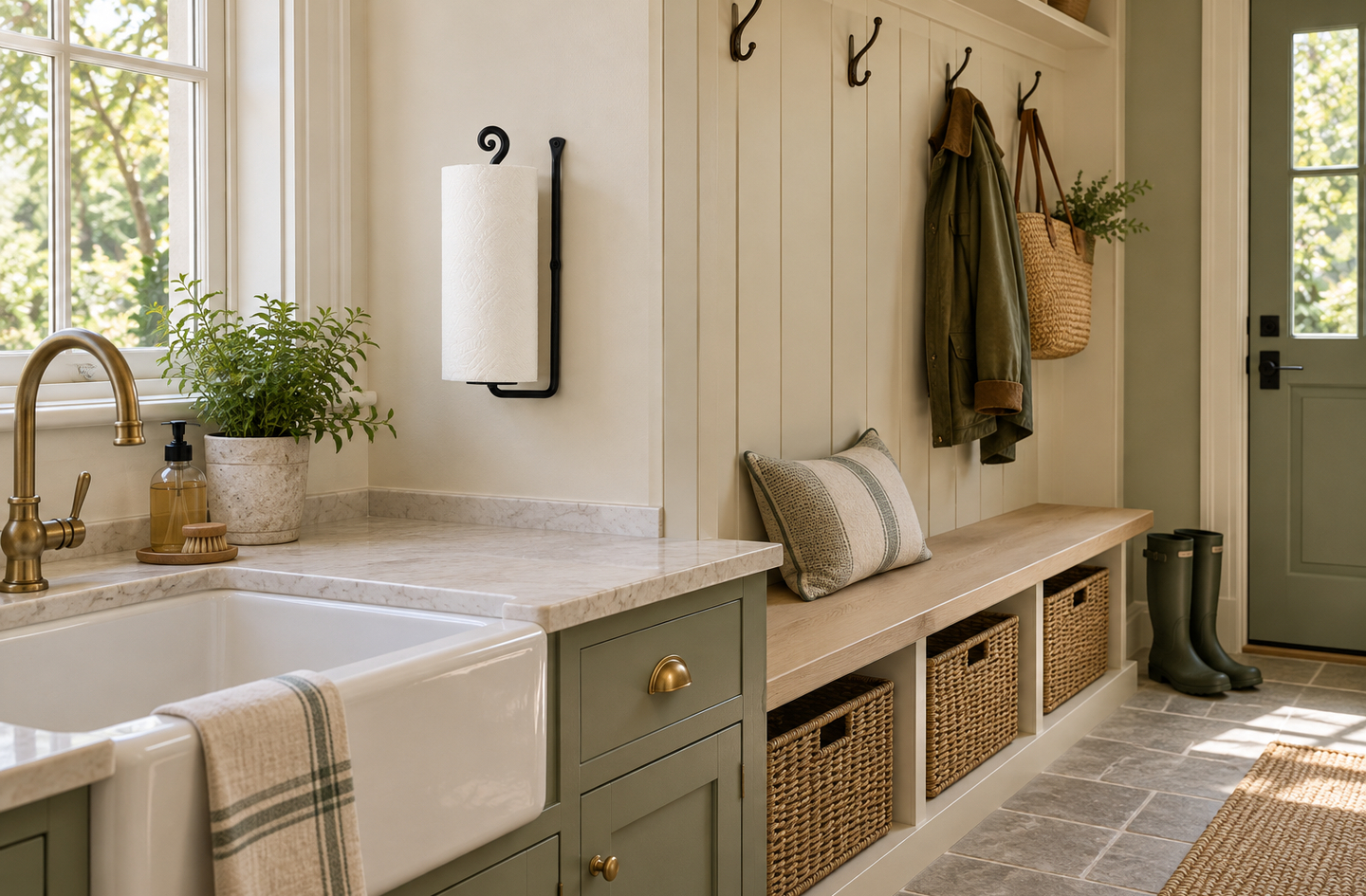
Choose a vertical holder where the wall is narrow and a horizontal holder where the wall is wide but short, such as a backsplash. A conventional roll is eleven inches wide with a core about 1.625 inches across1. Standing upright, the roll needs eleven inches of height; lying flat, it needs eleven inches of width. Then match the screws to the wall.
Key Takeaways
- A conventional roll is eleven inches wide and 5 to 6 inches in diameter1. A horizontal holder spends that width across the wall, and a vertical holder spends it up the wall.
- Bob Vila’s standard kitchen leaves 18 inches of wall between the countertop and the upper cabinets3. A horizontal roll fits that gap with room to spare, while a vertical roll and its base use most of it.
- In Family Handyman’s test in one-half inch drywall, every anchor held at least 80 pounds6. Plan on the package rating, though, and use a masonry or tile bit on harder walls.
- A 2012 Mayo Clinic Proceedings review of washroom hand-drying studies concluded that paper towels are superior to electric air dryers from a hygiene viewpoint8.
Wall Mounted Paper Towel Holder Styles Compared
Wall mounted paper towel holders come in three basic styles, and they differ in which way the roll faces and how it goes on. A horizontal holder is a wall holder that carries the roll lying flat, parallel to the floor. A vertical holder is a wall holder that stands the roll on end around an upright spindle. Horizontal holders split again by how many brackets touch the wall.
| Style | Wall space used | How the roll goes on | Tearing | Best fit |
|---|---|---|---|---|
| Horizontal, open arm | Wide and short: the roll’s width across, its diameter up | Slides on from the free end of the arm | Steady when the arm ends in a raised tip or scroll | Backsplashes and other short, wide walls |
| Horizontal, two brackets | Wide and short, plus a bracket at each end | A rod or spindle comes out, takes the roll and goes back | Very steady, because both roll ends are held | Busy counters and shop benches with hard, fast tearing |
| Vertical spindle | Narrow and tall: the roll’s diameter across, its width up | Drops over the top of the spindle | Steady when the roll sits snug on its base | Narrow wall strips beside a sink, door or window |
Decorative scrollwork sits on top of any of these styles rather than forming a style of its own. The RTZEN Decorative holder adds wrought iron scrollwork, is listed for standard and jumbo rolls, and mounts to kitchen walls, pantries or workshop areas. The Swirls holder uses an open arm, so standard rolls slide on and off easily.
Pick the style by the shape of the free wall first, and only then by looks. A narrow strip points to a vertical spindle, and a short, wide gap points to a horizontal arm.
Orientation: Horizontal vs Vertical on the Wall
Horizontal wins on short walls and vertical wins on narrow ones, because each orientation spends the roll’s width in a different direction. Patent US7048225, granted in 2006, describes paper towels as invariably eleven inches wide1. The same record puts a conventional roll at 5 to 6 inches in diameter, with a core about 1.625 inches across1.
A horizontal holder therefore needs about eleven inches of width but only the roll’s diameter in height. A vertical holder flips that: the roll’s diameter across, and its full width up the wall. Bob Vila’s standard kitchen leaves 18 inches of backsplash between the countertop and the upper cabinets3. A 2024 Procter & Gamble patent notes that home holders are designed for rolls up to 6.5 inches in diameter2.
Worked example, calculated from cited inputs: a conventional roll is eleven inches wide1, and a standard backsplash gap is 18 inches tall3. A vertical spindle about as tall as the roll stands about 11 inches. To reload it, the new roll’s core has to clear the spindle tip, so the roll rises another full width. That calculation gives about 22 inches of clear height1, which is 4 inches more than the backsplash gap3. A horizontal roll up to 6 inches in diameter leaves 12 inches of the same gap free13.
The result explains a common mismatch. A vertical holder looks compact, yet under an upper cabinet it may not reload in place. On an open wall beside a sink, a door or a window, the same holder fits a strip only a roll’s diameter wide.
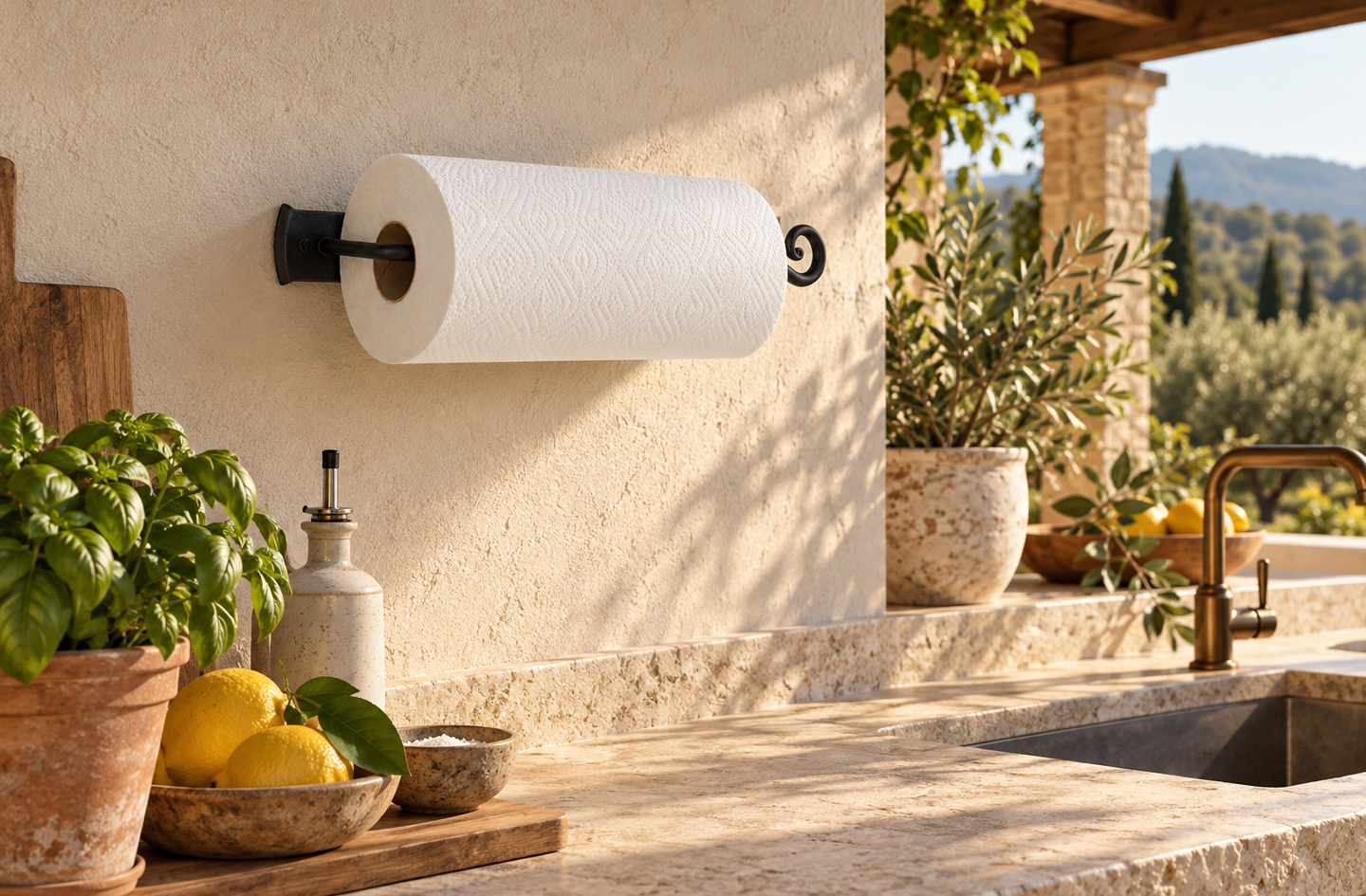
Under upper cabinets, choose a horizontal holder; save the vertical spindle for open wall where nothing sits above it.
Sizes: Roll Width, Diameter and Jumbo Rolls
Holder size comes down to two roll measurements: the width the arm or spindle must carry and the diameter the wall clearance must allow. The roll diameter is the distance across the full roll, measured through the core before the first sheet is used. A holder that clears a new roll clears every roll after it, because the roll only shrinks.
Larger rolls are where sizes split. Procter & Gamble’s patent US11952724, granted in 2024, says home paper towel holders are designed for rolls up to 6.5 inches in diameter2. The same patent says those holders become problematic, if not worthless, with larger rolls2. Brand names such as jumbo or mega are not a measurement, so measure a full new roll before choosing.
The full fit check, roll by roll and brand by brand, sits in the guide to jumbo roll holder fit. For a wall holder, two quick checks cover most cases. The arm or spindle should be longer than the roll’s eleven-inch width1, and the clearance from wall to arm should exceed the largest roll’s radius.
If the household buys large rolls, choose a holder the maker lists for jumbo rolls; a standard-only holder will fight every new roll.
Reach: Where the Roll Sits Against the Counter
A wall holder over a counter should keep the roll within easy reach of a standing cook. A backsplash mount does that in a standard kitchen. Bob Vila puts the upper cabinet bottom at 54 inches above the floor and 18 inches over the countertop3. That leaves the countertop 36 inches above the floor3.
A horizontal roll centered in that gap sits about 45 inches above the floor3. The 2010 ADA Standards set the unobstructed high side reach at 48 inches maximum and the low side reach at 15 inches minimum4. Over a deep reach, the limit is lower: where the reach depth exceeds 20 inches, the high forward reach is 44 inches maximum4. The ADA limits govern public buildings, but at home they are a useful reference for a seated user or a wheelchair user.
Exact mounting heights by room sit outside this comparison. For choosing a style, one rule is enough. The sheet edge should sit where wet hands reach it without stretching over a sink or a hot cooktop.
For a standing cook, a horizontal roll centered on the backsplash sits within easy reach. For a seated user, a roll on the wall beside the counter, not behind it, avoids the deeper reach.
Mounting Surface: Drywall, Studs, Tile and Masonry
The wall behind the holder decides which fastener it needs, and the right fastener matters more than the holder’s weight. This Old House notes that drywall can typically support between 5 and 10 pounds with a simple nail5. Anything heavier needs a drywall anchor or a screw into a stud5.
Drywall and Studs
A drywall anchor is a plug or toggle that grips the wallboard, so a screw holds where no stud sits behind it. In Family Handyman’s test, each anchor was installed in one-half inch drywall and loaded with a tension scale until it buckled6. All the anchors lived up to their claims, and all but one exceeded their weight rating6. Across the seven anchors, the claimed ratings ran from 22 to 90 pounds, and the tested results ran from 80 to 180 pounds6.
This Old House adds a planning rule: anchors should be able to hold four times the weight of the object being hung5. Calculated from that rule, a 22-pound rating supports an object of about 5.5 pounds56. The 80-pound test result works out to 20 pounds56. Plan on the package rating, because the test shows what one anchor survived, not what every wall allows.
A screw into a stud skips the anchor entirely. Older houses usually space studs 16 inches on center, while some newer houses use 24 inches5. A vertical holder has one narrow plate, so it lands on a stud more easily than a wide horizontal holder with a bracket at each end.
Tile, Brick and Concrete
Masonry walls hold well but need different tools. This Old House says concrete and brick walls require masonry bits and anchors5. For brick or concrete, it recommends a hammer drill with a carbide-tip masonry bit5. The hole should run deeper than the plastic insert, so the anchor does not bottom out5.
Tile is a hard face over a softer wall. This Old House says a carbide-tipped masonry bit is usually sufficient for ceramic tile7. It recommends a diamond-tipped bit for porcelain and glass, or whenever the tile type is in doubt7. Before drilling, it suggests a piece of masking tape over the area7. Behind the tile, wall anchors go in where the wall needs them7.
| Wall surface | What to check |
|---|---|
| Drywall over a stud | Screws long enough to reach the stud through the wallboard |
| Drywall between studs | An anchor whose package rating clears the holder with margin |
| Plaster | Anchors made for plaster, and care against cracking5 |
| Ceramic tile | A tile-rated bit and a plan for the wall behind the tile |
| Brick or concrete | A carbide-tip masonry bit and masonry anchors |
| Wood paneling or plank wall | Wood screws set into solid wood, not a thin veneer |
Check the package rating of any supplied anchor against the four-times rule; on tile or masonry, the drill bit is the part to buy.
Roll Access: Loading, Tearing and One-Handed Use
An open-arm horizontal holder is the fastest to reload, because the empty core slides off and the new roll slides on from the same free end. A tear stop is a raised tip, scroll or cap at the free end of an arm that keeps the roll on during a pull. Scroll ends on forged holders often do this job as well as decorate.
A two-bracket holder asks for more handling at each reload. The rod or spindle has to come out, pass through the new core and seat again while the roll is held level. In return, the roll cannot walk off the end, so a hard, quick tear stays clean.
A vertical spindle loads from the top. The Vertical holder uses a space-saving vertical spindle that holds the roll neatly against the wall for easy dispensing. One-handed tearing works best when the roll sits snug on its base, so the free hand pulls the sheet down and sideways.
For one-handed reloading, the open arm and the vertical spindle beat a two-bracket rod; for hard, fast tearing, the two-bracket holder wins.
Everyday Use by Room: Kitchens, Workshops and Bathrooms
Each room favors a different wall mounted paper towel holder, because the free wall, the wall surface and the mess differ from room to room. The sections below match the style to the room rather than repeating mounting steps.
Paper Towel Holder for Kitchen Wall Space
In a kitchen, the backsplash beside the sink is the usual spot, and a horizontal holder suits its short, wide gap. A narrow strip beside a window or the end of a cabinet run suits a vertical holder, as long as nothing sits above the spindle. Keep the roll away from the cooktop and clear of outlets and switches, so wet sheets and wet hands stay away from them.
Where an upper cabinet already sits over the prep zone, an under cabinet paper towel holder hangs the roll from the cabinet instead. That leaves the backsplash free, and the choice follows its own checks on cabinet material and arm drop.
Workshops, Garages and Laundry Rooms
Some workshops and garages have block, brick or concrete walls, so the masonry bit and anchors matter more there than in a kitchen. Hands are greasy and pulls are hard, which favors a two-bracket holder or an open arm with a raised scroll end. A holder mounted at the end of the bench, not over it, keeps the roll out of the dust from sanding and cutting.
Laundry rooms sit between the two. The walls are often drywall, but they can see steam and splashes, so the finish counts as much as the style.
Bathrooms and Powder Rooms
A wall roll in a bathroom serves hand drying, and the evidence favors it. A 2012 review in Mayo Clinic Proceedings found that most studies suggest paper towels can dry hands efficiently and remove bacteria effectively8. The same studies suggest that paper towels cause less contamination of the washroom environment8. In one study the review describes, paper towels and jet air dryers both reached 90% dryness after 10 seconds8. Hot air dryers needed 40 seconds to achieve a similar dryness8.
“From a hygiene viewpoint, paper towels are superior to electric air dryers.”
Cunrui Huang, Wenjun Ma and Susan Stack, Mayo Clinic Proceedings8
That review weighed public washrooms and clinics, not home bathrooms, but the drying point carries over. In a small powder room, a vertical holder beside the sink takes the least wall width.
Bathrooms and sink walls also test the finish. RTZEN wall holders are cut, hand-forged, zinc-galvanized and powder-coated in the workshop Tsach Levy has run since 1997. The zinc layer sits under the powder coat, and the catalog carries a Lifetime Warranty against material and workmanship defects under normal use.
Match the style to the room’s free wall and the finish to its moisture. In practice, that means a horizontal arm on a kitchen backsplash, a two-bracket holder in a shop, a vertical spindle in a narrow bathroom.
Who Should Choose Which Wall Holder
The simplest rule: choose horizontal for short, wide walls and vertical for tall, narrow ones, then let the room settle the details.
- Kitchens with a standard backsplash: a horizontal open arm, centered in the gap beside the sink.
- Narrow walls beside a sink, door or window: a vertical spindle, with open space above it for reloading.
- Workshops with hard, fast tearing: a two-bracket holder, or an open arm with a raised scroll end.
- Households that buy jumbo rolls: a holder the maker lists for jumbo rolls, checked against a full new roll.
- Not a fit for any wall style: renters who cannot drill, who are better served by a countertop stand such as the Fancy stand. Kitchens whose only free space is under a cabinet suit the Under Cabinet holder instead.
On these criteria the horizontal open arm suits the widest range of kitchens; the vertical spindle solves narrow walls, and the two-bracket holder solves hard tearing.
Verdict by Category
The horizontal open arm wins most categories for a home kitchen, while the vertical spindle wins on narrow walls alone.
| Category | Best style | Why |
|---|---|---|
| Orientation on a backsplash | Horizontal open arm | The roll’s diameter, not its width, takes the wall height |
| Narrow wall strips | Vertical spindle | Only the roll’s diameter takes the wall width |
| Reach from the counter | Horizontal, centered on the backsplash | The sheet edge sits low and close to the sink |
| Mounting on a stud | Vertical spindle | One narrow plate lands on a stud more easily |
| Roll access | Horizontal open arm | The old core comes off and the new roll goes on from the same end |
| Steadiness during a tear | Horizontal, two brackets | Both ends of the roll are held |
| Overall | Horizontal open arm | Fast reloads and a low sheet edge suit most kitchens |
Start with a horizontal open arm on the backsplash, and move to a vertical spindle only where the wall is too narrow for it.
Frequently Asked Questions
Is a vertical or horizontal paper towel holder better?
Neither is better everywhere. A horizontal holder suits a short, wide wall such as a backsplash, because only the roll’s diameter takes up wall height. A vertical holder suits a narrow strip, but the roll stands eleven inches tall on its spindle1. It also needs open space above the spindle for reloading.
Where should a paper towel holder go in a kitchen?
Put it beside the sink, on the backsplash or the nearest free wall, where wet hands reach the sheet first. In Bob Vila’s standard kitchen, the backsplash gap is 18 inches tall3, enough for a horizontal roll with room to spare. Keep the roll clear of the cooktop, outlets and switches.
Can you mount a paper towel holder on tile?
Yes, with the right bit. This Old House says a carbide-tipped masonry bit is usually sufficient for ceramic tile, and it recommends a diamond-tipped bit for porcelain and glass7. Tape the spot before drilling, and add wall anchors where the wall behind the tile needs them.
Can you put a paper towel holder in a bathroom?
Yes, and it serves hand drying well. In a study described in a 2012 Mayo Clinic Proceedings review, paper towels and jet air dryers both reached 90% dryness after 10 seconds8. Hot air dryers needed 40 seconds8. Choose a finish with a zinc layer under the coating, because a bathroom wall takes steam and splashes.
Where do you put a paper towel holder in a garage?
Put it at the end of the workbench, within reach but out of the dust from cutting and sanding. Where the garage wall is brick or concrete, This Old House says those walls require masonry bits and anchors5. A two-bracket holder or a scroll-ended arm stays steady during hard pulls.
Limitations and Edge Cases
- The roll dimensions come from two patent records, granted in 2006 and 2024. No independent standard found for this article fixes the size of jumbo or mega rolls.
- The anchor figures come from one magazine test in one-half inch drywall. The four-times rule is a planning rule, not a rating for any holder or its supplied anchors.
- The ADA reach limits govern public buildings, so in a home they serve as a reference rather than a requirement. Exact heights by room and step-by-step installation belong to the Paper Towel Holders overview rather than this comparison.
References
Methodology: RTZEN compiled the figures in this article from two patent records, published home-improvement references, the 2010 ADA Standards and a peer-reviewed hygiene review, read in October 2026. Tsach Levy holds editorial responsibility for the comparison.
- Google Patents – US7048225B2, Narrow paper towel roll and holder, Nicholas A. Delfino, granted May 23, 2006.
- Google Patents – US11952724B2, Paper towel rolls, The Procter & Gamble Company, granted April 9, 2024.
- Bob Vila – Upper Cabinet Height for Kitchens, Solved!, Manasa Reddigari, updated October 5, 2020.
- U.S. Access Board – ADA Accessibility Standards, 2010 ADA Standards for Accessible Design, sections 308.2.2 and 308.3.1.
- This Old House – How To Hang Something Heavy On a Wall.
- Family Handyman – How Much Weight Can Drywall Anchors Hold?, Jason Ingolfsland, updated October 28, 2024.
- This Old House – How To Drill Through Tile With Ease, Andy Engel, updated October 7, 2024.
- Mayo Clinic Proceedings – The Hygienic Efficacy of Different Hand-Drying Methods: A Review of the Evidence, Cunrui Huang, Wenjun Ma and Susan Stack, 2012, volume 87, pages 791 to 798.
Conclusion
The right wall mounted paper towel holder matches the shape of the free wall and keeps the sheet within easy reach. Its screws also suit the surface behind it. For most kitchens that means a horizontal open arm on the backsplash, while narrow walls suit a vertical spindle. RTZEN backs its forged holders with a Lifetime Warranty.
See the broader Paper Towel Holders guide for how wall mounts compare with under-cabinet and countertop options.