
A jumbo roll paper towel holder takes a mega roll only when four measurements line up: roll width, outer diameter, core size and clearance. This article narrows the broader overview in the Paper Towel Holders guide to one question: will a larger roll fit your holder? Roll names do not settle it, because Bounty sells Double, Triple and Mega rolls at 2x, 3x and 4x the sheets of its Regular roll1. None of those names states a diameter, so the fit has to be measured.

Quick Answer
Will a jumbo or mega roll fit your paper towel holder?
A jumbo or mega roll fits when the holder clears the complete new roll’s width, outer diameter and core. Household rolls on the market have typically shown roll diameters of 6.5 inches or less3. A 2024 Procter and Gamble patent claims a roll diameter of at least 8.52 inches3. Measure your own roll and holder, in this order:
- Read the label for sheet count and sheet size.
- Measure the roll width against the holder length.
- Measure the outer diameter of a complete new roll.
- Check the core against the arm or spindle.
- Measure the usable clearance around the mount.
- Test-fit a complete new roll.
Key Takeaways
- Bounty defines its Double, Triple and Mega rolls as 2x, 3x and 4x the sheets of a Regular roll1. The names measure paper, not roll size.
- Federal rules have paper towels labeled by total area and ply, plus a count and the size of one sheet4. The rule does not require the roll’s diameter.
- Market rolls have typically shown roll diameters of 6.5 inches or less, while a 2024 patent claims rolls of at least 8.52 inches3. A holder sized for the first can miss the second.
- The arm of a holder has to sit at least half the roll’s diameter from the wall or cabinet. A roll of 8.52 inches requires 4.26 inches of that standoff3.
Why Jumbo and Mega Roll Names Do Not Give You a Size
Paper towel roll names describe how much paper sits on the roll, not how wide or how fat the roll is. Bounty offers Regular, Double, Triple and Mega rolls, rated at 2x, 3x and 4x the sheets of a Regular roll1. That tells you how often you will change the roll, but not whether the roll clears your holder.
The package label is not built to answer the fit question either. Under the federal labeling rule, roll products such as paper towels are labeled in terms of total area and the number of ply4. The rule then asks for one more layer of detail:
“Such area measurement, however, shall be supplemented by a count statement and the dimensions of a single unit.”
Electronic Code of Federal Regulations (eCFR), 16 CFR 500.154
So a label lists the sheet count, the size of one sheet, the total area and the ply. Roll diameter is not on that list, and neither is the core size. Two brands can both print “Mega” on the pack and still wind rolls of different sizes.
Sheet counts change from year to year
Roll names also stay put while the paper on them changes. A 2024 LendingTree study found that Bounty Select-A-Size triple roll paper towels shrank 18.2% from 165 sheets a roll to 1356.
In 2026, Mouse Print reported Viva going from 94 sheets on the old double rolls to just 86 sheets, about 8.5% fewer7. AARP reported in 2022 that Consumer World found Sparkle cut six sheets off each roll, from 116 to 110, about 5.2%8.
Treat every roll name as a guide to how much paper you get, then measure the roll itself before you judge whether it fits.
What You Need Before You Measure
Checking roll fit requires a few household tools and one full roll of the exact product you plan to purchase. Measure a new roll, because a roll in use has already lost paper and reads smaller than it will on day one.
- A complete new roll: the same brand and roll name you plan to purchase, still sealed or just opened.
- A flexible tape measure: a sewing tape wraps around a roll; a steel tape works for straight distances.
- The holder or its listing: the arm or spindle length, the distance from the arm to the mounting plate, and the space under any finial.
- Two hardcover books: they help you read a diameter without squashing the roll.
- Difficulty: beginner, and no step requires drilling.
Step 1: Read the Package Label for Sheet Count and Sheet Size
By the end of this step, you will have the label figures that let you compare one roll with another. The federal rule has paper towels labeled by total area and ply4, with a sheet count and the dimensions of one sheet added to it.
- Find the net quantity statement on the pack and read the paper towel figures in it.
- Write down the sheet count per roll, the sheet dimensions and the total area for the pack, the figures the rule requires4.
- Note the ply, because a two-ply sheet is two thin layers pressed together and takes more room on the roll than one ply.
- Repeat for any other brand you are weighing.
The sheet’s long side is the roll width, because each sheet runs the full width of the roll. More total area on the same width means more paper wound around the core. How much thicker that makes the roll depends on how tightly the maker winds it. The Procter and Gamble patent treats roll density as its own measured property, apart from roll diameter3.
Confirm your work: you should have a sheet count, a sheet size and a total area for each product. If the sheet sizes match, compare the areas to see which roll carries more paper.
The label tells you which roll carries more paper and how wide it is. Only a tape measure tells you how large it is across.
Step 2: Measure the Roll Width Against the Holder Length
Roll width is the length of the roll along its core, from one cut edge to the other. Conventional paper towels were described in a 2006 U.S. patent as invariably eleven inches wide2. Newer designs vary, and the 2024 Procter and Gamble patent claims a large-diameter roll with a roll width of less than 10.0 inches3.
A larger roll is not always a wider one, so measure the width on the roll you will actually purchase.
Horizontal arms on wall and under-cabinet holders
- Stand the roll on end and measure from one cut edge to the other.
- Measure the holder arm from the inside face of the mounting plate to the inside of the end stop or scroll.
- Confirm the arm is longer than the roll, since a roll pressed against both ends drags when you pull a sheet.
Vertical spindles on countertop stands
- Measure the spindle from the top of the base to the underside of the finial or top piece.
- Compare it with the roll width, since the roll has to drop over the spindle and sit flat on the base.
- Check whether the top piece lifts off or stays fixed, because a fixed top must clear the roll as it slides on.
Width is the measurement most buyers skip, yet it decides whether a finial or an end stop lets the roll rotate at all.
Step 3: Measure the Outer Diameter of a Complete New Roll
Outer diameter is the distance straight across the full roll, through the center of the core. In the 2006 patent, a conventional roll measures 5 to 6 inches in diameter2. In the 2024 Procter and Gamble patent, prior art rolls designed for use in consumers’ homes have typically shown roll diameters of 6.5 inches or less3.
The same patent then claims a paper towel roll with a roll diameter of at least 8.52 inches3. A holder that clears the first figure with room to spare can still block the second.
Two ways to read the diameter
- Book method: stand two hardcover books upright against the roll on opposite sides, then measure the gap between them.
- Wrap method: wrap a sewing tape once around the middle of the roll, read the distance around, and divide it by pi.
- Measure at the middle of the roll and near one end, then use the larger figure.
- Keep the tape light on the paper, because a soft roll squashes and reads small.
Write the result next to the label details you noted in Step 1, and measure every brand you compare the same way.
| Roll figure | Published value | What it means for fit |
|---|---|---|
| Conventional roll width | Invariably eleven inches wide2 | Arm or spindle must be longer than this |
| Conventional roll diameter | 5 to 6 inches in diameter2 | Falls within the typical household range |
| Market household rolls | Roll diameters of 6.5 inches or less3 | Typical upper bound for household rolls |
| Patented large roll | Roll diameter of at least 8.52 inches3 | Plan clearance for this if you purchase large rolls |
| Core inside diameter | About 1.625 inches2 | Arm or spindle must be thinner than this |
Size the holder for the largest full roll you are likely to purchase, because the published diameters run well past the conventional roll.
Step 4: Check the Core Against the Arm or Spindle
The core is the cardboard tube at the center of the roll, and the holder’s arm or spindle has to pass through it. The 2006 patent describes a central core with an inside diameter of about 1.625 inches2. The 2024 Procter and Gamble patent claims a core with an outer diameter of less than 2.25 inches3.
- Measure the inside of the core across its widest point, using the end of a steel tape.
- Measure the thickest part of the holder’s arm or spindle, including any scroll, collar or knob the roll must pass over.
- Confirm the arm is clearly thinner than the core, so the roll slides on by hand and spins without catching.
Check the core on every new brand, because a larger roll does not promise a larger core. A decorative end on an arm can be wider than the arm itself.
The core is the one measurement where larger rolls give no extra room, so a thick decorative arm end deserves a check before anything else.
Step 5: Measure the Usable Clearance Around the Mount
Usable clearance is the open space a full roll requires around the arm or spindle to rotate without rubbing the wall, cabinet or counter. On any arm that holds the roll through its core, the arm has to sit at least the roll’s radius from the nearest surface. The radius is the distance from the roll’s center to its outer edge.
Worked example, calculated from cited inputs. Standoff is the distance from the arm’s center to the wall or cabinet. A market roll at the typical upper bound of 6.5 inches3 requires 6.5 / 2 = 3.25 inches of standoff.
A patented large roll with a roll diameter of 8.52 inches3 requires 8.52 / 2 = 4.26 inches, about 1 inch more standoff than the market roll.
Bob Vila recommends hanging upper cabinets 18 inches above the countertop5. Under that cabinet, the market roll leaves 18 – 6.5 = 11.5 inches of open space below it5.
The large roll leaves 18 – 8.52 = 9.48 inches5, before the bracket’s own drop is counted. The result: the larger roll requires only about 1 inch more standoff, but it takes the full extra diameter out of the counter space.
Wall-mounted holders
Measure from the wall to the center of the arm, not to its top edge. That distance has to beat half the diameter of your largest full roll. RTZEN lists its Decorative wall holder for standard and jumbo paper towel rolls, with matching wall mounting hardware supplied.
Also inspect the area below the arm, where a light switch, a backsplash ledge or a faucet handle can stop a larger roll from rotating.
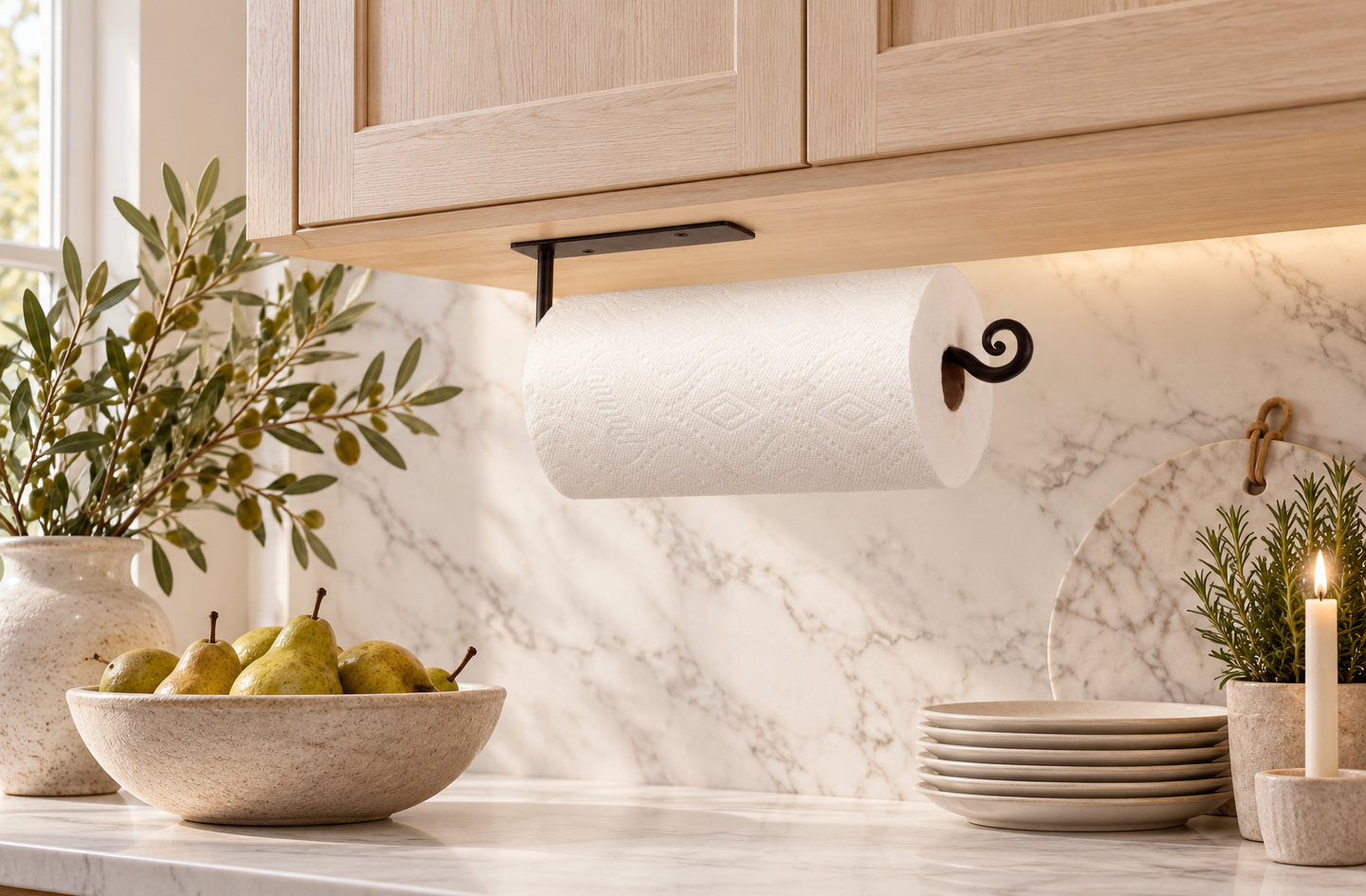
Under-cabinet holders
Measure from the cabinet bottom down to the center of the arm. That drop has to beat half the roll’s diameter, and the roll’s lowest point still has to clear anything standing on the counter. RTZEN lists its Under Cabinet holder for standard paper towel rolls, so measure before you load a jumbo or mega roll there.
Countertop stands
On a stand, the roll sits on the base and rotates around a vertical spindle. Confirm that the base is wide and heavy enough that the roll does not tip it during a one-handed tear. RTZEN’s Fancy Holder Stand takes standard and jumbo-sized rolls on its vertical spindle, with a decorative forged top that keeps the roll contained.
For a wall or under-cabinet mount, purchase for the standoff your largest roll requires. For a stand, purchase for spindle height and a steady base.
Step 6: Test-Fit a Complete New Roll Before You Commit
A test fit with a complete new roll is the only check that covers width, diameter, core and clearance at once. Do it before you drill, and again whenever you switch brands or roll names.
- Slide the full roll onto the arm or spindle and seat it fully.
- Hold the holder in its planned position, or tape a cardboard template there, and spin the roll through one full rotation.
- Pull and tear one sheet with one hand, and check that the roll rotates smoothly and stops without unrolling extra paper.
- Inspect the wall, the cabinet and the backsplash for rubbing marks.
- Swap in the next brand you plan to purchase and repeat.
If the roll rubs at full size, it will keep rubbing until the roll is partly used. Move the mount, choose a holder with more standoff, or switch to a stand.
One full-roll test before drilling saves a second set of holes, and it is the step that catches a mismatch the label figures cannot show.
Common Mistakes When Fitting Jumbo and Mega Rolls
Most fit problems with an oversized paper towel holder come from measuring the wrong roll or trusting the wrong number.
- Measuring a roll that is half used: it reads smaller than a new one, so the holder looks roomier than it is. Measure a sealed roll of the product you plan to purchase.
- Treating the roll name as a size: Double, Triple and Mega describe sheet multiples1, and the label gives no diameter. Compare measured rolls, not names.
- Measuring the wall arm from its top edge: the roll rotates around the arm’s center, so the standoff is measured to the center line.
- Forgetting the finial on a stand: a fixed top piece can stop a wider roll from dropping onto the spindle at all.
- Assuming one brand’s fit carries over: sheet counts change under the same roll name6, so test each new product.
What a Good Fit Looks Like in a Paper Towel Holder for Large Rolls
A good fit means a complete new roll slides on easily by hand, rotates freely, and tears with one hand without rubbing any surface. Use the checklist below with the measurements from Steps 1 to 5.
| What to check | Pass sign |
|---|---|
| Roll width against arm or spindle length | The roll sits between the end stops with a little side play |
| Outer diameter against standoff or drop | The arm center clears the wall or cabinet by more than the roll’s radius |
| Core against arm or spindle | The roll slides over every scroll, collar or knob by hand |
| Space below the roll | The full roll clears the counter, the backsplash and any switch or faucet |
| Tear test | One sheet tears with one hand and the roll stops cleanly |
The holder’s build matters once the roll fits, because a larger roll puts more weight on the arm every time someone tears a sheet. RTZEN holders are made in a four-step process: cut, hand-forge, zinc-galvanize and powder-coat, and each one is backed by the Lifetime Warranty.
If every row passes with a complete new roll, the holder takes that product. If one row fails, change the holder or the roll before you drill.
Frequently Asked Questions
Do mega rolls fit a standard paper towel holder?
Only when the holder clears the mega roll’s width, diameter and core. Bounty rates its Mega roll at 4x the sheets of its Regular roll1, and more paper makes a thicker roll unless it is wound tighter. Measure a complete new roll and compare it with the arm length and standoff.
How wide is a standard paper towel roll?
A 2006 U.S. patent describes conventional paper towels as invariably eleven inches wide2. Newer designs vary: a 2024 Procter and Gamble patent claims a large roll with a roll width of less than 10.0 inches3. Read the sheet dimensions on the label, because the sheet runs the full roll width.
What is the diameter of a jumbo paper towel roll?
No single figure applies, because roll names follow sheet count. In a 2024 patent, household rolls on the market typically showed roll diameters of 6.5 inches or less3. The same patent claims a roll diameter of at least 8.52 inches3. Measure the outer diameter of a complete new roll.
Are all paper towel rolls the same size?
No. Sheet counts differ by brand and change over time. Mouse Print reported Viva going from 94 sheets on the old double rolls to just 86 sheets7. Labels give total area, ply, count and sheet size4, so compare labels and measured rolls instead of names.
What size paper towel holder do I need for jumbo rolls?
Choose an arm longer than the roll is wide and thinner than the core, set far enough out to clear the full roll. For a roll diameter of 8.52 inches, the arm’s center requires 4.26 inches of standoff from the wall or cabinet3.
Limitations and Edge Cases
- The diameter figures come from two patents. The 6.5-inch figure is the typical upper bound for market rolls in a patent comparison. The 8.52-inch figure is a claimed design, not a measured retail product.
- The sheet-count changes cover single products reported between 2022 and 2026. They show that roll names do not fix a size, not how any one brand’s rolls measure today.
- RTZEN’s jumbo-roll statements come from its product descriptions. Coreless rolls and commercial dispenser rolls fall outside this guide; the Paper Towel Holders guide covers mount types more broadly.
References
Methodology: RTZEN compiled the roll, label and clearance figures in this article from two U.S. patents, the federal labeling rule, a paper towel maker’s roll-size guide, published sheet-count reporting and a cabinet-height guide, all read in October 2026, and calculated the standoff and counter-space figures from those inputs; Tsach Levy holds editorial responsibility.
- Bounty – Bounty Roll Sizes: A Simple Comparison, Procter and Gamble, updated May 28, 2026.
- Google Patents – US7048225B2, Narrow paper towel roll and holder, Nicholas A. Delfino, granted May 23, 2006.
- Google Patents – US11952724B2, Paper towel rolls, Procter and Gamble Co, inventors Michael Bills, Jeffrey Glen Sheehan and Paul Thomas Weisman, granted April 9, 2024.
- Electronic Code of Federal Regulations (eCFR) – 16 CFR 500.15, Units of count, more than one ply, Federal Trade Commission regulations under the Fair Packaging and Labeling Act.
- Bob Vila – Upper Cabinet Height for Kitchens, Solved!, Manasa Reddigari, updated October 5, 2020.
- LendingTree – 71% of Americans Have Noticed Shrinkflation, Here Are the Products and Categories That Shrunk the Most, Maggie Gunara, September 30, 2024.
- Mouse Print – Here We Shrink Again, Winter 2026, Part 1, Edgar Dworsky (MrConsumer), Consumer World, January 19, 2026.
- AARP – 7 Products That Are Impacted by Shrinkflation, December 2, 2022.
Conclusion
A roll name tells you how much paper you are buying, not whether the roll fits. Measure the width, the outer diameter of a complete new roll, the core and the clearance, then test-fit once before you drill. Every RTZEN holder is cut, hand-forged, zinc-galvanized and powder-coated, and backed by a Lifetime Warranty.
See the overview in the Paper Towel Holders guide for how roll fit sits beside mount type and placement.