
A hand towel ring has three measurements that matter before you drill: the internal diameter of the loop, the projection from the wall, and the clearance between the ring’s bottom and your countertop. Most residential rings run 6 to 7 inches in internal diameter, which is enough to loop a folded hand towel without the tail bunching at the counter.1 For a broader look at the options in this hardware category, see the overview in Hand Towel Holders: Everything You Need to Know. This guide focuses on how towel size, ring shape, and wall dimensions affect which ring actually works for your space.

Quick Answer
What size hand towel ring do you need?
Most hand towel rings have an internal diameter of 6 to 7 inches, sized for hand towels that measure 16 to 18 inches wide.2 Standard rings project 2.5 to 3 inches from the wall5 and typically center at 50 to 52 inches above the finished floor when paired with a standard 32-inch vanity.6 Ring shape (full circle, half-circle, or geometric) affects how the towel loads but does not change these core dimensions.
Key Takeaways
- Standard hand towel rings measure 6 to 7 inches in internal diameter, matched to hand towels that are 16 to 18 inches wide.
- Wall projection runs 2.5 to 3 inches, setting how far the towel hangs from the wall surface.
- The ring center normally sits 50 to 52 inches above the finished floor with a standard-height vanity, or 18 to 20 inches above the countertop.
- Full closed rings require passing the towel end-first through the opening; open and half-circle shapes let you slide the towel in from the side.
- Bath towels fold to 9 to 10 inches wide, wider than a standard ring opening. They belong on a bar, not a ring.
What Size Is a Standard Hand Towel Ring?
The internal diameter of the ring’s loop is the measurement that determines whether your towel will hang properly. Most wall-mounted hand towel rings have an internal diameter between 6 and 7 inches.1 That range is not arbitrary. It matches the way hand towels are actually used: folded once or twice lengthwise, then passed through the ring so the two halves hang evenly on either side.
Standard hand towels measure 16 to 18 inches wide and 28 to 30 inches long.2 A towel folded in thirds along its width produces a panel roughly 5.3 to 6 inches across. That panel fits comfortably through a 6-inch ring, with a 7-inch ring providing noticeably more room for thicker towels or for pulling the towel through quickly without bunching.
Why Diameter Range Varies by 1 Inch
The 1-inch spread between 6 and 7 inches covers two design choices. A 6-inch ring sits closer to the wall plate and reads as more compact on the wall. A 7-inch ring gives the towel more clearance as it hangs, which improves airflow and reduces contact with the ring’s inner edge when the towel is wet. For everyday residential bathrooms, either dimension works. For a guest bathroom where presentation matters and towel weight is lighter, the smaller 6-inch ring gives a tighter, more composed look.
The Measurement That Is Often Confused: Inner vs. Outer Diameter
Manufacturer specifications sometimes list the outer diameter of the ring frame, not the clear interior opening through which the towel passes. The outer dimension is typically 1 to 1.5 inches larger than the usable interior, depending on the thickness of the forged or cast frame. When comparing rings across brands, ask specifically for the clear interior diameter, not the overall outer size. A ring listed as “7.5 inches overall” may have an interior of only 6 inches if the frame is substantial. Hand-forged wrought iron rings tend to have thicker frame stock than stamped or hollow-metal rings, so the outer and inner measurements differ more noticeably.
How Towel Thickness Affects the Fit
Thin linen or waffle-weave hand towels thread through a 6-inch ring easily. Heavier terry towels, especially those with extra loops or a higher GSM (grams per square meter), can be noticeably stiffer when folded. With heavier towels, a 7-inch interior gives you practical room to adjust or redrape the towel without fighting the ring. The difference becomes most apparent when pulling the towel to straighten it after washing hands: a ring that is just barely wide enough will cause the towel to bunch at the fold rather than fall flat.
ASTM D5433 is the recognized US performance specification for household and institutional towel products, covering hand towels, bath towels, and washcloths.7 It defines performance characteristics, not retail dimensions, so the 16-to-18-inch width range for hand towels is an industry consensus figure derived from manufacturer standards rather than a mandated measurement. That consensus has been stable for decades, which is why ring diameter ranges have converged on the 6-to-7-inch band.
How Ring Shape Changes Daily Use
The shape of a hand towel ring affects three things: how you load the towel, how securely the towel stays in place during daily use, and what the ring looks like on the wall. The most common shapes are the full closed circle, the half-circle (also called the semicircle or open-top ring), and geometric forms such as triangles or asymmetric arcs.
Full Closed Circle: The Standard Shape
A full circle is the most familiar ring shape. The towel is threaded through the opening by folding it lengthwise, inserting one end through the loop, and pulling it halfway through so both ends hang at equal length. Because the ring is fully enclosed, the towel will not slide off the ring accidentally during use, even if someone tugs a corner while drying their hands. The tradeoff is that replacing a wet towel requires threading again, which takes a few extra seconds compared to an open shape. For a Towel Ring in a busy household bathroom, the security of a closed loop is usually worth that small step.
Half-Circle and Open Shapes: Faster to Load
A half-circle (open-top) ring has its flat edge at the top, with the curved arc below. The towel hangs over the open edge rather than through the loop. You drape it from above rather than threading it, which makes swapping towels take two seconds instead of ten. The towel is held in place by the curve at the bottom and its own weight. In most everyday situations, this is sufficient. If young children or a busy morning rush means the towel gets pulled from one end repeatedly, however, an open shape may let the towel slide sideways and bunch to one side more readily than a closed ring would.
The Half-Circle Ring in wrought iron translates this functional distinction into a visual one: the flat top edge reads as a clean horizontal line on the wall, while the arc below gives visual weight without the full circular footprint of a round ring. In modern and Scandinavian-inflected bathrooms, this shape often reads as more intentional than a standard circle.
Geometric Shapes: Triangle and Asymmetric Rings
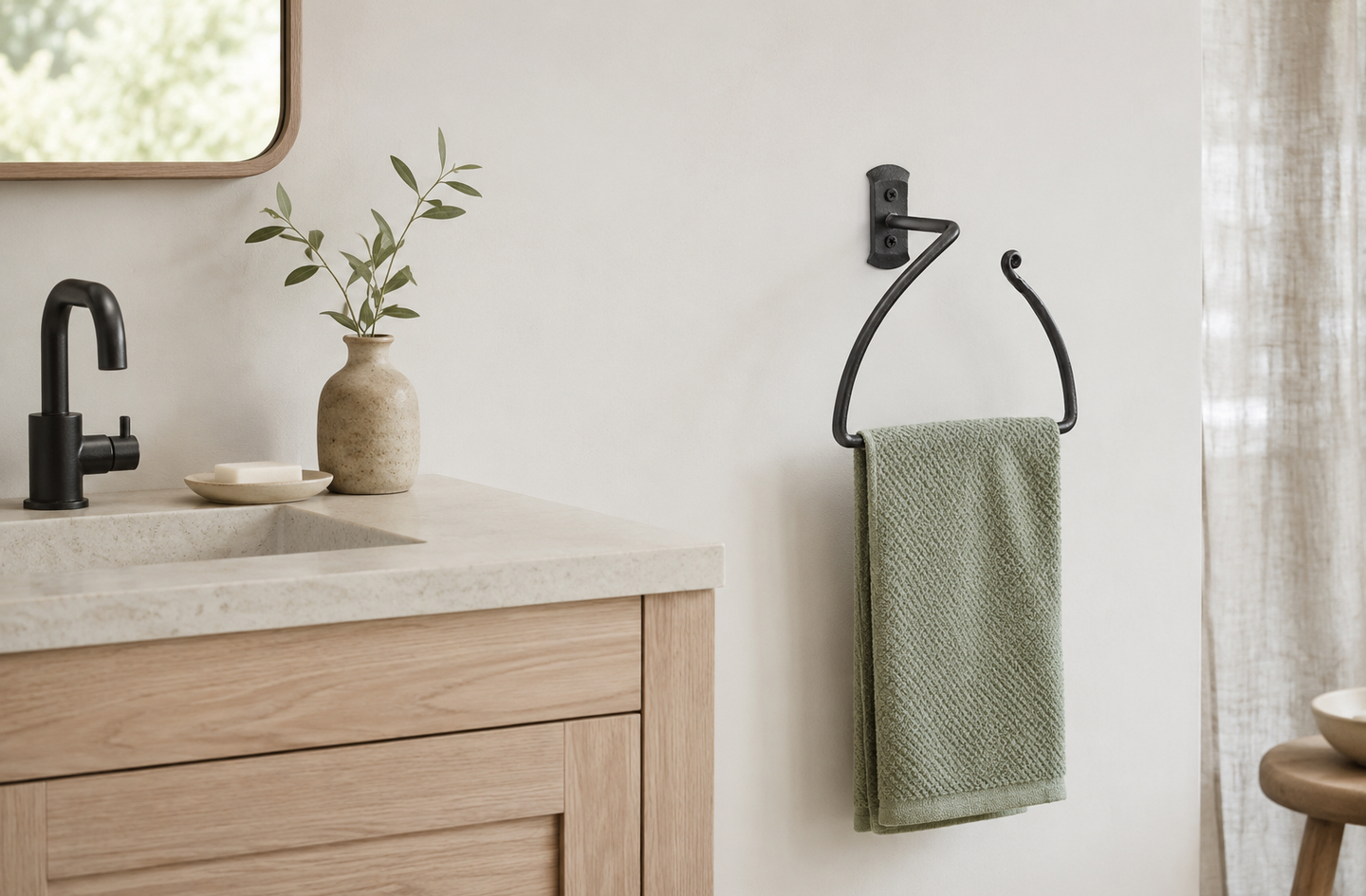
Triangle rings and other angular forms follow the same functional logic as the full closed circle: the towel threads through the interior opening. The difference is visual. A triangle brings straight lines to hardware that normally lives in curves. In a bathroom with square-edge mirrors, angular cabinet pulls, or linear tile grout, a geometric ring can tie the hardware together in a way a round ring would not.
The one practical consideration with triangular rings is the interior clearance. Because the towel passes through the diagonal of a triangle rather than a round opening, the effective loading area may be narrower in one direction than the stated dimension suggests. Confirm the clear interior opening before purchasing, not just the stated overall size. The Triangle Ring in hand-forged wrought iron has the same wall-mounting footprint as a round ring but gives the towel a distinctly different visual framing once hung.
Decorative Scrollwork and Projection from the Frame
Some rings incorporate decorative elements at the wall plate or along the frame: scrollwork, forged curves, or twisted iron details. These do not affect how the towel hangs, but they do affect one thing: how far the ring’s outermost decorative point projects from the wall relative to the ring loop itself. In a tight bathroom, a ring with substantial scrollwork on the wall plate can project further than a minimalist ring of the same stated dimension. If clearance next to a door, mirror, or outlet matters in your space, measure the total projection including any decorative element at the mounting plate, not just the loop depth.
Projection and Clearance: What the Numbers Mean
Wall projection describes how far the ring’s outermost point extends away from the wall surface. Most towel rings project 2.5 to 3 inches.5 This is a small number, but it sets the behavior of the towel when hanging. At 2.5 inches of projection, a towel of standard weight falls close to the wall and may brush the tile or paint when wet. At 3 inches, the towel hangs more freely, which improves airflow and reduces contact marks on the wall surface over time.
Clearance Above the Counter
The practical question is not just how far the ring projects, but how the ring’s position interacts with the vanity countertop. Industry guidance places a towel ring center 18 to 20 inches above the counter surface, measured from the top of the countertop to the center of the ring.6 With a standard 32-inch vanity, that puts the ring center at 50 to 52 inches above the finished floor.
The bottom of a standard hand towel, when folded once in half and hung through a ring, typically falls 7 to 9 inches below the ring center. At 50 inches of mounting height, the towel’s lowest point lands at 41 to 43 inches off the floor, well clear of the countertop. If the ring center drops to 46 or 47 inches, the bottom of a longer hand towel can end up touching or draping over the counter edge, which looks unintentional and means the towel wicks moisture from the counter surface.
ADA Reach Requirements for Accessible Bathrooms
The 2010 ADA Standards for Accessible Design, enforced under federal law, set reach-range requirements for elements in accessible bathrooms. The U.S. Access Board states:
“The high forward reach shall be 48 inches (1220 mm) maximum and the low forward reach shall be 15 inches (380 mm) minimum above the finish floor or ground.”3
U.S. Access Board, 2010 ADA Standards for Accessible Design, Section 308.2.1
For bathrooms where an accessible user reaches over a sink or vanity that projects more than 20 inches from the wall, the standard lowers the maximum further: the high forward reach is capped at 44 inches above the floor.3 Standard residential ring placement at 50 to 52 inches does not meet ADA reach requirements. In bathrooms designed or remodeled to meet ADA accessibility standards, the ring center must come down to 44 to 48 inches above the finished floor, depending on vanity depth.
Door Swing and Mirror Conflicts
Projection becomes relevant in a second way when wall space is shared with a door or medicine cabinet. A ring mounted directly in the arc of a swinging door will be struck as the door opens, eventually working the anchor screws loose. The simplest test is to swing the door fully open while standing in the space and marking its outer arc on the wall with painter’s tape before drilling. Mirror frames that project 1 to 2 inches from the wall surface can also catch the towel end of a ring mounted too close, causing the towel to deflect rather than hang straight. Leave at least 3 to 4 inches between the edge of any mirror frame and the nearest point of the ring loop.
How Much Wall Space Does a Hand Towel Ring Need?
A towel ring’s mounting plate is small: typically 2 to 4 inches wide. The ring loop extends from that plate. The total wall footprint, including the loop at its widest, rarely exceeds 7 to 8 inches across. That compact size is one reason rings suit small bathrooms better than bars: a bar needs 18 to 24 inches of unobstructed horizontal wall, while a ring needs a section roughly 8 inches wide and clear of outlets, switches, and tile borders.
IRC Lavatory Clearance and Its Effect on Ring Placement
The International Residential Code specifies a minimum clearance from a lavatory’s centerline to any side wall, partition, or vanity of 15 inches.4 For a typical 18-to-20-inch wide sink, that means the sink edge lands 6 to 7 inches from the wall (half the sink width, minus the 15-inch centerline clearance minimum). In practice, many bathroom layouts place sinks closer to walls than the NKBA’s recommended 20-inch centerline clearance, leaving only 5 to 8 inches of usable wall between the sink edge and the nearest wall corner. A towel ring placed in that gap needs to clear the sink apron and any faucet handles by at least 2 to 3 inches so the towel does not drag across the faucet when someone pulls it through the ring.
Recommended Horizontal Position: Beside the Sink, Not Behind It
The most functional position for a hand towel ring is on the wall beside the sink or vanity, within arm’s reach of the faucet. Reaching across or behind the sink to dry hands is awkward and leads to water dripping across the counter. The ring should be close enough that a person finishing at the sink can reach it without moving their feet: typically 6 to 14 inches from the faucet’s nearest edge. If the only available wall space puts the ring more than 18 inches from the faucet, a bar or hook on the side of the vanity cabinet can be a more practical alternative.
Outlet and Switch Clearance
Electrical boxes in bathrooms require a minimum clearance from plumbing fixtures under the National Electrical Code, but no code sets a minimum distance between a towel ring and an outlet. The practical concern is different: a towel ring placed directly above an outlet creates a scenario where the hanging towel can cover the outlet face. Beyond the inconvenience of reaching behind a towel to plug in a device, a damp hand towel resting against an outlet face in a moisture-prone environment is not a safe configuration. Leave at least 4 to 6 inches of vertical clearance between the bottom of a towel ring loop and the top of any outlet or switch plate on the same wall.
| Hardware Type | Typical Wall Width Needed | Typical Projection from Wall | Best Scenario |
|---|---|---|---|
| Hand towel ring (6-7″ dia.) | 7-8 inches | 2.5-3 inches | Narrow wall beside vanity; compact powder rooms |
| Short hand towel bar (12-18″) | 12-18 inches | 2-3 inches | Wall with 14+ inches of clear horizontal space |
| Single wall hook | 2-3 inches | 1.5-3 inches | Very tight spaces; towel folds over hook point |
Hand Towels vs. Bath Towels: Why the Hardware Differs
A hand towel and a bath towel look similar folded on a shelf. Hung on hardware, the size difference matters enough to require different hardware entirely. Standard bath towels measure 27 to 30 inches wide and 52 to 58 inches long.8 A hand towel measures 16 to 18 inches wide and 28 to 30 inches long.2 The width difference is the critical one for rings.
Why a Bath Towel Does Not Fit a Standard Ring
A bath towel folded in thirds along its width produces a panel 9 to 10 inches across. That is wider than the internal diameter of any standard hand towel ring, which tops out at 7 inches. Forcing a bath towel through a 6- or 7-inch ring requires folding it so tightly that the towel bulges out on both sides of the ring, blocking airflow and looking misshapen. The ring would also be under continuous lateral stress from the towel’s weight and daily use, which can work the wall anchors loose faster than the hardware was designed for.
Bath towels belong on a towel bar long enough to let the towel hang flat, or on a double-arm bar if drying time matters. The minimum practical bar length for a single bath towel is 18 inches; 24 inches allows the towel to spread open rather than fold. If you want a bar and a ring in the same bathroom without visual conflict, choosing both in the same finish and mounting hardware style keeps the hardware family coherent.
Washcloths and Smaller Guest Towels
On the smaller end, a washcloth typically measures 12 by 12 inches. It folds to 4 to 6 inches in one direction, which fits through a standard ring without any difficulty. Fingertip towels, sometimes used as folded guest towels in powder rooms, measure roughly 11 by 18 inches. These fold to a narrow panel and hang in a ring more like a decorative drape than a functional drying towel. If your intent is decorative guest presentation rather than daily use, the ring diameter matters less than the towel’s finished length once hung: a fingertip towel hanging through a ring should reach at least 6 to 8 inches below the ring center to look intentional rather than stubby.
What Makes Wrought Iron Ring Hardware Different from Standard-Weight Rings
Most mass-produced towel rings use thin stamped or hollow-tube metal for the ring loop. The frame stock is light, which keeps the external diameter close to the interior opening. Hand-forged wrought iron rings use thicker stock throughout: the rod that forms the ring loop is typically 5/16 to 3/8 of an inch in diameter, and the mounting plate is heavier. This means the outer diameter of a hand-forged ring runs noticeably larger than its interior opening. When a hand-forged ring states a 7-inch dimension, confirm which dimension that is. The four-step production process for RTZEN rings, which includes zinc galvanization and powder coating applied over solid forged iron, adds a small additional layer to the frame’s exterior. The interior opening is what matters for towel fit, not the overall stated size.
Frequently Asked Questions
What diameter should a hand towel ring be?
Most hand towel rings have an internal diameter of 6 to 7 inches, which suits hand towels in the standard 16-to-18-inch width range.1 A 6-inch opening works well for lighter linen or waffle-weave towels folded in thirds. A 7-inch opening provides more comfortable clearance for heavier terry towels and makes day-to-day adjustments easier.
How high should a hand towel ring be mounted?
The ring center typically sits 50 to 52 inches above the finished floor when paired with a standard 32-inch vanity, placing it 18 to 20 inches above the countertop.6 At that height, a folded hand towel clears the counter edge with room to spare. For ADA-accessible bathrooms, the mounting height must drop to 44 to 48 inches above the floor, depending on how far the vanity projects from the wall.3
Will a bath towel fit on a hand towel ring?
A standard bath towel measures 27 to 30 inches wide.8 Folded in thirds, it produces a panel 9 to 10 inches across, which is wider than the 6-to-7-inch opening of a hand towel ring. A bath towel will not hang properly on a ring and belongs on a towel bar at least 18 inches long. Washcloths, which measure roughly 12 by 12 inches, fit through a hand towel ring without difficulty.
How far should a towel ring project from the wall?
Standard towel rings project 2.5 to 3 inches from the wall surface.5 More projection lets the towel hang freely away from the wall, which improves airflow and reduces contact between a damp towel and painted or tiled surfaces. In a very compact bathroom, 2.5 inches of projection keeps the ring from interfering with movement near the vanity. In a larger space, 3 inches makes the towel easier to grab without brushing the wall.
How close to the sink should a hand towel ring be?
The ring should be close enough to reach from the faucet without moving your feet: generally 6 to 14 inches from the faucet’s nearest edge. The International Residential Code requires a minimum 15-inch clearance from a lavatory’s centerline to any side wall,4 which in practice leaves 5 to 8 inches of usable wall space beside a typical 18-to-20-inch sink. The ring must sit within that gap without the towel dragging across faucet handles.
Limitations and Edge Cases
- Dimensions in this guide reflect US residential standards. Metric markets (Europe, Australia) use towel sizes and ring specifications stated in centimeters; convert before ordering hardware from international suppliers.
- ADA reach-range requirements (Section 308) apply to spaces subject to the ADA and the Fair Housing Act. Residential single-family homes are not required to meet ADA standards, but ADA dimensions serve as useful accessibility benchmarks regardless of legal requirement.
- Ring projection figures (2.5 to 3 inches) represent typical finished hardware. Rings with substantial decorative elements at the wall plate can project further at their outermost decorative point. Confirm total projection from the wall before installing in tight spaces.
References
- Knobs.co – Towel Rings for Bathroom Vanities: 2026 Buying Guide, July 2026.
- TowelTrend – What Is the Standard Hand Towel Size?, 2024.
- U.S. Access Board via UpCodes – 2010 ADA Standards for Accessible Design, Section 308.2 Forward Reach (reproduced verbatim), currently enforced.
- Building Code Geek – IRC Bathroom Fixture Spacing Requirements, reporting IRC Section P2705.1, 2021 and 2024 editions.
- Liberty Hardware – How to Install Towel Racks, installer guide, 2024.
- Hunker – Installation Height for a Bathroom Towel Ring, citing NKBA planning guidelines.
- ASTM International – D5433 Standard Performance Specification for Towel Products for Institutional and Household Use, reaffirmed 2019.
- FL&B – Understanding Bath Towel Sizes, 2024.
Conclusion
The size, shape, and projection of a hand towel ring all determine whether it works day to day or just looks functional. A 6-to-7-inch internal diameter handles standard hand towels folded in thirds. A 2.5-to-3-inch wall projection keeps the towel clear of painted surfaces. Mounting the ring 18 to 20 inches above the counter puts it within reach without letting the towel drape onto the counter edge. Ring shape changes how you load the towel, but it does not change these core dimensions.
For context on how a ring fits within the broader family of hand towel hardware options, see the overview in Hand Towel Holders: Everything You Need to Know.