
Whether a ring or a bar works better for hand towels comes down mainly to wall space. A towel ring’s diameter runs up to 8 inches,2 making it the right fit for most compact vanity walls. A standard 18-inch bar needs at least 22 inches of clear wall once you account for mounting brackets and clearance on each end. The hand towel holders overview covers the broader hardware category. This article compares towel ring vs towel bar directly on wall footprint, drying airflow, reach from the sink, and the room layouts where each fixture performs best.
Quick Answer
Is a towel ring or a towel bar better for hand towels?
For most vanity walls with limited space beside the sink, a ring works better. It occupies roughly 8 inches of wall width, compared to 22 or more inches for an 18-inch bar.2 When your wall section runs 22 inches or longer without obstructions, a bar lets the towel hang fully open and dry faster, which matters where the towel sees heavy daily use.
Key Takeaways
- A towel ring needs roughly 8 inches of wall width; a standard 18-inch hand towel bar needs at least 22 inches, making the ring the better fit for most compact vanity walls.
- A bar holds the towel open across its full width, improving airflow and drying speed compared to the folded position a ring creates.
- Your available wall width beside the sink and how often the towel is used should drive the choice between a ring and a bar.
Quick Comparison: Towel Ring vs Towel Bar
A standard hand towel measures 16 to 18 inches wide and 28 to 30 inches long.1 Both a ring and a bar hold that size of towel, but they hold it differently and require very different amounts of wall space. The table below captures the key differences before the sections below explain each one.
| Category | Towel Ring | 18-in Hand Towel Bar |
|---|---|---|
| Wall footprint | ~8 in wide | ~22 in minimum |
| Best for | Tight vanity walls under 20 in | Walls 22 in or longer |
| Towel position | Folded through the ring | Draped open, full width |
| Airflow coverage | Partial (inner fold gets less air) | Full width exposed |
| Fixture size | 6-8 in diameter | 18 in nominal length |
| Wall projection | 2.5-3 in | 2.5-3 in |
| Fits a hand towel | Yes | Fits well |
| Installation difficulty | Easy | Equal effort |
| Overall winner | Compact spaces | Wider walls, high-use vanities |
The biggest practical gap between the two fixtures is wall footprint. Every other difference follows from that: the ring saves wall space but keeps the towel partly folded, while the bar takes more wall but lets the towel hang fully open. Both hold a hand towel well and cost roughly the same effort to install.
Wall Footprint: How Much Space Does Each Need?
The wall footprint is where rings and bars differ most. Before you buy, measure the clear wall beside your sink. A mismatch between the fixture you choose and the space you have is the most common reason a hand towel holder ends up in the wrong spot or conflicts with adjacent cabinet edges, outlet plates, or mirror frames.
Ring: Under 8 Inches of Wall Width
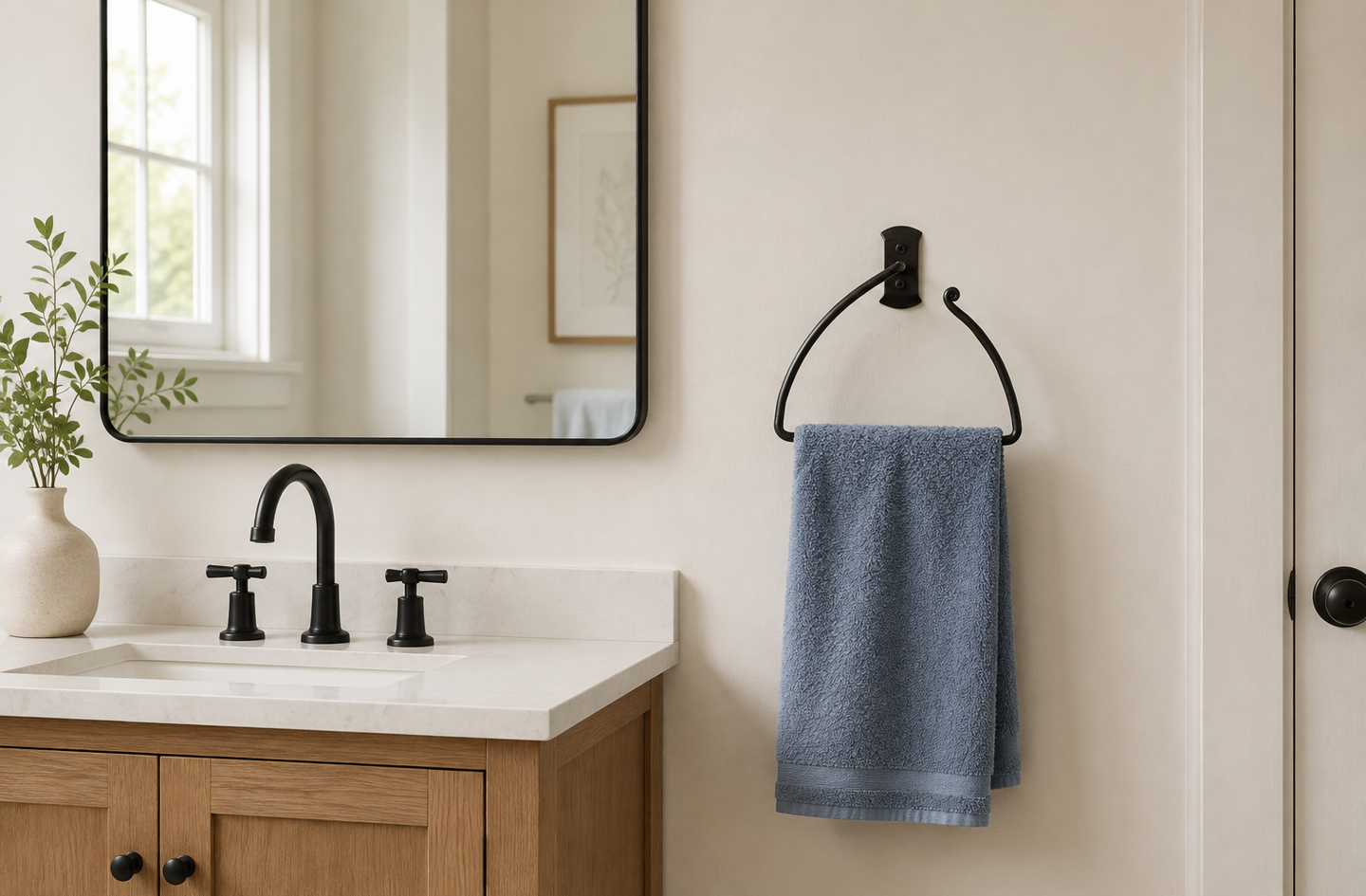
A towel ring sits within a circle. Most vanity rings run 6 to 7 inches in diameter, with a maximum of 8 inches.2 Add the backplate and the brackets that project the ring from the wall, and the total occupied width on the wall surface is roughly 8 to 9 inches. That fits almost any bathroom vanity. A 12-inch clear wall beside the sink is enough for a ring with several inches to spare on either side.
The ring’s wall mount is a single backplate, typically 2 to 4 inches wide at most. That footprint stays consistent regardless of the ring’s visual design: a round ring, a half-circle, a triangle, or a geometric shape all attach through the same size of backplate. The outer diameter of the ring is the number to check, and 8 inches is the practical ceiling for a wall-mounted hand towel ring.
Because the footprint is so compact, rings also tolerate walls with obstacles nearby. If an outlet plate sits 10 inches from the center of your planned ring location, the ring still fits without conflicts. A bar in the same spot would extend well into the clearance zone around that outlet.
Bar: 22 or More Inches of Clear Wall
Towel bars for hand towels come in nominal lengths of 18, 24, and 30 inches.2 An 18-inch bar is the shortest common option and the best fit for hand towels specifically. But the bar’s nominal length is not the only thing using wall space. You need mounting clearance at each end: at minimum 2 inches beyond each bracket to avoid conflict with adjacent fixtures, cabinet edges, or door trim. Bob Vila’s installation guidance recommends leaving 4 inches of clearance between a towel bar and any outlet or switch.2
That means an 18-inch bar needs a clear wall section that runs roughly 22 to 24 inches. Many bathroom walls beside a sink do not offer that. This is not a design flaw in bars as a category. It is a layout constraint that determines whether a bar is actually an option in your specific room. Before buying a bar, hold a measuring tape against your wall and check for interruptions: outlet plates, mirror frame edges, towel hook plates, door trim, and cabinet returns all reduce the available run.
If your clear wall measures 20 inches, the 18-inch bar technically fits in length, but the clearance on each side would be only about 1 inch. That may cause the bar ends to sit uncomfortably close to adjacent surfaces, and the towel itself will overhang the mounting brackets and brush the wall on each side. A ring in that same 20-inch section would sit centered with 6 inches of clearance on each side.
Verdict, wall footprint: The ring wins for compact spaces. A wall section under 20 inches calls for a ring. With 22 or more clear inches, a bar becomes a real option, and its advantages in drying and presentation come into play.
Towel Presentation and Airflow: Which Dries Faster?
How a towel hangs affects how fast it dries. How fast it dries affects how much bacterial growth occurs between uses. This matters more for hand towels than for bath towels, because a hand towel gets touched throughout the day. A bath towel generally dries between single daily uses. A hand towel near a frequently used sink may never fully dry between sessions.
How a Ring Holds a Hand Towel
A ring holds a towel by threading it through the center loop, so the towel folds over itself with two sides hanging below. The fold sits at the top of the ring, pressed against the ring’s inner diameter. On a ring with a 6-inch inside diameter, the fold spans roughly 6 inches across at the top, while the remaining fabric hangs in two layers below.
A standard hand towel is 16 to 18 inches wide.1 Folded through a 6-inch ring, only about 35% of the towel’s width is exposed at the top of the fold line, with the remaining fabric hanging in two overlapping layers. The inner surfaces of those layers receive less airflow than the outer faces. The towel dries from the outside in, and the folded core near the ring can stay damp longer than the hanging ends.
This is not a hygiene crisis in normal use. A hand towel aired in a reasonably ventilated bathroom still dries between uses in most homes. But in a poorly ventilated powder room or a small interior bathroom without a window, the inner fold can stay damp for hours, especially when the towel gets used repeatedly through the day.
How a Bar Holds a Hand Towel
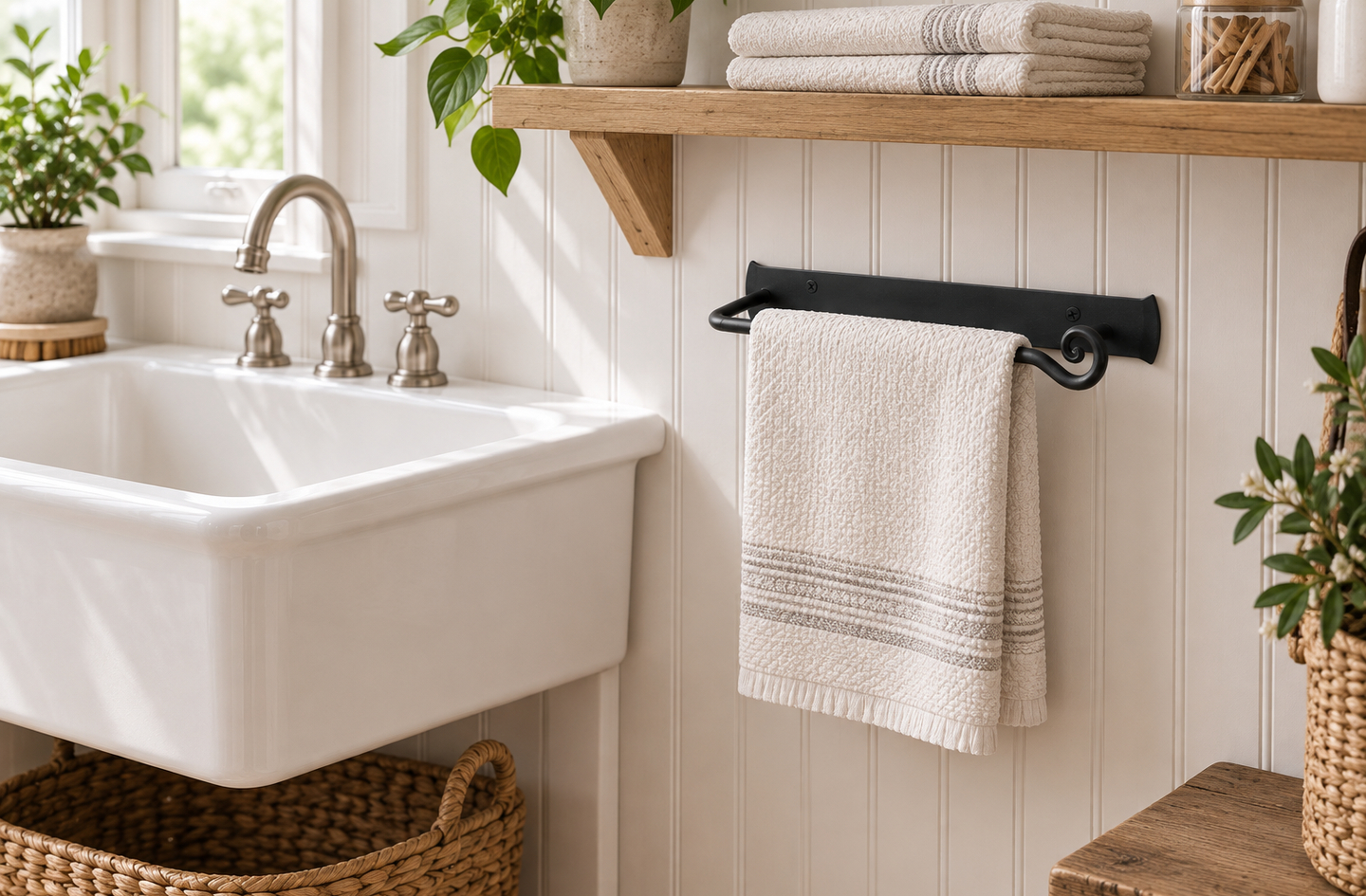
A bar holds a towel by draping it over the rod, with the towel folded over at the center and both halves hanging down in front and behind the bar. The full width of the towel lies across the bar, and both faces are exposed to the air. Airflow reaches every surface. The towel dries evenly from all sides, and the drying time is shorter than for the same towel on a ring.
Research on kitchen hand towels in daily use found that bacteria concentration on used towels ranged from 1.46 x 10⁴ to 6.1 x 10⁷ colony-forming units per gram, compared to just 675 CFU/g on an unused control towel.4 A study on kitchen towel microbiology by researchers at the University of Arizona found broader contamination still:
“Coliform bacteria were detected in 89.0% and E. coli in 25.6% of towels.”3
Charles P. Gerba et al., University of Arizona, Food Protection Trends, Vol. 34, No. 5, 20143
These figures come from kitchen hand towels, not bathroom towels, and the contamination reflects repeated handling over time rather than a single use. The principle transfers directionally: damp towels that stay folded dry more slowly, and slower drying gives bacteria more time to multiply on the fabric surface.
Verdict, airflow and drying: A bar holds the towel more open and dries it faster. For a powder room or guest bathroom where the towel is used infrequently and the space is well ventilated, a ring is fine. For a high-use main bathroom vanity where the towel stays damp through the day, a bar offers a clear functional advantage.
Reach and Placement Near the Sink
Both fixtures should place the towel where someone can reach it directly after washing their hands, without leaning, stepping sideways, or searching. That means mounting beside the sink, not above it, and within a comfortable arm’s length of the faucet. Both a ring and a bar can meet that standard, but the ring gives you more placement options when obstacles restrict the available wall space.
Placing a Ring Beside the Sink
A ring’s narrow footprint gives you more flexibility in choosing the exact mounting spot. Because the ring fits within 8 to 9 inches on the wall, you can position it close to the faucet without running into adjacent fixtures. The towel hangs centered on the ring, with the ends falling 8 to 12 inches below the ring center depending on how it is threaded. At a standard mounting height of 50 to 52 inches from the floor, the grab point sits near countertop height, which is where most people naturally reach after washing their hands.
A ring also clears obstacles more easily. Cabinet door hinges, decorative backsplash tiles, mirror frame edges, and towel hook plates all create narrow conflict zones on a bathroom wall. A ring’s 8-inch footprint fits between or beside many of these elements without requiring repositioning. This is why rings are common beside compact pedestal sinks, where the wall runs only a short distance before meeting a door, a mirror, or a cabinet corner.
Placing a Bar Beside the Sink
A bar requires a long, unobstructed wall section. Before mounting, check for cabinet edges, mirror frames, outlet boxes, door trim, and decorative hardware on both sides of the planned location. The 18-inch bar itself runs almost the full width between a sink column and an adjacent wall on many vanity layouts, leaving little room for the mounting brackets to clear the surrounding surfaces cleanly.
When a bar does fit, it mounts at the same height as a ring: 50 to 52 inches from the floor puts the towel at a natural grab height. One advantage of the bar at this position is that the towel spans the full 18 inches, so a person walking up to the sink can grab any part of it, not just the center hang point that a ring creates. The wider grab zone is useful in a family bathroom where several people use the same fixture throughout the day.
On walls where splash from the sink reaches 8 to 10 inches to the side of the faucet, placing a bar at the near end of its allowed run can leave part of the towel inside the splash zone. A ring’s compact width lets you position the towel just at the edge of the splash zone rather than starting inside it.
Verdict, reach and placement: Both fixtures work when properly placed. The ring gives you more wall positions to choose from, especially near compact sinks with constrained wall sections. The bar requires more planning before installation but delivers a wider grab zone on the towel once mounted.
When a Ring Works Better
A ring is the right fixture in three specific situations: a tight wall beside a compact sink, a powder room, and any wall layout where obstructions limit the available run.
Powder rooms make the clearest case for rings. A powder room is typically the smallest room in a house, with a vanity that sits close to the door, a mirror that extends toward the ceiling, and walls that offer 10 to 15 inches of free space on either side of the sink. An 18-inch bar does not fit in that space without conflicts. A ring mounts in 8 inches, leaves the rest of the wall clear, and keeps the hand towel within immediate reach of the faucet.
Kitchen walls near a sink are another natural fit for rings. The backsplash often runs between a window and a cabinet edge with only a short stretch of open wall. Cabinet door hinges project from the face frame, drawer pulls take up horizontal clearance, and the gap between the sink and the nearest cabinet can be 12 inches or less. A ring mounts in that gap without any of these conflicts.
Walls where a bar’s clearance would force the towel close to a mirror edge or an outlet plate also favor rings. Because the ring’s backplate is narrow and the ring itself projects only 2.5 to 3 inches from the wall, the fixture stays out of the way of the surfaces that surround it.
On the hardware side, RTZEN’s half-circle ring, hand-forged from solid wrought iron, mounts on the same compact backplate as a round ring and fits in the same tight spaces while presenting a different visual profile. The open semi-circle holds the towel slightly forward and creates a distinct silhouette compared to a full circle.
For a deeper look at ring dimensions and how different shapes fit specific wall sizes, the hand towel ring sizing guide covers inside diameter, projection, and shape options in more detail.
When a Bar Works Better
A bar wins when you have 22 or more clear inches of wall and want the towel to dry as fast as possible between uses.
Any bathroom with a wall section that long beside the sink can fit an 18-inch bar. In that scenario, the bar is the better default for a main bathroom or any vanity that sees heavy daily use. The towel hangs open across its full width, dries faster, and stays fresher. For a family with several people using the same hand towel before and after meals or throughout the morning routine, the faster drying time matters in a practical way.
Bars also work better when you want the towel to look its best. A hand towel draped over a bar presents its full width: the weave pattern, the color, and any decorative border are visible from the door. A ring folds the towel, which hides the pattern at the fold and creates a gathered look at the center. In a guest bathroom styled to make a specific impression, a bar displays a quality towel more clearly.
Thick towels benefit from a bar as well. A waffle-weave hand towel or a heavier Turkish cotton towel folded through a 6-inch ring can look bulky at the fold and can be harder to thread neatly each time someone replaces it. Draped over a bar, the same towel hangs flat and shows its texture across the full surface.
RTZEN’s classic bar is built from solid hand-forged wrought iron with a horizontal rod set out from the wall on scroll-detailed mounting brackets. The rod’s projection from the wall leaves airflow space behind the hanging towel as well as in front of it, which helps both sides of the towel dry evenly.
How to Match the Fixture to Your Bathroom
The decision comes down to two measurements and one habit. First, measure the clear wall beside your sink: the uninterrupted stretch free of outlets, hinges, mirror frames, and cabinet returns. Second, note whether the towel at that location will be used many times each day or just occasionally. Those two inputs resolve the choice for most bathrooms.
| Situation | Better fixture |
|---|---|
| Clear wall under 18 inches | Ring |
| Clear wall 22 inches or more | Bar |
| Powder room with compact vanity | Ring |
| Main bathroom, high daily use | Bar |
| Wall with outlets or hinges nearby | Ring |
| Display-focused guest bath, good wall space | Bar |
| Thick or waffle-weave hand towels | Bar |
| Standard cotton hand towels | Either |
If you have a powder room with a pedestal sink and 12 to 15 inches of clear wall beside the faucet, a ring is the right choice. Mount it 8 to 10 inches to the side of the faucet center, at 50 to 52 inches from the floor. RTZEN’s triangle ring, with its geometric wrought iron frame, fits this wall profile cleanly and suits farmhouse, modern, and industrial interiors without adding visual bulk to a small space.
If you have a main bathroom with a 36-inch-wide double vanity and 24 or more inches of clear wall on either side of the sink, an 18-inch bar suits both function and presentation. The towel dries faster and looks better. Mount the bar at 50 to 52 inches and position it so the center falls directly beside the faucet, not at the far end of the wall run.
If you have a kitchen sink flanked by cabinet doors on both sides, with 12 to 15 inches available between the cabinet edge and the window frame or adjacent appliance, a ring is almost always the right fit. Cabinet face frames, hinges, and drawer pulls reduce the effective clear run below what a bar needs, and a ring works in the space that remains.
Towel racks and rings together held a 42.5% share of the bathroom accessories market in 2024,6 reflecting how consistently these two fixture types meet the needs of a wide range of bathroom layouts. ASHRAE Standard 55 recommends indoor relative humidity between 30% and 60% for occupied spaces;5 keeping a hand towel in good drying position contributes to controlling moisture at the fixture level, though ventilation and room airflow are the larger factors in bathroom humidity.
Frequently Asked Questions
Is a towel ring or towel bar better for a small bathroom?
For a small bathroom or powder room, a ring fits better. Most rings have a diameter of 6 to 8 inches and fit in 8 to 9 inches of wall width, compared to the 22 or more inches an 18-inch bar requires.2 In a tight space beside a compact pedestal sink, that difference makes the ring the practical choice.
What size towel bar is right for hand towels?
An 18-inch bar is the standard size for hand towels. Standard hand towels measure 16 to 18 inches wide,1 and an 18-inch bar holds that width without leaving empty bar exposed. Twenty-four and 30-inch bars are options when the wall is longer, but they are sized for bath towels and create excess bar length for most hand towels.2
Can a hand towel ring hold a standard hand towel?
Yes. Standard hand towels measure 16 to 18 inches wide and 28 to 30 inches long.1 A ring with a 6 to 8 inch diameter holds the towel by threading it through the center loop. The towel hangs with both sides falling below the ring, keeping it accessible and tidy in a small amount of wall space.
How far from the sink should a hand towel holder be mounted?
Mount a hand towel holder 8 to 12 inches to the side of the sink at a height of 50 to 52 inches from the floor. This puts the towel within easy reach after washing hands without sitting inside the direct splash zone. Bob Vila recommends leaving at least 4 inches of clearance between any towel hardware and an outlet or switch.2
Does a hand towel dry faster on a bar than on a ring?
Yes. A bar holds the towel fully open across its width, exposing both faces to air. A ring folds the towel, which reduces airflow to the inner fold. Research on used kitchen hand towels found bacterial concentrations up to 6.1 x 10⁷ CFU per gram on used towels versus 675 CFU/g on an unused control,4 underscoring why faster drying matters.
Limitations and Edge Cases
- This comparison covers wall-mounted rings up to 8 inches in diameter and 18-inch hand towel bars. Twenty-four and 30-inch bars are alternatives on longer wall sections but are primarily sized for bath towels.
- The bacterial contamination data cited draws from kitchen hand towel studies (Gerba 2014, PMC 2025), not bathroom hand towels specifically. The directional finding transfers but the exposure context differs between kitchen and bathroom use.
- Double rings, swing-arm rings, and combined ring-and-hook designs are not included in this comparison.
References
- American Soft Linen – “What Size Is a Hand Towel? Standard Hand Towel Dimensions Explained.” Evergreen product guide.
- Bob Vila – “Solved! The Perfect Height for Towel Bars and Hooks.” Installation guidance covering ring diameter, bar lengths, and clearance requirements.
- University of Arizona – Gerba CP, Tamimi AH, Maxwell S, et al. “Bacterial Occurrence in Kitchen Hand Towels.” Food Protection Trends, Vol. 34, No. 5, 2014.
- National Library of Medicine – “Biofilm Compositions and Bacterial Diversity on Kitchen Towels in Daily Use.” Microorganisms, January 2025. PMC11767729.
- IndoorHumidity.com – “Recommended Indoor Humidity Levels: EPA, CDC & ASHRAE.” Covers ASHRAE Standard 55 guidance on occupied-space humidity ranges.
- Market.us – “Bathroom Accessories Market Size, Share.” 2024 market analysis, product segment data.
Conclusion
For most compact vanity walls with less than 20 inches of clear space beside the sink, a ring is the right choice: it mounts in 8 inches, clears nearby outlets and hardware without conflicts, and holds a hand towel neatly within reach. When your wall section runs 22 or more clear inches and the vanity sees heavy daily use, a bar earns its place by letting the towel spread open and dry faster.
For a broader look at hand towel hardware options across different room types and mounting situations, see the hand towel holders overview for more context on how rings, bars, and hooks each fit the spaces they serve best.