
A hand towel holder is any wall-mounted fitting that suspends a hand towel within reach of a sink. The three main formats are the ring, the short bar, and the hook. Each one affects daily reach, towel clearance from the counter, and how the cloth dries between uses. Standard hand towels are typically 16 inches wide, which means the holder’s inner diameter or bar length has to accommodate that width without bunching the fabric. This guide covers types, placement, installation, style, and care in full.
Quick Answer
What is a Hand Towel Holder?
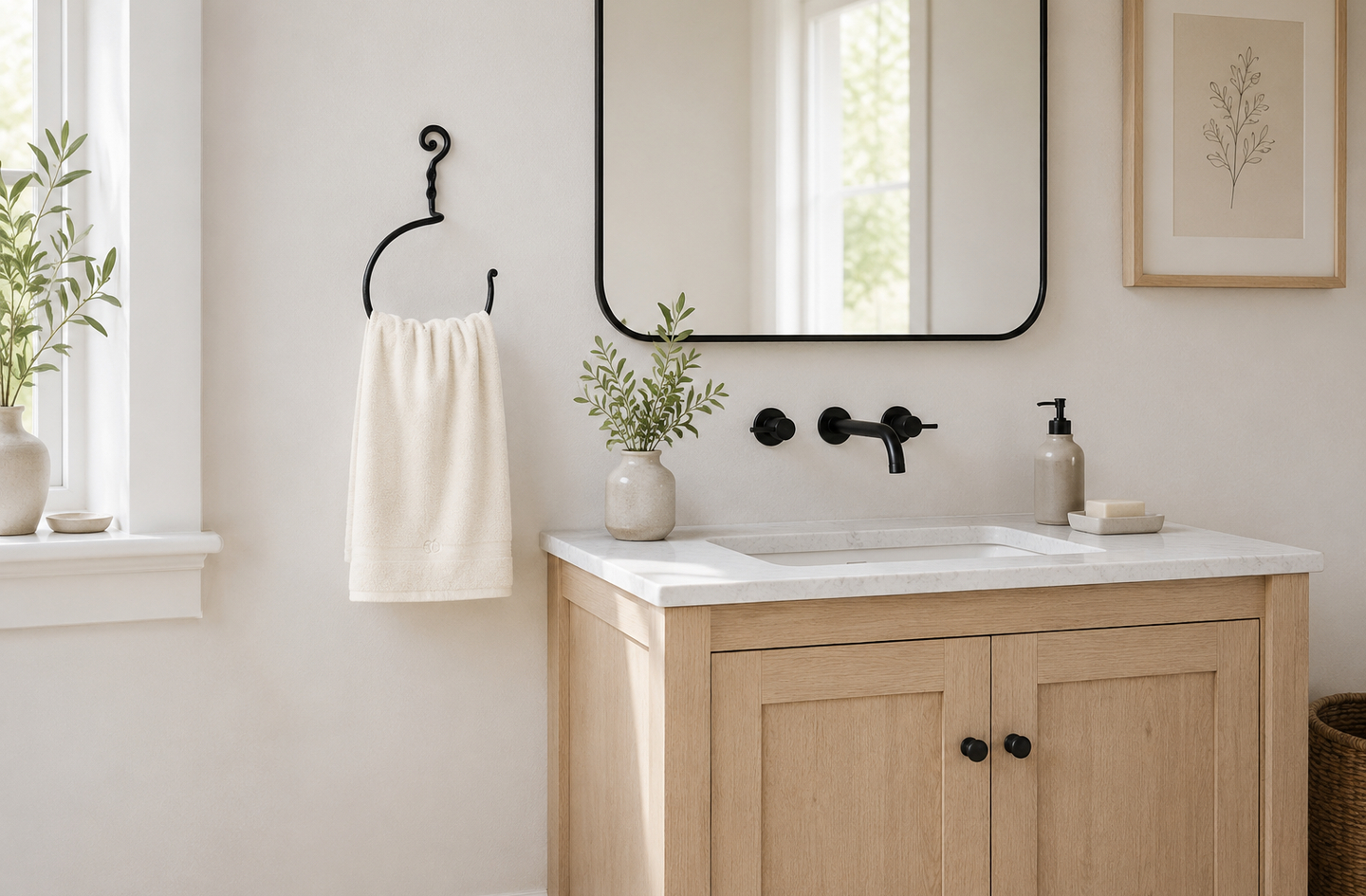
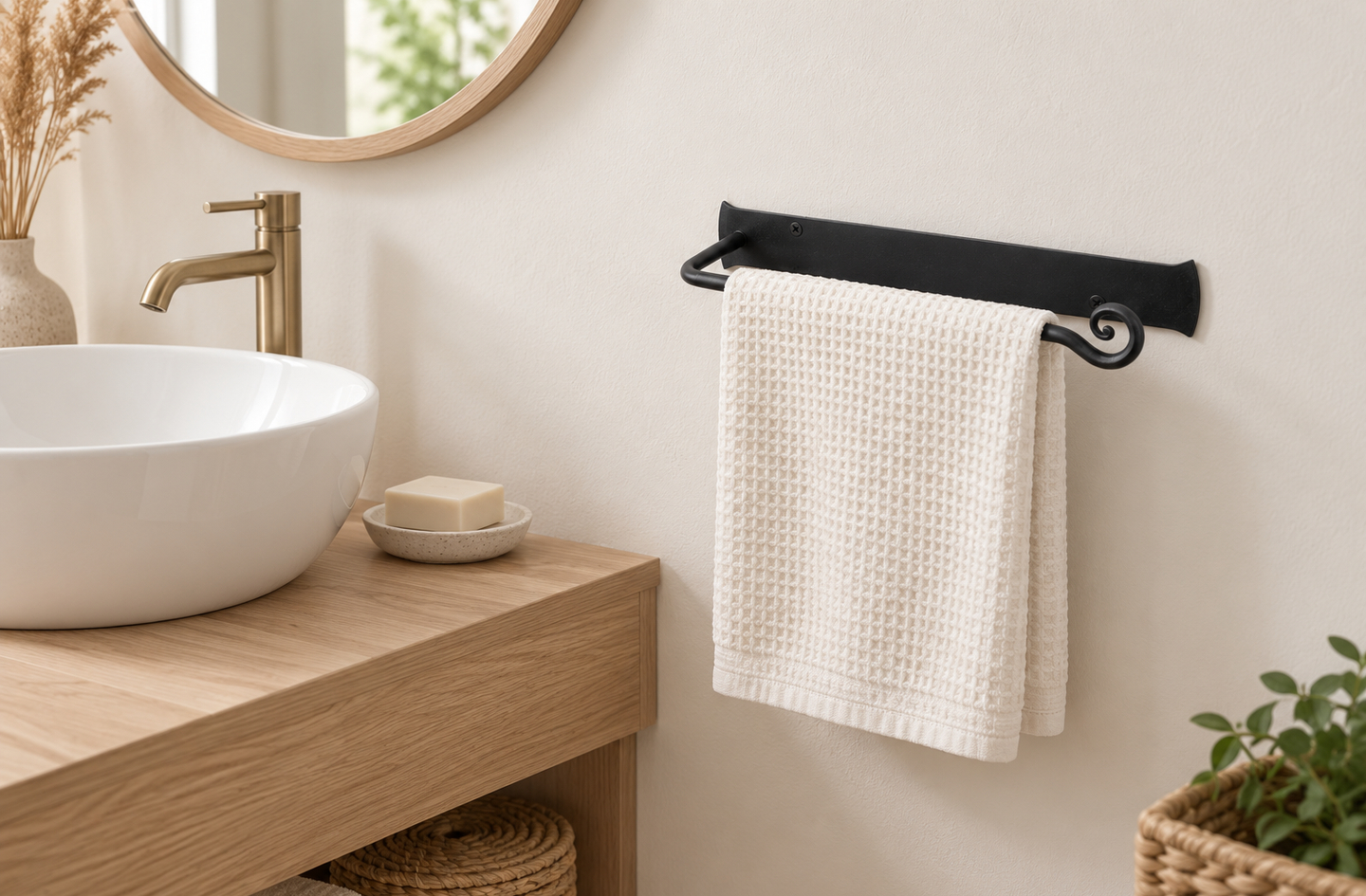
A wall-mounted fitting that keeps a hand towel within reach of a sink. The ring suspends the towel from a loop around 6 to 8 inches in inner diameter. The short bar holds the towel between two brackets, typically 12 to 16 inches long. The hook projects from the wall as a single point. Ring holders are most common in bathrooms; bars are standard in kitchens where a spread-flat towel matters.
Why it matters:
CDC data shows that handwashing reduces respiratory illness rates by 16 to 21%.1 A towel holder placed too far from the sink or at an awkward height disrupts the hand-drying step that completes the routine.
Key Takeaways
- Hand towel holders come in three formats, ring, short bar, and hook, each with a different wall footprint and towel presentation.
- Ring inner diameter matters: a ring smaller than 6 inches bunches most standard hand towels rather than spreading them.
- Placement height and horizontal distance from the sink determine daily reach and splash exposure more than holder format alone.
- Wrought iron holders finished with zinc galvanization beneath powder coating resist bathroom humidity without surface rust.
Hand Towel Holders in 30 Seconds
| If you are… | Do this |
|---|---|
| Installing in a small bathroom with limited wall space | Choose a compact ring mounted 4 to 6 inches above the counter on the dominant-hand side of the sink. |
| Setting up a powder room for guests | Mount a ring or short bar at roughly 48 inches from the floor, beside the vanity where it is visible from the sink. |
| Placing a holder near a kitchen work zone | Use a short bar or hook at least 12 inches from the sink basin edge, clear of cabinet hinges and appliance handles. |
| Matching dark or matte hardware in a bathroom | Choose a dark wrought iron ring or bar to coordinate with faucets, drawer pulls, and mirror frames. |
| Fixing a ring that wobbles or spins in place | Tighten the set screw under the ring body first; if the wall anchor pulled loose, refasten into a stud or replace with a larger anchor. |
What Is a Hand Towel Holder?
A hand towel holder is a wall-mounted fitting designed to suspend a hand towel within arm’s reach of a sink. The category includes three main formats. The ring is a closed or open loop mounted on a single wall plate, with an inner opening the towel threads through or drapes over. The short bar spans 10 to 18 inches between two wall brackets, letting the towel hang spread flat. The hook is a single wall projection the towel folds over, with the smallest footprint of the three.
The category covers hand-size towels (roughly 16 by 28 to 16 by 30 inches) mounted near bathroom vanities, kitchen sinks, powder rooms, laundry areas, and any other regular handwashing point in the home. It does not include full-size bath towel bars (typically 24 inches and longer), paper towel roll holders, or freestanding countertop towel stands.
Wrought iron holders built with a zinc-galvanized base coat and powder-coat top layer are well suited to the humidity cycle in bathrooms. Chrome, brushed nickel, brass, and matte black finishes are also available in the broader market. The holder’s wall footprint (the area of wall covered by its mounting plate or plates) determines whether it works in a tight space.
Why Hand Towel Holders Matter
Regular handwashing is one of the most documented hygiene behaviors for reducing illness. CDC research shows that proper handwashing reduces respiratory illness, including colds, in the general population by 16 to 21%1 and diarrheal illness by 23 to 40%.1 Despite this, only 19% of people worldwide wash hands after using the toilet.1 Accessible drying materials placed near the sink are part of the infrastructure that supports the habit.
Three common problems come from a poorly chosen or poorly placed holder:
- The towel ends up on the floor or counter because the holder is the wrong format or too far from the sink.
- The holder sits in the faucet splash zone, leaving a wet towel between uses.
- The hardware clashes with the room’s faucets or drawer pulls, making the bathroom feel unfinished rather than considered.
The World Health Organization identifies access to hand-drying materials near the sink as a required component of proper hand hygiene infrastructure.3 Getting the holder right is a small decision with a measurable daily payoff.
The 5-Part Hand Towel Holder Framework
A hand towel holder decision covers five interconnected factors: format type, placement location, style and finish, installation method, and ongoing care. These five dimensions together account for every question in the category. The subsections below teach each dimension and route to the deeper guides for each specific question.
1. Type and Format
The choice of ring, bar, or hook determines how the towel hangs, how easy it is to grab with wet hands, and how much wall area the fitting needs. A ring takes roughly 4 to 6 inches of wall width and holds the towel in a centered loop from a single mounting plate. A short bar needs 12 to 18 inches of clear wall between its two end brackets and lets the towel spread fully flat. A hook needs as little as 2 to 3 inches and mounts on a single point, holding the towel in a compressed fold.
Within the ring format, two sub-decisions apply. The ring’s inner diameter determines whether the towel spreads or bunches: most standard hand towels need at least 6 inches of inner diameter to hang without puckering at the center. The ring’s form (open versus closed) changes how the towel loads onto the ring and whether it can slide off during daily use.
Deeper read: Hand Towel Ring Guide: Size, Shape and Everyday Fit.
Deeper read: Towel Ring Size Guide: Diameter, Projection and Towel Clearance.
Deeper read: Open vs Closed Towel Ring: Which Design Should You Choose?
Deeper read: Towel Ring vs Towel Bar for Hand Towels.
Deeper read: Towel Ring vs Towel Hook: Space, Drying and Daily Convenience.
2. Placement and Location
Placement has two variables: height from the floor or counter, and horizontal distance from the sink basin. The standard bathroom approach puts the center of a towel ring or bar 4 to 6 inches above the counter surface, high enough to clear splash drip while staying within reach. A holder mounted too high requires an awkward upward reach with wet hands; too low and the towel sits in the faucet splash zone.
Horizontal position follows reach logic. The holder goes on the dominant-hand side of the sink, within roughly 12 inches of the basin edge. Placing it behind the faucet or directly in front of the mirror forces the user to reach across the plumbing or interfere with the reflection. Different room types apply different constraints: a powder room has minimal wall area, making the ring beside the vanity the priority; a kitchen requires clearance from cabinet handles and appliance doors.
The U.S. Access Board recommends mounting fixtures within an accessible reach range for all users, including those who cannot stand, a standard that also guides household placement choices for multi-user homes.2
Deeper read: Hand Towel Ring Height: Floor, Counter and Vanity Measurements.
Deeper read: Bathroom Towel Ring Placement: Sink Reach, Splash Zones and Clearance.
Deeper read: Powder Room Hand Towel Holders: Guest-Friendly Placement and Style.
Deeper read: Small Bathroom Hand Towel Holders: Best Wall-Mounted Options.
Deeper read: Kitchen Hand Towel Holders: Placement Near Sinks and Work Zones.
Deeper read: Where to Hang a Hand Towel Holder Around the Home.
3. Style and Finish
The material and finish determine both appearance and longevity in a moisture-prone room. A wrought iron holder produced through a four-step process (cut, hand-forged, zinc-galvanized, powder-coated) resists the daily humidity cycle through a dual-layer finish that needs nothing beyond routine wiping. The finish color ties the holder to the room’s other hardware: dark or near-matte iron reads naturally beside matte black or oil-rubbed bronze faucets; a white powder-coated ring pairs with chrome or brushed nickel.
Decorative ring profiles carry visual weight. A scroll or geometric ring in a farmhouse or vintage bathroom looks considered; the same ring in a minimal modern bathroom can overpower a simple space. Matching the ring’s visual character to the room’s existing hardware style prevents the holder from reading as an afterthought.
Deeper read: Decorative Towel Rings: Choosing a Style That Still Works Daily.
Deeper read: Wrought Iron Towel Rings: What Quality Looks Like.
Deeper read: Black Towel Rings: Matching Finish, Wall Color and Hardware.
4. Installation and Mounting
Most hand towel rings mount at two screw points, either through a single back plate with two holes or two separate wall plates spaced apart. The critical installation decision is wall construction and anchor selection. Drywall requires a plastic toggle or metal expansion anchor unless the screw hits a stud directly. Tile needs a masonry bit and tile-rated anchor. Concrete and brick need a hammer-drill bit and masonry anchors rated for the load.
After mounting, the towel hangs most neatly when threaded lengthwise through the ring and folded once forward so the hemmed ends center on the ring face. A ring that wobbles or spins after installation usually traces to a loose set screw under the ring body or to a failed wall anchor, two distinct problems with different repair paths.
Deeper read: How to Install a Hand Towel Ring Securely.
Deeper read: How to Hang a Hand Towel on a Towel Ring Neatly.
Deeper read: Loose Towel Ring: How to Diagnose and Fix the Mount.
5. Care and Maintenance
A zinc-galvanized and powder-coated wrought iron holder needs routine wiping with a damp cloth and drying afterward. Abrasive scrubbers, chlorine-based cleaners, and standing water pooling at the mounting plate damage the powder-coat layer over time. The CDC recommends 20 seconds of handwashing1 per use, which puts the holder in daily contact with moisture. Any finish flaking or rust appearing at the mounting screws early in the product’s life signals a workmanship issue, not normal wear, and falls under a manufacturer warranty rather than DIY repair.
Deeper read: How to Clean a Wrought Iron Towel Ring and Protect the Finish.
How to Choose the Right Hand Towel Holder
The single most important decision criterion is available wall space. The wall area beside the sink, not personal preference, sets the upper limit on holder size. Once that is confirmed, the remaining decisions follow in order.
- Measure the clear wall beside the sink. Identify the clean wall section between the sink edge, cabinet edge, door swing, and any electrical outlets. A section under 6 inches wide supports only a compact ring. A section 12 inches or wider opens up short-bar options.
- Confirm the towel size. Standard hand towels run about 16 inches wide. A ring with an inner diameter of 6 inches or more accommodates that width without bunching the towel at the center fold. A bar of 12 inches or more lets the towel spread fully.
- Choose the format for the room context. Rings are standard in bathrooms because they fit on tight wall sections and keep the towel centered. Bars suit kitchens where the towel needs to spread flat for drying. Hooks suit spaces where loading speed matters more than towel presentation.
- Pull the finish from existing hardware. Check faucet finish, cabinet pull finish, and mirror frame finish before selecting the holder. A dark iron ring beside a chrome faucet reads as a mismatch; the same ring beside a matte black faucet reads as intentional.
- Confirm wall construction before ordering anchors. Drywall, plaster over lath, tile over drywall, and solid masonry each require a different anchor. Running a stud finder across the intended mounting zone before buying confirms whether a simple wood-screw mount is possible or an anchor is required.
Bathroom design guidelines recommend positioning towel holders within comfortable reach of the basin and on the same side as the dominant hand.4
Compare All Hand Towel Holder Types
| Criteria | Ring | Short Bar | Hook |
|---|---|---|---|
| Wall footprint | 4 to 6 in. wide | 12 to 18 in. wide | 2 to 3 in. wide |
| Towel loading | Thread or drape through loop | Fold over top of bar | Fold over single point |
| Towel spread | Moderate (looped at center) | Full flat spread | Compressed fold |
| Drying airflow | Both sides exposed | Both sides exposed | Compressed, slower to dry |
| Projection from wall | 2 to 4 in. | 3 to 5 in. | 2 to 4 in. |
| Best room context | Bathroom vanity, powder room | Kitchen, wide wall beside sink | Compact space, quick-grab use |
Choose a ring if: the clear wall section beside the sink is under 8 inches wide or the bathroom look calls for compact, single-plate hardware.
Choose a short bar if: the wall allows 12 or more inches of clear space and the towel needs to spread flat, as in a kitchen beside a sink used for dish towels and hand towels alike.
Choose a hook if: the available wall space is too narrow for a ring back plate, or the priority is speed of loading rather than neat presentation.
Deeper read: Towel Ring vs Towel Bar for Hand Towels.
Deeper read: Towel Ring vs Towel Hook.
Common Mistakes
Mistake 1: Mounting too close to the faucet splash zone
Why it is a mistake: A ring or bar placed directly beside or below the faucet head sits in the area where water drips off hands during rinsing. The towel absorbs splash water between uses and stays damp, which defeats the point of a separate hand towel and shortens the towel’s usable period between washes.
What to do instead: Position the holder at least 4 inches above the counter surface and to the side of the faucet, not in front of it. If the only available wall space is in the splash zone, choose a short bar that keeps the towel higher off the counter and allows faster drying between uses.
Read more: Bathroom Towel Ring Placement: Sink Reach, Splash Zones and Clearance.
Mistake 2: Choosing a ring with an inner diameter smaller than the towel width
Why it is a mistake: A ring with an inner diameter under 6 inches bunches a standard 16-inch-wide hand towel at the center fold. The towel looks crumpled rather than draped, and the compressed fabric takes longer to dry between uses.
What to do instead: Confirm the ring’s inner diameter before purchasing. A 6- to 8-inch inner diameter accommodates most standard hand towels without bunching. If the available wall section is tight, a half-circle or open-ring profile with a 6-inch opening fits in less horizontal space than a full round ring while still clearing the towel width.
Read more: Towel Ring Size Guide: Diameter, Projection and Towel Clearance.
Mistake 3: Centering the holder directly above the counter
Why it is a mistake: A holder mounted above the counter center, rather than to the side of the sink, forces the user to reach across the faucet or the basin with wet hands. Water drips across the counter during the reach, and the towel is harder to grab single-handed.
What to do instead: Mount the holder on the dominant-hand side of the sink, within 12 inches horizontally of the basin edge. This allows a natural side-reach for drying without clearing the faucet or the mirror area.
Read more: Hand Towel Ring Height: Floor, Counter and Vanity Measurements.
Mistake 4: Using the wrong anchor for the wall type
Why it is a mistake: A standard drywall anchor in a tile-over-drywall wall, or a plastic anchor in a plaster wall, pulls out under the repeated lateral stress of daily towel use. The holder wobbles within days of installation and leaves enlarged screw holes that are harder to repair than the original holes would have been.
What to do instead: Identify the wall construction before drilling. Tile over drywall requires a tile-rated bit and a masonry-appropriate anchor. Plaster over lath supports a wood screw into the lath or a toggle bolt for heavier loads. Using the correct anchor from the start prevents most loose-holder problems.
Read more: How to Install a Hand Towel Ring Securely.
Mistake 5: Ignoring cabinet and appliance clearance in the kitchen
Why it is a mistake: Kitchen installations often place the holder too close to a cabinet hinge edge or an appliance handle. The holder then interferes with the cabinet door swing or forces the user to reach around an obstruction for the towel.
What to do instead: Mark the intended mounting location and swing every adjacent door and drawer before drilling. Leave a minimum of 2 to 3 inches of clearance between the holder’s mounting plate edge and the nearest hinge or handle. If no clear side-wall section exists beside the sink, a side-of-island or side-of-cabinet mount can work instead.
Read more: Kitchen Hand Towel Holders: Placement Near Sinks and Work Zones.
Best Hand Towel Holders by Use Case
Best for a Powder Room
A compact ring suits a powder room best. Wall space is limited, and the ring’s single-plate mount fits between the vanity edge and the corner without dominating the wall. A decorative or forged iron ring in a finish that matches the faucet adds visual detail to a small room where guests notice every fixture. Placement beside the vanity at eye level matters more here than in a private bathroom.
Deeper read: Powder Room Hand Towel Holders: Guest-Friendly Placement and Style.
Best for a Kitchen Beside the Sink
A short bar works well in a kitchen because it lets the towel spread flat between uses, which is especially useful when the same towel handles both hands and dishes. The bar needs a clear 12-inch section of wall away from cabinet hinges and appliance handles. A dark iron bar beside a farmhouse sink or a modern kitchen with black hardware reads as intentional rather than functional hardware left on the wall.
Deeper read: Kitchen Hand Towel Holders: Placement Near Sinks and Work Zones.
Best for a Small Bathroom
A tight bathroom rewards the ring’s compact footprint. A ring mounted on the side of the vanity cabinet, if no clear side wall exists, avoids reducing the walking path further. The ring’s single back plate takes up less visual space than a two-bracket bar and keeps the towel within reach without crowding the sink area.
Deeper read: Small Bathroom Hand Towel Holders: Best Wall-Mounted Options.
Best for a Farmhouse or Rustic Interior
A wrought iron ring with scroll detailing or a short bar with hammer-nail brackets fits naturally into a farmhouse, rustic, or vintage interior. The hand-forged iron texture and matte dark finish carry the visual character the room already has without adding a separate decorative object to the wall. The holder becomes part of the hardware story rather than a utility fixture.
Deeper read: Decorative Towel Rings: Choosing a Style That Still Works Daily.
Best for a High-Traffic Family Bathroom
A closed-ring design in a heavily used bathroom prevents the towel from sliding off during fast, repeated use. A closed ring holds the towel in place without relying on a careful fold from the user. Iron with a durable powder-coat finish handles daily moisture exposure without maintenance beyond wiping.
Deeper read: Open vs Closed Towel Ring: Which Design Should You Choose?
Frequently Asked Questions
What height should a hand towel holder be mounted?
Standard practice places the holder center 4 to 6 inches above the counter, keeping the towel clear of faucet drip while staying within reach. When there is no counter reference, 48 inches from the floor is the common residential standard and aligns with U.S. Access Board accessible reach range guidance.2
How far from the sink should a hand towel ring be placed?
The ring goes on the dominant-hand side of the sink, within roughly 12 inches of the basin edge. Closer is better: a ring beyond 16 inches requires reaching over the faucet or counter edge with wet hands, which drips water across the surface rather than moving it to the towel.
What is the difference between an open and a closed towel ring?
A closed ring is a complete loop; the towel must be threaded through before mounting or removed to change. An open ring has a gap, so the towel slides on without threading. Closed rings hold the towel more securely. Open rings load faster but can let the towel slip off during quick grabs.
Can a hand towel ring be mounted on tile?
Yes. Tile installation requires a carbide-tipped masonry bit at low speed to drill through the tile face without cracking it. The anchor must be rated for tile and drywall, not drywall alone. Pre-marking the drill point with tape prevents bit slip. Allow any silicone-sealed anchor to cure before loading the ring.
How do I stop a wrought iron towel ring from rusting?
A zinc-galvanized and powder-coated ring does not require rust prevention under normal indoor use. Wipe with a damp cloth and dry afterward. Avoid chlorine-based cleaners and abrasive pads, which damage the finish layer. Surface rust appearing early is typically a finish defect rather than normal wear and is covered by most manufacturer warranties.
What This Hub Does Not Cover
- Full-size bath towel bars (24 inches and longer) are a separate category with different wall-spacing and projection requirements; this guide covers hand-size towels only.
- Paper towel roll holders are a distinct product type with their own mounting formats and roll-size considerations; see dedicated paper towel holder resources for those decisions.
- Multi-hook racks and coat-hook systems share some wall-mounting principles but address a different use case than single-towel hand holders.
- Commercial and workplace installations are governed by OSHA sanitation regulations (29 CFR 1910.141), which specify different requirements than residential practice.5 This guide addresses residential contexts only.
References
- CDC – Clean Hands: Show Me the Science, handwashing effectiveness statistics including respiratory illness reduction rates, diarrheal illness reduction, and global handwashing rates
- U.S. Access Board – 2010 ADA Standards for Accessible Design, Section 308 Reach Ranges, accessible mounting height guidance for wall-mounted fixtures
- World Health Organization – Hand Hygiene fact sheet, evidence for hand-drying materials as a component of proper hand hygiene infrastructure
- National Kitchen and Bath Association – NKBA Kitchen and Bathroom Planning Guidelines, towel holder placement recommendations relative to the sink basin
- OSHA – Personal Hygiene Practices (29 CFR 1910.141), sanitation and hand-drying requirements for commercial workplace facilities
Next Read
Choosing the right hand towel holder starts with the wall space available beside the sink and the format that fits it. A ring suits compact bathroom vanities; a short bar suits kitchens and wider walls; a hook suits the smallest spaces. Once the format and placement are confirmed, finish selection and installation are direct decisions that tie the holder to the rest of the room’s hardware.