
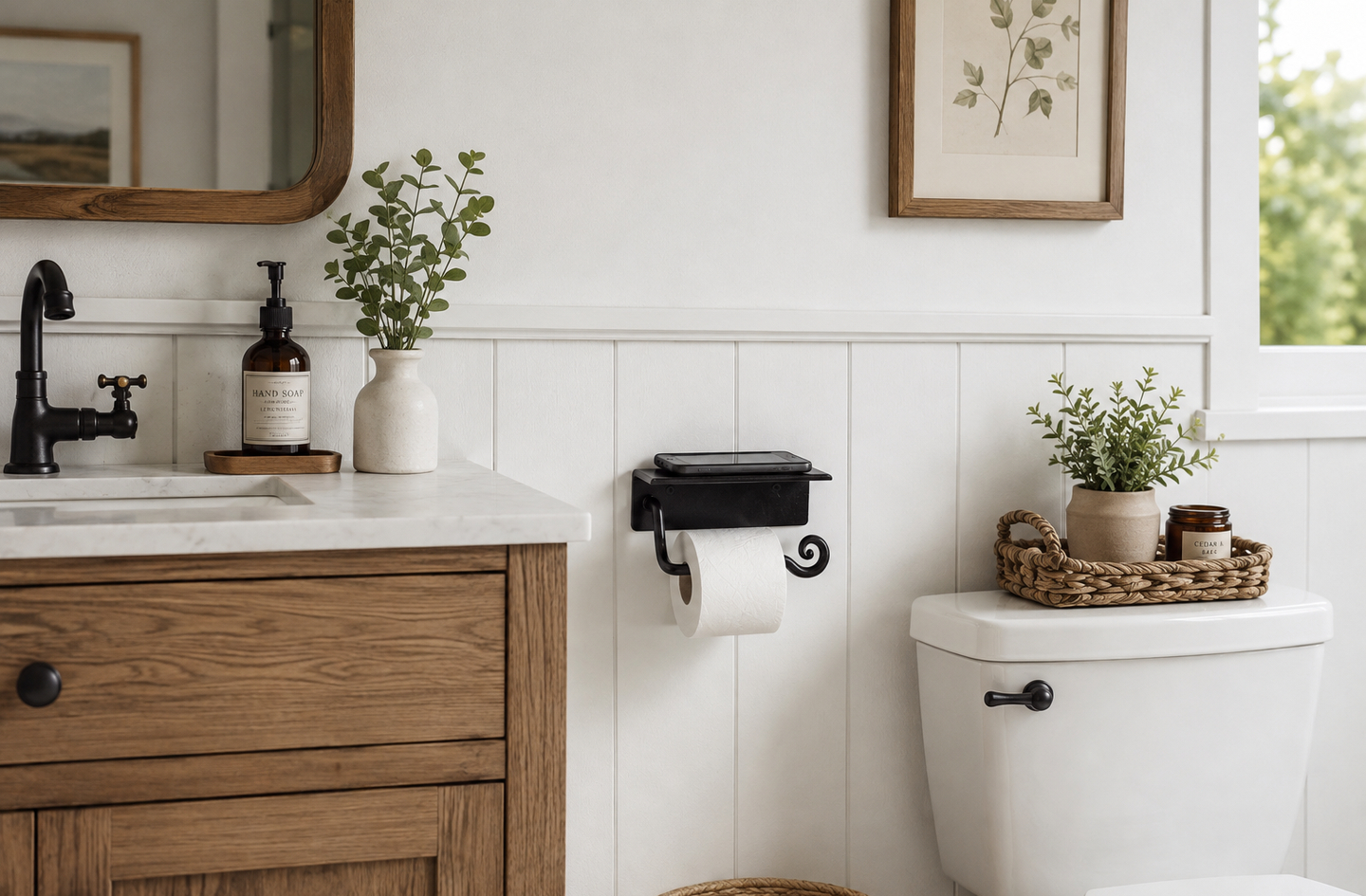
A toilet paper holder with shelf gives you one wall mount that holds the roll and adds a small flat surface for a phone, spray bottle, or candle. For context on how shelf-style designs compare to standard wall mounts, see the toilet paper holders overview. Three in four Americans admit to using their phone in the bathroom according to a survey reported by CBS News,1 which makes a dedicated surface at arm’s reach genuinely useful. Whether that shelf earns its wall space comes down to a few measurable factors: shelf dimensions, roll clearance, how well the holder mounts, and whether your bathroom has room for the additional wall depth.
Quick Answer
When is a toilet paper holder with shelf worth adding to your bathroom?
When you will actually use the surface. Shelves on these holders typically run about 5 inches deep, which fits a smartphone in portrait orientation (average flagship width 2.7 to 2.9 inches)2 as well as a small spray bottle or candle. The main trade-offs are reduced vertical clearance for larger rolls, slightly more cleaning effort, and the need for a sturdier anchor since the shelf extends the holder’s load farther from the wall.
Key Takeaways
- A shelf on a wall-mounted holder typically measures about 5 inches deep, enough for a smartphone in portrait mode, a small spray bottle, or a candle, but not a spare roll of toilet paper.
- Mega rolls (outer diameter up to 6 inches) need extra vertical clearance below the shelf; standard rolls (outer diameter 4.5 to 5 inches) fit under most shelf designs without issue.
- The shelf adds leverage on the mounting bracket, so a stud mount or toggle anchor is the right call; a basic plastic expansion plug is marginal for this amount of cantilevered load.
- In bathrooms under 40 square feet, a wall-mounted shelf holder often frees vanity counter space by keeping everyday items on the wall where they are already needed.
What a Toilet Paper Holder With Shelf Adds to Your Wall Mount
A shelf-equipped toilet paper holder does two things from one wall location: it holds the roll on an open arm and provides a flat raised surface, typically positioned directly above the arm. The shelf itself is usually a flat plate, sized to hold small everyday items and finished to match the rest of the hardware. The functional difference from a standard holder is surface area. A basic wall mount puts the roll on the wall and nothing else. A shelf holder keeps the roll in the same position but adds a horizontal surface at roughly the height where you would naturally set a phone or a small bottle.
The surface is compact by design. Most shelves on these holders are rectangular, running 5 to 7 inches wide and 4 to 6 inches deep. That is large enough for a phone or a candle but not large enough for a magazine or a full-size spray can. Understanding what fits, and what does not, is the starting point for deciding whether the design works for your specific bathroom.
Single-Roll vs Double-Roll Shelf Designs
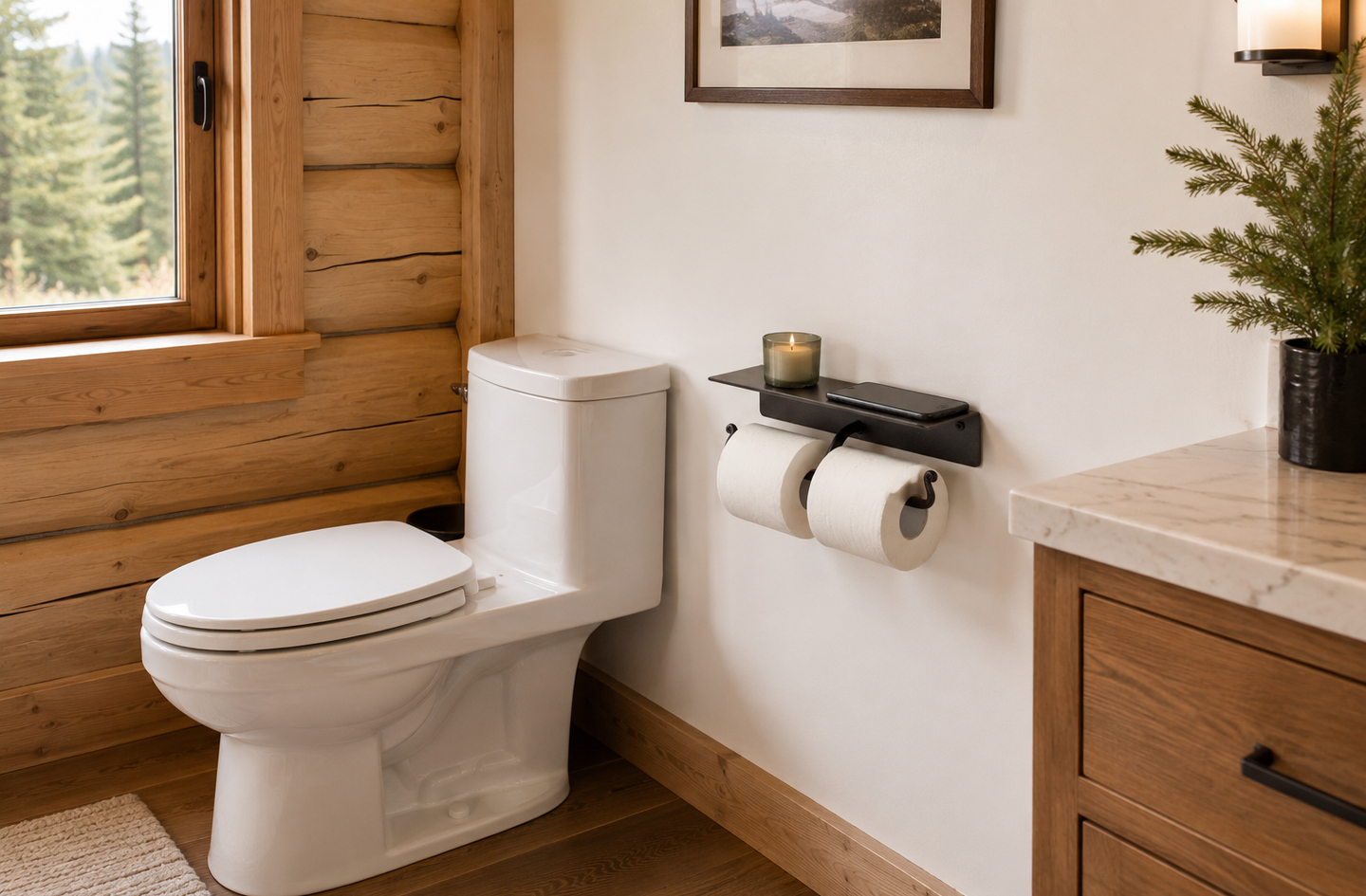
Two shelf variants cover most buyers. The single-roll version holds one standard roll on an open arm below the shelf. The double-roll version holds two rolls side by side, which adds wall width but keeps the same shelf above. The shelf dimensions are similar between the two because the shelf’s purpose is the same regardless of how many rolls sit beneath it.
The RTZEN single-roll shelf holder is made from solid wrought iron with a dual-layer zinc galvanization plus powder coating finish that resists rust through bathroom humidity cycles. The double shelf holder adds a second dispensing arm and the same integrated shelf, useful in high-use bathrooms where running out between roll changes is a recurring problem. Both are hand-forged through a four-step process: cut, hand-forge, zinc-galvanize, powder-coat. That process produces a surface smooth enough to wipe clean and a finish that holds without flaking over the lifetime of the piece, backed by a catalog-wide Lifetime Warranty.
What the Shelf Is Not
The shelf is not a storage platform. It holds items you reach for often, not items you are keeping in reserve. If you need a location that holds several spare rolls or a group of small bottles, a freestanding stand with a vertical storage pole serves that job better. The wall-mounted shelf holder works best when one or two small items stay on it consistently, not when it becomes a catch-all surface.
The shelf is also not weather-resistant at the finish level of a fully outdoor piece, though a properly finished wrought iron shelf handles bathroom humidity without problems. The zinc-galvanized plus powder-coated finish is specifically built for damp interior environments. What changes that calculation is sustained water contact, such as direct shower spray. Mount the holder where it gets ambient bathroom humidity, not where the shower can reach it.
Pros and Cons at a Glance
| Pros | Cons |
|---|---|
| Keeps phone, spray bottle, or candle within arm’s reach at toilet height | Shelf reduces vertical clearance for mega rolls (outer diameter 5.5-6 inches) |
| Frees vanity counter space in compact bathrooms | Flat surface needs regular wiping to stay clear of dust and aerosol residue |
| Wall-mounted, so no floor footprint unlike a freestanding stand | Requires a sturdier wall anchor than a standard single-arm holder |
| Solid wrought iron resists bathroom humidity with proper finish | Projects 1-2 inches further from the wall than a comparable arm-only holder |
| Lifetime Warranty covers material and workmanship defects under normal use | Not suited for storing spare rolls; that requires a freestanding or double holder |
How Well Does a Phone Fit on the Shelf?
Most people who buy a shelf holder have a phone in mind. The math works in their favor. Modern smartphones average 2.5 to 2.9 inches wide in portrait orientation,2 well inside the 5-inch depth of a typical shelf. A survey reported by CBS News found that three in four Americans admit to using their phone in the bathroom,1 which means the phone-shelf use case is not niche. It is the default for most households.
Portrait vs Landscape Orientation
In portrait orientation, a phone 2.7 to 2.9 inches wide sits flat on a 5-inch shelf with roughly 2 to 2.3 inches of clearance on either side. That gives the shelf a stable, uncluttered feel. A small phone with a case stays well within the boundary.
Landscape orientation is a different story. Average smartphone height (which becomes the horizontal length in landscape) runs 5.8 to 6.4 inches.2 On a 5-inch-deep shelf, a phone in landscape extends past the shelf edge by 0.8 to 1.4 inches. The phone stays put in most cases because it rests on the back of the case, but it is not fully supported. Portrait is the natural position for most people in this context.
What Else Fits: Spray Bottles, Candles, and Reed Diffusers
A standard travel-size spray bottle runs about 2 to 2.5 inches in diameter at its widest point. It sits on the shelf with room to spare. Tea light candles are 1.5 inches in diameter and fit easily. Slim reed diffuser bottles are typically 1.5 to 2 inches wide at the base and also clear the shelf edges without difficulty. A small hand soap pump with a base of 2 to 3 inches fits on most shelves.
What does not fit: a full-size aerosol can (typically 2.5 to 3 inches in diameter but too tall at 7 to 10 inches to sit safely on the shelf without risk of tipping), a spare toilet paper roll (4.5 to 5 inches in outer diameter, which approaches the shelf depth and cannot be efficiently retrieved in that position), or anything with a footprint wider than 4 inches. The shelf is a convenience surface, not a storage shelf.
Roll Clearance: What the Shelf Does to Arm Geometry
The shelf sits above the roll arm. The gap between the top of a loaded roll and the bottom of the shelf is the clearance measurement that matters. Too little clearance and the roll binds against the shelf, making it hard to spin freely and difficult to tear a sheet cleanly. This is the one technical check that buyers most often skip, and it is the most common reason a shelf holder creates friction in daily use.
Standard Rolls: No Problem Under Most Shelf Designs
Standard toilet paper rolls have an outer diameter of 4.5 to 5 inches.4 With the spindle at the holder’s arm centerline, the top of a standard roll sits roughly 2.25 to 2.5 inches above the spindle center. Most shelf-equipped holders are designed with 3 to 4 inches of clearance between the arm centerline and the underside of the shelf. Standard rolls clear this gap without binding. You pull the paper, the roll spins, and the shelf is above it without interference.
The wall projection also matters. The roll must spin freely not just below the shelf but away from the wall behind it. Standard arm lengths on wall-mounted holders project 3.5 to 4.5 inches from the wall surface, which gives a standard roll a few millimeters of clearance from the tiles or drywall. That measurement stays the same whether or not a shelf is present above.
Mega and Double Rolls: Measure Before You Buy
Mega rolls push the outer diameter to 5.5 to 6 inches,3 which puts the top of the roll 2.75 to 3 inches above the spindle center. If your holder’s shelf sits only 2.5 to 3 inches above the arm centerline, a mega roll will press against the shelf bottom and resist spinning. The result is a roll that tears unevenly or jams on each pull.
The practical test before mounting: hold a tape measure from the arm centerline upward to where the shelf will sit. If that distance is at least 3.5 inches, a mega roll clears cleanly. If it is closer to 3 inches, stick to standard rolls with this holder. For a full look at how mounting height affects both clearance and reach from the seat, the toilet paper placement guide covers the vertical and horizontal positioning rules in detail.
Mounting Stability When the Shelf Adds Weight and Reach
A shelf holder puts more torque on the mounting bracket than a simple arm. The shelf acts as a horizontal extension from the wall, and any weight placed on it multiplies the pull on the screws. Standard toilet paper holders mount at about 26 inches above the floor,8 placing the arm and its load at a height where a small torque on the bracket translates directly to stress on the screws. A phone weighs 6 to 8 ounces. Set that on a shelf 5 inches from the wall and it creates a lever arm that applies continuous low-level stress to the mounting hardware. Over months, that stress works a poor anchor loose even without anyone grabbing the holder itself.
Why Shelf Holders Need Better Anchors
In drywall without a stud, a toggle bolt or Molly bolt is the correct fastener. A plastic expansion plug alone is marginal for a standard holder and genuinely insufficient for a shelf holder. Plastic plugs expand laterally against the drywall paper, which compresses over time under cyclic loading. The plug gradually backs out. A toggle bolt spreads the load across a wide metal wing on the backside of the drywall, which does not compress.
Into a stud, standard wood screws of the correct length (at least 1.25 inches into the stud face) anchor the holder firmly with no risk of pull-through. Most bathroom walls place studs at 16-inch centers. Finding one on your chosen wall position is worth the effort for this type of holder.
On tile, drilling the pilot hole is the critical step. A carbide-tipped tile bit at slow speed with light pressure prevents cracking. Once through the tile and into the substrate, use an anchor rated for the substrate material (hollow wall anchor for drywall substrate, concrete anchor for a masonry substrate).
The Wrought Iron Advantage: Solid Construction, No Flex
The bracket plate on a solid wrought iron holder resists bending at the wall-contact point. When someone grabs the shelf or leans on the arm while pulling paper, the load transfers to the screws without the bracket deforming. A hollow stamped metal bracket flexes slightly under that same load, working the anchor loose over time even if the initial installation was correct.
Solid iron also adds self-dampening mass. A roll of toilet paper pulled quickly introduces a small rotational impulse to the arm. On a heavy wrought iron holder, that impulse dissipates through the material’s mass. On a lightweight bracket, the holder vibrates slightly with each pull, which cycles the anchor in and out of its hole over thousands of uses. The difference compounds over years. Solid iron, finished with the four-step process that seals the surface against corrosion, does not change its structural properties as the bathroom environment cycles through humid and dry conditions. The mounting stays tight.
Cleaning Access Around a Shelf-Style Holder
The shelf adds a horizontal surface that collects dust, aerosol residue from sprays used nearby, and occasional water splash. How much cleaning effort it requires depends more on the shelf’s surface design than on its size.
The Shelf Surface Itself
A flat, smooth shelf wipes clean in one pass. A damp cloth takes 10 to 15 seconds to clear the top surface. The powder-coated iron finish on a wrought iron shelf has a slight texture that holds surface residue more than polished chrome does, but it is still fast to clean with any standard bathroom wipe or a soft damp cloth.
Ornate scroll or lattice edges on the shelf perimeter trap dust in the corners. Budget an extra 20 to 30 seconds per week if the shelf has decorative edges rather than straight ones. The RTZEN shelf holders use a clean flat shelf with scroll accents on the arm below, not on the shelf surface itself, which keeps the cleaning surface simple. Avoid abrasive scrubbers on any powder-coated iron surface. They dull the finish over time without improving the clean.
Under the Shelf and Around the Arm
The underside of the shelf and the arm below it collect dust in the joint where the shelf meets its vertical support. This is a once-a-month area rather than a weekly one. A soft brush or a dry cloth folded to fit the gap clears it quickly. The open design of a wrought iron arm does not trap significant buildup because there are no closed corners or flat hidden surfaces along the arm length.
The bracket face at the wall picks up a thin line of dust in the seam between the mounting plate and the tile or drywall. A cotton swab runs along that seam cleanly. Aerosol products used frequently in the same bathroom, such as air freshener or dry shampoo, leave a thin oily film that builds up faster on the underside of the shelf than on any other surface. If the holder is in a bathroom where aerosols are used daily, a weekly wipe of the shelf underside prevents residue from becoming sticky and harder to remove.
Fitting a Shelf Holder Into a Compact Bathroom
Small bathrooms leave very little counter space. A full bath at the lower end of typical residential sizes runs 36 to 40 square feet, and a powder room typically ranges from 20 to 30 square feet.6 In rooms that size, the vanity counter holds a soap dispenser and has little room left. Moving a phone and a small spray bottle to the toilet paper holder shelf takes those items off the counter entirely, which matters when the counter is 18 to 24 inches wide.
The Wall-Mount Advantage in Small Rooms
A wall-mounted shelf holder takes no floor space, unlike a freestanding stand, and no counter space, unlike a tray or basket set on the vanity. That makes it the most space-efficient option for keeping a few items within reach of the toilet. In a powder room, this is particularly useful because the toilet and the vanity compete for the same narrow space, and every item moved to the wall is an item off the counter or the tank lid.
The scale of the bathroom accessories market reflects just how much attention homeowners pay to every square inch of wall and counter space. As Metatech Insights reported in their 2024 market analysis:
“The Bathroom Accessories market accounted for USD 25.6 Billion in 2024 and is expected to reach USD 47.1 Billion by 2035, growing at a CAGR of around 5.7% between 2025 and 2035.”5
Metatech Insights, market research firm
Shelf-equipped holders sit within that broader category as a practical combination of dispenser and surface in one wall location, appealing to buyers who want function without adding footprint.
When a Shelf Holder Gets in the Way
The minimum toilet side clearance under the International Residential Code is 15 inches from the toilet centerline to any side wall or fixture.7 In bathrooms built to that minimum, the wall beside the toilet is 15 inches from the bowl center. A holder that projects 4 to 5 inches from that wall will be close to the toilet seat edge. Items placed on the shelf in that position can be knocked off during normal use, and the shelf itself may feel intrusive rather than useful.
If you are working with 15 to 17 inches of side clearance, consider mounting the holder on the wall in front of the toilet (at the standard 8 to 12 inch forward position from the bowl) rather than the side wall. The forward-mount position keeps the holder accessible without putting the shelf directly beside the seat. If forward mounting is not possible because of the door swing or vanity, a standard arm-only holder may be the better fit for that specific layout.
Who Gets the Most Out of a Shelf Holder?
The shelf adds real value in specific situations. It is not universally better than a standard holder, but for the right bathroom and the right user, it solves a genuine problem.
Strong Fit
The shelf holder earns its place when you currently set your phone on the tank lid, the floor, or the vanity counter across the bathroom. Moving it to a surface at the right height and the right location changes a friction point into a non-issue. It also fits well when your bathroom has 40 square feet or less and the vanity counter is consistently crowded with soap, lotion, and other items that have nowhere else to go. The wall-mounted shelf returns those items to a dedicated location without requiring any furniture or additional footprint.
The fit is strongest when you use standard rolls (outer diameter under 5 inches) and when the wall allows a stud or toggle anchor. Both of those conditions ensure the holder works as intended without requiring workarounds on the roll size or the mounting.
Better Options Exist If…
If you buy mega rolls almost exclusively, measure the arm-to-shelf clearance on any model before purchasing. A holder with less than 3.5 inches of clearance between the spindle center and the shelf underside will create daily friction with a 6-inch-diameter roll. Some buyers in this situation prefer a standard holder alongside a small wall hook or a nearby ledge for the phone rather than a combined shelf holder with clearance problems.
If you need to keep two or three spare rolls within reach, a freestanding stand with a vertical storage pole holds multiple reserve rolls and includes its own dispensing arm. That format stores more than any shelf holder and costs no wall anchoring. The trade-off is floor space, which matters in compact bathrooms.
Limitations and Edge Cases
- Roll clearance figures in this article apply to standard residential holders. Holders with non-standard arm positions (very low or angled) may behave differently; measure your specific model before buying mega rolls.
- Mounting guidance covers drywall, stud, and tile substrates. Plaster walls, hollow-block, and concrete each need a different anchor type not detailed here.
- Cleaning frequency estimates assume typical bathroom use. Bathrooms where aerosols are used daily will see shelf residue build up faster.
Frequently Asked Questions
Will a toilet paper holder with shelf hold a phone safely?
Yes, for most phones. The average smartphone is 2.7 to 2.9 inches wide in portrait orientation,2 well within the 5-inch depth of a standard shelf holder. The phone rests flat on the shelf without needing to lean against anything. In landscape orientation, the phone may extend slightly past the shelf edge, so portrait mode is the practical position.
Do mega rolls fit under a shelf-style toilet paper holder?
It depends on the clearance. Mega rolls reach an outer diameter of 5.5 to 6 inches,3 which puts the top of the roll 2.75 to 3 inches above the spindle center. If your holder’s shelf sits 3.5 inches or more above the spindle centerline, a mega roll clears without binding. Less than 3.5 inches of clearance and the roll will drag against the shelf on each pull.
How do I mount a toilet paper holder with shelf so it stays tight?
Mount into a stud when possible using wood screws at least 1.25 inches into the stud face. In drywall without a stud, use a toggle bolt or Molly bolt rather than a plastic expansion plug. The shelf extends the holder’s load farther from the wall, which increases the pull on the fasteners. Plastic plugs compress over time under that cycling load and work loose even if they feel solid at installation.
How hard is it to clean a shelf on a toilet paper holder?
The flat shelf surface wipes in one pass with a damp cloth, typically 10 to 15 seconds. Ornate scroll edges around the shelf perimeter take slightly longer. A powder-coated iron surface resists rust and cleans well with standard bathroom wipes. Avoid abrasive pads, which dull the finish without improving the clean. Weekly wiping keeps residue from building up.
Is a toilet paper holder with shelf worth it in a small bathroom?
Often yes. Small bathrooms, including powder rooms that typically run 20 to 30 square feet,6 have limited counter space. A wall-mounted shelf holder keeps a phone and a small spray bottle on the wall rather than the vanity counter, freeing that surface for soap and hand lotion. It takes no floor space and no counter space, which is the right trade for a compact room.
References
- CBS News – Survey: 75 percent of Americans admit to using phone while in bathroom, citing 11Mark survey of 1,000 U.S. adults, 2013.
- Accio – Smartphone Display Size Trends, physical dimension analysis of flagship and mid-range devices, 2025.
- Top Source Hygiene – Toilet Paper Roll Size Guide: Mega vs. Jumbo vs. Standard, dimension chart for roll outer diameters, 2025.
- NL Bamboo – Toilet Paper Roll Dimensions: Size, Diameter and Width Guide, standard roll outer diameter reference, 2024.
- Metatech Insights – Bathroom Accessories Market Size, Share and Trends 2025-2035, market valuation report, November 2024.
- Badeloft USA – The Most Common Bathroom Sizes and Dimensions, residential bathroom size reference guide, 2026.
- InspectApedia – Toilet Clearance Distances Required Space at Sides and In Front of a Toilet, IRC and ADA clearance requirements, 2024.
- PlumbersStock – Standard Toilet Paper Holder Height: What’s the Right Placement?, standard mounting height reference at 26 inches, 2024.
Conclusion
A toilet paper holder with shelf is worth it when the shelf will actually be used. For most households, that means a phone, a small spray bottle, or a candle within arm’s reach at the toilet. The design works best with standard rolls, a solid anchor, and a bathroom where the side clearance allows a bit of wall depth. In compact spaces, the wall-mounted surface is often the most efficient way to keep a few items accessible without claiming any counter or floor space.
For context on how shelf holders compare to standard arm-only designs and freestanding formats, see the toilet paper holders overview.