
A toilet paper holder does one job every day. Choose the wrong format and it pulls loose from the wall, blocks the door, or leaves the roll out of reach. There are five main holder formats, three mounting methods, and placement rules that vary by bathroom size and accessibility need. This guide covers every decision point, from mount type and drywall anchors to ADA clearances and mega-roll fit, and routes to deeper guides on each topic.
Quick Answer
What is a toilet paper holder?
A toilet paper holder is a wall-mounted, freestanding, or tank-mounted fixture that dispenses a roll of toilet paper. The five main formats are wall-mounted, recessed, freestanding stand, over-the-tank, and shelf-integrated. Most residential bathrooms use a wall-mounted holder positioned 26 inches from the floor and 8 to 12 inches in front of the toilet bowl.
Why it matters:
Wrong placement means the roll is out of reach or the fixture pulls free from the wall. The right mount type, anchor, and position prevent both problems.
Key Takeaways
- ADA-compliant dispensers must sit 7 to 9 inches (180 to 229 mm) in front of the water closet and between 15 and 48 inches (381 to 1219 mm) above the floor.1
- Mega and large household rolls reach diameters of 5 to 5.5 inches, so holders need at least 3 inches of clearance from the wall face to the arm end.
- Adhesive mounting loses strength in high humidity; screw-and-anchor mounting on drywall or tile is the stable long-term choice for any holder carrying daily use.
- A freestanding stand needs no drilling but requires 6 to 8 inches of floor clearance on each side to stay stable and accessible.
- Toilet seat height ranges from 15 to 17 inches (381 to 432 mm) for standard models and 17 to 19 inches (432 to 483 mm) for comfort-height models;2 holders placed at 26 inches (660 mm) remain within easy reach for both.
Toilet Paper Holders in 30 Seconds
| If you are… | Do this |
|---|---|
| Renting or avoiding wall damage | Choose a freestanding stand or over-the-tank holder |
| Installing in a small bathroom | Use a wall-mounted holder with a shelf, or a vertical-format holder to save horizontal wall space |
| Mounting in a tiled bathroom | Use a carbide or diamond-tipped drill bit, plastic or nylon anchors, and pre-drill slowly with no hammer setting |
| Meeting ADA requirements | Position the dispenser 7 to 9 inches forward of the toilet centerline, outlet at 15 to 48 inches above the floor |
| Using large or mega rolls | Check the holder’s arm clearance; you need at least 3 inches from wall face to arm end for rolls wider than 5 inches |
| Replacing a loose holder | Check the set screw and anchor first; if the wall is damaged, repair with a patching kit before remounting |
What Are Toilet Paper Holders?
A toilet paper holder is a fixture that holds and dispenses a roll of toilet paper within arm reach of the toilet. The category spans wall-mounted bars, recessed in-wall boxes, freestanding floor stands, over-the-tank units, and shelf-integrated combinations. Each format serves a different set of conditions: wall space, installation method, roll capacity, and accessibility needs all vary.
Wall-mounted holders make up most residential installations because they keep the roll within easy reach without taking up floor space. Recessed models sit flush with the wall, requiring 3 to 4 inches of cavity depth but saving projection space. Freestanding stands need no drilling, which makes them popular in rentals and powder rooms where wall damage is a concern.
This hub does not cover commercial jumbo-roll dispensers, institutional toilet tissue cabinets, or lockable vandal-resistant dispensers found in public facilities. Those products use different mounting standards and roll formats entirely.
Why Toilet Paper Holder Choice Matters
Placement and mount type directly affect usability, safety, and wall integrity. A holder positioned too far back forces an awkward reach that matters most for older adults and anyone with limited mobility. A holder mounted with the wrong anchor type pulls loose under repeated daily stress, leaving a damaged wall behind.
- Bathroom fixtures that pull loose from walls create trip and sharp-edge hazards; proper anchoring into solid backing or using the correct drywall anchor type prevents this.
- Roll clearance matters more than most buyers expect: standard rolls are about 4.5 inches in diameter, but mega and large household rolls reach 5 to 5.5 inches and bind in holders designed only for standard cores.
- Accessibility standards define specific reach ranges so that holders work for wheelchair users and people with limited hand strength, requirements that affect any bathroom modified for aging-in-place use.
The 6-Part Toilet Paper Holder Framework
Six dimensions together cover every decision a buyer or installer faces: format, installation method, placement and accessibility, roll compatibility, maintenance, and materials. Each dimension routes to the spoke guide that covers it in depth.
1. Format: Wall-Mounted, Freestanding, Recessed, and Specialty Types
The format determines how the holder attaches to the room, how much floor and wall space it uses, and whether it can move or be repositioned. Wall-mounted holders are the most common residential choice: they keep the floor clear and mount once. Freestanding stands are portable but take floor space and can tip if bumped. Recessed models disappear into the wall but require cavity depth and more complex installation. Over-the-tank units hook over the toilet tank without drilling but limit the tank lid from being lifted easily. Double holders and shelf-integrated models add function in one footprint.
Deeper read: wall-mounted vs freestanding vs over-the-tank formats.
Deeper read: choosing the right wall-mounted design.
Deeper read: recessed vs wall-mounted: space, installation, and trade-offs.
Deeper read: freestanding stands: stability, storage, and floor-space trade-offs.
Deeper read: stands with storage: how much capacity do you need.
Deeper read: holders with a shelf: when the extra surface is worth it.
Deeper read: double holders: when two rolls make sense.
2. Installation: Anchors, Adhesives, and Surface Type
Installation quality is what separates a holder that stays tight for years from one that works loose in weeks. On drywall, the holder must either hit a stud or use an anchor rated for the pull-out load of daily use. Plastic expansion anchors work for light loads; toggle bolts carry more. Tile surfaces need a carbide or diamond-tipped drill bit to avoid cracking the glaze. Adhesive mounting skips the drill entirely but loses strength in the humidity and heat cycling of a bathroom, making it unreliable for long-term hold on anything heavier than a lightweight holder.
Deeper read: how to install a wall-mounted toilet paper holder.
Deeper read: adhesive vs screw-mounted: what works on bathroom walls.
Deeper read: drywall anchors: how to mount it so it stays tight.
Deeper read: how to install on tile without cracking it.
3. Placement and Accessibility
The holder’s position on the wall matters as much as its format. Too far back and the user has to twist; too high and it’s out of reach for seated users. NKBA Bathroom Planning Guidelines recommend 26 inches (660 mm) from the floor as the standard residential height for comfortable seated reach.4 ADA-governed spaces require the dispenser outlet to be between 15 and 48 inches (381 to 1219 mm) above the floor and 7 to 9 inches (180 to 229 mm) in front of the water closet centerline,1 and the dispenser must allow continuous paper flow without the user needing to pinch or grasp tightly. Side grab bars in accessible toilet rooms must be 33 to 36 inches (838 to 914 mm) above the floor;3 a dispenser mounted too close to that zone interferes with both the grab bar and the dispenser. Left-side installation is common in standard layouts where the wall is clear on the left when seated, but the right side works in mirror-image bathrooms.
Deeper read: height and placement: height, distance, and side.
Deeper read: small bathrooms: save floor space and keep rolls reachable.
Deeper read: ADA placement: what the 2010 standards require.
4. Roll Compatibility and Layout Orientation
Standard toilet paper rolls have a core diameter of about 1.5 inches and a finished-roll diameter around 4.5 inches. Mega and large household rolls reach 5 to 5.5 inches in diameter and require more clearance from the wall face to the end of the holder arm. A holder with a 3-inch arm projection may bind on a standard roll; it will definitely bind on a mega roll. Vertical-format holders use less horizontal wall space, which helps in narrow bathrooms, but they require the user to rotate the roll to tear, which some find awkward. Double holders keep a spare roll ready on the same fixture.
Deeper read: holders for large and mega rolls: check fit before you mount.
Deeper read: vertical vs horizontal holders: which layout works better.
5. Maintenance, Repair, and Replacement
Most holder failures trace to the anchor, not the fixture itself. A loose holder almost always means the screw has backed out of the anchor, the anchor has spun in the drywall, or the wall material around the mount point has crushed over time. Tightening the set screw re-seats the arm on the post; a fresh anchor or relocation to a stud fixes a spinning mount. When replacing a holder entirely, the old holes may be reusable if the new bracket matches the spacing, or the wall needs patching and a fresh layout before mounting.
Deeper read: how to fix a holder that keeps coming loose.
Deeper read: how to replace a wall-mounted holder and reuse the wall cleanly.
6. Materials and Finish
Wrought iron, stainless steel, brass, and cast iron each behave differently in the moisture and humidity of a bathroom. Wrought iron finished with dual-layer zinc galvanization and powder coating resists rust reliably indoors. Stainless steel does not require a protective finish layer and wipes clean easily. Brass develops a patina over time that some find appealing and others want to polish away. Cast iron is heavier and more brittle at the mounting points. Finish color matters for hardware coordination: black iron pairs with matte black faucets and cabinet pulls; brushed nickel or chrome holders work better in a silver-toned hardware palette.
Deeper read: materials: wrought iron vs stainless steel, brass, and cast iron.
Deeper read: black holders: how to match dark hardware without overdoing it.
How to Choose the Right Toilet Paper Holder
The most important decision is whether the wall can accept a permanent mount. Everything else follows from that.
- Decide on mount permanence. If drilling is acceptable, wall-mounted is the most stable and space-efficient choice. If the wall is off-limits (rental, temporary setup, or tile with no backing), a freestanding stand or over-the-tank unit avoids damage entirely.
- Check wall material. Drywall with a stud gives the cleanest mount. Drywall without a stud requires an anchor rated for the pull load. Tile needs a carbide or diamond-tipped bit and plastic anchors that expand behind the tile rather than crushing it.
- Measure roll diameter. Confirm the holder’s arm clearance against the largest roll used in that bathroom. Mega rolls need 3 or more inches of clearance from the wall face.
- Set the position before drilling. Mark the mounting height (26 inches from floor is the residential standard), confirm the forward distance from the toilet bowl front (8 to 12 inches for standard reach; 7 to 9 inches from the water closet centerline for ADA compliance1), and check door swing and vanity clearance before any holes go in.
- Match the finish to existing hardware. Mixing satin nickel faucets with a black iron holder works in eclectic spaces but can look unplanned in more formal bathrooms. Matching all fixtures to one metal family is the lower-risk approach.
- Check minimum toilet clearance. The International Residential Code requires 21 inches (533 mm) minimum clear floor space in front of a residential toilet.5 The holder’s arm must not project into that clearance zone.
- Confirm reach and accessibility. For aging-in-place or accessible design, check that the outlet height falls within 15 to 48 inches (381 to 1219 mm) above the floor1 and that the holder position does not conflict with grab bars.
Compare All Toilet Paper Holder Types
| Criteria | Wall-Mounted | Recessed | Freestanding Stand | Over-the-Tank | Shelf-Integrated |
|---|---|---|---|---|---|
| Installation effort | Low to medium (drill + anchor or stud) | High (requires 3-4″ wall cavity) | None (no drilling) | None (hooks over tank) | Low to medium (same as wall-mounted) |
| Floor space used | None | None | 6-12 sq in footprint | None (tank top) | None |
| Wall projection | 3-5 inches | 0 inches (flush) | N/A | N/A | 3-6 inches |
| Roll capacity | 1 roll (2 with double holder) | 1 roll | 1-4 rolls depending on model | 1-3 rolls | 1-2 rolls plus shelf space |
| ADA compatible | Yes, when correctly positioned | Yes, when correctly positioned | No (not wall-anchored) | No | Yes, when correctly positioned |
| Best for | Most bathrooms | Tight walls, modern aesthetic | Rentals, powder rooms | Temporary or no-drill setups | Small bathrooms needing storage |
Choose wall-mounted if: the wall can accept a permanent fastener and floor space is at a premium.
Choose recessed if: projection depth must be zero and the wall has at least 3.5 inches of open cavity.
Choose freestanding if: drilling is not an option or the location changes seasonally.
Choose over-the-tank if: no drilling is possible and the tank top is accessible.
Choose shelf-integrated if: storage for a phone, wipes, or a spare roll matters as much as the dispenser function.
Deeper read: recessed vs wall-mounted comparison.
Common Mistakes
Mistake 1: Mounting Into Drywall With No Anchor or Stud
Why it is a mistake: A screw driven directly into drywall without hitting a stud holds only a few pounds. Daily pulling on the roll applies repeated lateral force that works the screw loose in weeks.
What to do instead: Use a stud finder first. If no stud is within reach, use a toggle bolt or a self-drilling hollow-wall anchor rated for bathroom hardware loads. Toggle bolts carry more than standard plastic expansion anchors in soft drywall.
Read more: drywall anchors: how to mount it so it stays tight.
Mistake 2: Buying a Holder Without Checking Mega-Roll Clearance
Why it is a mistake: Many holders are designed around a standard-diameter roll. A mega or jumbo roll can be more than an inch wider in diameter and will bind against the wall or arm before it can spin freely.
What to do instead: Measure the diameter of the roll used in that bathroom, then confirm the holder’s arm projection provides at least 0.5 inches of clearance on each side of the roll.
Read more: holders for large and mega rolls.
Mistake 3: Positioning the Holder Too Far Behind the Toilet
Why it is a mistake: A holder mounted flush with the wall behind the toilet requires an uncomfortable backward reach. It is one of the most common placement errors in bathroom remodels, and it only becomes obvious after installation.
What to do instead: Mark the position on the wall with tape before drilling. Aim for 8 to 12 inches forward of the toilet bowl front for standard reach, or use the 7-to-9-inch ADA forward distance from the water closet centerline1 in accessible bathrooms.
Read more: height, distance, and side placement guide.
Mistake 4: Using Adhesive Mounting in a High-Humidity Bathroom
Why it is a mistake: Adhesive-backed mounting strips are rated for controlled indoor conditions. Bathroom humidity, steam from showers, and temperature cycling degrade the adhesive bond over weeks or months, and the holder drops without warning.
What to do instead: Reserve adhesive mounting for lightweight holders in low-humidity powder rooms. In full bathrooms with a shower or tub, use screws with appropriate anchors. If a no-drill solution is needed, a freestanding stand is more reliable than adhesive on tile or drywall.
Read more: adhesive vs screw-mounted: what works on bathroom walls.
Mistake 5: Ignoring Hardware Finish Coordination
Why it is a mistake: A holder purchased without checking the existing faucet, towel bar, and cabinet pull finish creates a mismatched bathroom. Mixing warm-toned metals (brass, bronze) with cool-toned ones (chrome, brushed nickel) in the same room reads as unplanned rather than eclectic.
What to do instead: Identify the dominant metal finish in the bathroom first. Match the holder finish to that family. Black iron is the most forgiving contrast finish because it anchors a palette rather than competing with it.
Read more: black holders: matching dark hardware without overdoing it.
Best Toilet Paper Holder by Use Case
Best for Small Bathrooms
A wall-mounted holder with a shelf uses one mounting footprint to serve two functions, keeping the floor and counter clear. A vertical-format holder reduces horizontal wall space used. In very tight layouts, a recessed holder eliminates projection entirely.
Deeper read: small bathrooms: save floor space and keep rolls reachable.
Best for Rentals and No-Drill Setups
A freestanding stand or over-the-tank unit avoids wall damage entirely. Freestanding models with a weighted base stay put without tipping and store one or more spare rolls on the same unit.
Deeper read: freestanding stands: stability, storage, and floor-space trade-offs.
Best for Accessible and Aging-in-Place Bathrooms
ADA-compliant placement (15 to 48 inches above floor, 7 to 9 inches forward of the water closet centerline1) combined with a holder that allows continuous paper flow without pinching covers the federal standard. A fixed wall-mounted holder at the correct height and position is more reliable than any freestanding option for accessibility.
Deeper read: ADA toilet paper holder placement: what the 2010 standards require.
Best for High-Traffic Family Bathrooms
A double holder keeps a spare roll ready without a separate storage solution. Mounting on a stud or with a heavy-duty toggle bolt handles the extra weight and the higher frequency of roll changes.
Deeper read: double holders: when two rolls make sense.
Best for Design-Forward Bathrooms
A shelf-integrated holder in wrought iron adds storage without adding a second fixture. Matching the holder’s finish to faucet and towel hardware keeps the palette coherent. Black iron works in modern, farmhouse, and eclectic spaces without requiring all other fixtures to be black.
Deeper read: holders with a shelf: when the extra surface is worth it.
Frequently Asked Questions
How high should a toilet paper holder be mounted?
The standard residential recommendation is 26 inches from the floor to the center of the holder arm. For accessible bathrooms, the 2010 ADA Standards require the dispenser outlet to be between 15 and 48 inches above the finish floor.1 Comfort-height toilets with seats at 17 to 19 inches2 still work with the 26-inch standard because the holder sits within easy downward reach from that seat height.
What is the ADA requirement for toilet paper holder placement?
The 2010 ADA Standards for Accessible Design, Section 604.7, require the dispenser to be 7 inches minimum and 9 inches maximum in front of the water closet, measured to the centerline of the dispenser. The outlet must be 15 to 48 inches above the finish floor.1 The dispenser must also allow continuous paper flow without requiring pinching or tight grasping.
Will a standard holder fit mega or large rolls?
Not always. Standard rolls have a finished diameter of roughly 4.5 inches. Mega and large household rolls reach 5 to 5.5 inches in diameter. A holder needs at least 0.5 inches of clearance on each side of the roll between the roll surface and the wall or the arm end. Measure the roll diameter first and compare it against the holder’s stated arm projection or clearance spec before buying.
Can I mount a toilet paper holder on tile without cracking it?
Yes. Use a carbide-tipped or diamond-tipped drill bit sized to match the anchor diameter. Drill slowly at low speed with no hammer setting. Apply painter’s tape over the tile surface to reduce slipping. Pre-drill a pilot hole through the tile, then expand to the anchor size. Use plastic or nylon expansion anchors rather than metal toggles that could crack the tile from behind.
Why does my toilet paper holder keep coming loose?
The most common causes are: a screw not reaching a stud or anchor, an anchor that has spun or pulled through softened drywall, or a set screw that has backed out of the post. Remove the holder and inspect each mount point. If the anchor has crushed the drywall, patch the area with a joint-compound repair before installing a new anchor in a solid location. Toggle bolts hold more reliably in soft drywall than plastic expansion anchors.
What This Hub Does Not Cover
- Commercial and institutional jumbo-roll dispensers (different mounting standards, roll formats, and locking systems) – consult commercial restroom fixture suppliers.
- Toilet paper holder pricing and product reviews – this hub covers selection criteria and installation; product pages and marketplace listings carry current pricing.
- Curtain rods, towel bars, and other bathroom hardware (covered in separate clusters on this site).
- Building-permit requirements for bathroom renovations – local code authorities govern structural work; TP holder installation in residential settings generally does not require a permit, but full bathroom remodels may.
References
- U.S. Department of Justice – 2010 ADA Standards for Accessible Design, Section 604.7: toilet paper dispenser 7 to 9 inches (180 to 229 mm) in front of the water closet centerline; outlet 15 to 48 inches (381 to 1219 mm) above the finish floor
- U.S. Department of Justice – 2010 ADA Standards for Accessible Design, Section 604.4: water closet seat height 15 to 17 inches (381 to 432 mm) standard; 17 to 19 inches (432 to 483 mm) ADA comfort height
- U.S. Access Board – ADA Accessibility Guidelines for Buildings and Facilities: Chapter 6 requirements for grab bar height (33 to 36 inches, 838 to 914 mm above floor) and dispenser placement relative to grab bar clearance zones
- National Kitchen and Bath Association – NKBA Bathroom Planning Guidelines: recommended toilet paper holder height at 26 inches (660 mm) from the floor for comfortable seated reach in residential bathrooms
- International Code Council – 2021 International Residential Code, Section R307: minimum 21 inches (533 mm) clear floor space in front of a residential toilet, governing accessory placement relative to toilet reach zones
Next Read
Choosing the right toilet paper holder comes down to six decisions: format, installation method, placement height and reach, roll clearance, finish coordination, and long-term anchoring. Get any one of those wrong and the fixture either fails structurally or creates a daily frustration that is hard to fix without repatching the wall.
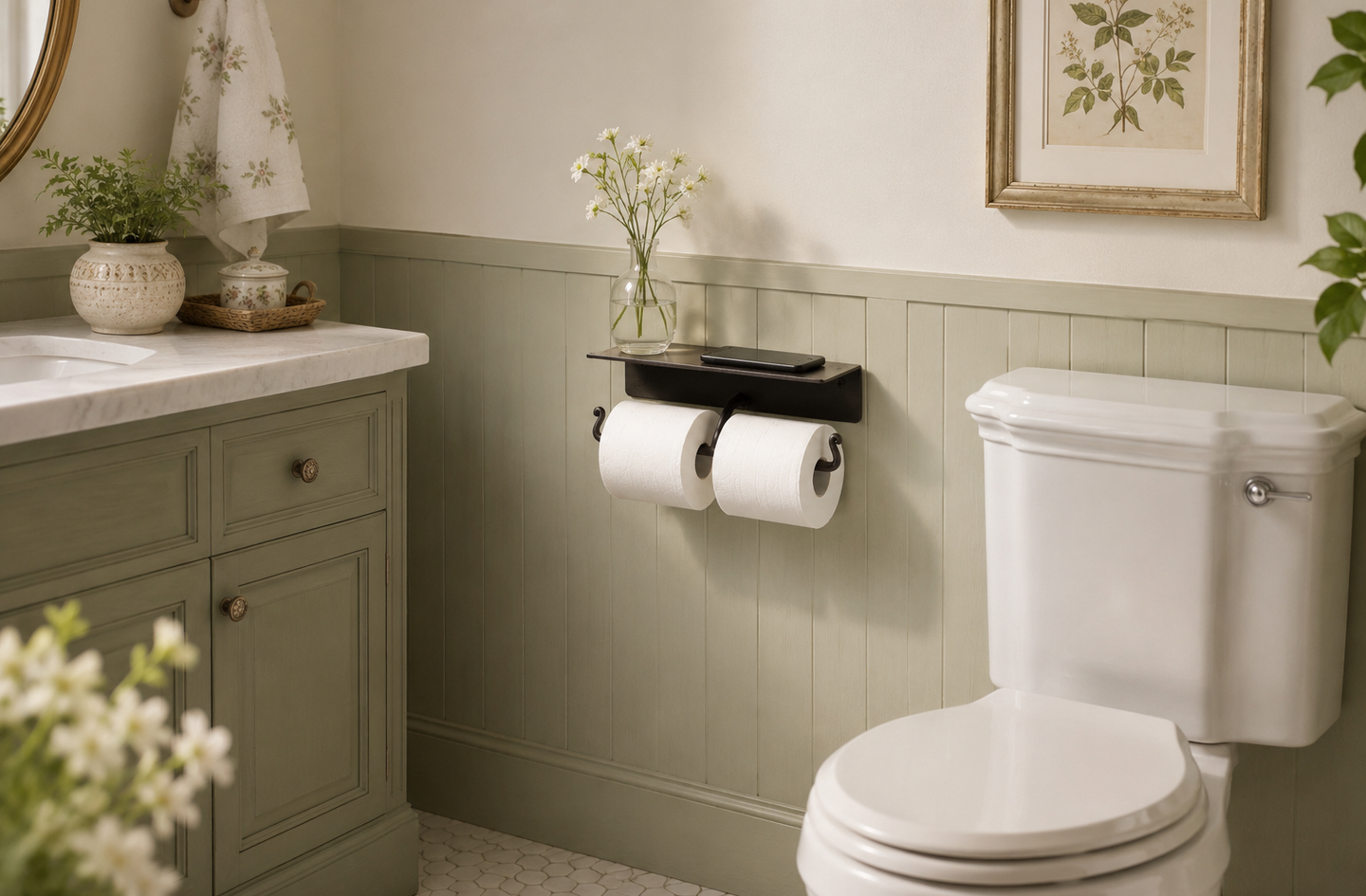
Double with Shelf – wall-mounted wrought iron, holds two rolls plus a shelf, hand-forged with dual-layer zinc and powder-coat finish, backed by a Lifetime Warranty.