
The standard toilet paper holder height is 26 inches from the finished floor, measured to the center of the holder.1 That number, recommended by the National Kitchen and Bath Association (NKBA), puts the roll within comfortable reach for most adults seated on a standard toilet. For a broader overview of holder formats and mounting options, see Toilet Paper Holders: The Complete Guide. This guide focuses on the measurements that determine correct placement: height from the floor, forward distance from the bowl, which side to choose, and what clearances to verify before drilling.
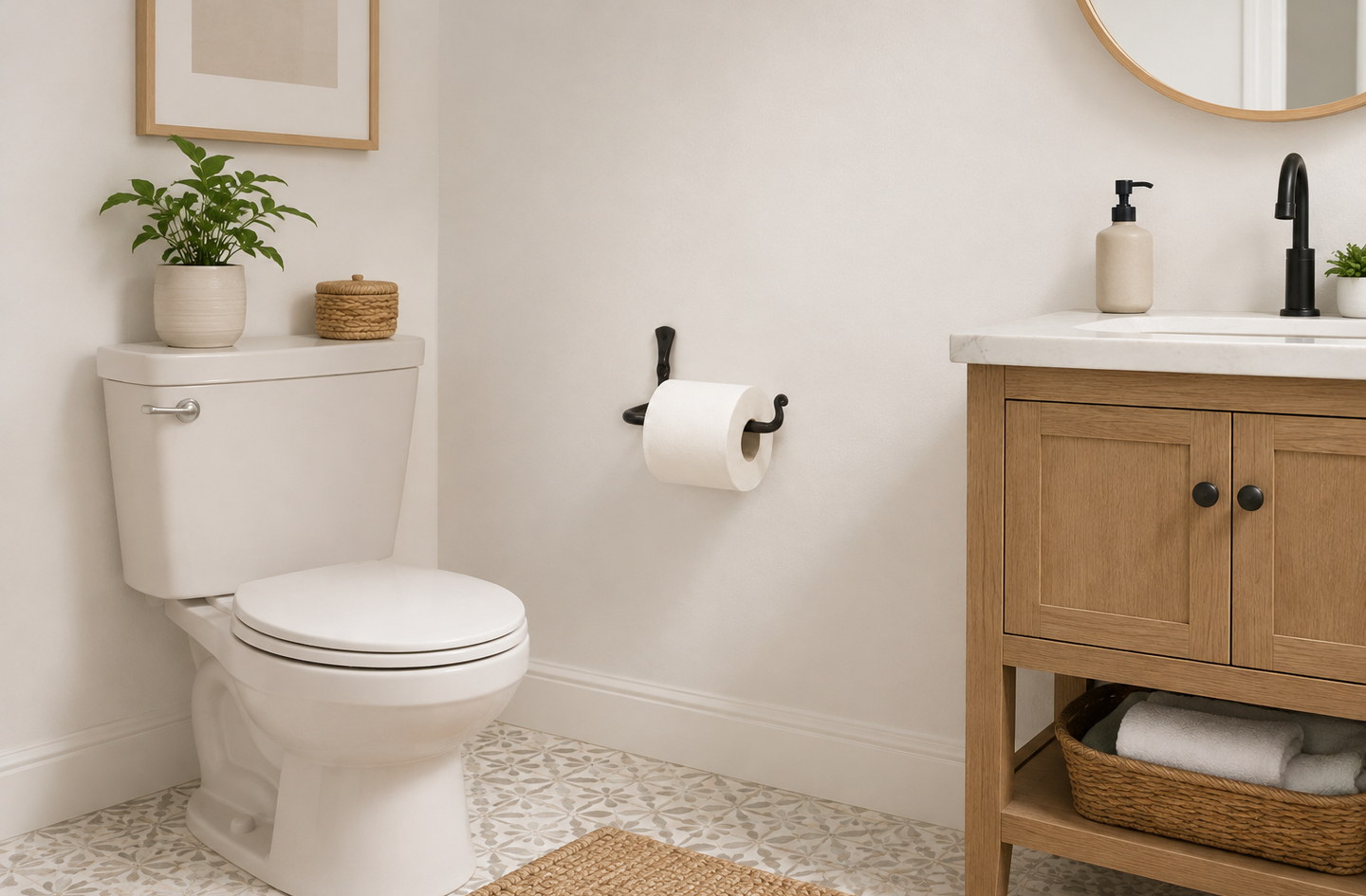
Quick Answer
What is the correct toilet paper holder placement?
Mount the holder 26 inches from the finished floor to the center, 8 to 12 inches forward from the front edge of the toilet bowl.1 Left or right depends on your layout: choose the side wall that gives a clear reach without door-swing conflicts or fixture crowding. For ADA-compliant spaces, the outlet must sit 15 to 48 inches above the floor and 7 to 9 inches forward from the toilet’s centerline.2
Key Takeaways
- The NKBA recommends 26 inches from the finished floor to the center of the holder, and 8 to 12 inches forward from the front edge of the toilet bowl.1
- A comfort-height toilet (seat at 17 to 19 inches) calls for raising the holder to 28 inches instead of 26.3
- Left or right is a layout decision. The side with a clear, unobstructed wall and direct reach from the seated position is always the better choice regardless of hand dominance.
- In ADA-compliant spaces, the dispenser outlet must be 15 to 48 inches above the floor and cannot be placed behind grab bars.2
Before You Begin
Three things shape where the holder goes: toilet type, dominant wall space, and what fixtures or doors are nearby. Getting them clear before picking up a pencil saves a second set of holes. This guide applies to wall-mounted holders in standard residential bathrooms. Freestanding and over-tank holders have no mounting height to set, so they are out of scope here.
Know your toilet type before you measure
Standard toilets have a seat height of 15 to 17 inches above the finished floor.3 Comfort-height toilets, sometimes called chair-height models, sit 17 to 19 inches at the seat.3 That 2-inch difference directly changes the correct holder height. Sit on the toilet before marking anything. Where your hand falls at a relaxed elbow height tells you more than any rule of thumb.
What to gather before marking
You need a tape measure, a pencil, a small torpedo level, a drill with bits sized for the included anchors, and the bracket hardware that ships with the holder. If you have drywall without a stud in the ideal position, have expansion anchors ready. A piece of painter’s tape is useful for marking test positions before committing to a location. Estimated time: 20 to 25 minutes for a first install on a prepped wall.
Step 1: Set the Toilet Paper Holder Height
By the end of this step you will know the exact height, in inches from the finished floor, for the center of your holder’s mounting bracket. Get this number right first; every other measurement works from a fixed position on the wall.
Standard residential height: 26 inches
The NKBA recommends mounting the holder 26 inches above the finished floor, measured from the floor to the vertical center of the dispenser.1 This height keeps the roll at natural elbow height for most adults seated on a standard toilet. It is also the most common height you will find in finished residential bathrooms, which matters if you are replacing an existing holder and want to reuse the wall holes.
The 26-inch figure has been the standard for decades because it works across a wide range of body heights. Shorter adults and teenagers can reach comfortably at 26 inches. Taller adults may prefer an inch or two higher, but the gains from adjusting are small and the cost of landing outside the expected residential band (needing to patch and re-drill) is real. For a first-time install with no prior holes, 26 inches is the right starting point.
Comfort-height toilet: raise to 28 inches
A comfort-height toilet raises the seated position by about 2 inches compared to a standard model. To preserve the same relative reach angle, raise the holder to 28 inches from the finished floor.3 Mounting at 26 inches on a comfort-height toilet places the roll below the natural hand position, which means bending down slightly more than necessary each time. The 2-inch upward shift is the same logic as raising a light switch to match a raised counter: the fixture follows the use position.
If you have a comfort-height toilet and are unsure, sit down and let your arm hang at the elbow. Measure from the floor to the tip of your fingers. That measurement is your practical ceiling; your holder centerline should sit a couple of inches below it so the roll is easy to grip and tear. For most people on a comfort-height toilet, this lands between 27 and 29 inches, with 28 inches as the center of that window.
Children’s bathroom: drop to 20 to 22 inches
For a bathroom used primarily by young children, lower the holder to 20 to 22 inches from the finished floor.3 This range keeps the roll reachable for kids 4 to 10 years old seated on a standard toilet. If the bathroom is shared by adults and children, 24 inches is a workable compromise: adults can reach down without discomfort, and older children can reach up without much effort.
| Scenario | Mounting Height (center) | Forward Distance |
|---|---|---|
| Standard bathroom (NKBA) | 26 inches from floor | 8 to 12 inches from front of bowl |
| Comfort-height toilet | 28 inches from floor | 8 to 12 inches from front of bowl |
| Children’s bathroom | 20 to 22 inches from floor | 8 to 10 inches from front of bowl |
| ADA accessible space (outlet) | 15 to 48 inches from floor | 7 to 9 inches from toilet centerline |
Step 2: Measure the Forward Distance
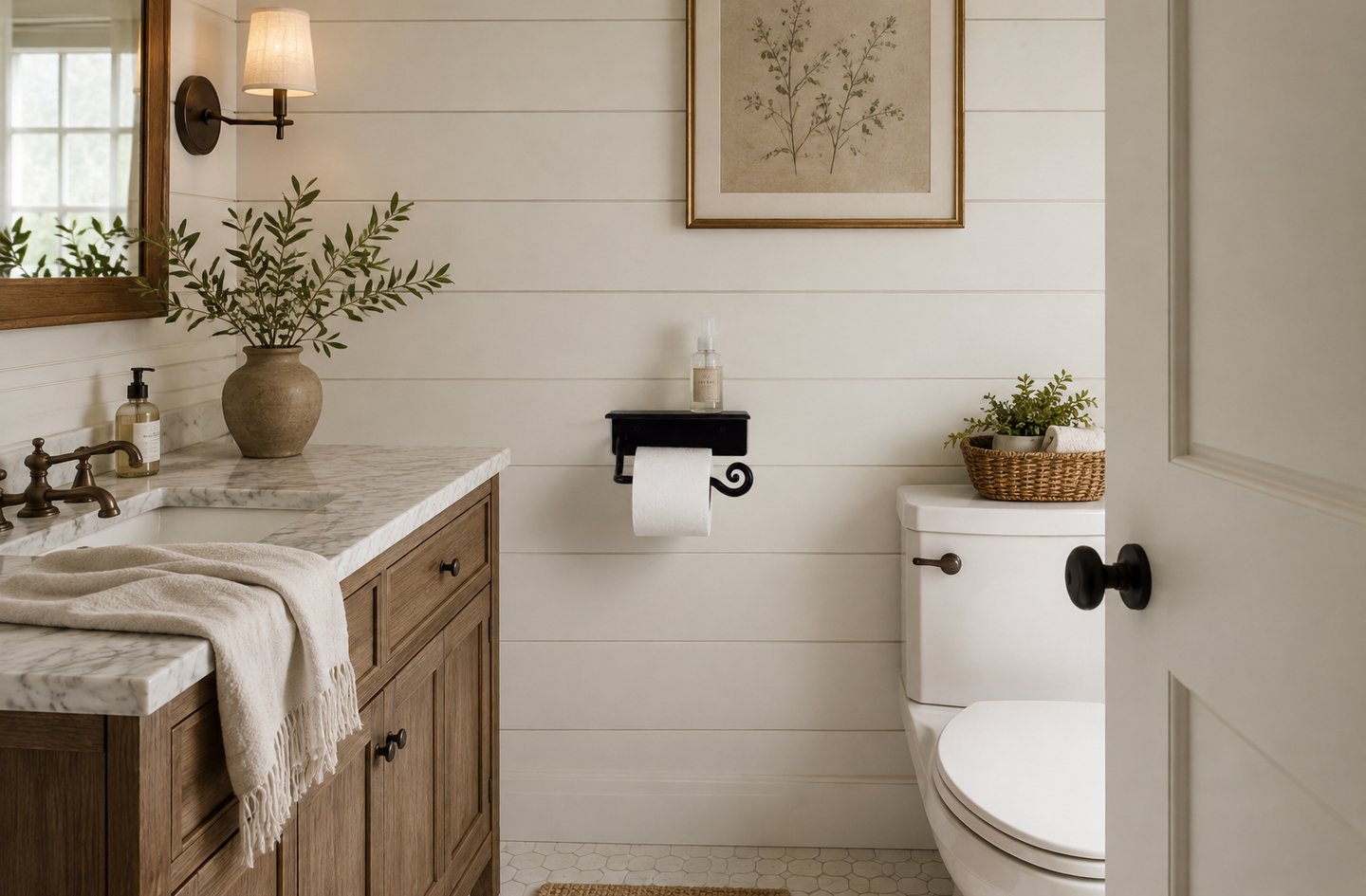
Forward distance is measured from the front edge of the toilet bowl to the vertical centerline of the holder. The NKBA puts this at 8 to 12 inches, measuring from the front edge of the toilet bowl to the horizontal center of the dispenser.1 This range exists for a reason: less than 8 inches places the roll uncomfortably close to the bowl, while more than 12 inches requires leaning forward to reach the paper.5
Why 8 to 12 inches is the comfortable range
From a seated position, the forearm naturally extends forward and slightly down. At 8 inches forward, a person with a short reach can grab the roll without rotating the torso. At 12 inches, a person with a longer arm span can reach comfortably without crowding the adjacent wall space. Anything closer than 8 inches risks the roll touching the bowl during dispensing. Anything past 12 inches forces a visible lean, which becomes a real problem for users with limited flexibility.
In practice, the wall space beside most residential toilets makes 8 to 10 inches the natural landing zone. The available side wall is often within 10 to 15 inches of the bowl, so placing the holder at the midpoint of its arm length puts the roll’s center at roughly 8 to 10 inches forward. Check the actual measurement with your tape rather than relying on the holder’s arm to position it automatically: arm lengths vary by model.
ADA forward requirement: 7 to 9 inches from the toilet centerline
The 2010 ADA Standards for Accessible Design measure forward distance differently from the NKBA. The ADA measures from the toilet’s centerline (the front-to-back midpoint of the bowl), not from the bowl’s front edge. Under Section 604.7, the dispenser centerline must be 7 inches minimum and 9 inches maximum in front of the water closet centerline.2
The NKBA residential guideline (8-12 inches from the bowl’s front edge) and the ADA standard (7-9 inches from the toilet’s centerline) were developed independently for different user populations. Both describe the same basic reach zone for a seated person; the different reference points just reflect different measurement conventions. Neither standard directly contradicts the other for most standard-depth toilet bowls.
For residential bathrooms without ADA requirements, the NKBA’s 8 to 12 inches from the front of the bowl is the practical target. For bathrooms that require ADA compliance, use 7 to 9 inches from the toilet’s centerline. When in doubt on forward position, place the holder at 8 to 9 inches forward from the bowl’s front edge. That position satisfies the NKBA minimum, is close to the ADA range, and works comfortably for most adults.
Step 3: Choose the Right Side
There is no industry standard that dictates left or right placement for residential toilet paper holders. The side that works depends entirely on your bathroom layout: which walls are available, where the door swings, where the vanity sits, and where your hand naturally falls when you reach from the seated position.4
Let the layout decide
In most bathrooms, one side of the toilet is bordered by a wall at an accessible distance and the other is blocked by a door, a tub, or insufficient wall space. Start by eliminating the side that cannot work: if the door swings on the right side of the toilet’s field of view, the right wall may be behind the swing arc when the door is open. If the vanity sits on the left and ends within 4 inches of the toilet’s front edge, mounting there leaves no room for the holder at the proper forward distance. Whichever side has an unobstructed wall between 8 and 12 inches forward of the bowl’s front edge is the correct side.
Hand dominance matters less than you think
A common piece of advice is to put the holder on the dominant-hand side. Right-handed people are often told to mount it on the right; left-handed people on the left. In practice, most people tear paper from the holder without much conscious attention to which hand they use, and the layout constraint overrides hand dominance anyway. If the only workable wall is on the non-dominant side, mount it there. It takes one or two uses to adapt. What does not adapt is reaching over your opposite shoulder for a holder mounted behind the door.
ADA grab-bar constraint
In ADA-compliant bathrooms, the dispenser placement is further constrained by grab bars. The 2010 ADA Standards require that the dispenser not be located behind grab bars.2 A grab bar on the side wall typically runs horizontally at 33 to 36 inches above the floor. Placing the holder behind or above the grab bar puts it out of reach and violates the standard. In accessible bathrooms, mount the holder between the toilet and the grab bar, at the required 7-to-9-inch forward position and within the 15-to-48-inch height window.
“The outlet of the dispenser shall be 15 inches (380 mm) minimum and 48 inches (1,220 mm) maximum above the finish floor.”
2010 ADA Standards for Accessible Design, Section 604.7, U.S. Department of Justice2
Residential bathrooms not subject to ADA requirements have no grab-bar constraint to work around. But if you are designing a bathroom for a user who relies on a grab bar now or may in the future, keep the holder position clear of any grab bar location.
Step 4: Check Door Swing and Vanity Clearance
Even a correctly height-placed holder on the correct side will cause problems if it lands in a door swing path or too close to the edge of the vanity. Check these two clearances before marking the final position.
Door swing clearance
Open the bathroom door fully and observe where it swings. If the door swings toward the toilet, note the arc’s edge position. The holder and its mounted roll should sit entirely outside that arc. A standard toilet paper roll is about 4.5 inches in diameter; add that to the wall surface position of the holder’s arm to find the outermost point the roll occupies when loaded. That point needs at least 2 inches of clearance from the door’s sweep arc at its closest pass.
If the only workable wall sits within the door’s swing arc, you have three options: mount the holder lower than the arc (which may conflict with the height guideline), move the holder further back on the side wall (which may push it past 12 inches forward from the bowl), or choose a recessed or compact holder model that projects less from the wall surface. A holder that projects only 2 inches from the wall rather than 5 inches gives you much more clearance in a tight layout.
Vanity and fixture clearance
The holder should not be so close to the vanity that the mounted roll overlaps with open cabinet doors or drawer pulls. A minimum of 4 inches between the outer edge of the roll and any adjacent cabinet edge is a practical buffer. For open-arm holders where the roll slides on from one end, you also need enough wall clearance to lift the roll on and off: most require at least 6 inches of vertical clearance above the spindle for loading.
On the wall facing the toilet (common in very small bathrooms where the side walls are too close), the forward distance rule changes: the holder should be centered on the wall at a height that keeps the roll above knee height and well below the tank. In this position, forward distance from the bowl is less of a constraint because the user reaches straight ahead rather than to the side.
Step 5: Mark the Wall and Test Before Drilling
Once you have a position in mind, the most reliable way to confirm it is to sit on the toilet and physically reach to the candidate spot on the wall. Use a small piece of painter’s tape to mark the position at the height you intend to mount and at the forward distance you measured. Then sit down, reach to the tape, and test the motion of pulling and tearing. Move the tape if the reach feels awkward. This dry run costs nothing and prevents the most common outcome of a first install: a holder that looks correct by the tape but feels wrong in use.
Marking the bracket position
Once the tape-test position feels right, mark the two mounting holes for the bracket directly from the bracket itself. Hold the bracket against the wall at the target height and center it at the target forward distance. Use a pencil to mark through each hole. Then use the torpedo level to verify the two marks are level before drilling. A holder mounted even slightly off level will be visible from across the bathroom every day, and re-drilling is a significant annoyance on tile or hard plaster walls.
For wrought iron holders like the classic holder, the bracket plate mounts flat against the wall and takes two screws. Line the plate against your pencil marks, drive the screws into the anchors or stud, and check that the plate does not rock before attaching the holder arm. A secure bracket is the only variable you control that prevents the holder from loosening over time.
Verifying fit after mounting
Once the holder is mounted, load a roll and sit down on the toilet again. The reach should feel immediate and natural: elbow roughly at rest, wrist turning to pull paper, no lateral lean or forward bend. If you installed a decorative style like the swirl holder, check that the open arm allows the roll to spin freely and that the arm’s scroll end does not interfere with grabbing a sheet. Open-arm designs do not require removing the roll for replacement, which is a practical advantage in small spaces. If anything feels wrong at this stage, re-evaluate the forward distance first (it is the most common variable that goes off): moving the holder one wall-anchor position closer or further often resolves a reach that felt off by a small margin.
Common Mistakes to Avoid
These are the placement errors that show up most often in a first install and the ones most likely to require re-drilling.
Mounting too far behind the bowl
Placing the holder at the rear of the toilet’s footprint, aligned with the tank, is the most common mistake. At that position, the holder may be 14 to 18 inches from the bowl’s front edge, well outside the 8 to 12 inch NKBA range. From a seated position, reaching that far back requires rotating the torso and bending at the waist. It feels awkward the first day and uncomfortable every day after. The error usually happens because the installer marks the position while standing, not while seated. Always sit down to check before drilling.
Using the standard height on a comfort-height toilet
Mounting at 26 inches in a bathroom with a comfort-height toilet places the roll slightly below the natural hand position. It is usable but subtly off: users tend to tilt their wrist slightly downward each time they reach for paper. Over time this is a minor annoyance, but it is easy to avoid. Measure your toilet seat height before deciding. If the seat is at 17 to 19 inches, go to 28 inches for the holder center.3 The adjustment costs no extra effort at install time and makes a measurable difference in daily use.
Mounting on the hinge side of the door
The hinge side of the bathroom door is rarely the problem. The problem is mounting on the side where the door SWINGS. If the door swings right and the holder is on the right wall, opening the door fully may swing the door face into the roll or the holder arm itself. In a small bathroom this contact can dislodge a roll or stress the bracket over time. Map the full swing arc before marking your position. If the preferred side sits in the swing path, move the holder lower on that wall where the door clears it, or switch to the opposite wall.
Placing the roll behind the user’s shoulder line
A holder mounted on the rear side wall, behind the toilet’s tank, places the roll behind the shoulder when seated. Reaching back and slightly up for paper is a motion almost no one does naturally. It is also hard on the shoulder for users with any mobility limitation. The holder should always be at or slightly forward of the hip line when seated. A holder positioned directly beside the toilet bowl’s front half, at the correct height, satisfies this requirement automatically.
Ignoring grab-bar positions in accessible bathrooms
In bathrooms designed for a user who needs a grab bar, the holder placement has to account for where the grab bar is or will be. The ADA Standard is explicit: the dispenser cannot be placed behind grab bars.2 Even in a residential bathroom not subject to ADA code, mounting the holder where a future grab bar would need to go is poor planning. If the bathroom is being designed for a user who may need aging-in-place features, leave the area between 33 and 36 inches above the floor on the side wall clear of fixtures, and mount the holder below or forward of that band.
Frequently Asked Questions
What is the standard toilet paper holder height?
The standard residential height is 26 inches from the finished floor to the center of the holder, measured vertically.1 This measurement comes from the National Kitchen and Bath Association (NKBA) and is widely used in residential bathroom design because it places the roll at a comfortable reach height for most adults seated on a standard toilet.
How far from the toilet should the holder be?
The NKBA recommends 8 to 12 inches from the front edge of the toilet bowl to the horizontal center of the holder.1 Less than 8 inches puts the roll too close to the bowl. More than 12 inches requires leaning forward to reach the paper. For most residential layouts, 8 to 10 inches forward is the practical landing zone given typical side-wall distances from the bowl.
Should the toilet paper holder go on the left or right?
There is no industry standard for left or right in residential bathrooms. The side you choose should be the one with a clear wall at 8 to 12 inches forward from the bowl, free from door-swing interference and vanity crowding.4 Hand dominance is a secondary factor at most: layout constraints nearly always determine which side works, and the reach motion adapts quickly regardless of side.
Do I need a different height for a comfort-height toilet?
Yes. A comfort-height toilet has a seat at 17 to 19 inches above the floor, roughly 2 inches higher than a standard toilet.3 To preserve the same natural reach angle, raise the holder center to 28 inches instead of 26. Mounting at the standard 26-inch height on a comfort-height toilet places the roll slightly below where your hand rests comfortably, which is a minor but persistent inconvenience.
Can I mount the toilet paper holder on the wall facing the toilet?
Yes, when side walls are too close or occupied. In very small bathrooms or powder rooms, the wall directly opposite the toilet is sometimes the only usable surface. Mount at 26 inches from the floor (or adjusted for toilet type) and center it horizontally so it is directly in front of the seated user. The forward-distance rule does not apply in this configuration since the reach is straight ahead rather than to the side.
Limitations and Edge Cases
- These measurements apply to standard wall-mounted holders in residential bathrooms. Recessed holders, over-tank holders, and freestanding stands each have different positioning logic not covered here.
- Bathrooms subject to ADA or local accessibility codes require measurements from the toilet’s centerline (not the bowl’s front edge) and must meet the outlet height range of 15 to 48 inches.2 Residential bathrooms without accessible-design requirements are not bound by these rules, but the ADA figures are useful for designing a bathroom with aging-in-place in mind.
- Wall type (tile, shiplap, drywall over concrete) changes the anchor hardware required, but does not change the placement measurements. For tile-specific drilling or drywall anchor selection, see the installation guides in this cluster.
References
- Hunker – “Standard Height of Toilet Paper Holders,” citing National Kitchen and Bath Association guidelines for dispenser height (26 inches) and forward distance (8-12 inches from bowl front).
- U.S. Department of Justice – 2010 ADA Standards for Accessible Design, Section 604.7 (Dispensers): outlet height 15-48 inches, forward position 7-9 inches from water closet centerline, prohibition on placement behind grab bars.
- Zogics – “Toilet Paper Holder Installation Guide,” specifying comfort-height toilet adjustment to 28 inches, standard toilet seat height 15-17 inches, comfort-height seat 17-19 inches, and children’s bathroom range 20-22 inches.
- The Bathroom Blueprint – “Where Should A Toilet Paper Holder Be Located?” covering left-vs-right placement guidance and the primacy of layout constraints over hand dominance.
- Designingidea – “Toilet Paper Holder Height and Distance,” summarizing ergonomic reach considerations and residential measurement standards for holder placement.
Conclusion
Correct toilet paper holder placement comes down to three numbers: 26 inches from the floor for standard toilets (28 for comfort-height), 8 to 12 inches forward from the bowl’s front edge, and whichever side wall provides a clear, unobstructed reach. Getting all three right the first time avoids a second round of drilling and delivers a holder that feels natural rather than just mounted. The NKBA figures are a reliable residential baseline; ADA requirements apply to accessible spaces and serve as a useful reference for aging-in-place design regardless of code requirements.
For a broader look at holder types, mounting formats, and buying considerations, see the toilet paper holder overview.