
Heavy duty wall hooks are solid metal hooks fixed to a wall with screws, anchors or masonry fasteners so they can carry coats, bags, towels and tools every day. Their real strength comes from the whole system, not the hook alone. Plain drywall holds only 5 to 10 pounds on a simple nail, so anything heavier needs a stud or a proper anchor1. This guide is for homeowners and renters who want hooks that stay put. It covers the whole topic in short and points to deeper guides on each part.
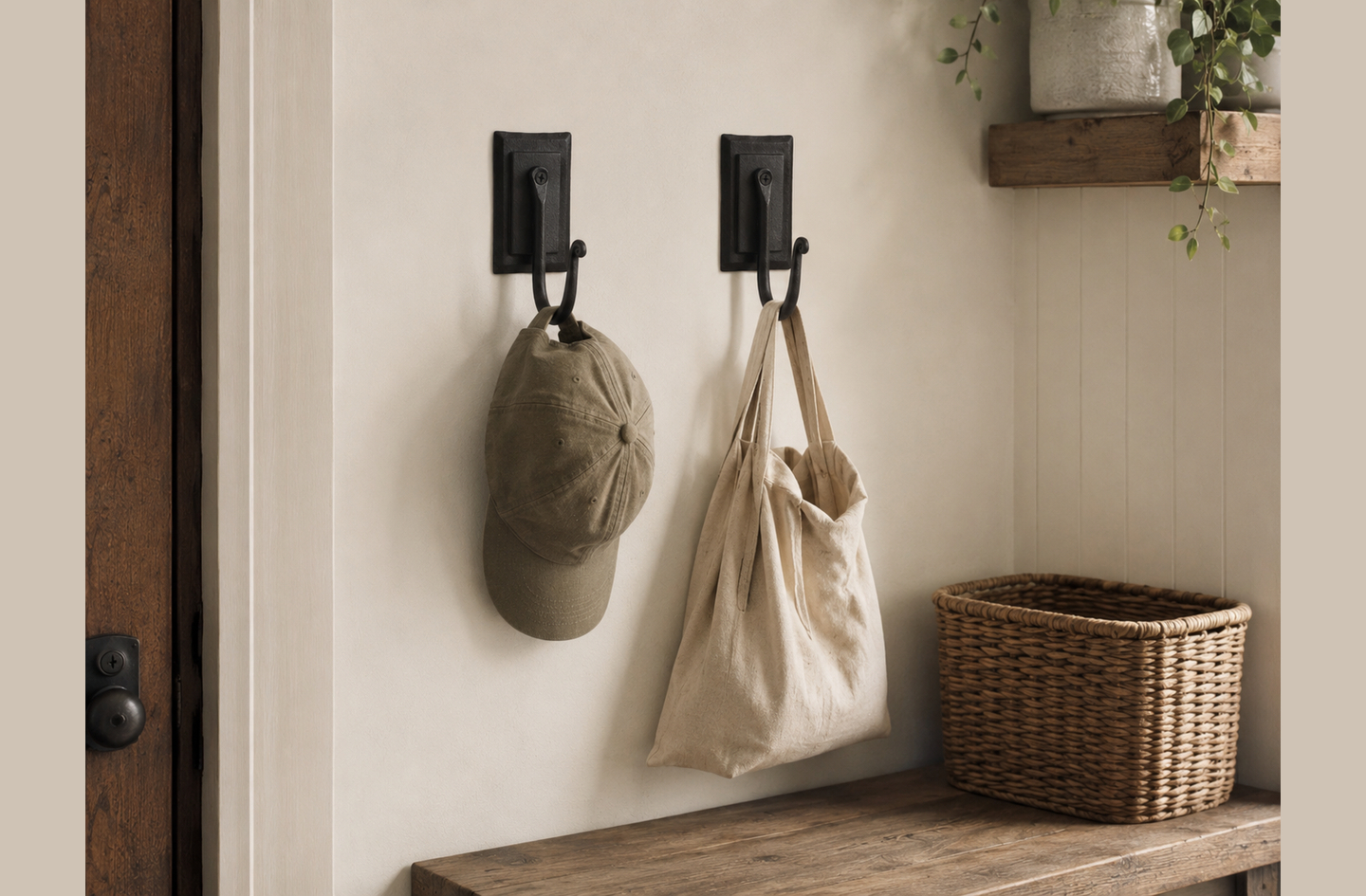
Quick Answer
What are heavy duty wall hooks?
Heavy duty wall hooks are forged or solid metal hooks mounted with mechanical fasteners into studs, solid wood, masonry or rated anchors. A practical rule is to choose fasteners rated for about four times the weight being hung1. The hook, the screw, the anchor and the wall must all share the load.
Why it matters:
A strong hook on a weak wall still fails, usually by pulling out slowly under daily use.
Key Takeaways
- An anchor rated for 100 pounds should be trusted with about 25 pounds of working load2.
- Wood studs sit 16 or 24 inches apart, and a screw into a stud beats any hollow-wall anchor2.
- The number stamped on a hook describes the hook, not the wall, the anchor or the screw holding it.
- Hook depth, prong shape and spacing decide whether a bulky winter coat actually fits.
- Damp rooms and outdoor walls call for a sealed finish, such as zinc under powder coating.
Heavy Duty Wall Hooks in 30 Seconds
| If you are… | Do this |
|---|---|
| Hanging winter coats in a hallway | Screw each hook into a stud or a backer board fixed to studs |
| Mounting on drywall with no stud nearby | Use a metal toggle anchor and keep the load well under its rating |
| Working on brick, concrete or stone | Drill with a masonry bit and use sleeve or screw-in masonry anchors |
| Fitting out a bathroom or patio | Pick zinc plus powder coated iron and smooth, rounded prongs |
| Storing bikes, ladders or hoses in a garage | Fix hooks into framing and spread heavy items across several hooks |
| Renting with a no-drill rule | Keep adhesive hooks for light items only and skip heavy bags |
What Are Heavy Duty Wall Hooks?
Heavy duty wall hooks are wall-mounted hooks built to carry real daily loads, such as a wet winter coat, a full backpack or a coiled extension cord. They differ from light hooks in three ways: solid material, a wider base with two or more screw holes, and mechanical mounting. Most are made from forged iron, solid steel or cast metal rather than thin stamped sheet.
A mounting system is the hook, its screws, any anchor, and the wall material working together as one load path. Each part has its own limit, and the weakest part sets the real capacity. A hook screwed into a wood stud behaves very differently from the same hook in hollow drywall with a plastic plug.
The category includes single hooks, double or two-prong hooks, hook rails and wall-mounted coat racks. It covers walls, doors and backer boards in entryways, closets, bathrooms, kitchens, garages and patios. It does not cover ceiling hooks, planter brackets, over-the-door racks or freestanding coat trees. Those carry load in other directions and follow different rules. Related ideas include shear load, pull-out strength, stud spacing, corrosion protection and hook projection, each taught in the framework that follows.
Why Heavy Duty Wall Hooks Matter
Heavy duty wall hooks matter because the most common failure is not a snapped hook but a fastener that slowly pulls out of the wall. Anchor makers publish a shear rating, and a cautious working load is about one quarter of that figure, so a 100 pound anchor suits roughly 25 pounds2. Few buyers apply that margin.
- Ratings on packaging describe test conditions, not a particular wall.
- Hollow walls, plaster, tile and masonry each need a different fastener.
- Repeated daily loading, such as a bag lifted on and off, works a weak fixing loose over months.
Understanding the system changes outcomes in busy rooms. An entryway hook loaded twice a day, a bathroom hook in damp air, and a garage hook holding a ladder all fail in different ways. Knowing which way each one fails tells the reader where to put the effort. This Old House states the safety margin plainly:
As a rule, anchors should be able to hold four times the weight of the object you’re hanging.
This Old House pairs that rule with a reminder that a simple nail in drywall holds only 5 to 10 pounds1.
The Five-Part Heavy Duty Wall Hook Framework
The Five-Part Framework splits the topic into load, wall and fastener, hook design, layout, and room exposure. It was grouped from the four ways wall hooks fail in homes (pull-out, bending, crowding and rust) into the smallest set of decisions that prevents all four.
1. Load and Weight Ratings
Working load is the weight a fixing can carry every day with a safety margin, as opposed to the weight that breaks it in a test. Published ratings are usually closer to break points. In one Family Handyman test in one-half inch drywall, a ribbed plastic anchor rated for 22 pounds held 80 pounds, and all but one anchor beat its rating3. That headroom exists on purpose and should not be spent. Adhesive hooks sit at the light end of the scale and suit only small items.
A rating is a ceiling measured in a lab, so the useful question is how much margin remains after a wet coat and a daily tug.
Deeper read: how to read 50, 100 and 200 lb wall hook ratings.
Deeper read: no-drill vs. drilled wall hooks for heavy loads.
2. Wall Type and Fasteners
Shear load is force pulling straight down along the wall face, which is how most hooks are loaded. Wood framing handles shear and pull-out best, and design values for wood screws still rest on equations built from over 10,000 withdrawal tests4. Drywall needs toggles or similar anchors when no stud is available. Plaster, tile, concrete, brick and hollow-core doors each need their own drill bit, fastener and level of care.
Finding what sits behind the wall surface is the single step that decides whether the rest of the installation can succeed.
Deeper read: how to install heavy-duty wall hooks securely.
Deeper read: heavy duty wall hooks for drywall.
Deeper read: mounting heavy hooks on plaster walls in older homes.
Deeper read: concrete, brick and stone wall hooks.
Deeper read: installing wall hooks on tile without cracking it.
Deeper read: wall anchors for heavy-duty hooks.
Deeper read: mounting heavy-duty hooks on solid and hollow-core doors.
Deeper read: how to fix a loose wall hook for good.
3. Hook Material, Shape and Size
Projection is how far the hook tip stands out from the wall, and it decides what fits. A puffy coat or a thick bag strap needs a deep, open hook. A towel needs a smooth, rounded prong. Solid forged iron resists bending better than thin stamped metal, and welds or formed joints at the base carry the load into the screws. Double hooks add a second hanging point but also add leverage.
The hook body rarely fails first, so its shape and finish matter more to daily use than its claimed strength.
Deeper read: wrought iron wall hooks.
Deeper read: coat hook depth, projection and shape.
Deeper read: when two-prong double coat hooks make sense.
Deeper read: decorative heavy-duty wall hooks.
Deeper read: choosing heavy-duty coat hooks for winter coats.
4. Height, Spacing and Load Distribution
Hook layout decides whether every hook stays usable once loaded. For people who need lower reach, accessible design sets the high side reach at 48 inches maximum and the low side reach at 15 inches minimum above the floor6. Spacing must allow for the bulk of a winter coat, not the hook base. A backer board fixed to two or more studs spreads a whole row of hooks across the framing.
Fewer hooks with room between them usually hold more in practice than a crowded row where only every second hook is usable.
Deeper read: coat hook height for adults and kids.
Deeper read: how far apart wall hooks should be.
Deeper read: heavy-duty wall-mounted coat racks and rails.
Deeper read: building a DIY hook board that hits the studs.
5. Room, Use and Exposure
Galvanizing is a zinc coating applied to iron or steel so the zinc corrodes first and protects the metal under it. Damp air is the main threat indoors, and the EPA advises keeping indoor relative humidity below 60 percent, ideally 30 to 50 percent5. Bathrooms and laundry rooms often exceed that during use. Patios, porches and garages add rain, condensation and temperature swings, while entryways, closets and kitchens add heavy repeated loading.
The room sets the finish and the load pattern, so the same hook can be the right choice in a closet and the wrong one on a porch.
Deeper read: rust-resistant outdoor wall hooks.
Deeper read: heavy-duty wall hooks for bathrooms.
Deeper read: heavy-duty wall hooks for kitchens.
Deeper read: heavy duty garage hooks.
Deeper read: closet wall hooks for coats, bags and rewear clothes.
Deeper read: planning an entryway drop zone.
Deeper read: wall hooks for loaded backpacks.
How to Choose the Right Heavy Duty Wall Hooks
The most important choice is the wall behind the hook, because it caps every other decision. Work through these steps in order:
- List the heaviest item each hook will hold, including wet or loaded weight, and keep the result in mind when reading wall hook weight ratings.
- Find out what sits behind the surface: wood studs, hollow drywall, plaster and lath, tile or solid masonry.
- Match the fastener to that material, using screws into wood first and rated wall anchors only where no stud exists.
- Pick a hook depth and prong shape that suit the item, with smooth edges for fabric.
- Choose a finish for the room, with zinc plus powder coating for damp or outdoor walls.
- Plan height and spacing before drilling, so the row still works when every hook is full.
| Item | Hook shape | Preferred mounting |
|---|---|---|
| Winter coat | Deep single or double hook, rounded tip | Stud or backer board |
| Loaded backpack | Open J hook wide enough for the strap | Stud or metal toggle |
| Bath towel or robe | Smooth rounded prong, sealed finish | Stud, or anchor through tile |
| Extension cord or hose | Deep hook with a raised tip | Framing or masonry anchor |
Red flags include a single screw hole on a hook meant for heavy coats, hollow tubing sold as solid metal, and a rating with no wall type stated. For a row of coats, a rail such as the 5-Hook Coat Rack fixed to two studs spreads the load better than five separate anchors.
Compare All Heavy Duty Wall Hook Mounting Methods
| Criteria | Screw into wood stud | Metal toggle in drywall | Plastic expansion anchor | Masonry anchor | Adhesive, no drill |
|---|---|---|---|---|---|
| Wall type | Studs, solid wood, backer board | Drywall, plaster, hollow block | Drywall, light plaster | Concrete, brick, stone | Smooth painted or tiled surfaces |
| Typical load class | Heaviest of the five | Heavy loads, 25 to 50 pounds | Light to medium, up to 25 pounds | Heavy, per anchor rating | Light items only |
| Effort | Stud finder, pilot hole | Larger hole, careful sizing | Small hole, quick | Masonry bit, hammer drill | None |
| Removal | Small screw hole | Larger patch needed | Small patch | Hole in masonry | Clean if removed slowly |
| Best for | Coats, bags, garage gear | Coats where no stud exists | Keys, hats, light towels | Patios, garages, basements | Rentals, light decor |
Choose a stud screw if: the hook sits on or near framing and will carry heavy daily loads.
Choose a metal toggle if: no stud is available and the wall is hollow.
Choose a plastic anchor if: the load stays light, such as keys or hats.
Choose a masonry anchor if: the wall is concrete, brick or stone in sound condition.
Choose adhesive if: drilling is not allowed and the item is light.
Deeper read: no-drill vs. drilled wall hooks.
Common Mistakes
Mistake 1: Trusting the number on the hook
Why it is a mistake: the rating describes the hook body under test, not the anchor, the screw or the wall it ends up on.
What to do instead: size the weakest part of the system, usually the anchor or the wall, with a wide safety margin.
Read more: reading wall hook weight ratings.
Mistake 2: Using small plastic plugs for heavy coats
Why it is a mistake: expansion plugs grip a thin layer of gypsum, and repeated pulls crumble the hole around them.
What to do instead: screw into a stud, or switch to a metal toggle when no stud is in reach.
Read more: choosing wall anchors for heavy hooks.
Mistake 3: Putting an indoor finish on a damp or outdoor wall
Why it is a mistake: single-layer paint chips at the hook tip, where hangers rub, and bare iron then rusts and stains the wall.
What to do instead: choose zinc plus powder coated hooks, such as Loop Hooks, and place them under cover where possible.
Read more: rust resistance for outdoor wall hooks.
Mistake 4: Re-tightening a loose hook in the same hole
Why it is a mistake: a loose hook usually means a widened hole or a failed anchor, and extra torque strips what remains.
What to do instead: diagnose the cause, then fit a larger anchor, fill and redrill, or move the hook to a stud.
Read more: fixing a loose wall hook.
Best Heavy Duty Wall Hooks by Use Case
Best for Busy Entryways and Mudrooms
Families loading hooks several times a day need deep hooks fixed into studs or a backer board, with a lower row for children. Spacing matters more than hook count here.
Deeper read: entryway wall hook planning.
Best for Bathrooms and Humid Rooms
Wet towels and robes need smooth prongs and a sealed finish that resists damp air. Hooks should sit clear of the shower spray and away from door swings.
Deeper read: bathroom wall hooks for towels and robes.
Best for Garages and Workshops
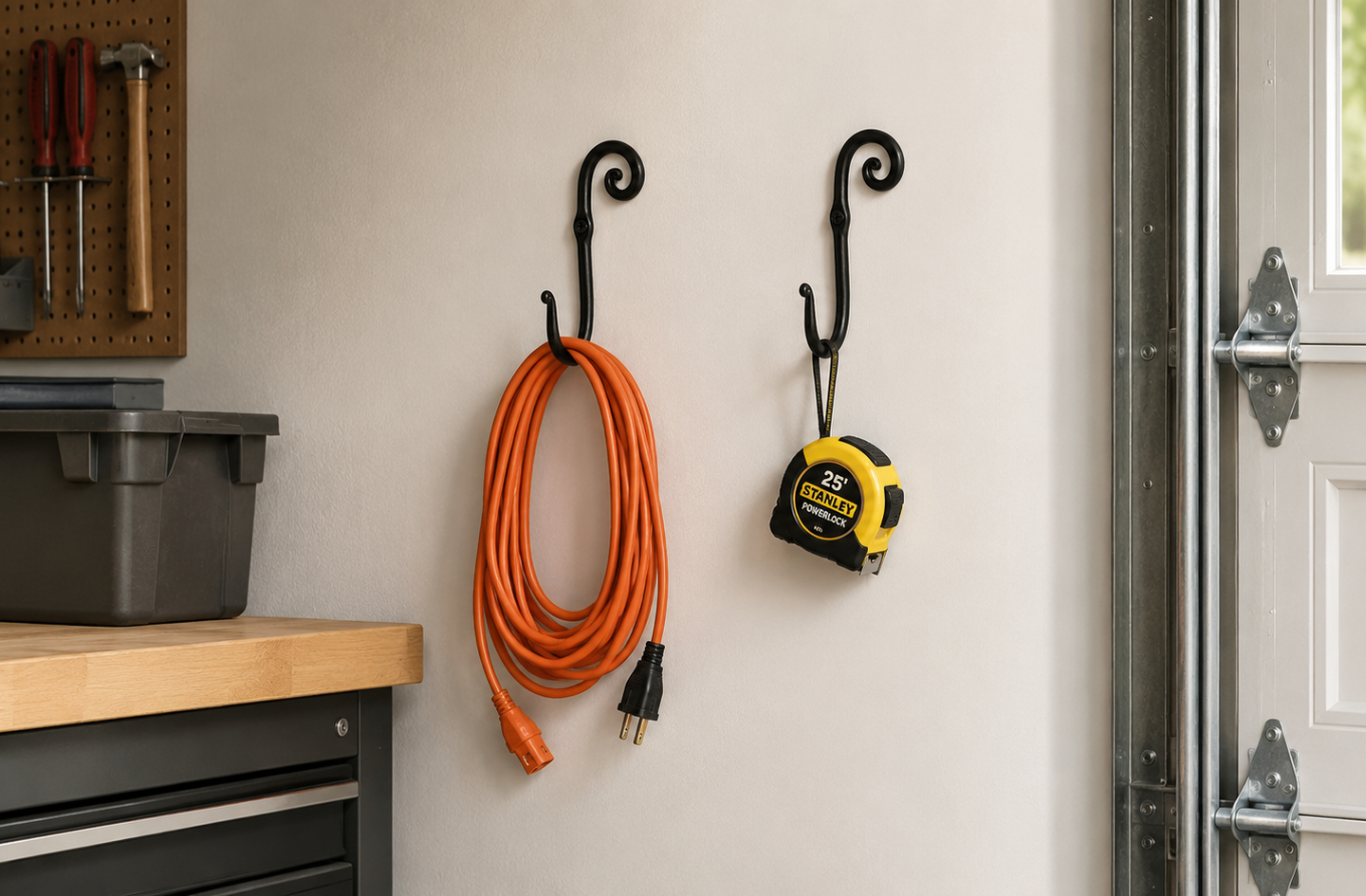
Cords, hoses, ladders and bikes call for deep hooks screwed into framing, with heavy items spread across two or more hooks.
Deeper read: garage hooks for tools, ladders and bikes.
Best for Closets and Bedrooms
Handbags, robes and rewear clothes suit double hooks with a short projection, such as Double Round Hooks, placed clear of rods and doors.
Deeper read: closet wall hooks for coats and bags.
Frequently Asked Questions
How much weight can heavy duty wall hooks hold?
Heavy duty wall hooks hold as much as their weakest part allows, which is usually the anchor or the wall rather than the hook. This Old House advises dividing an anchor’s shear rating by four, so a 100 pound anchor suits about 25 pounds of daily load2. A screw driven into a solid wood stud carries more than any hollow-wall anchor. Wet coats, loaded bags and repeated pulls all count toward the total.
Can heavy duty wall hooks be mounted on drywall without a stud?
Heavy duty wall hooks can go on drywall without a stud when the anchor is chosen for the load. A plain nail in drywall holds only 5 to 10 pounds, so heavier hooks need toggle bolts or similar metal anchors1. Toggles spread the force across the back of the board instead of gripping the thin edge of the hole. For the heaviest items, such as a full coat row, finding a stud remains the safer option.
Do wrought iron wall hooks rust in bathrooms or outdoors?
Wrought iron wall hooks rust only where moisture reaches bare metal, so the finish decides how well they last. The EPA advises keeping indoor humidity below 60 percent, and bathrooms often exceed that after a shower5. A zinc layer under powder coating protects the iron even when the top coat is scratched. Outdoors, covered spots such as porches and balconies under a roof extend finish life further than walls exposed to direct rain.
How high should heavy duty coat hooks be mounted?
Heavy duty coat hooks should sit where the shortest regular user can reach them while long coats still clear the floor or a bench. Accessible design limits the high side reach to 48 inches and the low side reach to 15 inches above the floor6. Many homes add a second, lower row for children and keep the adult row higher. Furniture, door swings and garment length all shift the final height.
How This Guide Was Built
The methodology behind this guide combines published fastener guidance, independent anchor testing and government data on humidity and reach. Each figure links to the page that states it, and every source was checked on October 2, 2026. The five-part framework was derived from the four common failure modes of wall hooks. Tsach Levy, a blacksmith since 1995, wrote the guide, and Rami Abramson reviewed its technical content on October 2, 2026, with a review planned every twelve months.
What This Hub Does Not Cover
- Ceiling hooks and wall-mounted planter brackets, which carry hanging loads away from the wall and need their own rules.
- Over-the-door racks and freestanding coat trees, which use no wall fasteners at all.
- Wall-mounted TVs, cabinets, shelves and grab bars, which need rated mounting hardware and, for grab bars, a qualified installer.
- Damaged, crumbling or wet walls, which need repair before any hook is fitted.
References
- This Old House – How to Hang Something Heavy on a Wall
- This Old House – How to Choose the Right Hanging Hardware
- Family Handyman – Drywall Anchors Weight Tested
- USDA Forest Service – Withdrawal strength of wood screws and lag screws, Forest Products Laboratory research paper
- U.S. Environmental Protection Agency – Mold Course Chapter 2: Why and Where Mold Grows
- U.S. Access Board – ADA Accessibility Standards, Section 308 Reach Ranges
Next Read
Heavy duty wall hooks hold only what their weakest link allows, and that link is usually the wall or the anchor. Matching the fastener to the wall, the hook shape to the item and the finish to the room prevents nearly every common failure. Drywall is the wall most homes start with, so it is the natural next step.