
Key hangers for wall mounting work best in the room where the household actually walks in, drops its things and walks out again. For most homes that is the entryway, but bedrooms, kitchens and home offices each win in specific situations. This comparison sits under the key holders overview and covers only the choice of room and wall. Location matters because routine does the remembering: about 43 percent of everyday actions repeat almost daily in the same context1. A hanger placed on that path becomes part of the habit.
Quick Answer
Where should you put key hangers for wall mounting at home?
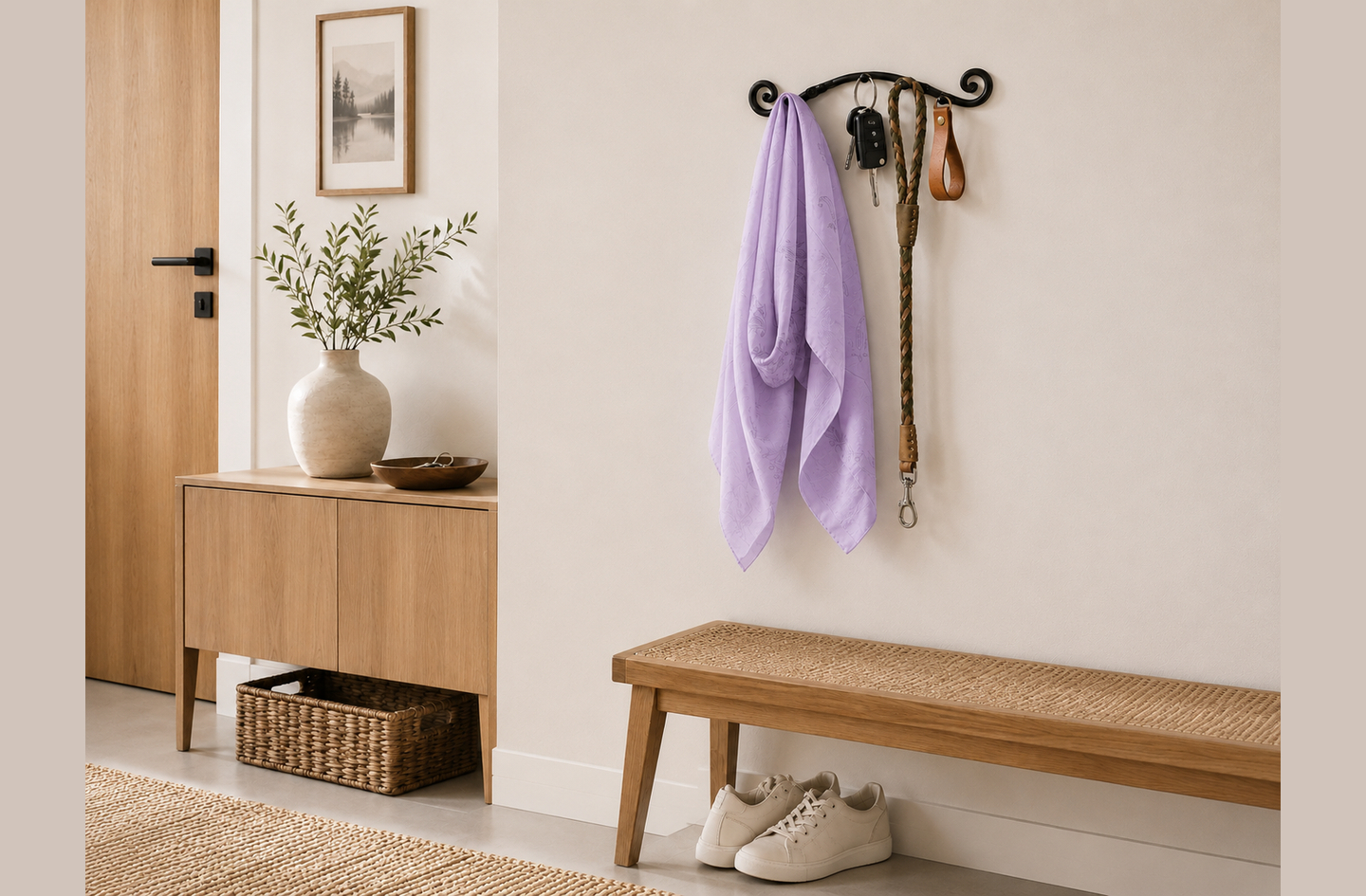
Put the main key hanger in the entryway, on the latch side of the door you use most, at a height every key user can reach. Accessible reach tops out at 48 inches above the floor for an unobstructed forward or side reach3. Add a second hanger in the bedroom, kitchen or office only when that room is where a specific routine starts or ends.
Key Takeaways
- The entryway wins for daily keys because the hanger sits on the arrival path, where about 43 percent of everyday actions already run on habit1.
- One fixed spot beats several: Harvard Health advises leaving car keys, glasses and phone in the same place every day2.
- In a hallway, any object mounted between 27 and 80 inches above the floor should protrude no more than 4 inches into the walking path3.
- A hanger in plain view of a letterbox or window is a security risk, so car keys belong out of sight and out of reach of the letterbox5.
Key Hangers for Wall by Room at a Glance
Key hangers for wall mounting serve a different routine in each room, so the right location depends on where the household arrives and leaves. The entryway covers the most people and the most trips. The bedroom, kitchen and home office each serve one narrower routine better than the front door does.
A key hanger is a wall-mounted rack with hooks for keys, and on larger models for leashes, lanyards and small bags. A drop zone is the spot where a household sets down keys, bags and mail on the way in, and picks them up on the way out. The best key hanger location turns the drop zone into one fixed point on the wall rather than a cluttered table.
| Factor | Entryway | Bedroom | Kitchen | Home office |
|---|---|---|---|---|
| Best for | Daily house and car keys for the whole household | Jewelry, watches and spare keys | Homes entered through a garage or side door | Work keys, ID badges and lanyards |
| Routine it serves | Every arrival and departure | Dressing and undressing | Unloading bags and groceries | Starting and ending the workday |
| Items it suits | Keys, leashes, small bags | Necklaces, bracelets, a spare key | Keys, aprons, reusable bags | Office keys, badges, headphones |
| Main risk | Keys visible from the letterbox or a window | Keys forgotten on a rushed morning | Heat, steam and splashes near the stove and sink | Work keys left behind on office days |
| Clearance to check | Door swing, light switch, coat hooks | Dresser height and drawer swing | Upper cabinets and backsplash | Desk, shelving and chair backs |
| Verdict | Wins for most households | Wins for accessories | Wins for side-door homes | Wins for work items |
The table shows one clear default and three specialist rooms. A single hanger by the main door handles most homes. A second hanger earns its wall space only when a room starts or ends a routine that the entryway misses.
Choose the room by the household’s real path through the house, not by where there happens to be a free patch of wall.
Entryway: Which Location Best Matches the Daily Routine
The entryway wins for daily keys because it is the only place every household member passes on every trip in and out. Wendy Wood, a psychology professor at the University of Southern California, has found that about 43 percent of everyday actions repeat almost daily in the same context1. Hanging keys on the way in is exactly that kind of action.
“About 43 percent of everyday actions are done repeatedly almost every day in the same context.”1
Wendy Wood, psychology professor at the University of Southern California, speaking on NPR’s Hidden Brain
A hanger by the door uses that pattern instead of fighting it. Keys go up as the door closes, and they come down as the coat goes on. Nothing depends on remembering, because the location sits on a path the household already walks.
Harvard Health makes the same point from the memory side. Its advice is to leave car keys, glasses and a phone in the same place every day, so finding them takes no thought2. The entryway is the easiest place to keep that promise, because it is the last stop before the car and the first stop after it.
Latch side or hinge side of the door
Mount the hanger on the latch side, the side where the handle is, so a hand can reach the keys while the other hand opens the door. On the hinge side, the open door covers the wall and can strike the keys or the hooks. Accessible design keeps 18 inches of clear floor beyond the latch side of a door that is pulled open3. A hanger mounted just past that zone stays out of the way of anyone approaching the handle.
Keep keys out of sight from the letterbox
The entryway carries one real risk: keys visible from outside. Guidance from the London Borough of Richmond upon Thames describes thieves who peer through the letterbox and fish for keys left within easy reach5. The same guidance advises leaving car keys in less obvious places, out of sight. A hanger on a side wall, around the corner from the door or out of the line of a glass panel, keeps the routine and removes the view.
The Swirly key holder is a typical entryway piece: a wrought iron rack with five forged hooks for keys, dog leashes and small accessories. Like every RTZEN piece, it is hand-forged, zinc-galvanized and powder-coated, and the catalog-wide Lifetime Warranty covers material and workmanship defects under normal use.
For most homes, the entryway is the answer, and the only real question is which wall beside the door keeps the keys reachable but out of view.
Bedroom: Jewelry, Watches and Spare Keys
The bedroom wins for accessories and spare keys, because it is where people dress, undress and put on the small items they wear every day. Necklaces, bracelets and watches tangle in a drawer but hang cleanly from a row of hooks. A key hanger near the dresser turns those pieces into a visible set that is ready each morning.
The bedroom loses for daily car and house keys. It sits off the main path, so a rushed morning is the moment the keys get left behind. Harvard Health’s advice to keep keys in one place every day works best when that place is on the route out of the house2. For most homes, the bedroom is a detour.
The bedroom does win on one security point. Richmond’s guidance advises keeping house keys and car keys in separate places5. A bedroom hanger is a sensible home for the spare car key, well away from the front door. Rarely used keys, such as a storage unit key, fit there too.
Placement beside the dresser
Mount the bedroom hanger beside or above the dresser, where a hand already reaches when dressing. Keep it clear of the top drawer so a drawer pulled fully open does not catch a hanging necklace. A mirror nearby makes jewelry choice faster, and a white finish suits light bedroom walls.
The White Classic holder fits that role. Its powder-coated white finish sits quietly on a pale wall, and five forged hooks along one bar keep necklaces and a spare key apart.
Use the bedroom as a second location for accessories and spare keys, never as the only home for the keys that leave the house every day.
Kitchen: Utility Near the Real Back Door
The kitchen wins when the household enters through a garage, side door or mudroom that opens into it. In those homes the front door is for guests, and the kitchen is the real arrival point. A hanger there catches keys at the same moment the grocery bags hit the counter.
Kitchen hangers carry more than keys. Leashes, aprons, reusable shopping bags and a small tote all end up on the hooks, and the load adds up. Drywall supports between 5 and 10 pounds with a simple nail, and anything heavier needs an anchor or a stud7. A full tote and a leash on one rack pass that range quickly.
This Old House sets the margin plainly: anchors should hold four times the weight of the object being hung7. A rack that carries a bag as well as keys belongs on a stud or on anchors rated well above the load. The key holder mounting guide covers screws and anchors for drywall, plaster and wood.
Where not to hang keys in a kitchen
Keep the hanger away from the stove, the kettle and the sink. Heat and steam reach the wall above a cooktop, and splashes reach the wall beside a sink. A spot near the kitchen door frame or at the end of a run of cabinets stays dry and out of the cooking zone.
Working around cabinets and tile
Kitchen walls are crowded with upper cabinets, backsplash tile and outlets. The open wall beside the door frame is the most practical choice. It keeps the keys at the edge of the room, where they are grabbed on the way out rather than in the middle of the cooking work.
If the household walks in through the kitchen, the kitchen is the entryway, and the hanger belongs by that door rather than the front one.
Home Office: Work Keys, Badges and Lanyards
The home office wins for work items, because hybrid schedules split the week between the desk at home and the desk at work. Among employed adults whose job can be done from home, 75% work remotely at least some of the time8. On office days, the work keys, ID badge and lanyard have to leave the house together.
A hanger in the home office keeps those items where the workday starts and ends. The badge comes off when the laptop closes, and it goes back on with the bag on the next office day. Mixing work keys into the entryway rack works for some households, but a separate office hanger stops a badge from disappearing under a pile of house keys.
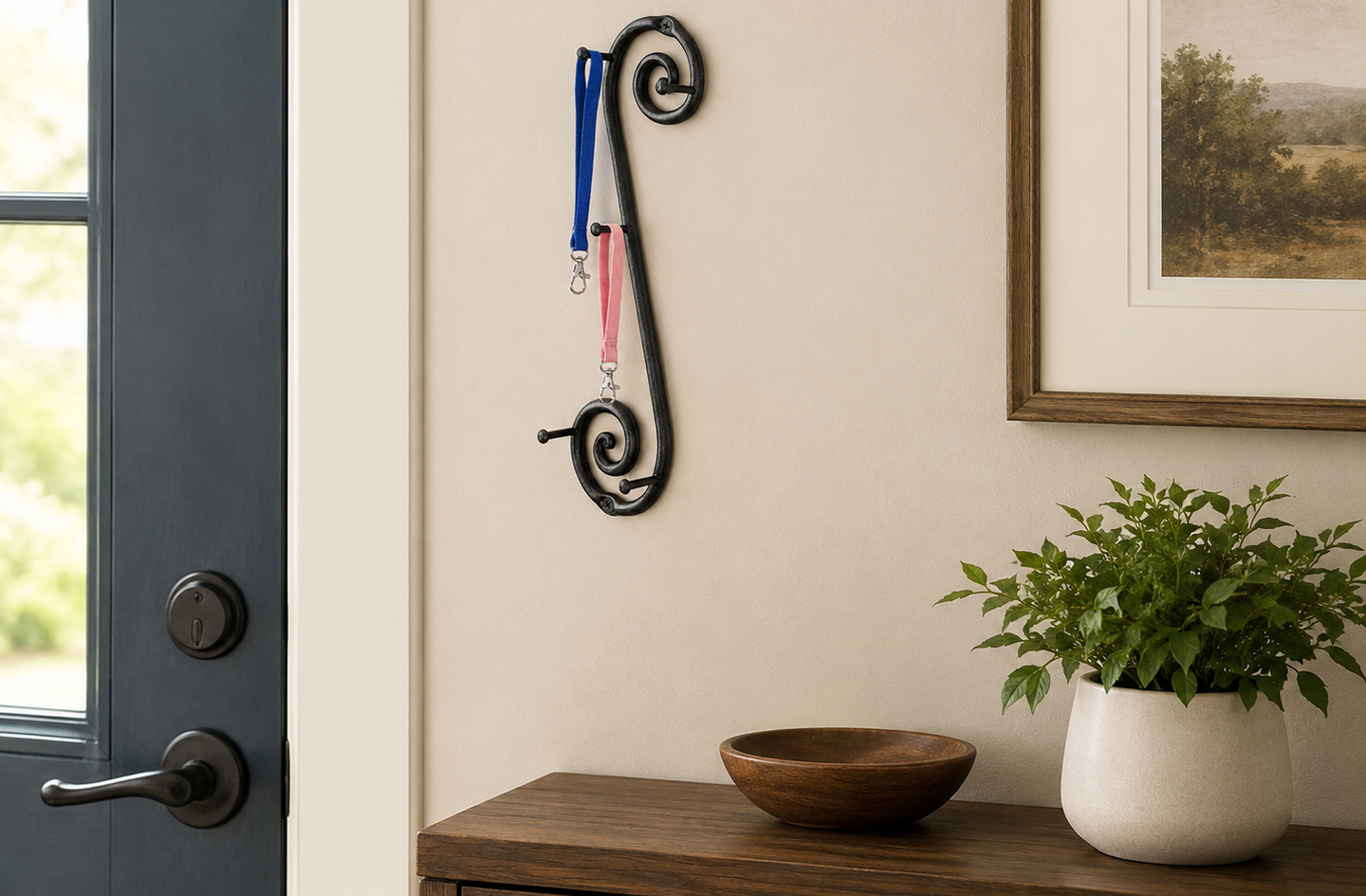
Office walls fill quickly with shelving, monitors and a calendar, so a narrow vertical rack fits better than a long horizontal bar. The Vertical key holder has a slim profile with hooks arranged one above another for keys and lanyards. Mounted beside the office door, it is the last thing passed on the way out with the work bag.
Keeping work and house keys apart
Separate racks protect against a common mistake: taking the house keys and leaving the office key behind, or the reverse. Two clearly separate locations make each set easy to check at a glance. The same logic applies to a shared office used by two people, with one hook or one rack for each.
A home office hanger pays off for anyone with a badge or office key, because it ties those items to the workday instead of to the front door.
Reachable Height for Every Key User in the Household
The right height depends on who uses the hanger, and the published reach ranges set clear limits. For an unobstructed forward or side reach, the accessible high reach is 48 inches and the low reach is 15 inches above the floor3. A hanger inside that band suits every adult, including a seated user.
A reach range is the band of heights that a person can reach from a standing or seated position without stretching or bending. The 2010 ADA Standards publish separate ranges for children. The high reach is 36 inches for ages 3 and 4, 40 inches for ages 5 to 8 and 44 inches for ages 9 to 123. Those figures help when a hanger should serve a child, or stay out of a young child’s reach.
Body height sets the standing view. Measured average height for U.S. adults aged 20 and older is 68.9 inches for men and 63.5 inches for women4. A standing adult reaches well above 48 inches, which is why many hangers sit near shoulder height. That choice serves standing adults and leaves seated users and children out.
Setting the reach ranges beside average adult height reveals a useful band. A hanger mounted between 44 and 48 inches sits inside the accessible adult range but above the highest published reach for children up to age 123. That band suits a household that includes a wheelchair user and young children who should not take the car keys.
The key holder height guide sets out standard mounting heights and the measurement steps for each room. For choosing the room, the rule is simpler: pick a wall where the hanger can sit at the right height with no furniture or trim in the way.
Decide who must reach the keys, and who must not, before choosing a wall, because that one decision rules some walls out entirely.
Door, Switch and Furniture Clearance
Clearance decides which wall in the chosen room actually works. In a hallway or passage, objects with leading edges between 27 and 80 inches above the floor should protrude no more than 4 inches into the circulation path3. Every key hanger mounted at a usable height falls inside that band.
Protrusion is the distance an object stands out from the wall into the space where people walk. A rack with a short hook and a set of keys stays shallow. The same rack with a tote bag or a bulky leash on it can stick out much further, which matters in a narrow hall where a shoulder brushes past.
Door swing
Open each door fully before marking the wall. A door that swings back against the wall covers anything mounted behind it, and a handle can strike the keys with every opening. Keep the hanger beyond the arc of the door and its handle, on the latch side where possible.
Light switches and outlets
A key hanger set right beside a light switch gets in the way of the switch, and a hand fumbling for the keys flicks the lights. Leave a clear gap between the hanger and any switch plate. Wiring runs to every switch and outlet, so a quick check with a stud and wire detector belongs before any drilling near one.
Furniture and coat hooks
A console table under the hanger works well, because a tray or bowl on the table catches wallets and sunglasses. Leave enough space between the tabletop and the hooks for the longest keychain to hang freely. Coats on nearby hooks should not hang over the keys, or the keys vanish behind them each winter.
Narrow entryways leave the least room for all three checks. The compact key holder ideas article covers vertical layouts and shallow racks for tight walls.
The best wall clears the door, the switch and the coats at the same time, and a room with no such wall is the wrong room.
Why One Consistent Location Beats Several
One consistent location beats several scattered spots because each extra location is one more place to check when keys go missing. Harvard Health’s memory advice points to the same habit: the same keys, in the same place, every day2. A second hanger makes sense only when it serves a different set of items.
The cost of a lost car key makes the point in plain money. Replacement fobs run from $50 to as high as $400 depending on the brand, according to Consumer Reports6. Programming a new fob and cutting a mechanical backup key adds another $50 to $1006.
“The cost to replace the latest key fobs can run anywhere from $50 to as high as $400 depending on the brand.”6
Mel Yu, automotive analyst at Consumer Reports
A wall hanger does not prevent every loss, but it removes the most common one: keys put down somewhere new and then forgotten. The habit evidence explains why. An action repeated in the same context runs without a decision1, so the location has to stay put for the habit to form.
Rules for a second hanger
A second hanger should hold a different set of items with its own routine. Examples are jewelry in the bedroom, work items in the office, or the spare car key. Duplicating the daily keys across two racks defeats the purpose, because the keys could be on either one.
Give each set of keys exactly one home, and add a second hanger only for a second set.
Which Room Suits Which Household
Most households should start with the entryway and add a second location only for a separate routine. The profiles that follow match common situations to the room that suits each one.
- Families with children: the entryway, with a lower hook inside a child’s reach for school keys and the car keys on a higher hook above the published children’s range.
- Homes entered through the garage: the kitchen or mudroom door, because that is where the household actually arrives.
- Hybrid workers: the entryway for house keys and a home office rack for the badge, lanyard and office keys.
- Jewelry and watch wearers: a bedroom hanger beside the dresser for accessories, plus the spare car key.
- Small apartments: one shallow rack on the latch side of the front door, out of sight of the letterbox or door glass.
Neither the bedroom nor the office suits a household where several people share one car. Shared keys need one central spot that every driver passes, which in nearly every home is the entryway.
The simplest test is the doorway test: the hanger belongs by the door the household uses most, and every other location is a specialist add-on.
Verdict: Room Winners by Category
The entryway wins overall, while the bedroom, kitchen and home office each win one specific job.
| Category | Winner | Main reason |
|---|---|---|
| Daily house and car keys | Entryway | On the path of every trip in and out |
| Jewelry and watches | Bedroom | Where accessories go on and come off |
| Spare and rarely used keys | Bedroom | Out of sight and apart from the daily keys |
| Bags, leashes and side-door homes | Kitchen | The real arrival point for garage entries |
| Badges, lanyards and office keys | Home office | Tied to the start and end of the workday |
| Reach for every adult | Any room | Mount within the 15 to 48 inch band |
| Overall for most households | Entryway | Routine, reach and shared use |
Start with one hanger by the most used door and check the door swing and the view from outside. Add a second rack only where a second routine needs it.
Frequently Asked Questions
What is the best place to hang a key holder at home?
The best place is the entryway, on the latch side of the door the household uses most. Keep it within the accessible reach band of 15 to 48 inches above the floor3 when seated users or older children need it. Add a second rack only for a separate routine.
Should car keys hang right by the front door?
Car keys should hang near the front door only when the rack is out of sight from the letterbox and any door glass. Borough crime guidance describes thieves fishing for keys through the letterbox5. A side wall or a spot around the corner keeps the routine without the view.
Is the kitchen a good place for a key hanger?
The kitchen is a good place when the household enters through a garage or side door that opens into it. Keep the rack away from the stove and sink. Drywall holds only 5 to 10 pounds on a simple nail7, so a rack carrying bags needs anchors or a stud.
How high should a key hanger be for children?
A key hanger for children should sit at or below their high reach. That is 36 inches for ages 3 and 4, 40 inches for ages 5 to 8, and 44 inches for ages 9 to 123. Keep car keys above those heights when young children should not reach them.
Is it worth having two key hangers in one home?
Two key hangers are worth it when each holds a different set, such as daily keys at the door and spare keys in the bedroom. A lost car fob costs $50 to $400 to replace6, so every set needs one fixed home rather than two possible ones.
Limitations and Edge Cases
- The reach ranges come from the 2010 ADA Standards for public and commercial buildings. Private homes do not have to meet them, so they serve here as a practical guide.
- The letterbox guidance comes from a London borough; homes without a mail slot face the same risk through door glass and street-facing windows.
- The load figures assume drywall; for plaster, tile or masonry walls, the surface-by-surface mounting guide covers the fasteners.
References
Methodology: every figure in this article comes from an independent published source and links to the page that carries it. The height band in the chart combines published reach ranges with measured average heights, and the article is reviewed by Rami Abramson.
- NPR – Creatures Of Habit: How Habits Shape Who We Are, Hidden Brain interview with Wendy Wood, December 2019.
- Harvard Health Publishing – Tips to get the most from your memory, with advice from Dr. Anne Fabiny, Harvard Medical School.
- U.S. Access Board – Guide to the 2010 ADA Standards for Accessible Design, sections 307.2, 308 and 404.2.4 with Advisory 308.1 on children’s reach ranges.
- CDC National Center for Health Statistics – FastStats: Body Measurements, data for August 2021 to August 2023, last reviewed June 2025.
- London Borough of Richmond upon Thames – Fishing for car keys: How safe are your car keys overnight, Community Safety Partnership leaflet, 2012.
- Consumer Reports – How to Replace Your Car’s Key Fob, Mike Monticello, May 2019.
- This Old House – How To Hang Something Heavy On a Wall, Jim Gorman, updated June 2026.
- Pew Research Center – Many remote workers say they’d be likely to leave their job if they could no longer work from home, January 2025.
Conclusion
Key hangers for wall mounting belong where the household’s routine already runs. For most homes that is the entryway, on the latch side of the main door and out of view from outside. The bedroom suits accessories and spare keys, the kitchen suits garage and side-door homes, and the home office suits badges and work keys. Whatever the room, one set of keys gets one fixed home at a height every key user can reach.
For how room placement fits the wider topic of key holders, see the key holders overview.