
Picking the right towel ring size before you drill prevents the most common frustration in bathroom hardware: a towel that bunches, drags the counter, or barely clears the sink. Most bathroom vanities pair best with a ring that has a 6 to 7 inch inner diameter3, but towel ring size means more than the ring alone. For a broader overview of mounting styles and hardware types, see Hand Towel Holders: Everything You Need to Know. This guide covers exactly three things: ring diameter, wall projection, and the clearance measurements you need before drilling.
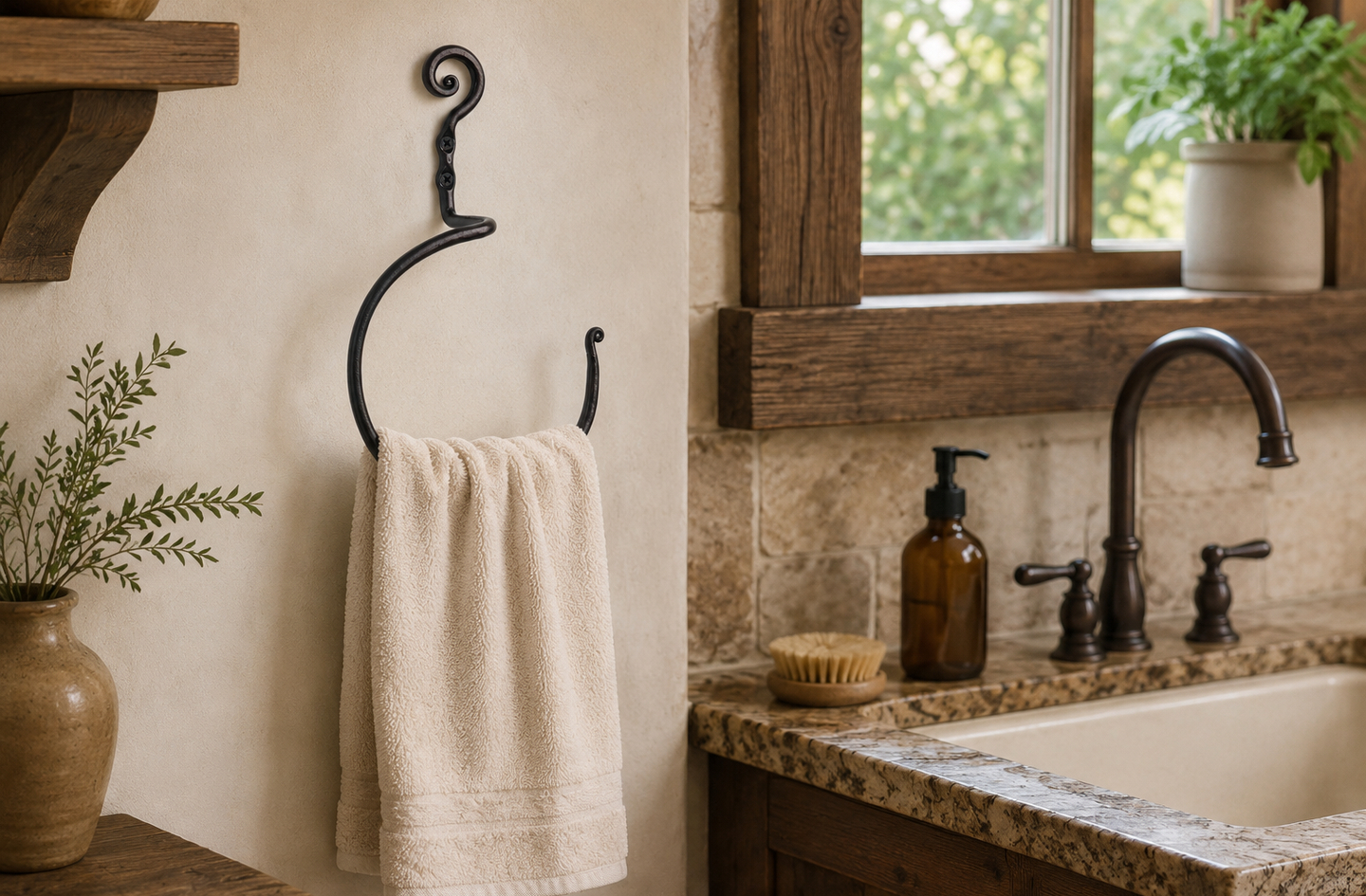
Quick Answer
What is the right towel ring size for a standard hand towel?
A ring with a 6 to 7 inch inner diameter fits most standard hand towels, which are 16 to 18 inches wide.1 Mount the ring so its center sits 50 to 52 inches from the floor and at least 16 to 18 inches of clearance exists between the bottom of the ring and the countertop.4 Then confirm lateral clearance from the faucet and the air gap below the hanging towel before drilling.
Key Takeaways
- Standard hand towels are 16 to 18 inches wide; a ring with a 6 to 7 inch inner diameter fits a towel folded to about a third of its width, leaving only a small overhang on each side.3
- Mount the ring center 50 to 52 inches from the finished floor, which typically places it 24 to 28 inches above a standard 32 to 36 inch vanity counter.4
- Ring diameter does not need to match the towel width; a 6 to 7 inch ring is correct for a 16 to 18 inch towel because the towel hangs folded, not flat.
What You’ll Need Before You Start
Before taking any measurements, gather these items: a steel measuring tape, a pencil, a short level, and the hand towel you intend to hang. Having the actual towel on hand matters. Two towels labeled “standard” can differ by an inch or more in width, and that difference is the entire margin of a well-fitting ring. You’ll also need to note the location of the nearest faucet, mirror edge, and any wall trim before you commit to a spot.
- Measuring tape (metal, at least 36 inches)
- Pencil or painter’s tape for marking the wall
- Level (4-inch or 8-inch torpedo level)
- The hand towel itself, folded as it would hang
Difficulty: beginner. Measure and mark the wall in one short session, then install once the spot is confirmed. The included screws and anchors in an RTZEN wrought iron ring handle standard drywall, tile, and brick without additional hardware.
Step 1: Measure Your Hand Towel Width
By the end of this step, you’ll know exactly how wide your folded towel is, which is the only dimension the ring must accommodate.
Spread the towel flat and measure its width edge to edge. A standard hand towel measures between 16 and 18 inches wide and 28 to 32 inches long.12 Those numbers describe the towel unfolded and flat. The relevant number for ring sizing is the folded width, not the full width.
How to fold for the measurement
Fold the towel into thirds lengthwise (the way it typically hangs on a ring). A 16 inch towel folds to about 5.3 inches. An 18 inch towel folds to about 6 inches.1 That folded width is what sits inside the ring. Measure the folded bundle and write it down. You now have the minimum clear interior span the ring needs to hold the towel without pinching the fabric at the sides.
Why the full width does not matter for ring sizing
A common mistake is choosing a ring based on the full 16 to 18 inch towel width. That logic leads buyers toward rings 16 to 18 inches across, which are bath towel bars, not hand towel rings. Hand towel rings are sized for the folded bundle, not the open towel. Keep the folded measurement handy for the next step.
Step 2: Match Towel Ring Size to Your Folded Towel
By the end of this step, you’ll know which ring diameter fits your towel with the right amount of clearance on each side.
Inner diameter is the clear interior span of a ring, measured across its opening from inside edge to inside edge. It is the only dimension that determines whether your towel fits. Most vanity rings run 6 to 7 inches in inner diameter, which accommodates a folded hand towel without the tail dragging on the counter.3
A 16 to 18 inch towel folded in thirds is 5.3 to 6 inches wide.1 A 6 to 7 inch ring gives 0.3 to 0.85 inches of clearance on each side.3 That small gap is enough to let the towel slide on and off easily. A wider ring, say 8 to 9 inches, creates too much slack and the towel shifts and bunches. A narrower ring under 6 inches risks pinching the folded fabric and making the towel hard to remove.
What about differently shaped rings
Rings come in several shapes: round (full circle), half-circle, and geometric forms such as triangles and rectangles. The shape affects the visual style, but the sizing principle stays the same. For a triangle or half-circle ring, measure the clear horizontal span of the opening, not the outer edge. The relevant dimension is still the interior clearance the folded towel must pass through. An RTZEN triangle ring or half-circle ring, for example, each offer a 6 to 7 inch interior span that fits the folded standard towel comfortably. For a comparison of ring shapes and styles, the ring size and shape guide covers selection criteria in detail.
| Measurement | Standard Range | Notes |
|---|---|---|
| Hand towel width (flat) | 16-18 in | Full unfolded width; not the ring sizing input |
| Hand towel (folded in thirds) | 5.3-6 in | The actual width the ring must accommodate |
| Ring inner diameter | 6-7 in | Standard vanity ring size; 0.3-0.85 in clearance per side |
| Ring wall projection | 1.5-3.5 in | Product-specific; check the spec sheet before ordering |
| Floor to ring center | 50-52 in | Industry standard for average adult height |
| Counter to ring center | 24-28 in | Use this when vanity height varies from standard |
| Counter to ring bottom (clearance) | 16-18 in | Minimum for towel to clear counter without dragging |
| Lateral clearance from faucet | 6-12 in | To side of faucet; prevents splash-back on the towel |
| Air gap below hanging towel | 2 in min | Between bottom of towel and counter or trim below |
Step 3: Assess Wall Projection and Counter Clearance
By the end of this step, you’ll know whether a given ring will leave the towel hanging freely or pushing against the counter.
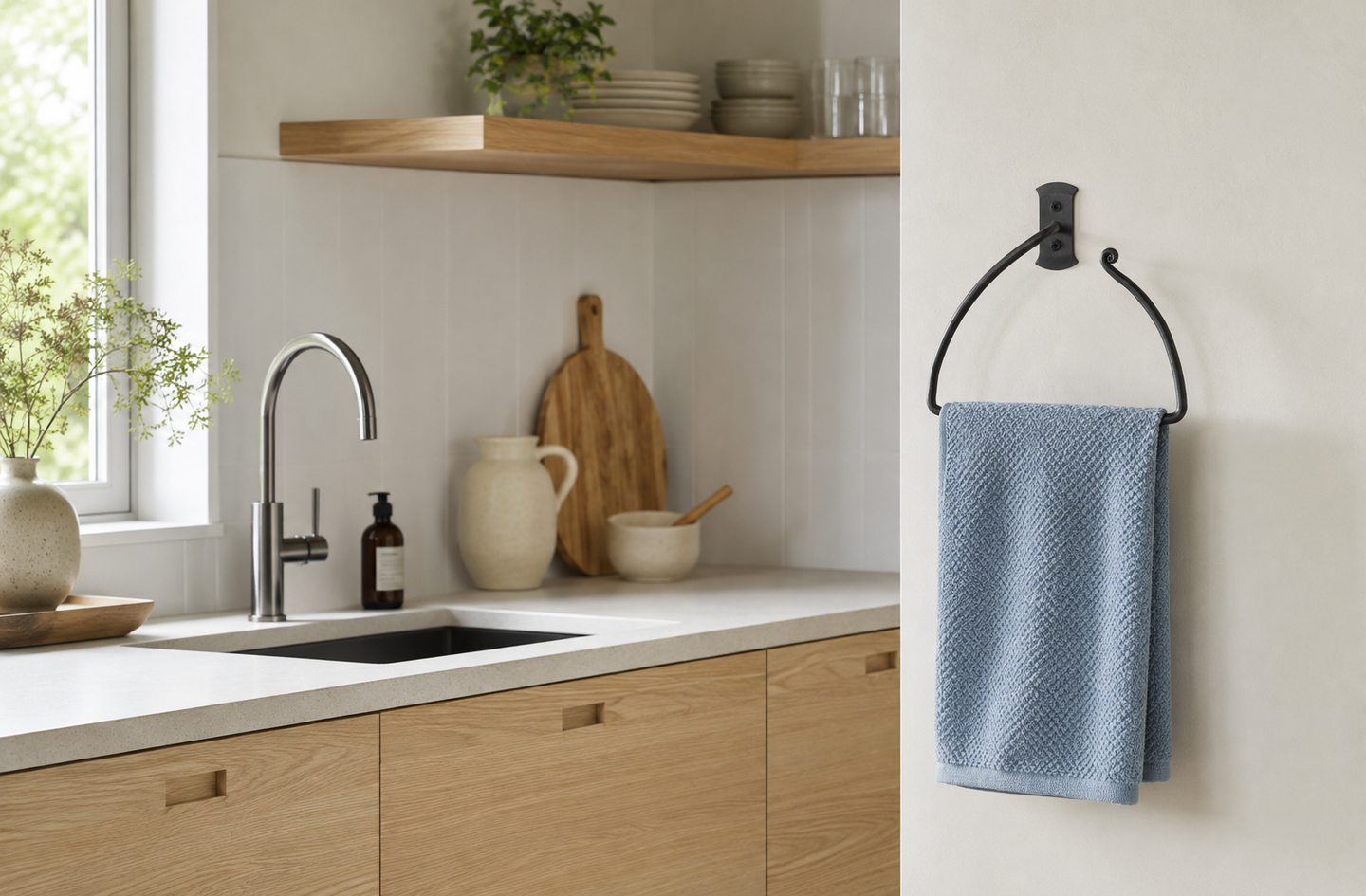
Projection is the distance a towel ring extends outward from the wall, measured from the back plate to the front face of the ring. No industry standard governs this dimension. It is entirely product-specific and varies with the bracket design. Check the product spec sheet before ordering.
How projection affects counter clearance
The ring hangs the towel out from the wall at a distance equal to the projection. A ring with 2 inches of projection holds the towel 2 inches from the wall. On a narrow bathroom vanity with a countertop that extends 21 inches out from the wall, a ring mounted directly above the sink still leaves the towel hanging well clear of the counter surface. On a wider kitchen counter, projection becomes more important because the counter may extend 24 inches or more.
The practical check: measure from the wall to the front edge of the counter. If that distance is 21 inches and your ring projects 2.5 inches, the towel hangs 2.5 inches out from the wall while the counter extends 21 inches. The towel clears the counter by about 18 to 19 inches horizontally. That gives plenty of room even for a 30 inch long towel that drapes a few inches at each end.
The one projection scenario to avoid
The problem arises when the ring is mounted on a side wall directly adjacent to a countertop, with the counter surface running perpendicular to the wall. In that layout, projection determines how far the towel sticks into the counter’s airspace. A ring with 3.5 inches of projection on a wall 4 inches from the counter edge means the towel’s center point is only 0.5 inches clear of the counter. Measure that gap before ordering, and choose a lower-projection mounting bracket if space is tight.
Step 4: Mark the Mounting Height
By the end of this step, you’ll have a pencil mark on the wall at the exact center height for the ring’s mounting hole.
Two reference points give you the mounting height: the finished floor and the top of the counter. Both measurements arrive at the same spot; use both as a cross-check.
“According to accepted industry practices, the perfect height to hang a towel ring is 50 to 52 inches.”
Hunker, home improvement editorial guide4
Measuring from the floor
Measure 50 to 52 inches up from the finished floor to mark the center of the ring’s mounting hole.4 This range places the ring at roughly elbow height for most adults and keeps a 28 to 30 inch towel hanging without the bottom corners touching the counter. Use 50 inches as the starting point if your counter sits at the standard 32 to 34 inch height. Move up to 52 inches if your counter is taller or if the towel you intend to hang is longer than 30 inches.
For accessible (ADA-influenced) layouts, hold to 48 inches exactly for the ring center, which falls at the maximum forward reach for a seated user.6 If you share your bathroom with someone who uses a wheelchair, measure from the floor to 48 inches instead of the 50 to 52 inch standard.
Measuring from the counter
Measure 24 to 28 inches up from the top of the vanity counter to find the ring’s center point.3 This counter-relative measurement is more reliable when the bathroom has a non-standard vanity height (say, a vessel-sink vanity that stands 36 to 38 inches tall). In that case, the floor-to-center measurement would place the ring too low relative to the tall counter, and the towel would brush the top of the sink bowl.
When both measurements agree (floor measurement lands 24 to 28 inches above your specific counter), you have the right height. When they disagree, defer to the counter measurement and adjust upward so the ring center sits 24 to 28 inches above the counter surface. For a detailed look at height variations across different vanity types, see ring height guide.
Step 5: Confirm Lateral Placement from the Sink
By the end of this step, you’ll have verified that the ring sits far enough from the faucet, mirror frame, and cabinet doors to avoid the splash zone.
Splash zone refers to the area around a sink faucet where water droplets land during normal hand-washing use, typically extending 6 to 8 inches from the sink’s edge in all directions.5 A ring placed inside the splash zone means the towel stays damp, which shortens its usable life and encourages mildew.
How far from the faucet to place the ring
Place the ring within easy arm’s reach of the sink, ideally 6 to 12 inches to the side of the faucet.5 Shorter than 6 inches and the towel enters the splash zone on every wash. Farther than 12 inches and reaching for the towel with wet hands means water drips across the counter.
A tighter test is the faucet arc and mirror frame rule: measure at least 10 inches of clear wall space away from both the faucet arc and the mirror frame before committing to a spot.3 The faucet arc is the invisible arc the faucet’s spout traces when it swings. On single-handle faucets this can extend further than the spout’s resting position suggests.
Adjacent cabinet doors and trim
Hold the ring’s mounting template (or a piece of tape marking the ring’s outer diameter) against your planned wall spot, then open and close any cabinet doors or drawers within 18 inches. A cabinet door that swings past the ring will hit the towel or the ring bracket. Allow at least 2 inches of clearance between the ring’s outer edge and the door’s travel arc. If the bathroom has wood trim or chair-rail molding, visually align the ring’s mounting centerline with the trim’s horizontal lines so the hardware looks intentional rather than placed at random.
Step 6: Run the Final Clearance Check
By the end of this step, you’ll have confirmed the ring in your chosen spot clears the counter below it and any trim behind it, so the towel hangs freely on all sides.
Drape the towel (folded as it will hang) over your hand and hold it at the planned ring height. Let the ends hang naturally. The bottom of the hanging towel should clear the counter below by at least 2 inches of open air.5 That 2 inch gap prevents the towel from wicking moisture off a damp counter and from picking up soap residue.
Checking clearance above the ring
Most rings mount with a single wall bracket above the ring body. The bracket adds clearance above the ring’s center point. Confirm there is no shelf, mirror lower edge, or wall cabinet bottom directly above your planned center height before drilling.
Checking clearance behind the ring
If the wall has a tile backsplash that ends partway up the wall, the ring’s back plate will span the tile-to-drywall seam if placed near that boundary. That seam can be uneven, making the ring sit at an angle. Hold a straight edge against the wall at the planned mounting spot before drilling. If the wall surface changes material or texture within 4 inches of the planned hole, shift the ring up or down until the back plate sits entirely on one consistent surface.
Common Mistakes to Avoid
Most towel ring problems trace to a small set of measurement errors. Here are the ones that come up most often, why they happen, and how to avoid them.
Choosing a ring based on the full towel width
The mistake: ordering a ring with an inner diameter of 16 to 18 inches because the towel is 16 to 18 inches wide.1 Why it happens: the towel’s full width is the most visible number on the label. The fix: size the ring to the folded width (5.3 to 6 inches), which means a standard 6 to 7 inch ring.3 A ring the full towel width would look like a bath-towel bar, not a hand-towel ring, and the towel would never drape neatly inside it.
Ignoring the wall projection depth
The mistake: ordering a ring online without checking the projection spec, then finding that the hanging towel drapes against the counter edge or the cabinet side. Why it happens: projection is often buried in a product’s dimension table rather than listed in the headline specs. The fix: before ordering, find the projection dimension (sometimes labeled “depth” or “reach”) in the product’s full spec sheet. A compact bathroom benefits from a projection under 2 inches; a wide kitchen counter with a ring mounted beside it can handle 3 to 3.5 inches.
Mounting too close to the faucet
The mistake: placing the ring directly beside the faucet to keep the towel within arm’s reach, then finding the towel is damp within hours. Why it happens: the splash zone is invisible, so placement that looks close enough ends up inside the wet radius. The fix: measure 6 to 12 inches to the side of the faucet before marking the wall.5 If the wall space is truly that short, consider a towel ring on the side wall perpendicular to the vanity rather than on the vanity’s backsplash wall. For a longer discussion of how ring placement compares to bar placement in tight spaces, see Towel Ring vs Towel Bar for Hand Towels.
Using the floor measurement without adjusting for vanity height
The mistake: drilling at 50 to 52 inches from the floor regardless of vanity height, then finding the ring too low (or too close) to the counter. Why it happens: the 50 to 52 inch figure comes from industry convention for a 32 to 34 inch standard vanity. A vessel-sink vanity standing 36 to 38 inches tall shifts the ring almost into the basin if the same floor measurement is used. The fix: always cross-check with the counter-relative measurement (24 to 28 inches above the counter surface) and use whichever result places the ring higher. The NKBA’s own guidance acknowledges a 30 to 48 inch range for towel hardware, precisely because vanity heights vary.6
Not checking the wall type before drilling
The mistake: assuming the included anchors will work in any wall, then finding them spinning in hollow tile or failing to grip in concrete block. Why it happens: bathroom walls mix drywall, tile, cement board, and sometimes brick, and the drilling spot may cross two materials. The fix: tap the wall with a knuckle to hear whether it is solid or hollow, use a stud finder to locate framing, and verify the anchor type against the wall material before starting. RTZEN wrought iron rings include anchors rated for standard drywall. For tile or masonry, use the appropriate drill bit and anchor for that substrate.
Frequently Asked Questions
What is the standard towel ring diameter for a hand towel?
Most standard hand towel rings have a 6 to 7 inch inner diameter.3 A standard hand towel (16 to 18 inches wide) folds in thirds to about 5.3 to 6 inches wide, so a 6 to 7 inch ring leaves roughly 0.3 to 0.85 inches of clearance on each side – enough for easy hanging without excessive slack.
How high should a towel ring be above the counter?
The bottom of the ring should sit 16 to 18 inches above the countertop, and the ring’s center should be 24 to 28 inches above it.4 That placement lets a standard 28 to 30 inch hand towel hang freely without its lower edge dragging across the counter surface.
What does wall projection mean on a towel ring?
Wall projection is the distance the ring extends outward from the wall, measured from the mounting plate to the front face of the ring. This dimension is product-specific and varies by bracket design. A larger projection holds the towel farther from the wall, which can reduce the clearance between the hanging towel and a counter edge directly below.
How far should a towel ring be from the faucet?
Place the ring 6 to 12 inches to the side of the faucet.5 This keeps the towel within arm’s reach while staying outside the splash zone, which typically extends 6 to 8 inches from the sink edge. Less than 6 inches from the faucet and the towel gets wet from splash-back during normal hand-washing.
What is the minimum air gap needed below a hanging towel?
Leave at least 2 inches of open air between the bottom of the hanging towel and any surface below it, such as the counter, a shelf, or a baseboard.5 That gap prevents the towel from wicking moisture off the counter and keeps the fabric from contacting soap residue or other debris on the surface below.
Limitations and Edge Cases
- The height figures in this guide (50 to 52 inches from floor, 24 to 28 inches above counter) are calibrated for standard adult reach ranges; a dedicated children’s bathroom benefits from dropping both measurements by 6 to 8 inches.
- On pedestal sink layouts with no counter, use only the floor measurement (50 to 52 inches for the ring center) since there is no counter surface to reference.
- Wall projection is a product-level spec with no industry-wide standard; always verify the exact projection listed in the manufacturer’s dimension table before ordering, especially when counter space is tight.
References
Methodology: every figure below comes from an independent published source and links directly to the page carrying it; this article is reviewed by Rami Abramson, co-founder of RTZEN and co-owner of the Iron-Craft workshop.
- American Soft Linen – What Size Is a Hand Towel? Standard Hand Towel Dimensions Explained.
- FLandB.com – Understanding Bath Towel Sizes: Standard, Bath Sheet and Hand Towel Dimensions.
- Knobs.co Editorial Team – Towel Rings for Bathroom Vanities: Buying Guide, July 2026.
- Hunker – Installation Height For a Bathroom Towel Ring, Static Media editorial team.
- D&G Flooring – Towel Ring Placement: Where to Mount It for Function and Looks.
- Mosaic Design Build – Tips on Installing Bathroom Accessories; references NKBA (National Kitchen and Bath Association) bathroom design guidelines.
Conclusion
Getting towel ring size right comes down to three measurements you take before drilling. First, the folded width of your towel: a standard 16 to 18 inch hand towel1 folds to 5.3 to 6 inches. Second, the ring’s inner diameter: 6 to 7 inches fits most vanity applications.3 Third, the clearances around the final mounting spot: height, lateral placement, and projection each need a check before drilling. A ring that fits the towel but ignores these clearances will still cause problems once it is on the wall.
For the broader context of mounting styles, hardware types, and how rings compare to other hand-towel solutions, see the overview in Hand Towel Holders: Everything You Need to Know.