
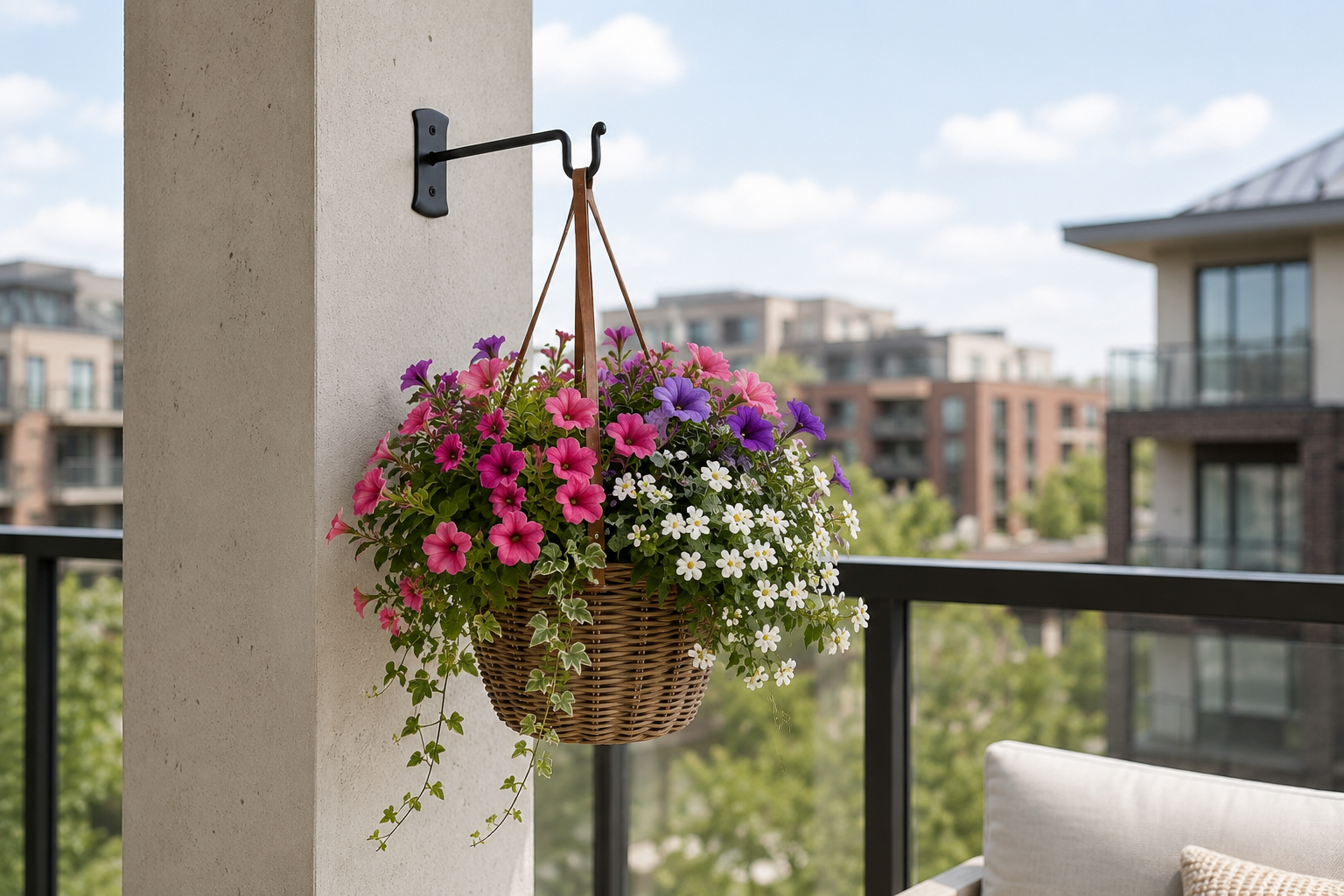
Choosing the wrong plant hanger hooks is how a healthy basket ends up on the ground. This article is part of the overview in plant hangers overview. A fully loaded 16-inch self-watering hanging basket can reach 40 to 45 pounds when its reservoir, plants, and wet soil are all accounted for1, yet the plastic expansion anchors packed with many budget brackets hold as little as 10 pounds in drywall2. The five steps below give you a repeatable method for sizing any hook or bracket to any pot, on any wall.

Quick Answer
How do you match a plant hanger hook or bracket to your pot?
Weigh the pot after a full watering, then choose a hook or bracket rated well above that figure. Pick an arm long enough that the pot’s widest point clears the wall by two inches. Mount to a wood stud wherever possible: a screw into a 2×4 stud holds 80 to 100 pounds3, while a plastic anchor in drywall holds as little as 10 pounds2.
Key Takeaways
- Always weigh the pot after a full watering: a 16-inch basket with wet soil can reach 45 pounds, far above what plastic drywall anchors can carry1.
- The arm length of the bracket must exceed the radius of your pot by at least two inches to keep foliage off the wall.
- The single strongest upgrade you can make is moving your fastener from a plastic anchor to a wood stud or toggle bolt; that swap multiplies holding capacity by five to ten times.
What You Need Before You Start
Gather these items before beginning. Having them in hand prevents mid-project trips to the hardware store and removes the temptation to eyeball measurements instead of checking them.
- A bathroom or kitchen scale with a capacity of at least 50 pounds. A hanging scale works well for large baskets already suspended from a temporary hook.
- A tape measure to check the diameter of the pot and the horizontal distance from the wall to the planting zone.
- A stud finder for interior drywall walls. Studs are almost always the strongest anchor point available.
- A drill and a 3/16-inch bit for pilot holes in wood, or an appropriate masonry bit for brick and concrete.
- The hook or bracket manufacturer’s stated weight rating. This number is on the packaging or the product listing, and it is the one figure you cannot skip.
- Time: 15 to 30 minutes per mounting point, including measuring and drilling.
- Difficulty: Beginner. Basic tool familiarity is enough for most wall types.
Step 1: Understand What Separates a Hook from a Bracket
A single-arm wall hook and a projecting bracket are often used interchangeably in product listings, but they function differently. Getting this distinction right narrows your options immediately and prevents you from mounting hardware that physically cannot hold the pot you have in mind.
Single-arm wall hooks
A single-arm hook attaches flush to the wall and projects outward at an angle, usually between six and ten inches, ending in a curved tip that holds a chain, rope, or wire hanger. The curve is what keeps the item from sliding off under wind or lateral movement. Shepherd’s hook brackets are the most common version: the arm sweeps upward in a classic arch before the tip curls under to catch the hanging chain. These are suited to standard flower baskets, bird feeders, and lanterns where the load hangs cleanly below the arm tip. Because the load is directly below the mounting point, the pull is almost entirely downward, which is the direction fasteners handle best.
From RTZEN’s own testing and manufacturing experience, a properly double-front-welded shepherd’s hook in hand-forged wrought iron handles a 30-pound rated load through years of outdoor cycles without bending at the arm joint. The double weld at the wall plate is what distributes the leverage created by the arm’s reach; single-weld or stamped hooks often fail at that joint, not at the fastener. Opting for shepherd’s hooks made from solid hand-forged iron, rather than hollow stamped steel, is the first structural decision that matters.
Projecting wall brackets
A projecting bracket uses a triangular or L-shaped brace to push the hanging point farther from the wall, often eight to twelve inches or more. The triangle brace below the arm carries the compressive load and prevents the arm from sagging under heavy pots. This geometry makes brackets better suited to wider or heavier planters that need clearance from the wall surface. Butterfly-style and scroll brackets fall into this group: the decorative element sits along the horizontal arm, and the structural triangle sits below it. Longer arms mean more torque at the wall plate, so larger brackets require fasteners placed into studs or masonry rather than drywall anchors. The curved hooks in RTZEN’s butterfly series use exactly this triangular brace geometry, allowing a compact 8-inch arm to carry a full small planter without flex.
“Larger and deeper containers will not dry out as quickly but will be heavier, an important consideration of hanging baskets.”
Iowa State University Extension, Yard and Garden4
The practical upshot: if your pot hangs from a chain or rope at a single central point, a hook works. If the pot has no hanging chain and instead sits in a wire cradle or has a flat rim, a bracket with a wider support ring is the right choice. When in doubt, weigh first, then choose.
Step 2: Weigh Your Pot Wet, Not Dry
The single most common reason a plant hanger hook fails is that the buyer weighed the pot when it was empty and dry, then filled it with soil and watered it after mounting. The weight difference between a dry plastic basket and that same basket fully planted and watered can be four to six times larger, and the hardware never gets a warning.
Water the pot as you normally would, let it drain for ten minutes, then step onto a bathroom scale while holding the pot and subtract your own weight. For very large baskets, hang them temporarily from an S-hook on a luggage scale or hanging fish scale attached to a door frame. Round the final number up to the nearest five pounds. That figure is your working load, and every piece of hardware you choose must be rated above it.
Pot material makes a large difference. Plastic pots are substantially lighter than terracotta at the same planting diameter, as confirmed by both the University of Nebraska Extension and Fine Gardening magazine56. A grower switching from a 10-inch plastic nursery pot to a 10-inch terracotta pot of the same plant can easily double the hanging load before soil and water are added. Terracotta has real advantages for plant health, but for hanging applications the weight penalty forces you up to a heavier bracket or a stronger fastener, and sometimes both.
Self-watering planters with built-in reservoirs add the most unexpected weight. The EarthPlanter Pro Series 16-inch self-watering basket, for example, reaches a maximum weight of 40 to 45 pounds when the reservoir is full, the plants are established, and the soil is wet1. Most residential wall hooks marketed for 16-inch baskets are not rated for that load. Always check the spec sheet, not just the product photo.
Verification: after weighing, write the number on a piece of tape and stick it to the bottom of the pot. That way, if you re-pot or repot with heavier soil, the reminder is right there at the next watering.
Step 3: Choose Arm Length to Clear the Pot
Arm length determines two things: how far the planting zone sits from the wall, and how much lateral leverage the hook exerts on its fasteners. Both matter, and they pull in opposite directions. A longer arm gives foliage more room and makes larger pots look better, but it also multiplies the torque at the mounting plate, which means the fasteners must be correspondingly stronger.
The geometry is straightforward. Measure the widest point of the pot (usually the rim diameter). Divide that by two to get the radius. Add two inches for foliage clearance. The result is the minimum arm length you need to keep the plant from rubbing against the wall.
Examples:
- A 10-inch pot has a 5-inch radius. Add 2 inches. Minimum arm: 7 inches.
- A 12-inch pot has a 6-inch radius. Minimum arm: 8 inches.
- A 16-inch basket has an 8-inch radius. Minimum arm: 10 inches.
This is the minimum. In practice, going one size up from the minimum looks better and keeps trailing plants from plastering themselves against stucco or siding after rain. RTZEN’s 12-inch extended brackets are specifically built for baskets in the 12-to-16-inch range, where extra clearance prevents moisture-related wall damage as well as visual crowding. The 12-inch curved hooks in the butterfly series hit that sweet spot for standard large baskets.
The torque penalty for longer arms: if you double the arm length from 6 inches to 12 inches, you roughly double the bending moment at the wall plate. This means the fasteners holding the bracket to the wall must be twice as resistant to pull-out. Moving from a short hook on a light pot to a long bracket on a heavy pot without upgrading the fasteners is the recipe for a bracket that slowly tilts away from the wall over months before finally letting go.

Step 4: Match Your Fastener to the Wall Material
The bracket is only as strong as the fastener holding it to the wall. Every bracket installation fails at the wall-fastener interface before it fails anywhere else, and the type of wall you are mounting into sets the ceiling on what that fastener can hold. Getting this step right makes every other decision in this guide redundant; getting it wrong undoes all of them.
Drywall without a stud
Drywall alone is the weakest option. A plastic expansion anchor in 1/2-inch drywall has an actual pull-out strength of as little as 10 pounds2. Threaded drywall anchors do a bit better at 15 to 25 pounds, and winged plastic anchors reach 25 to 35 pounds2. None of these is adequate for any planter over about 20 pounds, and even in that range a strong gust of wind creates dynamic loads that can exceed the static rating. If your only available anchor point is drywall without a stud, keep the pot small and the pot weight under 15 pounds.
Wood studs
A screw driven 2 inches into a 2×4 wood stud holds 80 to 100 pounds, and two screws in the same stud hold more than double that3. This is the benchmark to target for any basket over 20 pounds. Most residential wall brackets ship with two or three screws, so a two-screw mount into a single stud comfortably handles a 30-pound loaded planter with a 2-to-1 safety margin. Use a stud finder before drilling: studs run vertically at 16-inch or 24-inch centers, and finding one takes less time than patching drywall after a failed anchor. The included mounting screws in RTZEN hardware are sized for stud mounting; if you need longer screws to reach a stud through thick exterior cladding, a hardware store sells matching 3-inch versions.
Masonry: brick, block, and concrete
Masonry is dense and strong, and a correctly set masonry anchor outperforms most drywall options. The key word is correctly: masonry anchors require a matching drill bit, a slow drill speed to avoid overheating the bit, and enough depth (typically 1.5 times the anchor’s rated embedment depth) to develop full holding capacity. Toggle bolts can also work in hollow block, where a 3/8-inch toggle holds more than 50 pounds2. Solid brick or poured concrete with a proper masonry anchor is one of the most reliable mounting surfaces you will encounter. If you are unsure whether a wall is solid brick or hollow block, tap it: solid brick sounds dull and dense; hollow block has a slight ring.
Wood fence boards and deck posts
Fences and deck posts are wood, which means a screw holds well – but only if you do not split the board. For fence mounting specifically, drilling a pilot hole slightly smaller than the screw’s shank diameter prevents splitting and lets the screw thread grip the fibers rather than wedge them apart. The related spoke on fence plant hooks covers the pilot hole sizing and bracket placement in detail. The short version: a 2-inch wood screw into a 2×6 fence board holds a planter comfortably up to 25 pounds when both screws of a two-hole bracket are used.
Step 5: Read the Weight Rating Before You Buy
Every reputable plant hanger hook or bracket lists a weight rating on its packaging or product page. This number represents the maximum static load the hardware is designed to carry, typically tested by the manufacturer under controlled conditions. What the rating does not account for is the dynamic loading caused by wind, swinging, or an accidental knock, all of which produce momentary forces that can exceed the static rating in real-world conditions.
The practical approach is to choose a hook or bracket rated comfortably above the wet weight of your pot. If the pot weighs 20 pounds fully watered, choosing hardware rated at 30 pounds provides meaningful headroom for wind loading, the slight jar of re-hanging after watering, and day-to-day variation in load.
| Wet pot weight | Minimum bracket rating (1.5x) | Suggested arm length |
|---|---|---|
| Under 10 lbs | 15 lbs | 6-8 in. |
| 10-20 lbs | 30 lbs | 7-10 in. |
| 21-35 lbs | 50 lbs | 10-12 in. |
| Over 35 lbs | 60+ lbs | 12+ in. with stud mount |
Be skeptical of listings that use vague language such as “strong” or “heavy duty” without a number. The phrase “heavy duty” has no regulated meaning in the plant hanger category; some products use it to describe brackets with a 25-pound rating. Look for an actual pound figure. For wrought iron hardware made with verifiable hand-forged construction and double front welding, the rated capacity is a reflection of real metallurgical strength, not a marketing claim. Hollow stamped steel brackets often carry the same rating numbers as solid forged ones, but they deform gradually under sustained load and can fail without warning.
One underappreciated detail: weight ratings on plant hardware are typically measured as a downward pull from the tip of the hook. A basket that swings in the wind applies load at an angle, not purely downward, and angled pulls reduce the effective holding capacity of both the bracket and the fastener. In exposed outdoor locations, a coastal garden or a windy rooftop balcony for example, it is worth treating the listed rating as the fair-weather limit and selecting hardware with a comfortable margin above it.
Common Mistakes That Cause Plant Hanger Hooks to Pull Out
Most bracket failures trace back to one of five mistakes, and most of them happen before the drill comes out of the bag. Understanding each one takes about a minute; fixing one after the bracket has been mounted in the wrong place takes considerably longer.
Weighing the pot before watering
A 12-inch terracotta pot with a small plant and dry potting mix might weigh 10 pounds in the garden center. After a thorough watering, that same pot plus saturated soil can tip the scale past 30 pounds – exceeding the bracket you bought based on the dry weight. Always weigh after a real-world watering, not a light misting. If you cannot water before buying the bracket, use the pot’s diameter as a proxy: plastic pots in the 12-inch range when fully planted and watered typically stay under 20 pounds, while terracotta pots of the same size routinely exceed 25 pounds and sometimes approach 355.
Using the included anchors in the wrong wall type
Hardware packaged with plastic expansion anchors assumes you are mounting into drywall or soft plaster, and even then, those anchors are sized for light loads. Plastic expansion anchors hold as little as 10 pounds in drywall2. If your wall is brick, concrete, or solid block, standard drywall anchors will not set correctly and can pull out at a fraction of their rated load. Match the anchor to the substrate. Masonry walls need masonry anchors and a hammer drill; wood walls need wood screws and a pilot hole; drywall walls need studs or toggle bolts for anything over 20 pounds.
Skipping the pilot hole on wood
Screwing directly into a fence board or deck post without a pilot hole is the fastest way to split the wood along the grain, and a split board cannot hold any load. The screw still feels tight after splitting because the threads grip the wood fibers on one side – but under sustained load, the split opens and the bracket loosens progressively. Drill a pilot hole 1/64 inch smaller than the screw’s shank diameter. It takes 20 extra seconds and saves the board. For deck post mounting, use a right-angle drill bit if access is tight; forcing a straight drill at a bad angle shears the pilot hole and puts the screw off-center.
Choosing the bracket based on style before checking the weight rating
Decorative scroll and butterfly brackets are chosen for how they look, which is reasonable. But a bracket with a beautiful silhouette and a 15-pound rating cannot carry a 25-pound pot no matter how well it is installed. Select for weight capacity first, then choose among the options that meet that threshold. Most wrought iron bracket ranges come in multiple arm lengths and capacity ratings within the same design family, so you rarely have to sacrifice aesthetics for load capacity.
Over-tightening the wall screws
Stripping a screw head or crushing the drywall around an anchor reduces holding capacity by compressing the wall material the anchor needs to grip. Drive screws until the bracket plate sits snug against the wall, then stop. If the screw spins without tightening, the anchor is stripped: remove it, fill the hole with a wood toothpick and construction adhesive, let it cure, then re-drill and re-anchor. Starting over properly takes five minutes; leaving a stripped anchor in place risks a bracket failure under the first heavy load.
What a Correct Install Looks Like
A properly mounted plant hanger hook or bracket has three visible signs that the installation is solid. First, the bracket plate sits completely flush against the wall with no gap along any edge. A gap means the fastener is pulling the plate away from the wall, either because it is not in a stud or because the anchor is already slightly loose. Second, there is no lateral wobble when you push the arm sideways gently. A small amount of movement is normal for a long arm, but the wall plate itself should feel rigid. Third, the arm tip is level within a few degrees so the pot hangs centered rather than tilting toward one side and creating an uneven load.
After a heavy rain or the first time you water a new planting fully, re-check these three points. Waterlogged soil is noticeably heavier than dry soil, and the first real load cycle reveals any marginal installation before the pot reaches its heaviest point in mid-summer. If any of the three signs has changed – a gap appeared, the plate wobbles, or the arm has tilted – remove the pot, tighten or re-anchor the bracket before continuing.
Long-term, an annual check before spring planting season is enough for most installations. Inspect the mounting screws for any rust bleeding onto the wall paint, which is an early sign of moisture getting behind the wall plate. Wrought iron hardware with a dual zinc and powder-coat finish resists this for years in normal outdoor conditions, but painted or treated steel can begin to rust at the screw holes within a season if the finish was thin at the factory. The Lifetime Warranty on RTZEN wrought iron hardware covers material and workmanship defects, so any bracket that develops structural rust or deformation under normal use can be replaced. That warranty removes the guesswork about long-term durability and lets the installation decision focus purely on the sizing and mounting variables covered in this guide.
Frequently Asked Questions
How much weight can a typical plant hanger hook hold?
Most residential wall-mounted plant hanger hooks are rated between 15 and 30 pounds for light to standard loads, while heavy-duty wrought iron brackets with stud mounting can carry 50 to 80 pounds or more. The holding capacity depends on the hook material and construction, but ultimately caps at what the wall fastener can hold: a screw into a wood stud holds 80 to 100 pounds3, while a plastic anchor in drywall holds as little as 10 pounds2.
What size bracket do I need for a 14-inch hanging basket?
A 14-inch basket has a 7-inch radius. Add 2 inches of foliage clearance, giving a minimum arm length of 9 inches. When fully planted and watered, a 14-inch basket weighs considerably more than its dry weight suggests1, so choose a bracket rated for at least 45 pounds and mount to a wood stud.
Can I hang a terracotta pot from a wall bracket?
Yes, but terracotta is substantially heavier than plastic at the same diameter, which forces you to a higher-rated bracket and a stronger fastener6. Weigh the terracotta pot after a full watering before buying hardware. A 12-inch terracotta pot with wet soil is heavy enough to exceed the capacity of most light-duty hooks and almost all plastic drywall anchors. Use a bracket rated at 50 pounds or above and mount to a stud.
Do I need to hit a stud to hang a heavy planter?
For any planter over 20 pounds, hitting a stud is the safest option. A wood screw into a 2×4 stud holds 80 to 100 pounds3, compared to 10 to 30 pounds for plastic drywall anchors depending on type2. If a stud is not available at the exact location you want, a 3/8-inch toggle bolt through drywall holds over 50 pounds and is the next best option for heavier pots on interior walls.
What is the difference between a shepherd’s hook bracket and a straight bracket?
A shepherd’s hook bracket has a curved arch that sweeps the arm upward before curling the tip under to catch a hanging chain, which keeps the pot away from the wall and distributes the load downward through the arch. A straight bracket projects horizontally from the wall with a supportive brace below. Shepherd’s hooks suit baskets with chains; straight or L-shaped brackets suit pots with rim rings or cradles. Both styles carry similar loads when made from the same material and mounted the same way.
Limitations and Edge Cases
- All wall fastener figures in this guide assume standard wood-frame residential construction with 1/2-inch drywall or exposed wood members. Older plaster-and-lath walls behave differently from modern drywall and may require specialty fasteners; consult a hardware specialist before mounting heavy loads in pre-1950s homes.
- Weight ratings discussed here cover static downward loads. Bracket and fastener behavior under sustained lateral wind loading or repeated dynamic loads (swinging, impact) requires a more generous safety margin than a calm-condition static rating; in fully exposed coastal or rooftop installations, consider a structural engineer’s input for very heavy planters.
- Mounting into hollow block or cavity masonry requires specific hollow-wall anchors sized for the block cavity depth; the toggle bolt capacities cited here apply to standard 1/2-inch drywall, not hollow masonry.
References
- EarthPlanter – Hanging Basket Knowledge Center, product weight specifications for Pro Series 16-inch and 22-inch self-watering hanging baskets, retrieved 2026-07-15.
- Natural Handyman – Wall Anchor Guide: pull-out strength data for plastic expansion anchors, winged anchors, molly bolts, and toggle bolts in 1/2-inch drywall, retrieved 2026-07-15.
- Silicon Underground – “How Much Weight Can a Screw in a Stud Hold?” by Dave Farquhar, screw holding capacity figures for wood studs, retrieved 2026-07-15.
- Iowa State University Extension – Yard and Garden: “Creating and Growing Hanging Baskets,” weight considerations for container depth and size, retrieved 2026-07-15.
- Fine Gardening – Taunton Press: “Pick the Perfect Pot,” comparative weight assessment of plastic versus terracotta and cast stone containers, retrieved 2026-07-15.
- University of Nebraska Extension – Lancaster County: “Choosing Clay or Plastic Pots for Plants,” weight and portability comparison for hanging applications, retrieved 2026-07-15.
Conclusion
Matching a plant hanger hook to a pot comes down to three numbers: the wet weight of the pot, the arm length needed to clear it from the wall, and the holding capacity of the fastener in the wall you have. Get all three right and the installation is solid through seasons of watering, wind, and re-potting. Get any one of them wrong and the failure is usually slow enough to miss until the bracket has already begun to pull away from the wall.
For the wider context on how hooks and brackets fit into a complete hanging plant setup, the overview in plant hangers overview covers the topic from a broader angle, including ceiling hooks and different mounting surfaces.