
A kitchen towel bar earns its place by where it sits, not by what it looks like. Set it too close to the sink and the towel never dries; set it too far from the cooking zone and hands drip across the floor. For the broader picture, see the concise overview of towel racks and hangers. This guide covers dish and hand towel bar placement around sinks, prep counters, cabinets, and appliances. It uses the National Kitchen and Bath Association’s 36-inch walkway minimum2 and the reach range that governs how tall a mount your household can actually use.
Quick Answer
Where should a kitchen towel bar go?
Mount the hand towel bar within arm’s reach of the sink, at 42 to 48 inches from the floor. Pick a stretch of wall or cabinet side that clears the splash zone by 6 to 9 inches. Put a dish towel bar on the cooking-zone side, away from the cooktop, on an island end or a cabinet gable where hand drying happens during prep. Keep both bars inside the ADA side-reach ceiling of 48 inches1.
Key Takeaways
- Hand and dish towels want different homes: treat them as two jobs, and stop trying to make one bar carry both.
- The NKBA’s 36-inch walkway minimum and 42-inch single-cook work aisle set the corridor a bar cannot narrow2.
- The ADA side-reach range from 15 to 48 inches above the floor is the height band a mixed household of kids and adults can share1.
- A wet, multi-use kitchen towel is a real hygiene risk: one study found bacterial growth on 49 percent of used kitchen towels, so placement that lets the towel dry matters3.
Before You Choose a Spot for the Bar
Before drilling anything, walk the kitchen and decide where hands, dishes, and pans actually get dried during a normal week. Placement is not a design choice made on paper. It is a decision the room makes for the cook: the sink, the range, the traffic path, and the tallest reacher in the household all vote.
Kitchen towel bar is a wall-mounted rod, typically 6 to 30 inches long. It holds a hand towel, a dish towel, or a tea towel within arm’s reach of a specific work zone. On paper a bar is simple hardware. In a working kitchen its position drives whether hands stay dry, whether a wet towel airs out overnight, and whether an open dishwasher door still swings clean.
The measurement that matters here is how far a cook’s hand travels to a dry towel while food is on the stove. It is not how the bar looks on an empty wall.
Two design authorities set the numbers that shape the answer. The National Kitchen and Bath Association, or NKBA, publishes the Kitchen Planning Guidelines with Access Standards2. The U.S. Access Board publishes the ADA reach ranges that cap how high an accessible mount can sit1. Neither document names a “towel bar” line. Together they name the space around it.
Split Hand Towel and Dish Towel Duties
Give hand drying and dish drying two separate bars, because they belong in two different zones of the kitchen. The hand towel wants to live at the sink, close enough that wet hands never pass over the floor or a counter to get to it. The dish towel wants to live at the prep or cooking counter. It should sit close enough that a chef can wipe a knife, dry a pan lid, or catch a spill without turning around.
Treating hand and dish towels as two jobs is what stops one bar from failing at both, and it is the single decision that fixes the most placement problems downstream.
Hygiene is the reason this split is not aesthetic. A 2018 study presented at the American Society for Microbiology conference sampled 100 kitchen towels after one month of household use and found bacterial growth on 49 percent of them, with E. coli, Enterococcus, and Staphylococcus aureus among the isolates3. Multi-purpose towels and damp towels carried higher loads. Two bars, each with one clear job, keep a hand towel from becoming a dish towel by accident.
“Humid towels and multipurpose usage of kitchen towels should be discouraged. Bigger families with children and elderly members should be especially vigilant to hygiene in the kitchen.”
Susheela Biranjia-Hurdoyal, lead researcher, University of Mauritius3
The layout also affects how quickly a towel dries between uses. A hand towel bar with 6 to 9 inches of clear wall on either side gives the towel enough air movement to dry overnight. A dish towel jammed behind a bowl of fruit stays damp. The wall on either side of the bar is part of the bar.
Set the Hand Towel Bar Within Reach of the Sink
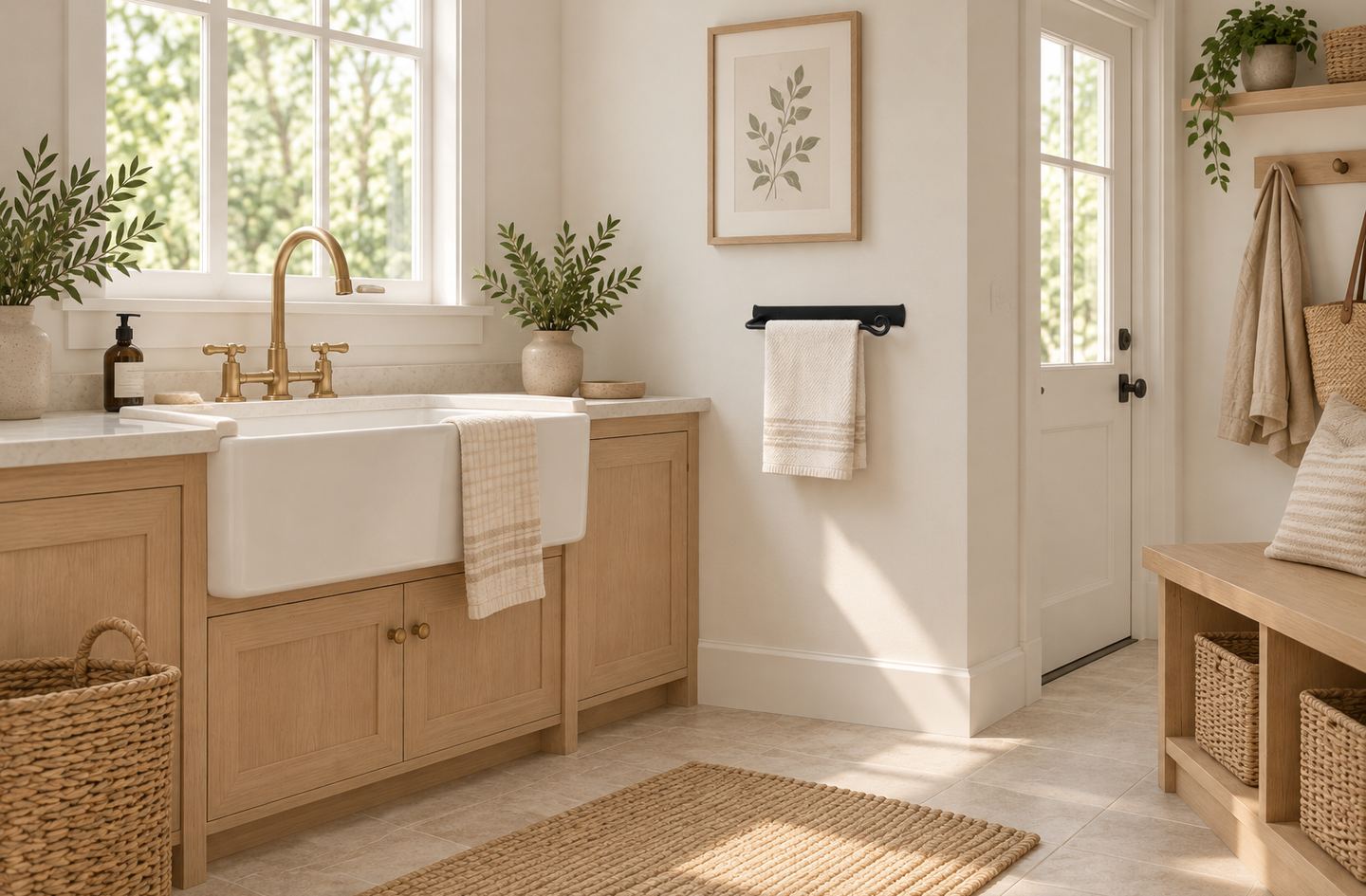
The hand towel bar belongs within one arm’s reach of the sink. Mount it on the wall, on the cabinet gable, or on the apron sink return, 42 to 48 inches above the finished floor. That range keeps the bar inside the ADA side-reach ceiling for operable parts, which the U.S. Access Board caps at 48 inches from the floor1. It also stops the towel from dropping onto a hot pan or into water in the basin.
For most single-cook households the hand towel bar or ring sits to the left of the faucet, at 44 to 46 inches. That is the shortest travel path from a wet hand to a dry cloth. Left-handed cooks flip the bar to the right side. Either way the anchor point is the faucet, not the wall stud.
The splash zone: leave 6 to 9 inches
Sink water carries. A hand towel mounted flush against the sink deck stays damp for hours after every rinse and stops drying at all if the household preps at the sink daily. Set the bar so the near edge of a hanging towel sits 6 to 9 inches beyond the sink lip. In the kitchens RTZEN’s workshop has documented across 1997 to 2026, that gap is where a hanging towel switches from “always damp” to “dry by morning”.
A classic hanger mounted on the cabinet return next to the sink usually clears the splash zone by default because the cabinet face already sits back from the sink lip. A bar mounted on the wall over the counter needs to be nudged sideways until the same clearance holds.
Where children and mixed households need a second height
The Access Board’s side-reach range spans 15 inches to 48 inches above the floor. The low end is what accessible mounts and children’s stations use1. A kitchen shared by kids and adults benefits from a second, lower hand towel bar at 34 to 38 inches. Mount it on the cabinet side or the apron return so a child can reach it without stepping on the dishwasher door.
Reach range is the vertical band inside which a user standing next to an element can operate it without leaning. The ADA sets it at 15 to 48 inches for an unobstructed side reach1. Mount the towel bar inside that band and adults, teenagers, and shorter cooks share the same hardware without arguments.
Drying method matters as much as height. The CDC states plainly that hands should be dried with a clean towel after washing, because germs transfer more easily when hands are wet4. A bar close enough to the sink to make a clean towel the easy choice is the point of the placement decision.
A hand towel bar 3 feet from the sink is a hand towel bar most kitchens stop using, and an unused bar is a wet cloth on the counter.
Give the Dish Towel Bar Its Own Real Estate
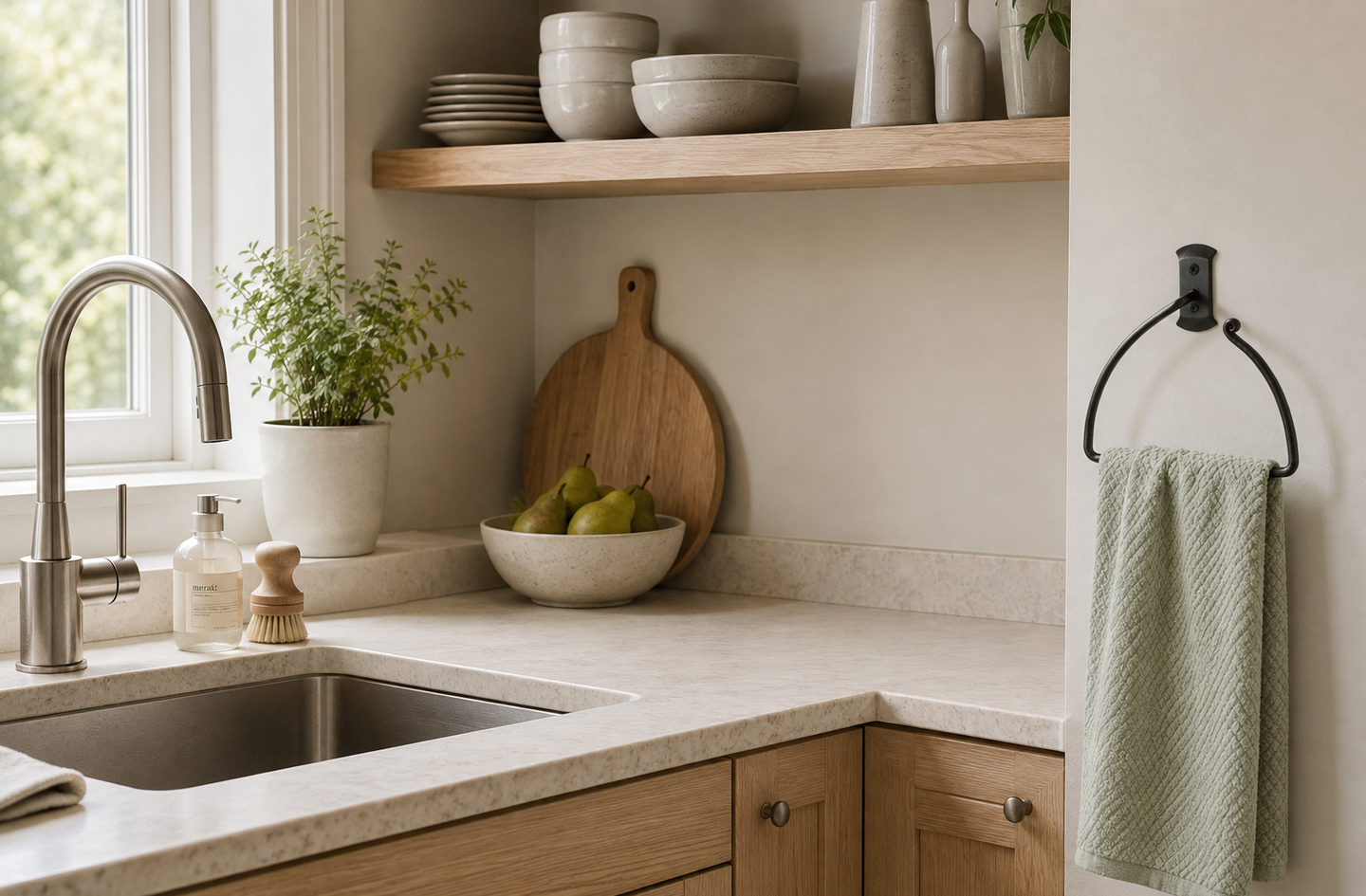
Put the dish towel bar in the cooking or prep zone. Good candidates include an island end, a cabinet gable next to the prep counter, or the underside of a wall cabinet away from any open burner. The dish towel gets used with dry hands, catches food spills, and dries pans as they land on the counter. That is a different job than sink drying, and it earns its own real estate.
The prep counter is usually the strongest candidate. A dish towel there works both directions: toward the sink for a rinse-and-wipe and toward the cooktop for a hot pan handle. Mount the bar within one step of the primary cutting board, at the same 42 to 48 inch band the hand towel bar uses. That way a household member can grab either towel without recalibrating.
The dish towel is the towel a cook actually uses during a meal. Its bar has to sit where the cook already stands, not where an empty wall invites a bar to go.
Keep the towel away from open flame
A dish towel mounted directly above a gas or electric cooktop is a fire risk, and manufacturers of range hoods routinely warn against fabric hanging within the burner zone. Keep the bar at least 12 inches sideways from the outer edge of the cooktop, and never in the direct rising path of steam or flame. A cabinet end 18 to 24 inches from the range edge is a common safe location that still puts the towel within one step of the burners.
Long bars, short bars, and rings on the island
Island ends are the most under-used dish towel location in a modern kitchen. A single long bar on an island gable holds a full dish towel flat for airflow. A hammer-nail hanger sized to that gable does the same job as three separate hooks with less visual noise. Where the gable is narrow, a hand towel ring returns the same accessibility in less width.
Under-cabinet mounting is the other quiet win. Fixing a short bar to the underside of an upper cabinet lifts the towel out of the counter’s usable area and keeps it visible without adding wall clutter. Confirm the cabinet floor is at least 3/4 inch of solid wood, not veneered particleboard, before drilling: an included wall anchor does not compensate for a hollow surface. See the step-by-step install process when the location is chosen.
Check Cabinet and Drawer Clearance Before You Commit
Before committing to a spot, open every door and drawer within 6 inches on both sides of the proposed bar and confirm nothing collides with a hanging towel. Cabinet clearances are the placement errors that surface a week after installation, not on the day of mounting, so a five-minute swing test earns the time back.
Landing zone refers to the counter or wall space a cook needs next to an appliance, a work surface, or a sink to set items down safely. The NKBA guidelines set specific minimums for each zone2. A towel bar shares the wall with those zones. It does not get to shrink them.
Upper cabinet swing and door hinges
An upper cabinet door swings out roughly 10 to 15 inches, depending on the hinge angle and the door width. A towel bar mounted on the wall directly under that door needs to sit deep enough on the wall that the open door clears the towel. Otherwise the bar moves sideways beyond the cabinet edge. Confirm by opening the door with a towel visually simulated in place.
Drawer and pull-out interference
Base cabinet drawers extend 20 to 24 inches when fully open on ball-bearing slides, and pantry pull-outs extend further. A towel bar mounted on the front of a base cabinet face has to sit above every drawer that might open beneath it. Hanging towels have to stop above the deepest pull-out. Trash pull-outs are the classic collision: the drawer clears the cabinet, but the towel does not clear the drawer’s rim.
The cabinet gable, or the vertical panel at the end of a cabinet run, is the safest mounting surface for a towel bar in most kitchens. A gable has no doors, no drawers, and no hardware behind it. A wall stud usually sits within an inch of the gable’s edge for anchor purchase, and the towel hangs into open floor space where nothing swings into it.
Solve Appliance Door Swings and Landing Zones
Map the arc of every appliance door before the towel bar goes on the wall. Dishwasher, oven, range, wall oven, warming drawer, microwave drawer, refrigerator, and beverage fridge each swing on their own hinge geometry. Each demands specific counter or floor clearance to load and unload safely.
The NKBA guidelines recommend a landing zone of at least 21 inches of counter frontage next to the dishwasher, measured from the edge of the dishwasher opening2. That 21 inches is where the cook sets a stack of plates on the way to the cabinet. A towel bar mounted on the wall above that landing zone must not force the cook to reach through the towel to set plates down.
A towel bar that fits every rule on paper but blocks the dishwasher door on Tuesday night is a failed bar, no matter how well the anchors are set.
Dishwasher door: the most common collision
A dishwasher door opens flat at 90 degrees and extends 22 to 24 inches into the aisle, then the racks pull out 18 to 20 inches further. A towel bar on the adjacent cabinet gable has to clear the fully open door AND the extended lower rack, or it will catch on the rack rail every wash cycle. Test by opening the door and pulling the lower rack all the way out before drilling any anchor.
Range, oven, and refrigerator arcs
Ovens under a cooktop drop straight down, and the door lies flat at roughly 18 inches out. Refrigerator doors swing well past a right angle and travel 28 to 36 inches out from the closed face, with French-door refrigerators splitting that arc between two doors. A towel bar hidden behind an open refrigerator door means a wet towel every time someone stores groceries.
Under-cabinet microwaves and drawer microwaves add another arc that gets overlooked. A drawer microwave slides forward 16 to 18 inches, and a towel bar on the adjacent gable at counter height has to clear that slide. The safest mounting rule stays the same across every appliance: open the door, pull out the drawer, then place the bar.
Preserve Walking Paths and Multi-Cook Aisles
The bar cannot narrow the walkway or the work aisle. The NKBA sets the walkway minimum at 36 inches, the single-cook work aisle at 42 inches, and the multi-cook work aisle at 48 inches2. Those figures are measured between counter frontage, tall cabinets, and appliances. A towel bar that sticks out 4 inches into a 42-inch aisle turns it into a 38-inch aisle, and hips catch.
Work aisle refers to the standing space between two runs of cabinets, appliances, or tall furniture where the cook prepares food. The NKBA sizes it wider than a walkway because a working cook uses more room than a person passing through2. A bar takes some of that width whenever it sits inside the aisle. Mount the bar on the aisle’s outer wall or on a gable that faces away from the aisle, so the towel hangs into open floor.
The kitchen work triangle still matters for towel bars
The NKBA work triangle rules keep every leg between 4 and 9 feet and cap the total perimeter at 26 feet, and no major traffic pattern should cross the triangle2. A towel bar mounted inside the triangle is a bar the cook actually uses; a bar mounted outside the triangle collects house guests and mail. Map the triangle first, then choose the bar’s wall.
Multi-cook households need the extra 6 inches of aisle for a reason: two people passing each other with pans in hand cannot share a 42-inch aisle safely. Where the household has two cooks and one 42-inch aisle, mount the towel bars on the outer walls only, and skip the island-facing side of the aisle entirely.
Common Placement Mistakes to Avoid
Five patterns cover most of the placement errors RTZEN sees in customer photos and installation questions each year. Each one has a specific fix that costs nothing at the planning stage and hundreds of dollars in redone drywall after the bar has been in place for a month.
1. Mounting the hand towel bar directly above the sink deck. The towel stays damp, the bar splashes on every rinse, and the wet towel becomes the cross-contamination source the two-bar split was meant to prevent. Move the bar 6 to 9 inches beyond the sink lip onto a wall or cabinet return.
2. Choosing a wall stretch without swinging every door and drawer first. A bar that looks perfect at 10 a.m. becomes a collision at 6 p.m. when the trash pull-out extends. Open every door and drawer within 6 inches of the proposed mount before drilling.
3. Mounting inside a 42-inch aisle at hip height. The bar and a hanging towel narrow the aisle by 3 to 5 inches, and the cook catches a hip on every trip. Move the bar to the outer wall or above hip height, at 48 inches or higher.
4. Placing a dish towel bar above the cooktop. A hanging towel over open flame is a fire risk. Move the bar 12 inches or more sideways from the cooktop’s outer edge, and never mount it in the vertical steam path.
5. Using one bar for hand and dish drying. The bar sits in the wrong place for one of the two jobs, and both towels stay damp. Set two bars in two zones and pick the size for each job separately, using the sibling bar-length guide as the reference.
What Good Kitchen Towel Bar Placement Looks Like
A well-placed pair of kitchen towel bars looks almost invisible. The hand towel sits within one arm’s reach of the sink, 42 to 48 inches from the floor, on a wall or cabinet return that clears the splash zone. The dish towel lives on the island end, on the prep-counter gable, or under a wall cabinet in the cooking zone. Both bars sit inside the ADA side-reach ceiling of 48 inches1, and neither narrows the NKBA work aisle below 42 inches for one cook or 48 inches for two2.
Every appliance door swings clean, every drawer extends without catching a towel, and the walking path stays at least 36 inches wide from countertop to the opposite wall2. The bars are made of solid wrought iron so they hold the weight of a wet bath towel through a wet week. A rust-resistant finish protects the bar through kitchen humidity for years of daily use.
The final test is boring on purpose: the household stops thinking about the towel bar, because it works.
Frequently Asked Questions
What is the standard mounting height for a kitchen towel bar?
Mount a kitchen towel bar 42 to 48 inches above the finished floor for adult users. The ADA side-reach range caps operable parts at 48 inches from the floor1. Kitchens shared with children work best with a second bar at 34 to 38 inches on a cabinet gable or apron return.
How far from the sink should the hand towel bar sit?
Position the hand towel bar so a hanging towel’s near edge sits 6 to 9 inches past the sink lip. That gap clears the splash zone, keeps the towel dry enough to reuse, and still allows a wet-handed cook to reach the towel in one step without turning.
Can one bar hold both the hand towel and the dish towel?
One bar for both jobs usually fails at both. A 2018 study found bacterial growth on 49 percent of used household kitchen towels, with multi-purpose towels carrying higher loads than single-use ones3. Two bars in two zones cost slightly more wall space and prevent that cross-use.
Should the dish towel bar go above the cooktop?
No: hanging fabric above open flame or a hot electric coil is a fire risk. Keep the dish towel bar at least 12 inches sideways from the cooktop’s outer edge, on a cabinet gable, an island end, or under an upper cabinet at least one bay away from the burners.
What clearance should stay between the bar and a dishwasher?
Preserve the NKBA’s 21-inch counter landing zone next to the dishwasher opening2. Open the dishwasher door flat and pull the lower rack out fully before drilling any anchor: the bar has to clear both the door arc and the extended rack rail on every wash cycle.
Limitations and Edge Cases
- Clearance figures cite US design guidance from the NKBA and US accessibility standards from the ADA reach-range guide; international kitchen codes and metric conventions differ.
- The guide assumes wall-mounted bars on drywall, tile, or wood cabinet gables; freestanding towel stands, over-cabinet-door hangers, and magnetic hooks follow different placement logic.
- Sizing choices for 18-, 24-, and 30-inch bars live in the sibling bar length guide; the drilling and anchoring steps live in the sibling installation walkthrough.
References
Methodology: every figure below comes from an independent, non-competitor published source, each URL was verified live on the publication date of this article, and the article follows the RTZEN editorial methodology of two-yearly review by the founding designer.
- U.S. Access Board – Guide to the ADA Standards, Chapter 3: Operable Parts (reach ranges, section 308), 2024.
- National Kitchen and Bath Association – Kitchen Planning Guidelines with Access Standards (walkways, work aisles, landing zones, work triangle), 2022 revision.
- Popular Science – Reporting on Biranjia-Hurdoyal and Moodelly, “Role of kitchen towel as risk factor for home-based food poisoning,” presented at ASM Microbe 2018, published June 2018.
- Centers for Disease Control and Prevention – Hand Hygiene Frequently Asked Questions (clean-towel drying guidance), updated 2024.
Conclusion
Kitchen towel bar placement comes down to two decisions made in the right order: split hand and dish drying into two zones, then respect the NKBA aisle minimums and the ADA reach range at every step. When both rules hold, the bar disappears into daily use, which is the point.
For the broader view of the category, see the towel racks overview for how kitchen placement fits alongside bathroom and laundry hardware.