
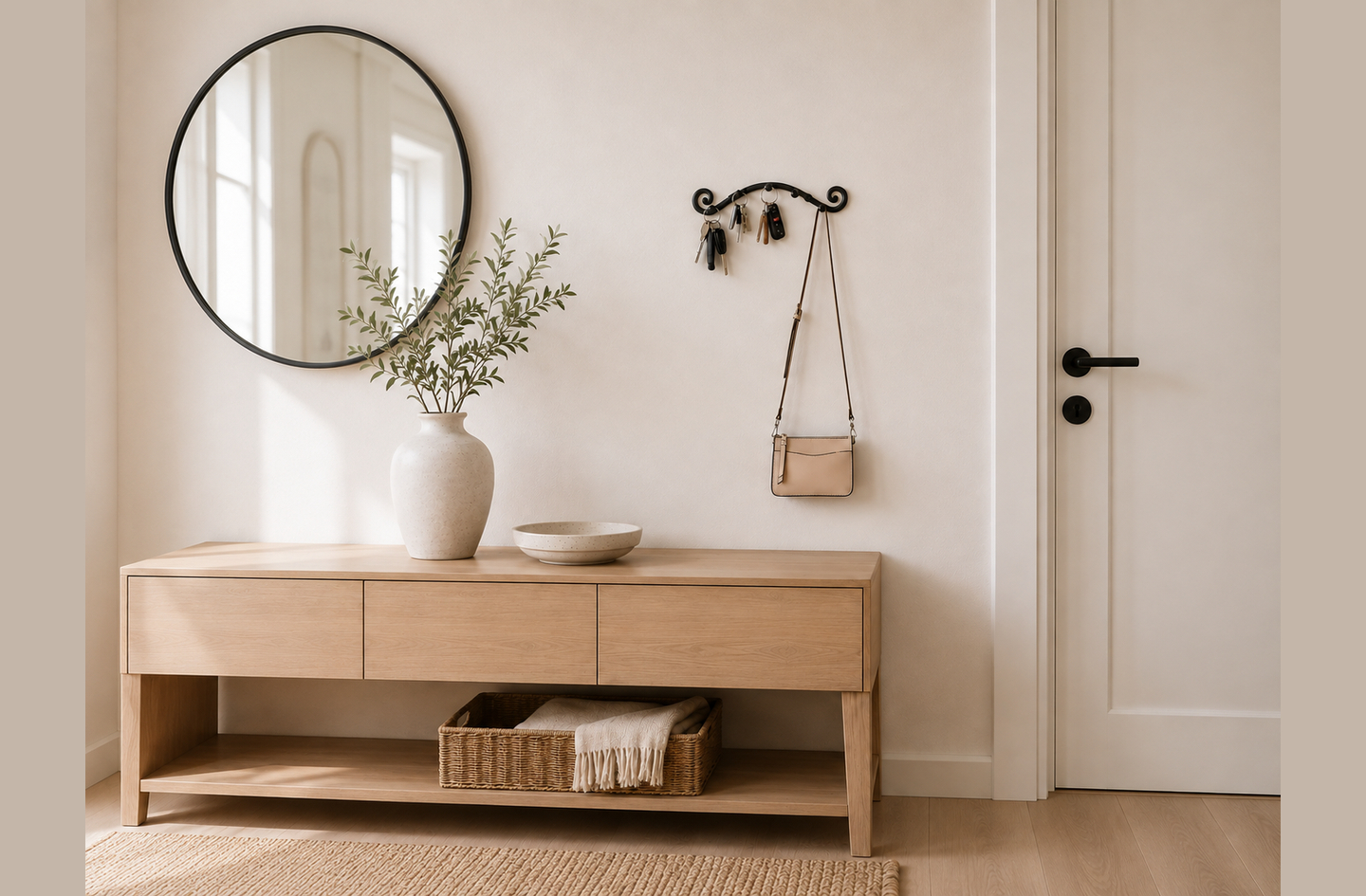
A wall-mounted key holder gives every set of keys a fixed home near the door, replacing the daily search across countertops, pockets, and random surfaces. Most consist of a metal backplate fitted with three to six hooks, mounting to the wall with screws, anchors, or adhesive pads. This complete guide covers every decision in the key holder category: location, mounting method, hook count, material, finish, and organization system, with routes to deeper guides on each topic.
Quick Answer
What is a Key Holder?
A key holder is a wall-mounted hook rack that gives keys a fixed spot near the door. Most households need three to five hooks: one per regular key set plus one or two spares. The rack mounts at 60 to 66 inches from the floor for comfortable adult reach and installs with standard drywall screws or toggle anchors.
Why it matters:
A fixed drop zone near the entryway eliminates the daily search for misplaced keys and builds a consistent departure routine. Wrought iron racks outlast stamped metal because forged iron holds its shape and finish under repeated daily use.
Key Takeaways
- Most households fit a three-hook or five-hook rack: one hook per person or key set, plus one or two spares.
- The practical mounting height for most adults is 60 to 66 inches from the floor; the ADA accessible limit for forward reach is 48 inches.
- Wall anchors, not the holder itself, determine the practical load capacity for heavier items like leashes and bags.
- Wrought iron outperforms stamped or hollow metal because forged construction keeps hooks rigid under daily loading.
- Vertical holders fit narrow walls; horizontal racks suit standard entryways and serve families with multiple hook assignments.
Key Holders in 30 Seconds
| If you are… | Do this |
|---|---|
| A renter avoiding permanent holes | Choose a no-drill adhesive holder for smooth painted walls |
| A household of three or more | Use a five-hook horizontal rack and assign one hook per person |
| Working with a narrow wall strip | Mount a vertical single-column holder to use height instead of width |
| Matching existing black door hardware | Select a matte black wrought iron rack for a consistent finish |
| Storing keys plus a dog leash | Choose a rack with hooks rated for at least 10 lbs of load |
| Installing on brick or concrete | Drill masonry anchors; adhesive backing will not hold on porous surfaces |
What Is a Key Holder?
A key holder is a wall-mounted rack designed to store keys near the main entrance of a home, office, or regularly accessed space. The core piece is a backplate, usually metal or a combination of metal and wood, with two to six hooks projecting forward far enough to clear key rings without the keys dragging against the wall. Most install above a console table, bench, or clear wall strip beside the front door.
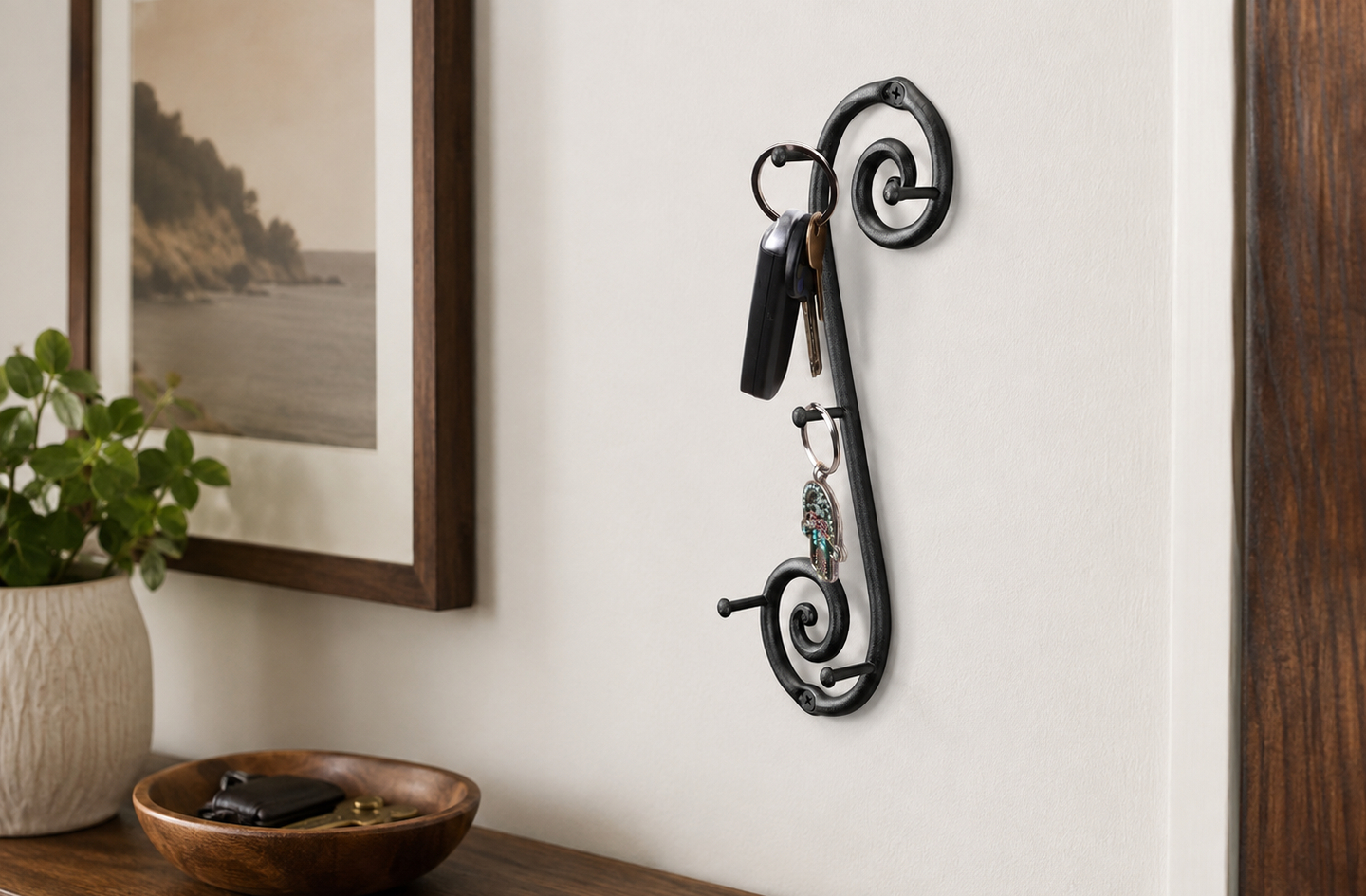
The category spans several product types. Horizontal racks, the most common form, spread hooks across a single bar and suit standard entryways. Vertical holders stack hooks in a column and fit narrow wall strips beside door frames. Racks with an integrated shelf add a flat landing surface for wallets, phones, or small accessories. Multi-function designs combine key hooks with coat hooks, mail slots, or leash storage for a single entryway fixture.
Key holders mount in three main ways: through screws into drywall or studs, through masonry anchors into brick or concrete, or through adhesive pads on smooth painted walls. The right mounting method depends on wall material, expected load, and whether the installation needs to be reversible. The holder itself is rarely the limiting factor for weight; the fastener and wall surface determine the practical capacity.
Why Key Holders Matter
The primary benefit of a wall-mounted key holder is habit formation. When keys have a fixed spot at eye level near the door, the act of hanging them becomes automatic within a few days. Without a fixed location, keys end up in pockets, on countertops, inside bags, or on random hooks around the house. A different spot every day is what drives the morning search.
Approximately 65 percent of US households are owner-occupied5, meaning the majority of residents can install a permanent screw-mounted rack without landlord approval. For renters, no-drill adhesive and magnetic options hold enough weight for keys without damaging the wall surface.
Beyond keys, most wall-mounted racks naturally handle leash storage, bag hooks, and hat hangers. A five-hook rack near the door serves the full range of daily essentials for most households at a single departure point, which removes the multiple-location search that costs the most time each morning.
- A fixed drop zone near the door shortens departure time and reduces missed items.
- Wall-mounted hooks keep countertops clear for other uses.
- Assigned hooks prevent key mix-ups in households with multiple drivers or key sets.
The Six-Part Key Holder Framework
Every key holder decision falls into one of six dimensions. Choosing well in each dimension in order produces a rack that gets used every day. Skipping any dimension produces a rack that looks right but fails on installation, reach, or habit.
Location, Height, and Placement
The single most important decision is where to mount the holder. The location must sit within natural reach at the moment of arrival or departure, which almost always means the wall nearest the entry door. Entryway walls beside or opposite the front door are the default. Bedroom walls work for personal jewelry and secondary keys. Kitchen walls suit utility keys and charging cables when the entryway is too small for a rack.
Mounting height determines daily usability. Most adults hang a key holder at 60 to 66 inches from the floor, keeping hooks at roughly shoulder and eye level. For households with children or wheelchair users, the ADA specifies that unobstructed forward reach must not exceed 48 inches from the floor1, and side reach with an obstruction is permitted up to 54 inches1. Door swing is the primary clearance constraint: the holder must sit at least 6 inches from the door frame to avoid being blocked when the door is open.
Deeper read: Key Hanger Placement by Room.
Deeper read: Compact Key Holder Ideas for Small Entryways.
Deeper read: key holder height, placement, and mounting location.
Mounting Methods and Wall Surfaces
Wall type determines the mounting method before anything else. Standard drywall with wood studs accepts ordinary wood screws without anchors when the holder spans a stud. Standard residential wall studs are spaced 16 inches on center2, so a holder at least 16 inches wide nearly always lands over one. When no stud aligns, a toggle bolt or winged drywall anchor fills the gap. Plaster walls over wood lath need a smaller screw gauge and a slower, more careful pilot-hole approach. Concrete and masonry require a hammer drill, a masonry bit, and a rated masonry anchor for the expected load.
Adhesive and magnetic mounts avoid drilling entirely. Most peel-and-stick strips support three to five pounds per strip, which handles a single key ring but not a leash or a bag. Renter-safe no-drill options make practical sense only when the expected load stays at keys alone.
Deeper read: no-drill versus screw-mounted key holders for renters and homeowners.
Deeper read: installing a wall-mounted key holder on drywall, plaster, or wood.
Deeper read: mounting a key holder on brick, concrete, or tile.
Form, Size, and Hook Configuration
The physical form of the holder determines how it fits the wall and how many items it separates. Horizontal racks spread hooks across a bar, typically 8 to 18 inches wide, and suit walls beside console tables or between doors and windows. Vertical holders use height instead of width, fitting a 3-to-5-inch strip beside a door frame or in a corner. Racks with an integrated shelf add a 2-to-4-inch-deep landing surface for wallets, sunglasses, or a small tray.
Hook count should match household size. A three-hook rack serves one or two people with one key set each and one spare. A five-hook rack covers a family of four with one hook per adult set plus one shared or utility hook. Beyond five hooks, visual clutter becomes a concern, and a full coat rack or mudroom system usually serves the space better than an oversized key holder.
Deeper read: key holder with shelf versus hook-only rack.
Deeper read: vertical versus horizontal key holders.
Deeper read: how many hooks a key holder should have.
Deeper read: key hook shape, spacing, and what each hook should hold.
Material, Construction, and Finish
The base material determines how a key holder ages over years of daily contact. Wrought iron, hand-forged and finished with a dual zinc-and-powder-coat system, resists rust and keeps hooks rigid through years of repeated hanging. Cast iron is heavier and more brittle; it holds shape well but chips on impact. Stamped or hollow steel is the most common mass-market material and the weakest in its thinnest forms: hooks on stamped sheet metal bend or separate from the backplate under repeated loads.
Finish determines maintenance and visual match. Matte black suits most door hardware and cabinet pulls. White finishes suit light-painted walls and coastal or cottage interiors. Antique brushed zinc works in farmhouse and rustic rooms where warm metal tones anchor the design. A 3/16-inch toggle bolt holds 90 to 110 pounds in standard drywall3, meaning the anchor rarely fails before a poorly welded hook does. A 1/8-inch toggle bolt holds 30 to 55 pounds4, which is more than enough for keys but borders on marginal for a leash plus keys combined.
Deeper read: cast iron versus wrought iron versus steel key holders.
Deeper read: what determines load capacity on a wall-mounted key rack.
Deeper read: matching key holder finish to entryway hardware.
Deeper read: what hand-forged construction changes in a wrought iron key holder.
Organization, Systems, and Multi-Function Use
A key holder becomes far more useful with a deliberate organization system. Assigning one hook per person or key set, then labeling hooks with a small tag, prevents mix-ups in households where multiple sets look similar. Spare and utility keys benefit from a designated hook at the far end of the rack, visually separated from daily-use positions.
Multi-function racks extend the holder’s role beyond keys. A combined coat-and-key rack integrates heavier-duty hooks for outerwear with lighter key hooks, but it requires sturdier mounting because coats and bags load the upper hooks with two to five pounds each. Mail slots add incoming-mail storage to the entryway without a separate fixture. Dog leash hooks work when the hook tip is large enough for a loop handle and the mounting fastener handles the intermittent tug load of a dog pulling toward the door.
Deeper read: setting up a wall-mounted key organizer for an entryway that stays tidy.
Deeper read: organizing family, spare, and shared keys on one wall rack.
Deeper read: coat and key rack with shelf as a single entryway organizer.
Deeper read: mail and key holder for wall organization.
Deeper read: using a wall key holder as a dog leash station.
Style, Buying Decisions, and Custom Options
Key holders span a wide decorative range without changing their core function. Modern and minimalist designs use clean horizontal bars or geometric motifs. Farmhouse and rustic options lean on scrollwork, hand-forged curves, and dark iron or antique-finish metal. Bohemian and vintage styles incorporate decorative motifs like stars, botanicals, or hand-hammered texture. A decorative key holder that coordinates with the entryway mirror, console hardware, and light fixture reads as part of the room rather than a functional afterthought.
Wall-mounted racks typically outperform countertop key bowls and trays on habit reliability. A hook at a fixed height is easier to build into an arrival routine than a bowl that competes with other countertop items and accumulates keys alongside phone chargers, change, and receipts. For households that prefer a countertop solution, a tray with a defined key position works, but the habit tends to erode faster without the physical hook to hang from.
Deeper read: key rack organizer versus key bowl or tray.
Deeper read: DIY wall key holder with a custom rack and decorative hooks.
Deeper read: how to choose a wall key holder.
Deeper read: decorative wall key holders that match style to function.
How to Choose the Right Key Holder
The single most important criterion is household size. Match hook count to the number of regular key sets in the home, add one or two spare hooks, then stop. An oversized rack with many empty hooks fills with non-key items within a week and becomes a cluttered catch-all.
- Count key sets. One hook per person or vehicle, plus one shared or spare hook. Most households land at three to five hooks.
- Check the wall material. Drywall with accessible studs supports screws directly. Masonry requires a hammer drill and masonry anchors. Smooth painted walls without drilling need quality adhesive strips sized for the expected load.
- Measure available wall width. A horizontal five-hook rack needs at least 14 to 18 inches of clear wall. A vertical rack needs only 3 to 5 inches of width but requires ceiling clearance above it.
- Confirm door clearance. The holder should sit at least 6 inches from the door frame so the door swings without catching the hooks.
- Identify total load. Keys weigh almost nothing. A dog leash, a small bag, or a set of car keys with a heavy fob can add one to three pounds per hook. Size the anchor for the heaviest realistic load, not just the keys.
| Criterion | Practical guideline |
|---|---|
| Hook count | 1 per key set + 1-2 spares (3-5 total for most households) |
| Mounting height | 60-66 inches for adults; 48 inches max for accessible forward reach1 |
| Wall clearance from door frame | At least 6 inches on hinge side, more on strike side |
| Anchor type | Wood screw into stud; toggle bolt for drywall without stud; masonry anchor for concrete or brick |
| Finish match | Match the dominant hardware finish in the entryway (door handle, hinges, light fixture) |
Compare All Key Holder Types
| Criteria | Horizontal Rack | Vertical Rack | With Shelf | Multi-Function | Adhesive / No-Drill |
|---|---|---|---|---|---|
| Typical width | 8-18 inches | 3-5 inches | 8-18 inches | 12-24 inches | 4-10 inches |
| Hook count | 3-7 | 3-6 | 3-5 | 4-10 | 2-4 |
| Wall depth needed | Minimal | Minimal | 3-5 inches for shelf | Moderate | None |
| Best load | Keys, light accessories | Keys, small fobs | Keys, wallet, glasses | Keys, coats, leashes, bags | Keys only |
| Installation | Screws or anchors | Screws or anchors | Screws or anchors | Screws into studs | Adhesive pads |
| Best for | Standard entryways | Narrow strips, beside door frame | Small-space convenience | Mudrooms, high-traffic entries | Renters, temporary setups |
Choose a horizontal rack if: the wall has at least 14 inches of unobstructed width and the household needs three or more hook positions.
Choose a vertical rack if: the only open wall space is a narrow strip between the door frame and nearby trim or furniture.
Choose a rack with shelf if: a landing surface for wallets, phones, or sunglasses would eliminate a second fixture nearby.
Choose a multi-function rack if: keys, coats, and bags all need organized positions at the same wall location.
Choose a no-drill adhesive option if: the installation must be fully reversible with no marks and the total load stays at keys only.
Deeper read: vertical versus horizontal key holders by wall fit.
Common Mistakes
Mistake 1: Mounting too close to the door swing
Why it is a mistake: When the holder sits within the door’s swing arc, the door blocks access to the hooks on every entry or blocks the holder completely when open. On inward-swinging doors, the holder is unreachable until the door closes.
What to do instead: Test the door swing with a piece of tape on the wall first. Mount the holder at least 6 inches beyond the swing radius on the hinge side, or move it to the wall directly opposite the door.
Deeper read: key hanger placement by room and door position.
Mistake 2: Choosing too many hooks
Why it is a mistake: Empty hooks collect non-key items within days. Hats, sunglasses, charging cables, and miscellaneous accessories fill unused hooks, which turns a tidy key rack into an unorganized catch-all and defeats the purpose of the fixture.
What to do instead: Count the key sets in the household, add one or two spare hooks for guests or utility keys, and select a rack that size. A full rack looks better and stays more functional than a half-empty one.
Deeper read: choosing the right hook count for a key holder.
Mistake 3: Using adhesive on a textured or porous wall surface
Why it is a mistake: Peel-and-stick adhesive strips need a smooth, clean, non-porous surface to form a reliable bond. Textured paint, plaster with a sand finish, wallpaper, or brick surfaces all interrupt adhesion. The holder typically holds for a short time and then fails without warning, dropping keys and sometimes pulling a strip of paint off with it.
What to do instead: Check the wall surface before selecting a mounting method. Run a hand across the wall. If it is not perfectly smooth, use screws. If holes are not acceptable, a thin piece of smooth-faced material (such as a small wood panel) can create an adhesion surface over the textured wall.
Deeper read: no-drill versus screw-mounted key holders for different wall surfaces.
Mistake 4: Sizing the anchor for keys instead of the total load
Why it is a mistake: Keys weigh almost nothing on their own. But a dog leash, a small crossbody bag, a set of car keys with a heavy fob, or a lanyard with ID badge can add one to three pounds per hook. Over time, a hook system anchored only for key weight fails or tilts in the wall from cumulative load and repeated removal.
What to do instead: Identify the heaviest item that will realistically hang from the rack, and select an anchor rated for at least three times that weight. A toggle bolt rated for 30 to 55 pounds at the 1/8-inch size4 handles keys and a leash without margin issues.
Deeper read: what determines load capacity on a wall-mounted key rack.
Mistake 5: Installing at an inconvenient height
Why it is a mistake: Hooks set too high require deliberate reaching with each use. Hooks set too low require stooping. Both habits break faster than a comfortable, natural grab-and-go motion. Habits depend on the action feeling effortless; awkward height removes that effortlessness.
What to do instead: Mark the target height on the wall with a piece of tape and practice the motion before drilling. Most adults land at 60 to 66 inches. Households with children or mobility considerations should verify that the chosen height works for everyone who will use the rack daily.
Deeper read: key holder mounting height, placement, and best location.
Best Key Holders by Use Case
Best for a Single Person or Small Household
A three-hook compact holder beside the front door gives each person one hook plus a shared spare. Vertical designs fit particularly tight spots next to door frames.
Deeper read: compact key holder ideas for small entryways and narrow walls.
Best for a Family with Multiple Key Sets
A five-hook horizontal rack with assigned hook positions prevents daily mix-ups. A spare hook at the far end keeps guest and utility keys separate from daily-use positions.
Deeper read: organizing family, spare, and shared keys on one wall rack.
Best for a Renter in a Short-Term Space
A no-drill adhesive or magnetic holder gives renters a key drop zone without wall damage. Verify the wall is smooth and non-textured before committing; adhesive strips fail on painted texture.
Deeper read: no-drill versus screw-mounted key holders for renters and homeowners.
Best for a Design-Conscious Entryway
Matching the key holder finish to door handles and light fixtures makes the rack look built-in rather than added. Black iron suits farmhouse and industrial spaces; white suits coastal and cottage styles.
Deeper read: matching key holder finish to entryway hardware and wall color.
Best for a Dog Owner Who Also Needs Leash Storage
A rack with curved hooks large enough for a leash loop handles key rings and a folded leash without tangling. Toggle-bolt mounting handles the intermittent pull load of lifting a leash with a dog attached.
Deeper read: using a wall key holder as a dog leash station.
Frequently Asked Questions
What is the best height to mount a key holder?
Most adults find 60 to 66 inches above the floor comfortable for a grab-and-go motion. ADA guidelines set 48 inches as the maximum forward reach height and 54 inches for side reach.1 For households with children or seated users, mount at the lower end of that range.
How many hooks does a key holder need?
One hook per person or regular key set, plus one or two spare hooks for guests, covers most households. A three-hook holder suits one or two users; a five-hook holder handles a family of three or four. More hooks than needed tend to accumulate non-key items within weeks.
What anchors should I use when no wall stud is available?
What is the difference between wrought iron and cast iron for key holders?
Wrought iron is worked while hot, producing a fibrous grain that handles repeated bending load well. Cast iron is poured into molds and is stronger under compression but brittle under lateral force. For key hooks subject to repeated hang-and-remove loads, wrought iron’s ductility is the practical advantage.
Can a wall key holder also hold leashes, bags, or other accessories?
Hooks sized for key rings handle lightweight accessories including lanyards, small bags, and dog leashes in most cases. The limits are the hook’s opening gap and the anchor’s rated load. If a leash or bag is the primary item, a hook and anchor rated for that weight is a more appropriate fit.
What This Guide Does Not Cover
This hub covers wall-mounted mechanical key holders. Bluetooth key finders, NFC tags, and smart key locators are out of scope. Step-by-step installation instructions for specific RTZEN models are on each product page and in the wall mount installation guide.
References
- U.S. Access Board. Americans with Disabilities Act Accessibility Guidelines: Reach Ranges, Section 308. Washington, D.C.: U.S. Access Board, 2010. access-board.gov
- International Code Council. International Residential Code for One- and Two-Family Dwellings (IRC 2024), Section R602: Wood Wall Framing. Country Club Hills, IL: ICC, 2024. codes.iccsafe.org
- Tanner Resources Inc. Toggle Bolt Holding Power in Drywall. Tanner Resources, 2023. tannerresources.com
- All Points Fasteners. Toggle Bolt Specifications and Load Ratings. All Points Fasteners, 2024. allpointsfasteners.com
- U.S. Census Bureau. Homeownership Rate in the United States: 2024 Annual Survey. Washington, D.C.: U.S. Census Bureau, 2024. census.gov
Summary
A wall-mounted key holder is a simple fixture with a meaningful effect on daily entry and exit. Getting it right means choosing the correct hook count for the household, picking a material and finish that fits the entryway hardware, mounting at a height everyone can reach without effort, and using an anchor rated for the total load rather than just the weight of keys.
Hand-forged wrought iron key holders outlast stamped or cast alternatives in both surface durability and hook strength under repeated use. The RTZEN catalog covers horizontal and vertical formats in black and white finishes, each backed by a Lifetime Warranty covering material and workmanship defects under normal use.
The next practical step after choosing a key holder is getting the mounting right. The guide below covers installation on drywall, plaster, and wood surfaces with step-by-step detail:
Key Holders Wall Mount: How to Install on Drywall, Plaster or Wood