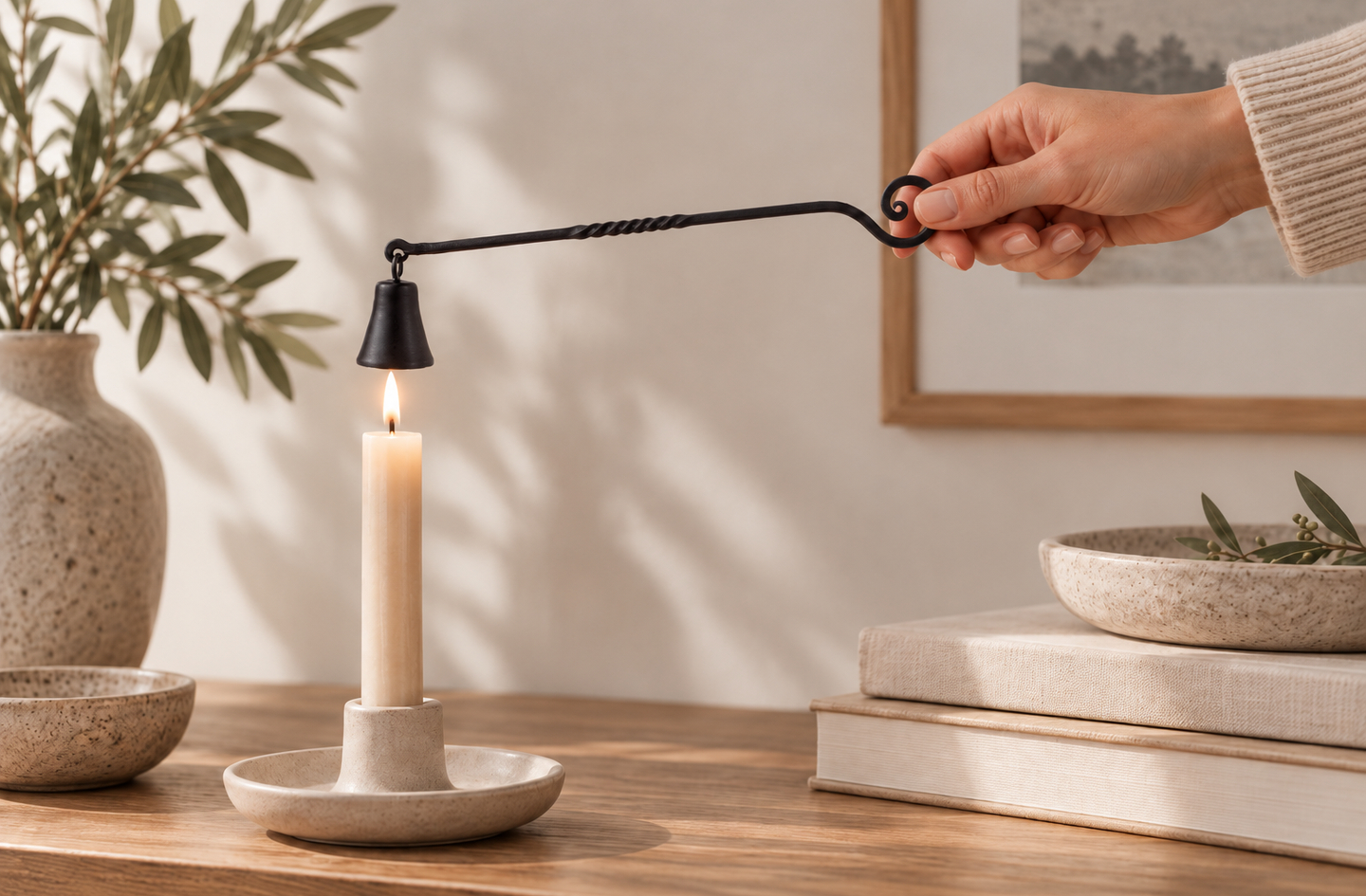
Learning how to choose a candle snuffer starts with the candles a household actually burns, not with the tool. This buyer’s checklist sits under the candle snuffers overview, which introduces the topic as a whole. The National Candle Association (NCA) reports that container and jar candles are the most popular type with American consumers2. Approximately three-fourths of candle users say they typically burn candles for 4 hours or less per sitting2. Each of those sessions ends with putting out a flame, so bell fit, reach and grip decide the tool’s value.
Quick Answer
What should a buyer check when choosing a candle snuffer for daily use?
Start with bell fit: the bell has to cover the widest flame in the home without touching wax or glass. Then confirm usable reach for the deepest jar and a slim handle. CCOHS recommends a handle diameter of about 12 mm for precision grips6. After that, check for an even heat-resistant finish, tight joints, dry storage and written warranty terms. Material and decoration come after those working checks.
Key Takeaways
- The National Candle Association advises putting candles out with a snuffer or a gentle breath, and warns that water can make hot wax splatter1.
- Usable reach is the length beyond the hand, not the overall length. CCOHS wants tool handles to span the palm, at no less than 100 mm (4 in)6, and the gripped part never reaches the flame.
- Among iron, stainless steel, brass and copper, heat flow differs far more than weight. Engineering ToolBox lists copper at 390 W/mK against 59 W/mK for wrought iron4.
- The Canadian Conservation Institute states that all iron rusts when relative humidity rises over about 65%7. A damp windowsill is a poor home for any iron tool.
- A common misconception is that longer is always better. Past the reach a household needs, extra length only moves the bell further from a steady hand.
Before You Shop: List the Candles the Snuffer Will Serve
The right snuffer depends on the candle mix in the home, so the first job is an inventory rather than a product search. Note each candle’s type, its height, the width of any jar opening and the room where it burns. Candle users tell the NCA they burn candles most often in the living room (42%), followed by the kitchen (18%) and the bedroom (13%)2. Those rooms decide where the snuffer will live between uses.
A candle snuffer is a hand tool that puts out a flame without blowing, by lowering a small bell over it or pinching the wick. Because it needs no breath, it leaves the wax pool undisturbed.
- Candle types: tapers, pillars, jars, tealights, multi-wick and wooden-wick candles each place the flame differently.
- Deepest container: measure the tallest jar from the rim down to the inside base with a ruler.
- Narrowest opening: measure the inside width of the smallest jar mouth in the house.
- Who will use it: note any user with small hands, a weak grip or stiff joints.
- Gift or household tool: a gift has to work with candles the giver has never seen.
That last point matters for many buyers. The NCA reports that candle purchasers view candles as an appropriate holiday gift (76%), housewarming gift (74%) and hostess gift (66%)2. A snuffer given with a candle has to suit that candle and the jars already in the recipient’s home. A versatile bell and a medium reach make the safer gift.
A few minutes with a ruler and the household’s candles prevents the most common buying error: choosing a snuffer for one candle while owning five others.
Step 1: Choose Between a Pinch Snuffer and a Bell Snuffer
For daily use across mixed candles, a bell snuffer is the more versatile choice, while a pinch snuffer suits households that burn mostly tapers. The two tools put out a flame in different ways, and that difference decides where each one works.
A bell snuffer is a snuffer whose small cup settles over the flame and starves it of air. A pinch snuffer is a tong or scissor-style tool that closes two small pads or cups directly on the wick. CCOHS defines a pinch grip as holding an object between the thumb and fingers of a single hand6. A pinch snuffer is worked with that kind of grip.
Where a bell snuffer works and where a pinch snuffer struggles
A bell needs only enough space above the flame to settle over it, so it works on tapers, pillars, jars, tealights and lanterns. A pinch tool needs a clear, exposed wick that its jaws can reach from the side. That makes it quick on a taper and awkward in a deep jar, where the glass walls block the jaws. Wide wooden wicks and multi-wick candles add another limit, because small jaws close on one narrow wick at a time.
Smoke, wax and the extinguishing habit that matters for both tools
The National Candle Association recommends a snuffer or a gentle breath for putting out a flame. It also advises double-checking the wick to ensure it is fully extinguished1. A bell leaves the wick untouched, so the wick stays upright and ready for the next lighting. A pinch tool presses the burning tip directly, which can bend a soft cotton wick down into the wax.
A home with jars, pillars and tapers is best served by one bell snuffer. A pinch tool earns a place only as a second tool for a taper-heavy dining table.
Step 2: Pick the Material for Weight, Heat and Wear
Among the dense metals used for snuffers, material changes how fast the tool carries heat far more than its weight in the hand. Engineering ToolBox lists wrought iron at 7750 kg/m³ and yellow brass at 8470 kg/m³3. Its thermal conductivity table puts yellow brass at 111 W/mK and wrought iron at 59 W/mK4. By RTZEN’s calculation from those two tables, brass is about 9% denser than wrought iron but passes heat almost twice as fast34.
Thermal conductivity is the rate at which heat moves through a material, measured in watts per meter-kelvin (W/mK). A higher figure means heat from a hot bell travels up the shaft toward the fingers sooner.
- Wrought or forged iron: dense and slow to pass heat at 59 W/mK4, and shaped by heating and hammering. Bare iron rusts, so the finish carries much of the long-term value.
- Stainless steel: the slowest heat path in the group, at 14.4 W/mK for Type 3044, with a density range of 7480 to 8000 kg/m³3. It resists rust without a coating.
- Brass and copper: heavier than iron and much faster to pass heat, with electrolytic copper listed at 390 W/mK4. Both darken with tarnish over time.
- Aluminum: the lightest option at 2730 kg/m³ for rolled 3003 alloy3, yet quick to pass heat at 190 W/mK4. A very light tool gives less feedback when the bell touches something.
For a tool held over flames every evening, iron or stainless steel keeps the heat near the bell. Among the dense metals, the weight difference is too small to decide the purchase.
Step 3: Check Bell Fit Against Your Widest Flame
A bell fits when it covers the widest flame in the home with clearance on every side and still passes cleanly into the narrowest jar opening. Flame size starts with the wick. The NCA advises trimming the wick to ¼ inch before each use to prevent high flames and soot1. An untrimmed wick therefore calls for a larger bell.
Two measurements that settle bell size for most homes
Measure the bell’s outside width with a ruler and compare it with two numbers from the inventory. The bell should be wider than the flame of the widest wick, including wooden and multi-wick candles. It should also be narrower than the inside of the smallest jar mouth, with a finger’s width to spare, so it never scrapes the glass. When one bell cannot meet both limits, the jar opening wins, because a bell that cannot enter a jar cannot reach a low flame.
Tapers, pillars and grouped candles need different clearance
Tapers burn a slim flame high above the table, so almost any bell covers it. The risk is the holder. The NCA advises sturdy candle holders that won’t tip over easily1, because a bell can knock a light candlestick over. Pillars form a wide pool, so the bell has to settle over the flame without dipping into liquid wax. The NCA also advises keeping multiple candles at least 3 inches apart1, and a compact bell drops between neighbors more easily than a wide one.
With both wide jars and wooden wicks in the house, choose the bell by the jar opening first. Then confirm that it still covers the widest flame.
Step 4: Measure Usable Reach, Not Overall Length
Usable reach is the distance from the front of the gripping hand to the bell. It has to exceed the depth of the lowest flame in the home. Overall length overstates it, because part of every handle sits inside the hand. For a full-hand grip, CCOHS says a handle should extend across the entire breadth of the palm, at not less than 100 mm (4 in)6.
How deep a jar flame sinks before the candle is finished
A jar candle’s flame sinks as the wax burns down. The NCA advises stopping a candle when ½ inch of wax remains1. By RTZEN’s calculation from that guidance, the last flame in a jar 4 inches deep sits about 3.5 inches below the rim1. Adding room for the bell and for knuckles above the glass, that jar calls for roughly 5 inches of usable reach, by RTZEN’s estimate.
A simple reach formula for the household’s deepest candle
Usable reach equals overall length minus the gripped length. The gripped part is up to a palm’s width for a full-hand hold, as in the CCOHS guidance6, and less for a fingertip hold. By RTZEN’s estimate, a 10-inch snuffer leaves roughly 6 to 8 inches of usable reach, enough for a jar 4 inches deep. Measure the deepest jar at home before choosing. The Antique Snuffer pairs an elongated handle with a hinged bell, so compare its usable reach with that jar.
Size the reach to the deepest candle in the house plus a little spare. Too little reach puts knuckles over a hot rim, while modest spare reach costs nothing.
Step 5: Test Grip Comfort and Balance in the Hand
A comfortable snuffer is light enough for fine control, slim enough for a fingertip grip and balanced so the bell does not dip. CCOHS gives 0.4 kg (1 lb) as its weight recommendation for precision tools, to allow good control6. For precision grips it recommends a handle diameter of 12 mm (0.45 in), within a range of 8 to 16 mm6. That guidance is written for workplace tools, but the same hand holds a snuffer.
Why weight is rarely the problem but balance often is
A slim iron snuffer sits far below that figure. By RTZEN’s calculation from the Engineering ToolBox density, a solid iron rod 10 inches long and ¼ inch thick weighs about 62 grams, or 2.2 ounces3. The same rod in yellow brass weighs about 68 grams3. Balance matters more. CCOHS advises that a tool’s center of gravity line up with the center of the gripping hand, and that front-heavy tools be avoided6.
Handle shapes that help small hands and stiff fingers
A looped or ring handle lets one or two fingers hook through, so the tool hangs from the hand instead of being squeezed. By RTZEN’s reasoning, that arrangement asks less pinch force from a weak or stiff grip. A straight, twisted or scrolled handle gives a more precise pinch and reaches further for the same weight. The Classic Snuffer uses a decorative looped handle for a secure grip on everyday tapers and pillars.
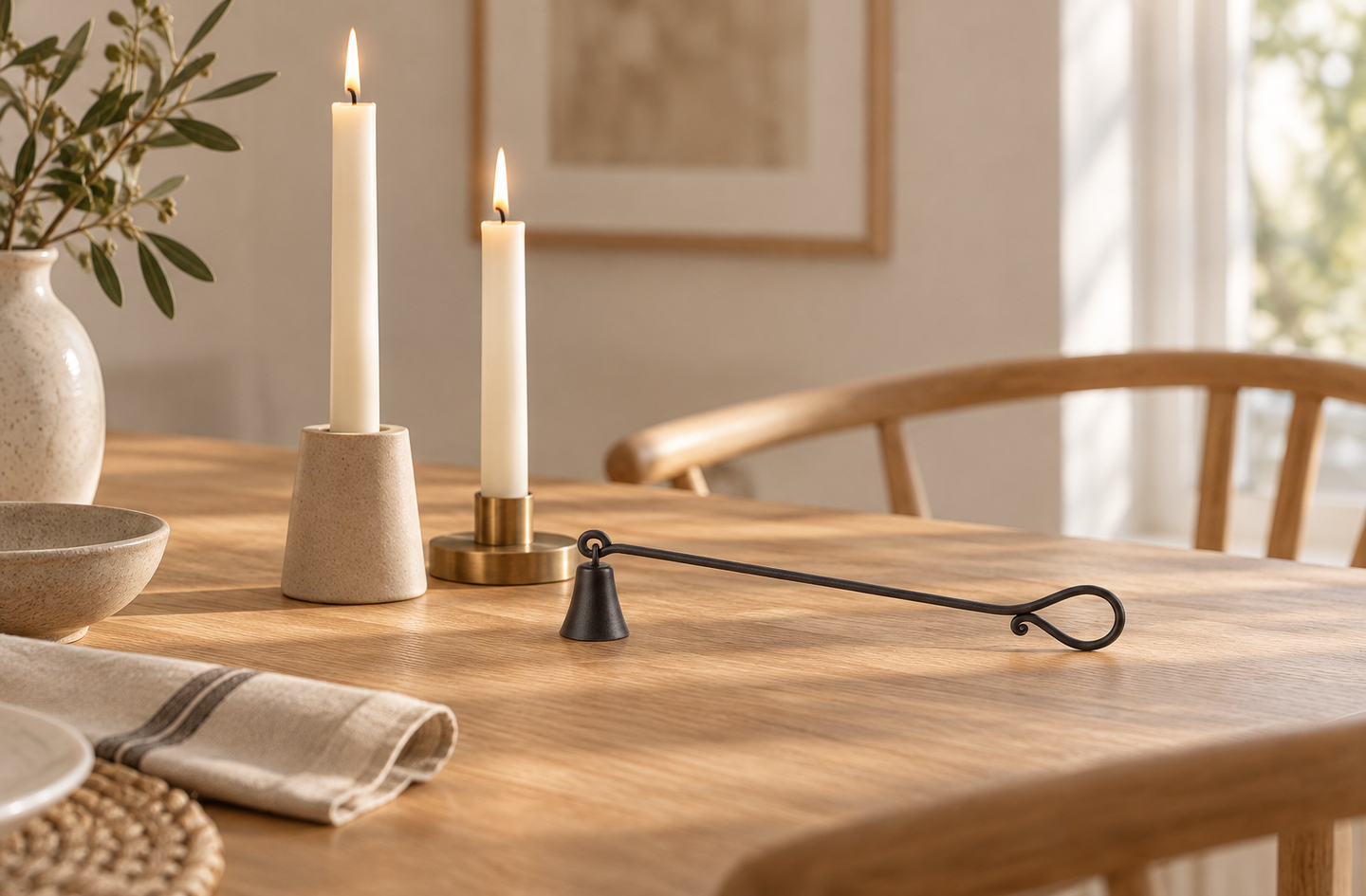
Hold a new snuffer level at arm’s length over a table, because a bell that dips in the hand will dip over a flame.
Step 6: Inspect the Finish Where Heat and Soot Collect
A good finish covers every surface evenly, including the inside of the bell, the bell rim and the joint. Those spots meet the most heat, soot and handling. The National Park Service explains why coverage matters on iron. Surfaces of iron and steel exposed to the atmosphere develop a crust of iron oxide, and that rust is porous, letting deeper layers oxidize5.
Powder coating is a dry paint powder applied to metal and cured with heat into a hard, even layer. Zinc galvanizing is a zinc coating that shields the iron beneath it. RTZEN’s four-step process cuts and hand-forges the iron, then zinc-galvanizes and powder-coats it, so the outer coating sits on a protected base instead of bare metal.
- Even color at the edges: thin or shiny spots at the bell rim show where the coating ran short.
- Coverage inside the bell: soot collects there, and cleaning rubs that surface more than any other.
- No flaking at the joint: a hinge or pivot that wears through its coating exposes iron at a moving point.
- Heat resistance in the description: a finish described as heat-resistant suits a tool that meets warm air above a flame every day.
Treat bare spots at the rim or joint as a reason to pass on a snuffer, because corrosion starts where the protective coating stops.
Step 7: Judge the Craftsmanship at the Joints and Shaft
Craftsmanship shows in three places on a snuffer: how the shaft was shaped, how the bell is attached and whether every edge is smooth. Hand forging leaves a shaft that was heated and worked into shape instead of stamped from sheet. The National Park Service describes colonial wrought-iron gates in which the iron was heated, hammered, bent and twisted to shape the design5.
“Wrought iron is also remarkably malleable, which means it can be reheated and hot-worked again and again to the desired shape.”5
National Park Service, Metals in America’s Historic Buildings5
What the wrought iron label does and does not guarantee
The same NPS publication observed that little wrought iron was still made, and that almost all metal sold as wrought iron was really mild steel5. The label therefore says less than the method. A buyer learns more from three questions than from the metal name: was it hand-forged, how is the bell fixed and what finish protects it?
Hinged, pivoted and fixed bells under daily use
A hinged or pivoted bell swings to hang level, which helps it settle flat over a flame when the handle is tilted. The pin should be snug: the bell should swing freely but never rattle or drop sideways. A fixed bell has no moving parts to wear, but the user must hold the handle at the right angle every time. Run a fingertip around the rim and along the shaft, since a burr or a sharp seam catches cloth and skin.
A snug pivot, a smooth rim and visible hand-forging marks are better signs of a tool built for daily use than ornament or sheer weight.
Step 8: Plan Storage and Read the Warranty Terms
Dry storage beside the candles and a written warranty that names its coverage protect a snuffer long after the purchase. The Canadian Conservation Institute recommends relative humidity between 35% and 55% for storing and displaying mixed collections7. Museum storage is stricter than a home, but the same chemistry acts on an iron tool.
Relative humidity is the amount of water vapor in the air compared with the most the air can hold at that temperature.
“All iron rusts when the RH is over about 65%.”7
Canadian Conservation Institute, CCI Notes 9/2, Storage of Metals7
Where to keep a snuffer between evenings of candlelight
Keep the snuffer in the room where candles burn, on a dry tray or shelf, so it is in hand before anyone leans in to blow. Avoid a bathroom ledge or a windowsill that collects condensation. Let the bell cool, then wipe soot away with a dry cloth before setting the tool down. A compact snuffer that stores neatly beside a candle display stays in use, while one kept in a drawer is easily forgotten.
Warranty terms worth reading before checkout
US federal rules on warranty titles appear in 16 CFR 700.6. A written warranty on a product costing the consumer more than $10, excluding tax, must carry a set title8. It is either a full warranty with its duration or a limited warranty8. That title tells a buyer what kind of promise is being made. Read what the warranty covers, such as the finish, the joints or both, and how a claim works. RTZEN backs its catalog with a Lifetime Warranty covering material and workmanship defects under normal use.
A snuffer stored dry and covered by written terms that name the finish and joints gives a buyer the clearest protection over years of daily use.
Common Mistakes When Choosing a Candle Snuffer
Most disappointing snuffer purchases come from judging the tool on looks or total length instead of on the candles it has to serve. Five errors come up often when a buyer skips the inventory step.
- Buying for one candle: a bell sized for a taper can be too small for a wooden wick and too wide for a narrow jar.
- Counting overall length as reach: the gripped part never reaches the flame, so a long-looking tool can still fall short in a deep jar.
- Choosing a pinch tool for jars: its jaws need a clear side view of the wick, and glass walls block that view.
- Ignoring the bell joint: a loose pivot lets the bell swing off the flame and bump the glass, and a rattle rarely improves with use.
- Storing it damp and sooty: a snuffer left on a humid ledge invites rust wherever the finish has worn. CCI links iron rust to humidity over about 65%7.
A sixth error concerns use rather than buying. The NCA warns against putting a candle out with water, which can cause hot wax to splatter1. A snuffer kept within reach removes the temptation.
Every one of these mistakes is avoided by measuring the household’s candles first, which is why the inventory comes before any product comparison.
How to Choose a Candle Snuffer: The Daily-Use Checklist
A snuffer that passes all eight checks below should suit a mixed household of jars, pillars and tapers every evening. The table turns each step into a test a buyer can apply to any model, together with the red flag that should end the search.
| Check | What to look for | Red flag |
|---|---|---|
| Snuffer type | A bell snuffer for a home with mixed candles | A pinch tool as the only snuffer in a home with jars |
| Material | Iron or stainless steel for a slow heat path along the shaft | An uncoated iron tool destined for a humid room |
| Bell fit | Wider than the widest flame, narrower than the smallest jar mouth | A bell that scrapes glass or dips into wax |
| Usable reach | Reach below the hand greater than the deepest jar flame | Knuckles over the rim when the bell reaches the flame |
| Grip and balance | A slim handle and a bell that stays level at arm’s length | A bell that tips forward and needs a hard pinch |
| Finish | Even coverage inside the bell, at the rim and at the joint | Thin, shiny or flaking spots at the edges |
| Craftsmanship | A snug pivot, smooth edges and hand-forged shaping | A rattling bell, burrs or sharp seams |
| Storage and warranty | A dry spot beside the candles and written terms that name coverage | No written terms, or terms that do not say which defects are covered |
For buyers asking what to look for in a candle snuffer bought as a gift, the same table applies with one change. Favor a versatile bell and a medium reach, because the recipient’s candles are unknown, and include a note on dry storage with the gift.
Bell fit and usable reach decide whether a snuffer works at all, while finish, joints and warranty decide how long it keeps working.
Frequently Asked Questions
Pinch snuffer vs bell snuffer: what is the difference?
A bell snuffer covers the flame and starves it of air, so it works on tapers, pillars, jars and tealights. A pinch snuffer closes on the wick and needs a clear side view of it, which deep jars block. Either beats water, which the NCA warns can make hot wax splatter1.
How long should a candle snuffer be for jar candles?
The usable reach below the hand should exceed the deepest flame. By RTZEN’s calculation from NCA guidance, the last flame in a jar 4 inches deep sits about 3.5 inches below the rim1. By RTZEN’s estimate, a 10-inch snuffer covers that jar; measure the deepest jar at home, and expect lanterns to need a longer tool.
Is a brass or iron candle snuffer better for daily use?
Iron passes heat more slowly, since Engineering ToolBox lists wrought iron at 59 W/mK and yellow brass at 111 W/mK4. Brass does not rust but tarnishes, while iron needs a protective coating. By RTZEN’s calculation, brass is only about 9% denser3, so weight barely differs.
Where should a candle snuffer be stored between uses?
Store it dry and close to the candles, after the bell cools and the soot is wiped away. The Canadian Conservation Institute gives 35% to 55% relative humidity as the range generally recommended for storing and displaying mixed collections7. A bathroom ledge or a damp windowsill is the wrong spot for any iron tool.
Does a candle snuffer make a good housewarming gift?
It does, and it pairs naturally with a candle. Candles themselves are a popular gift: the NCA reports that candle purchasers view them as an appropriate housewarming gift (74%) and hostess gift (66%)2. Choose a versatile bell and a medium reach, because the recipient’s candles are unknown.
Limitations and Edge Cases
- The metal figures come from engineering reference tables for standard alloys near room temperature4. A real snuffer’s heat flow also depends on its coating, shaft thickness and length.
- The grip and weight guidance from CCOHS is written for workplace hand tools6, and the CCI humidity ranges for museum collections7. Both serve here as benchmarks for a household tool, not as rules.
- The reach calculation assumes a jar burned down to the NCA’s stopping point. Candles in lanterns or recessed holders can sit deeper and need a longer tool.
References
Methodology: every sourced figure comes from an independent published source and links to the page that carries it. Derived figures are labeled as RTZEN’s calculation or reasoning, and co-founder Rami Abramson reviewed the article.
- National Candle Association – Candle Safety Tips, candle fire safety guidance, accessed November 2026.
- National Candle Association – Facts and Figures, About the Candle Industry and Consumer Preferences, accessed November 2026.
- Engineering ToolBox – Metals and Alloys, Densities, reference table in kg/m³, accessed November 2026.
- Engineering ToolBox – Thermal Conductivity of Metals and Alloys, Data Table and Reference Guide, values in W/mK, accessed November 2026.
- National Park Service – Metals in America’s Historic Buildings: Uses and Preservation Treatments, Technical Preservation Services, second PDF of the book (Part I, A Historical Survey of Metals), accessed November 2026.
- Canadian Centre for Occupational Health and Safety – Hand Tool Ergonomics, Tool Design, OSH Answers fact sheet, modified October 20, 2026, accessed November 2026.
- Canadian Conservation Institute – Storage of Metals, CCI Notes 9/2, by Judy Logan, revised by Lyndsie Selwyn, modified December 2, 2025, accessed November 2026.
- Electronic Code of Federal Regulations – 16 CFR Part 700, Interpretations of Magnuson-Moss Warranty Act, section 700.6, Designation of warranties, accessed November 2026.
Conclusion
Choosing a candle snuffer for daily use comes down to fit before looks. It needs a bell that covers the widest flame and enters the narrowest jar, enough reach for the deepest candle and a steady grip. Iron keeps heat near the bell, and an even finish with a snug pivot keeps it working for years. RTZEN’s hand-forged snuffers are backed by a Lifetime Warranty.
For how this buying checklist fits the wider subject, see the candle snuffers overview.