
A candle snuffer is a small metal bell on a handle that puts out a candle flame by cutting off its air. It ends a burn without blowing melted wax across the table, and with less lingering smoke than a hard breath. Candles are an everyday household item: users burn them most often in the living room (42%), followed by the kitchen (18%) and the bedroom (13%)1. This guide is written for anyone who lights candles at home or gives them as gifts. It covers the whole topic, from the science of the bell to choosing, cleaning and displaying one, with routes to deeper guides.
Quick Answer
What is a candle snuffer?
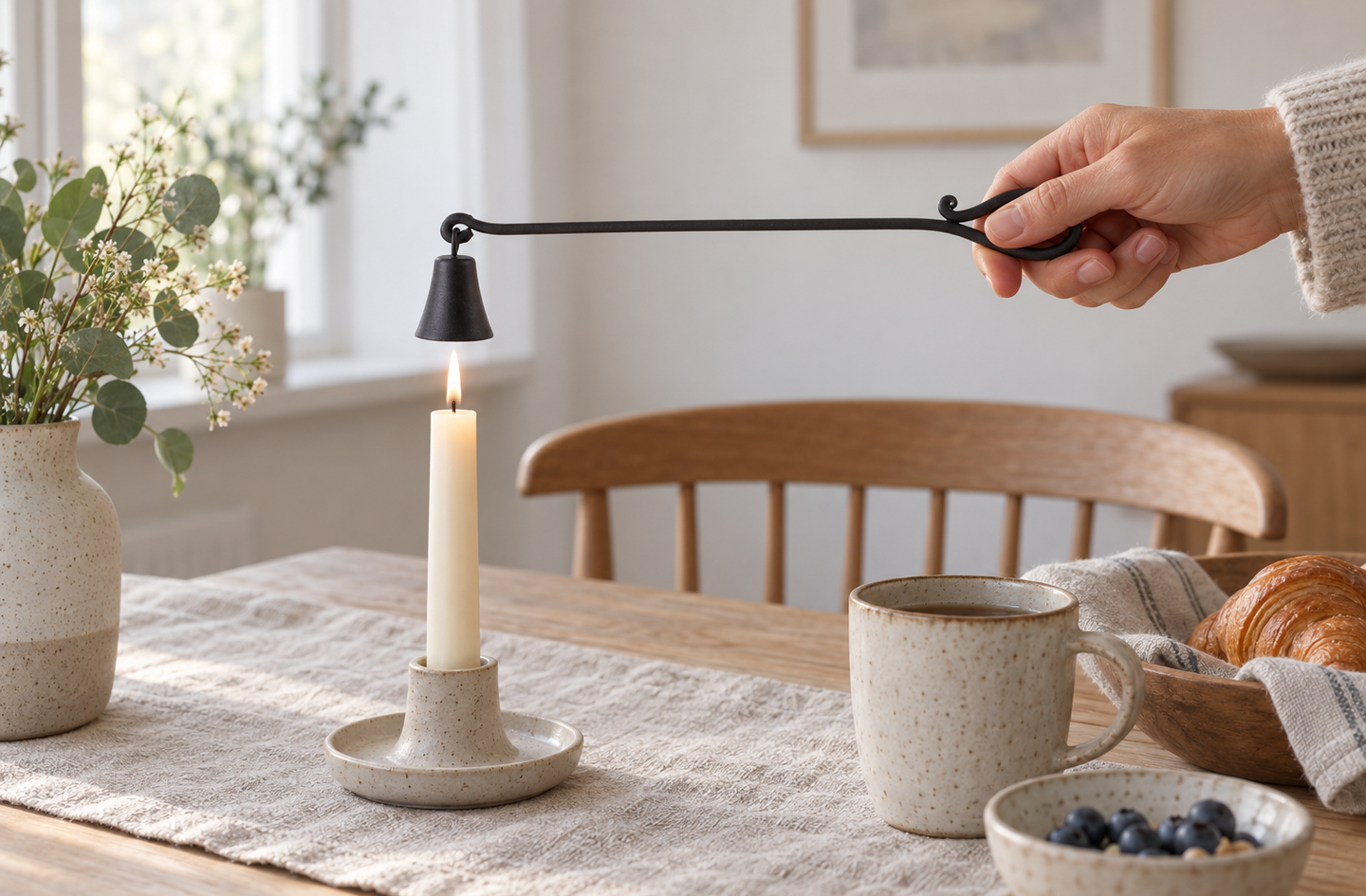
A candle snuffer is a hand tool that lowers a small metal bell over a flame. The bell traps the air around the wick, and the fire stops once it runs short of oxygen3. Used gently, it keeps melted wax still and avoids the spray that a hard breath can cause. A good match has a bell wide enough for the flame and a handle long enough for the holder.
Why it matters:
The way a candle is put out decides where its wax, soot and smoke end up. A calm, controlled method protects tables, candle surfaces and the air in the room every single evening.
Key Takeaways
- A bell snuffer works by starving the flame of oxygen, the same principle as covering a small candle with an empty glass3.
- Fit has two separate parts: a bell opening that clears the whole flame, and a handle long enough to reach into the holder.
- Candle type changes the technique, so tapers, pillars, jars, tealights, multi-wick and wooden-wick candles each call for a slightly different approach.
- Before the mid 19th century, the word snuffer meant a scissor-like wick trimmer rather than the bell extinguisher sold under that name today2.
- The most common misconception is that a snuffer makes candles safer to leave alone, when it only ends the flame at the moment someone uses it.
Candle Snuffers in 30 Seconds
| If you are… | Do this |
|---|---|
| Hosting a dinner with taper candles | Lower the bell straight down over each flame, pause a moment, then lift it clear of the wick. |
| Burning a deep jar candle | Use a long-handled snuffer and keep the bell clear of the glass rim and the liquid wax. |
| Putting out tealights or votives | Leave the cup where it sits and lower a small bell without tilting the container. |
| Trying to cut lingering smoke | Snuff instead of blowing, and leave the bell in place for a few seconds before lifting it. |
| Buying a snuffer as a gift | Check bell size, handle reach, finish and warranty before choosing on looks alone. |
| Keeping the tool on display | Let the bell cool, wipe off soot, and store it on a dry shelf beside the candles. |
What Is a Candle Snuffer?
A candle snuffer is a hand tool, usually a small cone or bell at the end of a handle, used to put out a burning candle2. The same object is also called a candle extinguisher or a douter. The user lowers the bell over the flame, the air inside runs short, and the flame dies without being blown.
The name needs one clarification. Before the mid 19th century, a snuffer was a scissor-like tool with two flat blades and a small box. It trimmed the charred wick while the candle kept burning2. That job now belongs to the wick trimmer, a separate tool for cooled wicks. Modern usage gives the name to the bell, and this guide follows it.
The topic covers bell snuffers in every common material, the technique for each candle type, and the care that keeps the tool working. It sits beside three related tools with different jobs: the wick dipper, the wick trimmer and the candle lid. Fire extinguishers, candle making and fragrance belong to other subjects.
Why Candle Snuffers Matter
Candle snuffers matter because candles are both a daily habit and a common gift, and every burn ends with someone putting out a flame. Approximately three-fourths of candle users say they typically burn candles for 4 hours or less per sitting1, so most candles are lit and put out many times. Candle buyers also rate candles an appropriate housewarming gift (74%) and a hostess or dinner party gift (66%)1.
The National Candle Association, whose member companies make approximately 80 percent of all candles made in the United States1, describes the gift habit plainly:
Both men and women consider candles to be an always-acceptable and highly appreciated gift for a wide variety of occasions.
Three everyday problems make the method of putting a candle out worth learning:
- Wax movement: a hard breath can push liquid wax onto a tablecloth, a jar rim or the side of a pillar.
- Smoke and odor: blowing often leaves a smoldering wick, and a snuffer helps avoid that smoke and smell2.
- Reach and control: jars, lanterns and tall candlesticks put the flame where breath and fingers work poorly.
A snuffer addresses all three problems, but it does not replace supervision. The same habits that keep a lit candle safe still apply while it burns.
The Six-Part Candle Snuffer Framework
The Six-Part Candle Snuffer Framework covers the whole topic in six dimensions. They were grouped from 27 specific reader questions into the smallest set that still covers using, choosing and caring for a snuffer. Each dimension teaches one layer of the subject and points to deeper guides.
How the Bell Puts Out a Flame Without Blowing
A flame needs three things to keep burning: heat, fuel and an oxidizing agent, usually oxygen3. The bell removes the third. Once the cup sits over the flame, the trapped air runs short and the fire stops, much as a small candle goes out under an empty glass3. Blowing works the other way, pushing the flame off the wick with a gust that can also move liquid wax. A wick may still glow briefly after the flame dies, so a bell reduces smoke rather than removing every trace of it.
The practical lesson is patience, because holding the bell in place for a few seconds does more for smoke and relighting than any feature of the tool.
Matching the Snuffing Technique to Each Candle Type
Candle shape decides where the bell can go. Tapers in candlesticks have a narrow, exposed flame that a small bell covers easily, but a tall holder can tip if the tool knocks it. Pillars form a wide wax pool, so the bell should enclose the flame without touching melted wax or the candle wall. Container and jar candles are the most popular type with American consumers1, and they put the flame below a glass rim. Tealights and votives sit low in cups, multi-wick jars need each wick put out in turn, and wooden wicks burn with a broad flame that needs a wider bell. Lanterns and recessed holders add trapped heat and tight access, so the enclosure must be open, stable and safe to reach into.
Knowing the candle and its holder before choosing a tool prevents most problems, because a bell that suits one candle can be wrong for the next.
Bell Fit and Handle Reach as Two Separate Checks
Bell clearance is the space between the flame and the inside wall of the bell when it sits over the wick. Too little clearance lets the bell touch the flame tip or the wax, while too much makes it hard to center inside a jar. Handle reach is a separate measure: the distance from the hand to the bell. It decides whether the user can reach into a deep jar or a tall lantern with fingers well away from heat. A long handle helps with tall candlesticks and deep holders, but grip and balance matter as much as length.
Fit should be judged against the candles already in the home, since no single bell size or handle length suits every wick and holder.
Deeper read: how to choose a candle snuffer for daily use.
How Snuffers Compare With Dippers, Trimmers and Lids
A wick dipper is a thin hooked rod that bends a burning wick into the melted wax pool and then straightens it again. It works well in containers with a deep enough pool, but not on tapers, which hold almost no liquid wax. A wick trimmer does a different job altogether, shortening a cooled wick before the next lighting. Candle lids are made to cover a jar between burns. Whether one may go over a lit candle depends on the candle maker’s instructions and the lid’s heat rating.
A household with many jar candles may want both a snuffer and a dipper, while a taper-only household needs only a bell for putting candles out.
Material, Finish and the Craft Behind the Tool
Wrought iron is iron with very little carbon, not over .035 percent according to the National Park Service4. That makes it remarkably malleable, so a smith can reheat and hot-work it again and again into a twisted shaft, a scroll or a looped handle4. Iron is also dense: wrought iron weighs about 7,750 kilograms per cubic meter, against roughly 2,712 for aluminum5. That weight gives a forged handle a steady feel, while brass offers a warm gold tone with its own polishing routine. Antique-style pieces borrow historic shapes and forged textures, and that look is a design choice rather than proof of age.
Material choice is mostly about feel, finish care and style, since iron and brass both put out a flame equally well when the bell fits.
Safety, Cleaning and Display Between Uses
A snuffer bell gets hot during use, so it should cool on a heat-safe surface before anyone touches, cleans or stores it. Using a snuffer does not remove the risks of an unattended candle, which still needs a stable holder, clear space and someone in the room. Cleaning is simple: soot and soft wax come off a cooled bell with a soft cloth, and drying matters most for iron. Iron exposed to the air develops a crust of iron oxide, commonly known as rust4, which is why an intact protective finish counts. A snuffer displayed beside the candles is easier to reach than one in a drawer, and that visibility also makes it a practical gift.
Care and display support each other, because a clean, dry tool kept in plain sight is the one that actually gets used.
How to Choose the Right Candle Snuffer
The single most important criterion is bell fit: the bell must cover the flames of the candles actually burned at home without touching wax or glass. Reach, comfort and finish come after that. A short sequence keeps the decision simple:
- List the candle types: tapers, pillars, jars, tealights, multi-wick and wooden-wick candles each place the flame differently.
- Check bell clearance: the opening should sit over the widest flame in the home with room to spare, especially for wooden wicks.
- Measure the reach: deep jars, lanterns and tall candlesticks call for a longer handle that keeps the hand clear of heat.
- Test comfort and balance: a steady grip matters more than length, because a wobbling bell can tip a light holder.
- Inspect the finish and craft: an even coating, a secure bell joint and clean forging point to a tool built for daily use.
- Read the warranty: written terms show how long the maker expects the finish and the joints to last.
Red flags: a bell that wobbles on its joint, a coating that flakes at the edges, and a handle too short to keep knuckles away from a jar rim.
Two handle styles show how the checklist plays out. An elongated handle with a hinged bell, as on the Antique Snuffer, suits deep jars and tall holders. A looped handle gives a secure grip for everyday tapers and pillars, and gift buyers can run the same checks before choosing a style.
Compare All Candle Snuffing Methods
Four common ways to put out a candle differ in how they stop the flame, what they do to the wax and which candles they suit. The wick trimmer is left out of this table because it never touches a burning candle.
| Criteria | Bell snuffer | Wick dipper | Blowing out | Candle lid |
|---|---|---|---|---|
| How it stops the flame | Cuts off air under a small bell | Smothers the wick in melted wax | Pushes the flame off with a gust | Cuts off air over the whole jar |
| Wax disturbance | Little, if the bell stays clear of the pool | A small ripple in the pool | Can spray or ripple liquid wax | None, if the lid sits flat |
| Smoke afterward | A brief wisp as the wick cools | Little, since the wick is coated | Often a longer trail from the wick | Held under the lid |
| Candle types | Tapers, pillars, jars, tealights | Containers and pillars with a deep pool | Small, open flames | Jar candles whose maker approves it |
| Main limit | Bell must fit the flame and the space | No use on tapers with no pool | Little control near hot wax | Heat rating and glass stress |
Choose a bell snuffer if: the household burns a mix of tapers, pillars and jars and wants one tool for all of them.
Choose a wick dipper if: most candles are containers that hold a full, deep wax pool.
Choose blowing out if: the candle is small, open and nowhere near liquid wax that a gust could push.
Choose a candle lid if: the jar maker’s instructions approve it and the lid is rated for the heat.
Common Mistakes
Mistake 1: Blowing Hard Across a Pool of Liquid Wax
Why it is a mistake: a strong gust can push melted wax onto the table or jar rim, and it often leaves a smoldering wick that smokes and smells2.
What to do instead: lower a bell straight down over the flame, hold it still, and lift it clear once the flame is out.
Mistake 2: Lifting the Bell Before the Wick Stops Glowing
Why it is a mistake: a wick can keep glowing after the flame dies, and fresh air reaching a hot ember can bring back smoke or even a small flame.
What to do instead: keep the bell in place for a few seconds, then check that no red ember remains before walking away.
Mistake 3: Pressing the Hot Bell Into Wax or Glass
Why it is a mistake: dipping the bell coats it in wax and soot, and hot metal knocking a glass rim can chip the jar or tip the holder.
What to do instead: hover the bell over the flame without contact, and switch to a longer handle or a wick dipper when a jar is too deep.
Mistake 4: Putting the Snuffer Away Damp or Sooty
Why it is a mistake: iron and steel surfaces exposed to the atmosphere develop a crust of iron oxide4, and trapped moisture works fastest wherever a finish is chipped.
What to do instead: let the bell cool, wipe off soot with a soft dry cloth, dry it fully after any damp cleaning, and store it somewhere dry.
Best Candle Snuffers by Use Case
Best for Dinner Hosts Who Set Out Taper Candles
Hosts who set tapers in candlesticks need a small, steady bell and a light touch, so wax stays on the candle and the holder stays upright. A stable base such as the Classic Candle Holder helps as much as the snuffer does.
Best for Owners of Deep Jars and Lanterns
Deep jars and lanterns call for a long handle and a bell narrower than the opening, so the hand stays clear of trapped heat. When the flame sits too low to reach safely, a wick dipper or the candle maker’s own method is the better choice.
Best for Housewarming, Host and Holiday Gift Buyers
A snuffer makes a sensible gift when its bell suits common candles and its finish suits the recipient’s room. Approximately 35% of candle sales occur during the Christmas and holiday season1, which is also when candle-care gifts are most welcome.
Best for Traditional and Antique-Style Rooms
Rooms with farmhouse, vintage or classic decor suit forged textures, twisted shafts and darker finishes that echo older metalwork. Displayed on a mantel or console beside the candles, the snuffer reads as decor while staying within reach.
Frequently Asked Questions
Does a candle snuffer stop candle smoke completely?
No. A bell snuffer stops the flame by cutting off its air, but the wick can still glow and release a thin wisp for a few seconds. Blowing often leaves a smoldering wick, and a snuffer helps avoid most of that smoke and smell2. Holding the bell in place a little longer, then lifting it straight up, keeps the remaining wisp small. Good airflow in the room handles the rest.
Can a candle snuffer be used on a jar candle?
Yes, when the bell is narrower than the jar opening and the handle is long enough to reach the flame. The bell should hover over the wick without touching the glass rim or the liquid wax. Container and jar candles are the most popular candle type with American consumers1, so reach matters in many homes. For very deep jars, a wick dipper or another method the candle maker approves may be easier.
Is a candle snuffer the same as a wick trimmer?
No. Today a snuffer puts out a burning candle, while a wick trimmer shortens a cooled wick before the next lighting. The names overlap for historical reasons. Before the mid 19th century, a snuffer was a scissor-like tool with flat blades and a small box for trimming a burning wick2. Many candle owners keep both tools, because each one handles a different step of the burn.
Why are so many candle snuffers made of wrought iron?
Wrought iron suits the job because it is low in carbon and remarkably malleable, so a smith can hot-work it into twisted shafts, scrolls and looped handles4. It is also dense, at about 7,750 kilograms per cubic meter5, which gives the handle a steady, balanced feel. Brass and other metals work equally well when the bell fits. Iron does need a sound finish and dry storage, because exposed iron rusts.
Is it safe to walk away right after using a candle snuffer?
Only after confirming the wick is fully out. A snuffer ends the flame, but the bell stays hot for a while and an ember can linger in the wick. After snuffing, check that nothing glows, let the bell cool on a heat-safe surface, and keep the candle away from anything that can burn. Approximately three-fourths of candle users burn candles for 4 hours or less per sitting1, so this quick check becomes a frequent habit.
How This Guide Was Built
The methodology behind this guide is a source-first review. Each figure was checked against a live page from the National Candle Association, a National Park Service technical publication or an engineering data reference. Every figure links to the page that carries it. Encyclopedia entries support definitions only. The six-part framework was built by sorting 27 reader questions by the decision each one serves. Editorial responsibility rests with RTZEN founders Tsach Levy, as author, and Rami Abramson, as reviewer, and the guide is re-checked once a year.
What This Hub Does Not Cover
- A candle fire that has spread beyond the wick, which calls for leaving the room and calling emergency services rather than reaching for a snuffer.
- Candle making, wax blends, wick sizing and fragrance choices, which belong to candle-making guides.
- Candle holders and menorahs as products in their own right, beyond their role in safe snuffing.
- Prices, which vary by retailer and change often.
References
- National Candle Association – Facts and Figures about the candle industry and candle users
- Wikipedia – Candle snuffer (definition and history of the term)
- Wikipedia – Fire triangle (heat, fuel and oxygen)
- National Park Service – Metals in America’s Historic Buildings, Part II (iron and iron alloys)
- The Engineering ToolBox – Metals and Alloys Densities (kg/m3)
Next Read
A candle snuffer rewards good fit and a patient hand. The bell must clear the flame, the handle must reach the holder, and the bell should rest a few seconds before it lifts. Iron, brass and other metals all work when those basics are right, and care comes down to cooling, wiping and keeping the tool dry.
Next step: explore the Classic Snuffer, a hand-forged bell snuffer with a looped handle for tapers, pillars and jars.
All guides in Candle Snuffers