
Heavy duty coat hooks rarely hold one coat, since a single winter hook can carry a parka, a scarf and a school bag together. This guide sits under the heavy duty wall hooks overview, which summarizes how to choose and mount hooks for real loads. Here the focus is narrower: choosing a coat hook by depth, edge shape, mounting and placement. Pediatricians advise keeping a backpack at or under 15% of a child’s body weight, which still allows a 15-pound bag for a 100-pound child1.
Quick Answer
How do you choose heavy duty coat hooks for winter coats and daily gear?
Choose a solid hook with a deep, upturned tip and smooth, rounded edges, then select a mounting that matches the wall. This Old House advises heavy-duty anchors and screws for anything over 25 pounds, and anchors that hold four times the hung weight2. Place hooks so a long coat hangs clear of the floor and the bench.
Key Takeaways
- The AAP advises keeping a child’s backpack at or under 15% of body weight1. A family hook that holds coats and school bags carries more than a single jacket.
- A simple nail in drywall typically holds 5 to 10 pounds, according to This Old House2. A heavy coat hook requires a stud or a rated anchor behind it.
- In Family Handyman’s test, six of seven drywall anchors held more than their claimed rating, from 22 pounds claimed up to 180 pounds tested3. In that test the package rating proved conservative, but it is not a promise for every wall.
- In museum storage guidance, NPS textile conservation advice notes that a hanging garment’s stress concentrates at the shoulders and neck4. By RTZEN’s reading, a wide, smooth hook distributes that load better than a thin one.
- A common misconception is that all black metal hooks are the same. Solid forged iron and stamped hollow metal behave very differently under a full winter load.
Before You Begin: What a Winter Coat Hook Has to Carry
A winter coat hook carries a heavier, bulkier and more frequent load than a decorative hook, so the choice starts with the load, not the look. A heavy duty coat hook is a wall-mounted hook of solid material, with a deep tip for thick garments and a base fastened into solid backing. The term “heavy duty” describes the whole system: the hook, the screws, the anchors and the wall behind them.
Entryway hooks usually fail in three ways: a shallow tip drops a puffy coat, a thin edge creases the collar, or loose screws let it tilt. The six steps address each failure in the order a buyer encounters it.
Gather the following information and equipment before selecting or mounting any hook:
- A short list of users: adults, children and visitors, since each group reaches a different height.
- The heaviest items per hook: the winter coat, the school bag, the work bag and anything clipped to them.
- A tape measure and a level: for measuring hook depth, coat length and the mounting line.
- A stud finder: or a willingness to tap the wall and listen for solid framing.
- The mounting hardware that came with the hook: plus a note of the wall type, whether drywall, plaster, tile, brick or wood paneling.
The table sets out the daily items a coat hook usually meets and the demand each one places on it. Weights are left out deliberately, because coats and bags vary too widely.
| Item | What it asks of the hook | Main risk | Feature that answers it |
|---|---|---|---|
| Insulated winter coat or parka | Depth for a thick collar loop or hood | Slides off a shallow tip | Deep throat with an upturned end |
| Wool overcoat | Broad, smooth contact at the hanging loop | Creased or stretched collar | Rounded, wide hook profile |
| School backpack | Short, heavy load on one strap | Screws loosening from repeated pulls | Stud fastening or rated anchors |
| Purse or work bag | Strap stays put as the bag swings | Strap slipping off the tip | Tip that rises above the strap line |
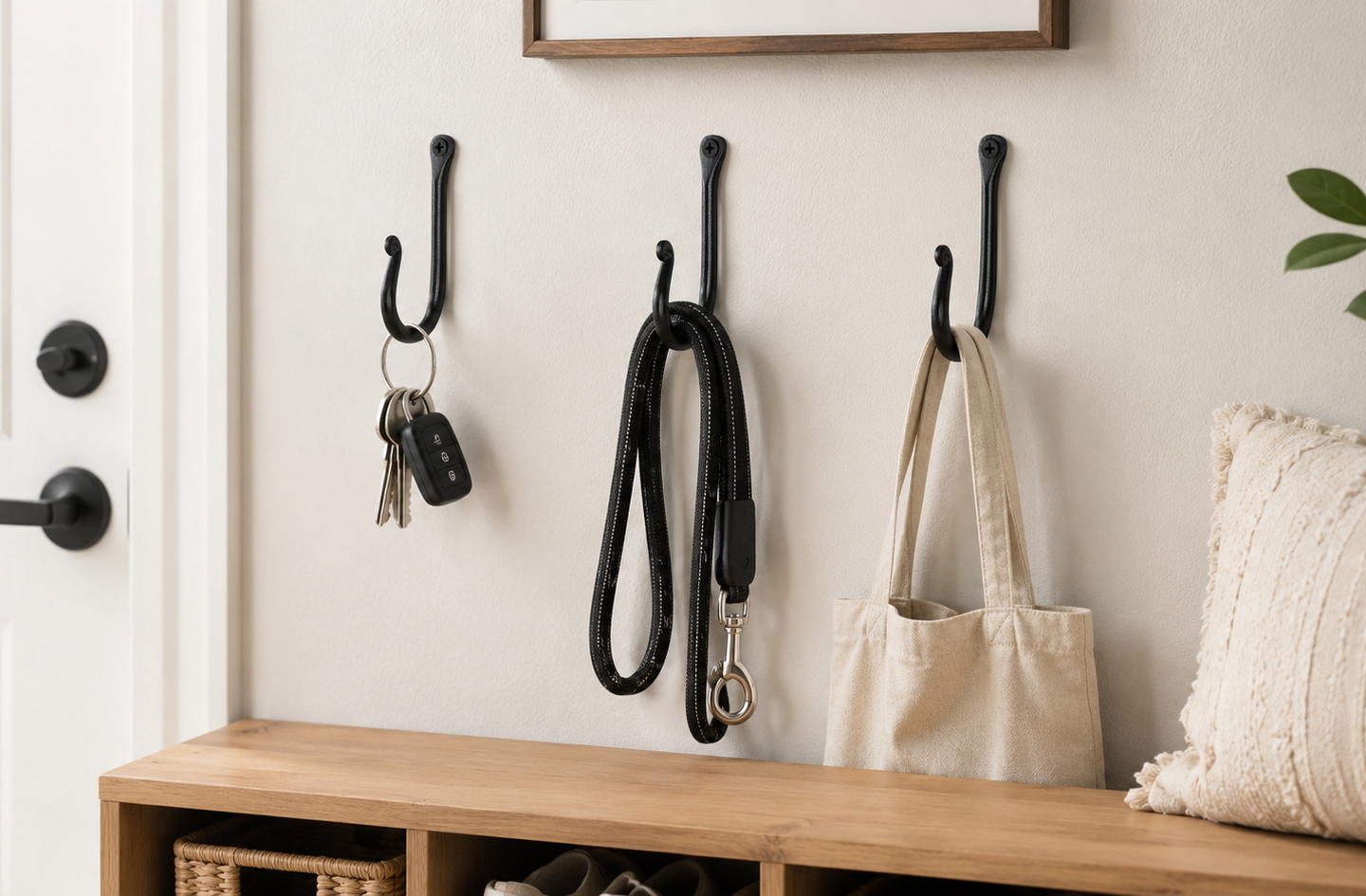
| Scarf, hat or dog leash | A separate point from the coat | Crowding and tangling | Double hook or a second hook |
A coat hook is judged on its worst morning, not its average one, so plan for the bulkiest coat and the heaviest bag together.
Step 1: Add Up What Each Hook Carries on a Busy Morning
Step 1 produces a realistic load estimate for every hook, built from the family’s own coats and bags. The AAP advises that a school backpack weigh no more than 15% of the child’s body weight1. For a 100-pound child, that still allows a 15-pound bag, and when it hangs over a winter coat, one hook carries both.
The guidance comes from the AAP Section on Orthopaedics and the Pediatric Orthopaedic Society of North America, published on HealthyChildren.org. It is a health limit for the child, not a hook rating, but it gives a family a fair planning weight for a packed school bag1.
Count every stacked item on the hook, not just the coat
Hooks in a busy entryway almost never carry one item: a coat goes on first, then a scarf, then a bag strap on top. The load is the sum of that stack, and the strap usually sits farthest out on the tip, where screw leverage is greatest.
List each hook by user, together with the heaviest combination it will carry in winter. That list decides which hooks require stud fastening and which can rely on anchors.
Give keys, leashes and other small gear a separate place
Keys, dog leashes and lanyards add little weight, but they crowd the coat hook and dislodge the coat when someone grabs them. A short row of small hooks or a dedicated key rack beside the coats keeps those items accessible without disturbing the heavy layer. It also prevents keys from scratching a leather or wool collar.
Two more checks finish the count: mark hooks that will hold soaked coats or bags, and hooks a child will swing on. Both deserve the strongest mounting in the row, since wet gear weighs more and swinging adds sudden force.
The planning load for a family coat hook is the heaviest bag plus the heaviest coat, hung at the tip on the wettest day.
Step 2: Choose a Hook Depth That Holds a Bulky Coat
A hook holds a bulky coat when its throat is deeper than the coat’s hanging loop or hood, and its tip rises above the fabric. Throat depth is the distance from the wall plate to the inside of the hook’s tip, the space where the garment actually sits. Overall length and throat depth are different numbers, and only the second one keeps a parka in place.
A shallow hook suits a light jacket with a thin hanging loop. A down parka or a hooded coat compresses into a thick bundle at the hook. If that bundle is deeper than the throat, the coat rests on the tip and eventually slides off.
Measure the throat depth before buying any hook
Hold the thickest coat by its hanging loop and pinch the fabric where it would normally rest on a hook. Measure that thickness, then compare the measurement with the throat depth on the hook’s listing or the actual piece. A throat at least as deep as the pinched fabric, with a tip that rises above it, keeps the coat securely seated.
For coats that hang by the hood, measure the hood as well; a broad, rounded curve supports it better than a narrow peg.
Why an upturned tip stops coats and straps from sliding
The tip shape matters as much as the depth. A tip that turns upward, or finishes in a ball or a loop, gives a strap or collar something to rest behind. A straight peg angled slightly upward holds a jacket on a calm day, but a swinging bag strap gradually travels along it and falls off.
Double hooks: separate prongs for separate layers
A double hook gives two hanging points on one mounting, so a hat or scarf can sit apart from the coat or bag. The Hammer Nail hooks offer two sturdy prongs in solid iron with a rust-resistant black finish, intended for coats, hats, bags and tools.
Depth has a cost, because a deeper hook projects farther into the room, and a fully loaded hook projects farther still. In public buildings, ADA standards cap protrusion into a circulation path at 4 inches for objects with leading edges 27 to 80 inches above the floor5. At home, that figure is a useful benchmark for a narrow hallway where people regularly pass close to the wall.
Buy coat hooks by throat depth and tip shape first, since a long hook with a shallow throat holds less than a short, deeply curved one.
Step 3: Check the Edge Shape and Contact Width
A coat hook treats fabric well when the portion touching the garment is rounded, smooth and wide enough to distribute the weight. National Park Service conservators explain that a hanging garment’s stress concentrates at the shoulders, neck and bodice4. A coat on a hook hangs from an even smaller area, usually the loop or the collar.
“When garments hang vertically, stress concentrates on the upper body sections, such as the shoulders, neck, and bodice.”
Anne Ennes, textile conservator, and Sara Thornburg, National Park Service Conserve O Gram 4/5, December 20204
The same NPS guidance recommends properly sized, padded hangers that minimize distortion to the fabric and reduce tension on the seams4. That advice is written for museum storage, not a busy hallway. The principle still carries over, because a narrower, sharper contact point puts a heavy coat’s weight on a smaller patch of fabric.
How to recognize a good edge on a coat hook
Run a finger along the hook where the garment will rest; it should feel round, with no casting seam, burr or sharp corner. A forged hook is shaped by hammering heated bar stock, so its curves are continuous and its edges are softened by the process. A stamped hook is cut from sheet metal, which can leave a flat blade with square edges exactly where it contacts the collar.
Wider contact for heavy wool coats and leather jackets
Wool overcoats and leather jackets are prone to showing a dent from a narrow hook. A hook with a wide, rounded saddle distributes the load across more of the loop. For coats hung by the collar instead of a loop, a broad curve prevents the collar from folding into a sharp crease.
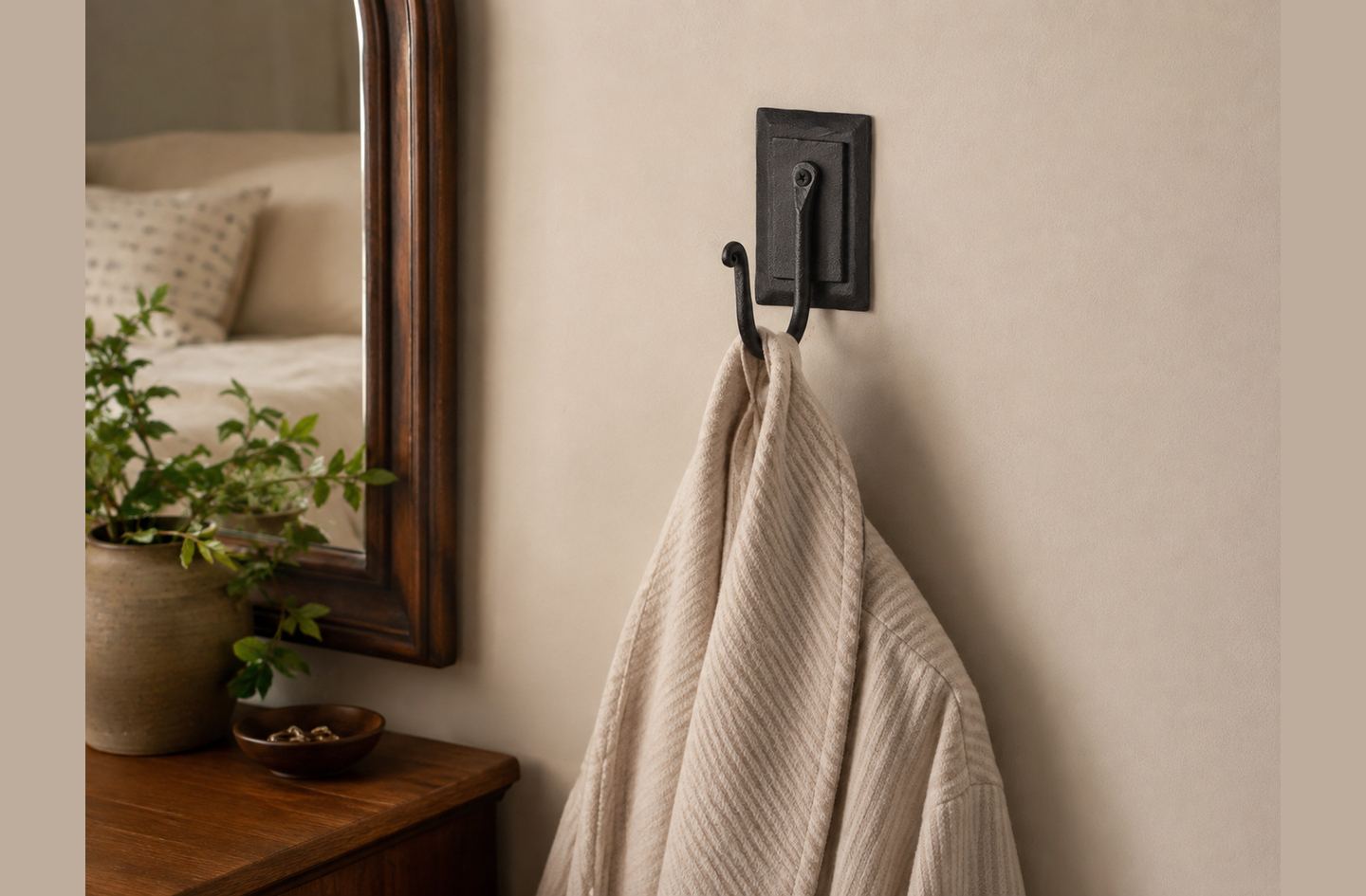
For long-term storage, the NPS advice points the other way: it lists heavy garments among those that should not be hung at all4. A good winter coat that leaves the hook for summer is better stored folded, as NPS advises for heavy garments, while the hook serves daily rotation.
A coat hook’s edge decides how a coat ages, so a smooth, rounded profile is a garment-care feature as much as a style choice.
Step 4: Match the Mounting to the Wall Behind It
A heavy coat hook is only as strong as its fastening, and the wall determines that fastening. This Old House reports that drywall typically supports 5 to 10 pounds with a simple nail, and calls for heavy-duty anchors and screws above 25 pounds2. A loaded family hook can pass that line in winter.
Shear load is a force that pulls a fastener sideways, parallel to the wall, while tensile load pulls it straight out. This Old House notes that manufacturers rate anchors for both, and gives a simple rule: anchors should hold four times the hung weight2. On a coat hook, the weight hangs out on the tip, so the top screw also experiences a pull away from the wall.
Fasten into a wood stud whenever one is available
A wood stud gives the screw solid material to grip, which makes it the preferred choice for a heavy coat hook. Studs usually sit 16 or 24 inches on center, with older houses usually at 16 and some newer houses at 242. Position a single hook over a stud, and align a row so its mounting points land on studs where possible.
“The sound and the pitch goes from a little hollow, low pitch to something a little higher.”
Tommy Silva, plumbing and heating expert, This Old House, describing how he finds studs by knocking2
Read drywall anchor ratings with a safety margin
Family Handyman tested seven drywall anchors in half-inch drywall, tightening a turnbuckle against a tension scale until each anchor buckled. Claimed ratings ran from 22 to 90 pounds, and tested results ran from 80 to 180 pounds3. All of them lived up to the claims, and all but one exceeded the rating.
That test is encouraging, but it applied a slow, steady pull in a controlled setup. A coat hook receives quick, uneven tugs every day, often on older wallboard. By RTZEN’s reading, that is a reason to apply the four-times rule to the claimed rating, not the tested result.
By RTZEN’s calculation, dividing each claimed rating in the Family Handyman test by four gives a working load of 5.5 to 22.5 pounds per anchor32. Set against the AAP’s 15-pound limit for a 100-pound child’s backpack, only anchors rated 60 pounds or more clear that line on their own1. The comparison is per anchor; a hook on two anchors shares the load, although by RTZEN’s reading the top one takes more of the pull.
Spread a long coat rail across several studs or anchors
A rail of several hooks divides the load among more fasteners. Hunker advises fastening a coat rack to studs if available, or else to at least two sturdy anchors, and more on racks over 2 feet long6. The 5-Hook Coat Rack follows this pattern, with five forged hooks on one horizontal rail and wall mounting hardware included.
Masonry walls require their own approach. This Old House recommends masonry anchors for concrete and brick, and toggle bolts, molly bolts or expansion anchors for drywall2. For the full method on hollow walls, the drywall mounting guide explains how the anchor, screw and hook work together.
The hook sets the ceiling, but the screw and the wall set the real limit, so choose the mounting for the stacked winter load.
Step 5: Build for Repeated Daily Loading
A family entryway hook is loaded and unloaded every winter day, so it must resist bending, loosening and finish wear, not just hold weight once. A static rating says nothing about a hook that is yanked, swung on and bumped by a backpack twice a day for months.
Why solid metal matters at the bend of the hook
The point where the hook leaves its base carries the most stress, because weight on the tip acts as a lever there. Solid bar stock retains its full material through that bend. A hollow or thin stamped hook has less metal at the same location, which is where it tends to open up or tilt over time.
Hand-forged iron is iron that a smith heats and shapes by hammering, bending and twisting, rather than stamping it from sheet. RTZEN’s hooks are made in four steps: the iron is cut, hand-forged, zinc-galvanized and powder-coated. Double front welding on load-bearing pieces joins the hook to its base, and the catalog carries a Lifetime Warranty.
Check the screws once the season starts
Repeated tugs can slowly loosen a screw in drywall, even with a well-rated anchor. An inspection after the first weeks of winter catches it early. If the hook rocks, tighten the screw by hand, or relocate the hook to a stud when the anchor has spun.
How wet winter gear affects the hook’s finish
Snow-soaked coats, umbrellas and wet bags deliver moisture to the hook every day. The EPA advises drying water-damaged items within 24 to 48 hours to prevent mold growth, and keeping indoor humidity below 60 percent where possible8. A wet coat crammed against others dries slowly, while a spaced row allows air to circulate around each one.
The hook’s finish meets the same moisture. In RTZEN’s four-step process, zinc galvanizing under a powder coat gives iron two layers of rust protection where wet fabric rests. Separately, the Black Classic hooks are described with a rust-resistant black finish for indoor or outdoor use.
Ladders, tool bags and bikes load a hook far beyond any coat, and the garage hook layout guide demonstrates how to distribute that weight. For the material side of durability, the wrought iron hook guide explains construction, joints and finishes in more depth.
Daily use rewards a hook that stays tight and dry, so judge solid construction, a sealed finish and a secure fastening together.
Step 6: Place Heavy Duty Coat Hooks So Long Coats Hang Freely
Heavy duty coat hooks work well at approximately 5 feet on the wall. Hunker suggests that height for adults and older school-aged children, while long coats stay off the floor6. Begin from that line, then adjust it for the room and the people using it.
CDC data for August 2021 to August 2023 put average U.S. adult height at 68.9 inches for men and 63.5 inches for women7. The figures cover adults ages 20 and older. By RTZEN’s comparison, a hook at 5 feet sits 3.5 and 8.9 inches below those averages, so most adults reach it without stretching. The main reason to mount higher is a full-length coat that would otherwise touch a bench or boots.
Setting the height above a bench or boot tray
Over a bench, Hunker advises a height where a jacket hangs clear of boots and the seat, yet stays within the shortest user’s reach6. Measure the longest winter coat from its hanging loop down to its hem. Add the bench or tray height, and that total is the minimum workable hook height for that coat.
Adding a lower row of hooks for children
In accessible toilet and bathing rooms, ADA standards require coat hooks within the reach ranges of section 3085. ADA advisory guidance also lists children’s reach ranges for elements such as coat hooks designed mainly for children. The listed high reach is 36 inches for ages 3 and 4, 40 for ages 5 to 8, and 44 for ages 9 to 125. Those listed reaches sit well below the 5-foot line, so younger children are better served by a lower row at their own height.
Spacing hooks for bulky winter coats
A winter coat occupies far more wall width than a summer jacket. Hang the bulkiest coat, measure its shoulder width, and use that as the minimum center-to-center spacing. On a fixed rail, assign every other hook to bulky coats and the hooks between them to hats and scarves.
Placement in a full entryway also involves traffic flow, door swings and mixed adult and child storage. The entryway drop zone planning guide covers that layout in detail.
The longest coat and the shortest user set the right height together; when they conflict, a second, lower row works better than a compromise.
Common Mistakes With Heavy Coats on Hooks
The most common mistake with heavy coats is choosing the hook for its looks and assuming the wall will cope. This Old House’s guidance that a nail in drywall typically holds only 5 to 10 pounds demonstrates how little margin a weak mounting leaves2.
- Buying by length instead of throat depth: a long, straight peg looks strong, but a shallow throat drops a parka.
- Hanging the heaviest bag on the weakest point: position heavy school bags on stud-fastened hooks, never an end hook on a single anchor.
- Crowding wet coats together: three wet coats on two hooks stay damp longer, so leave space and give dripping gear its own hook.
- Ignoring the hook’s edge: a sharp or narrow contact point can dent a wool collar, so run a finger over it before buying.
Most coat hook problems start at the purchase, so the throat, the edge and the mounting deserve the same attention as the finish.
What Success Looks Like After a Full Winter
A well-chosen coat hook still sits level and tight after a full winter of daily use. The screws have not loosened, the mounting plate has not tilted, and each coat comes off with one hand.
The garments show it too: collars and loops carry no dents, wet coats dry overnight, and long coats hang clear of the bench and boots. The stretch goal is a matched set, with one hook style, finish and spacing across the whole entryway.
Frequently Asked Questions
How much weight should a heavy duty coat hook hold?
Plan for the full winter stack on each hook: coat, scarf and bag together. This Old House calls for heavy-duty anchors and screws above 25 pounds, and anchors that hold four times the hung weight2. A family hook carrying a packed school bag can approach that line.
Can heavy coat hooks go on drywall when there is no stud?
Yes, with rated anchors: in Family Handyman’s test in half-inch drywall, anchors claimed 22 to 90 pounds and held 80 to 180 pounds when pulled3. For daily coat loads, divide the claimed rating by four, and use a stud whenever one sits behind the hook.
How high should coat hooks be for young children and teens?
Match the hooks to the child’s reach. ADA advisory guidance lists high reach at 36 inches for ages 3 and 4, 40 for 5 to 8, and 44 for 9 to 125. At home, a lower row near those heights works well.
Can a narrow coat hook damage a wool coat or jacket?
A narrow or sharp hook can dent a collar over time. In museum storage guidance, NPS textile conservators note that hanging stress concentrates at the shoulders, neck and bodice4. By RTZEN’s reading, a smooth, rounded, wide hook spreads that load, and off-season coats store better folded.
What height works best for adult coat hooks in an entryway?
Approximately 5 feet suits most entryways, a height Hunker suggests because long coats stay off the floor there6. Average U.S. adult heights are 68.9 inches for men and 63.5 inches for women7. By RTZEN’s comparison, that line sits comfortably within adult reach.
Limitations and Edge Cases
- The anchor figures come from one Family Handyman test in half-inch drywall, with a slow, steady pull3. Older, damaged or thinner wall board can hold less, and quick daily tugs are harder on an anchor than a lab pull.
- The AAP’s 15% figure is a health limit for a child’s backpack, not a hook rating1. It is used here only as a planning weight for a packed school bag.
- The ADA reach and protrusion figures apply to public buildings; at home they are benchmarks, not requirements. The hooks named here do not list a weight capacity, so no load figure is claimed for them.
References
Methodology: every sourced figure comes from an independent published source and links to the page that carries it. Figures and comparisons derived from those sources are labeled as RTZEN’s, and co-founder Rami Abramson reviewed the article.
- HealthyChildren.org, American Academy of Pediatrics – School Backpack Safety: Proper Fit, Smart Packing & Preventing Back Pain, Saji Azerf, MD, FAAP; source: AAP Section on Orthopaedics and Pediatric Orthopaedic Society of North America; last updated August 27, 2026.
- This Old House – How To Hang Something Heavy On a Wall, Jim Gorman, updated June 7, 2026.
- Family Handyman – How Much Weight Can Drywall Anchors Hold In Your Home?, Jason Ingolfsland, updated October 28, 2024.
- National Park Service – Conserve O Gram 4/5: Storage Techniques for Hanging Garments: Padded Hangers, Anne Ennes and Sara Thornburg, December 2020.
- U.S. Access Board – ADA Accessibility Standards, sections 307.2 (protrusion limits), 308 (reach ranges) and 603.4 (coat hooks and shelves).
- Hunker – The Height On A Wall To Hang A Coat Rack, Kathy Adams, February 27, 2011.
- Centers for Disease Control and Prevention – FastStats: Body Measurements, National Center for Health Statistics, data for August 2021 to August 2023, last reviewed June 26, 2025.
- U.S. Environmental Protection Agency – A Brief Guide to Mold, Moisture and Your Home, last updated February 18, 2026.
Conclusion
Heavy duty coat hooks earn the name when the whole system holds. That means a deep, upturned throat, a smooth, rounded edge, and a fastening matched to the wall and the stacked winter load. Set the height by the longest coat and the shortest user, and check the screws once the season starts. Hand-forged iron with a zinc and powder-coat finish keeps that row working through every winter, backed by a Lifetime Warranty.
For the wider context of choosing and mounting hooks for heavy loads, see the heavy duty wall hooks overview.