
The best toilet paper holder for small bathroom layouts is usually a wall-mounted one, because it keeps the floor clear and the roll within reach. This comparison sits under the toilet paper holders overview, which summarizes how to choose a holder for a home bathroom. Available floor space is the deciding constraint in this comparison. The building code allows as little as 21 inches of clear space in front of a toilet, while NKBA designers recommend 30 inches1. A holder, a door and a pair of knees all compete for that strip.
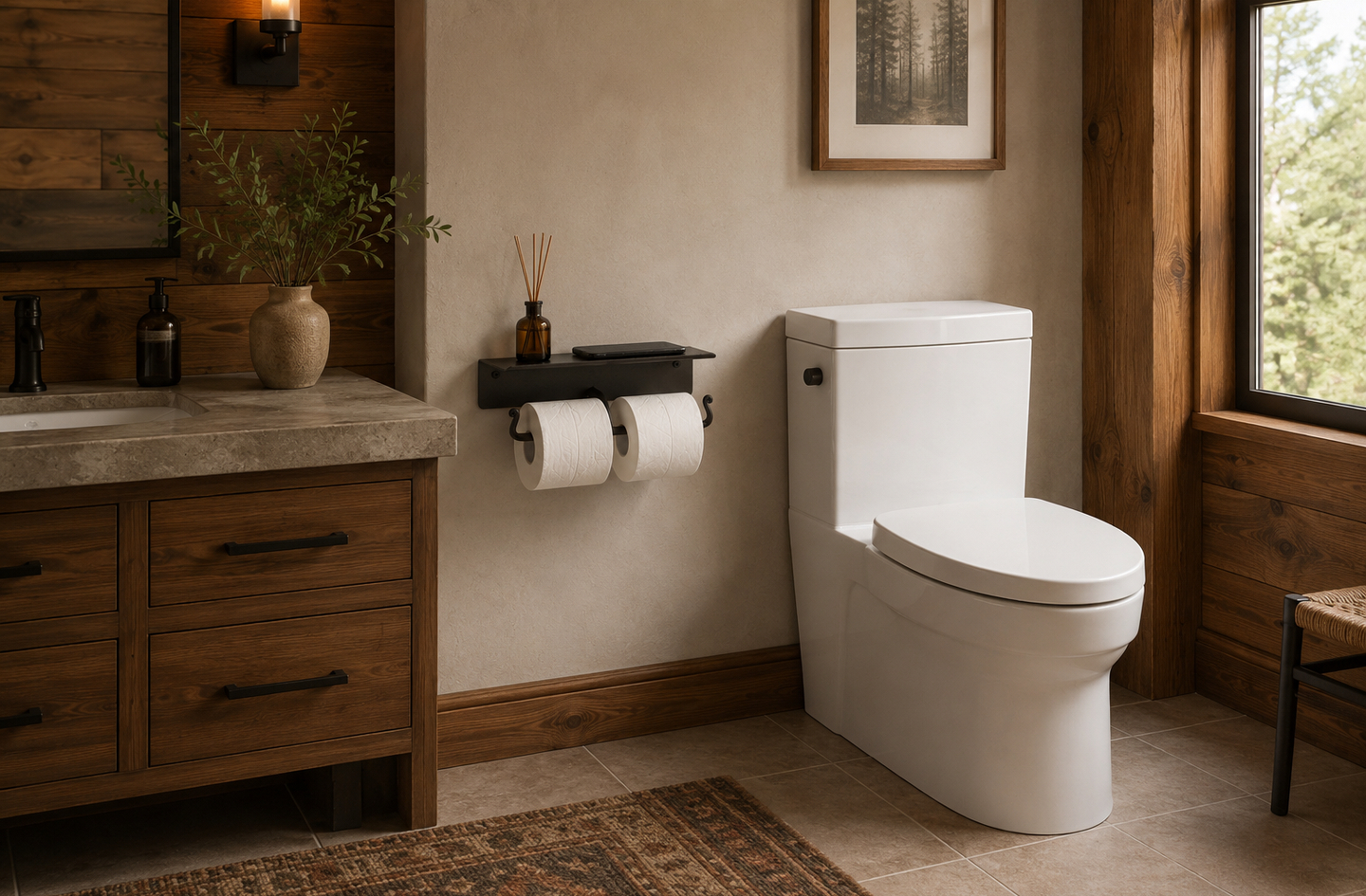
Quick Answer
Which toilet paper holder works best in a small bathroom?
A wall-mounted holder works best in most small bathrooms, because it occupies no floor and positions the roll where a seated person reaches it. The NKBA places the holder 8 to 12 inches in front of the bowl and 26 inches above the floor1. Choose a shelf or double model when wall space allows, and a slim stand only when drilling is not an option.
Key Takeaways
- Floor space is the scarce resource: code allows 21 inches of clear space in front of a toilet, and the NKBA recommends 301.
- By RTZEN’s comparison, the ADA and NKBA forward ranges overlap at 8 to 9 inches in front of the bowl12.
- Home toilet paper holders are designed for rolls up to 6.5 inches across, according to a Procter & Gamble patent3.
- In a CU Boulder test of a lid-less public restroom toilet, flush droplets rose 4.9 feet within 8 seconds5. An open shelf beside the bowl may be exposed.
- A common assumption is that a freestanding stand saves space; it trades wall area for floor area, which a small bathroom has even less of.
Quick Comparison: Four Holder Formats for Tight Bathrooms
Four common formats cover most holders sold for home bathrooms: the single wall-mounted arm, the holder with a shelf, the double holder and the freestanding stand. Recessed holders set into the wall save the most space, but they require opening the wall, so they suit a renovation rather than a swap. Each one solves a different small-bathroom problem: the single arm occupies the least wall, and the shelf model adds a surface for a smartphone. The double model holds a spare roll ready, and the stand avoids drilling altogether. The table compares them on the points that matter most in a tight bathroom: floor, reach, door swing, cleaning and spare storage.
| Category | Single wall-mounted | Holder with shelf | Double holder | Freestanding stand |
|---|---|---|---|---|
| Best for | Powder rooms and the narrowest walls | Bathrooms with no counter beside the toilet | Shared bathrooms that run out of paper | Rentals, tile you cannot drill, temporary setups |
| Floor used | None | None | None | The base footprint, usually beside the toilet |
| Wall width used | One roll plus the end brackets | The shelf width, which sets the size | Two rolls side by side plus brackets | None |
| Reach from the seat | Fixed at the mounting point | Fixed, shelf above the roll | Fixed, second roll slightly farther away | Moves wherever the stand is placed |
| Door swing risk | Low on the side wall | Moderate if the shelf projects | Moderate on a narrow side wall | High if the door sweeps the floor beside the toilet |
| Cleaning access | Floor fully clear | Floor clear, shelf requires wiping | Floor clear | Base must be lifted to clean under it |
| Spare-roll storage | None | One roll can sit on the shelf | One spare on the second arm | Spare rolls stack on the spindle |
| Drilling | Yes | Yes | Yes | No |
| Verdict | Wins on floor and wall space | Wins on surface | Wins on refill readiness | Wins on no-drill installation |
In a small bathroom the deciding question is which resource is scarcest: floor, wall or the willingness to drill.
Floor Space: Choosing a Toilet Paper Holder for Small Bathroom Floors
A wall-mounted holder wins on floor space, because it occupies none. That matters more than it sounds. The building code allows a minimum of 21 inches of clear space in front of a toilet, and NKBA designers recommend 30 inches1. In a powder room built near the minimum, every inch of floor beside the bowl is already spoken for by feet, knees and the door.
Clear floor space is the open area in front of and beside a fixture that a person needs to stand, sit and turn. Side clearance is equally tight: the NKBA recommends at least 18 inches between the toilet and another fixture or vanity, and codes allow 151. For accessible toilets, the ADA sets the centerline 16 to 18 inches from the side wall2. A freestanding stand set into that gap shrinks it further, often right where a hand reaches down to steady the body when sitting.
Why a stand costs more floor than it seems
A stand’s footprint is its base, not its roll. The base must be wider than the roll to stay upright when paper is pulled, so it claims floor in every direction. A wall arm claims only the wall above the floor, which in a small bathroom is often the one surface with room to spare. Measure the gap between the toilet and the vanity or wall before purchasing any stand. If the gap beside the toilet is already near the code minimum, the stand belongs elsewhere.
Where a single arm fits when the wall is narrow
A single open-arm holder requires only enough wall for one roll and its end brackets. That suits the short stretch of wall between a toilet and a vanity in most powder rooms. RTZEN’s Classic holder is one example: an open roll bar on a hand-forged iron arm, so a new roll slides on from the open end. The open arm also matters in a tight bathroom, because it makes changing rolls fast and simple.
When the floor is the scarcest resource, the holder belongs on the wall, even if the wall section is short.
Reach From the Seat: Where Each Format Puts the Roll
Wall-mounted formats win on reach, because they fix the roll in the zone that published guidelines agree on. The NKBA places the holder 8 to 12 inches in front of the bowl and 26 inches above the floor1. The ADA standards place a dispenser 7 to 9 inches in front of the water closet, measured to its centerline2.
By RTZEN’s comparison, the two ranges overlap, so a holder centered 8 to 9 inches in front of the bowl satisfies both. That position is a useful target in a small bathroom, where a holder cannot easily move later. The ADA also sets the outlet height between 15 and 48 inches above the floor2. The NKBA’s 26-inch height sits comfortably inside that band.
How a stand changes reach
A freestanding stand positions the roll wherever the base lands, which is both its strength and its weakness. Positioned carefully, it can match the wall location closely. Positioned where the floor happens to be free, it often ends up behind the seat or too low to reach without twisting. A stand also invites drift, because it gets nudged during cleaning and rarely returns to the same location.
Shelf and double models at the same height
A shelf model sets the roll under the shelf, so the roll height follows the bracket, not the shelf. A double model places the second roll farther along the wall, slightly beyond the first. For the full placement method, including left or right side, the holder height and placement guide covers the measurements in detail.
A fixed wall position is a feature in a small bathroom: once it sits in the 8-to-9-inch overlap, nobody has to hunt for the roll.
Door Swing and Passing Clearance
A single wall-mounted holder wins on door clearance, because it projects the least from the wall. Door swing is the arc a hinged door sweeps as it opens, and in a small bathroom that arc often crosses the toilet area. Bob Vila’s bathroom design guide advises that no door should bump into another. In a very small bath, it suggests rehanging the door to swing out1.
The entry door also establishes a minimum width. Under the ADA, a bathroom door opening should be at least 32 inches wide, measured from the open door to the opposite stop1. An ADA advisory note adds that when the door sits directly in front of the toilet, the toilet itself cannot overlap the door’s maneuvering clearance2.
Projection is what the door hits
Projection is how far a holder sticks out from the wall, measured from the wall surface to its outermost point. A single arm projects approximately one roll’s depth, while a shelf model projects as far as its shelf, which is often deeper than the roll. If the toilet sits beside the door, open the door fully and mark its edge on the wall before choosing a shelf model.
The stand is the riskiest choice near a door
A stand on the floor sits in the door’s sweep when the toilet is close to the entry. Every time the door opens, it can strike the base or tip the spare rolls. Rehanging the door to swing out solves both problems, but that is a larger job than mounting a wall holder.
Before any holder goes up, the door should be opened fully and its edge marked. A door conflict is the one mistake that moving a roll cannot fix.
Cleaning Clearance Around the Toilet
Wall-mounted holders win on cleaning, because they leave the floor around the toilet completely open. The floor beside and behind a toilet is the hardest part of a small bathroom to clean. A mop or cloth has to reach around the base of the bowl, and anything standing on that floor blocks the path. Every object on the floor adds one more thing to lift, wipe under and set back.
The NKBA’s recommended 18 inches between the toilet and the next fixture leaves room for a hand and a cloth1. Near the code minimum of 15 inches, that space is already tight before a stand base goes in. A wall holder mounted at the NKBA’s 26-inch height sits well above the mop line1.
What each format adds to the cleaning routine
A single arm adds almost nothing: a quick wipe of the bar during the weekly clean. A shelf model adds a flat surface that collects dust and splashes, so it requires wiping as often as the vanity top. A double model adds a second bar, while a stand adds the most work of any format. Its base and underside require cleaning, and the stand has to be moved and replaced each time.
For anyone who cleans a small bathroom weekly, the open floor under a wall holder saves more effort than any feature a stand can offer.
Roll Fit and Spare-Roll Storage
The double holder wins on spare-roll storage, while every wall format must be checked for roll fit first. A Procter & Gamble patent states that existing home toilet tissue holders are designed for rolls up to 6.5 inches in diameter3. The same patent notes that home rolls have typically measured 6.5 inches or less across3.
A spindle is the rod or arm that slides through the roll’s cardboard core and allows the roll to turn. A 2014 patent explains that a holder’s roll capacity is limited by the distance between the spindle and the wall or base plate4. It adds that jumbo rolls of 5 or more inches across can hit the wall and stop turning on some holders4.
A simple fit check before buying
By RTZEN’s calculation from those patents, a 6.5-inch roll requires more than 3.25 inches between the spindle’s center and the wall to turn freely34. Measure that distance on the holder, or ask for it, before choosing a model for large rolls. In a small bathroom the same projection also decides door and knee clearance, so a holder should clear the roll without sticking out further than needed.
Where the spare roll lives
A small bathroom rarely has a cabinet near the toilet, so the spare roll needs a home. A double holder stores one spare on its second arm, ready to use without getting up. A stand stacks reserve rolls on its spindle, and a shelf model can hold one roll on top, though that roll sits in the open. A single arm holds nothing extra, which is why it suits powder rooms that guests use briefly.
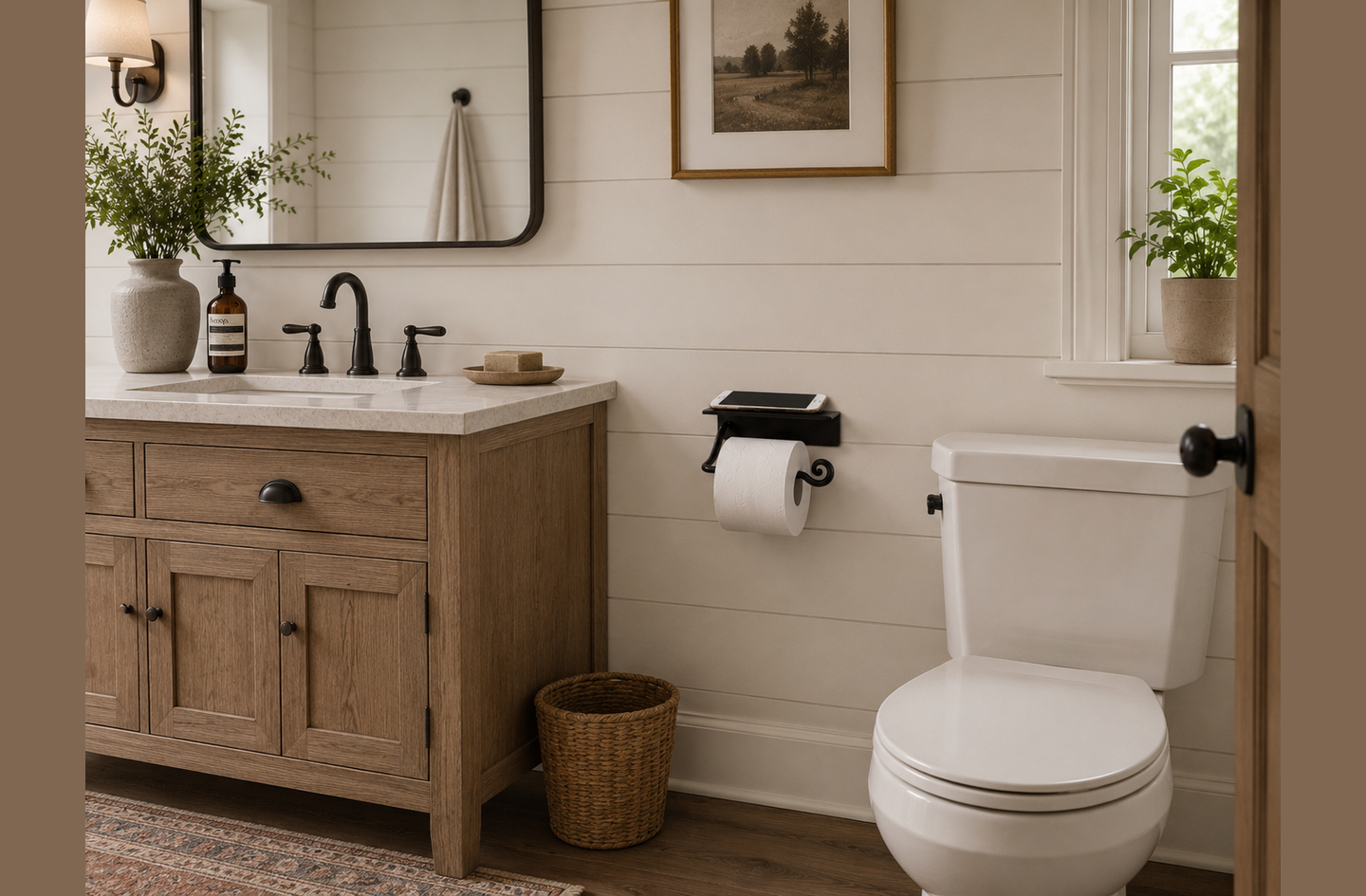
RTZEN’s Double Shelf holder combines two of these answers on one bracket. Its two lower arms hold standard rolls, and the flat shelf above takes a smartphone or small decor.
In a shared bathroom, the second roll is what prevents the empty-holder moment. That benefit grows with the number of people using one small bathroom, and it costs only a few more inches of wall.
Roll fit is a measurement, not a guess. Check the spindle-to-wall distance first, then select the format that stores the spare where the household requires it.
Shelf Surfaces and the Flush Plume
The holder with a shelf wins on surface, but anything left on that shelf sits close to the bowl. Toilet plume refers to the fine droplets thrown into the air when a toilet is flushed. CU Boulder engineers measured particles leaving an open-bowl toilet at 2 meters per second and reaching 1.5 meters above it within 8 seconds5.
That study used a lid-less public restroom toilet with a flushometer valve, filled only with tap water5. A residential toilet with a closed lid would behave differently. Still, a shelf beside the bowl at the NKBA’s 26-inch holder height1 sits lower than the 1.5 meters droplets reached in that test5.
“If it’s something you can’t see, it’s easy to pretend it doesn’t exist.”
John Crimaldi, lead author and professor of civil, environmental and architectural engineering, University of Colorado Boulder5
How to use a shelf sensibly
Close the lid before flushing, which is the simplest way to keep the spray in the bowl. Treat the shelf as a short-term surface for a smartphone or a small item, not as long-term storage. Wipe it on the same schedule as the vanity countertop. A spare roll kept on an open shelf for weeks is better moved to a closed cabinet or a second arm.
When the shelf is worth it
A shelf earns its place in a small bathroom with no counter beside the toilet. Without it, a smartphone ends up on the floor or the tank lid. The holder with shelf guide covers shelf size and roll clearance in more depth.
A shelf is a fair trade in a counter-less bathroom, provided the lid goes down before each flush and items stay only briefly.
Installation by Wall Type: Drilling or No Drilling
The freestanding stand wins on installation, because it requires no drilling at all. Every wall format requires screws, and the wall material decides how difficult that is. In a small bathroom, the wall beside the toilet is often drywall, but it can be tile, which calls for a different bit.
Drywall performs well with an appropriate anchor. Family Handyman tested seven anchors in half-inch drywall, and the lowest-rated one, claimed at 22 pounds, held 80 pounds8. The same test found that all but one anchor exceeded its weight rating8. A holder takes far less load than that, though a person grabbing it for balance adds more.
“For ceramic tile, a carbide-tipped masonry bit is usually sufficient.”
Andy Engel, This Old House7
This Old House recommends a diamond-tipped bit for porcelain and glass tile, or whenever the tile type is unknown7. It also suggests a strip of masking tape over the location to stop the bit from slipping7.
When a stand is the right answer
A stand suits a rental with a no-drilling rule, a fully tiled wall the owner will not drill, or a bathroom awaiting renovation. RTZEN’s Decorative Stand is built from solid iron with a weighted base for stability, and its vertical spindle holds the active roll and reserve rolls together. Placement still matters, because the stand must sit clear of the door sweep and within reach of the seat.
Wall formats and included hardware
RTZEN’s wall-mounted toilet paper holders ship with mounting hardware. For a closer look at open-arm and pivoting designs and how each one installs, the wall-mounted holder design guide compares them side by side.
A stand is the right call only when drilling is genuinely impossible. On any wall that accepts a screw, a wall holder returns the floor to the bathroom.
Finish and Moisture in a Small Bathroom
A holder with a proper rust-resistant finish wins in a small bathroom, because small rooms hold moisture longer. A compact bathroom with a shower and no window often stays humid well after use. The EPA advises keeping indoor humidity below 60 percent, ideally between 30 and 50 percent6.
The EPA also advises drying water-damaged areas within 24 to 48 hours to prevent mold growth6. A holder near the toilet meets splashes and damp hands every day. Bare or thinly painted metal can rust at the screw holes and the roll bar, where the finish wears first.
What a lasting finish looks like
RTZEN holders are hand-forged from solid iron and made in a four-step process: cut, hand-forge, zinc-galvanize and powder-coat. That gives two protective layers, zinc under powder coating. For coordinating a dark holder with faucets and towel hardware, the guide to matching dark hardware covers finish choices.
In a small, humid bathroom, the finish stack matters as much as the format, because a rusted holder is the first thing a guest notices.
Who Should Choose Which Format
A single wall-mounted holder suits a powder room, and a shelf model suits a toilet with no counter beside it. A double holder suits a shared bathroom, and a stand suits walls that cannot be drilled.
- Powder room or half bath: a single open-arm holder on the side wall. Guests use the bathroom briefly, so spare storage matters less than floor and door clearance.
- Small family bathroom: a double holder, so the spare roll is always ready. The second arm costs a few inches of wall and saves the empty-roll moment.
- Bathroom with no counter beside the toilet: a holder with a shelf, used for a smartphone or small items, with the lid closed before flushing.
- Rental or tiled wall that cannot be drilled: a weighted stand, placed clear of the door sweep and within reach of the seat.
If none of these fit, for example where the only free wall sits behind the toilet, a holder mounted on the vanity side panel can work. Check that the drawer or door still opens fully.
Verdict by Category
| Category | Winner | Why |
|---|---|---|
| Floor space | Any wall-mounted format | Uses no floor |
| Reach from the seat | Wall-mounted, 8 to 9 inches in front of the bowl | Meets both NKBA and ADA ranges |
| Door swing | Single wall-mounted | Lowest projection |
| Cleaning access | Single wall-mounted | Floor clear, one bar to wipe |
| Spare-roll storage | Double holder | Spare roll ready on the second arm |
| Surface for a smartphone | Holder with shelf | Only format with a flat top |
| Installation | Freestanding stand | No drilling |
| Overall | Wall-mounted, single or double | Best fit for most small bathrooms |
For most small bathrooms, the wall-mounted holder is the right toilet paper holder, single for a powder room and double for a shared bath. The shelf model is the choice where no counter exists, and the stand is the fallback when the wall cannot be drilled.
Frequently Asked Questions
Where should a toilet paper holder go in a small bathroom?
On the side wall or vanity panel beside the toilet, centered 8 to 9 inches in front of the bowl. That position falls inside both the NKBA’s 8-to-12-inch range1 and the ADA’s 7-to-9-inch range2. Keep it clear of the door’s swing.
Is a freestanding toilet paper stand good for a small bathroom?
Only when drilling is not possible. A stand occupies floor space, and code allows as little as 15 inches between a toilet and the next fixture1. It also sits in the mop path and can drift. In a rental or on undrillable tile, a weighted stand is the practical choice.
Will a jumbo roll fit a standard wall holder?
Not always. A 2014 patent notes that jumbo rolls of 5 or more inches across can hit the wall and stop turning on some holders4. For rolls up to 6.5 inches3, RTZEN’s calculation calls for more than 3.25 inches from the spindle’s center to the wall.
Is it unhygienic to keep a phone on a toilet paper shelf?
It carries some exposure, because in a CU Boulder test, flush droplets reached 1.5 meters above an open-bowl toilet within 8 seconds5. Closing the lid before flushing, keeping the smartphone there briefly and wiping the shelf regularly all reduce the risk.
Do I need special anchors to mount a holder on drywall?
Standard anchors are usually enough. In a Family Handyman test of seven anchors in half-inch drywall, the lowest-rated anchor, claimed at 22 pounds, held 80 pounds8. Use a stud where one sits behind the mounting location.
Limitations and Edge Cases
- In RTZEN’s reading, the NKBA and ADA ranges fit a standard floor-mounted toilet with a side wall or vanity beside it. A toilet in an alcove with no side surface requires a stand or a rear-wall position.
- The flush plume figures come from a lid-less public restroom toilet with a flushometer valve5. Home toilets with tank flushes and closed lids were not measured in that study.
- The 3.25-inch clearance is an RTZEN calculation for a 6.5-inch roll34. Rolls larger than that, or holders with a recessed spindle, require their own measurement.
- Fully accessible bathrooms follow the ADA standards in full, including grab bar heights and clearances that this comparison does not reproduce.
References
Methodology: every measured figure comes from the published sources below. The 8-to-9-inch overlap and the 3.25-inch clearance are RTZEN calculations from those figures, and product details come from RTZEN listings. Rami Abramson, Founder & CEO, reviewed the article before publication.
- Bob Vila – The Basics of Good Bathroom Design: Measurements to Know, Joe Provey, updated May 31, 2024, reporting NKBA recommendations and code minimums.
- U.S. Access Board – ADA Accessibility Standards, sections 604.3 and 604.7 on water closet clearance and dispensers.
- Google Patents – US11633076B2, Sanitary tissue product rolls, The Procter & Gamble Company, granted April 25, 2023.
- Google Patents – US8622333B2, Toilet tissue roll holder capacity extender, Mario Dermo, granted January 7, 2014.
- University of Colorado Boulder – CU scientists shine light on what comes up when you flush, Kelsey Simpkins and Nicholas Goda, December 8, 2022, on a study published in Scientific Reports.
- U.S. Environmental Protection Agency – A Brief Guide to Mold, Moisture and Your Home, last updated February 18, 2026.
- This Old House – How To Drill Through Tile With Ease, Andy Engel, updated October 7, 2024.
- Family Handyman – How Much Weight Can Drywall Anchors Hold In Your Home?, Jason Ingolfsland, updated October 28, 2024.
Conclusion
In a small bathroom, the right toilet paper holder is almost always on the wall. A single arm suits a powder room, a double suits a shared bath, and a shelf model suits a bathroom with no counter. Install it 8 to 9 inches in front of the bowl, clear of the door, and keep the stand for walls that cannot be drilled.
To see how this choice fits the wider topic, read the toilet paper holders overview. Every RTZEN holder is hand-forged from solid iron and backed by a Lifetime Warranty.