
A countertop paper towel holder is judged by two things: how much counter it occupies and how easily the roll comes off and goes back on. This comparison sits under the paper towel holder overview, which summarizes how to choose a holder for your home. Counter space is the scarce resource here. The National Kitchen & Bath Association recommends 158 inches of countertop frontage, 24 inches deep, to cover every kitchen task combined1. Any freestanding stand competes with prep space, landing areas and small appliances for that frontage.
Quick Answer
Which countertop paper towel holder suits a small kitchen?
A center-post stand with a weighted base suits a small kitchen best, because its footprint is close to the roll’s own circle. A 2006 patent describes conventional rolls as 5 to 6 inches across3, so the stand claims little more than a saucer of space. A tension-arm stand adds a spring arm that holds the roll still, which helps one-handed tearing but widens the footprint.
Key Takeaways
- Footprint follows the roll: existing home holders are designed for rolls up to 6.5 inches across, and a 2024 Procter & Gamble patent describes rolls of about 8.52 inches4.
- Height matters only under wall cabinets, where the standard gap is 18 inches2 and an upright roll alone stands 11 inches tall3.
- Center-post stands refill by lifting the roll straight up, so under a cabinet the stand is slid forward to change a roll.
- A heavy base, not a gripping arm, is what keeps a stand upright when a sheet is pulled sideways.
- The common misconception is that every stand is the same; the base material, post design and finish decide how it behaves over years of daily use.
Quick Comparison: Center-Post Iron Stands vs Tension-Arm Stands
Two designs cover most freestanding stands. A countertop paper towel holder is a freestanding stand that carries a roll upright on the counter, with no screws, brackets or wall anchors. The decorative wrought iron type relies on a heavy base and a fixed center post. The tension-arm type adds a spring-loaded arm that presses on the roll. Side by side, the table shows how each design handles footprint, height, the center post, refill access and portability. One point applies to both: stability comes from base mass, so a heavy base steadies either design.
| Category | Center-post wrought iron stand | Tension-arm stand |
|---|---|---|
| Best for | Small counters, dining tables, outdoor cooking areas | Households that tear sheets one-handed on a lighter stand |
| Footprint | Base close to the roll’s circle; rolls run 5 to 6 inches across | Roll circle plus the arm and its hinge beside the roll |
| Overall height | Roll height of 11 inches plus base and finial | Roll height plus base; arm sits within the roll height |
| Center post | Fixed post, finial on top keeps the roll contained | Post plus a separate pressure arm |
| Refill access | Lift the roll straight up over the post | Move the arm aside, then lift the roll over the post |
| What resists a pull | Base mass | Arm pressure on the roll, plus base mass |
| Portability | Picks up by the post and moves anywhere | Picks up the same way; the arm adds a moving part |
| Moving parts | None | Spring and hinge |
| Verdict | Wins on footprint, refill and portability | Wins on one-handed tearing |
The comparison is closer than it looks: the arm buys tearing control and pays for it in width and parts.
Footprint: How Much Counter a Countertop Paper Towel Holder Uses
A center-post stand wins on footprint, because its base only needs to be a little wider than the roll it carries. A 2006 patent describes conventional rolls as 5 to 6 inches in diameter3. A 2024 Procter & Gamble patent adds that existing home holders are designed for rolls up to 6.5 inches across4. That roll circle sets the minimum footprint for every freestanding design.
Footprint is the patch of counter a stand covers, measured across its base or across the roll, whichever is larger. A tension-arm stand covers the same roll circle and then adds the arm, its hinge and the base extension that anchors them. The roll still decides most of the width, but the arm pushes the stand off-center and makes it harder to tuck into a corner.
Counter depth and the landing area
NKBA’s countertop guideline is written around counters 24 inches deep1. By RTZEN’s calculation, a roll 6 inches across3 set against the backsplash uses a quarter of that depth. The rest of the counter stays open in front of it.
Landing area is clear counter beside a sink or appliance where hot pans, groceries and dishes are set down. NKBA measures it as countertop frontage next to the sink or appliance1. NKBA recommends a landing area at least 24 inches wide on one side of the sink and 18 inches on the other1. The counter must be at least 16 inches deep to qualify1.
Put those figures together and the placement rule becomes clear. By RTZEN’s calculation, a stand pushed against the backsplash of a 24-inch counter leaves about 18 inches of depth in front of the roll. That is still more than NKBA’s 16-inch minimum depth for a landing area1, so the stand can sit behind it. A stand placed at the front edge, by contrast, cuts straight into the landing area.
Larger rolls widen every design
Roll sizes are not fixed. A Procter & Gamble patent describes rolls with a diameter of about 8.52 inches4, well past the 6.5-inch size existing holders were designed for4. On a center-post stand, a roll that wide overhangs a small base and brushes nearby jars or a backsplash outlet cover. On a tension-arm stand, the arm has to open further, which can push it past its comfortable range. Anyone buying bulk or mega rolls should run a jumbo roll fit check before choosing a stand.
Verdict: the center-post stand takes less counter, as long as its base suits the roll size the household actually buys.
For a crowded counter, the backsplash position matters more than a slimmer stand, because it protects the landing area the cook uses most.
Overall Height and Clearance Under Wall Cabinets
Height only decides the choice where a stand sits under wall cabinets. The standard gap between the countertop and the bottom of the upper cabinets is 18 inches2. NKBA’s countertop guideline asks for at least 15 inches of clearance above working counter1. An open counter or an island has no ceiling at all, so either design fits there.
The roll sets the floor for overall height. Conventional towels are 11 inches wide3, so a roll standing upright on its post is 11 inches tall before the base and finial are added. A base plate and a finial together add a few inches, which still leaves room under an 18-inch gap. For households with limited mobility, the same guidance lowers the gap to 14 inches2, which leaves very little spare height above the finial.
The refill height nobody measures
Standing height is only half the story. To lift a roll off a fixed center post, the roll must rise the full height of the post before it clears the top. With an 11-inch roll3, RTZEN’s calculation puts that at about 22 inches of open space. No standard cabinet gap offers that much.
The practical result: under cabinets, a center-post stand is refilled by sliding it to the counter edge first, unless the roll is tilted off. A freestanding stand makes that easy, which is a hidden advantage of the countertop format. A tension-arm stand shares the same limit, and its arm has to be moved aside as well.
Verdict: both designs fit under a standard 18-inch gap; the center-post stand is quicker to slide out and refill because it has no arm to manage.
If the stand lives under cabinets, judge it by how easily it slides forward, not by how tall it stands.
Center Post vs Tension Arm: How Each Design Holds the Roll
The fixed center post wins on simplicity, while the tension arm wins on holding the roll still. Both designs thread the roll over an upright post through its cardboard core. The 2006 patent gives a conventional core an inside diameter of about 1.625 inches3, so every post must be narrower than that.
A center post is the upright rod that passes through the roll’s core and carries its weight. Its diameter controls how freely the roll turns. A slim post leaves a loose fit, and the roll spins easily when a sheet is pulled. A post closer to the core’s inside diameter adds a little friction, which slows the spin without any moving part. The finial at the top keeps the roll from riding up and off when someone lifts a sheet at an angle.
How a tension arm works
A tension-arm stand is a freestanding holder with a spring-loaded arm or bar that presses against the outside of the roll. The pressure stops the roll from spinning on its own, so a single hand can tear a sheet. The arm swings out of the way during a refill and springs back once the new roll is seated.
Spring-loaded parts are an old idea in roll holders. Patent US 7,048,225 notes that conventional wall holders typically use resilient arms that push apart to take a roll3. Those arms grip the core ends, not the roll’s outside, but they also work through stress held in a flexible part. A fixed post has fewer parts that can loosen.
What the finial does on an iron stand
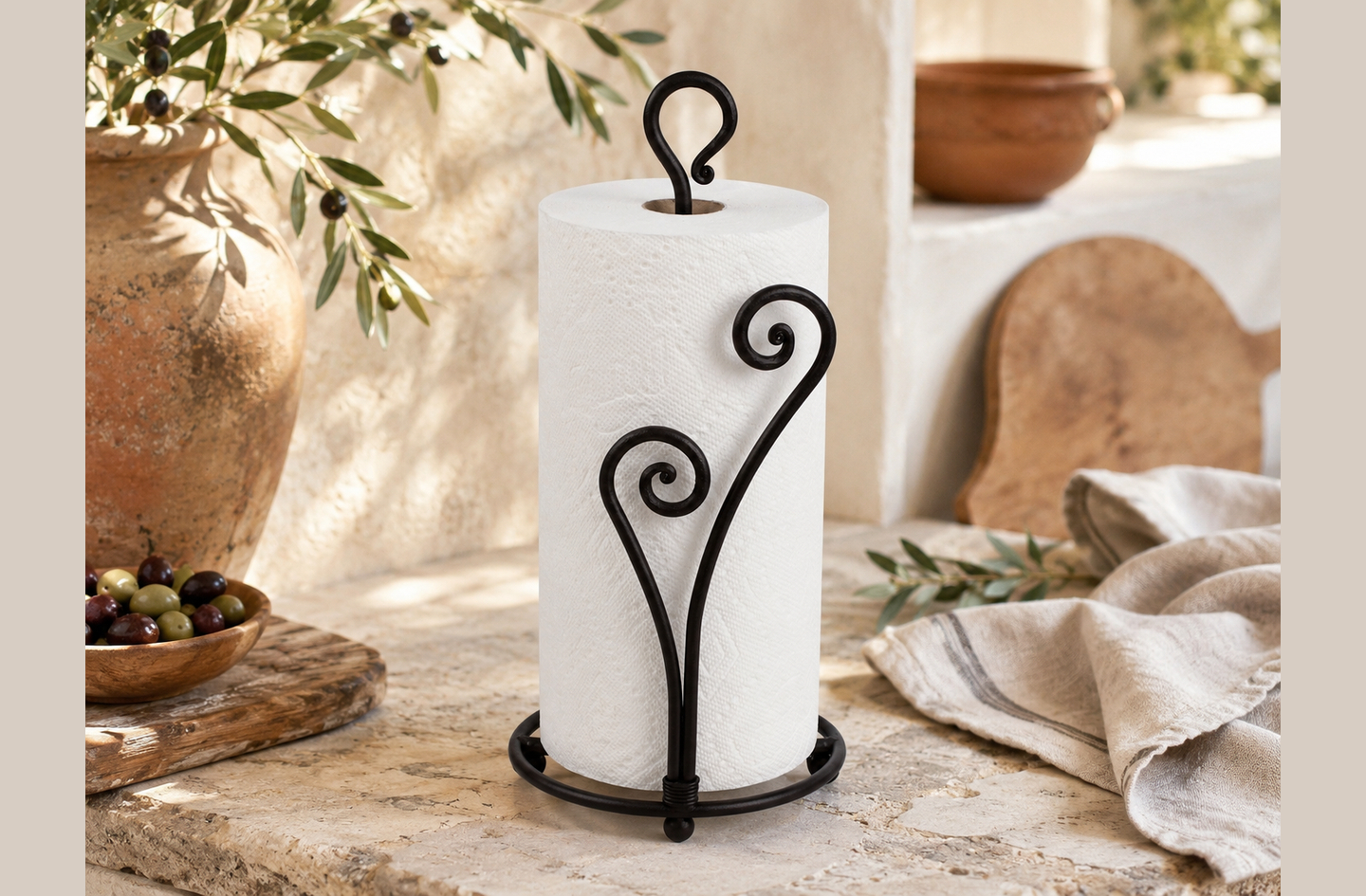
On a forged stand, the finial is both ornament and handle. The Fancy stand tops its upright rod with a decorative forged element. That element keeps the roll contained and gives the hand a grip when the stand is lifted or moved. Like every RTZEN piece, it is cut, hand-forged, zinc-galvanized and powder-coated in the workshop Tsach Levy opened in 1997. Its vertical spindle accommodates standard and jumbo rolls, according to the product listing. It has no tension arm, and RTZEN does not describe one for any countertop model.
Verdict: the fixed post wins on simplicity, with fewer parts to loosen; the tension arm wins only where hands-free spin control matters most.
A post that fits the core closely adds some spin control without adding a moving part.
Refill Access and One-Handed Tearing
A center-post stand refills faster, while a tension-arm stand tears more cleanly with one hand. Each conventional sheet is about 9 inches long3, and every tear asks the stand to resist a short pull to the side. How each design meets that pull explains the difference.
Changing the roll
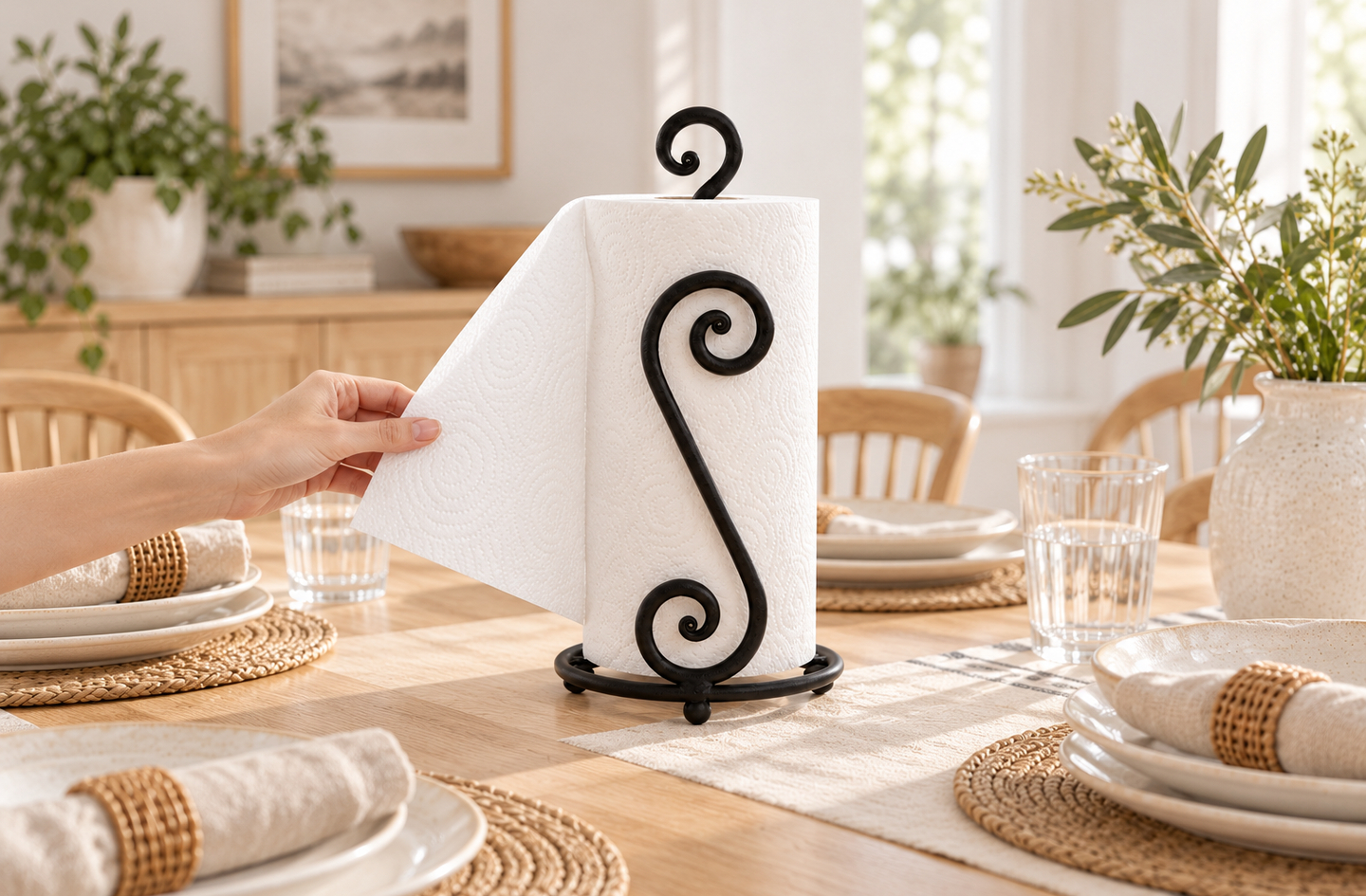
A center-post refill takes three moves: lift the empty core over the finial, drop the new roll onto the post and pull the first sheet free. Nothing needs to be held open. The Heart stand, with its ornate forged base and decorative top finial, follows this pattern and is listed for easy roll replacement. A tension-arm stand adds a fourth move, because the arm must be held aside while the new roll goes on.
Tearing with one hand
When a hand pulls a sheet, the roll wants to spin and the stand wants to slide or tip. A tension arm answers the spin directly by pressing on the roll. A center-post stand answers it with weight: a heavy base stays put, so a quick downward snap tears the sheet along its perforation. The technique matters too. Pulling down toward the counter, rather than out toward the room, keeps the force low on the stand and close to its base.
Light stands fail this test in the same way. A thin metal or wooden base slides across the counter before the perforation gives, and the user ends up steadying the stand with the other hand. That two-handed habit defeats the purpose of a countertop stand near a sink.
Verdict: the center-post stand wins on refill; the tension arm wins on one-handed tearing unless the post stand is heavy enough to stay put.
For most kitchens, a heavy center-post stand closes the tearing gap without the arm’s extra refill step.
Stability: Why Base Weight Beats Grip
Base mass, not grip, keeps a freestanding stand upright, and the base material sets that mass. Wrought iron has a density of about 7,750 kg/m3, against 2,712 kg/m3 for aluminum5. Oak runs 600 to 900 kg/m3 and bamboo 310 to 400 kg/m36.
In decor usage, wrought iron refers to iron that is heated and hammered into shape, the way a blacksmith works it, rather than poured into a mold. Its weight comes from the metal itself. A base of the same size and shape in wrought iron weighs about 2.9 times as much as one in aluminum5. It weighs more than 8 times as much as one in the densest oak56.
Why weight matters more than width
A stand tips when the pull on a sheet, acting at the height of the roll, outweighs the stand’s own weight acting over half its base. A wider base helps, but every extra inch costs counter space. Extra weight helps without costing any space at all. That is why a compact iron base can match a much wider light base for stability.
Stainless steel sits close to iron at 7,480 to 8,000 kg/m35, so a solid stainless base is also heavy. Thin stamped or hollow bases lose that advantage, because their weight depends on how much metal is actually in them. A hollow tube looks solid but carries only the metal in its wall.
Verdict: a heavy, solid base wins on stability in either design; a tension arm alone cannot keep a light stand from sliding or tipping.
When comparing stands, ask what the base is made of and whether it is solid, because that answer predicts how the stand behaves at every tear.
Portability: Moving a Stand Between Counter, Table and Patio
A freestanding stand wins on portability by definition, and the simpler center-post design is the easiest to carry. It needs no screws, anchors or drill, so it moves wherever the mess is. The roll that serves the prep counter at noon can sit on the dining table at dinner and beside the grill on the weekend.
The Fancy stand’s product listing names kitchen countertops, dining tables and outdoor cooking areas as intended places, and it requires no wall mounting or installation tools. On a center-post stand, the finial doubles as a carrying handle, so the stand lifts with one hand and the roll stays seated. A tension-arm stand carries the same way, but the arm can swing open in transit and drop the roll.
When a fixed holder makes more sense
Portability has a cost: a stand always occupies counter. Where the counter is genuinely full, a fixed holder moves the roll off the work surface entirely. A wall-mounted holder guide covers rolls hung on a backsplash or pantry wall. An under-cabinet holder keeps the roll above the counter and frees its whole surface.
Renters and anyone with a tiled backsplash they do not want to drill tend to favor the stand for the same reason. It leaves no holes, and it moves out with them.
Verdict: the center-post stand is the most portable option; a fixed holder wins only where every inch of counter is already taken.
Choose a stand when the roll needs to follow the work; choose a fixed holder when the counter cannot spare the space.
Finish and Moisture: What Keeps an Iron Stand From Rusting
Finish decides how an iron stand ages beside a wet sink. On galvanized steel, zinc under powder coating outlasts either coating alone7. A duplex system is the galvanizing industry’s term for a zinc coating that is sealed under paint or powder coating. The American Galvanizers Association describes the payoff in plain terms.
“When paint/powder coating and galvanized steel are used together, the corrosion protection is superior to either protection system used alone and can last from 1.5 to 2.3 times the combined lifetimes of both systems.”7
American Galvanizers Association, Duplex Systems: Paint or Powder Coating Over HDG7
Every RTZEN stand goes through the catalog’s four steps: cut, hand-forge, zinc-galvanize and powder-coat. The Fancy stand’s listing names a zinc coating under a black powder finish to protect against rust and daily kitchen moisture. That stack follows the same zinc-plus-powder principle the association describes for galvanized steel7.
Other base materials near water
Wood and bamboo stands avoid rust but rely on a sealed surface near the sink, because standing water marks unsealed grain. Stainless and chrome stands resist corrosion well, although thin plated parts show scratches over time. A tension-arm stand adds a spring and a hinge, and both sit in the splash zone where crumbs and moisture collect.
Daily care for a powder-coated iron stand is a wipe with a damp cloth and a dry towel. Abrasive pads can cut through the powder coat, so a soft cloth is the safer choice. RTZEN backs its catalog with a Lifetime Warranty that covers material and workmanship defects under normal use.
Verdict: a zinc-and-powder-coated iron stand carries the stronger finish stack; tension-arm stands add parts that sit in the wettest part of the counter.
Near a sink, ask what sits under the visible finish, because the hidden layer is what decides the stand’s lifespan.
Who Should Choose Which Stand
If the counter is small and the roll lives near the sink, choose a heavy center-post stand. If one-handed tearing on a light stand matters above everything else, choose a tension-arm model. The profiles below apply that rule to common kitchens.
- Compact kitchens with wall cabinets: a center-post wrought iron stand set against the backsplash, slid forward for refills.
- Islands and open counters: a decorative iron stand, since there is no height limit and the stand is on display from every side.
- Dining tables and outdoor cooking: a weighted center-post stand that lifts by its finial and needs no mounting.
- Households that tear with one hand on a light stand: a tension-arm stand, accepting the wider footprint and extra parts.
- Counters with no room at all: a mounted holder; the under-cabinet mount guide compares arm openings and roll loading.
For most homes, the deciding question is not which stand looks best but where the roll will be used most.
Verdict by Category
| Category | Winner | Deciding reason |
|---|---|---|
| Footprint | Center-post stand | Base close to the roll’s own circle |
| Overall height | Tie | Both fit an 18-inch cabinet gap standing up |
| Center-post design | Center-post stand | No spring or hinge to wear |
| Refill access | Center-post stand | Lift and drop, with no arm to hold aside |
| One-handed tearing | Tension-arm stand | Arm pressure stops the roll spinning |
| Stability | Heavy solid base, either design | Base mass resists sliding and tipping |
| Portability | Center-post stand | Finial doubles as a handle |
| Overall | Center-post wrought iron stand | Best fit for small counters and daily use |
The center-post design takes five of the eight rows, and the tension arm keeps one clear win. Stability turns on material rather than design. A heavy base narrows even that gap, because a stand that cannot slide lets a single hand snap a sheet free.
Frequently Asked Questions
How much counter space does a countertop paper towel holder need?
A center-post stand needs a patch only slightly wider than the roll, and conventional rolls measure 5 to 6 inches across3. Set it against the backsplash: on a 24-inch counter that leaves about 18 inches of depth, above NKBA’s 16-inch minimum for a landing area1.
Will a paper towel stand fit under kitchen wall cabinets?
Yes, in most kitchens. The standard gap between counter and upper cabinets is 18 inches2, and an upright roll stands 11 inches tall3 before the base and finial. Refilling is different: lifting a roll off the post needs about twice its height, so slide the stand forward first.
Do freestanding paper towel holders fit jumbo rolls?
Many do, but check the roll first. Existing home holders are designed for rolls up to 6.5 inches in diameter4, and larger rolls can overhang a small base. Measure the new roll’s diameter and compare it with the base and the spindle height before buying a stand.
Is a tension arm worth having on a paper towel stand?
It helps on a light stand, where the roll spins and the base slides during a tear. On a heavy stand the benefit shrinks, because base mass already holds the stand still. Wrought iron, at about 7,750 kg/m35, gives a compact base that much weight without an arm, spring or hinge.
How do you keep an iron paper towel stand from rusting?
Start with the finish. On hot-dip galvanized steel, powder coating over zinc can last 1.5 to 2.3 times the combined lifetimes of both systems7. After that, wipe splashes with a damp cloth, dry the stand, and avoid abrasive pads that could cut through the powder coat.
Limitations and Edge Cases
- The cabinet gaps and counter depths come from US kitchen standards; kitchens built to metric standards use different heights and depths.
- The 22-inch refill estimate assumes a post at least as tall as the roll; a shorter post, or tilting the roll as it lifts, needs less height.
- The weight comparison assumes solid bases of equal size; hollow bases, or bases with a weighted insert, behave differently.
- RTZEN listings do not publish base width or overall height for its stands, so measure the stand or check its marketplace listing before placing it under cabinets.
References
Methodology: measured figures come from the published sources below. The footprint, refill-height and base-weight estimates are RTZEN calculations from those figures, and product details come from RTZEN listings. Rami Abramson, Founder & CEO, reviewed the article before publication.
- National Kitchen & Bath Association – Kitchen Planning Guidelines with Access Standards, guidelines on sink landing areas and countertop space.
- Bob Vila – Upper Cabinet Height for Kitchens, Solved!, Manasa Reddigari, updated October 5, 2020.
- Google Patents – US7048225B2, Narrow paper towel roll and holder, Nicholas A. Delfino, granted May 23, 2006.
- Google Patents – US11952724B2, Paper towel rolls, The Procter & Gamble Company, granted April 9, 2024.
- Engineering ToolBox – Metals and Alloys, Densities, density table in kg/m3.
- Engineering ToolBox – Density of Wood Species: Data and Material Guide, density table in kg/m3.
- American Galvanizers Association – Duplex Systems: Paint or Powder Coating Over HDG, knowledge base article.
Conclusion
For most counters, a heavy center-post stand is the better countertop paper towel holder. It takes the least space, refills fastest and stays put through a tear. A tension-arm stand earns its place only where one-handed tearing on a light stand matters most. Whichever design you choose, set it against the backsplash and check it against the rolls you buy.
To see how a countertop stand fits the wider choice of holder, read the paper towel holder overview. Every RTZEN stand is backed by a Lifetime Warranty.