
An under cabinet paper towel holder works when its arm clears a full roll, reloads easily and screws into a cabinet bottom that holds thread. This article narrows the broader overview in Paper Towel Holders to one decision: which screwed-in under-cabinet design suits a given kitchen. The roll sets the first limit. A conventional roll is eleven inches wide and 5 to 6 inches in diameter1. The arm length and the drop from the cabinet decide whether a full roll fits. Cabinet material and reach from the prep zone settle the rest.
Quick Answer
Which under cabinet paper towel holder design should you choose?
Choose an open-arm under cabinet paper towel holder when rolls change often and the cabinet bottom is solid. Choose a bracket at each end when steady tearing matters more than loading speed. Check fit first: a conventional roll is eleven inches wide with a core about 1.625 inches across1. The arm must be longer than the roll and thinner than the core.
Key Takeaways
- A conventional paper towel roll is eleven inches wide and 5 to 6 inches in diameter1. The arm length and the drop from the cabinet both have to clear a full roll.
- Calculated from the Wood Handbook’s withdrawal equation, a screw in the face of particleboard is predicted to hold about 29 percent more than one in the edge4. Under-cabinet screws belong in the face of a sound bottom panel.
- Bob Vila recommends hanging upper cabinets 54 inches above the floor2, higher than the 48-inch unobstructed high reach in the ADA Standards3. For a seated cook, the roll has to hang beneath the cabinet to come within reach.
- An under-cabinet roll is not automatically the hygienic choice. In a 2018 USDA study, numerous participants did not dry their hands with a clean towel5. The CDC ends its handwashing steps with a clean towel or an air dryer7. The roll helps only where wet hands reach it first.
Under Cabinet Paper Towel Holder Designs Compared
Most screwed-in under-cabinet holders fall into a small set of designs. They differ mainly in how the roll goes on and how firmly it sits during a tear. An open-arm holder is a single bracket with a cantilevered arm, so the roll slides on from the free end. The other designs hold the roll at both ends or on a hinge, which trades loading speed for steadiness.
| Design | How the roll goes on | Steadiness during a tear | Cabinet contact | Best fit |
|---|---|---|---|---|
| Open arm | Slides on from the free end of the arm | Steady when the arm ends in a raised tip or scroll | A single bracket at the fixed end | Frequent roll changes and sink-side stations |
| Lift-out rod | A loose rod drops into slots in a bracket at each end | Very steady, because both roll ends are held | A bracket at each end of the roll | Busy prep counters with hard, fast tearing |
| Spring spindle | A spindle compresses and snaps in between end brackets | Steady while the spindle stays tight in its brackets | A bracket at each end of the roll | Kitchens that want a closed look with no loose rod |
| Swing-down arm | The arm pivots down on a hinge, takes the roll, then folds back up | Depends on how firmly the hinge latches | A hinge bracket at the fixed end | Crowded undersides where a roll cannot slide on sideways |
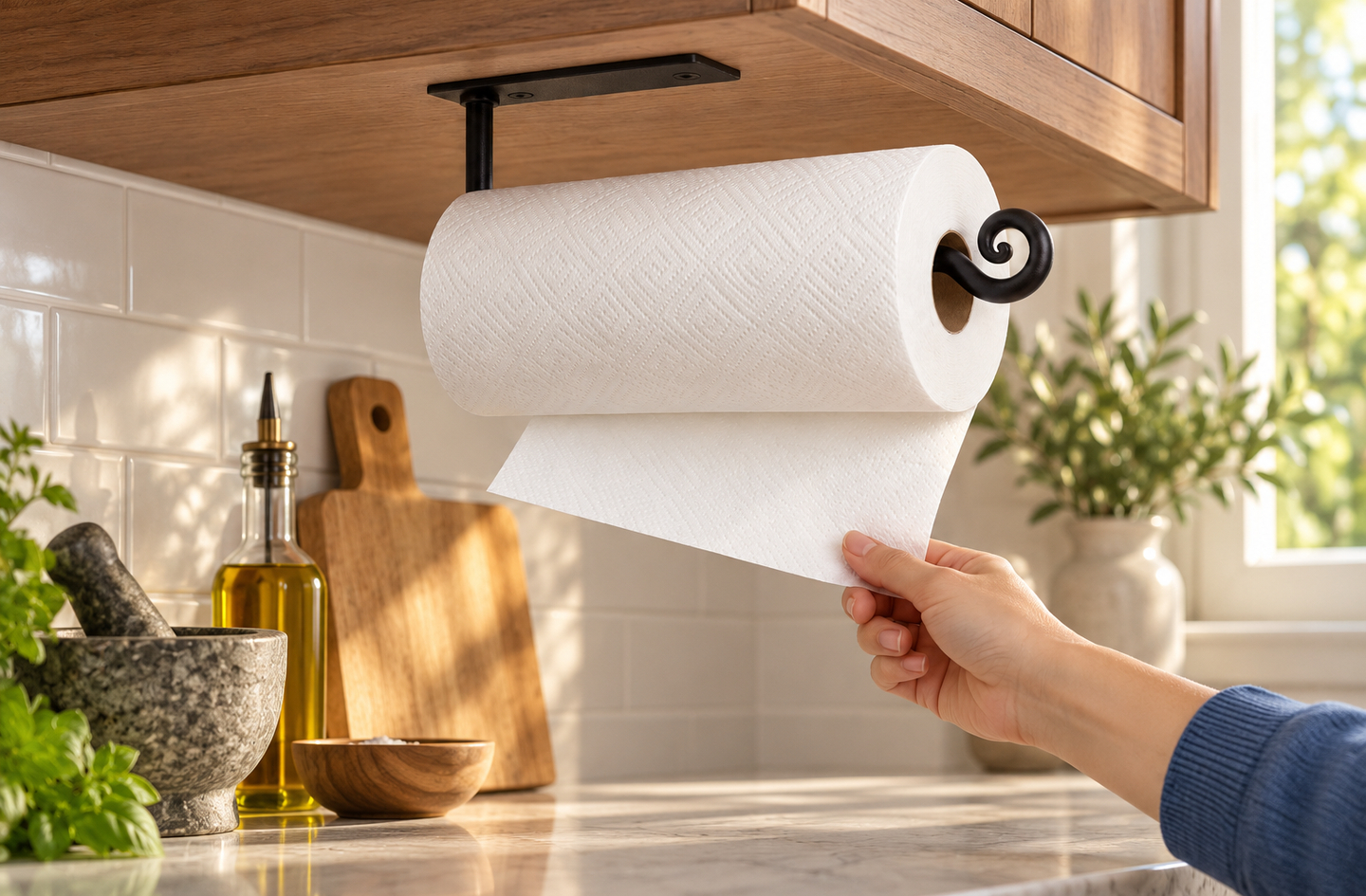
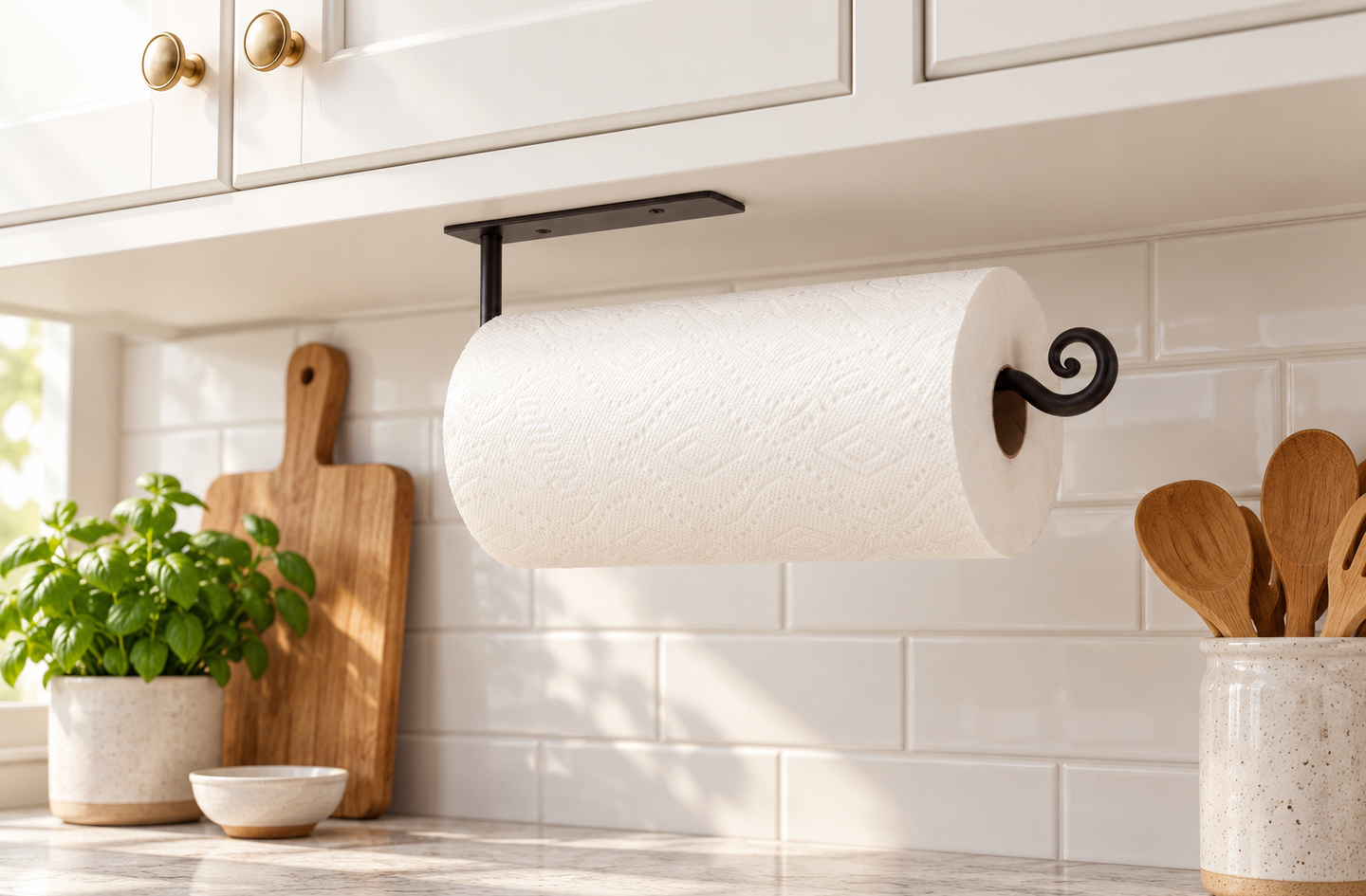
The RTZEN Under Cabinet holder is an open-arm design forged from solid wrought iron with a rust-resistant finish. The maker describes it for standard rolls, with an open arm for smooth roll replacement and easy tearing, and supplies the mounting screws. That puts it in the first row: quick to reload, with steadiness that comes from the arm’s shape rather than a second bracket.
For a kitchen that swaps rolls often, the open arm is the design to beat. The bracket-at-each-end designs earn their extra parts only where hard, fast tearing is the daily pattern.
Arm Opening and Roll Fit: Whether a Full Roll Clears the Cabinet
A holder fits a roll when its straight arm is longer than the roll is wide. The arm also has to hang far enough beneath the cabinet for a full roll to turn. The arm opening is the space a full roll occupies on the holder. It combines the clear length along the arm with the drop between the arm and the cabinet bottom. Both measurements matter, so check each one rather than the overall length alone.
Patent US7048225, granted in 2006, describes conventional paper towels as invariably eleven inches wide1. The same record puts a conventional roll at 5 to 6 inches in diameter, with a central core about 1.625 inches across inside1. Larger family-size rolls vary by brand, and no independent standard found for this article fixes their size, so a full new roll is the only reliable test.
Worked example, calculated from cited inputs: a conventional roll is eleven inches wide and up to 6 inches in diameter, with a core about 1.625 inches across1. A 6-inch diameter gives a 3-inch radius1. By that calculation, the arm’s center line must sit more than 3 inches beneath the cabinet bottom for a full roll to turn freely. It follows that the arm needs more than eleven inches of clear length to carry the whole roll. Any arm, rod or spindle thicker than 1.625 inches will not pass through the core. A holder that passes every check carries a conventional roll at full size.
The drop is the easiest check to overlook, since it shows only with a full roll in place. A holder with a short drop lets a full roll rub the cabinet bottom, so the first sheets tear unevenly until the roll shrinks. RTZEN lists the Under Cabinet model for standard rolls, while the wall-mounted Decorative holder is listed for standard and jumbo rolls.
Measure the drop and the clear arm length with a full roll in hand; a holder that only fits a half-used roll will frustrate every reload.
Roll Loading: Changing a Roll With a Single Hand
Roll loading is fastest on an open arm, because the empty core slides off and the new roll slides on from the same free end. A tear stop is a raised tip, scroll or cap at the free end of an arm that keeps the roll from sliding off during a pull. A good stop holds the roll in place yet lets a full roll pass over it without a fight.
The lift-out rod asks for more handling. The rod has to come out of its slots, go through the new core and drop back in while the roll is held level. A spring spindle is quicker but needs a firm squeeze to seat both ends. A swing-down arm suits a narrow underside, since the roll goes on below the cabinet instead of sliding in from the side.
Placement changes loading as much as design does. The free end of an open arm needs open air beside it. A free end pointed at a side wall, a range hood or a tall appliance blocks every reload. Pointing the free end toward open counter space keeps the swap quick.
When the cook also changes the roll, choose the design that reloads with wet or full hands. In most kitchens that means an open arm with its free end facing open space.
Cabinet Material: What the Mounting Screws Bite Into
Cabinet material decides how well an under-cabinet holder stays put, because the holder hangs from screws driven up into the face of the cabinet bottom. Withdrawal load is the force that pulls a screw straight out along its own axis, and a hanging holder loads its screws exactly that way. A sound bottom panel matters more than any detail of the holder itself.
Particleboard is a panel pressed from wood particles and resin, and the Wood Handbook notes that its faces usually consist of fine particles around a coarser core4. The handbook adds that particleboard is widely used in furniture, where it is typically overlaid with other materials4. It also warns that care must be taken when tightening screws in particleboard to avoid stripping the threads4.
For particleboard, the handbook’s withdrawal equation uses a constant of 2,655 for screws in the face and 2,055 for screws in the edge4. Calculated from those constants, with the same screw, embedment and board density, the face’s predicted withdrawal load is about 29 percent higher4. The handbook’s fiberboard constant for the face is 3,7004. At equal density, that works out about 39 percent above the particleboard face figure4.
Face-Frame and Frameless Cabinet Bottoms
A face-frame cabinet is a cabinet box with a solid wood frame fixed to its front edges. On some face-frame cabinets the lower rail of that frame sits past the bottom panel and leaves a shallow recess underneath. A holder’s mounting plate then has to fit inside the recess, and an arm that runs along the cabinet front has to clear the rail. Frameless cabinets show the box edges directly, so the bottom panel is flush with the front and the plate can sit anywhere along it.
Screw length is the second check. A screw longer than the bottom panel is thick will poke up into the cabinet. Compare the supplied screws with the panel thickness, measured from inside, before committing to a holder.
| Cabinet bottom | What to check |
|---|---|
| Solid wood or plywood | Screw length against panel thickness; any design works on a sound panel |
| Laminated particleboard | Screws set into the panel face and tightened snug, not forced |
| Fiberboard such as MDF | Screw length, with the screws set into the face of the panel |
| Recessed bottom behind a face frame | Plate width against the recess and arm clearance past the frame rail |
| Glass, wire or thin metal shelf | An unreliable screw hold; choose a wall or countertop mount instead |
On a particleboard cabinet, choose a holder whose screws go into the face of the panel and seat snugly. The panel’s weak point is stripped thread, not the weight of a paper roll.
Access During Food Prep: Height, Reach and the Sink
Access during food prep depends on where the roll hangs, because a cabinet at the recommended height starts above the reach limits that accessibility standards set. The right design keeps the sheet edge low, near the front and close to the sink.
Height and Reach From the Counter
Bob Vila’s cabinet guide puts the ideal upper cabinet height at 54 inches above the floor, 18 inches over the countertop2. For limited mobility, the guide lowers the cabinet bottom to 48 inches, or 14 inches over the countertop2.
The 2010 ADA Standards set the unobstructed high forward reach at 48 inches maximum3. Where the reach depth exceeds 20 inches, the high forward reach drops to 44 inches maximum3. A cabinet bottom at the recommended height therefore sits 6 inches above the unobstructed limit and 10 inches above the obstructed one23. The ADA limits govern public buildings, but at home they are a useful reference for a seated cook or a household member who uses a wheelchair.
An under-cabinet roll hangs its full diameter beneath the cabinet, which brings the sheet edge down toward the reach zone. Mounting the holder near the front edge of the cabinet keeps the reach over the counter short. An open arm parallel to the cabinet front also presents the sheet edge to the cook instead of the wall.
Hygiene at the Prep Station
A 2018 USDA study found consumers failing to properly clean their hands 97 percent of the time before meals5. The study also noted that numerous participants did not dry their hands with a clean towel5. The CDC’s handwashing steps call for scrubbing for at least 20 seconds and then drying hands with a clean towel or an air dryer7.
Cloth towels carry their own risk. In University of Mauritius research presented at the annual meeting of the American Society for Microbiology, 49% of the kitchen towels collected had bacterial growth6. Towels used for several jobs, such as wiping utensils, drying hands and cleaning surfaces, carried a higher bacterial count than towels kept for a single purpose6. The study tested cloth kitchen towels, not paper towels.
“Humid towels and multipurpose usage of kitchen towels should be discouraged.”
Susheela Biranjia-Hurdoyal, University of Mauritius6
That advice concerns cloth towels, but it favors a paper roll placed where wet hands reach it before a shared towel. Mount it within a step of the sink and the cutting board, with the fixed bracket toward the sink and the free end toward open counter.
Choose the mount position before the design: a holder near the front of the cabinet beside the sink beats a better holder tucked into a back corner.
Finish and Moisture: What Sits Over a Wet Counter
A holder over a sink or prep zone takes splashes and steam, so the finish stack matters more under a cabinet than on a dry wall. The American Galvanizers Association says paint or powder coating over galvanized steel can last from 1.5 to 2.3 times the combined lifetimes of both systems8. That research concerns duplex systems on galvanized steel in service, not small kitchen hardware, but it shows why a zinc layer under the coating matters.
RTZEN holders are cut, hand-forged, zinc-galvanized and powder-coated in the workshop Tsach Levy has run since 1997. The catalog carries a Lifetime Warranty against material and workmanship defects under normal use.
Over a sink, treat the finish as part of the fit: a zinc layer under the powder coat is worth more than any decorative detail on the arm.
When a Wall or Countertop Mount Fits Better
An under-cabinet mount is the wrong choice in a few cases. The cabinet bottom may not take screws, there may be no upper cabinet near the sink, or the household may buy jumbo rolls. Each of those cases has a brand-catalog alternative that keeps the roll near the prep zone.
- No upper cabinet near the sink: the wall-mounted Vertical holder keeps the roll on an upright spindle against the wall, with wall anchors and matching screws included.
- No drilling allowed: the freestanding Fancy stand sits on a weighted base, holds standard and jumbo rolls, and needs no wall mounting or tools.
- Jumbo rolls on a wall: the Decorative holder mounts to a kitchen or pantry wall and is listed for standard and jumbo rolls.
The Paper Towel Holders overview sets these mount types beside under-cabinet models for the broader choice.
If the cabinet bottom fails the material check, move the roll to the wall or the counter. Forcing screws into a weak panel only strips them.
Who Should Choose Which Under Cabinet Design
The simplest rule: choose an open arm unless the kitchen’s daily pattern gives a clear reason for a bracket at each end or a hinge.
- Sink-side stations with frequent roll changes: an open arm, mounted near the cabinet front with its free end toward open counter.
- Heavy prep with hard, fast tearing: a lift-out rod, because both ends of the roll are held and the roll cannot walk off the arm.
- A closed look with no loose parts: a spring spindle, accepting a firmer squeeze at every reload.
- Crowded undersides near lights or rails: a swing-down arm, which loads beneath the cabinet instead of from the side.
- Not a fit for any of them: renters who cannot drill and cabinets with glass or wire shelves, who are better served by a countertop stand.
On these criteria the open arm suits the widest range of kitchens; the other designs solve specific problems and add parts to solve them.
Verdict by Category
The open arm wins most categories for a home kitchen, and the lift-out rod wins on steadiness alone.
| Category | Best design | Why |
|---|---|---|
| Arm opening and roll fit | Open arm with a long arm and a deep drop | Nothing at the free end limits the roll width |
| Roll loading | Open arm | The old core comes off and the new roll goes on from the same end |
| Steadiness during a tear | Lift-out rod | Both ends of the roll are held |
| Cabinet material | Any design whose screws go into the panel face | Face screws hold better than edge screws in particleboard |
| Access during food prep | Open arm near the cabinet front | The sheet edge faces the cook and sits closest to the reach zone |
| Overall | Open arm | Fast reloads and an open front suit most kitchens |
Start with an open arm and move to a lift-out rod only if the roll keeps spinning loose during hard tears.
Frequently Asked Questions
Will the screws go through the bottom of my cabinet?
They can, if the screws are longer than the cabinet bottom is thick. Measure the panel from inside the cabinet and compare it with the supplied screws before buying. In particleboard, the Wood Handbook cautions against stripping the threads when tightening4, so a snug screw holds better than a forced one.
Will a jumbo roll fit an under cabinet paper towel holder?
A jumbo roll fits only when the arm is long enough and the drop from the cabinet clears its larger diameter. A conventional roll measures 5 to 6 inches across1, and bigger rolls vary by brand. RTZEN lists its Under Cabinet model for standard rolls and its Decorative wall holder for standard and jumbo rolls.
Which end of an under cabinet holder should face the sink?
Put the fixed bracket toward the sink and the free end of an open arm toward open counter. A new roll then slides on without reaching over the basin. Keep the sheet within easy reach of wet hands: the CDC ends its handwashing steps with drying on a clean towel or an air dryer7.
Is an under cabinet paper towel holder better than a countertop stand?
An under-cabinet holder is better when counter space is tight and the cabinet bottom takes screws, because the roll hangs off the work surface. A countertop stand wins where drilling is not allowed or the roll has to move. Bob Vila recommends hanging upper cabinets 18 inches over the countertop2, which leaves room for a hanging roll.
Can you mount a paper towel holder under a face-frame cabinet?
Yes, as long as the mounting plate fits inside any recess the frame leaves under the bottom panel and the arm clears the frame rail. Choose a holder whose screws go into the face of the panel, not an edge. The Wood Handbook’s particleboard constant is 2,655 for the face against 2,055 for the edge4.
Limitations and Edge Cases
- The roll dimensions come from a 2006 patent record that describes conventional rolls; no independent standard found for this article fixes the size of larger family or jumbo rolls.
- The Wood Handbook constants compare panel materials and screw directions in laboratory terms; they do not rate any holder or its supplied screws.
- The ADA reach limits govern public buildings, so in a home they serve as a reference point rather than a requirement. Drilling steps and full clearance planning belong to the Paper Towel Holders overview rather than this comparison.
References
Methodology: RTZEN compiled the figures in this article from a patent record, published building and accessibility references, a USDA engineering handbook, government food-safety guidance and a microbiology news release, read in October 2026. Tsach Levy holds editorial responsibility for the comparison.
- Google Patents – US7048225B2, Narrow paper towel roll and holder, Nicholas A. Delfino, granted May 23, 2006.
- Bob Vila – Upper Cabinet Height for Kitchens, Solved!, Manasa Reddigari, updated October 5, 2020.
- U.S. Access Board – ADA Accessibility Standards, 2010 ADA Standards for Accessible Design, sections 308.2.1 and 308.2.2.
- USDA Forest Products Laboratory – Wood Handbook: Wood as an Engineering Material, General Technical Report FPL-GTR-282, 2021, chapters 8 and 11.
- U.S. Department of Agriculture – Study Shows Most People Are Spreading Dangerous Bacteria Around the Kitchen and Don’t Even Realize It, press release, June 28, 2018.
- ScienceDaily – Kitchen towels could contribute to the growth of potential pathogens that cause food poisoning, American Society for Microbiology news release, June 11, 2018.
- Centers for Disease Control and Prevention (CDC) – About Handwashing, Clean Hands.
- American Galvanizers Association – Duplex Systems: Paint or Powder Coating Over HDG, Dr. Galv KnowledgeBase.
Conclusion
The right under cabinet paper towel holder clears a full roll, reloads easily and screws into the face of a sound cabinet bottom. For most kitchens that means an open arm mounted near the cabinet front, beside the sink and the cutting board. RTZEN backs its forged holders with a Lifetime Warranty.
See the broader Paper Towel Holders guide for how under-cabinet mounts compare with wall and countertop options.