
A wall mounted toilet paper holder is the most secure and space-efficient way to store toilet paper. The design you pick affects daily reach, roll changes, and how the bathroom reads at a glance. The overview in Toilet Paper Holders: The Complete Guide covers the full range of holder types; this guide goes deep on wall-mounted designs specifically. Bathroom remodeling is the most commonly undertaken home improvement project in the US,4 and homeowners spent a median of $15,000 on primary bathroom renovations in 2024.5 The five steps below walk you through placement, roll clearance, mechanism type, finish matching, and mounting quality so you leave the store with the right holder the first time.
Quick Answer
How do you choose the right wall-mounted toilet paper holder?
Measure 8-12 inches forward from the front of the toilet bowl and 26 inches above the floor for the mounting center, per NKBA residential guidelines.2 Then confirm the arm clears your roll diameter (mega rolls reach 5 inches across).3 Choose a mechanism that fits your routine, and pick a finish that aligns with your existing hardware.
Key Takeaways
- The NKBA recommends mounting the holder 26 inches above the floor and 8-12 inches in front of the toilet.2
- Mega household rolls reach up to 5 inches in diameter, so verify arm clearance before you buy.3
- Open-arm holders load faster and work with any roll size; spring-loaded spindles keep the roll centered but can bind on oversized rolls.
- Matte black bathroom hardware is the fastest-growing finish segment, projected at 9.3% CAGR through 2034.6
- Hand-forged wrought iron with dual-layer zinc and powder coating outlasts chrome-plated stamped steel in humid bathroom conditions.
Step 1: Confirm Your Placement Zone
Placement is the decision that determines reach from a seated position, and getting it wrong is more disruptive than picking the wrong finish. Before you drill anything, you need two numbers: forward distance from the toilet and mounting height above the floor.
Height and Forward Reach
The National Kitchen and Bath Association recommends mounting the holder so its center sits 26 inches above the finished floor and 8-12 inches in front of the toilet.2 Those figures come from ergonomic research on comfortable reaching distance for most adults. If you are working with a comfort-height toilet (which sits higher than a standard-height model), raise the holder by the same proportional amount to keep the reach distance the same.2
For accessible bathrooms, the requirements shift. The ADA Standards for Accessible Design, Section 604.7, require the dispenser outlet to be 7-9 inches in front of the toilet’s centerline.1 The outlet height must fall between 15 and 48 inches above the finished floor.1 That lower floor-to-outlet range accommodates both seated wheelchair users and children. Residential bathrooms are not typically required to meet ADA standards unless the home was built under accessibility guidelines, but the specs are worth knowing if you’re designing a multi-generational bathroom. The ADA placement guide for accessible toilet rooms is covered in more detail in our spoke on toilet paper holder height and placement.
“The outlet of the dispenser shall be 7 inches (180 mm) minimum and 9 inches (230 mm) maximum in front of the water closet measured from the water closet’s centerline. The outlet of the dispenser shall be 15 inches (380 mm) minimum and 48 inches (1220 mm) maximum above finish floor measured to the outlet of the dispenser.”1
2010 ADA Standards for Accessible Design, U.S. Department of Justice, Section 604.71
Left or Right Side?
Most right-handed users reach more naturally to their right side, which means placing the holder on the wall to the right of the toilet seat (from the user’s seated perspective). That said, bathroom layout usually decides this question before ergonomics does. Check for obstruction from the vanity, any open-door swing, or an adjacent wall. A holder mounted too close to a cabinet face can feel cramped even if the numbers look fine on paper. Leave enough clearance between the face of the holder arm and any adjacent vertical surface so the roll can extend without pressing against anything.
Marking the Spot Before You Drill
Use a pencil and a 2-foot level before picking up the drill. Mark the center point at 26 inches height, then hold the mounting bracket against the wall to confirm the arm will project outward without running into the toilet tank lid or the vanity door. A few seconds with a level here prevents a second set of holes. Once you have a mark, locate the nearest stud with a stud finder. If no stud falls within 2 inches of your mark, you will need a drywall anchor, which is covered in Step 5.
Step 2: Measure for Roll Clearance
Roll clearance refers to the gap between the holder’s arm (or cage) and the nearest wall or obstruction, measured when a full roll is loaded. Getting this wrong is one of the most common buying mistakes. Buyers pick a holder that looks right in a photo and discover the roll barely fits, spins with friction, or tears when pulled.
Standard vs. Mega vs. Jumbo Roll Dimensions
Standard household rolls run about 4.5 inches wide and 4.5 inches in diameter. Mega rolls, which have become the default in many households, reach 4.5-5.0 inches in diameter on the same 4.5-inch width. Jumbo commercial rolls used in office buildings can hit 8-12 inches in diameter, but those are not typical in residential bathrooms.3 The width dimension matters for the holder’s arm length: a bar that is too short leaves the roll rocking sideways. The diameter matters for clearance: a mega roll on a holder with only 4.5 inches of clearance will press against the wall and resist spinning.
Based on standard roll dimension data, look for holders with at least 5.5 inches of clearance between the arm and any adjacent surface.3 Open-arm designs (where the arm sits in a fixed U-shape with no cage) generally provide more clearance because the roll sits in open air rather than inside a box. Spring-loaded cage holders vary. Check the product description for stated roll capacity or inner cage depth before buying.
Arm Length and Width Fit
Beyond diameter, check the bar length. A standard holder’s bar should fit a 4.5-inch-wide roll with room to spare on both sides.3 If you stock extra-wide commercial-format rolls, you need a holder rated for that width. Measure the width of the rolls you actually buy, not the width listed on a standard-size package.
The wall projection matters too. A holder that sits too close to the wall may look trim but leaves barely enough room to grab the paper from a seated position. Enough projection to pull freely from a seated reach is the practical minimum for most adults.
Step 3: Choose the Loading Mechanism
The loading mechanism determines how fast a roll change is, how reliably the holder holds position, and whether it works at all with your roll size. Three types dominate the residential market.
Open-Arm Design
An open-arm holder is a wall-mounted bracket with a horizontal bar in a fixed U-shape. You slide a roll on from the open end without any spring mechanism. The arm projects out from the wall, the roll rests on it, and you push the paper down to tear. Loading takes under three seconds. There is no mechanism to fail, no spring to fatigue, and no cage depth to worry about. Open-arm designs work with any roll size as long as the bar is at least 4.5 inches long and the wall projection gives enough clearance.
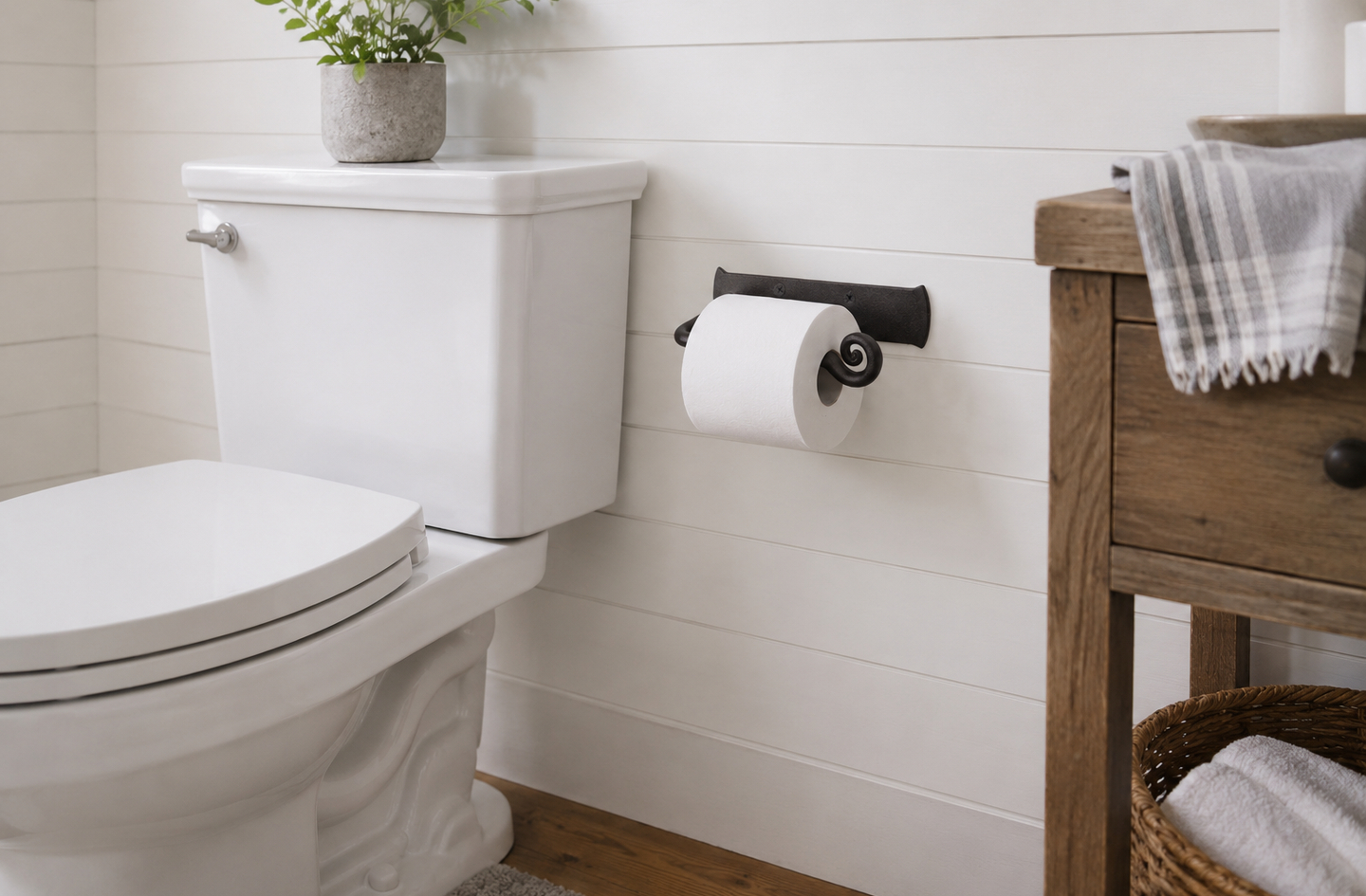
The trade-off is that the roll can shift sideways on the arm with heavy use. On a hand-forged iron arm with a slight upward curve at the tip, the roll is contained naturally. On a thin chrome bar with no retention feature, the roll can walk off the end over time. Look for a holder whose arm has a subtle upward bend or a rolled end that prevents the tube from sliding off. The RTZEN stylish holder uses this open scrolled-arm design and fits standard and oversized rolls without adjustment.
Pivoting Arm
A pivoting arm swings outward on a hinge so the roll slides onto the bar from the side, then the arm pivots back into position. This design keeps the roll fully enclosed on three sides when closed, which reduces lateral movement. The hinge does add a moving part, and low-quality pivots can loosen over time if the hinge pin is thin or the collar is stamped rather than forged. On a well-made holder, the pivot point is solid and the arm swings with a satisfying resistance. Check that the hinge is thick metal rather than plastic before buying.
Spring-Loaded Spindle
A spring-loaded spindle is a retractable post that compresses inward when pressed, allows the roll to slide onto the center tube, then extends under tension to hold the roll in place between two end caps. This is the most common design in contractor-grade chrome holders because it is cheap to produce. The problem: the spring fatigues with daily use, and the post can stop retracting fully, making roll changes awkward. On oversized rolls, the spindle sometimes cannot extend enough to grip the tube tightly. If you stock standard rolls and want a secure fit, a spring-loaded design works adequately. If you use mega rolls or prefer fast, no-fiddle changes, an open-arm design is more reliable.
| Mechanism | Roll Change Speed | Mega Roll Compatible | Moving Parts | Long-Term Reliability |
|---|---|---|---|---|
| Open-Arm (fixed bar) | 3 seconds or less | Yes (check arm length) | None | High (no mechanism to fail) |
| Pivoting Arm | 5-8 seconds | Yes | One (hinge) | High if solid-metal hinge |
| Spring-Loaded Spindle | 8-12 seconds | Variable (depends on spring tension) | One (spring) | Moderate (spring fatigue over time) |
Step 4: Match the Finish to Your Existing Hardware
A wall-mounted toilet paper holder sits in a bathroom alongside towel bars, robe hooks, faucet trim, and cabinet hardware. When those finishes conflict, the room looks assembled from separate shopping trips rather than designed. Getting the finish right costs nothing extra and takes five minutes of comparison before you order.
Reading the Room’s Existing Finish
Start with what is already on the walls. Look at the faucet handles, the towel bar brackets, and any cabinet pulls. Most bathrooms anchor around one dominant finish. The US bathroom accessories market was valued at $3.7 billion in 2024,7 reflecting how much attention homeowners are giving hardware choices. Chrome remains the most common finish by revenue (43% share in the faucet market as of 2024),6 but it has been giving ground to matte black, which is the fastest-growing finish segment at a projected 9.3% CAGR through 2034.6 Brushed nickel and oil-rubbed bronze fall in between.
If your bathroom has chrome fixtures, match chrome. If it has matte black towel bars and cabinet pulls, match matte black. Mixing finishes is acceptable only when you are doing it intentionally: one accent finish (say, a black towel ring in an otherwise brushed-nickel bath) can read as a design choice. Two mismatched finishes read as an accident. Three different finishes read as inattention.
Matte Black and Wrought Iron
Matte black is the finish that suits both traditional and contemporary bathrooms without effort. It pairs with white subway tile, wood vanities, shiplap, and painted wainscoting equally well. Hand-forged wrought iron with a black powder-coat finish covers this territory and adds texture that stamped chrome plate cannot match. The iron surface is not perfectly uniform the way machined chrome is, which is intentional. Every piece is hand-forged, which means subtle variation in the profile rather than mass-produced uniformity.
When you’re coordinating matte black hardware across a bathroom, coordinate the sheen as well. A flat matte black toilet paper holder next to a high-gloss black towel ring will look off even though both are technically “black.” RTZEN’s powder-coat finish reads as a warm, slightly soft black, which works best alongside oil-rubbed bronze, unlacquered brass, or other non-chrome metals. If your bathroom is all polished chrome, a flat-black holder will create a contrast that can feel intentional or awkward depending on the surrounding palette.
When Decorative Hardware Works as a Design Element
Not all toilet paper holders are simple bars. Some carry scrollwork, swirls, or forged geometric shapes that read as a design accent when the bathroom style supports it. Farmhouse, bohemian, vintage, and rustic interiors absorb decorative iron hardware naturally because the rougher texture and visible metalwork fit the aesthetic. In a minimalist or contemporary bathroom with clean flat surfaces, a heavily scrolled holder can feel out of place. Pick a simpler profile for modern spaces, and let the material quality carry the room.
The swirls holder suits farmhouse and traditional bathrooms. If your bathroom leans modern, a cleaner arm profile with the same black iron finish reads more naturally.
Step 5: Verify Material and Mounting Quality
The material and the mounting method together determine whether the holder stays on the wall for years or pulls away within months. Both are worth checking before you pay.
Wrought Iron vs. Chrome-Plated Stamped Steel
The two materials that dominate the residential market are solid wrought iron and stamped hollow steel with chrome plating. The difference in durability is not subtle. Stamped steel is thin-gauge sheet metal pressed into shape, then plated. The plating is the only thing protecting the metal from moisture. Bathrooms expose hardware to daily humidity, steam, and occasional direct water contact. When the chrome plating cracks or chips, rust develops underneath and spreads.
Solid wrought iron does not have a thin plating layer over a different substrate. The iron itself forms the structure. On a hand-forged holder finished with zinc galvanization followed by powder coating, the protection sits in two distinct layers. Zinc bonds to the iron and inhibits oxidation at the substrate level. The powder coat adds a second barrier on top. The result is a finish that withstands bathroom humidity without peeling or bubbling the way single-layer chrome plate does.
The RTZEN holders in this guide are hand-forged from solid wrought iron in a four-step process: cut, hand-forge, zinc-galvanize, powder-coat. That four-step production method and the Lifetime Warranty that covers it are the practical proof points. The workshop has been producing hardware this way since 1997.
Mounting Into a Stud vs. Drywall Anchors
A toilet paper holder mounted into a wood stud will stay fixed indefinitely. Studs run vertically at regular intervals in residential construction, so there is a reasonable chance one falls within range of your chosen placement. Use a stud finder before marking your holes. When a stud is available, drive two screws directly through the mounting bracket into the stud at the manufacturer’s specified length. No anchor needed.
When no stud is within range, a drywall anchor is required. The right anchor matters. A simple plastic expansion anchor grips only the drywall face and can pull out under repetitive loading. A toggle bolt or snap toggle passes through the drywall and spreads its grip across the back side of the panel. For a toilet paper holder, which sees repeated lateral pull every time someone tears paper, a snap toggle is the reliable choice. Drill the correct hole diameter specified for the toggle, compress the toggle through the hole, draw the bracket tight against the wall, and check for any movement before using. Most wrought iron holders include screws in the package; add appropriate anchors for your wall type if studs are not accessible. For detailed anchor guidance, the spoke on toilet paper holder height and placement covers wall type selection in more depth.
Bracket Plate Size and Weight Distribution
A larger mounting plate distributes the bracket’s load across more wall surface. A small single-screw plate concentrates all the stress on one fastener point, which is where most loose holders originate. Look for a bracket with at least two mounting points, and confirm the mounting hardware size matches the bracket holes. Thin machine screws in oversized holes allow the bracket to wobble even when tightened. The bracket should sit flush against the wall with no gap when both screws are driven home.
Common Wall Mounted Toilet Paper Holder Mistakes
Most installation regrets come from skipping one of the five steps above. These are the mistakes that show up repeatedly.
Mounting Too Close to the Toilet Tank
The tank lid extends above the toilet seat on most residential toilets. A holder mounted so its arm projects at tank height will make the paper hard to reach around the tank. Measure from the tank front edge when choosing the forward distance, not from the toilet seat centerline. Keep the arm positioned so the loaded roll clears the tank’s front face without pressing against it.
Skipping the Roll Clearance Check
Buyers choose a holder based on appearance and discover the roll binds against the wall or the adjacent cabinet. Standard roll dimensions appear in product photos but the critical measurement is the clearance between the loaded roll’s outer edge and the nearest surface. A mega roll at 5 inches in diameter on a holder with 4.5 inches of open space will press against the wall on the first spin. Confirm arm clearance before buying, not after the holes are in the wall.
Using Adhesive-Only Mounting in a Humid Bathroom
No-drill adhesive strips are suitable for lightweight accessories in dry, well-ventilated spaces. Bathrooms are not that space. Daily humidity, steam, and the repetitive lateral force of paper-tearing work against adhesive bonds. Adhesive-mounted toilet paper holders pull away from tile or painted drywall within months in a typical bathroom. Screw mounting into a stud or a proper anchor is the correct method for a wall-mounted toilet paper holder. Adhesive options work for temporary situations or rentals where drilling is not permitted, and the placement guide covers those scenarios.
Picking a Holder Without Checking the Included Hardware
Many holders ship with screws suited for stud mounting only. If you need anchors for drywall installation and the package does not include them, you will either improvise with the wrong fastener or make a second trip to the hardware store. Check what mounting hardware is included before ordering, and buy anchors rated for the holder’s weight and for your specific wall type before drilling the first hole. Wrought iron holders are heavier than stamped steel; confirm the included screws are long enough to reach a stud at the depth your wall requires.
Frequently Asked Questions
What is the standard height for a wall-mounted toilet paper holder?
The NKBA recommends mounting the holder’s center at 26 inches above the finished floor.2 That measurement applies to standard-height toilets. For comfort-height toilets (17-19 inches off the floor), raise the holder 1-2 inches to maintain a proportional reach angle from the seated position.
Can you install a wall-mounted toilet paper holder on tile?
Yes, with the right drill bit and anchor. Tile requires a carbide or diamond-tipped bit to avoid cracking, and a slowdown in drill speed when breaking through the glaze. Once through the tile and into the substrate (drywall or cement board), insert a wall anchor rated for the holder’s weight. Drilling into the grout line rather than the tile face reduces cracking risk but is not always possible given the placement you need. The spoke on how to install on tile without cracking it covers this step-by-step.
What’s the difference between a standard holder and one with a shelf?
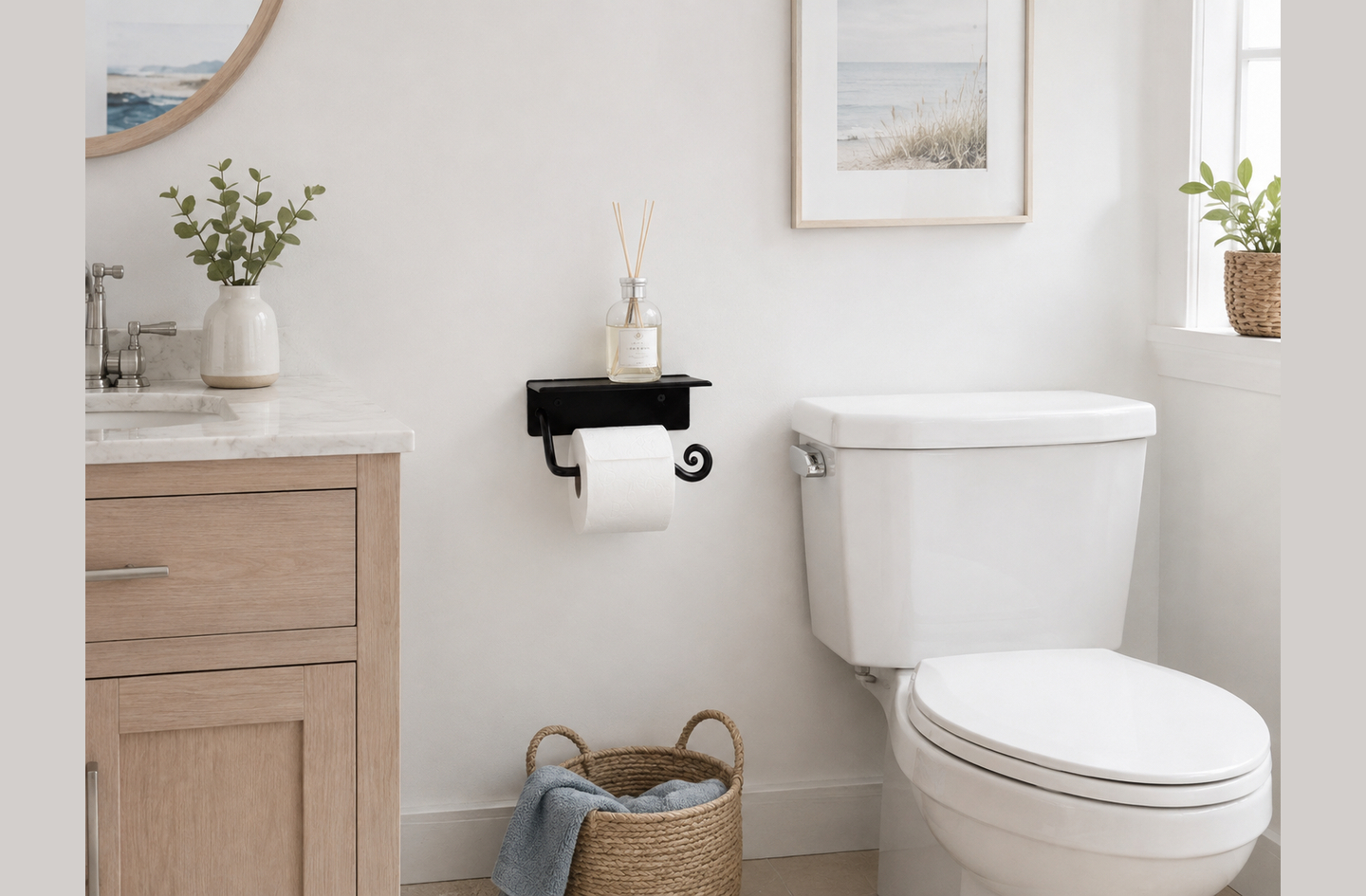
A holder with shelf adds a flat horizontal surface above the roll arm, typically 4-6 inches wide, for a phone, wipes, or a small decorative item. It mounts the same way as a standard holder but extends higher on the wall and requires slightly more clearance from the ceiling. The shelf is useful when there is no nearby cabinet or tank lid to set things on. In tight bathrooms, confirm the shelf does not project far enough to interfere with the vanity drawer or cabinet door above it.
How do I keep a wall-mounted toilet paper holder from coming loose?
Most loose holders trace back to one of three causes: screws driven into drywall without an anchor, anchors that are too small for the load, or a bracket that was never fully tightened. Start by confirming the screws reach a stud or a properly rated toggle anchor. Then check whether the bracket has any play by gripping it and pulling firmly in every direction. If there is movement, remove the screws, inspect the holes for damage, and re-install with wider anchors or reposition to hit a stud. Tighten the bracket set screws as well if the design uses them to secure the arm to the bracket.
Will a wall-mounted holder fit mega or jumbo rolls?
It depends on the design. Mega household rolls reach 4.5-5.0 inches in diameter,3 so the holder needs at least 5.5 inches of clearance between the arm and the adjacent wall. Open-arm holders provide this clearance naturally on most designs. Spring-loaded cage holders with tight inner dimensions may not. Check the stated clearance or inner cage depth in the product description before buying if you stock mega rolls regularly.
Limitations and Edge Cases
- The NKBA height and reach figures (26 inches, 8-12 inches forward) are residential guidelines in the US, not legal requirements. ADA placement requirements apply only to accessible facilities, not typical single-family bathrooms.
- The roll diameter data (4.5-5.0 inches for mega rolls) covers standard household brands. Specialty or imported rolls may differ; measure the specific rolls you stock before purchasing.
- The mechanism comparison table reflects typical product performance in each category. Individual products within each type vary. Check user reviews and product specifications before buying.
References
Methodology: every figure below comes from an independent published source and links directly to the page that carries it; figures were verified against source text before publication, and the article is reviewed by RTZEN co-founder Rami Abramson.
- U.S. Access Board – A Guide to the ADA Standards: Toilet Rooms (Chapter 6), U.S. Access Board, 2023. Section 604.7 dispenser placement requirements.
- Hunker – Standard Height of Toilet Paper Holders (citing NKBA guidelines), Hunker editorial team.
- Top Source Hygiene – Toilet Paper Roll Sizes: Standard, Mega, and Jumbo Comparison, Top Source Hygiene, 2024.
- NAHB – NAHB Expects Remodeling Growth in 2026 and Beyond, National Association of Home Builders press release, February 18, 2026.
- University of South Alabama – Mitchell College of Business – Home Renovation Statistics and Trends: 2024 Report (citing 2024 U.S. Houzz & Home Study), published June 13, 2024.
- Precedence Research – Faucet Market Size, Share, and Trends Report 2025 to 2034, Precedence Research, last updated November 13, 2025.
- Grand View Research – U.S. Bathroom Accessories Market Size & Outlook, 2025-2030, Grand View Research, 2025.
Conclusion
Choosing a well-fitted wall mounted toilet paper holder comes down to five decisions: placement, roll clearance, loading mechanism, finish match, and mounting quality. Get those five right and the holder becomes invisible in daily use, which is exactly what good bathroom hardware should do.
For the broader context on toilet paper holder formats, including freestanding and over-the-tank options, see the overview in Toilet Paper Holders: The Complete Guide.