
Paper towel holder placement in kitchen layouts comes down to one question: where does a wet or messy hand reach first? This comparison sits under the paper towel holders guide, which summarizes how to choose a holder for the home. It compares four locations: beside the sink, at the prep counter, at the pantry entry and near appliances. In a USDA test-kitchen study, participants failed to properly clean their hands before meals 97 percent of the time3. Many also skipped drying with a clean towel, so the towel’s position matters.
Quick Answer
Where should a paper towel holder go in the kitchen?
In most kitchens, the best position is just past the sink, on the side where food is prepared. In a lab model, sink droplets landed within 30 inches of the drain2. NKBA recommends placing a set share of shelf and drawer storage within 72 inches of the sink’s centerline1. A holder between those two distances stays dry and close. Keep it well away from the range.
Key Takeaways
- By RTZEN’s comparison, a holder 30 to 72 inches from the sink’s center clears measured splash2. It also stays inside NKBA’s 72-inch storage radius1.
- The residential code cited in NKBA’s guidelines sets 30 inches of vertical clearance from a cooktop to combustible material, or 24 with an approved hood1. A paper roll never belongs over the range.
- In a USDA test kitchen, participants spread bacteria to refrigerator handles 11 percent of the time3. A towel within one reach of the prep counter shortens that path.
- A pantry-entry holder wins on refill access but loses on reach, because it usually sits outside the work triangle.
- A common mistake is mounting first and testing later. A taped outline and a few practice reaches settle the spot before any hole is drilled.
Quick Comparison: Four Kitchen Locations Side by Side
Four locations cover most kitchens: beside the sink, at the prep counter, at the pantry entry and near appliances such as the range, microwave and refrigerator. Each one serves a different moment. The sink spot serves wet hands, and the prep spot serves messy hands. The pantry spot serves refills, and the appliance spot serves spills. The table compares them on the four factors that decide daily use: reach path, splash exposure, heat separation and refill access.
| Category | Beside the sink | Prep counter | Pantry entry | Near appliances |
|---|---|---|---|---|
| Best for | Drying washed hands and wiping the sink edge | Raw meat, chopping and quick wipes during cooking | Households that refill often and store spare rolls nearby | Spills at the microwave or refrigerator, never over the range |
| Reach from the faucet | One step or less | One step when the prep area adjoins the sink | Often several steps, outside the work triangle | Depends on the appliance; the refrigerator leg can be long |
| Reach from the cutting board | Short when the board sits next to the sink | Shortest | Long | Variable |
| Splash exposure | Highest when mounted at the sink edge | Low beyond the splash range | None | Low, except grease near the cooktop |
| Heat exposure | None | Low unless the prep area adjoins the cooktop | None | Highest beside or above the range |
| Refill access | Good on an open wall, tighter under a cabinet | Good | Best, spares sit inside the pantry | Fair |
| Traffic conflict | Low | Low | Highest, the holder sits on a walkway | Moderate around the refrigerator door |
| Common mounts | Under-cabinet, wall, countertop stand | Under-cabinet, countertop stand | Vertical wall holder on a door frame or end panel | Wall or stand beside the refrigerator or microwave |
| Verdict | Wins on drying wet hands | Wins on reach and hygiene overall | Wins on refills | Wins only away from heat |
The sink side of the prep counter wins most categories, because one position serves the two messiest moments of cooking.
Reach Paths: Paper Towel Holder Placement in Kitchen Work Zones
The best kitchen paper towel holder location is one a cook can reach without crossing the room with dripping or greasy hands. Kitchen designers plan those movements around the work triangle. NKBA guidelines recommend that its three legs total no more than 26 feet, with no single leg shorter than 4 feet or longer than 9 feet1.
A work triangle is the set of three paths linking the cooking surface, the cleanup or prep sink and the refrigerator. A paper towel holder is not one of its corners, yet every leg passes near it. Where the roll sits decides which leg carries wet hands. A towel parked by the refrigerator turns every hand wash into a walk along the sink-to-refrigerator leg, which can run up to 9 feet1.
A landing area is the stretch of countertop beside a sink or appliance where things are set down on arrival. NKBA recommends a landing area of at least 24 inches on one side of the sink and at least 18 inches on the other1. It also recommends a continuous prep area at least 36 inches wide and 24 inches deep immediately next to a sink1. Those two rules put the sink and the main prep counter side by side, and that shared edge is where a towel earns its place.
Wet hands at the sink
After a wash, hands drip on the way to whatever towel is closest. In the USDA observation study, numerous participants did not dry their hands with a clean towel3. A holder that requires a walk invites the shortcut: a wipe on an apron, a jeans pocket or a damp cloth. A roll within one step of the faucet removes that excuse.
Messy hands at the prep counter
Raw meat raises the stakes. In the same USDA study, participants spread bacteria from raw poultry onto other surfaces in the test kitchen. They contaminated spice containers used while preparing burgers 48 percent of the time and refrigerator handles 11 percent of the time3. Every surface touched between the cutting board and the towel can pick up what the hands carry. A holder within one arm’s reach of the board lets a cook tear a sheet without opening a door or gripping a handle first.
“You can’t see, smell or feel bacteria.”
Carmen Rottenberg, then Acting Deputy Under Secretary for Food Safety, U.S. Department of Agriculture, 20183
One-handed tearing matters for the same reason. A holder whose roll spins freely forces the second hand to steady it, which doubles the contact. A spring arm, a weighted base or a snug spindle lets one clean hand do the work.
Reach height above the counter
Height is part of the reach path. NKBA’s access standard, based on the ICC A117.1 accessibility standard, plans frequently used items 15 to 48 inches above the floor1. Where a counter 20 to 25 inches deep blocks a forward reach, the high reach drops to 44 inches1. A standard counter sits at about 36 inches: a 34-and-a-half-inch base cabinet plus a countertop 1-and-a-half inches thick7.
By RTZEN’s calculation, a roll meant to meet that 44-inch limit across a standard counter sits no more than 8 inches above the work surface. These are accessibility figures, and standing adults reach higher. A standing cook reaches an under-cabinet roll easily, while a seated cook finds it a stretch.
Reach decides placement more than looks do: the right spot sits on a path that wet and messy hands already travel.
Splash Exposure: How Close to the Sink Is Too Close
The best place for a paper towel holder is near the sink, not over it, because a roll at the sink edge collects spray. A damp roll tears badly and dries slowly. The bigger concern is what the spray carries. In a lab model of hospital hand-washing sinks, faucet use spread droplets from a colonized drain strainer to the surrounding areas within 30 inches2.
A P-trap is the U-shaped bend of drainpipe under a sink that holds water to block sewer gas. In the study by Kotay and colleagues, published in March 2017, bacteria placed in the trap did not splash out directly. Once allowed to mature under hospital-like conditions, they formed a likely biofilm that climbed to the strainer over 7 days2. Running the faucet then threw droplets onto the counter around the basin.
Scope matters here. The test used hospital-style sinks in a laboratory, with bacteria introduced on purpose. Basin depth, faucet height and water pressure all change how far a home sink sprays. By RTZEN’s reading, 30 inches is a measured reference point for planning, not a household safety limit. The study measured from the drain strainer, which sits at the center of a typical single-bowl sink.
Fast drying needs a close roll
Paper dries hands quickly when it is within reach. A review in Mayo Clinic Proceedings by Huang, Ma and Stack summarized one drying test. In it, paper towels and jet air dryers both reached 90% dryness after 10 seconds4. Hot air dryers needed 40 seconds to match it4. The reviewers concluded that paper towels are the more hygienic of those options4. That quick dry only happens when the roll sits a step away rather than across the room.
Paper and cloth at the same sink
Many kitchens pair the roll with a cloth hand towel on a ring or short bar beside the sink. The cloth towel handles clean, freshly washed hands, and the paper handles raw meat, grease and spills. The division works when the cloth towel is changed often and anything that touched raw food goes to paper, which is used once and thrown away.
The sink rewards a near-miss: close enough for a dripping hand, far enough that the spray falls short of the roll.
Heat Separation: The Range, Microwave and Refrigerator
A paper towel holder beside the range is the riskiest of the four choices, because a roll of paper is fuel stored next to a burner. The U.S. Fire Administration calls cooking the leading cause of home fires and home fire injuries5. Fire departments responded to an estimated 170,000 home cooking fires in 20215.
Those fires caused an estimated 135 deaths and 3,000 injuries5. Unattended equipment was the leading factor in nonconfined home cooking fires, at 37%5. The U.S. Fire Administration’s cooking handout tells households to move things that can burn away from the stove, including dish towels, bags, boxes, paper and curtains6. A paper towel roll belongs on that list.
Above the range
Combustible clearance is the minimum open distance required between a heat source and anything that can burn. Above a cooktop, the residential code cited by NKBA sets 30 inches to combustible material and metal cabinets1. With an approved hood or other approved noncombustible materials, the minimum is 24 inches1. Bob Vila’s cabinet guide gives the cabinet-side view: 30 inches above an electric range and 36 inches above a gas range7.
A 2006 paper towel patent describes conventional rolls as 5 to 6 inches across8. By RTZEN’s calculation, a full roll hung under a cabinet set at the 30-inch minimum sits about 24 inches above the burners. That is closer than the code allows for combustible material without an approved hood. No under-cabinet holder belongs on the cabinet run directly over a range.
Beside the cooktop
NKBA recommends a landing area of at least 12 inches on one side of a cooking surface and 15 inches on the other1. That counter is where hot pans land. As an RTZEN rule of thumb, the roll stays outside it, and farther is better. The landing area is a planning guideline, not a fire-safety distance, so it marks the minimum, never the target.
Microwave and refrigerator
The microwave is a safer neighbor. NKBA places the microwave bottom no more than 54 inches above the floor, with a 15-inch landing area above, below or beside its handle side1. A roll at the edge of that landing area handles splatters from reheated food without crowding the door. For a countertop toaster or toaster oven, the appliance manual sets the side clearance, and the roll stays outside it.
The refrigerator needs a 15-inch landing area on its handle side1. A holder there serves drips from pitchers and leftovers. It does little for the cook at the cutting board, whose hands may reach the refrigerator handle before the towel.
Heat is the only factor that rules a location out completely: no reach or style advantage justifies a paper roll inside the range’s clearance zone.
Refill Access: Pantry Entry, Cabinet Gaps and Roll Size
The pantry entry is the easiest kitchen paper towel holder location to refill, because the spare rolls usually sit a step away. Refill access matters more than it sounds. A holder that is awkward to reload stays empty, and an empty holder sends cooks back to the dish towel.
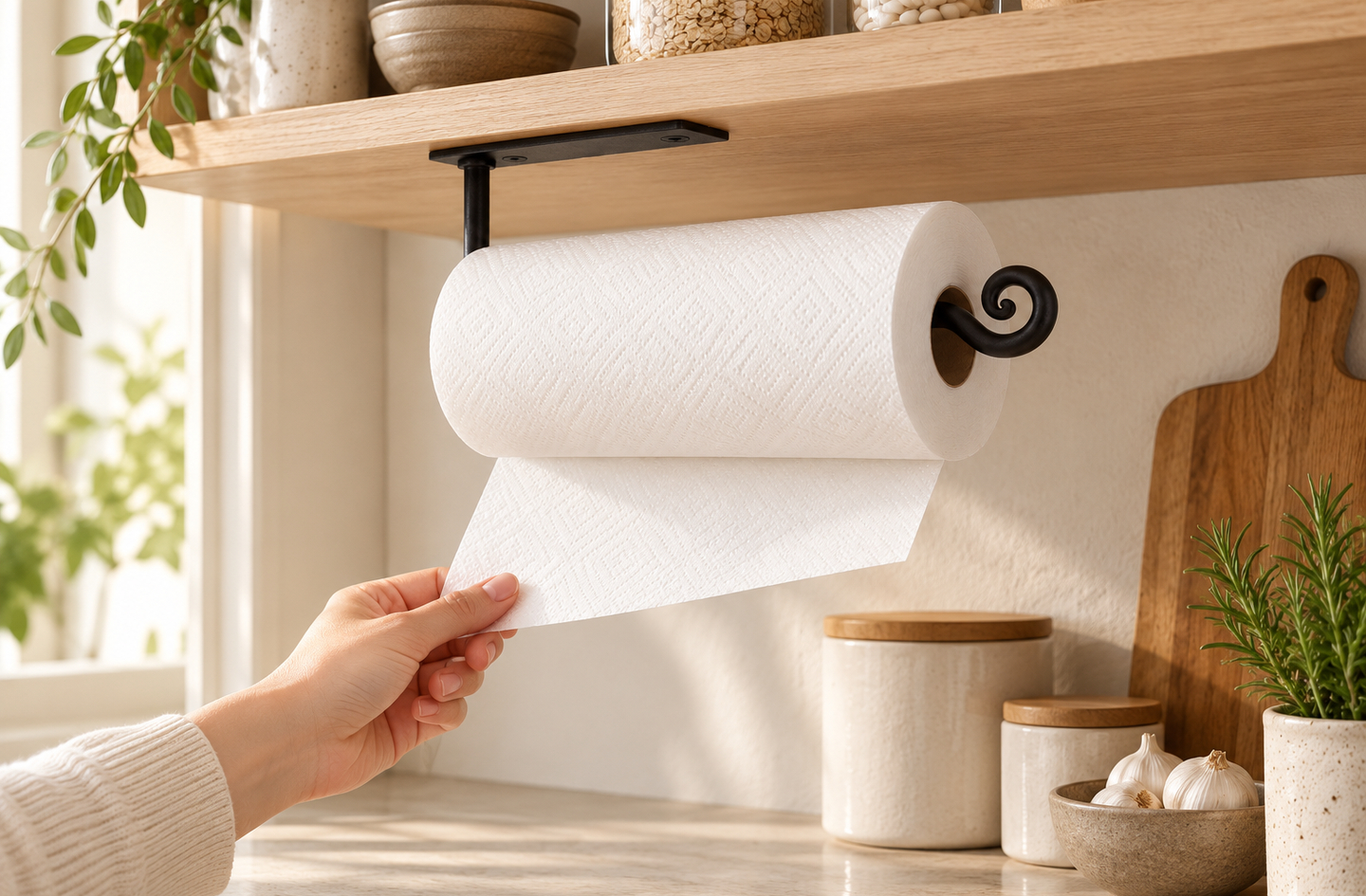
Roll size sets the space any holder needs. A paper towel patent describes conventional rolls as 11 inches wide and 5 to 6 inches in diameter8. Jumbo and mega rolls run larger, and the jumbo roll fit check explains how to measure them against a holder before buying.
The gap under the cabinets
Bob Vila’s cabinet guide sets 18 inches between the countertop and the upper cabinets, the height of a standard backsplash7. By RTZEN’s calculation, a full 6-inch roll under the cabinet leaves about 12 inches of open wall below it. That is enough for a toaster or a cutting board stood on edge, but not for a tall blender. Reloading also needs side room: an open-arm design lets a roll slide off one end, so that end needs a clear hand’s width beyond the roll. The Under Cabinet holder uses that open-arm layout for roll changes. Choosing between arm styles is the subject of the under-cabinet holder designs guide.
The pantry door and the walkway
A pantry opening sits on a walkway, and walkways have minimums. NKBA recommends a walkway at least 36 inches wide and a work aisle of 42 inches for one cook or 48 inches for several1. A wall holder at the pantry door projects into that width by roughly the depth of the roll. A Vertical holder on a door frame or cabinet end panel keeps the roll upright against the wall. That suits a narrow strip of wall better than a horizontal bar.
The trade is reach. NKBA advises that no major traffic pattern should cross the work triangle1, and pantries usually sit outside it. A wet hand therefore walks away from the sink to reach a pantry-side roll. Storage is the pantry’s strength. NKBA’s tables allot 180 inches of pantry shelf frontage even in a small kitchen1, enough for a stack of spare rolls.
The pantry entry suits a second holder or a refill station, while the roll that gets used most still belongs near the sink.
Try Before Mounting: A Painter’s Tape Placement Test
The simplest way to find the best place for a paper towel holder is to rehearse a normal day of cooking before drilling a single hole. A strip of painter’s tape costs almost nothing. A misplaced screw hole in tile or a cabinet bottom is permanent.
- Mark the candidate spot: tape an outline the size of the holder on the wall or under the cabinet. Add a second outline at the next best spot.
- Run the wet-hand test: wash at the sink and reach for the outline with dripping hands. One step or less passes, and anything farther fails.
- Run the raw-meat test: stand at the cutting board and reach for the outline. If the reach touches a handle, knob or cabinet door first, move the outline.
- Run the splash test: tape a dry paper towel over the outline and run the faucet at full flow while rinsing a pan. Any spots on the sheet mean the roll will get wet.
- Check the heat: confirm the outline sits outside the cooktop’s landing area and nowhere above the range.
- Check the refill: mime sliding a roll off and on, then open the dishwasher, cabinet doors and the pantry door. NKBA places the dishwasher within 36 inches of the sink1, so its open door often lands near the outline.
- Live with it: set a countertop stand on the spot for a few days of real cooking before committing to screws.
The last step is the one most people skip, and it catches the problems a single test cannot. A weighted stand such as the Fancy Stand needs no tools, so it can stand in for a mounted holder during the trial. The countertop stand comparison covers footprint and height if the stand ends up staying. When the trial confirms a wall position, the wall-mounted holder guide covers orientation and roll access.
Most bad placements are discovered in the first week of use, so the test simply moves that week ahead of the drill.
Who Should Choose Which Location
If raw meat and fish are cooked often, choose the sink side of the prep counter. If refills are the daily headache, add a second roll at the pantry entry rather than moving the main one.
- Cooks who handle raw meat often: the prep counter, on the side nearest the sink, so one clean hand tears a sheet without touching a handle.
- Small or galley kitchens: under the cabinet at the far end of the sink’s landing area. Where counter space is short, use a vertical holder on a cabinet end panel.
- Large households that refill often: the main roll near the sink, plus a refill station at the pantry entry.
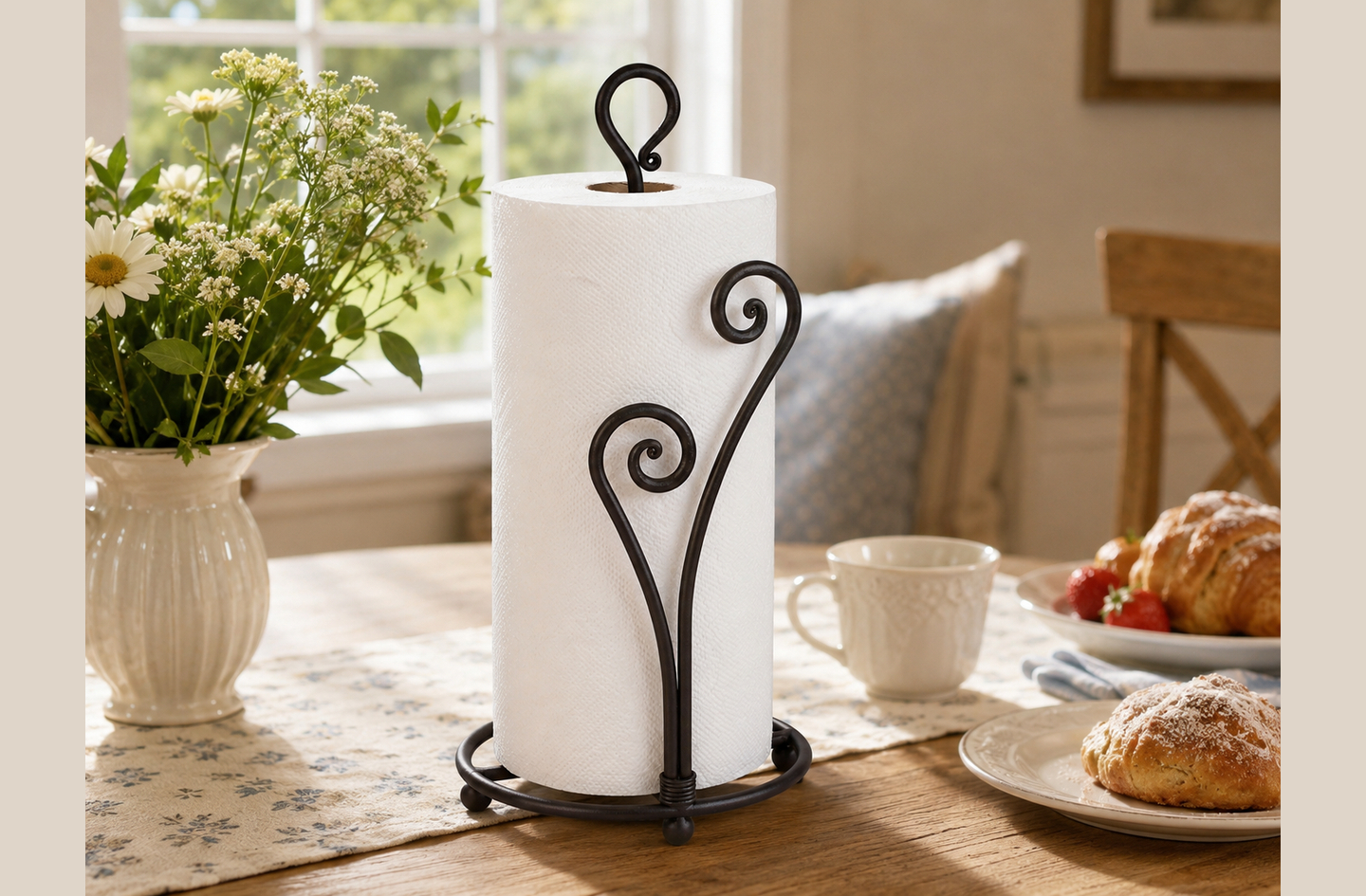
- Renters and anyone who cannot drill: a weighted countertop stand placed where the tape test passed.
- Seated cooks: a wall position low on the backsplash, within the 44-inch accessible reach that applies across a deep counter1.
The one location no profile should choose is the cabinet run over the range. Kitchens where the sink sits in an island follow different rules, because the island has no wall and no upper cabinets to mount on.
Verdict by Category
The prep counter on the sink side wins overall, because it serves wet hands and messy hands from one position without heat or traffic conflicts.
| Category | Winner | Why |
|---|---|---|
| Reach path | Prep counter, sink side | Within one step of the faucet and one reach of the board |
| Splash exposure | Pantry entry, then prep counter | The pantry sees no spray; the prep counter is the driest spot near the sink |
| Heat separation | Sink or pantry entry | Farthest from the cooking surface |
| Refill access | Pantry entry | Spare rolls stored a step away |
| Traffic | Sink and prep counter | Outside the walkway, inside the work triangle |
| Overall | Prep counter, sink side | Best balance of reach, dryness and safety |
The decision rule is short. Start just past the sink on the prep side, and keep the roll out of the spray and well clear of the range. Then let the tape test confirm the spot.
Frequently Asked Questions
Should a paper towel holder go right next to the sink?
Near the sink, but not at its edge. In a lab model, faucet use spread droplets from a colonized drain up to 30 inches away2. A roll just beyond that distance, on the prep side, stays dry while still sitting one step from the faucet.
Can a paper towel holder go above or beside the stove?
Not above it. The residential code cited by NKBA sets 30 inches between a cooktop and combustible material above it, or 24 with an approved hood1. The U.S. Fire Administration lists paper and dish towels among things to move away from the stove6. Beside it, keep the roll outside the cooktop’s landing area.
How high should a kitchen paper towel holder be mounted?
Within easy reach of the person who uses it most. NKBA’s access recommendation plans frequently used items 15 to 48 inches above the floor1. An under-cabinet roll hangs just below upper cabinets, whose commonly recommended height is 54 inches7. That suits standing adults better than seated cooks.
Is under the cabinet better than on the wall?
Under the cabinet frees the backsplash and keeps the roll off the counter. The recommended gap between countertop and upper cabinets is 18 inches7, so a full roll still leaves room below. A wall mount suits stretches with no upper cabinets, such as an end wall.
Where should spare paper towel rolls be stored?
In the pantry or the nearest tall cabinet, ideally close to the main holder. NKBA’s storage tables allot 180 inches of pantry shelf frontage even in a small kitchen1. A second holder at the pantry entry can double as a refill station.
Limitations and Edge Cases
- The 30-inch droplet figure comes from a laboratory model of hospital hand-washing sinks with bacteria introduced on purpose2. Home sinks with different basins and faucets will spray differently.
- NKBA figures are planning guidelines, and local codes govern. Clearance for an over-the-range microwave is set by its manufacturer1.
- This comparison assumes a sink on a perimeter wall. Island and peninsula sinks have no wall or upper cabinets beside them, so island-side mounting follows its own rules.
- The 44-inch reach limit and the 15-to-48-inch storage band come from NKBA’s access standards1. Standing adults reach higher, so those numbers suit shared kitchens rather than setting a rule for everyone.
References
Methodology: every measured figure comes from the published sources below. The 30-to-72-inch band, the 24-inch roll clearance over a range, the 12-inch gap below an under-cabinet roll and the 8-inch accessible roll height are RTZEN calculations from those figures. Product details come from RTZEN listings. Rami Abramson, Founder & CEO, reviewed the article before publication.
- National Kitchen & Bath Association – Kitchen Planning Guidelines with Access Standards, including the residential code clearance requirements it cites.
- Applied and Environmental Microbiology – Spread from the Sink to the Patient: In Situ Study Using Green Fluorescent Protein (GFP)-Expressing Escherichia coli To Model Bacterial Dispersion from Hand-Washing Sink-Trap Reservoirs, Kotay, Chai, Guilford, Barry and Mathers, March 2017.
- U.S. Department of Agriculture – Study Shows Most People Are Spreading Dangerous Bacteria Around the Kitchen and Don’t Even Realize It, press release, June 28, 2018.
- Mayo Clinic Proceedings – The Hygienic Efficacy of Different Hand-Drying Methods: A Review of the Evidence, Cunrui Huang, Wenjun Ma and Susan Stack, August 2012.
- U.S. Fire Administration – Cooking Fire Safety, page last reviewed September 28, 2026.
- U.S. Fire Administration – Cook Safely: Watch What You Heat, cooking safety handout, accessed October 27, 2026.
- Bob Vila – Solved! How to Find the Correct Upper Cabinet Height, Manasa Reddigari, updated October 5, 2020.
- Google Patents – US7048225B2, Narrow paper towel roll and holder, Nicholas A. Delfino, granted May 23, 2006.
Conclusion
The best paper towel holder placement in kitchen layouts is just past the sink on the prep side. That spot stays out of the spray and well clear of the range. A pantry-entry roll works as a refill station, and a spot near the microwave or refrigerator works for spills, never for heat. A taped outline and a week of practice reaches settle the final position before any hole is drilled.
For how placement fits the wider choice of holder, read the paper towel holders guide. Every RTZEN holder is hand-forged from solid iron, finished with zinc and powder coating, and backed by a Lifetime Warranty.