
Paper towel holders sit in a busy reach zone of the kitchen. A holder placed too high, too deep or on the wrong surface turns a quick grab into a stretch. The US Access Board caps unobstructed forward reach at 48 inches above the floor1, and that limit shapes most placement choices. This guide is for home cooks, renters and decorators planning a kitchen, laundry room or workshop. It covers holder types, placement, roll fit, mounting, materials and style at summary level.
Quick Answer
What are paper towel holders?
Paper towel holders are fixtures that keep a roll of kitchen towels on a rod so a sheet can be pulled and torn off. They come as countertop stands, wall mounts and under-cabinet mounts. The right choice depends on counter space, wall material and reach, and 48 inches is the standard’s upper reach limit1.
Why it matters:
A holder out of reach or on a weak surface gets ignored or pulls loose.
Key Takeaways
- The Access Board limits high forward reach to 48 inches, or 44 inches where reach depth exceeds 20 inches1.
- This Old House puts the hold of a simple nail in drywall at 5 to 10 pounds2, so wall holders need studs or anchors.
- For galvanized steel, duplex coatings of paint or powder over zinc can last 1.5 to 2.3 times the combined lifetimes of both systems3.
- A holder that fits a standard roll does not automatically fit a jumbo or mega roll, so test with a full new roll.
Paper Towel Holders in 30 Seconds
| If you are… | Do this |
|---|---|
| Short on counter space in a narrow kitchen | Use an under-cabinet or wall mount near the prep zone |
| Renting and unable to drill | Choose a heavy countertop stand that moves with you |
| Working across a deep counter | Mount on a side wall or under the cabinet front, within easy reach |
| Buying jumbo or mega rolls | Check arm length and clearance with a full new roll first |
| Setting up a kitchen island | Start with a portable stand before drilling into a side panel |
| Equipping a laundry room or workshop | Wall mount on sound backing beside the work surface |
What Is a Paper Towel Holder
A paper towel holder is a piece of kitchen hardware with a rod, a support and a base or bracket, and its mount type decides where the roll can live. The rod runs either horizontally between two arms or vertically from a base or wall plate. Most designs hold one active roll; spare rolls belong in separate storage.
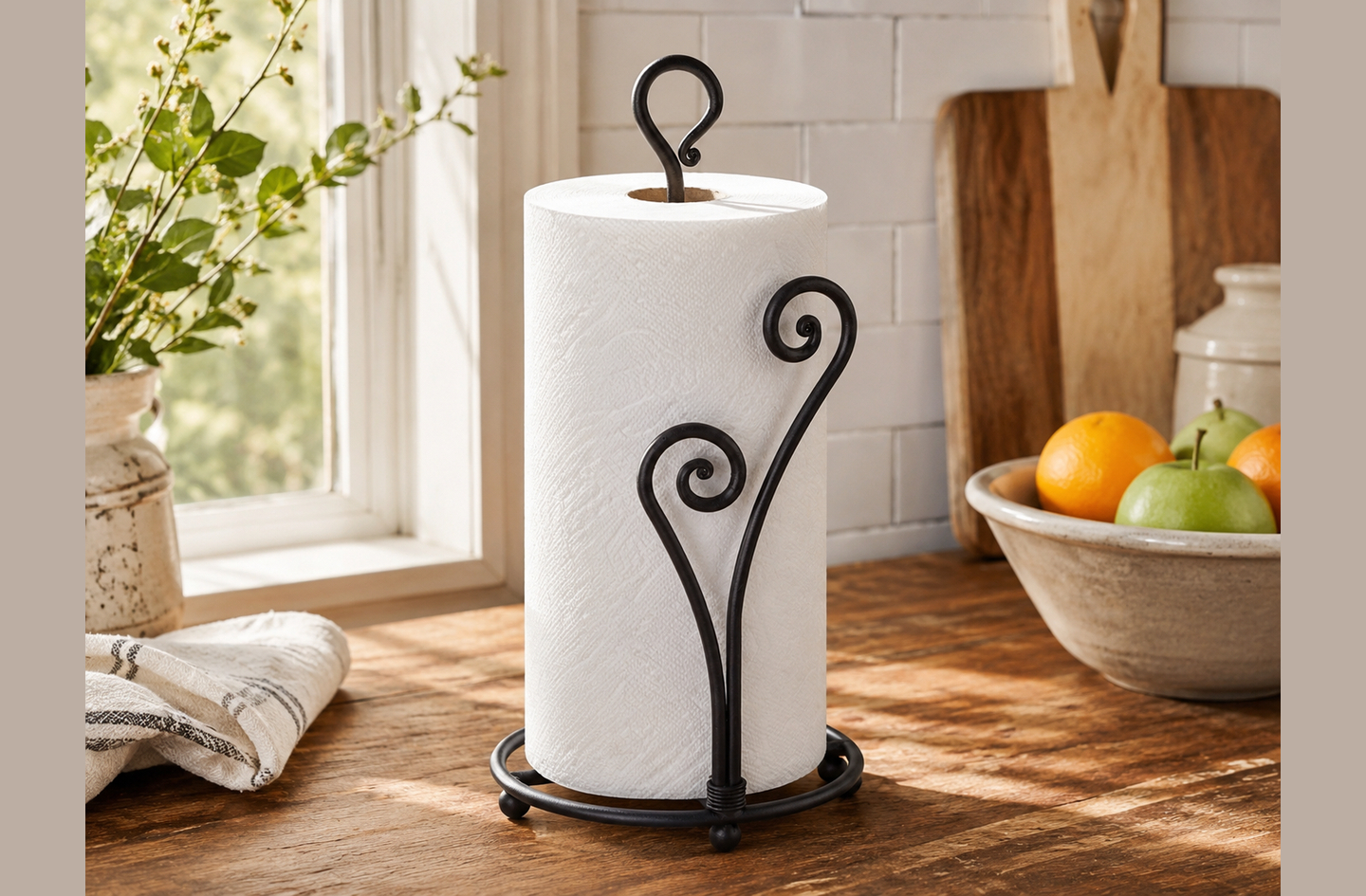
Spindle is the upright rod a vertical holder’s roll slides over. On a countertop stand it rises from a weighted base, often with a finial at the top that keeps the roll from lifting off.
Open-arm holder refers to a horizontal design with one free end, so a roll slides on and off without removing anything. It trades easy loading for a little less control when a sheet is torn.
The topic includes holders for kitchens, laundry rooms, workshops, offices and covered patios. It excludes commercial towel dispensers and built-in cabinet systems, which are installed products of a different kind. Related decisions sit around the holder itself: mounting height, the wall or cabinet material behind it, the roll sizes a household buys and the finish of nearby hardware.
Materials range from plastic and wood to stainless steel, cast iron and forged iron. Each changes the weight, the look and the care a holder needs. A heavy iron stand resists tipping better than a light one, while a wall mount transfers every pull to its fasteners. That difference explains why the mount type and the surface behind it matter as much as the design.
Why Paper Towel Holder Choice Matters
Paper towel holder choice matters because the holder is handled with wet hands many times a day, close to water, heat and food. A poor choice shows up as a stretch, a soggy roll or a loose mount.
- Reach: a holder above comfortable reach, or behind a deep counter, gets bypassed in favor of a dish towel.
- Moisture: the EPA advises drying water-damaged items within 24-48 hours to prevent mold growth4, so rolls kept under a leaking sink are better replaced than dried.
- Wall load: every tug on a sheet pulls the fasteners outward, and a screw in bare drywall loosens with that repeated force.
Finding solid backing is the step most installations depend on. This Old House plumbing and heating expert Tommy Silva describes how a knock on the wall reveals a stud:
The sound and the pitch goes from a little hollow, low pitch to something a little higher.
This Old House publishes that advice with its guidance on anchors and studs2.
Understanding the topic also changes outcomes in specific rooms. A renter avoids drilling holes a lease forbids. An island owner avoids drilling into a panel that hides plumbing. A workshop owner avoids mounting a holder where dust, oil or a swinging door blocks it. Each case starts with the same habit: decide the location and surface before choosing the holder.
Choosing Paper Towel Holders: The Six-Part Kitchen Reach Framework
The Kitchen Reach Framework breaks the topic into the decisions a household makes in order: holder type, placement, roll fit, mounting, material and style. It was derived by grouping the questions readers ask about holders into the sequence in which a real kitchen forces them.
Holder Types: Countertop, Wall-Mounted and Under-Cabinet
Paper towel holders fall into countertop, wall-mounted and under-cabinet families, and each trades counter space against drilling. A countertop stand is portable and needs no tools, but it takes a footprint on the work surface. A wall mount frees the counter and runs horizontally or vertically. A vertical mount suits a narrow strip of wall beside a window or the end of a cabinet run. An under-cabinet holder hangs from the cabinet floor and keeps the counter and backsplash clear. Hidden options inside a cabinet keep the roll out of sight but add a door to open each time. Under a sink they also face leaks, and the EPA advises drying wet items within 24-48 hours to prevent mold growth4.
Pick the family by the surface you are willing to give up, whether counter, wall or cabinet floor, before comparing designs.
Deeper read: Countertop vs. Wall-Mounted vs. Under-Cabinet Paper Towel Holders.
Deeper read: Countertop Paper Towel Holders: Stands That Suit Your Space.
Deeper read: Wall-Mounted Paper Towel Holders: Sizes, Styles, and Everyday Use.
Deeper read: Under-Cabinet Paper Towel Holders: How to Choose the Right Mount.
Deeper read: Vertical Wall-Mounted Paper Towel Holders: When They Make Sense.
Deeper read: Hidden Paper Towel Holder Ideas: Inside Cabinets or Out?.
Placement and Reach Around the Kitchen and Beyond
Reach depth is the horizontal distance a hand travels across a counter or obstacle to touch an object. It matters because the Access Board lowers the high forward reach limit from 48 to 44 inches once reach depth exceeds 20 inches1. The best spot sits on the path between the sink and the prep counter, away from cooktop heat and direct splash. Islands, galley kitchens, laundry folding counters, workbenches and covered patios each change that path. A simple test helps: set or tape a full roll in the planned spot and use it for a few days before drilling. Spare rolls belong in a dry pantry or cabinet nearby, with only the active roll on the holder.
Choose the location first and the holder second, because a well-made holder in the wrong place still gets ignored.
Deeper read: Where to Put a Paper Towel Holder in the Kitchen.
Deeper read: Paper Towel Holder Mounting Height: A Practical Reach Guide.
Deeper read: Kitchen Island Paper Towel Holder Placement Without Clutter.
Deeper read: Small Kitchen Paper Towel Holder Ideas That Save Work Surface.
Deeper read: Paper Towel Holders for Laundry Rooms, Workshops, and Offices.
Deeper read: Paper Towel Holders for Outdoor Kitchens and Covered Patios.
Deeper read: Paper Towel Roll Storage Ideas for Spare Rolls and Small Kitchens.
Roll Fit, Clearance and Tearing
Roll sizes are not uniform across brands, and jumbo or mega rolls are wider in diameter than a standard roll. The useful test is a full new roll: it must slide on, turn freely and clear the wall, the cabinet floor and any door trim. Under-cabinet holders need extra care, because the loaded roll needs more clearance than the bracket’s own dimensions suggest. Tension arm refers to a spring-loaded arm that presses on the roll so a single sheet tears off cleanly without a second hand. An open-arm holder has no such arm, so a steadying hand or a firm downward tug does the same job. Countertop stands add a stability question, since a light base can tip or slide as the roll empties.
Measure with the roll you actually buy, at full size, before trusting any listing that says a holder fits jumbo rolls.
Deeper read: Jumbo and Mega Paper Towel Rolls: Will They Fit Your Holder?.
Deeper read: Under-Cabinet Paper Towel Holder Measurements and Clearance.
Deeper read: One-Handed Paper Towel Tearing: Tension Arm or Open Holder?.
Deeper read: Why Your Countertop Paper Towel Holder Tips or Slides.
Mounting Method and Wall Material
The mounting surface decides the fastener, not the holder. This Old House lists toggle bolts, molly bolts and expansion anchors for drywall, and masonry anchors for concrete and brick2. Anchor ratings are conservative in some cases: in Family Handyman’s pull test, a Pop Toggle rated at 60 lbs held 130 lbs, more than twice its rated weight5. Tile needs a suitable bit and care around hidden pipes and wiring, and the screw must reach sound backing behind it. Adhesive and no-drill options suit rentals but depend on a clean, smooth surface; RTZEN documents screw-mounted holders. A loose holder points to a stripped hole or the wrong anchor, and remounting into sound material is safer than re-tightening it.
Identify the wall or cabinet material before buying, because it decides whether a holder can be mounted securely at all.
Deeper read: Adhesive vs. Screw-Mounted Paper Towel Holders: What Lasts?.
Deeper read: How to Install an Under-Cabinet Paper Towel Holder With Screws.
Deeper read: How to Install a Wall-Mounted Paper Towel Holder Securely.
Deeper read: Mounting a Paper Towel Holder on Tile Without Cracking It.
Deeper read: How to Fix a Loose Wall-Mounted Paper Towel Holder.
Materials, Finish and Care
Cast iron is poured into a mold, stainless steel relies on its alloy to resist rust, and forged iron is heated and shaped by hammering and bending. Duplex coating means a paint or powder coat applied over a zinc galvanized layer. For galvanized steel, the American Galvanizers Association reports that duplex systems can last 1.5 to 2.3 times the combined lifetimes of both systems3. RTZEN holders are hand-forged, zinc galvanized and powder coated, so routine care means a soft damp cloth, full drying and no abrasive cleaners. A bent arm, a detached joint or a chipped finish needs a different response. Cosmetic wear is maintenance, while a workmanship defect falls under the maker’s warranty terms, which at RTZEN means a Lifetime Warranty for defects under normal use.
Treat the finish as the first line of rust protection: keep it intact and dry, and a forged holder stays serviceable for years.
Deeper read: Wrought-Iron Paper Towel Holders: Construction and Craftsmanship.
Deeper read: Cast Iron vs. Wrought Iron vs. Stainless Steel Paper Towel Holders.
Deeper read: How to Clean and Protect a Wrought-Iron Paper Towel Holder.
Deeper read: Broken Paper Towel Holder: Repair, Replace, or Claim Warranty?.
Style, Color and Gifting
A paper towel holder stays in view all day, so its finish and silhouette should agree with the hardware already in the room. Black reads clearly against white or wood cabinets and pairs with dark pulls. White blends into light cabinetry, and a metallic finish echoes a faucet. Finish availability differs by model, so check the specific holder rather than a brand’s whole palette. Swirl and heart silhouettes suit farmhouse, rustic and vintage kitchens, while a plain vertical rod suits a quieter room. A countertop stand makes a practical housewarming gift because it needs no drilling and moves wherever the recipient wants it.
Match the holder to the faucet or pulls nearest it, since that is the hardware the eye compares it with first.
Deeper read: Black vs. White Paper Towel Holders: How to Match Kitchen Hardware.
Deeper read: Decorative Paper Towel Holders: Making a Practical Accent Feel Intentional.
Deeper read: Farmhouse Paper Towel Holder Ideas for Rustic and Vintage Kitchens.
Deeper read: Paper Towel Holder Gifts for a Housewarming or New Kitchen.
How to Choose a Paper Towel Holder
The most important criterion for choosing a paper towel holder is the reach path, meaning the route a hand travels from the sink or prep counter to the roll. Mount type, size and finish all follow from that spot.
- Find the spot: set or tape a full roll where you plan to use it, and live with it for a few days.
- Measure reach and clearance: note the counter depth in front of the wall and the space under any cabinet, including door trim.
- Check the roll: slide a full new roll of the size you buy onto the holder, or compare its width and diameter with the arm length.
- Read the surface: identify drywall, tile, masonry or cabinet wood, and plan fasteners that reach sound material.
- Match the finish: compare the holder with the nearest faucet, pulls and hooks.
For a household that cannot drill, a weighted countertop stand such as the Fancy Stand removes the fastener question entirely.
Worked example, calculated from cited inputs: the Access Board sets 48 inches as the unobstructed high forward reach and 44 inches where reach depth exceeds 20 inches1. Reaching across a deep counter therefore removes 4 inches of usable height, because 48 minus 44 leaves 4 inches.
Measured average heights for US adults are 68.9 inches for men and 63.5 inches for women6, a gap of 5.4 inches. In a household with users of different heights, the shortest regular user and the counter depth together set the ceiling for a wall-mounted holder.
Compare All Paper Towel Holder Types
The four common holder types differ most in counter use, drilling and portability, as the table shows.
| Feature | Countertop stand | Horizontal wall mount | Vertical wall mount | Under-cabinet |
|---|---|---|---|---|
| Counter space used | Base footprint on the counter | None | None | None |
| Drilling | None | Into wall or tile | Into a narrow wall strip | Into the cabinet floor |
| Portability | Moves to islands, tables and patios | Fixed | Fixed | Fixed |
| Roll loading | Lift off over the finial | Slide off the open arm | Slide off the spindle end | Slide off the open arm |
| Best surface | Flat, dry counter or table | Studs, masonry or anchored drywall | Side wall beside a window or cabinet | Solid cabinet floor thick enough for screws |
| Main trade-off | Uses prep space and can tip as the roll empties | Needs a sound wall within reach | Favors a left or right hand | Needs clearance for a full roll |
Choose a countertop stand if: you rent, move the roll between rooms or want a gift that needs no installation.
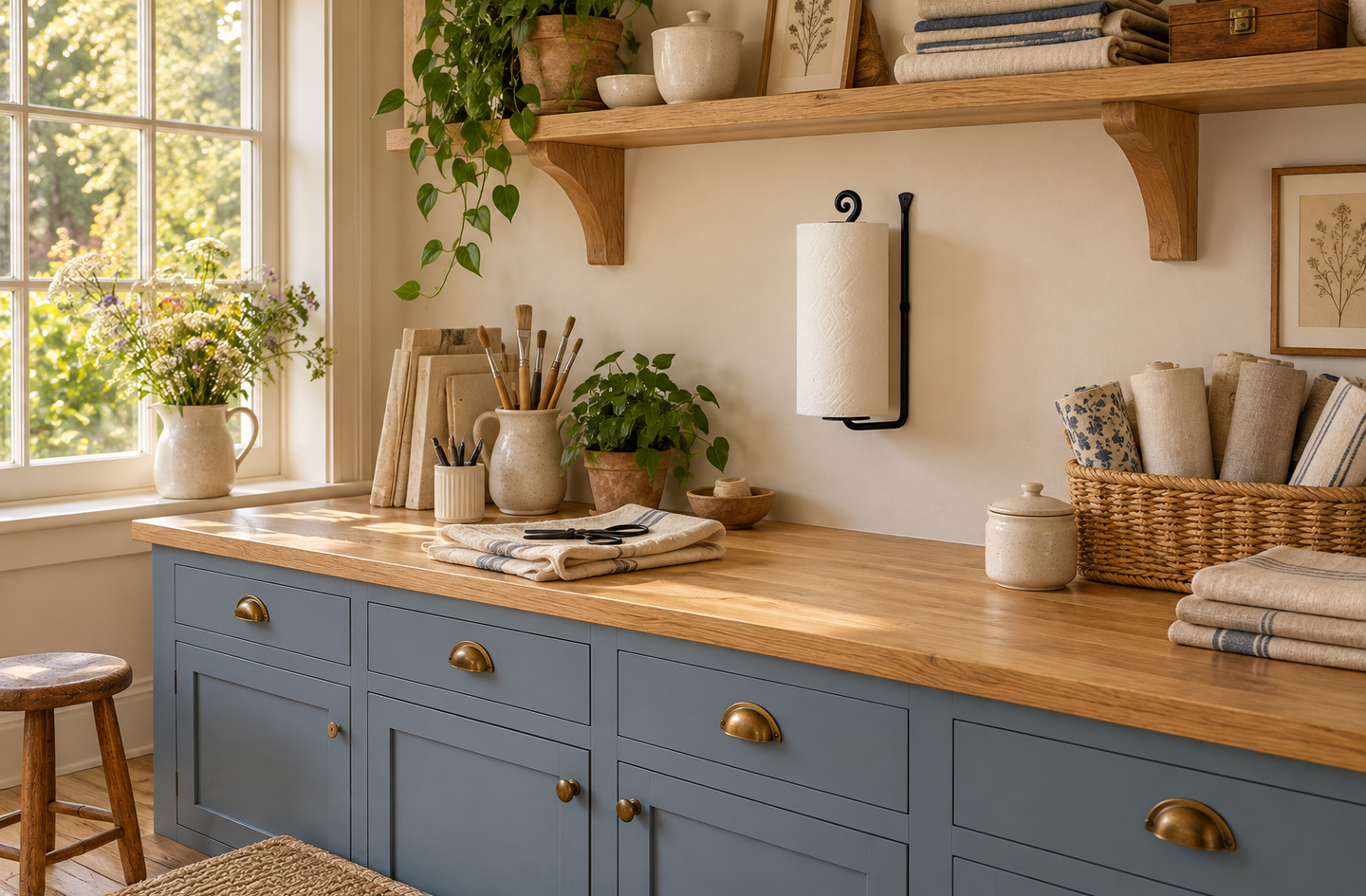
Choose a horizontal wall mount if: a wall near the sink has studs or masonry and the counter must stay clear.
Choose a vertical wall mount if: the only free wall is a narrow strip beside a window, door or cabinet end.
Choose an under-cabinet holder if: upper cabinets run above the prep zone and their floors are solid enough for screws.
Common Paper Towel Holder Mistakes
Mistake 1: Mounting at One Universal Height
Why it is a mistake: reach depends on the people and the counter. The Access Board limit falls from 48 to 44 inches when reach depth exceeds 20 inches1, and adults in the same home differ in height and arm length.
What to do instead: mount for the shortest regular user and keep the roll within easy reach across the counter. Leave room above the holder for lifting a full roll on and off.
Read more: Paper Towel Holder Mounting Height: A Practical Reach Guide.
Mistake 2: Driving Screws Into Bare Drywall
Why it is a mistake: This Old House notes that drywall supports between 5 and 10 pounds with a simple nail and that anything heavier requires additional support2. A holder is light, but every tug on a sheet pulls the screw outward until the hole wears.
What to do instead: fasten into a stud where possible, or use an anchor rated for the wall. In Family Handyman’s test, the Pop Toggle held more than twice its rated weight5.
Read more: How to Fix a Loose Wall-Mounted Paper Towel Holder.
Mistake 3: Assuming Every Roll Fits
Why it is a mistake: roll width and outer diameter differ between brands and between standard, jumbo and mega sizes. A holder that fits one roll can bind against the wall or the cabinet floor with another.
What to do instead: test with a full new roll of the size you buy, and check the arm length and the clearance behind and below the roll before drilling.
Read more: Jumbo and Mega Paper Towel Rolls: Will They Fit Your Holder?.
Frequently Asked Questions
How high should a paper towel holder be mounted?
No single height suits every kitchen. The Access Board sets 48 inches as the unobstructed high forward reach and 44 inches where reach depth exceeds 20 inches1, a useful ceiling for reaching across a counter. Mount for the shortest regular user, test the spot with a taped roll first, and leave enough space above the holder to lift a full roll on and off.
Will a jumbo paper towel roll fit a standard holder?
A jumbo roll fits only when the arm or spindle is long enough for its width and the space around it allows the larger diameter. Sizes vary between brands, so a package label alone proves little. Slide a full new roll on before mounting, and check the gap to the wall, the cabinet floor and any door trim. RTZEN lists its Fancy and Decorative holders for standard and jumbo rolls.
Is a wall-mounted or countertop paper towel holder better?
Neither wins in every kitchen; the choice turns on counter space and drilling. A countertop stand needs no tools, moves between rooms and suits renters, but it uses prep space. A wall or under-cabinet mount frees the counter and stays put, but it needs a sound surface. This Old House notes that drywall supports between 5 and 10 pounds with a simple nail2, so plan studs or anchors.
Why does my countertop paper towel holder tip over?
A countertop holder tips when the pull on a sheet acts above a base that is too small or too light, and the problem grows as the roll empties. Sliding is a separate fault caused by a smooth base on a slick counter. Pull sheets downward toward the base rather than sideways, keep the roll centered, and choose a wide, weighted base or a non-slip pad.
How do you clean a wrought iron paper towel holder?
Wipe a powder-coated iron holder with a soft cloth dampened in mild soapy water, then dry it fully, including the base if it sits on a wet counter. Avoid scouring pads and abrasive cleaners, which cut the coating. For galvanized steel, the American Galvanizers Association reports that the underlying zinc extends the life of the paint or powder coating by at least 50%3.
How This Guide Was Built
The methodology behind this guide is a review of published standards, government guidance and established home-improvement publishers. Figures come from the US Access Board, the CDC, the EPA, the American Galvanizers Association, This Old House and Family Handyman, and each links to the page that carries it. The framework groups the cluster’s reader questions in the order a kitchen install raises them. The worked example rests on Access Board reach limits and CDC height data. RTZEN editors hold editorial responsibility for this guide.
References
- U.S. Access Board – ADA Accessibility Standards
- This Old House – How To Hang Something Heavy On a Wall
- American Galvanizers Association – Duplex Systems: Paint or Powder Coating Over HDG
- US EPA – A Brief Guide to Mold, Moisture and Your Home
- Family Handyman – How Much Weight Can Drywall Anchors Hold In Your Home? (Jason Ingolfsland, updated Oct. 28, 2024)
- CDC National Center for Health Statistics – FastStats: Body Measurements (measured August 2021 to August 2023)
Next Read
Placement decides most of what follows: a paper towel holder works when it sits on the reach path, on a surface that holds a fastener, with room for a full roll. For a kitchen that cannot take a drill, a weighted countertop stand is the simplest place to start.