
Curtain tie back hooks are wall-mounted brackets that hold gathered fabric panels away from a window, letting light into the room. Choosing the wrong size or anchor leaves fabric pooling on the floor or a screw pulling loose from the wall. For a broader look at holdback styles, see the curtain holdbacks overview. This article covers hook arm designs, projection depth, wall mounting options, and how fabric weight guides your choice. The global curtain rods and hardware market reached USD 4.42 billion in 20241, which reflects how central this hardware category has become in finished window treatments.
Quick Answer
What are the main types of curtain tie back hooks?
Metal holdbacks come in two main profiles: a curved arm that cups gathered fabric from behind, and a loophole arm where a cord or fabric tieback threads through an opening. Install at 28 to 36 inches from the floor for standard 84-inch panels2, using the included hardware for drywall or stud installation. An arm projection of 4 to 6 inches clears most single-panel fabric3; lined or double panels need the full 6 inches.
Key Takeaways
- Install curtain tie back hooks 28 to 36 inches from the floor for standard 84-inch panels2, following the one-third rule as your starting point.
- Arm projection of 4 to 6 inches clears most single-panel fabric3; lined drapes and blackout panels need the full 6-inch reach.
- Toggle bolts rated at 100 lbs or more give the safest drywall hold5 when no stud sits at your target mounting spot.
Types of Curtain Tie Back Hooks: Quick Comparison
The table below compares the four main arm configurations you will encounter. Each suits different fabric weights, decor styles, and tieback accessories.
| Hook Type | Best For | Typical Projection | Fabric Compatibility | Tieback Method |
|---|---|---|---|---|
| Curved U-Arm (Classic) | Single-panel cotton, linen, polyester | 3 to 4 inches | Light to medium weight | Fabric gathers directly over the arm |
| Loophole Arm | Rope, ribbon, and cord tiebacks | 3 to 5 inches | Light to heavy weight | Cord threads through a ring at the tip |
| Decorative Finial Arm | Feature windows; themed decor rooms | 4 to 5 inches | Medium weight fabrics | Fabric gathers over the arm; finial faces outward |
| Large Swirl or Extended Arm | Lined drapes, velvet, heavy cotton | 5 to 6 inches | Heavy to extra-heavy | Fabric gathers over the extended arm |
The right arm design comes down to two questions: how thick is the gathered fabric stack, and are you hanging the curtain directly over the bracket or threading a separate cord tieback through it? Those two answers narrow the table to one row.
Hook Arm Design: How Different Shapes Hold Fabric
Every curtain tie back hook does the same mechanical job: it projects from the wall, and the gathered curtain sits behind or through the arm, held clear of the window opening. The design of that arm shapes how much fabric it can hold, how it looks from the room, and what type of tieback it accepts.
The Curved U-Arm (Classic Holdback)
Curtain tie back hooks with a curved U-arm are the most common design available. A solid iron arm projects outward from the wall bracket and curves upward, forming a shallow cradle. The gathered curtain drapes behind the arm, and the fabric’s own weight keeps it in place. This shape works cleanly with single-panel curtains in cotton, linen, or polyester. The arm does not grip or pierce the fabric, so panels slide on and off the bracket without effort each time you want to open the drapes.
RTZEN’s classic holdbacks use this curved-arm design, hand-forged in wrought iron from a four-step process: cut, hand-forge, zinc-galvanize, powder-coat. The backplate mounts flush to the wall, and the arm projects cleanly forward. For most rooms with standard-weight curtains, the classic curved arm is all you need.
The Loophole Arm
A loophole holdback is a wall-mounted bracket with a circular or oval opening at the tip of the arm. Instead of the curtain panel draping over a solid arm, a cord, ribbon, or fabric tieback threads through the ring. That tieback then wraps around the gathered curtain from the front and loops back through the opening, pulling the fabric into a neat bundle.
This design suits any room where you are already using a decorative rope or braided cord as the tieback accessory. The holdback becomes the anchor point on the wall; the cord does the actual gathering work. RTZEN’s loophole holdbacks are forged from wrought iron with the same four-step process and a ring opening sized to accept standard cord diameters. The loophole is also useful when you want the bracket itself to stay visually minimal while the cord tieback provides the decorative element.
Decorative Finial Arms
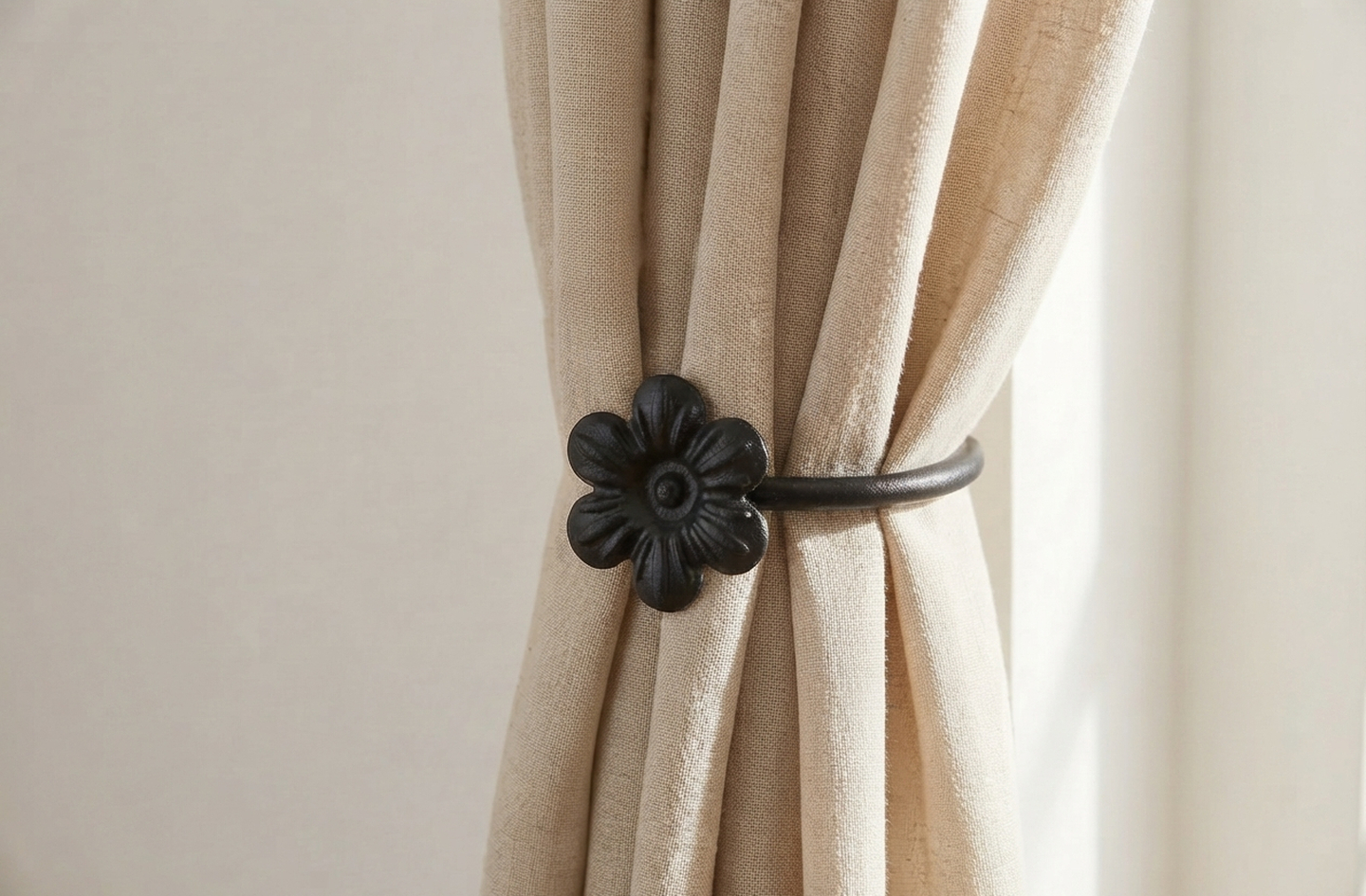
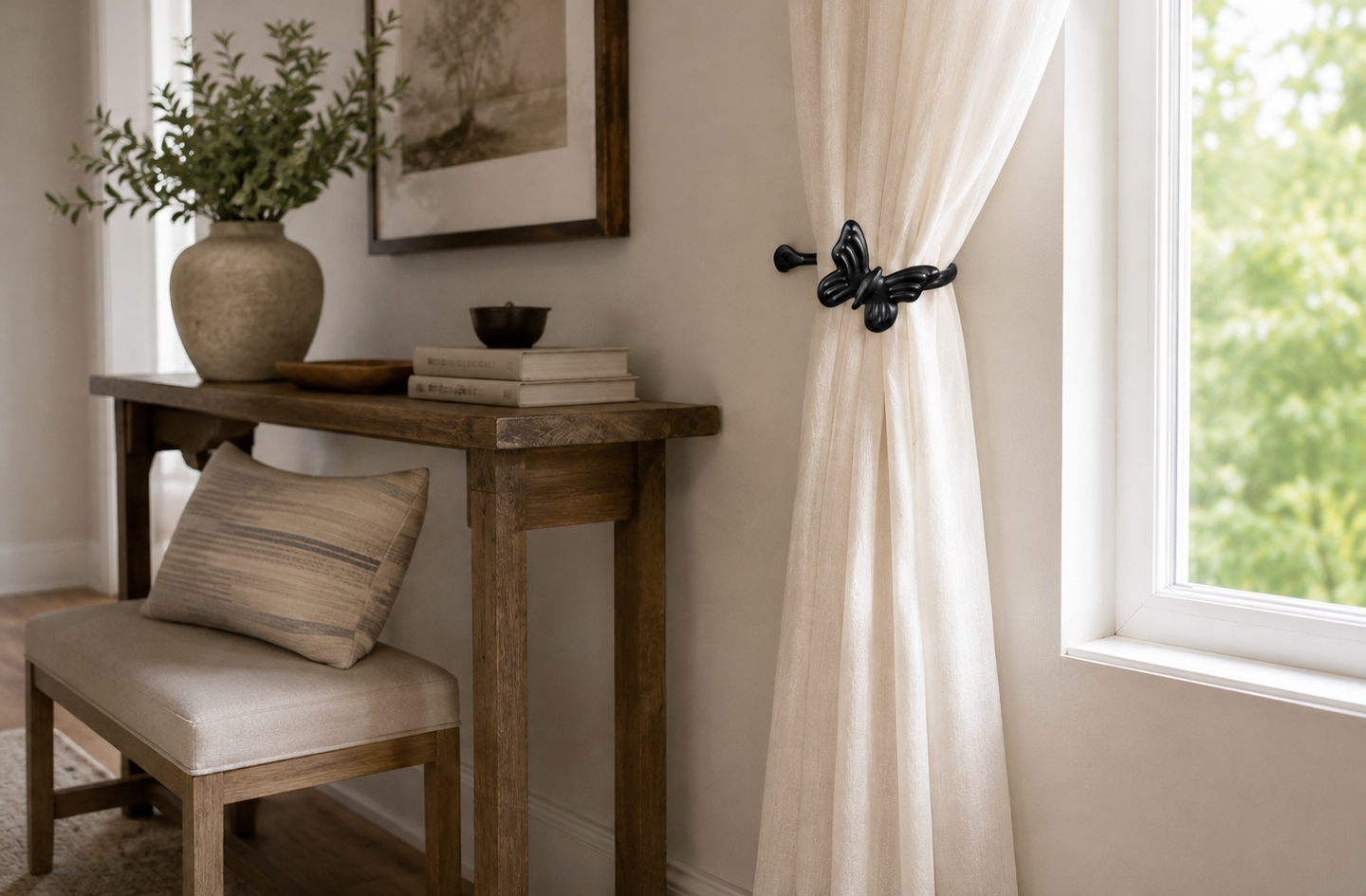
A finial is the shaped end piece at the tip of a holdback arm. Common finial shapes include flowers, butterflies, starfish, scrolls, and geometric swirls. Functionally, finial-arm holdbacks work exactly like a plain curved arm: the curtain gathers behind the bracket and the finial faces outward toward the room. The design difference is purely visual.
Finial shapes are the most visible element when the curtain is held open. A flower or butterfly finial reads as decorative hardware and contributes to the room’s character. A plain curved tip reads as utilitarian. The choice depends on how much you want the holdback to become part of the window’s design. Heavier finials add a small amount of weight to the bracket end, but this does not affect hold when the screws are properly anchored into drywall or a stud.
Decorative finial holdbacks come in the same two main mounting depths as plain arms. A medium-projection finial arm (around 4 to 5 inches) works for standard single-layer curtains. A longer arm with the same finial handle heavier or lined fabric without the curtain spilling forward off the bracket tip.
Large Projection Arms for Heavy Drapes
Some holdback brackets are designed specifically for lined panels, velvet, or layered window treatments. These arms project 5 to 6 inches from the wall rather than the standard 3 to 4 inches. They are built with a wider arc to accommodate the bulk of a heavily gathered fabric stack.
Lined panels and blackout fabric fold to a significant depth at the holdback point. A standard 3-inch arm lets that bulk spill forward off the bracket, leaving the curtain bunching at the floor. A large-projection arm stays well ahead of the fabric and keeps the drape held cleanly in place. RTZEN’s large swirls holdback extends the arm length and adds a scrolled finial, giving lined panels a stable anchor with a decorative finish. The large arm also suits any double-layer arrangement where a sheer panel runs behind a heavier face panel on the same rod.
Projection Depth: Choosing the Right Arm Length
Arm projection is the horizontal distance between the wall surface and the tip of the holdback bracket. It is one of the least-discussed specifications on holdback packaging, but it directly determines whether the bracket actually holds your curtain or lets it slip forward.
A hook too shallow allows thick or lined fabric to spill off the arm front. One that projects too far creates an awkward gap between the gathered fabric and the window frame, especially on narrower windows. The standard projection range for curtain tie back hooks is 4 to 6 inches3. That range covers most residential situations. Here is how to narrow it down:
- Single-panel sheers or lightweight fabric: 4 inches is sufficient. The gathered stack at the holdback is thin, and the shorter arm keeps the bunched curtain close to the wall where it belongs.
- Standard lined drapery panels: 5 inches gives clearance for both the lining and face fabric without the arm looking oversized against the wall surface.
- Blackout panels, velvet, or layered treatments: 6 inches of projection handles these fabrics without the gathered bundle escaping the arm tip. These materials stack deep when folded.
Fabric fullness also determines how much bulk the holdback must contain. Standard curtain panels in the United States are 48 to 50 inches wide per individual panel4, and the industry standard calls for 2x fullness: a panel roughly twice the width of the window opening4. At 2x fullness, the gathered stack at the holdback reaches roughly half the panel width, or about 12 to 13 inches of fabric folded into a bundle. A 5-inch or 6-inch arm handles this comfortably. A 3-inch arm often does not.
You are not always choosing the exact arm length; you are choosing between a medium or large holdback in the same style. Buy medium for lightweight to standard-weight panels and large for lined, blackout, or layered treatments. For a full comparison of metal types across the holdback range, the article on curtain holdback metals covers wrought iron, steel, brass, and aluminum side by side.
Mounting Hardware and Wall Types
Every curtain tie back hook mounts to the wall through two screw holes in its backplate. Most sets include screws and plastic drywall anchors sized for standard residential walls. What those included anchors can actually hold, and whether you need something stronger, depends on your wall type and the weight of your curtains.
Drywall Without a Stud
Most interior walls are drywall over wood or metal studs. Studs run either 16 inches or 24 inches apart on center, and a stud is almost never exactly where you want the holdback to sit. When no stud is available at the target spot, the anchor type matters.
Plastic expansion anchors (the kind typically included in holdback packaging) expand inside the drywall when the screw goes in, creating moderate grip. They work for lightweight curtains in rooms that do not see heavy use, but they pull out under repeated load or if the curtain is grabbed. For a more secure installation, upgrade to a toggle bolt or a molly bolt. Toggle bolts spread a metal wing behind the drywall, distributing the load over a wider area: toggle anchors hold 100 lbs or more depending on drywall strength5. Molly bolts work similarly and support up to 100 lbs5. Either option far exceeds the load a fabric panel and a tieback cord create at the bracket point.
Into a Wood Stud
Driving screws directly into a wood stud is the strongest mounting option for curtain tie back hooks. The screw bites into solid wood behind the drywall, and the pullout resistance is significantly higher than any anchor type. If your stud layout lands close to where you want the holdback, shift the placement slightly to hit the stud rather than using an anchor. The visual difference of 2 to 3 inches is invisible once the curtain is drawn back.
To locate a stud, use a magnetic stud finder or a simple tap test. Drive one screw into the stud first, then position the second screw to land in solid wood as well. Most holdback backplates are narrow enough that both screws fit within the stud width.
Masonry, Brick, and Concrete
Masonry walls require a masonry bit and masonry anchor screws (also called concrete anchors or Tapcon screws). Standard plastic anchors do not grip masonry reliably; they expand into a surface that does not compress the way drywall does, and they loosen over time. A properly set masonry anchor gives a hold comparable to a stud installation on a drywall wall. RTZEN’s holdback sets include hardware for standard drywall and wood mounting; for masonry or concrete, source masonry anchors separately before drilling.
Placement Height: The One-Third Rule
Mounting height is separate from the hardware question, but it determines whether the holdback actually looks right once the curtain is gathered behind it. The classic rule places the holdback roughly one-third of the way up from the bottom hem of the curtain panel.
“About 30 to 36 inches off the floor for standard 84-inch floor-length panels, which is roughly one-third of the way up from the bottom hem.”
Emily Green, home decor writer, TheHues3
For non-standard panel lengths, apply the rule directly: divide the panel length by three and round to the nearest inch. The chart below shows the resulting height for the three most common US residential curtain lengths.
Mounting 2 to 3 inches above or below the calculated height is within normal tolerance. What matters is that both holdbacks on the same window sit at exactly the same height. Use a level and a tape measure before drilling, and mark both holes with a pencil before committing. For a full height and offset matrix including bay windows and arched frames, the holdback placement guide covers each scenario in detail.
Curtain Weight and Fabric Fullness
Fabric weight is the single factor that determines whether a given holdback will perform or fail over time. The hook itself does not hold the fabric directly. It holds the gathered bundle, and that bundle puts continuous outward pressure on the arm and the wall anchor. That pressure is present every time the curtain is pulled back and left in the open position.
Estimating Fabric Weight
There is no universal weight stamp on curtain packaging. Most panels are labeled by fabric type, and fabric type gives you a reasonable estimate:
- Sheer and voile panels: Very lightweight. The gathered bundle on a standard window is minimal, and any standard holdback handles it without concern.
- Cotton and linen panels (unlined): Medium weight. A medium-arm holdback with a plastic expansion anchor holds this comfortably in most installations.
- Lined panels and blackout fabric: The face fabric plus lining plus any interlining adds up quickly. The gathered bundle is heavier than it looks. This is well within a toggle or molly bolt’s rated capacity, but it exceeds what a basic plastic anchor should hold long-term.
- Velvet and heavyweight cotton: Among the densest residential curtain fabrics. Use a toggle bolt anchor and a large-projection arm.
How Iron Holdbacks Handle Long-Term Load
A holdback made from hand-forged wrought iron holds its shape under continuous load because solid iron does not develop fatigue cracks under the static pressure of a curtain bundle the way hollow stamped metal does. The four-step RTZEN production process (cut, hand-forge, zinc-galvanize, powder-coat) produces a bracket with no internal voids and no single-layer finish that flakes under pressure at the mounting point.
The wall anchor, not the bracket arm, is usually the failure point in a heavy-curtain installation. Stamped metal holdbacks often fail at the backplate because the material is thin and the screw holes elongate under load. Forged iron backplates are thick enough that the screw holes remain true even after years of daily use. Lifetime Warranty coverage on every RTZEN holdback reflects this: the brackets are built for real daily use, not displayed above a rod that never moves.
When to Consider Heavy-Duty Hardware Instead
A standard holdback handles any residential curtain fabric when the wall anchor is appropriate for the weight. Very heavy commercial-grade drapes, salon-style velvet panels with multiple layers, or window treatments that also carry a thermal lining and an acoustic layer may exceed what a single bracket pair provides. In those situations, a heavier-duty hook with a larger backplate and a longer arm is a better fit. The sibling article on heavy duty curtain hooks covers the load thresholds and bracket specs where the step up makes practical sense.
How to Choose the Right Curtain Tie Back Hook
Four questions determine the right hook for your window. Answer them in order and the choice becomes straightforward.
What is the curtain fabric weight?
Start with weight because it determines both arm projection and anchor type. Sheers and lightweight panels: use a medium-arm holdback with the included plastic anchors. Standard lined panels: use a medium or large-arm holdback with a plastic or molly bolt anchor. Blackout, velvet, and heavy layered treatments: use a large-arm holdback with a toggle bolt anchor.
How do you want to tieback the fabric?
If the curtain drapes directly over the bracket arm, a classic curved arm or decorative finial arm works. If you are using a rope, ribbon, or cord tieback as a separate accessory, choose a loophole arm. It threads the cord through the ring at the tip and becomes the anchor point, while the cord does the gathering work. Both approaches look finished; the loophole version keeps the bracket visually recessed while the cord tieback takes visual priority.
What does the room decor ask for?
A plain curved arm reads as minimal and functional. A flower, butterfly, or starfish finial contributes a specific design character. Swirl and scroll finials sit between the two: decorative without being literal. Match the finial to the other iron or metal hardware in the room: the rod brackets, the curtain rings, the light fixtures, and any wall hooks or coat hooks nearby. Mixing too many finial shapes in one room dilutes the effect each piece produces.
What is the wall type?
If you have drywall and can hit a stud, drive the screws directly into the stud. If the stud lands in the right place, use it. If not, choose a toggle bolt or molly bolt over the plastic anchors included in most sets. Masonry requires masonry anchors sourced separately. These wall-type details are worth confirming before you drill; pulling a stripped anchor out of finished drywall and patching the hole adds time and cost to what is otherwise a 20-minute installation.
The one factor buyers most often overlook is projection depth. Arm shape and finial style are visible choices, so people think about them. Projection depth is invisible until the curtain slips off the arm a week after installation, and then the bracket has to come down and be swapped for a longer one. Buy the projection depth that matches your fabric weight, not the depth that looks right in the product photo.
Frequently Asked Questions
How high should curtain tie back hooks be installed?
Install curtain tie back hooks roughly one-third of the way up from the bottom hem of the curtain panel. For standard 84-inch floor-length panels, that puts the holdback at 28 inches from the floor2. A 96-inch panel calls for about 32 inches; a 108-inch panel calls for about 36 inches. Both holdbacks on the same window should be at exactly the same height.
What is the difference between a curtain tieback and a curtain holdback?
A curtain holdback is the wall-mounted metal bracket itself. A tieback is the fabric, cord, or rope that wraps around the gathered curtain. Holdbacks and tiebacks often work together: the fabric tieback loops around the curtain and hooks over or through the wall-mounted holdback bracket. The terms are sometimes used interchangeably in retail listings.
What arm projection do I need for lined curtains?
Lined curtains require an arm projection of 5 to 6 inches to keep the fabric bundle from slipping off the bracket tip. The lining and face fabric fold to a depth the standard 3-inch arm cannot fully contain. The standard arm projection range for holdbacks is 4 to 6 inches3, and the larger end of that range is the right choice for any panel with a backing layer.
Can I install curtain tie back hooks in drywall without hitting a stud?
Yes. A toggle bolt anchor rated at 100 lbs or more in drywall5 gives a secure hold for any residential curtain weight. Avoid relying on the basic plastic expansion anchors included in most holdback sets for heavy or frequently-used panels; they can loosen over time under repeated loading. Molly bolts offer similar holding strength and are easier to install in tight spaces.
How do loophole curtain holdbacks work?
A loophole holdback mounts to the wall like any standard bracket, but its arm ends in a circular or oval ring instead of a curved tip. A rope, ribbon, or fabric tieback threads through the ring. That tieback wraps around the gathered curtain panel and loops back through the ring, pulling the fabric into a neat held position. The ring is the anchor point; the tieback cord does the actual gathering work.
Limitations and Edge Cases
- Figures for arm projection ranges (4 to 6 inches) represent standard residential holdbacks; custom or oversized holdbacks for commercial drape panels may require specifications outside this range.
- Installation heights in this article are based on standard-length panels (84, 96, and 108 inches) on windows with floor clearance. Cafe curtains, valances, and tier sets follow different placement logic.
- For questions about which metal material ages best in humid environments, the article on curtain holdback metals covers finish durability across wrought iron, steel, brass, and aluminum in detail.
References
Methodology: every figure cited in this article is drawn from an independent published source linked to the page carrying it; the article was reviewed by Rami Abramson, co-founder of RTZEN, in September 2026. See the about RTZEN page for editorial and warranty details.
- Market Research Future – Curtain Rods Market Size, Share, Growth Report, analyst Pradeep Nandi, September 2026.
- Kwik-Hang Blog – Curtain Tiebacks 101, July 16, 2026.
- TheHues – How High Should Curtain Tiebacks and Holdbacks Be?, Emily Green, updated July 31, 2026.
- Workroom Wisdom and Fabric Finds – Standard Curtain Width: Your 2026 Sizing Guide, July 21, 2026.
- Bob Vila – 7 Types of Drywall Anchors Every Homeowner Should Know, Bob Beacham, updated June 23, 2025.
Conclusion
Curtain tie back hooks are a small piece of hardware with a clear set of sizing rules. Match projection depth to fabric weight, set height at one-third up from the bottom hem, and choose an anchor rated for the load. Decorative finial or plain arm, loophole or curved, the choice is almost entirely about the room’s design and whether you are using a cord tieback or hanging the fabric directly.
For the full context on holdback styles, installation heights, and how this hardware fits into a window styling plan, see the overview at curtain holdbacks.