
Choosing the right hanging plant hook comes down to two factors: what surface you are mounting into and how much your basket weighs fully watered. The indoor plants market reached USD 13.12 billion in 2025 and continues to expand1, and nearly 36% of U.S. households participate in indoor houseplant gardening2 – yet most hook failures happen because homeowners install a wall-rated anchor overhead or hang a 20-lb basket from a 5-lb adhesive strip. This article compares four types – wall bracket hooks, ceiling hooks, S-hooks, and no-drill adhesive hooks – by weight limit, best mounting surface, and practical trade-offs. For a broader overview of plant hanger styles and materials, see the overview in plant hanger basics.
Quick Answer
Which hanging plant hook holds the most weight?
A screw-in ceiling hook installed into a ceiling joist can hold up to 100 lbs3, making it the strongest option for large, water-heavy baskets. Wall bracket hooks screwed into a stud typically manage 30 to 50 lbs. S-hooks transfer load to whatever they hang from rather than carrying an independent rating. No-drill adhesive hooks are capped at 5 lbs3 and suit only the smallest succulent arrangements.
Key Takeaways
- Ceiling hooks into joists carry up to 100 lbs – the strongest option for heavy, water-logged baskets.
- Wall-rated drywall anchors perform at only 50 to 60% of their stated capacity when moved to a ceiling, so a 75-lb wall anchor becomes a 37 to 45 lb ceiling anchor5.
- Toggle bolts in 1/2-inch drywall have an ultimate load of about 140 lbs but a safe working load of only 35 lbs after applying a standard engineering safety factor of four4.
- Consumer S-hooks typically hold 12 to 20 lbs, but their effective limit is the lesser of the hook rating and the rated capacity of whatever they hang from.
- No-drill adhesive hooks are limited to 5 lbs under ideal conditions; always plan for the basket’s wet weight, not its dry weight.
Quick Comparison Table
| Hook Type | Best For | Max Load (Stud or Joist) | Max Load (Drywall Only) | Indoor / Outdoor | Drill Required |
|---|---|---|---|---|---|
| Wall bracket hook | Fences, brick, masonry, studs, exterior walls | 30 to 50 lbs | 25 to 35 lbs | Both | Yes |
| Ceiling hook | Covered porches, living rooms, high ceilings | 50 to 100 lbs | 35 to 75 lbs (toggle bolt) | Both | Yes |
| S-hook | Pergolas, curtain rods, chains, horizontal rails | Inherits parent structure rating | N/A | Both | No |
| No-drill / adhesive | Renters, lightweight succulents, smooth surfaces | N/A | 5 lbs | Indoor only | No |
Wall Bracket Hooks for Hanging Plants
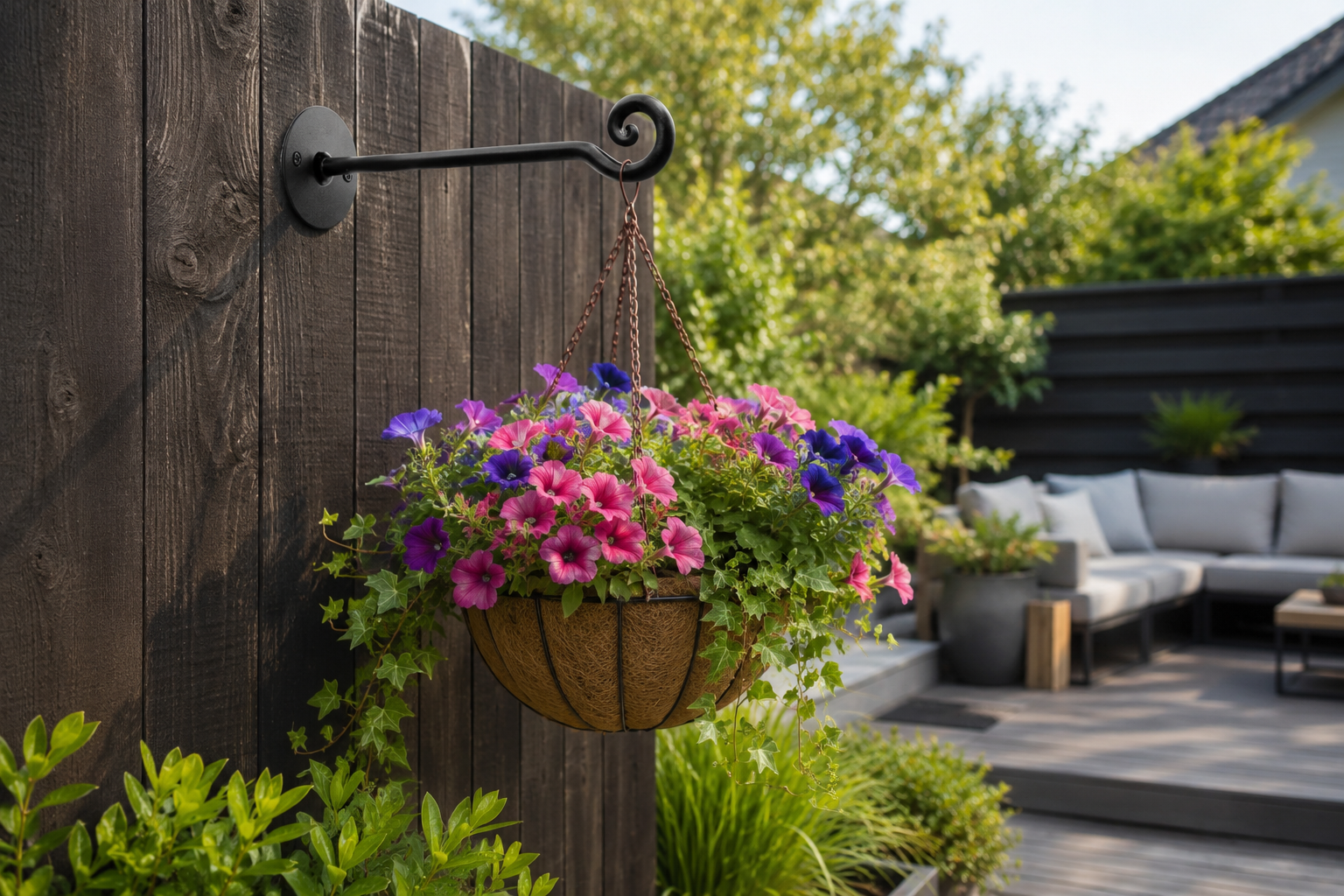
Wall bracket hooks are the most common hanging plant hook for home use. They mount into a vertical surface – a fence, exterior brick, concrete, or an interior stud – and project outward so the basket clears the wall, catches light on all sides, and drains freely. Because the load path runs straight down through the bracket arm into the mounting point, a properly installed wall bracket concentrates force where a stud or masonry anchor performs best.
Weight Limits for Wall Bracket Hooks
A wrought iron wall bracket screwed into a stud or fence post holds 30 to 50 lbs depending on arm length and fastener count. The longer the arm, the greater the lever force at the mounting plate – a 12-inch arm creates more torque than an 8-inch arm carrying the same load. RTZEN’s Shepherd’s Hooks are rated to 30 lbs per hook, built with double front welding at the bracket joint – the point where single-weld alternatives most often fail under sustained load.
In masonry with appropriate sleeve anchors, the range is similar – 25 to 40 lbs per hook depending on anchor diameter and mortar condition. In drywall without a stud, the range drops sharply: a self-drilling anchor holds 25 to 35 lbs under static conditions but needs a meaningful safety margin, as moisture from watering and wind movement gradually loosen the anchor.
Material and Finish for Outdoor Durability
For outdoor wall bracket hooks, the material is as important as the load rating. Hollow-stamped steel brackets corrode through in one to two outdoor seasons in wet or coastal climates. Hand-forged wrought iron is structurally different: it contains 1 to 2% slag fibers embedded during the forging process7 that form a protective layer at the metal surface. Chris Topp, an ironwork conservator and contributor to the RICS Built Environment Journal, explains it this way:
“More highly refined materials such as mild steel and pure iron corrode very rapidly in comparison because they lack the fibres of slag.”
Chris Topp, ironwork conservator, Topp and Co. Ltd.6
Wrought iron’s ultimate tensile strength falls between 240 and 350 MPa7 – comparable to mild steel in raw load capacity – but its corrosion behavior is fundamentally better outdoors. A wrought iron bracket finished with dual-layer zinc galvanization plus powder coating adds two further barriers against rust, which is why quality hand-forged hooks maintain their structural integrity through repeated wet-dry cycles and seasonal temperature swings.
Bracket Styles: Shepherd, Swirl, Butterfly, and Double
Shepherd’s hooks feature a smooth curved arm (typically 7.5 to 10 inches) with a flat mounting plate – the standard choice for flowering baskets where centered positioning and maximum clearance from the wall matter. Swirl hooks add decorative ironwork scrollwork along the arm without reducing structural performance; they suit garden walls and fence lines where the bracket itself is visible as part of the exterior design.
Butterfly and curved bracket hooks use a slightly wider mounting plate configuration that provides extra stability on wooden fences and deck posts, particularly on horizontal fence rails where a narrow plate might rock under side load. Double bracket hooks carry two baskets from a single mounting point – useful on garden walls where staggered heights look intentional and two separate holes would crowd a narrow surface. For a double hook, add both basket wet weights together and confirm the single mount point can carry that combined load before installation.
Ceiling Hooks for Hanging Plants
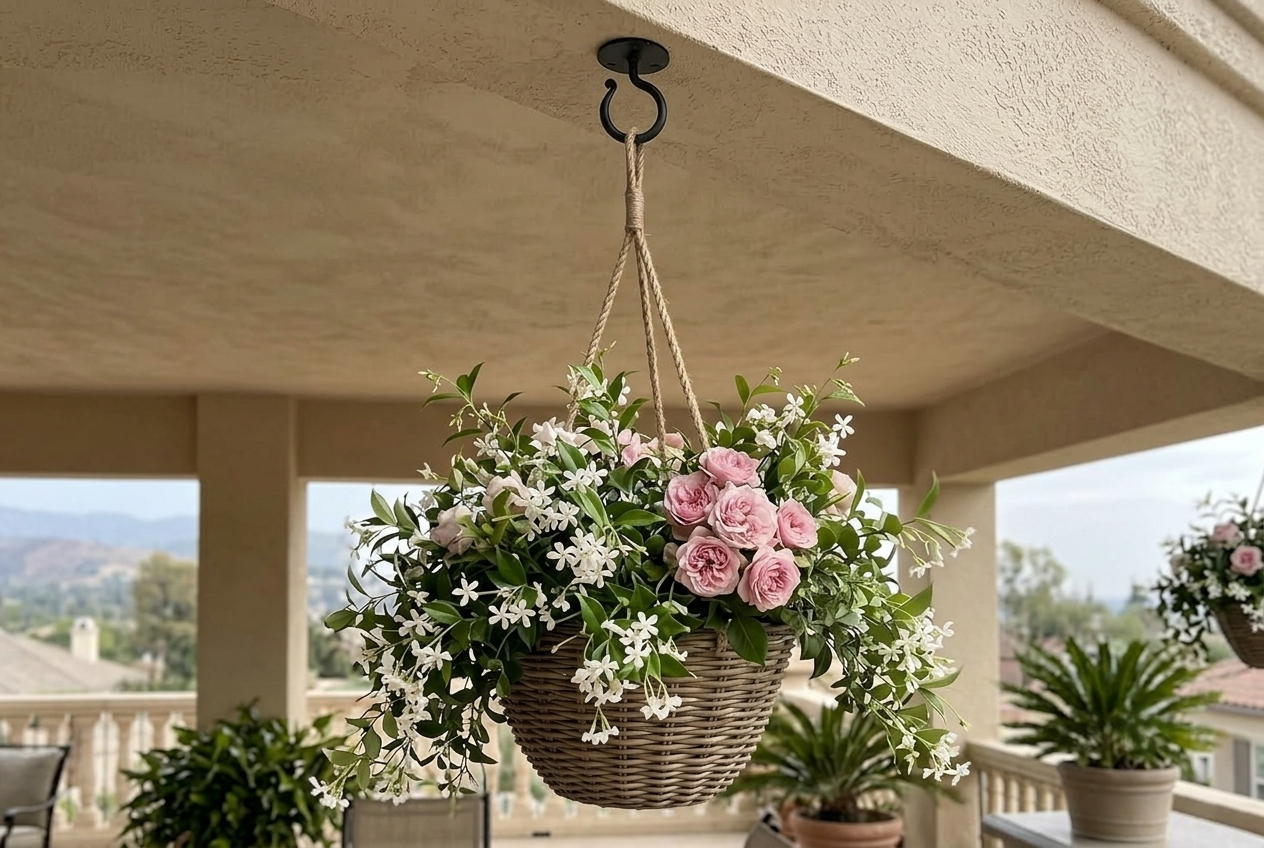
A ceiling hook suspends the plant from above, which lets it hang centrally in a room, under a covered porch overhang, or from a pergola beam without needing a nearby wall. Ceiling hooks carry load in pure vertical tension, which is mechanically efficient – a screw-in hook going directly into a ceiling joist can safely hold 50 to 100 lbs3, more than almost any wall bracket installation achieves in standard residential construction.
Weight Limits for Ceiling Hooks by Mounting Method
The load limit for a ceiling hook depends almost entirely on what it is screwed into. Into a ceiling joist – a structural framing member, typically 2×6 or 2×8 softwood lumber – a screw-in hook handles 50 to 100 lbs at a working load limit that already incorporates a safety buffer. That buffer is necessary because hanging plants are a dynamic load: watering suddenly adds weight, and wind or building vibration creates brief swing forces that multiply the effective downward pull on the fastener.
Into drywall alone, the numbers fall sharply. A 1/8-inch toggle bolt in standard 1/2-inch drywall has a laboratory ultimate tensile capacity of about 140 lbs. Applying a minimum engineering safety factor of four brings the allowable working load down to approximately 35 lbs4. A larger 3/8-inch toggle bolt raises the allowable working load to approximately 75 lbs4, but installing it correctly requires a larger pilot hole and careful management of the toggle wings above the drywall surface so they open flat rather than tearing the board.
A common and costly error: using a wall-rated anchor on a ceiling at the wall rating. Wall-rated drywall anchors perform at only 50 to 60% of their stated wall capacity when installed in a ceiling5. A 75-lb wall anchor becomes a 37 to 45 lb ceiling anchor. Most anchor packaging prints only the wall rating. If a separate ceiling rating is not listed, apply the 50 to 60% reduction before planning your hanging load.
Finding the Joist Before You Install
Locating a ceiling joist before installing any ceiling hook is non-negotiable for baskets over 15 lbs. Three reliable methods: a stud finder set to deep-scan mode; tapping the ceiling with a knuckle and listening for a dull solid thud rather than a hollow resonance; or measuring 16 or 24 inches from a wall (the standard joist spacing in North American residential construction). Mark both edges of the joist to locate its center before drilling. Drilling a small 1/8-inch pilot hole first confirms solid wood behind the surface – if the bit meets no resistance, you are in drywall only and need to relocate or switch to a toggle bolt system.
Indoor and Outdoor Ceiling Hook Applications
For indoor use, the finish of the ceiling hook matters. A white powder-coated hook reads as invisible against most painted ceilings. A black wrought iron hook suits farmhouse kitchens, industrial lofts, and any room where the hardware is meant to be noticed rather than hidden. RTZEN’s ceiling hooks are made from solid wrought iron and come as a 2-pack with mounting hardware designed for joist installation, which covers the most common indoor ceiling scenario cleanly.
Outdoors, any ceiling hook used under a covered porch or pergola needs a rust-resistant finish. Uncoated or lightly plated hooks develop surface corrosion within one to two seasons in humid environments, and rust streaks stain painted porch ceilings. Galvanized and powder-coated iron hooks are the practical outdoor choice. Avoid hollow-core hooks entirely for outdoor overhead use: they trap moisture inside and rust from the inside out, which can cause the hook to fail before any surface rust is visible.
S-Hooks for Hanging Plants
S-hooks are a shaped metal link where one end catches a horizontal support – a rail, chain, rod, or rafter – and the other carries the hanging basket. They carry no fixed weight limit independent of their support: the effective load limit is whichever is lower, the S-hook’s own rated working load or the rated capacity of the structure they hang from. Consumer-grade garden S-hooks typically carry 12 to 20 lbs3. Industrial rigging S-hooks are a different product class entirely and are not designed for residential plant display.
Where S-Hooks Work Best
S-hooks excel when a strong overhead structure already exists: an open pergola rafter, a steel chain descending from a ceiling hook, a curtain rod rated for the combined load, or a horizontal tension wire stretched across a balcony. In those scenarios, the S-hook functions as a convenient and repositionable connector. Repositioning is the key advantage – an S-hook can be slid along a rail or chain in seconds, moved to a sunnier spot, or swapped between display positions without any tools.
Rotating plant S-hooks, which incorporate a swivel bearing between the support end and the basket end, solve the even-light problem: the basket spins slowly as warm air moves through the room, giving all sides of the plant roughly equal sun exposure over the course of a day. These suit trailing plants such as pothos or string-of-pearls where uneven light causes one side to grow sparse while the other becomes dense.
S-hooks also function as a height-adjustment layer in a hanging chain system. A ceiling hook or wall bracket hook provides the structural anchor; a length of chain provides the primary drop distance; and an S-hook at the bottom provides fine height adjustment. Only the ceiling hook or wall bracket hook carries the structural load; the chain and S-hook are connectors.
S-Hook Failure Modes to Avoid
The most common S-hook failure mode is lateral loading. S-hooks are strongest when the load hangs straight down through the center of the curve. When a basket swings sideways in wind or bumps the hook tip against a rail, the force shifts to a point load at the tip of the hook – a moment that can bend or snap a lightly-gauged hook far below its stated working load. Using a closed or slightly crimped S-hook prevents tip-load failures: once the S-hook is in place, bend the open end slightly inward with pliers so the rail cannot slip out and the basket cannot cant sideways onto the tip.
Plastic S-hooks are not suitable for outdoor plant hanging. UV exposure degrades most commodity polypropylene S-hooks within a single growing season, making a hook that felt solid in spring unreliable by late summer. Use metal S-hooks – galvanized steel, wrought iron, or stainless – for any outdoor application that sees direct sun.
No-Drill Hanging Plant Hooks
No-drill hooks for hanging plants use an adhesive strip, suction cup, or tension mechanism to avoid drilling into a wall or ceiling. Their maximum load is 5 lbs for adhesive-strip hooks3. That is enough for a small air plant in a wire cradle or a 3-inch succulent in a lightweight ceramic pot. It is well below the 8 to 15 lbs a standard 6-inch plastic nursery pot weighs when freshly watered.
Where No-Drill Hooks Are the Right Choice
No-drill hooks are a genuine solution for rented apartments where drilling is prohibited by lease, tiled bathroom walls where a drill risks cracking grout or ceramic, and smooth glass or mirror surfaces where adhesive bonds cleanly and a drill would leave permanent damage. The critical requirement is a clean, dry, non-porous surface. Textured paint, rough plaster, brick, and porous concrete all reduce adhesive bond strength below the rated capacity – sometimes to less than half of the packaging claim – and are not suitable surfaces for load-bearing adhesive hooks.
Load Planning for No-Drill Hooks
The 5-lb limit is a ceiling, not a safe target3. Adhesive ratings are established under controlled conditions: clean surface, room temperature, low humidity, static load. Watering cycles and temperature swings reduce bond strength over time. A plant in a 4-inch pot may weigh 3 lbs dry but 5 to 6 lbs after watering. Plan for peak wet weight plus 20% margin; if that exceeds 4 lbs, a no-drill hook is not the right option.
Renters needing slightly heavier options without drilling can use a tension shower-curtain rod in a window recess with S-hooks, supporting 10 to 20 lbs with no wall penetration. This is limited to windows with a standard recess but is a structurally sound alternative to overloading adhesive hooks.
Modern and Double Hook Formats
The modern hanging plant hook category includes bracket designs with a cleaner profile than traditional shepherd curves – minimal flat arms, geometric forged shapes, and matte finishes that suit contemporary interiors. These are typically wall-mounted with screws, not no-drill, and carry the same weight limits as standard wall bracket hooks when installed into a stud or masonry anchor.
Double hanging plant hooks carry two baskets from one wall mount point. They work well on garden walls or fence sections where you want staggered heights from a single installation. The single mount point must carry the sum of both basket wet weights. For a double hook installed into a fence post, a through-bolt configuration – bolt, washer, and nut passing through the post – is more reliable than surface screws alone, particularly in treated lumber that may shrink and loosen fastener grip over time.
How to Match a Hanging Plant Hook to Your Surface
The mounting surface determines which hook and anchor combination is reliable. Three variables drive the decision: the material behind the mounting point, the basket wet weight, and whether the location is indoors or outdoors. Each surface type has a well-understood anchor strategy and a common failure mode worth knowing before you drill.
Wood Studs and Timber Framing
A wood stud is the most straightforward mounting surface for any wall bracket hook. A 3-inch coarse-thread screw driven at least 1.5 inches into a stud carries 80 to 100 lbs in lateral shear – far above the weight of any residential hanging basket. The RTZEN shepherd’s hooks include mounting screws sized for exactly this application. Locate the stud with a magnetic or electronic stud finder, mark it at the desired hook height, and drive the screws. In softer pine framing, pre-drilling is optional. In hardwood framing, which is common in homes built before 1960, a pilot hole prevents the mounting plate from splitting under the screw torque.
Masonry: Brick, Concrete, and Stone
Masonry surfaces require a masonry-rated drill bit and a sleeve anchor or a masonry screw. A 3/16-inch sleeve anchor in solid brick carries 200 to 400 lbs in shear depending on mortar condition – far above any residential planter load. The practical concern with masonry is the mortar joints. Never anchor into the mortar between bricks, only into the brick face itself. Old mortar can be soft and crumble around an anchor, reducing holding power unpredictably. Tap the mortar surface with a nail before installing: if the nail penetrates easily, the mortar is too soft to anchor into reliably and needs repointing before any hanging hardware goes up.
Drywall Without a Stud
Drywall is the weakest standard mounting surface for plant hooks because the gypsum core has essentially no tensile strength on its own. Use drywall anchors only for baskets you are confident weigh under 20 lbs fully watered, and choose the anchor for that specific load. Toggle bolts (wing or snap style) are the most reliable drywall anchor for plant hooks: the metal wings open behind the wallboard and distribute load over a larger area. Plastic expansion anchors are adequate for picture frames and towel rings but are not appropriate for a hanging planter that will be watered regularly and may swing. The combination of dynamic load and moisture ingress at the hole is exactly the condition that causes plastic anchors to pull through gradually rather than suddenly.
Wooden Fences and Deck Posts
A fence post or deck column is one of the best mounting surfaces for wall bracket hooks because it permits a through-bolt installation: drill a hole through the post, pass a bolt through the bracket plate, and secure a nut and washer on the back side. This assembly carries 50 to 80 lbs regardless of post species. It also resists corrosion better than surface screws, which can rust at the thread shank and gradually loosen over successive wet seasons. For fence pickets (typically 3/4 inch thick), use a mounting plate wide enough to span two adjacent pickets and bridge the gap between them; a plate anchored to a single picket relies on that one thin board for all structural support.
Who Should Use Which Hanging Plant Hook
The right hook depends on your mounting surface, plant weight, and whether the installation is permanent or seasonal. Four common scenarios and the practical choice for each:
The Outdoor Gardener With a Fence or Deck Post
A wall bracket hook is the right choice here. A shepherd’s hook or a curved swirl bracket mounts into a fence post or deck column with the included hardware, carries 30 to 50 lbs, and installs in under 15 minutes. Choose an 8-inch arm for 10-inch hanging baskets and a 10 to 12-inch arm for full-sized 14-inch flowering baskets that need wall clearance so they hang freely and drain without touching the fence surface. Hand-forged wrought iron with a zinc-plus-powder-coat finish handles the repeated wet-dry cycles of an outdoor growing season without corroding through. RTZEN’s shepherd’s hooks come as a 2-pack with matching mounting hardware, which suits the common scenario of pairing two identical baskets on either side of a gate or across a fence panel.
The Indoor Plant Person With Ceiling Access
A ceiling hook is the best option when you want a plant centered in a room, suspended above a dining table, or hanging from a covered porch ceiling without a nearby wall involved. For anything over 15 lbs, locate a joist and use a screw-in hook rated for joist mounting. For lighter plants under 15 lbs in a finished room, a toggle bolt ceiling hook is acceptable if the anchor’s ceiling rating (not just its wall rating) covers the basket’s wet weight with room to spare. RTZEN’s ceiling hooks are solid wrought iron and come as a 2-pack, well suited for symmetrical ceiling displays – two hooks separated by the joist spacing, two matching baskets, clean and stable.
The Renter or No-Drill Household
If the plant is 3 inches or smaller with a dry weight under 3 lbs, a no-drill adhesive hook on a smooth painted wall is workable. Water the plant before you hang it, set it down, let the pot drain fully, then weigh it: if the wet weight exceeds 4 lbs, the adhesive hook is not appropriate. For slightly heavier plants (4 to 10 lbs), a tension shower rod spanning a window recess, combined with an S-hook, suspends the basket without any wall contact. This works in casement and sash windows with a standard recess depth. For any plant heavier than 10 lbs, a freestanding plant stand is the safer choice over any tension or adhesive system.
The Pergola or Overhead Beam User
An S-hook combined with a chain or macrame cord is the most flexible option when a pergola rafter or overhead timber already exists. The beam takes all the structural load; the S-hook provides height adjustment and easy repositioning. Use a wrought iron or galvanized steel S-hook with at least a 20-lb rated capacity. Crimp the open end slightly after hanging so the basket cannot cant sideways onto the hook tip under wind load. RTZEN’s swirl hooks work well mounted to the vertical post of a pergola column as a decorative anchor point from which chains and S-hooks extend downward for vertical adjustment.
Frequently Asked Questions
How much weight can a hanging plant hook hold?
It depends on hook type and mounting surface. Adhesive no-drill hooks hold up to 5 lbs3. Consumer S-hooks hold 12 to 20 lbs from an existing structure. Wall bracket hooks into a stud carry 30 to 50 lbs. Ceiling hooks into a joist hold 50 to 100 lbs3. Always weigh the basket fully watered, not dry, before selecting the hook and anchor combination.
Can I use a wall-rated drywall anchor on a ceiling?
Yes, but not at the wall rating. Wall-rated drywall anchors perform at only 50 to 60% of their stated wall capacity when installed overhead5. A 75-lb wall anchor becomes a 37 to 45 lb ceiling anchor. Check whether the packaging lists a separate ceiling rating. If it does not, apply the 50 to 60% reduction before planning load.
What is the difference between a shepherd’s hook and a ceiling hook for plants?
A shepherd’s hook mounts on a vertical wall or fence, with a curved arm projecting outward so the basket hangs clear of the surface. A ceiling hook mounts overhead and suspends the basket directly below the mount point. Shepherd’s hooks suit outdoor walls, fences, and brick facades. Ceiling hooks suit indoor rooms and covered porches where centering the plant beneath an overhead structure is the priority.
What is the best outdoor hanging plant hook?
A hand-forged wrought iron wall bracket hook with a powder-coated finish is the most durable outdoor option. Wrought iron’s slag fiber composition resists corrosion better than mild steel or plated hooks6, and a dual-layer zinc-plus-powder-coat finish adds further protection. Look for a hook rated to at least 30 lbs, with mounting hardware included for the wall type you are working with.
Do I need a double hanging plant hook?
A double hook is useful when you want two baskets from a single wall mount point on a fence or garden wall where space for two separate anchor holes is limited. Add both basket wet weights together and confirm the single mount point – stud, post, or masonry anchor – can carry the combined load. Double hooks in 8-inch and 12-inch arm lengths let you offset basket heights so the plants have clearance and do not touch when they swing.
Limitations and Edge Cases
- Weight limits cited here reflect published working loads using a standard 4:1 engineering safety factor. Individual product ratings from hardware manufacturers may differ; always check the product label and packaging before installation.
- Ceiling load data applies to North American residential construction with standard 1/2-inch drywall and softwood joists. Older homes with plaster ceilings, engineered lumber, or steel joists require separate assessment before installing any ceiling hook.
- This article covers residential hanging plant applications. Commercial greenhouse systems, tension-wire growing arrays, and structural planting installations involve load calculations outside this scope.
References
- Mordor Intelligence – Indoor Plants Market Size, Share and Forecast Report, 2025-2031. Accessed July 2026.
- This Old House – Top Gardening Statistics, citing National Gardening Association survey data. Updated June 9, 2026.
- Storables – “How Much Weight Can Ceiling Hooks Hold,” 2024.
- Engineer Fix – Liam Cope, “How to Install a Ceiling Toggle Bolt for Heavy Loads,” 2025.
- BetterHomePro – “Drywall Anchors: Weight Ratings and Best Type for Every Job,” 2024.
- RICS Built Environment Journal – Chris Topp (Topp and Co. Ltd.), “Wrought Iron – Conservation, Maintenance and Repair,” 2023.
- Nuclear Power – “Wrought Iron – Microstructure and Properties,” engineering reference. Accessed July 2026.
Conclusion
Ceiling hooks into joists hold the most weight (up to 100 lbs) and suit large, water-heavy baskets in indoor rooms and covered porches. Wall bracket hooks provide 30 to 50 lbs of reliable load for outdoor fences, studs, and masonry, with a wider range of decorative styles to suit different garden and interior aesthetics. S-hooks are a flexible connector for pergolas and overhead structures, not a standalone anchor. Adhesive hooks are limited to 5 lbs and serve only the smallest, lightest plants. Match the hook type to the mounting surface first, confirm the wet basket weight, and work within rated limits with a safety margin.
For a broader comparison of arm lengths, material options, and installation tips across all plant hanger styles, see the summary in plant hanger selection and mounting.