
The standard towel rack height in a bathroom is 48 inches above the floor, measured to the center of the mounts1. This article takes one question from the broader overview in Towel Racks & Hangers and answers it in depth: where to set the bar, and when to move it. The 48-inch line is a starting point, not a rule. Towel length, the people who reach for the towel, the vanity, nearby switches and a second bar can each move it up or down.
Quick Answer
How high should a towel rack be in a bathroom?
Mount a bathroom towel rack 48 inches above the floor, measured to the center of its mounts1. This Old House gives 42 to 48 inches as the general range2. Go lower for children or seated users, and check that your longest folded towel still clears the floor.
- Start at the 48-inch standard.
- Fold your longest towel to find the minimum height.
- Adjust for adults, children and seated users.
- Work around the vanity, toilet and switches.
- Set rings, hooks and second bars from the same line.
- Mark and mock up the height before drilling.
Key Takeaways
- The standard height is 48 inches to the center of the mounts1, and Hunker puts common placement between 42 and 48 inches3.
- The longest towel sets the minimum: fold it in half and hold it to the wall3, then add a two-inch clearance to the floor1.
- U.S. women average 63.5 inches in height and men 68.9 inches5, so the standard bar height sits within easy reach for most adults in a household.
- Children need a lower bar. The ADA advisory reach for ages 3 and 4 tops out at 36 inches4.
- A bath towel folded in half is too long to hang over a standard vanity from a 48-inch bar, so keep that wall for hand towels.
Before You Begin: What to Have on Hand
A correct mounting height comes from a few measurements taken in the room, not from the box. Gather these before you mark the wall:
- A tape measure and a pencil: every height in this guide is measured up from the finished floor.
- A level and painter’s tape: the tape lets you mark a trial line and move it without scarring the paint.
- Your longest towel: a bath sheet or the largest bath towel in the house sets the lowest safe height.
- The users’ heights and ages: a family bath shared with young children needs a different answer from an adults-only en suite.
- The bar itself: note where its mounts sit relative to the bar, because the standard is measured to the mounts.
Mounting height is the distance from the finished floor to the center of a bar’s wall mounts, which sit level with the bar itself1. Every figure below uses that definition unless it says otherwise.
Step 1: Start at the Standard Towel Rack Height in a Bathroom
The standard towel rack height in a bathroom is 48 inches above the floor, and independent guides treat it as the common or ideal height. Bob Vila calls 48 inches the standard towel bar height1. This Old House says towel bars are installed 42 to 48 inches above the floor2, and its magazine names 48 inches as the ideal height for a towel bar2.
Hunker gives the widest view. Common placement falls between 42 and 48 inches, but real installations range anywhere from 30 to 52 inches3. Hunker also notes that most people install their towel bars about 48 inches off the ground3.
Why 48 inches works for most adults
The standard rests on two checks. An adult of average height can reach it from a standing position with the arms comfortably outstretched1. Average-sized and oversized bath towels, folded in half widthwise, also hang from it without touching the floor1.
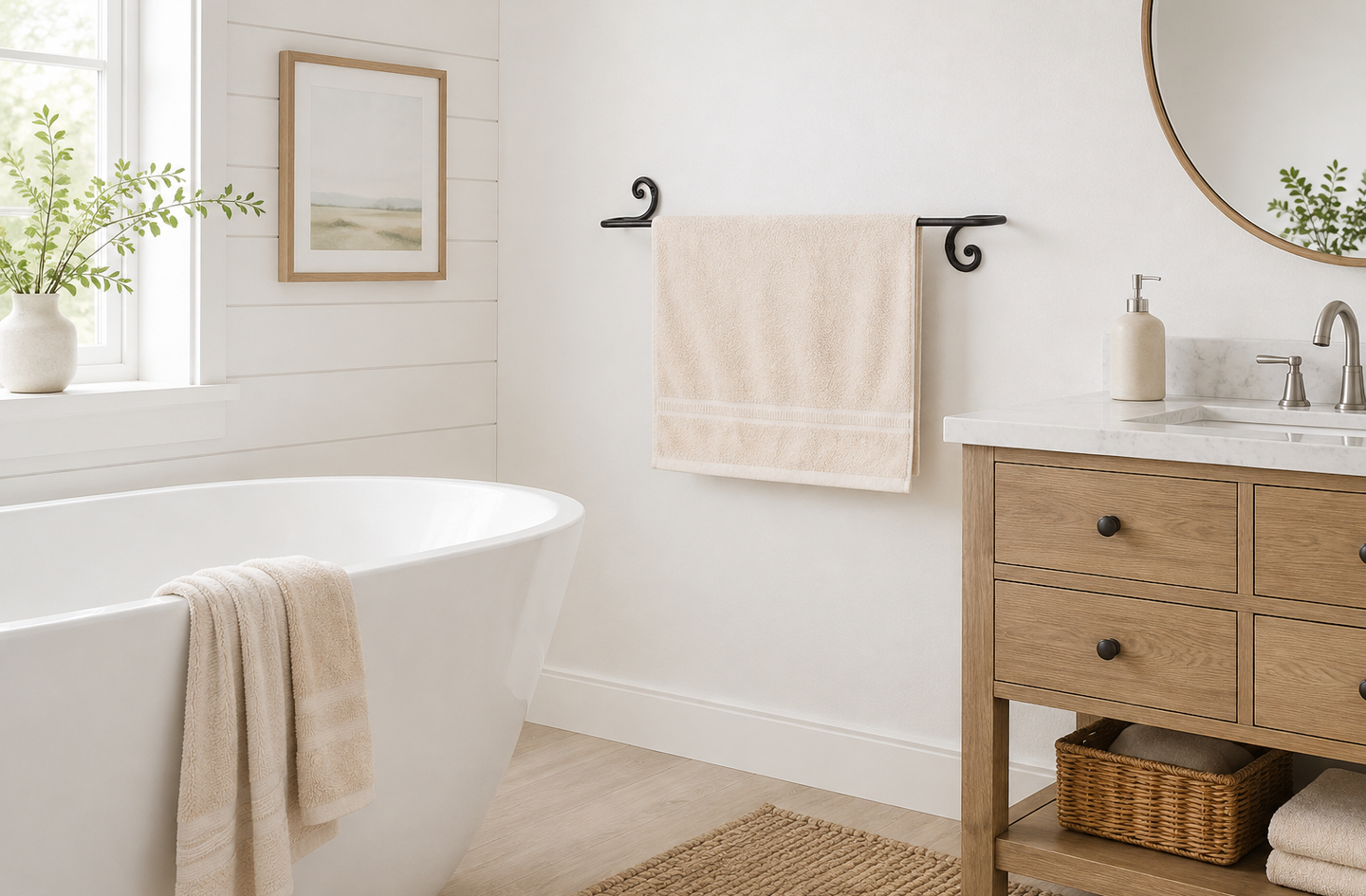
Those two checks are the whole method. A height that keeps the towel off the floor and within easy reach is the right height, whatever number it lands on. The Swirls towel hanger, a standard-length bar with forged swirl motifs on its mounting plates, follows the same 48-inch line as any other bar.
Mark 48 inches first, then treat every later step as a reason to move that mark or to leave it alone.
Step 2: Fold Your Longest Towel to Find the Minimum Height
The longest towel in the house sets the lowest height a bar can sit, because a folded towel must clear the floor. Hunker’s test is simple:
“Test the required height by folding your longest towel in half.”3
Hunker3
Hold the folded towel against the wall and mark where its top edge needs to sit. Hunker treats that mark as your minimum towel bar installation height3. Bob Vila’s rule for stacked bars leaves a two-inch clearance to the floor1, and the same margin works as a buffer under a single bar.
Towel sizes that set the floor clearance
Bob Vila describes an average-sized bath towel as 27-by-52-inch and an oversized one as 30-by-58-inch1. Folded widthwise, the 58-inch towel hangs 29 inches1. An average hand towel runs from 16 x 28 to 18 x 30 inches1, so it hangs far shorter.
Width matters less for height. Folded lengthwise, bath towels measure 13.5 to 15 inches across1, which sets the bar length rather than the mounting height.
Bar length is a separate decision from bar height. Long bars such as the Long Elegant bar hold wide bath sheets, and the towel bar size guide covers how long a bar each towel needs.
Worked example: floor clearance at three heights
Worked example, calculated from cited inputs. An average 27-by-52-inch bath towel folded widthwise hangs 52 / 2 = 26 inches1. An oversized towel hangs 29 inches1.
- At the 48-inch standard: the average towel ends 48 – 26 = 22 inches above the floor, and the oversized towel ends 48 – 29 = 19 inches up.
- At a 36-inch bar for ages 3 and 44: the average towel ends 36 – 26 = 10 inches up. The oversized towel ends 36 – 29 = 7 inches up.
- The lowest workable bar: 26 + 2 = 28 inches for the average towel and 29 + 2 = 31 inches for the oversized one, using the two-inch floor clearance1.
The result: even a child’s 36-inch bar keeps both towels off the floor. Towel length only becomes the limit below 31 inches1, which matters only at the bottom of Hunker’s 30 to 36 inch range for young kids3.
Floor clearance rarely forces a bar higher than 48 inches; it matters most when you lower a bar for children and hang a bath sheet on it.
Step 3: Adjust the Towel Bar Height for Adults, Children and Seated Users
The people who use the bathroom decide whether the bar stays at 48 inches, drops or rises. Adults rarely need a change, children need the biggest drop, and seated users need a bar inside the reach range.
Towel bar height for adults
U.S. men aged 20 and older average 68.9 inches in height, and women average 63.5 inches5, according to CDC measurements taken from August 2021 to August 2023. The 48-inch standard sits within comfortable reach for both. A household of tall adults can move toward the top of Hunker’s range, which runs to 52 inches3. Keep the bar below a robe hook, which This Old House places at 60 inches2.
Children’s bathrooms
A reach range is the band of heights a person can reach without stretching or bending, from a standing or seated position. The 2010 ADA Standards publish advisory ranges for children. The high reach is 36 inches for ages 3 and 4, 40 inches for ages 5 through 8 and 44 inches for ages 9 through 124.
Bob Vila uses the same heights for towel bars, as the highest a bar should sit for each age group1. Hunker suggests 30 to 36 inches for homes with young kids3. Children grow out of a low bar within a few years, so a second bar at adult height avoids drilling new holes later.
Seated users and limited mobility
The 2010 ADA Standards set an unobstructed forward reach of 48 inches maximum and 15 inches minimum4. Over an obstruction deeper than 20 inches, such as a counter, the high forward reach drops to 44 inches4. Bob Vila recommends lowering the bar to 44 inches for people with limited mobility1.
The ADA figures are written for public accommodations, commercial facilities and government buildings, but they give a home bathroom a measured reference point for a seated user. The chart sets every user group’s highest comfortable bar height side by side.
Set the bar for the shortest regular user who needs to reach it, because taller users can always reach down.
Step 4: Work Around the Vanity, Toilet, Switches and Doors
Nearby fixtures are a frequent reason to move a bar off 48 inches, and each one sets its own clearance. Check the wall for a vanity, a toilet, outlets and switches before you commit to a mark.
Above or beside a vanity
A vanity top sits 30 to 32 inches above the floor, so a 48-inch bar lands 16 to 18 inches above it1. Bob Vila notes that an average hand towel or a washcloth, folded widthwise, hangs at that height without touching the vanity top1.
A bath towel does not. The worked example puts the bottom of an average folded bath towel 22 inches above the floor at the standard height. Against a 30- to 32-inch vanity1, that leaves 8 to 10 inches of towel lying on the counter (30 – 22 = 8 and 32 – 22 = 10). Hang bath towels on a clear wall and keep the wall over the vanity for hand towels.
Above the toilet
A bar over the toilet has to clear the toilet paper holder as well as the tank. Hunker advises leaving enough space between the bottom of the towel and the toilet paper holder3. Hold a folded towel against the wall above the tank to check that gap before marking.
Outlets and light switches
Switches are the hardest conflict, because they share the standard height. Bob Vila notes that light switches are also commonly installed 48 inches above the floor1. Outlets sit at 16 inches to the top of the outlet, though some GFCI outlets sit above the countertop1.
“Leave a four-inch clearance between towel bars and outlets or switches.”1
Bob Vila1
When a switch blocks the standard height, Bob Vila’s fix is to set the bar at least four inches below the base of the switch1. Never mount the bar directly above an outlet or switch, because water from a wet towel can run down the wall into the box1.
Doors and the shower exit
A towel bar behind a door is only usable when the open door clears the hanging towel. Check the full swing before marking, and keep the bar’s ends out of the path of the handle. Beside a tub or shower, set the bar where the towel can be reached from the exit without stepping onto a wet floor first.
If a switch, vanity or door forces a compromise, move the bar along the wall before you move it far down the wall. Height protects the towel, and position protects the room.
Step 5: Set Ring, Hook and Double-Bar Heights From the Same Line
Rings, hooks and second bars all take their height from the same 48-inch reference, but each one measures it to a different point. Setting them from one line keeps a bathroom wall looking planned.
Towel rings
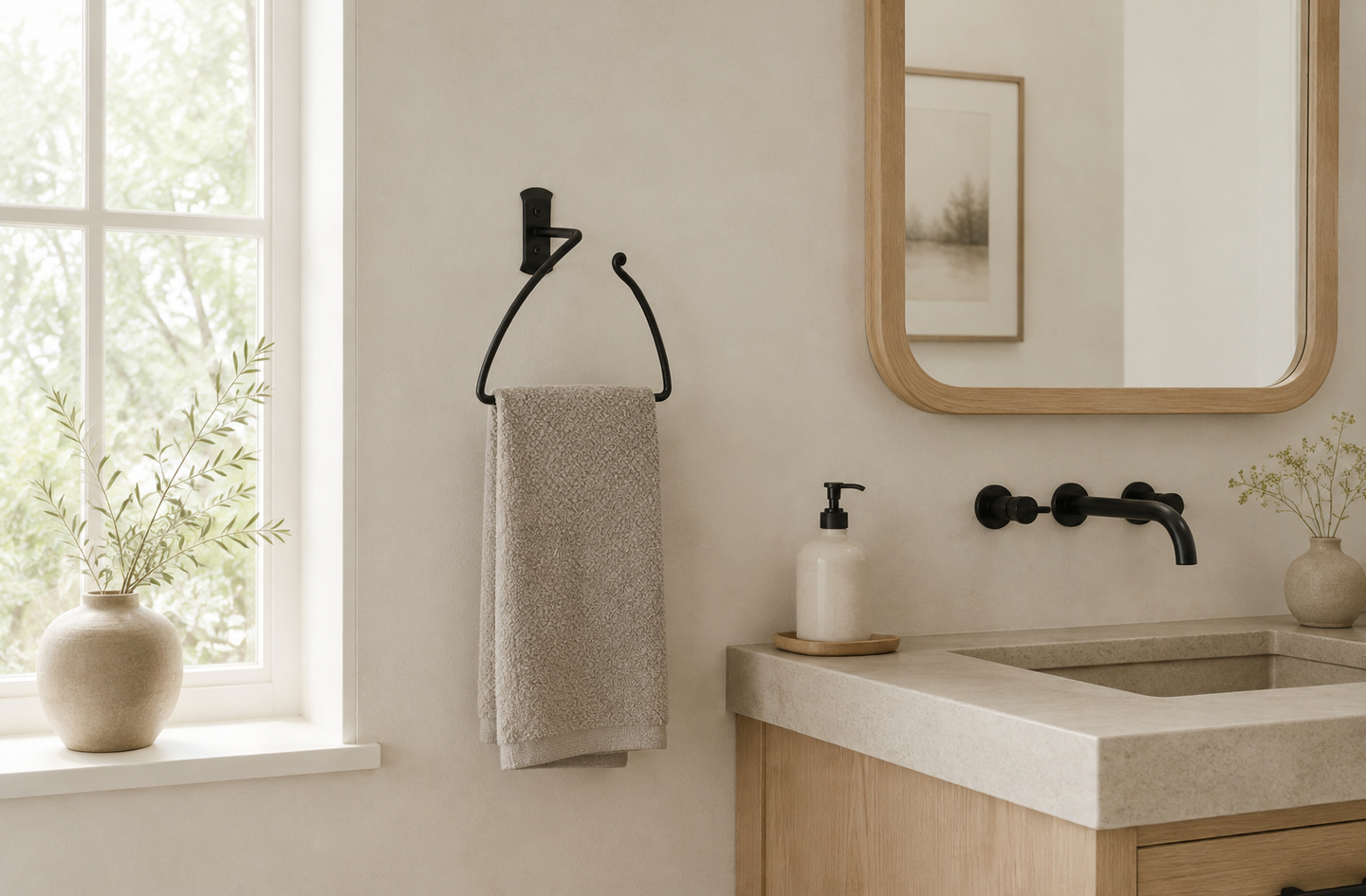
A ring’s drop is the distance from the bottom of the ring, where the towel hangs, to the center of its wall mount. Bob Vila sets the bottom of the ring at 48 inches and adds the drop to find the mount height1. With a six-inch drop, the mount goes at 48 + 6 = 54 inches1.
On a ring such as the Half-Circle ring, measure the drop on the actual piece before you mark, because ring shapes vary.
Robe and towel hooks
Hooks go higher than bars, because a robe or a towel hangs from a single point and drops further. This Old House places robe hooks at 60 inches above the floor2. A child’s hook follows the reach ranges in Step 3 instead.
Two bars on one wall
Stacked bars need two clearances: the lower towel must clear the floor, and the upper towel must clear the lower bar. Bob Vila’s method adds the folded towel length plus two inches for each. For a 58-inch towel, the lower bar goes at 29 + 2 = 31 inches and the upper bar at 31 + 2 + 29 = 62 inches1.
This Old House gives a tighter rule of thumb: space double towel bars 12 to 14 inches apart vertically2. The two methods fit different towels. The 62 – 31 = 31-inch gap suits full bath towels, while the tighter spacing only works when the upper towel still clears the lower bar. That upper bar also sits above the 60-inch robe-hook height2, so it suits a household of tall adults.
Measure each piece to the point where the towel hangs, then convert that to a mount height; the mount is what you drill, but the towel is what you see.
Step 6: Mark and Mock Up the Bath Towel Bar Mounting Height
A taped mock-up catches a wrong height before it becomes two holes in the tile. This Old House suggests applying a piece of painter’s tape on the wall at the desired height of the towel bar2. Level the tape, then mark the bracket positions on it.
- Measure from the finished floor, not from the top of a baseboard or a tile ledge.
- Run a level strip of painter’s tape at the chosen mount height.
- Hold the bar and your longest towel against the tape, and check the floor, the vanity and nearby switches.
- Ask the shortest regular user to reach for the towel at that height.
- Mark both bracket centers on the tape once the height passes every check.
Drilling, anchors and wall types are installation questions, and the towel bar installation guide covers measuring, leveling and fastening the brackets.
Leave the tape up for a day of real use if the height is a compromise, because a mark that feels wrong at the first shower is easy to move.
Common Mistakes When Setting Towel Rack Height
Most height mistakes come from measuring to the wrong point or forgetting what hangs below the bar. These five are easy to avoid:
- Measuring to the bar’s top or bottom edge: the 48-inch standard is measured to the center of the mounts1. A bar measured to its top edge ends up lower than intended.
- Hanging a bath towel over the vanity: at the standard height, a folded bath towel reaches the counter, as Step 4 works out.
- Mounting over a switch or outlet: water from a wet towel can run down into the box1.
- Setting a child’s bar once and forgetting it: the ADA’s advisory high reach climbs from 36 to 44 inches between ages 3 and 124. Plan a second, higher bar.
- Treating a towel bar as a grab bar: Hunker’s summary of NKBA guidelines recommends grab bars that support up to 300 pounds, installed 33 to 36 inches above the floor6. A towel bar is not built or anchored for a person’s weight.
If someone in the house needs support beside the tub or toilet, install a rated grab bar at its own height and keep the towel bar for towels.
What the Right Height Looks Like
A correctly placed bar passes four checks at once, and each can be confirmed with the towel in hand.
- The longest towel, folded, hangs clear of the floor with room to spare.
- The shortest regular user can lift the towel off and hang it back without stretching.
- The hanging towel does not touch the vanity top, the toilet paper holder or a switch plate.
- Rings, hooks and any second bar line up with the same reference height.
RTZEN bars are hand-forged in a four-step process (cut, hand-forge, zinc-galvanize, powder-coat) in the workshop Tsach Levy opened in 1997. A bar mounted at the right height gets used every day, and that daily use is what the forged iron and the Lifetime Warranty are for.
Frequently Asked Questions
What is the standard height for a towel bar in a bathroom?
The standard is 48 inches from the floor to the center of the mounts1. Hunker reports that common placement falls between 42 and 48 inches3. A bar a few inches lower is still normal when a switch or a short user calls for it.
How high should a towel bar be above a toilet?
Keep the bar at the standard height and check what hangs below it. Hunker says to leave enough space between the bottom of the towel and the toilet paper holder3. Hold a folded towel against the wall above the tank to confirm the gap before drilling.
How high should a hand towel ring be?
Set the bottom of the ring, where the towel hangs, at 48 inches, then add the ring’s drop to find the mount height. Bob Vila’s example uses a six-inch drop, which puts the mount at 54 inches1.
How high should a towel bar be for a child?
Match the bar to the child’s age. The 2010 ADA Standards list an advisory high reach of 36 inches for ages 3 and 4 and 40 inches for ages 5 through 84. For ages 9 through 12, the figure is 44 inches4. A second bar at adult height covers the years after that.
Limitations and Edge Cases
- The ADA reach figures come from a federal standard for public buildings; in a private home they are reference points, not code requirements.
- Towel lengths are typical sizes from a published guide, and real towels vary by maker, so the fold test with your own towel beats any table.
- Kitchen bars follow different constraints around sinks, cabinets and appliances, covered in kitchen towel bar placement.
References
Methodology: the heights come from published towel bar height guides, the 2010 ADA Standards, CDC body measurement data and NKBA guidance as reported by Hunker, all read in October 2026. The worked examples are calculated from those cited inputs. Tsach Levy holds editorial responsibility, and no product testing is claimed.
- Bob Vila – Towel Bar Height for Bathrooms, Solved, Manasa Reddigari, updated December 28, 2020.
- This Old House – How To Install a Towel Bar: A Step-by-Step Guide, Natalie Rodriguez, updated May 28, 2026.
- Hunker – Proper Height For Towel Bar Installation, Shelley Frost, updated March 29, 2023.
- U.S. Access Board – ADA Accessibility Standards, 2010 ADA Standards for Accessible Design, sections 308.1 advisory, 308.2.1 and 308.2.2.
- Centers for Disease Control and Prevention (CDC) – FastStats: Body Measurements, National Center for Health Statistics, data for August 2021 to August 2023.
- Hunker – What Are The NKBA Guidelines For Bathrooms?, Michelle Miley, updated April 7, 2022.
Conclusion
Start a bathroom towel bar at 48 inches to the center of the mounts. Then let the longest towel, the shortest user and the nearby fixtures decide whether it moves. Children and seated users need the biggest change, and the wall over a vanity belongs to hand towels.
See the overview in Towel Racks & Hangers for how height fits the wider topic of towel storage hardware.