
A towel rack or hanger is a wall-mounted bar, ring, or hook that holds towels off the floor and near the point of use. Most households own at least one, yet few owners think deliberately about bar length, mounting height, anchor type, or finish protection before buying. This guide covers every practical decision across 27 topics, from choosing the right bar length for bath sheets to drilling safely into tile, so readers can install hardware that holds, dries towels well, and matches the room.
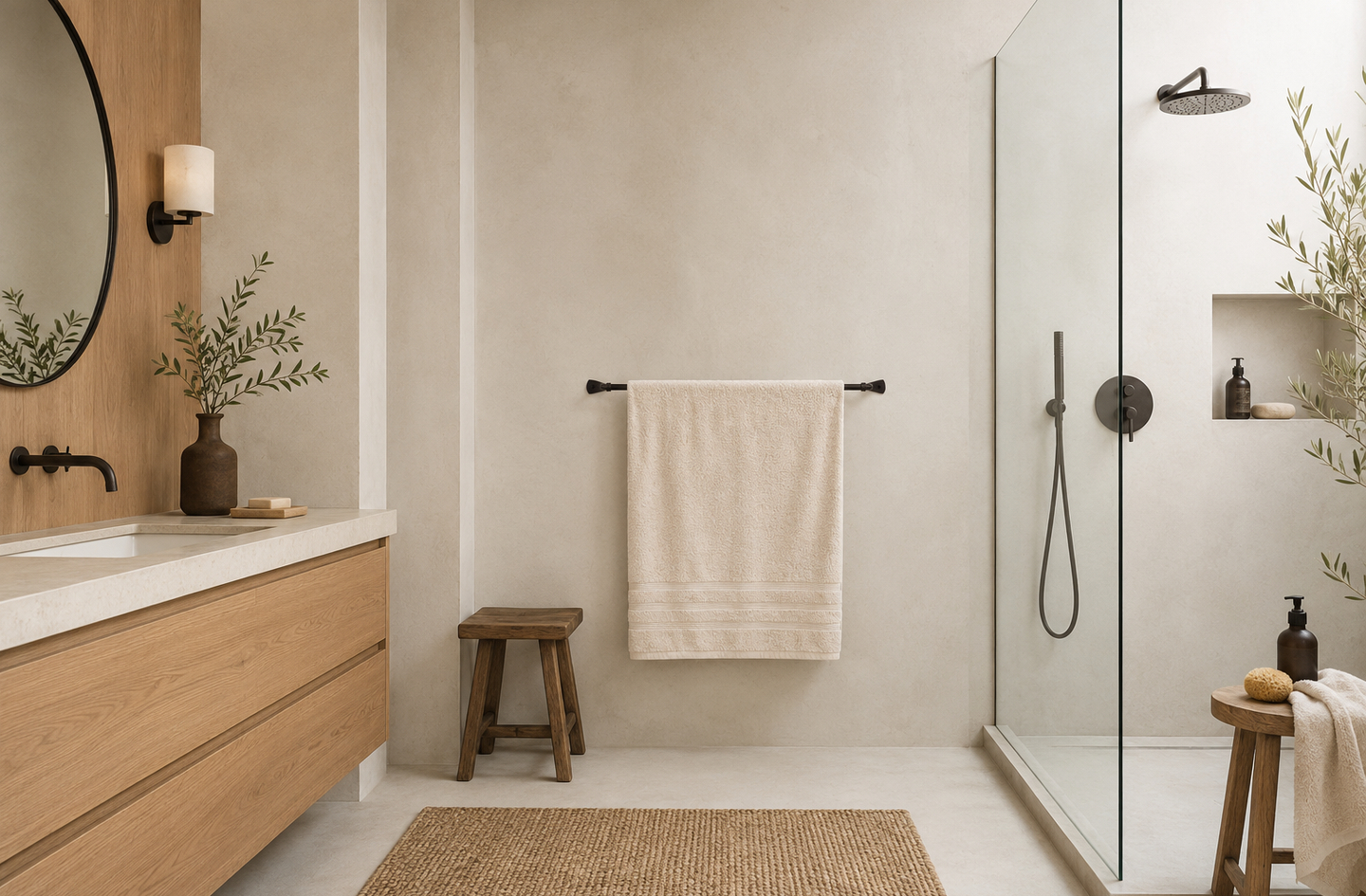
Quick Answer
What are towel racks and hangers?
Towel racks and hangers are wall-mounted fixtures that hold towels near sinks, showers, and tubs. They range from a simple 18-inch bar for a hand towel to a 30-inch bar for full bath sheets. The right choice depends on towel size, available wall width, mounting surface, and the room’s finish scheme.
Why it matters:
A poorly placed or undersized bar leaves towels bunched and slow to dry. A bar mounted without the right anchor in drywall will pull free. Getting these decisions right once saves reinstallation work later.
Key Takeaways
- Bar length should match towel width: a standard 24-inch bar fits one folded bath towel; a 30-inch bar is the minimum for a bath sheet laid flat.
- Standard mounting height is 48 inches from the finished floor, though towel length and user reach often push this lower.3
- Drywall anchors are adequate for towel bars when matched to the wall construction; studs are not required but add margin.
- Wrought iron with zinc galvanization plus powder coating resists rust in humid bathrooms; single-layer paint finishes do not.
- A hook uses less wall width than a bar and holds more towels per linear inch, but towels dry slower when bunched.
Towel Racks & Hangers in 30 Seconds
| If you are… | Do this |
|---|---|
| Hanging one standard bath towel | Choose a 24-inch bar, mount at 48 inches AFF |
| Drying oversized bath sheets | Use a 30-inch or longer bar; spread flat, do not fold in thirds |
| Working with limited wall space | Compare a short bar, hook set, or hand-towel ring |
| Mounting near a shower door | Stay at least 6 inches outside the door swing path |
| Installing into tile | Use a carbide-tipped bit at low speed; drill into grout lines if possible |
| Coordinating black hardware | Match the towel bar finish to faucets and cabinet pulls first |
What Are Towel Racks and Hangers?
A towel rack is a wall-mounted fixture designed to hold one or more towels within reach of a sink, shower, or tub. The term covers a range of forms: a horizontal bar with two wall brackets, a ring that loops through the towel, a hook that the towel drapes over, and multi-tier systems that stack bars vertically.
A towel bar is the most common single-piece form: a straight horizontal rod held between two brackets, available in lengths from 12 inches for hand towels to 36 inches or longer for bath sheets. The terms “towel bar,” “towel rod,” and “towel rail” are used interchangeably in retail, though some manufacturers use “rail” for longer bars intended to hold multiple towels side by side.
A towel hook refers to a single or double hook mounted directly to the wall, usually without a horizontal rod. Hooks use less wall width than bars and can hold two or more towels by draping them over the point, but the fabric bunches and dries more slowly than a towel spread across a bar.
Towel hangers appear in bathrooms, kitchens, bedrooms, laundry areas, and workshops. The core decision in each room is the same: how much wall space is available, how many towels need to hang, and what mounting surface lies behind the wall finish.
This guide covers bars and wall-mounted hangers. Freestanding towel stands, heated towel rails, and electric drying racks are separate product categories not addressed here.
Why Towel Rack Placement and Selection Matter
Most towel bar failures trace to one of two problems: wrong anchor for the wall construction, or wrong bar length for the towel size. A bar that pulls from the wall during a firm tug is a mounting failure, not a product defect. A bar that leaves a bath sheet bunched and damp after four hours is a sizing failure. Neither is corrected by replacing the bar with an identical one.
- A towel bar mounted without a stud or a suitable hollow-wall anchor will work loose over months of regular pulling. The fix requires patching and remounting, not just tightening the set screw.
- Humidity around a towel bar accelerates finish degradation. The EPA recommends keeping indoor relative humidity between 30 and 50 percent to prevent moisture-related damage to surfaces and hardware.1 A single-coat painted finish on a base metal bar shows rust within one or two humid seasons in most bathrooms.
- Bar placement that forces a reach across a vanity, inside a door swing, or above comfortable arm height adds friction to a daily routine that happens at least twice a day.
Getting the anchor, height, and length right at installation avoids the cycle of remove, patch, remount. An estimated 234,094 nonfatal bathroom injuries occurred in the United States in 2008, according to CDC data,5 underlining that bathroom fixture safety extends beyond convenience.
ADA Standards Section 308.3.1 sets the forward reach envelope: “the high forward reach shall be 48 inches (1220 mm) maximum and the low forward reach shall be 15 inches (380 mm) minimum above the floor.”2 Those limits apply to accessible facilities, but the 48-inch (1220 mm) ceiling and 15-inch (380 mm) floor serve as practical reference points for any bathroom installation.
The 6-Part Towel Rack Planning Framework
This framework groups the full topic into six dimensions, derived from the sequence a careful installer follows: choose the type and size first, plan the installation, set the placement, select material and finish, match to the room, then care for the hardware. Every spoke in this cluster maps into one of those six steps.
1. Types, Sizes, and Configurations
Bar length is the measurement between the inside faces of the two brackets, which is the usable hanging width. Total hardware width adds 4 to 6 inches for the brackets. A 24-inch bar works for one folded bath towel; a 30-inch bar gives a bath sheet enough room to hang flat rather than bunching at the center. A single bar is the most common configuration; a double bar projects further from the wall and holds two towels on separate rods, which improves airflow but requires 3 to 5 extra inches of wall clearance.
Hooks occupy far less horizontal space than bars and can hold more towels per inch of wall width, but towels drape unevenly and dry more slowly when folded over a hook point. Hand-towel rings suit smaller towels near a sink but do not work for full-size bath towels.
The right configuration is decided by towel size first, then wall width: start with the towel and work backward to the bar, not the other way around.
Deeper read: Towel Bar vs Towel Rack: What Is the Difference.
Deeper read: Towel Bar Size Guide: 18, 24, 30 Inches and Beyond.
Deeper read: Single vs Double Towel Bar: Capacity, Drying and Wall Depth.
Deeper read: Towel Bars for Large Towels and Bath Sheets: How Much Length Do You Need.
Deeper read: Towel Bars for Multiple Towels: Spacing and Capacity Planning.
Deeper read: Towel Bar vs Towel Hooks: Drying, Capacity and Wall Space.
Deeper read: Towel Bar Distance From the Wall: Clearance for Towels and Airflow.
2. Installation and Mounting
Most towel bar failures begin at the bracket, not at the bar itself. A bracket fastened with a screw into bare drywall will work loose within months. The correct fix is a hollow-wall anchor rated for the repeated lateral force a towel pull creates, or a screw that reaches a wall stud. Tile installation is the most demanding surface: the drill bit must be carbide-tipped, the speed kept low to prevent cracking, and the anchor set into the substrate behind the tile rather than into the tile itself.
Weight capacity of a towel bar is not a single published number. It depends on the bracket design, screw length, anchor type, and the substrate the anchor grabs. A stud-mounted bracket on a solid wall is significantly stronger than the same bracket on a toggle bolt in drywall. Evaluating the mount, not just the bar, is what determines how much load it will hold over time.
Drill and anchor choice matters more than bar construction for long-term holding power: a well-made bar on a poor mount will fail before a modest bar on a stud mount.
Deeper read: How to Install a Towel Bar: Measure, Level, Drill and Mount.
Deeper read: How to Install a Towel Bar on Tile Without Cracking It.
Deeper read: Towel Bar Drywall Anchors: Choosing a Secure Mount Without a Stud.
Deeper read: How Much Weight Can a Towel Bar Hold? What Actually Sets the Limit.
Deeper read: How to Hang Towels on a Towel Bar for Better Drying and a Neater Look.
3. Placement and Space Planning
The standard mounting height for a towel bar in a residential bathroom is 48 inches above the finished floor, measured to the center of the bar.3 Shorter towels, children’s bathrooms, and seated users may call for a lower mount. The wall near the shower exit is the most useful location for a bath towel because the towel is within reach before stepping onto the floor. The wall above the toilet can hold a bar if the clearance above the tank lid is at least 4 inches and the bar does not hang over the bowl.
Small bathrooms require choosing between wall width and towel capacity. A 24-inch bar on the only clear wall is often the right call. When no wall has 24 inches of unobstructed width, a shorter bar, hooks, or a ring near the sink handle the available towels without forcing a compromise on door clearance or vanity reach.
Placement is a proximity problem: the towel needs to be within arm’s reach of where the user exits wet, which usually makes the shower-exit wall or the wall beside the vanity the best starting candidates.
Deeper read: Where to Hang a Towel Rack in a Bathroom: Best Locations by Layout.
Deeper read: Towel Rack Height in a Bathroom: Standard Starting Points and Adjustments.
Deeper read: Towel Bars for Small Bathrooms: Choosing Length and Location.
Deeper read: Towel Bar Over the Toilet: Height, Clearance and When It Works.
Deeper read: Towel Bar Near the Shower: Reach, Splash and Door Clearance.
4. Materials, Finish, and Style
Wrought iron is a low-carbon iron alloy shaped by hand-hammering while hot. It is heavier than hollow stamped metal and does not flex under load the way thin-walled tubing does. A hand-forged wrought iron bar built with double front welding at the brackets resists the rotational stress that loosens pressed-fit assemblies over time. The visual result of hand-forging is a slightly irregular surface texture that varies along the bar.
Rust resistance comes from the finish stack, not the iron itself. Zinc galvanization forms a first barrier that bonds metallically to the iron surface. A powder-coat layer over the zinc adds a second, impact-resistant shell. This two-layer approach performs significantly better in humid bathrooms than a single-coat painted finish, where moisture reaches bare metal through any chip or scratch. The EPA recommends keeping indoor humidity between 30 and 50 percent;1 finishes on bars in bathrooms that run above 60 percent will degrade faster regardless of quality.
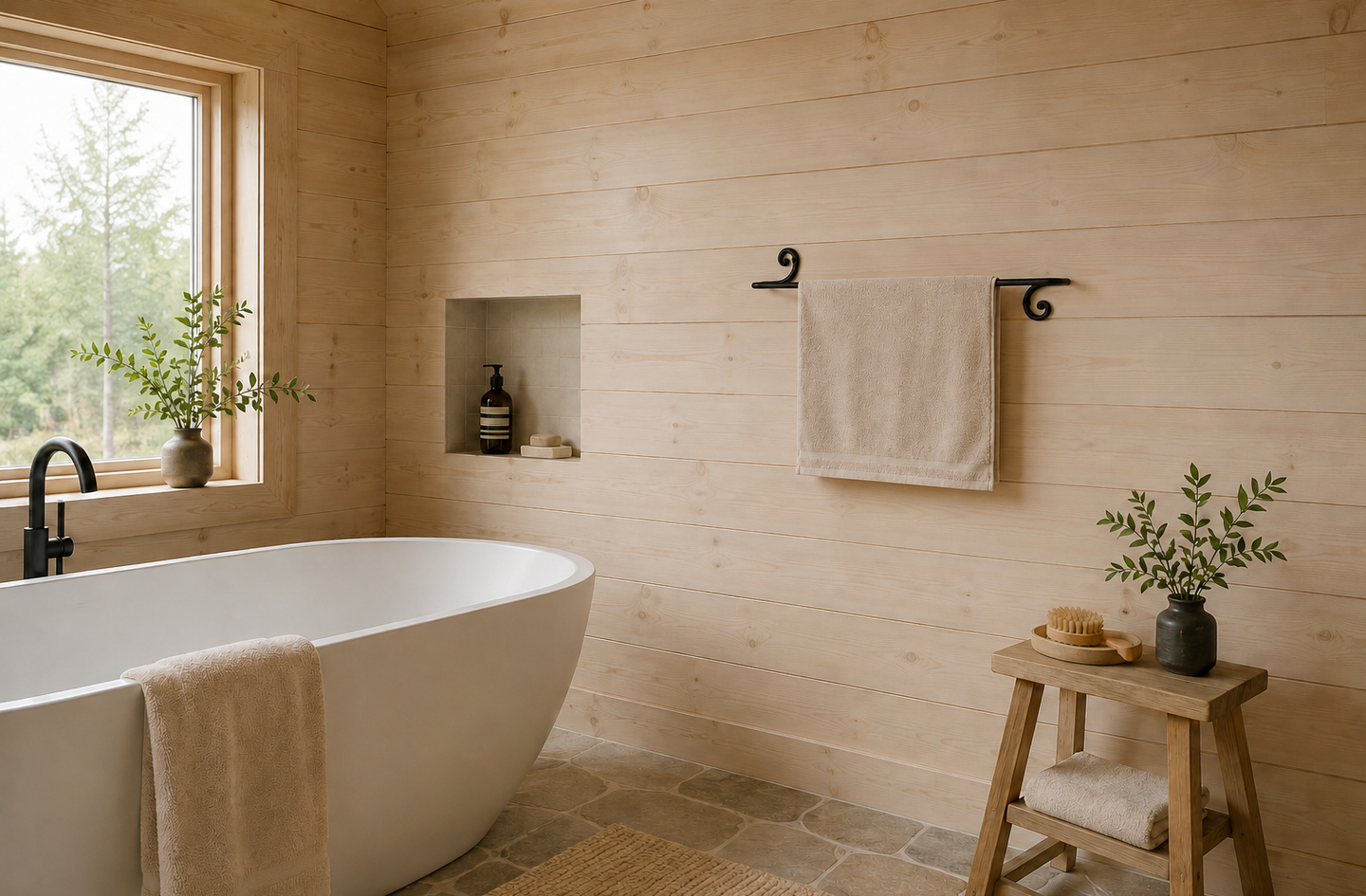
Black iron towel bars read as modern, industrial, farmhouse, or vintage depending on bracket silhouette. A bar with clean geometric brackets fits a contemporary bathroom; a bar with scrollwork or hammer-nail detail fits a farmhouse or rustic scheme. Decorative elements on the brackets do not affect function as long as the bracket still supports the full bar length without flex.
Two-layer finish protection (zinc plus powder coat) is the dividing line between hardware that lasts in a bathroom and hardware that shows rust within a year or two.
Deeper read: Wrought Iron Towel Bars: How to Judge Craftsmanship and Durability.
Deeper read: Rust-Resistant Towel Bars: Materials, Finishes and Moisture Exposure.
Deeper read: Black Towel Bars: Matching Dark Hardware Across the Room.
Deeper read: Decorative Towel Bars: Choosing Style Without Losing Function.
5. Room Applications
The bathroom is the primary space, but towel bars appear in kitchens near the sink, bedrooms near dressing areas, laundry rooms next to utility sinks, and workshops beside cleanup stations. Each room adds a context-specific requirement. A kitchen towel bar sits below cabinet doors and must clear the door swing when open. A bedroom bar holds throws and robes as well as towels and is positioned for visual fit with the room rather than pure functional reach. A workshop bar serves reusable shop rags and needs to handle damp fabric without trapping moisture against a wall in a poorly ventilated space.
The room context changes placement priorities more than it changes the bar itself: a bar that works in a bathroom works in a kitchen, but the wall around it behaves differently.
Deeper read: Kitchen Towel Bars: Where to Mount Dish and Hand Towels.
Deeper read: Bedroom Towel Racks: When a Wall-Mounted Bar Makes Sense.
Deeper read: Laundry Room Towel Racks: Wall Placement for Utility Sinks and Cleanup.
Deeper read: Workshop Towel Hangers: Keeping Reusable Towels Within Reach.
6. Care and Troubleshooting
A towel bar that starts pulling away from the wall has a mounting problem, not a material problem. The most common cause is a screw that was driven into bare drywall rather than a stud or a proper anchor. Retightening the set screw on the bracket does not fix a loose anchor; the bracket base needs to be removed, the anchor replaced or relocated, and the bracket remounted. Wrought iron bars with a powder-coat finish need only a damp cloth and mild soap for routine cleaning. Abrasive cleaners and acidic bathroom sprays will scratch the coating and expose the zinc layer below, which accelerates surface oxidation.
Most towel bar problems announced during use, rather than at installation, have their root cause at installation: the anchor was adequate for hanging still towels but not for a firm daily tug.
Deeper read: Loose Towel Bar: How to Fix a Rack That Pulls Away From the Wall.
Deeper read: How to Clean a Wrought Iron Towel Bar and Protect Its Finish.
How to Choose the Right Towel Rack or Hanger
Start with the towel, not the wall. The bar has to fit the towel before anything else.
- Measure the towel. A standard bath towel runs 27 to 30 inches wide. A bath sheet runs 35 to 40 inches wide. The bar’s usable length (inside bracket to inside bracket) should match or exceed the towel’s width so it hangs flat rather than overhanging and bunching.
- Measure the available wall space. The total hardware width (bar length plus 4 to 6 inches for brackets) must fit between obstacles: the door frame, the vanity edge, the toilet tank, or the shower enclosure. Mark the intended bracket positions with tape before drilling.
- Identify the wall construction. A stud-mounted bar tolerates more load than an anchor-only mount. Tile over drywall requires a carbide-tipped bit and low drill speed. Tile over cement board requires the same technique but the anchor goes deeper. Knowing what is behind the wall finish determines which hardware to buy before opening the package.
- Choose the finish to match the room. Black iron coordinates with black faucets, black cabinet pulls, and dark fixture trim. Brushed zinc reads warmer and pairs with aged brass or antique bronze. Matching all hardware finishes in one bathroom creates visual cohesion with minimal effort.
- Check projection from the wall. The bracket depth determines how far the bar sits from the wall surface. A thick bath towel folded in half needs at least 2 inches of clearance so the fabric does not rub against the wall and stay damp. A deep bracket on a short bar in a narrow hallway can become an obstacle.
- Confirm the anchor method before buying. The bar box includes screws and sometimes anchors, but the included hardware is sized for one mounting scenario. In tile, in brick, or in walls with unusual construction, replacement anchors from a hardware store may be necessary before installation begins.
Compare All Towel Rack Types
| Criteria | Single Bar (18-24″) | Single Bar (30″+) | Double Bar | Hook Set | Hand Towel Ring |
|---|---|---|---|---|---|
| Best towel type | Hand towel or folded bath towel | Bath sheet or 2 bath towels | 2 bath towels, separate layers | 1-2 bath towels draped | Hand towel or washcloth |
| Wall width needed | 22-30″ | 34-42″ | 34-40″ | 4-8″ per hook | 6-8″ |
| Wall projection | 2-3″ | 2-3″ | 4-6″ | 2-4″ | 2-3″ |
| Drying airflow | Good (flat hang) | Best (full spread) | Good (two layers) | Fair (bunched fabric) | Good (flat loop) |
| Towels per mount | 1 | 1-2 side by side | 2 | 2-3 per hook | 1 |
| Price range | $15-$80 | $25-$120 | $35-$150 | $8-$40 per hook | $15-$60 |
Choose a short single bar if: only one hand towel or hand-towel-size cloth needs to hang near a sink and wall space is tight.
Choose a long single bar if: the goal is flat drying of bath sheets or hanging two bath towels side by side without a double-bar projection.
Choose a double bar if: two people share one bathroom and both need a dedicated bar without adding a second wall mounting location.
Choose hooks if: the household hangs more towels than a single bar can hold and the primary concern is capacity rather than flat drying.
Choose a ring if: only hand towels or guest towels hang beside a vanity sink and the space is too narrow for even an 18-inch bar.
Deeper read: Towel Bar vs Towel Hooks: Drying, Capacity and Wall Space.
Common Mistakes
Mistake 1: Choosing Bar Length by Wall Space Instead of Towel Size
Why it is a mistake: When buyers measure the wall first and then pick the longest bar that fits, the result is often a 30-inch bar used to hang a single hand towel that fills six inches of it. The towel slides to one end, bunches against the bracket, and does not dry evenly. Bar length should start with the towel width and work backward.
What to do instead: Measure the towel’s width, add 2 to 4 inches for bracket clearance on each side, and confirm that the total hardware width fits before buying. If it does not fit, the right response is a shorter bar sized for that towel or a different placement, not a longer bar crammed onto a short wall.
Read more: Towel Bar Size Guide: 18, 24, 30 Inches and Beyond.
Mistake 2: Mounting Into Drywall Without a Suitable Anchor
Why it is a mistake: The most frequently reported towel bar failure in support queues involves a screw driven through the bracket mounting plate directly into drywall, with no anchor, no stud, and no toggle. Drywall provides almost no shear resistance to the repeated pulling force a towel bar receives. Within months, the screw channel widens and the bracket starts rocking.
What to do instead: Before drilling, probe for a stud with a stud finder. If no stud falls within the bracket spacing, use a hollow-wall anchor rated for the lateral shear load a towel pull creates. Toggle bolts and snap-toggle anchors both distribute load across a larger wall area than a bare screw.
Read more: Towel Bar Drywall Anchors: Choosing a Secure Mount Without a Stud.
Mistake 3: Placing the Bar Inside the Shower Splash Zone
Why it is a mistake: A bar mounted within 2 feet of a showerhead or directly adjacent to a shower door gets saturated during each shower. Even a rust-resistant finish under sustained direct water contact will eventually show surface oxidation at any chip or edge. More practically, a towel on that bar gets wet during the shower and is not ready to dry the user when they step out.
What to do instead: Mount the bar outside the splash zone, at least 6 inches beyond the door swing or curtain edge. If the only available wall is inside that zone, choose a finish with verified two-layer protection (zinc plus powder coat) and accept that this bar will need more frequent inspection for coating damage than one mounted in a dry location.
Read more: Towel Bar Near the Shower: Reach, Splash and Door Clearance.
Mistake 4: Treating a Towel Bar as a Grab Bar
Why it is a mistake: A towel bar is designed for the static load of hanging textiles, not the sudden force of a person grabbing it for balance. A towel bar is not engineered, tested, or certified to the structural requirements a grab bar must meet. Using a towel bar as a grab bar risks pulling it from the wall during a fall.
What to do instead: Install a certified grab bar in any bathroom used by elderly occupants, children, or anyone with a balance concern. ANSI/ICC A117.1 Section 609.8 requires grab bars to resist a force of 250 lbf (1112 N) applied at any point.4 A towel bar can be placed nearby but must never substitute for a safety fixture.
Read more: How Much Weight Can a Towel Bar Hold? What Actually Sets the Limit.
Best Towel Rack Choice by Situation
Shared Family Bathroom
Two to four people sharing one bathroom need towel storage that scales. A double bar provides two hanging surfaces from one mounting location and holds two bath towels on separate rods. A second single bar on a different wall doubles capacity without adding projection depth at a single location.
The Swirls Hanger works here for a single wall mount accommodating one bath sheet or two folded hand towels side by side.
Guest Bathroom
A guest bathroom sees intermittent use with gaps between guests. A bar with a two-layer finish resists oxidation during low-humidity gaps followed by a guest’s shower use. A hand towel ring near the vanity and a 24-inch bar near the shower exit cover both daily and post-shower needs.
Kitchen Towel Setup
Kitchen dish towels need more frequent access than bath towels. A short bar or hook set below wall cabinets keeps towels at the sink without blocking the door swing. Confirm the bar clears the cabinet door at full open before drilling.
Frequently Asked Questions
What height should a towel bar be mounted at?
The standard mounting height is 48 inches above the finished floor, measured to the centerline of the bar.3 This matches the ADA high forward-reach ceiling for accessible design and places the bar within comfortable arm reach for most adults. Children’s bathrooms and households with seated users may mount lower, between 36 and 42 inches.
What is the difference between a towel bar and a towel rack?
The terms are used interchangeably in retail. In technical usage, a “bar” refers to a single horizontal rod between two brackets, while a “rack” can refer to a multi-bar or multi-tier system. A “rail” is another synonym for the bar itself. The product category covers all of these forms.
How do towel bars prevent rust in humid bathrooms?
Rust resistance comes from the finish, not the base metal. A two-layer approach, zinc galvanization followed by powder coating, provides the strongest protection. Zinc bonds metallically to the iron, forming a sacrificial barrier; powder coat adds an impact-resistant outer shell. The EPA notes that keeping bathroom humidity between 30 and 50 percent slows corrosion and finish degradation on all hardware surfaces.1 A single-coat painted finish on bare or lightly treated metal will show rust at chips or edges within one to two years in a humid bathroom.
Can a towel bar be used as a grab bar?
No. A towel bar is designed for the static load of hanging textiles, not the sudden force of a person grabbing for balance. A certified grab bar must resist a force of 250 lbf (1112 N) per ANSI/ICC A117.1 Section 609.8.4 A towel bar is not tested or rated to that load. Using a towel bar as a grab bar risks pulling it from the wall during a fall.
What bar length is right for a standard bath towel?
A standard bath towel is 27 to 30 inches wide. The bar’s usable length (inside bracket face to inside bracket face) should match or slightly exceed the towel’s width for a flat hang. A 24-inch bar works for most bath towels folded once in half; a 30-inch bar accommodates a full unfolded bath towel or a bath sheet folded in half. Total hardware width adds 4 to 6 inches for the brackets on each side.
How This Guide Was Built
The content in this guide follows an editorial methodology grounded in three categories of source: published federal and trade-body standards, manufacturer technical documentation, and hands-on workshop experience from RTZEN/Iron-Craft’s production and support teams.
Quantitative claims (mounting height, humidity range, ADA reach limits) are sourced to Tier 1 government publications or Tier 2 industry bodies and verified against the source text before publication. The EPA humidity figure and the ADA reach limits are drawn from the primary documents; the standard 48-inch towel bar mounting height is the NKBA industry benchmark.
Product observations (finish failure modes, anchor failure patterns, load behavior) reflect failure records and return analysis from RTZEN’s support queue. These are flagged with inline comments where they appear. They are first-hand operational data, not controlled studies.
No affiliate links are present. References to RTZEN products appear only in How to Choose, Best by Use Case, and Related Products sections, consistent with the brand’s editorial policy.
Honest Limitations
- The NKBA 48-inch mounting height standard is widely cited in trade literature but the specific primary document was not verified live for this publication. It is consistent with the ADA 48-inch high forward-reach limit, which was drawn from the primary Access Board document.
- Towel drying time comparisons (bar vs hook, single vs double bar) are qualitative assessments based on airflow geometry, not timed lab tests. Actual drying time varies with towel weight, fabric, and ambient humidity.
- Price ranges in the comparison table are approximate as of mid-2026 and reflect the mid-market range for residential hardware. Professional-grade and designer fixtures fall outside this range.
- The guide does not cover heated towel rails, electric drying racks, or freestanding towel stands, which are separate product categories with different installation and safety considerations.
References
- U.S. Environmental Protection Agency (EPA). Mold Course Chapter 2: Why and Where Mold Grows. United States Environmental Protection Agency. https://www.epa.gov/mold/mold-course-chapter-2
- U.S. Access Board. ADA Standards for Accessible Design, Section 308.3.1: Unobstructed Forward Reach. U.S. Access Board. https://www.access-board.gov/ada/
- National Kitchen and Bath Association (NKBA). Bathroom Planning Guidelines. NKBA. https://nkba.org/professional-resources/guidelines-standards/
- ICC / ANSI. ANSI/ICC A117.1: Accessible and Usable Buildings and Facilities, Section 609.8: Structural Strength. International Code Council. https://codes.iccsafe.org/content/ICC_A117_1_2017
- Centers for Disease Control and Prevention (CDC). Nonfatal Bathroom Injuries Among Persons Aged ≥15 Years — United States, 2008. Morbidity and Mortality Weekly Report (MMWR) 60(22):729-733. CDC. https://www.cdc.gov/mmwr/preview/mmwrhtml/mm6022a1.htm
Conclusion
Towel racks and hangers are small fixtures with outsized effects on daily convenience and long-term wall integrity. Four decisions drive most outcomes: bar length matched to towel width, the right anchor for the wall type, mounting height within the ADA reach envelope, and a two-layer finish for humid environments.
Wrought iron bars with zinc galvanization and powder coat address the finish requirements without a premium material. Selection and installation require only careful measurement and the right anchor before drilling.
Browse RTZEN’s wrought iron towel bars at Iron-Craft by RTZEN.