
A plant hanger is any hook, bracket, swivel arm, stand or pole that holds a planter above the floor. The hardware matters more than the basket, because a watered planter is heavy and a simple nail in drywall holds only about 5 to 10 pounds1. This complete guide is written for home decorators who want hanging plants that stay put, indoors and out. It covers the whole topic, from hanger types and load to mounting, weather and finish, and routes to deeper guides on each part.
Quick Answer
What are plant hangers?
Plant hangers are wall hooks, projecting brackets, swivel arms, ceiling hooks, S-hooks, and freestanding stands or poles that hold a planter in the air. Choosing one comes down to three things: the planter’s weight after watering, how far the arm reaches, and what the screws bite into. As a rule, anchors should hold four times the weight they carry1.
Why it matters:
A hanger that is too small for a watered basket bends, swings into a walkway, or pulls out of the wall. The broken pot and the damaged wall then cost more than the plant.
Key Takeaways
- Size the hanger to the planter’s wet weight, measured right after watering, never to its dry weight on the shop shelf.
- Toggle bolts suit heavy loads of 25 to 50 pounds in drywall2, while a screw into a stud or solid masonry is the stronger fixing for a big basket.
- Under the ADA standards, wall objects 27 to 80 inches above a walkway may protrude no more than 4 inches3, so hang plants high or beside the path.
- A longer arm adds leverage, so the same basket on a long bracket twists the top screw harder than on a short one.
- The most common misconception is that the hook fails first; in practice the fixing in the wall is the part that has to be chosen with care.
Plant Hangers in 30 Seconds
| If you are… | Do this |
|---|---|
| Hanging a basket on a brick, stone or wood wall outdoors | Use a short forged bracket with masonry or wood screws and a zinc plus powder-coat finish |
| Hanging a plant over a path, doorway or seat | Use a ceiling hook or a high bracket so the basket bottom clears 80 inches |
| Renting, or without a solid wall nearby | Use a freestanding stand or tension pole rated for the watered weight |
| Turning a plant toward the light | Use a swivel bracket with a stop, and test the full rotation before loading |
| Hanging a large trailing basket in a windy spot | Use a heavy-duty short-arm bracket screwed into studs, posts or masonry |
| Hanging a macrame planter indoors | Use a ceiling hook in a joist, or a wall hook with room for the cord length |
Plant Hangers Defined
Plant hangers are fixtures that carry a planter’s full weight from a wall, ceiling, post or floor base, so the plant hangs free in light and air. The family includes wall hooks, projecting brackets, swivel arms, ceiling hooks, S-hooks, standing frames, poles and garden posts.
The scope of this guide is the hardware that bears the load: the basket, pot, liner and soil are part of the weight it carries, not part of the hanger. Rope and macrame slings are also outside the hanger itself, although the hook they hang from is inside it.
Every hanger does two jobs at once. It holds a load that changes every time the plant is watered, and it places the plant where it gets light without blocking a window, a door or a path. A hanger that does only the first job ends up in the wrong spot, and one that does only the second ends up on the floor.
Five ideas connect the whole topic: the planter’s wet weight, the arm’s projection, the fixing and the wall behind it, the exposure to wind and water, and the metal and finish of the hanger. Each one has its own deeper guide, and the framework on this page ties them together.
Why Plant Hangers Matter
Plant hangers matter because a hanging planter puts a constant, swaying load on a small fixing, and drywall alone holds only 5 to 10 pounds on a simple nail1. A large watered basket can pass that figure easily. This Old House states the safety margin plainly:
As a rule, anchors should be able to hold four times the weight of the object you’re hanging.
That margin exists because lab ratings are measured under steady pull, while a basket swings, gets bumped and grows heavier as it is watered. In a Family Handyman test in half-inch drywall, a plastic anchor claimed at 22 pounds held 80 pounds4. Ratings are honest, but a hanging plant is not a steady load, so the extra headroom is what keeps it up.
Understanding the topic closes three common gaps:
- Buyers compare hooks by looks and length, but the fixing and the wall decide what the hook can safely carry.
- Indoor hangers drip, and the US EPA advises drying wet materials within 24 to 48 hours to avoid mold growth5.
- Outdoor hangers face wind and rain, so finish and arm length matter as much as rated load.
Getting these choices right turns a hanging plant from a weekly worry into a fixture that simply stays where it was put.
The Six-Part Plant Hanger Framework
The Six-Part Plant Hanger Framework was built by grouping the 26 detailed questions in this guide’s library into the smallest set of decisions that still covers every hanging setup. The six parts are type, load and reach, mounting, freestanding support, outdoor exposure, and material and finish.
1. Hanger Types: Hooks, Brackets and Swivels
Hooks hold a planter close to a surface: wall hooks, ceiling hooks and S-hooks that link a chain or cord to a fixed point. Brackets add an arm that reaches out from the wall. Projection is the horizontal distance from the wall to the hanging point, and it decides how much foliage room the plant gets. Swivel brackets add a pivot so the plant can turn toward light or fold back against the wall.
Choose the type from where the plant must hang, then size it; picking a style first is how a heavy basket ends up on a decorative hook built for lanterns.
Deeper read: hanging plant hooks: types, uses and weight limits.
Deeper read: hanging plant bracket sizes, styles and load capacity.
Deeper read: S-hooks for hanging plants.
Deeper read: ceiling hooks for plants by ceiling type.
Deeper read: hooks for macrame plant hangers, wall vs ceiling.
Deeper read: swivel plant hangers: benefits, clearance and safe use.
Deeper read: swivel plant hanger bracket features to compare.
2. Load and Arm Length
Wet weight is the planter’s weight just after watering, with soil, water, pot and foliage together. It is the only weight that counts when sizing a hanger. This Old House advises dividing an anchor’s shear rating by 4 to find its safe working load2. Arm length then multiplies the effect: moving the same basket from a 7.5-inch arm to a 12-inch arm raises the twisting force on the top screw by more than half.
Use the shortest arm that clears the foliage, because every extra inch of reach is paid for by the screws, not the iron.
Deeper read: choosing the right indoor plant hanger bracket.
Deeper read: swinging plant hanger arms: clearance and safe movement.
Deeper read: heavy-duty plant hanger bracket load ratings.
Deeper read: plant hanger arm length and projection.
Deeper read: matching a potted plant hanger to pot weight.
3. Mounting Surface and Installation
The wall behind the hanger sets the real limit. Wood studs are typically spaced 16 or 24 inches apart and are found with a stud finder2. Brick, stone and concrete take masonry anchors, while hollow drywall between studs needs toggle bolts for heavy loads. Mounting height matters too: near windows, a hanger should clear the trim and the sash, and outdoors a post must be set deep enough for its soil.
Find the solid fixing point first and place the plant second; moving a hanger a few inches to reach a stud is a better trade than any anchor.
Deeper read: DIY indoor plant hanger bracket placement and mounting.
Deeper read: plant hanger posts for outdoor hanging baskets.
Deeper read: window plant hangers: light, placement and safe mounting.
Deeper read: installing a swivel plant bracket safely.
4. Freestanding Stands and Poles
Stands and poles carry plants where drilling is not allowed or no solid wall is close. A standing frame relies on base width and a low center of gravity, so its footprint has to grow with basket count and height. A tension pole presses between floor and ceiling instead, which needs a sound ceiling and the correct room height.
Treat a stand as a floor-mounted bracket: if the base is narrower than the widest basket swing, it will tip before it bends.
Deeper read: when an indoor standing plant hanger works best.
Deeper read: indoor plant hanger stands: stability, height and footprint.
Deeper read: tension vs freestanding plant hanger poles.
5. Outdoor Exposure: Rust, Wind and Weather
Outdoors, a hanger faces rain, sun, sprinklers and wind on every surface. Wind turns a basket into a sail, and a long arm passes that push straight into the fixing. Garden, deck and fence locations also need watering access and space for foot traffic beneath the basket.
For exposed spots, pick a shorter arm and a heavier fixing over a longer arm with a prettier scroll, because wind finds leverage before it finds style.
Deeper read: deck plant hangers for rails, posts and walls.
Deeper read: where to mount garden plant hangers.
Deeper read: heavy-duty outdoor plant hangers for rust, wind and load.
Deeper read: outdoor hanging plant hangers for rust, wind and weather.
6. Material, Finish and Craft
In decor hardware, wrought iron refers to solid iron worked into shape by heating and hammering, rather than poured into a mould like cast iron. Forged iron bends before it breaks, while cast iron is more brittle under a sudden jolt. RTZEN hangers are cut, hand-forged, zinc-galvanized and then powder-coated, so the zinc layer still protects the iron if the outer coat is chipped.
Judge a hanger by its weld and its finish layers, not its weight in the hand, because rust starts at the joints and at bare scratches.
Deeper read: ornamental plant hangers: style, strength and finish.
Deeper read: cast iron vs wrought iron plant hangers.
Deeper read: choosing a solid iron plant hanger that lasts.
How to Choose the Right Plant Hanger
The most important choice is the fixing, because the wall decides what any hanger can carry. Work through these steps in order:
- Weigh the planter wet. Water it, let it drain, and weigh it on a bathroom scale. That figure, not the dry weight, sets every later choice.
- Pick the mount point. Wall, ceiling, post or floor stand. Ceilings suit macrame and trailing plants; walls suit baskets that should sit close to a window or fence.
- Match the fixing to the surface. Screw into a stud, joist or masonry where possible. In hollow drywall, toggle bolts handle 25 to 50 pounds2, and any anchor should be rated at four times the load1.
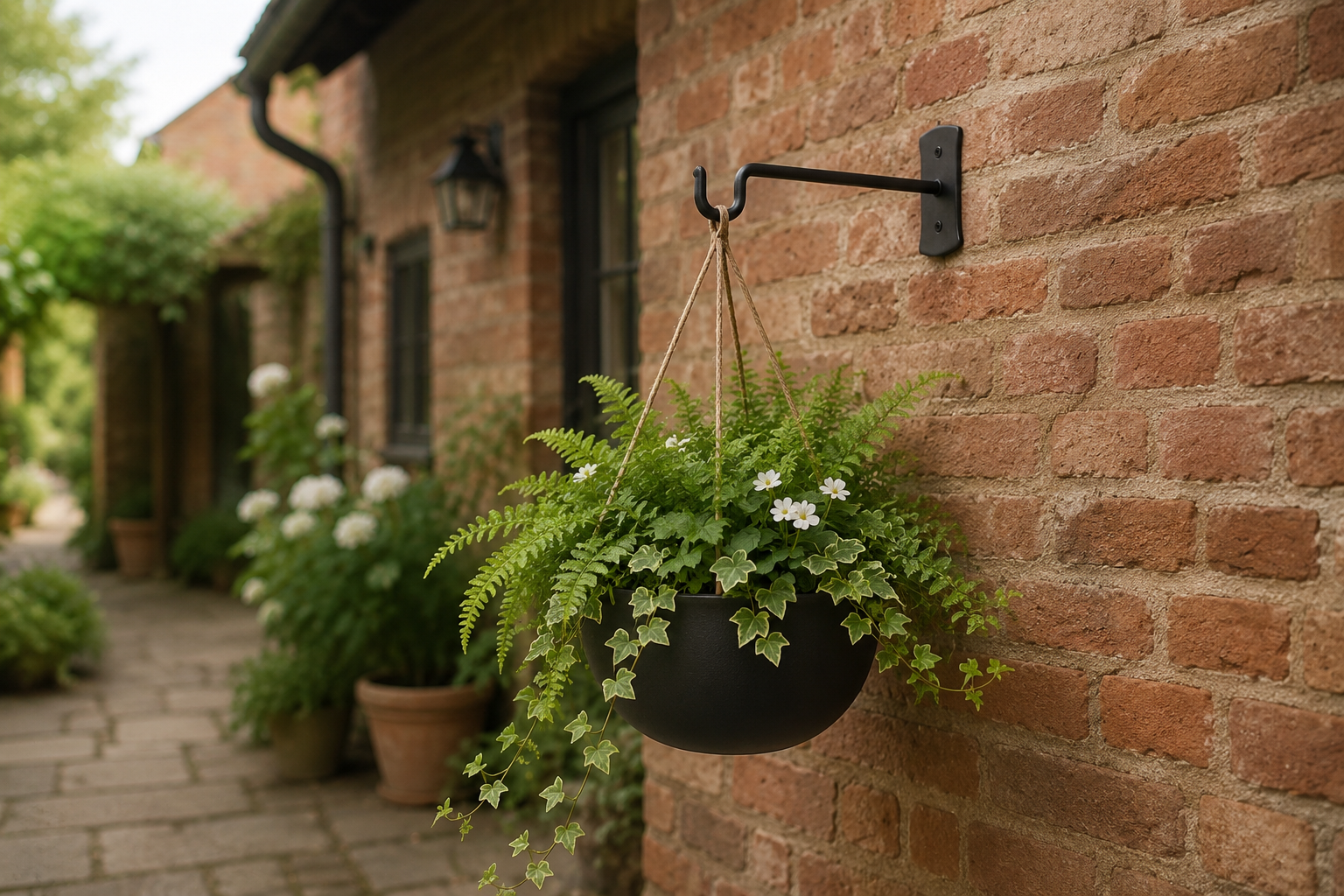
- Set the projection. Allow half the planter’s width plus the foliage spread and a little air from the wall. A short arm such as the Shepherd’s Hooks suits a compact basket on brick or wood.
- Check the clearance. In a path, keep the basket bottom above 80 inches, or keep the hanger within 4 inches of the wall below that height3.
- Choose the finish for the exposure. Covered porches and bright rooms are mild; open gardens, decks and coastal walls need zinc under the powder coat.
Readers mounting indoors can follow the full sequence for choosing the right indoor plant hanger bracket, where room placement and planter size are worked through in detail.
Compare All Plant Hanger Types
| Criteria | Wall hook | Short bracket | Long-arm bracket | Swivel bracket | Ceiling hook | Stand or pole |
|---|---|---|---|---|---|---|
| Mounts to | Wall face | Wall, fence, post | Wall, fence, post | Wall or post | Joist, beam, eave | Floor, or floor to ceiling |
| Typical reach | Under 4 in | 7.5-8 in | 10-12 in | 8-12 in, rotating | Directly below | Set by the arm |
| Load limited by | Wall fixing | Screws and wall | Leverage on the top screw | Pivot and stop | Joist or anchor | Base width |
| Wind behavior | Basket rubs wall | Low sway | Highest leverage | Can swing unless stopped | Free swing | Can tip |
| Best for | Small pots, herbs | Baskets on brick or wood | Wide trailing plants | Turning toward light | Porches, macrame | Rentals, no-drill rooms |
Choose a wall hook if: the pot is small and can sit close to the wall.
Choose a short bracket if: the basket is heavy or the spot is windy.
Choose a long-arm bracket if: wide foliage needs room and the fixing is solid.
Choose a swivel bracket if: the plant must turn or fold away.
Choose a ceiling hook if: a joist or beam sits above the spot.
Choose a stand or pole if: drilling is not an option.
Deeper read: hanging plant hooks: types, uses and weight limits.
Common Mistakes
Mistake 1: Sizing the hanger to the dry pot
Why it is a mistake: soil, water and growing foliage make a planter far heavier after watering than on the shop shelf.
What to do instead: weigh the planter wet and choose a hanger and fixing for that number, with the four-times anchor margin1.
Read more: matching a potted plant hanger to pot weight.
Mistake 2: Trusting a plastic plug in hollow drywall
Why it is a mistake: a simple fixing in drywall holds 5 to 10 pounds1, and a swinging basket loads it unevenly.
What to do instead: screw into a stud, or use toggle bolts and divide the anchor’s shear rating by 4 for the safe load2.
Read more: DIY indoor plant hanger bracket placement and mounting.
Mistake 3: Choosing the longest arm for looks
Why it is a mistake: reach is leverage, and a long arm twists its fixing far harder than a short arm under the same basket.
What to do instead: pick the shortest arm that clears the foliage, and save long arms for solid studs, posts or masonry.
Read more: plant hanger arm length and projection.
Mistake 4: Hanging into a walkway or over bare flooring
Why it is a mistake: objects between 27 and 80 inches high that stick out more than 4 inches catch heads and shoulders3, and drips left wet beyond 24 to 48 hours invite mold5.
What to do instead: hang above head height or beside the path, and water at the sink or use a drip tray.
Read more: swinging plant hanger arms: clearance and safe movement.
Best Plant Hangers by Use Case
Best for Patios, Brick Walls and Windy Gardens
Heavy outdoor baskets do best on short forged brackets screwed into masonry, posts or framing, with a zinc layer under the powder coat. A compact scroll design such as the Swirl Hooks keeps the basket close to the wall, where wind has less leverage.
Deeper read: heavy-duty outdoor plant hangers for rust, wind and load.
Best for Living Rooms and Bright Windows
Indoors, a bracket beside a window frame gives the plant light without blocking the sash or curtains. Fix it into a stud where possible, and keep the basket clear of the trim so drips never reach the sill.
Deeper read: window plant hangers: light, placement and safe mounting.
Best for Renters and No-Drill Rooms
Where drilling is not allowed, a standing frame or tension pole carries the plants instead. Choose a base wider than the largest basket and count the total watered weight of every planter it holds.
Deeper read: indoor plant hanger stands: stability, height and footprint.
Best for Porches, Ceilings and Macrame
Covered porches and high ceilings suit a ceiling hook screwed into a joist or beam, which lets a macrame sling or trailing fern hang straight down. Allow for cord length so the pot clears heads below.
Deeper read: ceiling hooks for plants by ceiling type.
Frequently Asked Questions
How much weight can a plant hanger hold?
A plant hanger can hold only as much as its weakest part, and that part is the wall fixing far more than the iron. A simple nail in drywall holds about 5 to 10 pounds, and anchors should be rated for four times the load they carry1. Toggle bolts in drywall handle 25 to 50 pounds2. Screws into studs, joists or masonry carry the heaviest baskets. Always size against the planter’s weight right after watering, not its dry weight.
How far should a plant hanger stick out from the wall?
A plant hanger should reach out by about half the planter’s width plus its foliage spread, with a small gap so leaves do not rub the wall. Shorter is stronger, because every extra inch of arm adds leverage on the screws. In walkways, the ADA standards limit wall objects between 27 and 80 inches above the floor to a 4-inch protrusion3. A long arm over a path therefore belongs above head height.
Can a plant hanger go into drywall without a stud?
A plant hanger can go into drywall without a stud for light and medium plants, provided the anchor is chosen for the job. Divide the anchor’s shear rating by 4 to find its safe working load2. In one Family Handyman test, a plastic anchor rated at 22 pounds held 80 pounds in half-inch drywall4. That headroom is the safety margin, so it should not be spent. Heavy or swinging baskets still belong on a stud.
How do you stop an indoor hanging plant from causing mold?
An indoor hanging plant stops causing mold when its drips never sit on walls, trim or floors. Water the planter at the sink and rehang it after draining, or fit a sealed drip tray inside the basket. The US EPA advises drying wet materials within 24 to 48 hours and keeping indoor humidity below 60 percent5. A dense group of plants near a cold window deserves extra watching, since that corner stays damp longest.
How This Guide Was Built
The methodology behind this guide was a review of the 26 detailed plant-hanger questions in its library, checked against accessibility standards, US EPA guidance and established home-improvement publishers. Each figure links to the page that states it, and each was confirmed on October 2, 2026. Arm lengths quoted in the comparison come from the RTZEN plant-hanger range, which the workshop has forged since 1997. Tsach Levy wrote the guide and Rami Abramson reviewed it on October 2, 2026; it is rechecked whenever a cited figure changes.
What This Hub Does Not Cover
- Making macrame, rope or textile plant slings; only the hook a sling hangs from is covered here.
- Structural ironwork such as railings, gates and pergola beams, which needs a contractor or engineer rather than a decor bracket.
- Plant care, such as choosing species, setting watering schedules or judging light levels, which belongs to horticulture resources.
- Commercial and public buildings, where local building codes and inspectors govern how anything is fixed overhead.
References
- This Old House – How to hang something heavy on a wall
- This Old House – How to choose the right hanging hardware
- U.S. Access Board – ADA Accessibility Standards, section 307 protruding objects
- Family Handyman – Drywall anchors weight-tested
- US EPA – Mold course, chapter 2: investigating, evaluating and remediating moisture and mold problems
Next Read
A plant hanger is only as strong as its fixing, so the planter’s wet weight, the arm’s reach and the wall behind it decide every choice. Finish and material then decide how long it lasts, which makes the bracket itself the natural next step.